Ten Years Later #10, What World Do We Live In? Part 2

On Monday I wrote a post about inequity in schools. It’s not the first time. In the fall of 2020, I wrote a piece called “What World Are We Living In” when I first started commuting from Ann Arbor to Detroit to teach in a small charter school and began to daily witness the disparity between the two communities. In the spring of 2023, I wrote the following after a day spent in a suburban school district. I’m posting it again because I’ve spent the last three weeks facing the realities of life in my school — inadequate staffing, building issues, and a paucity of resources — and I feel compelled to share these realities and to call for change.

Last Wednesday, instead of driving to Detroit first thing in the morning, I drove to Oakland County to participate in a day of professional development along with a dozen other teachers who use the Adolescent Accelerated Reading Intervention. I’ve been using the program for a little over a semester with great results, but I have been aware that I might not be crossing all my t’s and dotting all my i’s. Having the opportunity to be a fly on the wall of two separate classrooms as other teachers implemented this intervention would hopefully help me see what I’ve been missing.

The beginning of my commute looked largely the same as it does on my daily trip to Detroit — interstate highway merging onto surface streets. However, I noted that while my regular route takes me past fast food, gas stations, minimarts, and older working class neighborhoods, this route into Oakland County took me past Starbucks, Trader Joes, and nicer restaurants before it led me through residential sections with large suburban homes. And then, when I took the final turn, I saw the school where I would begin the day.

It was a sprawling two-story building on a large piece of property surrounded by multiple well-lit and freshly-lined parking lots. I found a spot, grabbed my stuff, and made my way to the guest entrance at the front of the building. I approached a door, pushed a button, and looked into the camera before I was buzzed in to a glass-enclosed foyer.

There, a staff member looked me over and buzzed me through the second door. She knew why I was there and directed me to room “two-oh-something or other”.

“Which way is that?” I asked.

“Up those stairs and follow the signs.”

I walked up the open carpeted stairway in the expansive atrium to the second floor, also carpeted, and found the group of teachers already in conversation.

They sat in a semicircle in the [also] carpeted classroom. I found a seat in the back of the room in a bar stool height chair next to a tall table. The students had not yet arrived, and the teachers were discussing what was on the agenda for the class this day — one of the final steps of reading a book in the AARI program, mapping the text.

I heard the bell ring in the hallway, and the students started coming in, finding their resources in a strategically placed filing system, then making their way to the table where I was sitting. I relocated myself and began to observe.

Right away I noticed a t I hadn’t been crossing when I looked at the big piece of butcher paper where they had started their text map. My students and I had mapped our own text the day before, and it looked somewhat similar to, if noticeably messier than, the one I was looking at, but there was one big difference — ours was written all in black on white paper. The map in this classroom was color-coded to illustrate its organization — sections of the book written in sequential order were outlined in pink, those written in a compare/contrast format were outlined in green, etc. I mentally thunked my forehead with my palm and said, “the colors! why do I always forget the colors!” And then I noticed the posters hung on the wall in this spacious classroom. At both the front and the back of the room, the teacher had full-color posters representing each of the eight text structures. Oh, I’d like to have those, I thought. If I had full color posters in my classroom instead of the black-and-white print outs I have, I might remember to use the color coding system!

One teacher asked, “Where did you get the posters?”

“Oh, I just printed them on our poster printer!”

Oh, I thought, they have a poster printer.

The class functioned mostly as my class does. The teacher had seven students around the table; one was absent. I have ten on my roster right now; typically one is absent. She used the socratic questioning that I use, and her students engaged as much as mine do, if slightly more politely, but then again, when I had a guest in my room last semester, my students were on their A game, too.

The second building was a literal carbon copy of the first, down to the same double buzzered entryway and carpeted stairs. We gathered in a classroom that “isn’t currently being utilized” where we found flexible seating — restaurant like booths, chairs on wheels at tables, and the one I chose, a rocking pod-like chair, where I noticed I could quietly shift my weight and stay better engaged in the discussion we were having before our second observation. Wow, I thought, I have some students who would benefit from chairs like these.

When the bell rang, we walked down the hall where our second teacher met us at the door and invited us first into her classroom and then across the hall to another room that “isn’t currently being utilized” so that she and her students could map their text.

Like me, she had a projection system where she displayed a slide that she used for her gathering — the time when we engage with our students to set the climate and build community. Her students were seated, much like mine are, around the room at desks. The difference I saw was, again, the carpeted floor, the colorful text-structure posters, and stacks of resources in every corner of the room.

In the room across the hall, we again found flexible seating — bar-height chairs with optional attached desks, lower seats on wheels, and one other form of desk-like seating. Again, full-color posters on the wall illustrating each of the text structures and some key questions to ask during the AARI process.

The students again were on their A-game, and I wondered if that was the case every day, even when they didn’t have a dozen teacher-y observers. I mean, what would get in the way of their learning in an environment like this?

As I drove home, I continued wondering, why do these schools look so different from my school? Why do students in Oakland County walk into a brand spanking new building every morning, pick what kind of chair works best for them, experience the warmth of carpeting, the advantage of full-color visual aids, and, when it’s hot outside, the benefit of air conditioning, while my students just thirty minutes down the road are bussed onto a crumbling parking lot, walk into an aging building with an inadequate gym, some windows that open and some that don’t, no air conditioning, no rooms that “aren’t currently being utilized”, one seating option whether it is appealing or not, and a jillion other obstacles to learning on any given day.

Is it just a case of money?

I spent some time this morning trying to figure out Michigan’s formula for school funding that might explain this disparity — why one child’s experience is so different from another’s when they both reside in the same state. But guys, I don’t understand the model.

It’s complicated and based on per student funding from the state, property taxes, income taxes, and even cigarette taxes! Low-income (and underperforming) districts like mine are supposed to get supplemental funding from the state — which is earmarked, but historically not always allocated. And even when it is allocated, why are most Detroit schools in disrepair, lacking in resources, and understaffed when schools in higher income districts are well maintained, richly resourced, and fully staffed with high quality instructors?

Why do they get the cool rocking pod chairs and my students don’t?

Is it because those students deserve better?

No! All students deserve better! Yet these disparities continue to exist — for going on centuries now.

And why?

The simple answer is systemic racism — in education, yes, but also in real estate, in health care, in hiring, in so many sectors of our society. It’s the historical practice of separating those who have from those who don’t to ensure that those who have will always have and those that don’t never will. And the remedy is anything but simple. It begins with recognizing that selfishness and greed have created the structures in our country that enable some to have a lovely experience and to guarantee that others do not.

Now, if you are in the camp that thinks I am completely off base and that the difference in schools is sheer economics and not based in historical racism at all, I ask you why the establishment is so up in arms about our students learning African American history or looking at history through the lens of Critical Race Theory? If there is nothing there to see, why not let our kids take a look for themselves? Maybe you’d like to take a look for yourself. If so, I recommend you check out the 1619 Project* which is available through The New York Times, on Apple podcasts, or in video form on Hulu. And if you still think I’m out of my mind, come spend a day with me at my school. Get to know my students and decide for yourself if you think they deserve more.

Yes, I feel pretty strongly about this.

It probably won’t come as a surprise that my seniors and I just finished learning about systemic inequities in preparation for reading Trevor Noah’s Born a Crime, where we see through the lens of his experience the structural racism of Apartheid and how it impacted his childhood experience. We learned terms like unconscious bias, prejudice, racism, and systemic racism, and my students created posters to illustrate disparities in health care, generational wealth, criminal justice, and education.

When I returned to my students on Thursday and we started our class with a review of terms, I saw that not everyone understood that Apartheid was like the systemic racism we see in the US. In order to help them fully make the connection, I asked them to recall examples of where we experience inequities in our community. As they started to list them off, I told them about my experience in the Oakland Schools.

I wondered if it was necessary — to point out the details I had experienced. Would I be rubbing it in their faces?

But then I thought, Don’t they deserve to know what the experience of students 30 minutes away is like? especially as we prepare to read this book? especially since some of them are about to go to college and may study beside some of these very students who are walking carpeted hallways, sitting in rocking pods, and enjoying an air conditioned full-sized gym? (Let alone taking AP classes, music, and other electives we are unable to offer.)

I described what I had seen, and I could see their faces register the reality — the reality that their experience is not equal to the students I observed just 24 hours before.

“This is educational inequity,” I said. “It is one aspect of systemic racism. And why do you suppose it’s not easy to change?”

“Because,” one student answered, “it’s part of so many systems — not just education. And they don’t want it to change.”

Who doesn’t want it to change?”

“The people in power.”

“Yes.” I gulped. “I suppose you are right. The people in power don’t want it to change.”

Pretty astute observation for a kid from Detroit? No. Kids from Detroit have this down, folks. They understand disparity; it’s the world they live in.

And the people in power can do something to change it. We are the people in power, my friends — people who vote, people in education, people in the church, white people — we can make choices that begin to make a difference for my students and their children and grandchildren. If we do nothing, this pattern will continue for more generations, and we shouldn’t be ok with that.

It’s not enough to fight for what’s best for our kids; we have to do what’s best for all kids.

As we established in my last post, I have “an insufferable belief in restoration.” The first step in restoration is acknowledging that our stuff is broken down, dilapidated, and no longer working, so I’m gonna keep talking about what’s broken to those who have the power and resources to fix it.

I hope you’ll start talking (and doing something) about it, too.


Do not withhold good from those to whom it is due, When it is in your power to do it. Proverbs 3:27

*The 1619 Project is one of many places to start learning about historical systemic racism in the United States. For a list of other resources check out Harvard’s Racial Justice, Racial Equity, and Antiracism Reading List.

**You can support underfunded schools wherever you live, but if you’d like to support mine, here is my current wish list

***Since the first time I posted this, someone donated the funds to pay for full-color posters for my classroom.

Thank you for reading!.

Role Reversal

Since I returned from my stint as dishwasher during A Week in the Desert, I’ve been leaning into another role — that of daughter. Of all the positions I’ve held in my life, I’ve held this one the longest. I’ve been a daughter since the day I was born, but the role today looks nothing like it looked on that first day.

On day one, I was totally helpless and in need of almost continuous 24 hour care. I was the third of four, so by the time I showed up on the scene, my mom and dad already had a two year old and a four year old to tend to, but somehow they found a way to protect, feed, diaper, rock, clothe, and otherwise care for me in those early days.

And their work became a gradual release of responsibility — to show the four of us how to move through life without harming ourselves, to teach us first how to eat solid foods and eventually how to prepare them ourselves, to manage our own personal hygiene, to find our own ways to deal with the challenges and disappointments of the world, to find, make, or buy our own clothing, and to eventually care for ourselves and then the others in our lives.

And in these last few years, our responsibilities have shifted our gaze back to where we began.

This is the way of life, of course. Many of us get the opportunity to parent our own children, to move them through the phases of less and less dependency on us, and some of us also get an opportunity to witness our parents as they gradually lose their independence and need us to step back into their lives to lend a hand.

We are there right now, and although our parents appreciate our willingness to step back in, it is not without some annoyance at their need. Last week, after we returned from Arizona, I made my way first to the hospital to check on my stepfather who had had a major surgery and was in the beginning stages of recovery. He wanted me to visit, but he also wanted me to leave. I can’t get inside his mind, but I can see that he is rather helpless — dependent on hospital staff to bring him ice chips, to help him move from the bed to the chair, and to change his dressings. He didn’t likely see this for himself — he didn’t see cancer, surgery, or an extended hospital stay, and I can tell he’s not a fan. He has never minded others making him food or refilling his drinks, but being in this compromised situation is somewhat humiliating, somewhat depressing. So, as I check in, I remind myself to be kind, to be respectful, and to help where I can, and I have do things I’ve never had to do before. I have to tell him what day it is, remind him that he won’t be going home for a while, assure him that I will go care for my mother.

He reaches for my hand as I leave — this one who’s never been super emotionally demonstrative — and I promise him that I will call, that I will be back in a few days.

I leave and drive to my mother’s, watch her take the rollers out her hair and apply lipstick, stand closely when she makes her way down the stairs, help her into the car, buckle her seat belt, walk slowly beside her when we enter a store, move away to give her some freedom, but stay close enough to make sure she is safe. While she appreciates me being there, she does not like to role shift. She has been fiercely independent even during times when her ability to be so was quite limited, so to depend on her children — the very ones who she has spent her life fighting to provide for — is quite uncomfortable.

But depend on us she must. Because of her limited vision, she can no longer drive, yet she has myriad doctor appointments and her husband is an hour away in the hospital and will likely be there for a couple more weeks. We take turns showing up — fixing things around the house, vacuuming the floors, driving her to appointments, helping pay the bills.

She thanks us over and over and over, and sometimes she says, “Now go home. You have your own things to do. I am fine,” but as she says them, she seems a little unsteady on her feet, a little weary, a little unsure.

Nevertheless, I leave. I drive back to the hospital. I sit next to my stepfather as he swallows the ice chips he’s been allowed for the hour. I find his phone charger. I listen to his nurse detail his progress and the goals they want him to meet before he is discharged to rehab. I sit next to him as one of the Bourne movies plays silently on the wall-mounted television. I hear his roommate snoring. Then, as I stand to leave, he reaches for my hand.

I promise to call. I assure him that my brothers are checking on our mom. I say I’ll be back in a few days. I walk away.

Back in my car, I call my mother to see if she’s taken her medication, to give her an update on my stepfather, her husband. I admit I’ve walked away with her charge card in my wallet. I promise to be back in a few days.

She thanks me over and over and over, and I finish driving home.

And today, I’m headed back — first to the hospital, then to my mother’s house.

It’s a gradual re-connecting. It’s beginning to hold more tightly to what was once let go.

She sees it as a burden. I see it as a privilege.

Not everyone gets to place a warm flaxseed pillow behind their 82 year old mother’s neck. Not everyone gets to clip the fingernails of a stepfather who has been at times annoying, disappointing, and problematic but nevertheless present throughout my life.

I’ve been building muscle for this role my whole life, and I’m thankful to have the strength to show up now.

Honor your mother and [step]father… Exodus 20:12

A Week in the Desert

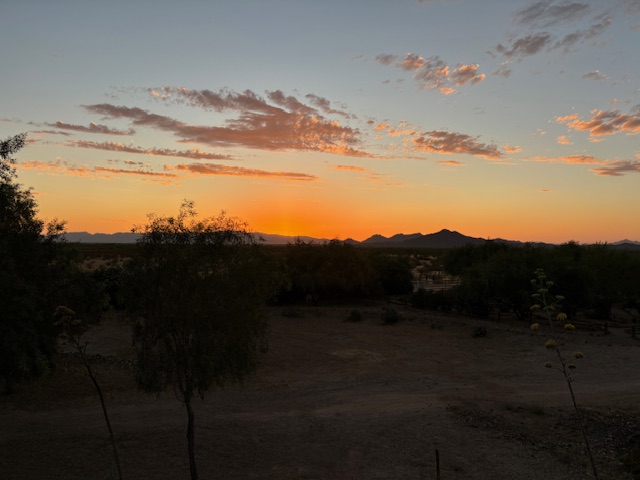
I’ve spent this week in the desert — the literal desert.

My husband, who is both an ordained pastor and a licensed therapist, is serving this week at Shepherd’s Canyon Retreat, outside Phoenix, Arizona. SCR is an organization that exists to assist Christian ministry leaders who are navigating a season of difficulty. Several times a year, eight participants come to the retreat and are served by a chaplain and two therapists who guide the participants through group, individual, and couples therapy.

Why am I here? Well, the chaplain and the therapists are allowed to bring a spouse for the week! When my husband suggested I come with him, I was thinking, that is the first week after school dismisses! Wouldn’t it be great to escape to the desert to read, write, and recover from the school year? I can sit poolside, and simply let my body heal from the strain of the year. Great plan, right?

I thought so, too!

About a month before our scheduled arrival, we received an email that asked if I’d be willing, while here at the retreat center, to volunteer in the kitchen. Well, I thought, I will be eating everyday, of course, and even if I were at home, I would have to spend some time in the kitchen — cooking, doing dishesand really, I reasoned, I don’t mind helping out a little each day. So, I responded to the email, “Of course, I’ll help! I love washing dishes!” And, I do! I really do love the rhythm and the industry of bringing order to post-meal chaos.

So, last Monday, we left our home at 4am EST, traveled to the airport, boarded our flight, stopped off for a change in aircraft, then landed in Phoenix many hours later. From there, we were picked up in a van and driven another hour, past mountains and hundreds of enormous saguaro cacti to a small town where we stopped to eat and gather whatever snacks and provisions we would need while staying — in the middle of the desert — at the ranch for the next week. Finally, about thirteen hours after we left our home, we arrived at the retreat center, were shown our rooms, and received some orienting information about where to go for meals, how to use the in-room humidifier, and why drinking water is so important.

Then, a little before dinner time, as I had been directed, I arrived at the kitchen and received my initiation to the crew. I was kind of in a dazed stupor, since we had been awake for over 16 hours by that time, but I followed directions, did as I was told, and even learned how to operate the kitchen’s dishwasher. When I walked away from the kitchen a couple of hours later, soaked to the skin across my belly and noticing the raisin-like quality of my fingers, it became clear to me what I had signed up for.

It took me a minute to adjust my vision of what the week would hold, but it wasn’t difficult. While I wasn’t really ever in the same room with the participants, I saw them coming and going from the dining room. I didn’t know any of them, but I saw familiarity. I saw clergy, missionaries, and other professional church workers who looked as I have looked in the past — weary and perhaps a little wary about what this week held for them.

I briefly flashed back to seasons in our lives when we could have used a week away in the desert, where someone else planned and prepared our meals, where we left dishes sitting on the table for someone else to clear, where snacks were mysteriously restocked, and refrigerators were continuously filled with cold drink. More than once in our lives of ministry, we would’ve benefitted from getting away from it all with some trained professionals who might’ve helped us navigate the unthinkable, process the traumatic, and begin to heal what Ann Voskamp calls our “unspoken broken”. Because of the careful confidentiality SCR practices, I don’t know the names of the participants or, of course, the issues they are navigating, but I do know that most professional church workers suffer from overwork and unreasonable expectations and many have been betrayed by their leadership, suffered personal family trauma that they don’t feel they can process in the public eye, or are journeying through their own personal struggles with mental or physical health.

The five of us in the kitchen, two paid staff members (both professional church workers), and three volunteers (all of us educators and two of us pastor’s wives), remarked early in the week that each of us have “been there”, and then got busy with the task at hand, preparing and presenting meals, and attending to the associated housekeeping tasks — dishwashing, packaging leftovers, vacuuming floors, and quietly attending to the needs of the participants.

After each “shift”, I would escape to my previously scheduled activities — daily journaling, re-engaging with The Artist’s Way, sitting poolside, reading an enormous novel, and taking daily dips in the pool. Then, I would make my way back to the kitchen, to join my “crew”. Together we chopped vegetables, arranged beautiful salads, poured condiments, and told stories about our lives. One has partnered with her husband in camp ministry for almost forty years, and it shows. She has endless cheer and positivity and a tireless ability to pivot when the propane tank runs out of gas before breakfast, when five of the week’s participants have specific dietary challenges, when there is no way that the baked potatoes will be ready to serve on time. Another has also spent her career in camp ministry and is one of those people who can chat about the difficulties of her life while browning ground beef or making French toast, and then stop everything she’s doing to show you a photo of the most beautiful sunset she’s seen in her months here in the desert or to tell you about the local movie theater’s habit of showing cowboy or alien movies on Tuesday nights. One woman joined us this week just because she loves the place. She paid her own airfare to come from Alaska and sleep in a camping trailer for two weeks, helping out in the kitchen for almost every meal. Another is the wife of the chaplain for the week. She not only worked in the kitchen three meals a day but made it her job to walk around in the the heat (of the desert) with a bucket of soapy water, scrubbing down any chair or bench that had become soiled.

Over the week, we have worked as a team, learning little known facts about Alaska, sharing stories of foods we like (or don’t like) to make, and laughing at one another’s silliness, and mostly making sure that the participants got what they needed when they needed it.

And, (you might have seen this coming), I got what I needed, too. When I was explaining to my colleagues that I was going to Arizona the week after school let out, I said I was looking forward to the abrupt transition into summer, a break in my school year routine, and an opportunity to detach from reality a bit. I got all of that, and I got another thing that I almost always need — a sense of purpose, of mission, of teamwork, of collaboration.

Even more, I’m walking away with some new lifelong friends — my kitchen crew — may we meet again, here or elsewhere.

‘Come away with me by yourselves to a quiet place and get some rest.” Mark 6:31

*If you or someone you know is a ministry leader navigating a personal, family, or ministry challenge, check out Shepherd’s Canyon Retreats.

**If you’d like to support this ministry, check out their latest newsletter for current needs.

The Buried Difficult

Dude.

Bruh . [or, Bro,]

That’s what the kids say these days when they just. can’t.

I think we used to say, “Ok, Ok!” And maybe our parents said, “Uncle!”

It’s what we say when we just don’t have a response because we are at the end of our rope.

I was trying to think of what to write today after several weeks of posting nothing, and all I could think was….

Dude.

Been there?

Have you been in those seasons when life is coming at you from all directions and you just. can’t. even?

I mean, this is definitely not the worst season of my life. In fact, the roughest seasons have given me so many tools that I am using to navigate this one — therapy, self-care, boundaries, yoga, music, laughter, and Netflix. [By the way, if you need something to carry you through difficulty, I have often recommended The Great British Baking Show; I now add to that Somebody Feed Phil (Netflix) and The Reluctant Traveler (Apple).]

But guys, there’s a lot going on right now. Some of it is great — my work, my husband’s new role as a private practice therapist, the fact that Spring is now here, our kids are doing great things and really stepping into their adulthood– but much of it is hard — the death of an extended family member, the cancer journeys of two others, and the uncovering of hidden realities that will need to be faced in the very near future.

And all I can say is…

Bruh.

It’s a lot.

It’s nothing uncommon to the human experience to be sure. Anyone reading this has navigated similar — illness, addiction, failure to communicate, and the accumulation of it all that someone eventually has to deal with.

And sometimes the ones who have to deal with it are the adult children of those who kept putting off the difficult.

Here’s the thing, though. The difficult doesn’t go away just because you don’t talk about it.

In fact, if you bury the difficult, keep it in a dark place, and even continue to water it from time to time, the damn thing grows. And often, it devours the beneficial, the beautiful, the healthy, the wonderful.

It just eats the good up and continues to grow until it bursts into the open — often at the most difficult of times — and somebody, finally, has to look it in the face, call it what it is, and give it its reckoning.

Dude.

I have been training for this moment my whole adult life, and still, I don’t wanna do it!

Just like my student didn’t wanna write a simple 300-600 word retelling of a day of his life where he learned a hard truth, I don’t want to look the difficult in the face.

But guys, the difficult thing has already surfaced. It’s sitting in the middle of the room, and everyone is trying to avert their eyes for just a little bit longer.

Fine. Look away if you must, but the difficult is not going anywhere.

It will not get easier to look at in a day or a week or a month.

I have been there.

Thing is, most things surface over time. Some of us learn this the hard way.

I’m not scared to look this thing in the face, but it’s not mine.

If it was mine, I might be throwing extra dirt on it right this minute.

But that would not keep it buried.

Nope.

It’s just a matter of time until all things surface.

So, here’s the thing. I have no judgment for the bury-er. Some anger, yes, but not judgment. I have no idea what led to the development of this difficulty. I don’t know the full story. I don’t even need to or want to. That is not my business.

It is truly none of my business to know about a “coming of age” moment that my student may or may not have had, but I always give the opportunity to students to tell their story, because telling about the difficult is where transformation happens.

But that kind of vulnerability is not for everyone. It can be downright terrifying to look the difficult in the eye.

But here’s the thing — once you have stared down the difficult, called it by name, navigated the ugly, grieved the devastating, and realized the freedom that comes with the uncovering, once you have tasted the power of transformation —

Dude.

You won’t wanna bury anything ever again.

I can almost guarantee it.

For a pair of shoes

I’d been watching the girls’ basketball team all season — from the first game of their first season ever, where very few showed any evidence of having played the game before, where one girl received a “traveling” call for carrying the ball football-style while running down the court, where our players froze in place as the other team stole the ball, where the referees pulled our girls aside to teach them the rules in the middle of the game. From that game forward, I had been encouraging the girls, both on the court and in the hallways, letting them know I was seeing their progress. They were not only learning the game –the skills, the rules, and the strategies — they were also building confidence, stamina, and resiliency.

Many on the team were girls I had had the previous year in my reading intervention class. They had been freshmen– freshmen who had spent most of middle school on Covid lock-down, freshmen who had missed some social development experiences, freshmen who had very little capacity to manage challenge, difficulty, or conflict. So when I saw them during that first game, barely hitting double digits on the score board, I wondered if they would make it the whole season. Could they take the losses they would certainly face? Could they [and their coach] see this for what it was — a building year. Could these young women show up every day, practice the basic skills of basketball, and arrive at the end of the season better for it?

Only time would tell.

But here I stood at the end of the season, watching this same group of girls prepare for one of the last games. As the other team was rolling into the building, our girls were practicing an inbounding strategy while the coach called cues from the sideline. The girl with the ball slapped it loudly, and the four on the floor quickly shifted to their new positions to receive the thrown in ball. I stood on the sidelines, recording the scene on my phone, grinning with pride.

I was there to sell concessions, so I was in a little room at the corner of the gym with one eye on the game and one eye on my concession window, when I noticed that one of the players, the center, was shuffle-jogging down the court. I had noticed that she wasn’t a very fast runner earlier in the season, but I had assumed it was as fast as she could move given that she was about 5’10” and probably close to 200 pounds or that she simply didn’t have the stamina to run up and down the court for an entire game. Being the first season, the team only had about ten team members total, and typically only six or seven of them were eligible to play on any given day. Whoever showed up typically played all four quarters — that’s a lot of running for anyone, even those who are are in top physical shape.

But for some reason on this day when I noticed her shuffle jogging, my eyes moved toward the floor and I noticed that her shoes appeared to be untied. When I looked a little closer, it appeared that they were not actually untied, but in a permanently knotted state of floppiness. She could neither tie nor untie them., so the laces flopped as she ran, and the shoes, a pair of high tops that appeared to have seen some days on and off the court, seemed to be of little support in her efforts to improve her pace.

Is this the pair of shoes she’s been wearing all season? Why didn’t I notice this before?

Now look, every day at my school I see need. I see students who need food, who need new clothing, who need a haircut, personal hygiene supplies, pens, pencils, or even a water bottle, but this pair of shoes got to me.

This girl, who against all odds shows up for school every day, goes to basketball practice every day, has a C average, and dares to put herself in front of an audience of classmates, teachers, and parents, has been doing so inside sneaker head culture where the shoes on your feet can be linked to your status, your belongingness, or your ridicule. (It would take another whole post to examine the complexity of sneaker head culture within the context of high poverty neighborhoods, so let me just say that yes, a student may have brand new Jordans and still experience housing insecurity or food insecurity. It is what it is.)

This girl, despite her classmates’ comments and/or ridicule, has enough grit and determination to continue to show up on the court in these beat up kicks for the entirety of the season. That should tell you something about her.

So, I’m standing, watching the game from the concession stand, a game in which an adult in the stands got in an insult contest with one of our sophomores that escalated into a fist fight that DID NOT disrupt the game play — nope, our girls kept right on playing as security officers wrangled a punching mass of bodies out of the gym–a game in which they were down by double digits, came back to tie and go into overtime, a game where they lost by two points at the buzzer, and I’m taking in the wonder of these young ladies who could barely bounce a ball at the beginning of the season, who were making eye contact and passing, who were boxing out under the boards, and I’m understanding the impact of it all on their development — their ability to overcome difficulty, their ability to stay the course, their ability to trust themselves in difficult times.

I was overwhelmed.

A couple weeks later, after the season had ended and track season was getting started, the same group of girls was walking down the hallway, headed to practice.

“Ya’all on the track team?” I asked.

“Yes, of course!” they replied.

“Excellent!” I said.

“Are you going to come to our meets?”

“Definitely!”

And during this quick exchange, I noticed that all of the girls had on the same shoes they had worn to run up and down the basketball court all season — including that beat up pair of high tops.

And something inside me snapped.

A few minutes later I saw the track coach, “Hey,” I said discreetly, ‘I notice that K’s shoes are not really appropriate for track. I’d be happy to anonymously fund a new pair for her. Is there a way to make that happen?”

“I’ll figure out a way,” she said.

A few days later, I mentioned the situation to our athletic director. “I don’t know how many students you have that could use running shoes or spikes for track, but if I gathered a few hundred dollars, could you put it to use?”

“I would love that,” she replied. “Let me take a little inventory and see how many pair of shoes we need.”

So here I am telling this story, friends, because this is what I know how to do. I know how to tell you that having athletics is transformational for all kids — but for my students, who have experienced poverty and trauma beyond what I can imagine, who have every reason to give up hope for a brighter future for themselves, sports can offer an opportunity to practice navigating low stakes wins and losses and build the muscle they need to weather bigger wins and losses outside of sports. For my students, the power of athletics is essential.

My school is doing what it can to build programs. Two years ago, the only sports we offered were boys’ basketball, football, and cheerleading. Last year we added track. This year we added girls’ volleyball and basketball. In the fall, we hope to have a cross country team.

Teachers show up to coach, to run a clock, and to sell concessions because we see the impact of these programs on the educational engagement and morale of our students. If they aren’t passing classes, they don’t get to play, so they get more invested in their classes. When they are invested in their classes, they learn more, their grades improve, and they have more opportunity for their future.

It’s not hard to connect the dots between athletic programs and successful adulthood. We’ve known this for decades. All students should have access to programs that lead to a hopeful future, and they should have everything they need to participate in such programs.

So I’m asking, friends. I’m asking you for help — again. If you love sports, if you love kids, if you have an insufferable belief in transformation, please consider joining me in building an Athletic Shoes Fund for my students. Funds will be used to provide athletic shoes for students like K who cannot otherwise purchase their own.

Email me at krathje66@gmail.com for details on how to give or simply send a check with “DLA Athletic Shoes Fund” in the memo line to Detroit Leadership Academy 5845 Auburn Street, Detroit, MI 48228.

And if this isn’t your project to give to, I hope you’ll keep cheering us on as I keep on sharing our stories.

The Unexpected

We never know what’s coming next, do we?

I was sitting in the naivety of January, setting goals for the year when I thought, “I know what I’ll do this year — I’ll post a vintage blog each Thursday and new blog most Mondays. That sounds like a great way to mark ten years of consistent writing.”

It was easy to begin, in the newness of the year, in the freshness of possibility. I was sitting there in early January gazing into a new season with my husband retiring from public ministry and transitioning to a private counseling practice. I was anticipating a slower pace after over thirty years of busy-ness.

And the year did indeed begin with a tone of spaciousness and possibility.

But we never know what’s coming next, do we?

We didn’t know that in the next couple of weeks his mother would be diagnosed with stage four liver cancer, that my stepfather would be diagnosed with stage 2-3 bladder cancer, that one of our kids would have a serious medical episode, that another would be starting a new job, and that another would be in the midst of several major life transitions.

We couldn’t anticipate all of that.

And it’s hard to know the emotions that such realities will bring up — shock, sadness, grief, anger, fear, worry, excitement, anxiety, joy, and even pride. But that whole chorus shows up and begins to take space in one’s body.

As each reality fleshes itself out — the reality of hospice, of surgery, of chemo, of diagnostics and medical leave, of transition and opportunity, of waiting and adjustment, those emotions jostle and elbow at each other, struggling to claim territory.

And one can’t anticipate how all that internal jostling will impact one’s external capacity for resiliency, for patience, for empathy, for tenacity.

So this past week, now that I am sitting with all these emotions and still struggling to accept all of these realities, after two weeks of testing students and selecting two new cohorts of reading students, after transitioning them to my class, and after working intentionally and diligently to gain their buy-in, I got an email directing me to test more students. Although I had selected enough students to meet the 10-student capacity of both sections of this course and two alternates, two of those students had unexpectedly elected to move to virtual instruction making it impossible for them to join my class and another two, along with their parents, had opted not to join the class. Consequently, my classes were both at 9 students — each one short of capacity.

As I read the email, I became annoyed. My classes were already in progress. I was already building community and establishing expectations. Couldn’t we just proceed with 9 students in each class?

Couldn’t my administrators see that although my classes weren’t at capacity, I was certainly at capacity?

I, ever the dutiful employee, uncharacteristically ignored the directive for a beat. Then, I replied to my principal somewhat pointedly that if he wanted to identify a few more students for me to test, he could be my guest, but I didn’t think any others would qualify.

Yup. I had a tone. It was a warning flag, to be sure — I was past my limit.

I had too many emotions crammed inside of me, they could no longer jostle for space, so they started seeping out in irritability, in pettiness, in sarcasm.

I was in a funk, and I couldn’t see a way out.

Nevertheless, at the end of my school day, I decided to call my son to check in. I hadn’t spoken to him for a while, and after he gave me a quick update, he asked, “How are you doing, Mom?”

I signed out a deep breath and said, “I. am. weary.”

And he replied, “I bet you are.”

And that little sentence, that acknowledgement of all that is going on, that validation that I am in fact at capacity, created an opening.

He allowed me to share just a little bit, some of those emotions found a passageway, and others were allowed more space to dwell.

That small offload allowed me to move through the next day with civility, however, I still had no intention of adding students to my course. The issue wasn’t resolved, though. As I left the building on Thursday, I got a text from my principal that a directive had come again to add more two more students.

I shot off a text, trying to veil my annoyance with professionalism, “Please let me know if you want me to look at the data again. I am moving forward with planning instruction for these classes, but if you think I need to go back I will.,”

I really wanted him to respond with, “No, no. You’re right. Move forward,” but instead he said, “If you can; I am too. Maybe there are kids right on the cusp that would opt in. Thank you so much.”

Argh. My defiance had gone on too long. The responsible core of my self rose up.

I grudgingly sorted and resorted the data and found a group of kids that hadn’t yet been tested and that met our criteria for the class. I sent him the list, reluctantly offering to test the ones he thought I should

By the next morning, he had chosen his top three, but after a search of the building, it appeared none were present. It was Friday morning, typically our lowest attendance day of the week.

I met up with the principal in the hallway and he invited me into his office. He said he wanted to touch base — how was I really doing with the directive to test more?

“It’s fine,” I said. “I get it. I am just at capacity with stuff going on in my personal life, and it is leaving me less capacity for stuff here at school. Every little thing is annoying me — the chaos in the hallways, the broken up parking lot, my unswept classroom floors, and this directive to test more when I thought I was already done. Normally this stuff doesn’t get to me, but so much in my family is outside of my control, I think I am looking for ways to find control here.”

He already knew about some of the stuff going on in our family, and he said, “I get it. I’m sorry you are dealing with all of this in your family. Also, these work things are annoying. How can I be a support to you?”

There it was again, the acknowledgement that my feelings were valid, and really that was all I needed.

“I’m good for now. Thanks for hearing me. I’ll find a way to test these kids, and I won’t be a jerk to anyone.”

“Thank you,” he smiled.

I did find a way to test one of the students later that day. I had no way of knowing that she could barely answer comprehension questions at the first grade level. I couldn’t have known that she was more than willing to join my class. I couldn’t have known what a gentle spirit she was.

We never know what’s coming next. Sometimes when we take the next step, we get a pleasant surprise.

No matter what is coming next — no matter if our parents have cancer, if our kids are going through transitions, no matter how little control we feel that we have — we can trust that we are always being prepared for it — that is my experience — I’m always being prepared for what is next.

A few years ago, when my husband and I were in the midst of one of the most challenging seasons of our lives, we reached out to a dear friend in the early hours of the morning. We shared with him our current reality, he heard us, he paused, and then he said, “None of this is a surprise to God,” and that was a comfort to me. Even though I hadn’t known what was coming next, surely God had known, and He had been at work in our lives to provide in advance everything we would need for that season. Even though on that morning all seemed hopeless, God did carry us through that season and provided miraculously for us along the way, just as he had through every other difficulty in our lives.

And so, as we face this uncertainty — of caring for our parents in ways that we never imagined, of encouraging our adult children in their own uncertainties — we can trust that we are ready — everything that we’ve experienced up until this point has prepared us.

And we are not alone. We have people around us who will hear us, and we have a God who is going before us, making a way, andproviding everything we need. He who will be with us in everything that is coming next.

Do not be afraid or discouraged, for the LORD will personally go ahead of you. He will be with you; he will neither fail you nor abandon you.

Deuteronomy 31:8

We Don’t Know Everything, a Reprise

You may have seen that I’m running a Thursday series called “10 Years Later” — a weekly reposting of something that I’ve written in this space over the last 10 years. This past Thursday, I re-posted We Don’t Know Everything, a reflection I wrote in January of 2015 about how if we knew everything that would happen in the wake of a major life decision, we might choose differently and how our limited vision allows us to step out in faith that God will provide for every eventuality.

I re-read that post again this morning, and it feels particularly apropos in this moment.

Over the years, we (like you) have made many major life decisions — the time I enrolled in graduate school, for example, or the time when we quit our jobs before securing new employment because it was just that important for us to move closer to our oldest son, whose other family had just relocated to the west side of the state.

When making these decisions, we look at the information we have in the moment, try to anticipate future needs, and make the choice that seems to make sense.

When I enrolled in graduate school in 2002, our younger children were in 1st, 3rd, and 4th grades. I thought that since I had been home with them for the last 10 years, it might be wise to ease in, maybe take one class at a time, in order to put less strain on the family. My husband disagreed. He said, “If you are going to do it, I suggest you go full time. Fully immerse yourself. We have no idea what is coming next.”

I was kind of surprised that he was willing to make that kind of commitment because I knew that in addition to his full-time ministry position, he would have to pick up more of the burden of caring for our children — after school pickups, homework, dinner, etc. But, if he was willing to do that, I was willing to — gulp — take three graduate courses at a time for two years.

We didn’t know at the time that we would, just two years later, be moving to St. Louis for him to attend the seminary. Turns out, I finished my program about one month before we moved. And because of that degree, I was situated to easily secure immediate employment, first teaching at a community college, then at a public high school (once I had obtained my Missouri teaching credential), and then in the Lutheran high school that would become such a formative place in my career.

When, in 2013, my health was very poor, and it was becoming clear that I could no longer sustain my role in that school, my husband was offered a position here in Michigan, and although it was our daughter’s senior year of high school, the position was such a good fit, that he decided to make the move ahead of us to not only take this new role but also to prepare a space for me to land when she was finished with high school and situated in college. We didn’t know how desperately I would need to convalesce, but that decision which was very difficult given that he would miss large portions of her senior year, set us up for a season of healing, not only for me but for our whole family.

It was that season that allowed me to learn new ways of living that supported my health, to process some trauma that could no longer be ignored, and to — after a while — be ready to land in the position I have now, a position that is incredibly fulfilling. We had no idea when I started this position if I would be able to sustain it, but for over three years I have, and this past fall it became apparent that we should consider a shift for my husband.

We had long discussed that he would one-day shift to private practice counseling, but we didn’t have a firm timeline, and we sure didn’t know what was coming when we sat down with our financial advisor this past fall to determine that this was indeed a good time for him to make that shift.

We just looked at the information that was available to us and made the choice that seemed to make sense.

We had no idea that the week before he intended to open his practice one family member would be diagnosed with cancer nor that the following week another one would. That’s right, two close family members in two weeks diagnosed with cancer.

We’ve had a little anxiety coming into this shift — what if he doesn’t get enough clients right away? What if he doesn’t get approved to take insurance for several months?

What would we do?

Well, we needn’t have been concerned. We didn’t know what was coming, but God did.

In these past weeks when he hasn’t had all the responsibility of his former position, he’s had time to rest, to take care of family details, to spend lots of time on the phone, to make extra trips, and to care for himself.

I don’t make it a practice to tell anyone else’s story in my blog, so I won’t right now share the details of those who are ill or go any further with what this transition has meant for my husband. That is his story to tell.

Suffice it to say, that I am noticing, once again, that God goes before us. He is always preparing us for what is next. He provides what we need at just the right time — even when we cannot see that that is true. He is always working on our behalf, always making a way.

This, my friends, is most certainly true.

Because of your great compassion you did not abandon them in the wilderness…[You] did not fail to guide them on their path

Nehemiah 9:19

10 Years Later #5

We don’t know everything

 ~ KRISTIN ~ 

On December 21, 1989, my husband proposed to me, and when I accepted he said, “Things are going to get busy.”  If I would have known then what ‘busy’ meant, I might have turned back.

But God orders life in such a way that He lets us see just a bit.   At that moment, I could say yes, even knowing that my future husband was a divorced father of a four-year-old.  But would I have said yes if I had known that we would live in eleven homes in twenty-four years?  That we would ultimately be the parents of four children? That I was not only marrying a teacher, but a therapist, and a pastor, and a university administrator?

Maybe.  I was a starry-eyed twenty-three year old when I said yes.  I knew what was behind me — divorced parents, an eating disorder, my college education.  I had survived so much already. How hard could this be?

Hard.  You probably know all too well that life is hard —  just when you think you are sailing smoothly, a storm pops up — a job change, an educational challenge, a health issue, financial trouble, extended family trouble, and the list goes on.  Sometimes it feels as though we can’t handle even what this particular day holds — how on earth would we manage if we had the whole script in front of us from day one?

I was still a little starry eyed in 2004 when my husband said to me, “God is calling me to the seminary.”  In six months’ time I finished coursework for my Master’s degree, prepared a house for selling, sold/gave away half of our possessions, packed up a family of five, and relocated three states away.  I was excited because of what I knew — God had called my husband into ministry.  Would I have been so excited if I had known,  really known, the struggles our children would face in St. Louis?  Would I have been happy to embrace a life of busy-ness, a busier busy-ness than we had ever known?  What if He’d said, “You’re going to be there for 10 years, you are both going to experience significant health issues, and there is going to be plenty of family strife.”  Would we have still signed up?

Maybe.  I mean, back then we were still, in our minds, pretty invincible.  We might have still signed up.  But maybe not.  We might have been scared.  We might have wanted to protect our family from struggle.  We might have wanted to protect ourselves from struggle.

And if we would have done that, the story would be much different than the story is today.  We have been changed.  I am not the starry-eyed twenty-three year old who agreed to marry my husband.  I am not the optimistic ‘let’s do it!’ wife who moved mountains so that we could answer God’s call.  I have been changed.

And I’m still changing, because life keeps happening — the good, the bad, and the downright ugly.

It’s pretty easy to thank God when He gives you a beautiful granddaughter to hold and adore. It gets a little more difficult when you, or the people who you love, are hurting. But I find assurance in knowing that even before 1989, God knew every little thing that He would bring into my life — even the stuff of today.  He knew in advance that He would be with me through all of it — that He would be carrying me in the palm of His hand.

This morning the pastor at the church we were visiting recalled, through the genealogy in Matthew 1, God’s faithfulness, especially in light of the faithLESSness of man.  He started with Abraham’s unfaithfulness, then Isaac’s, and so on.  His point was that God knew, from before the creation of the world, that we (all of us) would screw it up.  And yet he planned, from before the creation of the world, to keep a covenant with His people.  The covenant did not depend on us doing the right thing, saying yes at the right time, or answering a call.  It only depended on the faithfulness of God.

And He is faithful.  Faithful to love me when I couldn’t have cared less about Him.  Faithful to hold me when I felt all alone.  Faithful to heal me when I was hurting.  Faithful to carry me when I was too tired to walk on my own.  He knew before time began that He would be faithful in all these things, even when I was faithLESS.

Back in 1989 I didn’t know what was in store for me, and today is no different.  I have no idea what will come into our lives in the years to come, but I do know that God will remain faithful to us.  He will continue to carry us in the palm of His hand.

Deuteronomy 7:9

Know therefore that the Lord your God is God;

He is the faithful God, keeping His covenant of love to a thousand generations…

10 years later, #4

Write away

This year I am sharing posts that I’ve written over the last 10 years since I first started this blog in 2014. This one, from October 2014, shares a bit about my writing process — the process that allows me to … process.

 ~ 1 COMMENT ~ EDIT”WRITE AWAY”

A friend asked me yesterday if I know what I am going to write before I sit down at my laptop. Not usually. I sit down and think “Well, what’s it going to be today?”  Sometimes I just start typing. Sometimes I look at a blank screen for a very long time. Sometimes I get two or three paragraphs in, delete the whole thing, lather, rinse, repeat.

On rare very blessed days, I wake up with an idea in my mind, sometimes in the middle of the night, and I can’t get to the keyboard fast enough. I have a start, I don’t know where it will take me, but I know for sure that I have the topic right. In those moments, I feel like I am being instructed by the Teacher himself, as though He is pushing the words through my fingertips onto the screen, because He knows that is where I am most likely to pay close attention to them.

On other days, I get up, drink my tea, eat my oatmeal, skim Facebook, read my emails, do my Bible study, then come to my computer with a general idea of where I am headed. This type of writing is usually an extension of my Bible study, allowing my brain to explore what I just studied, making it personal.

Sometimes my writing sorts out what is happening in my life — the death of a friend, a change in medication, a potential job. This writing usually reveals the feelings that I typically keep below the surface…the ones that are pressing to be examined…the ones that I really need to process in order to move forward.

And today, I am writing about my writing. Writing allows my soul to breathe. I learned that when I was very young, back in the days of pink diaries that locked with a little golden key. I treasured the time I could lie on my bed and write in my diary. I poured my little heart out into those cheesy little books. Somewhere along the way I discovered poetry and dabbled a little in finding just the right combination of words to cryptically express my innermost emotions. Later, poetry gave way to song lyrics, devotions, and lesson plans.

My student often asked me if I would ever write a novel. “No, I don’t really know how to write what’s not true.”  And that’s a fact. The only type of writing I really know how to do is this — putting the ordinary stuff of life on the page in order to make sense of it.

Some people paint. Others dance. Some run marathons. Others garden. We each have to find the language of our heart and use it to say what’s inside of us. We know when we’ve found it because we can’t help but run to it, and getting there, we see that others too, miraculously, are blessed.

It’s a mystery, isn’t it?  Someone could be blessed by my fumblings? Your fumblings? But they are!  So, I’ll continue to fumble along.

I Corinthians 12:4

Now there are varieties of gifts, but the same Spirit…

10 Years Later, #3

I’ve just spent the last five days lounging around the house, moving from bed to couch to chair to bed to couch much like a cat thanks to the MLK weekend followed by a few days of below-0 wind chills. I have accomplished very little since last week, and it’s been lovely. It wasn’t always easy for me to be inactive — in fact, it was downright anxiety-inducing. Being busy was a coping strategy, but thanks to a chronic illness, a lot of therapy, and a new way of living, I am going more and more comfortable with being still. Below you’ll find a post from the beginning of my journey, when I had not yet learned to appreciate stillness.


The Backstory on Doing

 ~ KRISTIN ~ EDIT”THE BACKSTORY ON DOING”

I got my first job when I was 10.  No, it wasn’t it in sweatshop. My neighbor called my mother and asked if I could babysit her two sons while she and her husband went out.  They would be home by midnight.  Well, they weren’t home by midnight.  They were gone for seven hours and, at the extravagant rate of $0.50 per hour, I made a whopping $3.50.  It’s true. I continued to babysit for that family and then practically every family in my small town of 4,000 until I went to college.

My first tax-paying job was at a small dress shop on the main street of my home town.  I vacuumed, opened shipments, attached price tags, washed windows, etc.  This manual labor earned me the hourly wage of $2.00.  I worked Monday through Friday after school from 3:30-5:00.  Do the math — I was really pulling in the dough.

When I got my driver’s license I could venture to the neighboring town where I became employed at McDonald’s.  I climbed that ladder from mop-girl to fry-girl to order-girl to drive-thru-girl in no time flat.

In my senior year of high school I got a second job opening and closing at a public school day care center.  I arrived at 6:00 am to let the little critters in, went to school mid-morning, then returned after school to wave goodbye and close the place down.  Somehow I managed to work there, keep my job at McDonald’s, and graduate!

When I went off to college I worked several places — day care center, cafeteria, and development office.  Since then I have been a camp counselor, residential care staff, teacher, freelance writer, census worker (seriously), and who knows what else.

I think you get the point.  I have, almost always, had a job.  I took a brief sabbatical when my kids were babies.  I was blessed to stay home with them for seven years, but even then I was always busy baking, cleaning, homeschooling (seriously), leading Bible studies for women and teens, writing chancel dramas and worship songs, and (wait for it) becoming a Mary Kay consultant.

For the third day in a row I am going to say, I am not accustomed to being still.  Ten years ago we moved to St. Louis so that my husband could go to the Seminary.  For the next four years I was the primary wage earner in the family.  By the time he became a pastor,  I had become not only a teacher and department chair, but also the curriculum coordinator and member of the administrative team.

It is in my DNA to be doing.  I see opportunities and know I can meet them.  I see gaps and I know I can fill them. I see problems and I know I can fix them.  So when my husband took the job in Ann Arbor, I immediately started looking for what I could do!  (See yesterday’s post to more effectively roll your eyes at this.) I found several options.  I won’t get into all of those now, because I am trying to be still! (I told you this was going to be a challenge for me.)

The words from this morning’s Bible reading were written just for me, “Therefore I tell you, do not be anxious about your life, what you will eat or what you will drink, or about your body, what you will put on, [or dear Kristin, what you will do]…Look at the birds of the air: they neither sow nor reap nor gather into barns [they aren’t busy doingthey are being], and yet your heavenly Father feeds them.  Are you not of more value than they? And which of you by being anxious can add a single hour to his span of life?…But seek first the kingdom of God and his righteousness and all these things will be added to you.” (Matthew 6: 25ff)

Doesn’t get much clearer than that, does it? I am a child of God. That is my identify. My identity does not come from my work — from what I do.  It comes from whose I am. I continue my mantra. I am a human, being HIs, trusting that He will feed me — literally and metaphorically. I will not be anxious. I will just be.