Aye, Scotland!

At the end of our stay in Germany last month, where we explored the ancestral homelands of our parents, we flew from Nuremberg to Edinburgh, Scotland! Why Scotland? Our trip to the lands of our forefathers and mothers wouldn’t have been complete without exploring Perth, the home of the Drummonds, the family of my mother-in-law.

We’d grown accustomed to the neat orderliness of Germany with its flawlessly engineered highway system, rule-following citizens, and commitment to decorum, so our first moments in Scotland were characterized by contrast.

In Germany, our cab driver spoke fewer than a couple dozen words from the airport to the hotel (granted there was a language barrier), but our driver in Scotland barely paused for breath as she asked us about our visit, shared her fascination with genealogy, pointed out sections of town and historical landmarks, and told us about her family! She drove the 8-passenger van effortlessly through the narrow, winding streets and parked against the traffic so that we would not have to cross the street — a much more daring feat in Scotland than in “cross on the signal” Germany.

Our hotel, which was plunked right next to Old Town Edinburgh, was not the polished and poised establishment like those we’d enjoyed in Germany. It wasn’t bad; I’d just say it had the feel of being lived in. The lobby was crowded with folks playing board games and drinking beer. The clerk, instead of being in a suit like our German hosts, was clad in business casual/athleisure wear. She gave us our key, a print out of policies, breakfast times, and local eateries, answered our questions, and went back to reading her book. Our room was fine — a bed, a small couch, a large-ish bathroom, and out the window, an alley littered with spent kegs from the restaurant/bar next door.

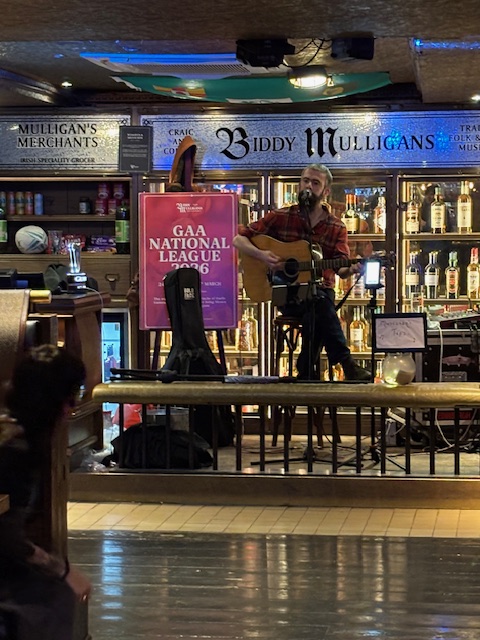
We unpacked and made our way down the narrow and winding cobblestone street just a block or two to one of the pubs listed on the hotel handout, Biddy Mulligan’s. At the doorway, we edged past a cluster of cigarette smokers (we saw plenty of smokers in Germany, too!), and wriggled through the crowded restaurant where dozens of folks were crammed in drinking, eating, laughing, and shouting at one another. Surely we’d never find a seat, though it was 6pm on a Sunday. But just as we were giving up hope, a crowded booth emptied out, leaving a graveyard of pint glasses on the sticky table. I slid in to claim the space while my husband gestured to the bartender who handed him 2 menus before he cleared the debris.

We chose our meals, roasted salmon for me and lamb stew for him — both on potatoes with roasted vegetables. Absolutely delicious. I even enjoyed a Scottish beer — the first beer I’ve had in ages due to my gluten sensitivity –I savored every single drop while live music played from the back of the bar.
We were just a few hours into Scotland, and though the culture shift was palpable, we were delighted!

As we did in Germany, we dedicated our first full day to driving. We rented a car — a Jeep SUV because it was the only automatic transmission in the place and though we both know how to drive a stick, we knew we’d be driving on the opposite side of the road all day and wanted to limit the variables. The car rental was four floors below ground in a parking garage, and John’s initiation to driving in Scotland was staying on the left as he wound up those levels to daylight and straight onto the busy, narrow streets of Edinburgh. With rush hour traffic and road construction, it took us a while to traverse the city, take the Queensferry Crossing over the Firth of Forth, and enter the countryside north of Edinburgh on our way to Perth.
Queensferry Crossing

The Scottish countryside is stunning — rolling hills, scattered farms, sheep, lakes, more sheep, mountains, and did I mention sheep? We drove far enough west and north to see the mountains, and then headed east to Perth where we walked through the very walkable shopping district, and had a bit of lunch — soup and a toastie, which is what the Scots call a grilled ham and cheese sandwich, and a scone, of course.
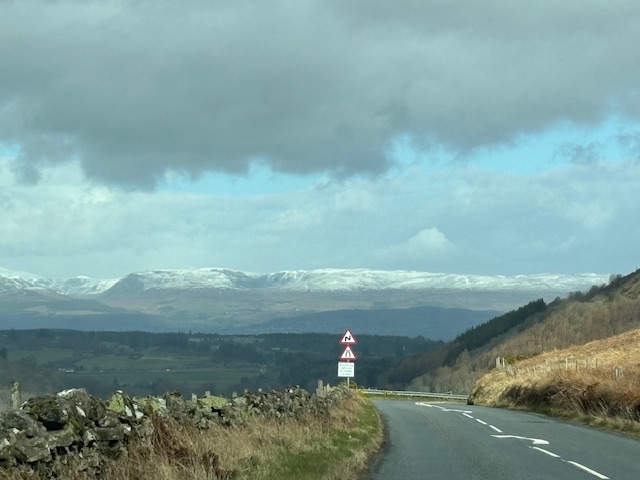
The Scottish countryside

We stood next to the River Tay, which runs through Perth.
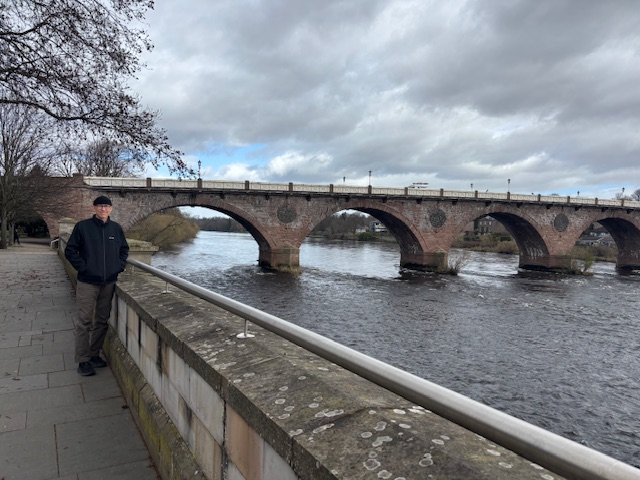
John standing beside the River Tay.

We then followed the river’s path to Dundee, where we saw the River Tay flow into the North Sea, smelled the salt air, then made our way back to Edinburgh, dropped off our rental car, and got a delicious dinner.

I am making this journey sound easy, but it was anything but. I was the co-pilot, which was the easy part, even though we kept losing our signal and sometimes didn’t know where we were. (Yes, we did have a paper map with us! ) My husband was the real trooper — driving an American-style vehicle on ancient, narrow, poorly-marked, winding country roads, on the left side of the street, from the right side of the car! And, I haven’t even mentioned the very frequently-placed roundabouts with anywhere from three to infinity exits that run in the opposite direction of the ones we are familiar with in the states! Driving in the UK on the eighth day of our European vacation was a courageous feat!

So, his fish and chips and my skink, a creamy Scottish stew with smoked haddock, potatoes, and onions, was a real comfort food treat at the end of a long and, at times, stressful day!
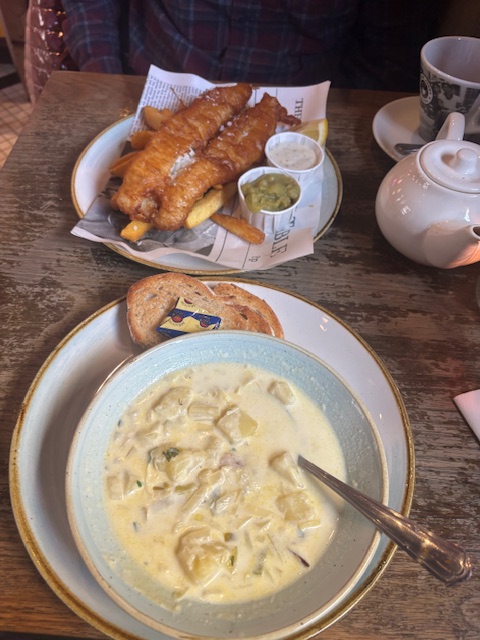
Fish and Chips (top) and Skink (bottom)

Our second day in Scotland, we walked the streets of Edinburgh — one street in particular, the Royal Mile. This highly travelled street runs from the Edinburgh Castle at the top, down a long incline to the Palace of Holyroodhouse, the Scottish residence of the King of England. The cobblestone path is lined on both sides with shops — gifts, kilts, food, whiskey, tea, etc. We went in countless stores looking for Drummond of Perth plaid and woolen sweaters. Between shops, we enjoyed the street performers — vocalists, bag pipers, and other entertainers who weren’t the list bit deterred by the seemingly continuous rain.

After a brief afternoon rest, we walked again, several blocks, down Princess Street to Castle Street to see where my husband’s great grandfather once worked as a cobbler in the shadow of the castle.
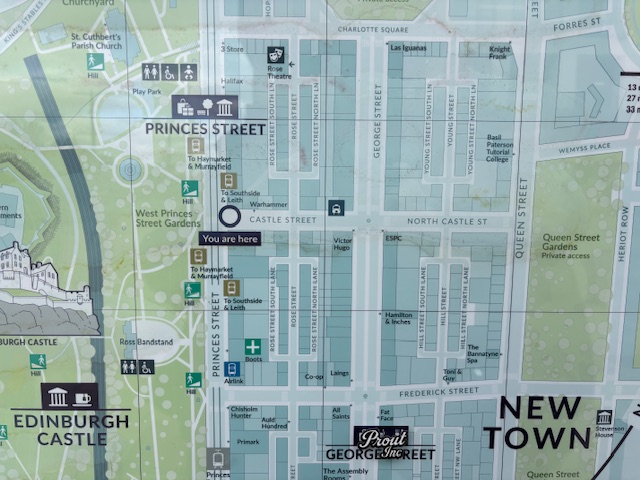
Map showing Edidnburgh Castle, Castle Street, and the Princess Street Gardens

How amazing to picture him there, over a hundred years ago!
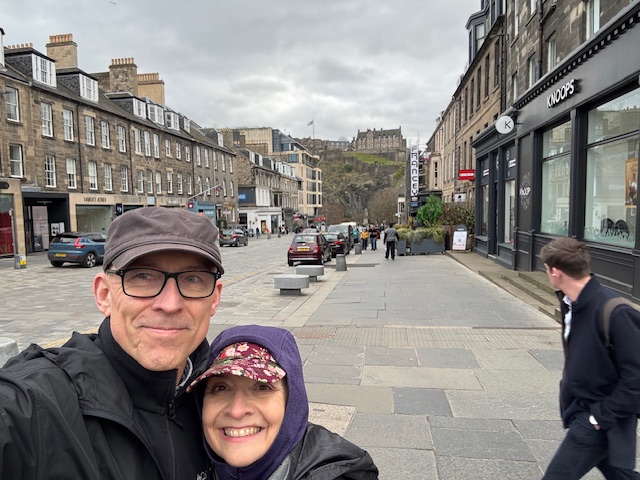
Standing on Castle Street with Edinburgh Castle in the background,

We wound our way back through the Princess Street Gardens, a beautiful place that reminded us of Forest Park in St. Louis and The Common in Boston, returned to our hotel, and collapsed into sleep.

On our last day in Scotland, despite the rain, we took a train to Glasgow, enjoying the views of the countryside again — rolling hills, sheep, town after town, and finally the city. We disembarked, explored the shopping district, had a lovely lunch in a small cafe, then walked our drippy selves back to the station, boarded the train, had one last delicious meal in Edinburgh — roasted lamb and chicken this time — and prepared our bags for our long journey home.

When our driver picked us up early the next morning, we shared our experiences with him, a man who’s lived his life in Scotland. With each tale we shared, he smiled and remarked, “Aye!” as if to say, “Yup, that’s how it is here!”

Scotland, we found you to be hearty, unbothered, celebratory, and friendly. Your land — gorgeous. Your food — delicious!

What a gift it was to visit, and though we don’t know if we’ll ever be back, Scotland you are part of us now. Aye!

You will go out in joy and be led forth in peace; the mountains and hills will burst into song before you, and all the trees of the field will clap their hands. Isaiah 55:12
Guten Tag, Germany!

If you click to listen, please note that I’ve placed captioned photos throughout the post that I did not read aloud.

Recently, my husband and I made our first visit to your land, and I wanted to send a quick note to extend our thanks for a lovely visit. We came on a sort of heritage tour — since both of my parents and his father all have roots in Germany, we wanted to come see where our forefathers and mothers lived, to touch the soil, to eat the food, to imagine what life might’ve been like for them.

We made our first home base Hamburg because of its proximity to Grabau, which is where my husband’s great grandfather would have grown up on a farm. When we landed at the airport, we easily found a taxi and found ourselves winding our way through a sprawling modern city, rich with many familiar retailers nestled beside others that were, dare I say, foreign. Exhausted from a flight that had left Detroit, touched down in London and then Copenhagen before finally alighting in Hamburg, we mostly just stared out the windows, trusting our driver to drop us at the hotel that was expecting us.

It wasn’t long before we found ourselves walking into a small but clean and recently updated establishment. The desk clerk found our reservation, told us where to go for breakfast in the morning, and advised us of a few places we might find something to eat for dinner. We stumbled to our rooms, freshened just a bit, then used Google maps to locate a shawarma restaurant just a couple of blocks away. We quickly outed ourselves as Americans when ordering– mostly pointing and nodding to the restauranteur who didn’t speak English– and then enjoyed a huge plate of food.

Full and exhausted, we made our way back to our room and dropped off to sleep.

Now, I won’t go blow by blow through our six days in Germany, but I do want to remark on some things that we noticed.

First of all, almost everyone we encountered spoke at least a little English and demonstrated a willingness to help — the hotel clerk who advised us where to get an outlet adapter when the one we brought didn’t work; the rental car agent who displayed curiosity about our quest and switched the car’s display into English for us; the gentleman in Grabau who, spotting someone he didn’t recognize, pulled over and chatted with us as we walked through the town; the server in Berlin who hung onto my passport that I left behind and delightedly returned it to me when we came panicking back to find it; and the waiter in Nuremberg who tried to tell us that the German meal we were ordering was an enormous amount of food and that we likely wouldn’t finish it.

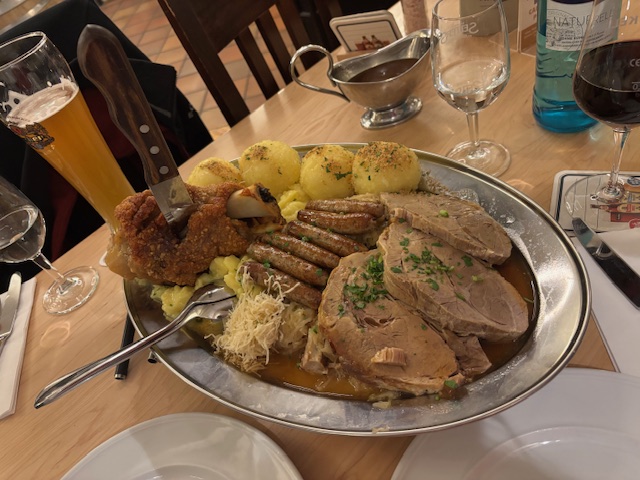
The mammoth "two serving" meal in Nuremberg.
The mammoth “two serving” meal in Nuremberg: pork loin, potato dumplings, bratwurst, sauerkraut, pork shoulder and potato salad.

Even those who didn’t speak English were eager to engage — the inn owner, Mr. Vogt, in Unterschwaningen, the ancestral home of my father’s family, who, through Google translate, shared that his family had run the inn, the only one in town for the past two hundred years, the waitress in a cafe who was willing to get us some oat milk once she knew (again, thanks to Google translate) what we were talking about.

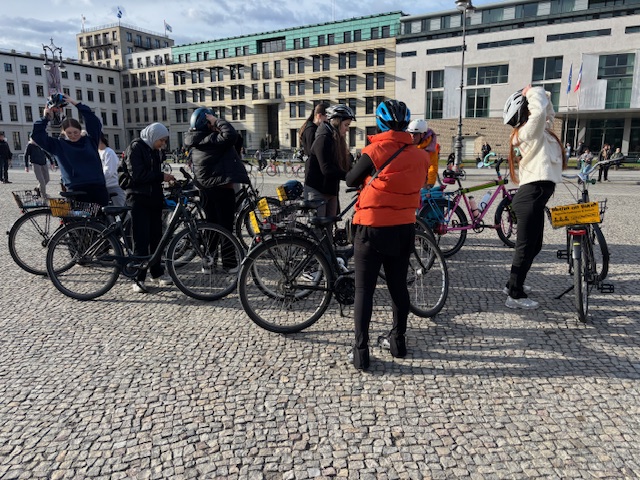
We also noticed the bikes! While it was around 40-50 degrees Fahrenheit most days that we were with you, countless folks made their way through the cities and even the countryside on bicycles. From the northern seaside city of Kiel to the resort town Baden-Baden in the Black Forest of southwest Germany, folks dressed for the weather, stayed in the bike lanes (which were very consistently everywhere), and pedaled their way from place to place. Some were toting children, some were making deliveries, some were dressed in work wear, most were bundled up with coats, hats, helmets, gloves, and often glasses.

One of many pictures we took of folks on bikes — this one, I believe, was in Berlin.

Perhaps because so many folks traveled by bicycle, and because of the storied German efficiency and engineering, the roads were virtually flawless! Well-marked and exceptionally well-maintained, these roads made it quite easy for two folks who have done very little international traveling to find our way in and around Hamburg, Nuremberg, and the surrounding towns and countryside.

Now let’s talk about the food. Where do I start? First of all, I have never, and I mean NEVER, been so excited to eat a hotel breakfast. In both hotels in which we stayed, the morning spread was remarkable — eggs, bacon, pastries, yes, but also, sliced meats and cheese, fresh fruit, cereal with nuts, seeds, and dried fruits for toppings, potatoes, fresh vegetables, and I could spend a whole paragraph on the coffee, tea, juice, and milk choices. We lingered each morning, savoring the experience. And then — then! — we found cafe after cafe and restaurant after restaurant that also did not disappoint. Every cuisine from the previously mentioned shawarma to curry to hamburgers with sweet potato fries to freshly made soups to the way too enormous traditional German meat-filled meal was outstanding. And I haven’t even mentioned the sandwiches.

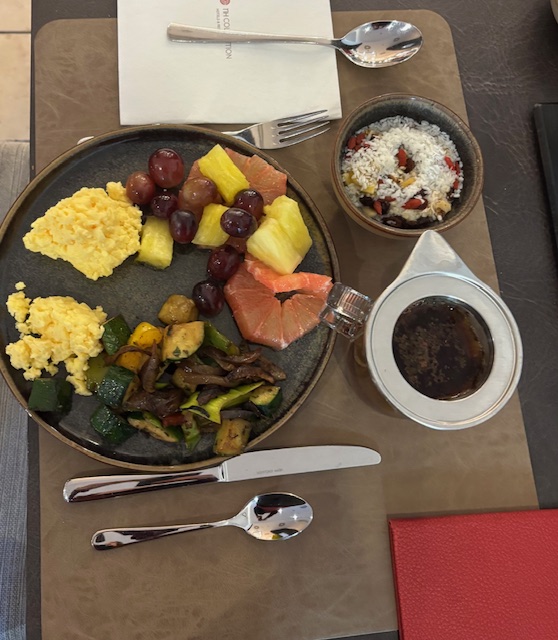
One day’s breakfast — perfectly scrambled eggs, sauteed vegetables, fresh fruit, oats with seeds and dried mango and goji berries, and loose leaf tea.

Now, you’ve got to understand that we regularly enjoy a gluten-free and dairy-free diet, but Germany, everywhere we turned was a carb! We couldn’t help ourselves. We had a rhubarb pastry in a small town near Grabau, lebkuchen in Nuremberg, a cherry crumble bar on the way to Baden-Baden, and soup with fresh bread in Berlin. In America, these things, at least for us, are rare treats, but in Germany, they became a daily requirement. But let me get to the sandwiches.

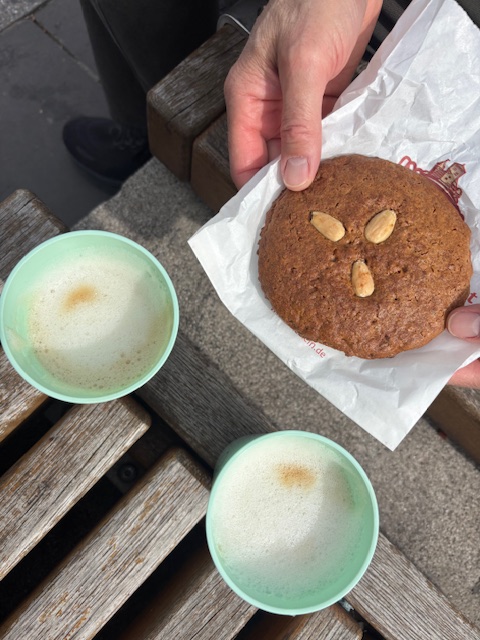
Lebkuchen with oat milk lattes — my great grandmother used to make these cookies every Christmas. These transported me back to my childhood.

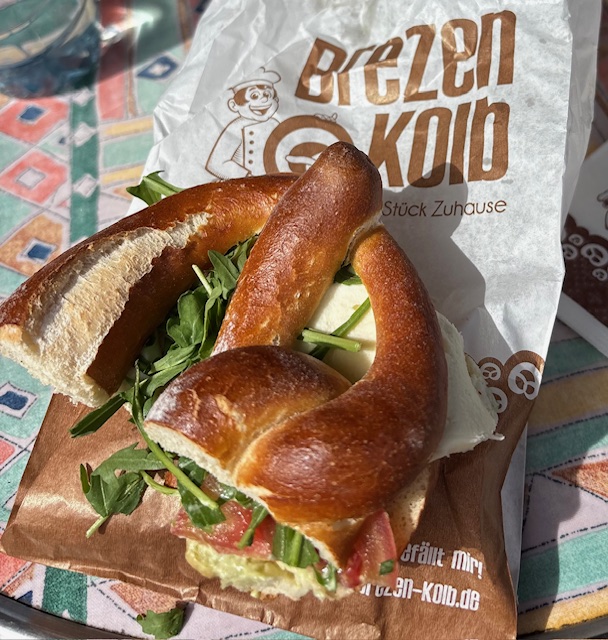
Everywhere we went in Germany — on trains, in cities, in the countryside, in shops — people of all ages were carrying small open bags from which they would inevitably pull enormous sandwiches that they would eat as they stood on the train platform, walking down the street, or riding on a bike. Even toddlers in strollers were eating enormous sandwiches! We obviously had to throw caution fully to the wind and give it a try, so when we saw the Kolb Pretzel company selling pretzel sandwiches, we purchased one, had them slice it in half, and enjoyed it as we walked through a Saturday morning market. Exquisite!

Kolb Pretzel sandwich — wow!

I’m starting to ramble on now, so let me return to the purpose of our visit. We wanted to visit the ancestral homes of our families — the Kolbs, the Meyers, the Rathjes — and we did! As we toured the small farm towns and small cities that our forefathers and mothers used to live in, we tried to imagine them there under the same castle we were exploring, worshiping in the church where we were standing, walking the same path we were on, taking in the beautiful pastoral scenes, and living their lives. Most remarkable to us was the thought of how bold and brave they were, most of them during the mid to late 1800s, to leave what they knew, the beautiful familiar, and to venture out — how? on foot? by train? on horseback or carriage? and certainly, undoubtedly via a long ship voyage — to a land they had never seen and could only imagine based on the words they had read or heard from others who had gone before them. What made them leave? A family issue? A government or political demand they could not abide? A dream for something different?

John standing in front of the Lutheran church in Grabau, Germany — his great grandfather likely worshipped here.

We know some of these answers because of those who have done the research — that’s how we knew to go to Grabau, and Kiel, and Unterschwanigen, and Baden-Baden — but our imaginations and our visit made us wonder even more.

And Germany, I can’t leave this message without saying that we felt your strength and your courage, too! We saw reminders of world wars, monuments to lives lost, evidence of destruction, and an intentional message of resiliency and a firm determination to not forget the past but to forge a different present and future. We saw that not just in Berlin, but everywhere we went — in the ashes displayed at the restored St. Lorenz church in Nuremberg, in the memorials at Kiel, in the words of the gentleman at Grabau who told us that most of the Germans left that village in the wake of World War II. Its current inhabitants, he said, are descendants of the Polish folks who settled there once the dust was settling.

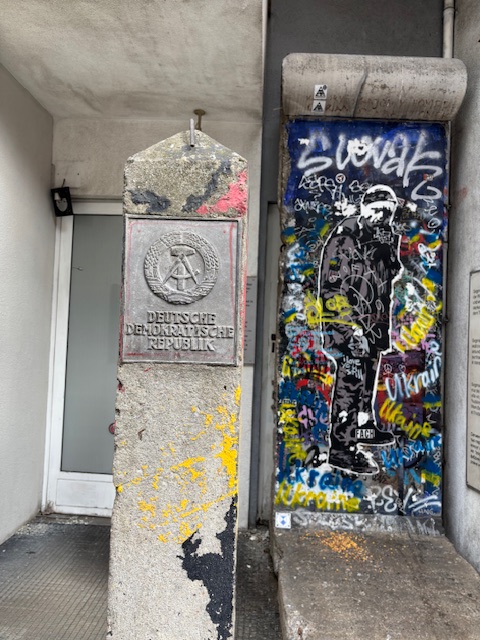
A small piece of the Berlin Wall that remains near Checkpoint Charlie at the border of what was once East and West Berlin.

Germany, you were a fine host. Thank you for accommodating us, for preserving the past for us, for showing us what it looks like to rebuild and move forward. I can only hope that one day we will be back, but regardless, we carry part of you with us, and we might just be packing a sandwich or two!

Tschuss!


In [God] our ancestors put their trust; they trusted and [He] delivered them. Psalm 22:4