Good Grief

It’s the mundane everyday moments that catch me unaware. I hop into my car at the end of a work day, reach for my phone to call my mom — and it hits me. Mom won’t be receiving phone calls any more.

The obvious moments are emotional, of course, but you can see those coming — the moment she stopped breathing, when the funeral home employees loaded her onto a gurney and gave me a minute to say goodbye, when I wrote a note to her only sister telling her how special she was to mom — each of these moments made me sob, of course, but they were not surprising.

It’s when I’m standing at communion and the pastor touches my am and says something about the “communion of the saints” or when my high school buddy who once ensured that I was voted “moodiest” in my high school class, showed up at the church right before the service just to ask how I was doing — these moments catch me off guard and I am immediately overcome.

And it’s not just the weeping; it’s also unbridled annoyance. I think because the loss of my mother is so fresh, because I’m still spending a lot of emotional and cognitive energy trying to believe that it’s real, I get annoyed at things that normally wouldn’t phase me. This is not a passing irritation, it’s a funk that settles on my face that leaks out of my mouth in the form of tone— the kind of tone you wouldn’t dare take with your mother.

This funk settled on me a week or so ago after a pretty run-of-the-mill series of events. First my supervisor sent me an email outlining my failure to update a document according to her specifications, then I received a delivery of a shirt that was supposed to be 100% cotton that certainly was not, then I proceeded to spend too much time weeding the garden when the day was well over 90 degrees. I came into the house in an overheated body, perseverating over the email and trying to initiate a return of the shirt when my husband cheerily arrived home and asked me a benign question. I unknowingly snarled my response (thank you, funk). A few minutes later, he asked an unrelated benign question and I, again unintentionally, snapped an answer. By this time, he had a valid response, which I didn’t know how to process — not with all the grief encased in irritation. No. At this point, I was on overload.

And what did I do? Did I talk through the situation with maturity? take ownership of my feelings? apologize?

No.

I retreated, withdrew, isolated.

For 36 hours.

And then, because we had a road trip on the calendar, I forced myself, sitting in my co-pilot seat, to open the vault, messily let go of irritation, and find, once again, the tears, the grief, the loss, the reality.

These emotional expressions, I’ll call them that, are not new to me. I have not seen them in a long while, but they feel very familiar. They take me right back to my childhood and adolescence when my parents divorced and my dad was living in another state. That was my first time experiencing deep grief — the practical loss of my dad. He’s still living, at almost 88, but since the time that I was about 8, he’s been removed, at a distance, no longer accessible in the ways that a girl needs and wants her dad to be, so it makes sense to me now — now that I’m an adult experiencing the loss of a parent — that those feelings I felt in my childhood were real, and though valid, outside of my control.

However, at that time, I was the only one of my siblings that I remember emoting in such a way. My two brothers and my sister seemed fine. They were getting on with life, while I was throwing myself on my bed sobbing, lashing out in anger and sarcasm, and generally feeling volatile.

Others apparently thought me volatile, too, because the feedback I remember getting was to quiet down, stop crying, and get a hold of myself.

I, at 8 or 10 or 14, didn’t have the self-awareness or the language to say, “I feel betrayed by my parents, devastated by their divorce, and totally unmoored,” and even if had, in 1976 or 1981, what would those around me have said? “Oh, well, didn’t that happen a while ago? Your parents didn’t die did they?” In other words, get over it.

The people around me didn’t have the awareness or the language for what to do with me, what to say to me, so they did what they knew how to do and tried to shush me.

And, feeling unmoored and ashamed of all the feelings I was having, I tried to shush. I really did, but all that did was push all the hurt down where I buttoned it up and tried not to be so moody. Over time, I learned to be a soldier, to power through, to kick butts and take names.

And, if you’ve been following this blog for any amount of time, you know that that strategy — the butt kicking and name taking — worked for a while, but it took a toll, and eventually that soldier had to put her rucksack down, but even if she hadn’t, even if she was still out in these streets large and in charge, even she might have some genuine and surprising feelings upon losing her mother.

But I am no longer a soldier — I have to remind myself of this when the irritation builds past funk into anger and I try to take out an unsuspecting customer service agent — I am no longer a soldier. I am a woman who has done years of therapy, who has spent the last twelve (12!) years bringing her vulnerability to the pages of this blog, who has learned that the best way to manage emotions is — shockingly! — to feel them, to talk about them, to write about them, to allow myself to have them.

And as I’m having all of these emotions, I am realizing that though my mom was not perfect (none of us are), she always — ALWAYS! — had my back. She flew to me when I needed her, she cheered me when I won and consoled me when I lost. She laughed with me almost every time we talked but she never — not once — cried with me.

She, too, had been shushed into silence too many times. She didn’t feel safe letting her hurt show. Vulnerability was too scary, so she soldiered through emotional and physical pain the likes of which some of us may never see. And she never once allowed herself to shed a tear — not in the 60 years that I knew her.

What a burden to carry. No wonder she was exhausted and made her exit as soon as she felt she had permission.

Let me learn from that. Let me feel each of these emotions. Let me talk about them. Let me write about them. Let me cry.

I think I’ll do a little bit of that now.

There is a time for everything…a time to weep…a time to mourn… Ecclesiastes 3:4

Just Do It

I had been trying to have empathy, to put myself in her shoes — but I had been struggling. Is it because she’s my mother?

I mean, this is the woman who would lift me on to the kitchen countertop when I was, what, four or five years old? She would have me lie on my back so my long blond hair could fall into the sink and she would wash it, pouring a pitcher of water over and over until the suds were gone.

This is is the woman who, newly divorced, piled four of us into the car and drove us from central Michigan to Sandusky, OH, so that we could enjoy Cedar Point for the day.

This is the woman who worked as a unit clerk at a hospital for an hourly wage, scraped her pennies together, then took us school shopping so that we could have new clothes to wear each year.

This is the woman who would, on her day off, drive two hours to come help me with my kids, who would take personal vacation days so that I could get a break, who purchased clothes, and toys, and household items that I could not afford with money that came from her own hard work.

How could she now be so helpless?

Crippled by unrelenting pain, she was spending most of her time in a reclining chair. She pushed a button to raise and lower her legs — doctors’ orders to help with the edema. When she did get up, she clung to a walker to move between bedroom, bathroom, living room, and kitchen. The volume on the TV stayed up because she struggled to hear. She, once an avid reader, could do so no longer because of limited vision.

Her life was confined, most days, to the upper floor of her home, and yet she had determined to traverse 728 miles to see her sister — her only sister, her older sister — who also is confined, most days, to a few rooms in her home, who ventures out occasionally and with great difficulty, whose life, which once was at the helm of her family, making it happen for her own kids and grandkids, has become much more limited due to aging and health issues, just as it will for us all.

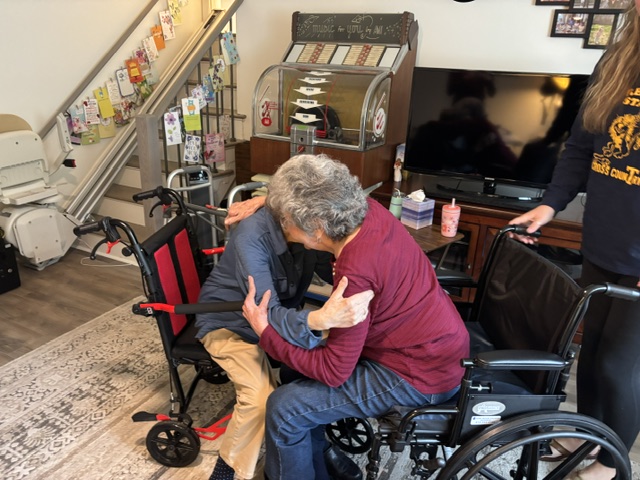
So, because of my mother’s fierce determination, after weeks of planning, phone calls, and arranging, we rode an hour in the car, took two short flights, drove another hour, and found ourselves at our goal. A cousin came to the car in the pouring rain, pushing a wheelchair while somehow also holding an umbrella. Around the house and through a back entry, and there it was, the reunion.

They sat, these two octogenarians, for five hours — smiling, telling stories, looking at photo albums, laughing, and for a few moments distracted from pain and limitation, occupied with connection, and basking in joy.

We made our trip there on a Friday, returned on a Sunday, rested on Monday, and by Tuesday, her pain was increasing, her kidney function was dropping, and the word hospice was being uttered for the first time.

On Wednesday she had lunch with her brother and his family, enjoyed more stories, laughter, and hugs. They said their I love yous right before we went to the lab for one last blood draw followed by the appointment where she agreed that hospice was a good choice for managing her pain. On Thursday, at her hospice intake, they expected she had three months or less to live; on Friday they said days to weeks; on Saturday they said 72 hours.

During that time she had some visitors — of course hospice nurses, and the personal care aide, and the social worker, but family members were also continuously present. On Friday after a long round of visits, she fell into a deep sleep that extended well into Saturday. The hospice nurse came during that visit, saw Mom was in a lot of pain, and started a smalll dose of morphine.

A couple of hours later, I walked in to check on Mom, who had been sleeping for twenty hours. She saw me come in and said, “You know, I’d like to start planning dinner.”

“Mom, I’ve got dinner started.”

“What are you making?”

“Spaghetti.”

She made a face and said, “I don’t want spaghetti. I was thinking of chicken,..” She closed her eyes and used her hands to help me picture what she meant, “you know how you cut up potatoes and carrots and put them in the oven? Maybe with a little onions and beets?”

I really thought the morphine was doing a trick because she hadn’t really eaten much in weeks. I actualy believed she would say all this and then fall back asleep. But she didn’t. She kept talking about this meal. So, I said, “Ok, let me go get started on it.”

I had turned on the oven, put away the spaghetti sauce, and started to clean the vegetables when I saw her walking from her bedroom to the kitchen with her walker. She had declined so quickly, we had been using a gait belt and assisting her in and out of bed for the past couple of days, but here she came of her own volition.

“Mom, what are you doing?”

“Well, I was thinking if I’m going to boss you around, I better get out here and help!”

I convinced her to sit at the table, and then I put her on the phone with first one granddaughter and then another. She listened, chatted, and laughed while I roasted vegetables, threw together a salad, and baked chicken. One of the granddaughters mentioned a milkshake, and Mom said she loved milkshakes, so I texted my brothers and one of them showed up in minutes, milkshake in hand.

By the time she was eating, she had two sons, a daughter, a daughter-in-law, and a granddaughter in the room. She ate everything, my little 90 pound mother, and slurped on the milkshake as she chatted with the neighbor who dropped by. For about three hours she smiled, ate, and laughed, and then she was in pain again, ready to go to bed, ready for more morphine.

We had a hard night that night until we got the dose and frequency of the morphine correct, but then she rested. On a Sunday, all day, she was quiet. She listened to her church service, which we streamed. Her step son and his wife visited. Three of her kids and three of her granddaughters took turns sitting with her, holding her hand, talking to her, crying, reading her stories, and playing her music.

When everyone else had gone home or to bed, one remained, playing Princess Diaries to wind down the night, and that is when Mom stopped breathing. Just like that.

Mom, who had many regrets from her life, spent the last few decades telling her grand kids to have a plan and “just do it”. In the end, that is exactly what she did. She made a plan to see her sister, and did it. She made a plan for a meal and ate it. And once she agreed to be on hospice and make her exit, she didn’t waste any time at all. She just did it.

And now the rest of us are going to have to figure out how to just do everything without her continual encouragement, unwavering support, and genuine curiosity. I’m not ready, but I don’t see as I have much choice.

Love you, Mom. You did just fine.

From his fullness we have all received grace upon grace. John 1:16