
Of Skating and Stumbling and Standing

If you choose to listen to this post, just know that one previous post is linked in the text.

You can be skating along nicely, smiling at the others at the rink, crossing your right leg over your left in a feat of bravery, vibing to the beat of the music. All can seem right with the world. You can feel like this is living.
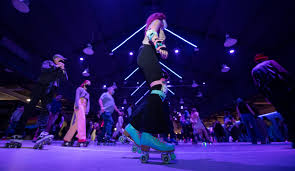
Then, suddenly, you face the first obstacle. A small child tumbles right in front of you. You awkwardly side step and regain your balance. You check to make sure the child is getting back up, and then you resume your previous vibe.

Sure, your smile momentarily left your face, but now you’re back in business– right back with the beat of the music, regaining your groove, getting lost in the moment. But then, when you least expect it, you spot someone from your past as you zoom by the watching crowd. They are glaring at you, holding up photographic evidence of that thing you did back in 2010 or 1983 or 2024 or 1997– that major blunder, that egregious oversight, that huge mistake — or series of mistakes — you made.

The smile drops from your face. You almost run into the wall. You turn to look back, to go over to them, wanting to reconnect, to reconcile, but they are gone. You can no longer hear the music — you can no longer register the people around you — you are transported back in time to a newsreel of all the ways you blew it back then.

What was wrong with you? What was happening? Where were you in your head?

You stumble off the rink and find a bench. You remove your skates and, forgetting to put on shoes or grab a jacket or say goodbye to the people you came with, you wordlessly walk out into the wilderness.

Of course, this is how it happens, isn’t it? We’re living our lives, managing our responsibilities (or even skating), when something — an image, a phone call, a text, a song — triggers us and we feel ourselves disengaging from those around us. If we have the wherewithal, we may try to bat away the images so that we can continue to function, so that we can continue to see the people around us, so we can continue to feel the ground beneath our feet.

Unfortunately, as we’re doing all that swatting, we often find ourselves off balance. We catch ourselves in the mirror, a look of distress crumpling our face, and we realize the heap of guilt and shame from the past that has mysteriously and overwhelmingly appeared on our backs.

One interchange — one glimpse, one image — has shifted reality and we’re no longer skating along.

In the past, such an instance might have sent us spiraling down into the abyss of regret — why didn’t I see? why didn’t I notice? why didn’t I ask? why didn’t I listen? what else was going on? why didn’t I act differently? do more? say more? — we might have spend hours or, frankly, days or weeks, unable to break the free fall, unable to find the ground, unable to take even a baby step forward, let alone try on a pair of skates.

This is not our first rodeo, however. We’ve been here before. We know what to do

We sit down. We recognize what’s going on, and for a while we take off the backpack of grief and peek inside and acknowledge, “yup, that was some messed up shit that happened.” We don’t haul it all out for close examination, not right now, but we acknowledge it — it’s true; it happened; it hurts; real bad.

We know the others involved are still angry/hurting/processing/grieving and sometimes, so are we.

We know our role — our culpability.

That hasn’t changed.

But…because we’ve been here before and know what it is, we choose not to fall into the abyss of grief this time. We choose to look in, to put our hand on the ache, to hope for restoration, and then, to step away.

What happened is true and awful and unchangeable. No amount of spiraling or wallowing or self-flagellation will change that. And, today is in front of us, full of folks who care, who count on us, who see us, who love us. Amazingly, even folks who know the terrible awful then continue to join us in the now. And now is what we have. Lots of opportunity to see, to notice, to ask, and to listen.

And, we resolve to do our best at that and to have grace for when, even now, we blow it. Because certainly, we will blow it again. It is the way of all flesh.

We won’t be skating any more today. No. But we won’t be free-falling either. We’re just gonna stand up, breathe, and take the next step forward.

And one day soon, we’ll be skating again.

the Lord is close to the brokenhearted and saves those who are crushed in spirit. Psalm 34:18

The Circumstance before the Pomp

*If you are listening to the audio recording, please note that I’ve linked several older posts in the text.

It’s May, and although I graduated from high school over 40 years ago, since I work in a high school, each year stirs up memories. As we move closer to June, I see glimpses of teenaged me in the students in our hallway — the excitement I felt as I anticipated the coming changes, the irritability I displayed in the face of uncertainty, the fear I pushed down as I considered the unknown, and the exhilaration that carried me through all of the ceremony — the prom and the banquets and the graduation itself.

I’ve been drawn to this year’s seniors — they might be just a tad more special than other seniors I’ve had (but I probably say that every year). This group were freshmen in 2022-23, our first full in-person year after the pandemic. They had spent middle school (MIDDLE SCHOOL!) in quarantine, and it showed. They were addicted to their phones, had a hard time focusing on academics, and found being in close proximity with their peers quite challenging. I don’t often work with freshmen, but because of Covid and the gaps in learning, I had been tasked with leading a reading intervention class with, at first, the eight freshmen who tested lowest in reading and, eventually, the majority of students in this class. I first wrote about them here in the beginning of that first semester.

They were an unruly bunch, those initial eight, and I was learning the curriculum and the process of the reading intervention program my district had adopted, so, as in many years of my teaching, we were growing together. I was trying to manage their behavior while keeping myself regulated, while also trying to push them to do the thing that was hardest for them — reading. Nevertheless, we persisted, and their end of semester re-tests showed it. In fact, I’ll never forget Kia’s* success story.

The next three semesters I worked with more of the students from this class — the one that is about to graduate in just over a month. I got to know them — their favorite snacks, the look they get on their faces when they are proud, the sound of their voices when they are irritated, and the little ways that they play with one another. Over the past four years I have watched them grow. I have seen them take on responsibility — like decorating the hallways for an open house, being the captain of a team, and completing their 20 hours of mandatory community service. I’ve seen them try sports they’d never tried before, navigate challenging conversations with teachers, and explore college campuses and potential careers. I’ve hugged many of them in the hallway as they’ve celebrated wins and as they have reeled from devastating losses.

And now, I’m watching them count down the days to graduation.

In this context, in addition to the typical anxieties that seniors face — college or career choices, the looming transition, the realities of adulthood — many of our students also face an additional layer of stress, profound financial insecurity. I won’t deny that all seniors are worried about money — how will they pay for college, a vehicle or some kind of transportation, and all the other expenses that come with the transition to adulthood — but for my students, this concern is on a different level altogether.

For these students, the gas money to get to school each day may not be a given, food may not be in the fridge, the electric bill might not have been paid, and yet each senior has to come up with $300 to cover the cost of cap and gown, prom, the senior breakfast, the pinning ceremony, and one 10 x 13 photo of themselves in their regalia.

For you and me, $300 is a chunk of change that we may have to budget for, but for some of my students, it might as well be $30,000. They don’t have it, and they are not going to have it.

This reality looms over these students because if they haven’t paid a deposit, they don’t get to participate in the pinning in March. If they haven’t paid a little bit more, they can’t get their senior t-shirt for decision day on May 1. If they haven’t paid the balance, they can’t go to prom at the end of May. (And if they couldn’t come up with $300, how could they get a dress or shoes or have their hair done?) And finally, if they haven’t paid their balance, they cannot get their diploma.

At each of these junctures, a plea goes out and teachers toss in money for one student or another — a $50 deposit so that one can go to the pinning, another $50 so that another can go to prom, a $100 to cover the balance so someone can get their diploma.

These aren’t just our students. They are our kids, and we are going to do what we can to get them to each of these moments. Each year, we have a number of students who just can’t come up with the money, but this year, the number seems especially high. The reasons are varied — the parents are out of work or have put the student out of the house or have larger issues they are dealing with and this is not even on their radar. The student may be working, but his paycheck may be going to help out the family with bills. Whatever the cause, these students do not have cash for senior dues

For many of our kids, graduation is the pinnacle, the moment they’ve been working for — to possibly be the first in their family to graduate, to overcome the odds, to get a diploma, to become an adult.

And, in the case of some of my students, becoming an adult means facing a very hard financial reality — they just don’t have enough money.

I’m wondering if we might teach them another lesson — that sometimes when you least expect it, someone will come through for you, that you really aren’t all alone in this world, that loads of people want to help, that God will make a way when there is no way.

If you’d like to help support a student’s graduation journey, click here to donate. Make sure to designate “DLA HS graduation dues” in the space provided.

I’ve come to this community so many times — for classroom snacks, for feminine supplies, for Christmas gifts, track shoes, and money for Ubers. Every single time, you’ve come through. I don’t know how I have such a privilege, but as long as you’re with me and as long as I’m working in this space, I’m going to keep asking. The needs are great; your hearts are huge. It’s a perfect match.

before they call, I will answer; and while they are yet speaking, I will hear. Isaiah 65:24