
The Choice: Changing Course, pt. 5

For the past two weeks, I’ve been chronicling my decision to leave the position I’ve held for the past two and a half years to go back to the classroom — a move I thought I wouldn’t be able to make again. For the back story, you can read the following posts: Prepared for What’s Next, But Wait There’s More, Ready, and Getting Here.

Let’s see, where did we leave off — oh yes, the decision.

How do you make a decision that will potentially alter the course of your life? When presented with one option that is familiar, safe, and consistent, and two others that, while being exactly what you’ve been asking for, represent the unknown.

First, you pray. And for me, that means writing. I’ve filled a spiral notebook during this process that started sometime after Memorial Day with that conversation with my husband in the kitchen, which prompted applications, which turned into phone calls, which turned into interviews, which turned into offers. As I page through my notebook, I see lists of questions for interviewers (would you describe the culture of the school? what curriculum do you use?), I see brainstorming for how education might be restructured post-Covid (what if we shifted the schedule entirely? more broadly utilized technology? forever adjusted class size?), I see feelings about diving into something new (it’ll be amazing, I’m terrified, what if I can’t manage? what if I thrive?), and I see my processing of everything else I was managing throughout that process — my current students and their needs, a temporary health issue that flared up (of course) in the midst of the added stress, and plans to connect with family and friends. Within all the lines I wrote is a groaning, a pleading: Lord, I lift it up to you. What would you have me do? Will you guide my steps? Will you keep me from taking on too much? Will you show me the right fit? Will you provide for my current students if/when I choose to leave? Will you show me how to balance my love for my family and friends with my love for teaching? Will you show me how to give my best without giving my all?

And as I wrote and prayed, I continued through the process.

The first phone call came quickly — perhaps a day or two after I submitted the first round of applications. I had plugged in my headphones and headed out on my lunchtime walk when my phone began to ring. I looked — it was a Detroit area code. My heart sped up. The questions came — did I know this was an inner city, low income school? Did I feel comfortable teaching in such an environment? What were my salary requirements? In other words, was I sure I wanted an interview? Yes, I was sure.

In the next day or two, I had a preliminary video chat with that school, let’s call it School #1, and an informational session with another agency, let’s call it Agency #1, that places teachers in low income schools in several locations across the country. This non-profit organization obtains grants to fund training on equity, inclusion, and classroom management strategies, which they provide to teachers who are then placed in these schools. I was interested in both School #1 and Agency #1 and signaled my desire to move forward with both.

Soon after, I had a second video interview with School #1, this time with the head of instruction, who was similar to me in age and experience, and who articulated the philosophy of the school and some of the initiatives they were working on. She didn’t mince words, and neither did I. That’s the beauty of being 50-something; I feel the freedom to clearly articulate who I am from the start, because I want to make sure I get a good fit. So when she told me that they are working on rebuilding school culture, I asked what does that look like? how are you setting school climate? do you utilize police or safety officers? what are your priorities in terms of curriculum? how do you view your role in racial justice work?

Maybe that same day, or the day after, I had a preliminary video interview with Agency #1. This was a little different. I was given five minutes to introduce myself, share my journey in education, and communicate why I was interested in this particular agency’s work.

As you can imagine, simply being in this process was clarifying and invigorating. Having to articulate my ideas about education and equity, often with interviewers who were themselves most often people of color, was challenging and affirming. I feel strongly about providing high quality education to all students, but most specifically students who have historically been denied access, and the more I talk about it, the more passionate I feel.

Within a week, School #1 offered me a position teaching freshman English. I was elated! I immediately drafted a list of questions I wanted answered before I accepted the offer and sent them off in an email.

That same day, I got an email from Agency #2, which was hiring for School #2; would I be available for a 15-20 minute interview in the next few days. Of course! The next day on my lunch hour, my phone rang. It was a typical call, “Let me tell you a bit about what we do,” followed by “tell me a little about your journey.” The more we talked, the more kinship I felt. This school follows a “do no harm” model and values “restorative justice”. Its current initiatives are to 1) increase academic achievement, 2) decrease suspensions, and 3) increase attendance. While, as with School #1, 99% of School #2’s students are Black and qualify for free and reduced lunch, and though only 25% of graduating seniors go on to college, this interview was upbeat and full of hope.

I hung up thinking, “I sure hope they hurry up and give me an offer before I have to respond to School #1,” and then my lunch hour was over, and I went back to work.

Over the next few days, I checked my email for responses to the questions I’d sent to School #1 but saw nothing. Then, I got a phone call from School #2, asking me if I could do an in-person interview at the school, socially distanced, of course.

Then, I got a call from School #3, asking if I could do a virtual interview. And, I had an follow-up video interview with Agency #1.

Yes, it was moving very quickly — and it was affirming. Imagine that — not only might I have an opportunity to go back to the classroom, I might even be able to be selective. This privilege was not lost on me.

I did all the interviews, including the in-person interview at School #2, where I met with the hiring agent I had spoken with on the phone and with the principal, who I immediately saw as a champion of kids. Within a week of that interview, at the end of a holiday weekend, I received an offer.

As it turns out, although both offers (from School #1 and School #2) were for freshman English and both offered the exact same salary, the communication I received from School #2, Detroit Leadership Academy (DLA), was far more timely and thorough than what I received from School #1. Not only that, when I toured both schools, I saw evidence at DLA of intentionality that I did not see at School #1. I saw a plan in place to support students in their ownership of their education and their future, and evidence of DLA’s commitment to not only the students but their community as well. In fact, DLA is the school I mentioned in an earlier post that has been providing food not only to their students but to any community member throughout this Covid-19 season.

In the end, the choice was not difficult, even though I interviewed with Agency #3 on the day I accepted DLA’s offer. That same day, I put in my notice at Lindamood-Bell, and the goodbyes began.

Although those goodbyes were tear-filled, I am very excited about this coming school year at DLA, even with all the questions that Covid brings. I’m taking some time right now to rest up, but I’m also gathering supplies and dreaming big dreams of how this choice will change my life in this next chapter.

I’m sure I’ll have more to say about that next time.

Now to him who is able to do far more abundantly than all that we ask or think, according to the power at work within us, to him be glory in the church and in Christ Jesus throughout all generations, forever and ever.

Ephesians 4:20-21
But Wait, There’s More, Changing Course, pt. 2

I have a confession to make: I like to apply for jobs. That might be an understatement. Applying for jobs has become sort of a hobby for me. I scroll through postings on Indeed and search school, district, and university websites to see what’s available, then I “throw my hat in the ring.”

Quite often.

I’ve been doing this for years — maybe close to thirty years, on and off, even when I had my most satisfying job ever at Lutheran North in St. Louis. I would burn off a frustrating day or month by applying at a community college or a public school. Typically nothing comes of all this applying, but once, about a year before I left Lutheran North, when I was quite sick with my first extended autoimmune flare, I applied for a job because I thought a different teaching position at a new school, in the city, closer to home, would lighten my load and be more doable in my weakened state. (I obviously was not thinking very clearly at the time.) I went through the interview process and received an offer but came to my senses and turned it down.

Shortly after that decision, my husband got an offer to take the position he has now, which afforded me an opportunity to take an extended break and begin healing.

When I was taking that break, I took applying for jobs to a whole new level. I did force myself to not apply for anything for the first four months, but then I started applying with abandon.

At first I applied for only part-time or gig work because that is what I felt up to. I applied to shelve books at libraries — can you imagine the bliss for an English teacher? I applied to fold towels at a gym — free membership included! I applied to proofread textbooks — I mean, come on — who’s got a better skill set?

While I cast a wide net, I found myself landing in jobs that have uniquely prepared me for what’s next.

I began by proofreading and tutoring which was like taking a course in grammar and MLA/APA style. I bent over ACT and SAT tests for hours with students, showing them patterns and strategies. I was constantly checking rules and then explaining those rules to students. I read and re-read college essays and coached students through AP literature and composition courses.

Then I worked a summer at Lindamood-Bell which gave me a framework and language for verbalizing my mental movie and teaching kids to do the same. It also helped me understand the nature of reading as two processes and how to spot which area was more difficult for a student.

I moved from there to the college classroom which not only let me apply some of my Lindamood-Bell language and skill to literature and composition courses, it also gave me a more realistic picture of university instruction, particularly through the lens of an adjunct instructor. I’d been romanticizing that role for a while, and I needed the reality check.

I worked two summers at the University of Michigan teaching students of means from all over the world how to write college essays. This experience reminded me that kids are kids are kids — whether they are from Manhattan or Turkey or Detroit. However, it also irked me — why should these kids get intense high-quality instruction in the summer when the ones who really need it don’t have access? Why should those who could easily pay for their college education get an extra leg up when it comes to admissions?

The next three summers I flew, along with thousands of other teachers, to score the AP Literature and Composition exam. I read over a thousand essays in the space of a week, each year, and the evidence of disparity in the United States educational system was palpable. Some students had been so well prepared — their analysis was mature and concise, their evidence vivid, their sentence construction well-developed. Other students wrote letters to whoever who end up reading their exams, “I don’t know what I’m doing. My teacher didn’t prepare me for this. We only read one book all semester.” I was reminded that while students who had excellent experiences in elementary and high school would inevitably go on to excellent college experiences, those from ill-equipped districts would not. Not without some kind of miracle.

I worked for another two and a half years at Lindamood-Bell. I went back when I realized that the adjunct instructor life wasn’t for me. Yes, it got me in the classroom, but unlike teaching in a high school, it didn’t allow me to form the kind of long-term relationships with my students that foster trust, growth, and transformation. Besides, it was a lot of work, and I felt isolated from other instructors who were all staying in their lanes, prepping their courses, grading their papers.

Lindamood-Bell was, once again, an excellent experience. This time around I was developed from an instructor into a leader. I took on more and more responsibility, had a caseload of students, and began mentoring other instructors. I was beginning to remember my skill sets — my ability to build strong rapport with students and families, my capacity to shift instructional gears in the moment based on student needs, and my deep empathy for students who struggle. Yet, it continued to eat at me that the students who were receiving this instruction — targeted one-on-one reading interventions — were mostly students of means whose parents could afford the high price tag of such instruction. What about all the kids whose parents could not? Who was helping them?

A couple of years ago, I was up late at night thinking such thoughts along with I just really miss the classroom! and I applied for a high school English position in Detroit. When I got an email asking me for an interview, I was ecstatic, so when I saw my husband at the end of the day, I blurted out, “I got an interview at a school in Detroit!” He looked at me dumbfounded and said, “What?” which is when it dawned on me that I hadn’t brought him along on the journey. He knew, everyone close to me knew, how I felt about inequity in education, but he didn’t know I had applied or that I was even considering the possibility of going back to the classroom. The days when I was so terribly ill were clear in his mind — he’d seen me lying on the floor writhing in pain, he’d watched all the experiments with treatments and medications, he didn’t want to see me go back there. How, he wondered, did I imagine that I could drive to Detroit every morning, teach a whole day, and then drive back home? Why did I think I wouldn’t end up right back in bed? Didn’t I remember the stacks of paper? the long days? the time on my feet?

Oh, yeah, I thought. He’s right. I probably can’t do that. What was I thinking?

But time passed. I continued to heal. I found myself working 40 hours a week at Lindamood-Bell, and though I got tired, I could feel my health beginning to stabilize, my stamina starting to build.

And then Covid happened.

And then George Floyd was killed by police. Ahmaud Arbery was murdered for running and being black. And Breonna Taylor died in her own home in her own bed. And people across the country walked out of their quarantine homes and said, “Enough is Enough.”

I looked at my husband and said, “I want to be part of this. I belong in the classroom. I belong with kids who have been told they don’t matter. I’m ready. I’m strong. I want to try.”

And he said, “You’re right. Let’s do it. Toss your name in the hat. Let’s see what happens.”

So, I tossed my name in some hats, and I can’t wait to tell you what happened.

The heart of man plans his way, but the Lord establishes his steps.

Proverbs 16:9

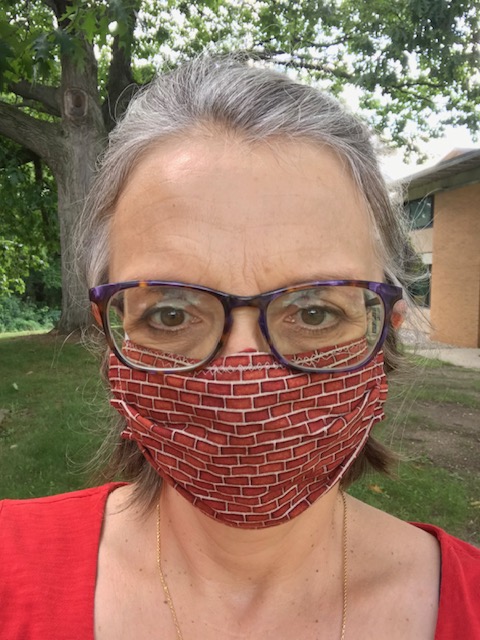
Coronavirus Diary 15: Wearing a Mask

I’ve been back in the office for two weeks now. I’d been working from my office in our little house by the river for almost three months when our company determined that we should be back in our physical space, so I packed up all my materials — laptop, auxiliary screen, student files, and other materials, and lugged them to my car, drove them across town, hauled them up two flights of stairs, and started to acclimate.

The first couple of days were especially stressful. I don’t know if it was the daily screening paperwork that I had to fill out every morning, the taking of my temperature, the putting away of all those materials (which I still haven’t finished), the spontaneously self-generating list of regular tasks that didn’t pause for a second as I learned all the new protocols, or the fact that I now have to wear a mask.

Of course I’ve been wearing a mask for months. It started in the early days when the only time I left our home was to go to the grocery store. I made a few masks following a simple pattern and using some leftover fabric I had here at home. Our church was making them for a local hospital, and since I have a sewing machine and we suddenly had lots of time on our hands, I began to mass produce them along with a small group of women.

On my weekly treks out, I not only donned a mask, but I wore latex gloves. I carefully procured my groceries, following arrows on the floor and being careful to keep six feet away from others. Back in my car, I would remove the mask and gloves, sanitize my hands, and then drive home where my husband would receive and wash all the items I purchased while I stripped and headed straight to the shower. In fact, we’ve kept this routine all these months. We’ve developed quite a system.

We’ve adopted these behaviors to stay safe — to keep ourselves from getting sick.

In those early days, I probably wore the mask for a grand total of 3-5 hours per week, but now that I’m back in the office, I am supposed to wear it for 8 hours a day!

I get it. Mask wearing is very important. The data shows us that our chances of spreading or contracting Covid-19 are greatly reduced by social distancing and wearing a mask.

So, I’m wearing one, but let me just say that it is challenging!

Probably the biggest reason I find face mask wearing challenging at work is that it covers my face and most of my facial expressions. I am an educator, and right now I see most of my students online. Working with students virtually has its own challenges, not least of which is the ability to communicate clearly. Since all the students can see of me is from the torso up, I am continually checking to be sure that I am centered on the screen, that my student can hear me clearly, and that I am allowing appropriate time to hear his or her response. I rely heavily on facial expression and hand gestures such as “thumbs up” and “high five” to communicate encouragement. Now that I am in the center and required to wear a mask, I lose my smile and the student’s ability to use the visual support of watching my mouth to understand what I am saying. (You’d be surprised how much we rely on this.)

My employer has done a pretty decent job of separating staff members from one another. I am sharing a room with one coworker, but we have a divider between our work spaces and we give each other a wide berth when we are coming and going. Additionally, we each wear a mask for most of the day. However, we have both determined that we will remove our masks when working with our most severe/youngest students for whom the mask seems a distraction or hindrance to instruction.

I am fine with this because my coworker and I have a strong relationship and we are both communicating about the ways in which we are continuing to limit our exposure to others outside of work — avoiding social gatherings, and wearing our masks when in public spaces such as grocery stores, doctor appointments and the like. We trust one another to act responsibly and out of concern for one another, so we feel comfortable several times a day removing our masks to work with these students.

I also dash outside once in the morning, once in the afternoon, and over my lunch hour to take off the mask and breathe some fresh air because I am just tired of wearing it! It fogs up my glasses, makes me feel hot, and smashes my hairstyle.

Wearing a face mask is annoying, but I am going to keep wearing one.

Why? Because in my county 37 new cases were reported yesterday. Michigan’s seven-day average is 508. The United States’ rate of infection and cumulative death count still far outpaces any country, even adjusted for population, and though people are still arguing about whether Covid-19 can be transmitted by people who are asymptomatic (or pre-symptomatic), each day we learn of more people who were infected because they gathered in large groups and chose not to wear masks.

Over 135,000 people have died in United States in the last few months, and we have been given a few simple instructions for diminishing further spread and death: 1) We should wash our hands, 2) we should stay away from people, and 3) we should wear a mask.

It’s really not a big ask.

Is it annoying? Yes.

Would I prefer not to? Yes.

But am I willing to take one for the team and do my best to stop the further spread of the coronavirus while thousands of medical staff are doing their best to keep people alive while wearing not only a mask, but often a shield, and all manner of PPE? while thousands of researchers, clad in hazmat suits, are working around the clock to find a vaccine, a treatment, a cure? Yes.

I’m willing to be a little annoyed — a little uncomfortable — for the sake of keeping myself and others safe. And what if wearing a mask turns out to be ineffective? I won’t mind, because at the very least, my choice to wear a mask signals to those around me that I am willing to care for them, to keep any possible infection to myself, and to join a united effort against this pandemic.

I think that’s worth something.

If it is possible, as far as it depends on you, live at peace with everyone.

Romans 12:18

Coronavirus Diary 14: Privilege

It’s a beautiful Michigan summer morning, and as I sit behind our home with a view of the woods — thick with bunnies and squirrels and deer and such — I can almost ignore the fact that we’re in the middle of a pandemic, that thousands continue to protest racial violence and inequity across the nation.

I made myself a cup of tea and walked right outside, mindless of the fact that over 2 million in our nation are incarcerated — over 500,000 of whom who have not yet been convicted but are merely awaiting trial (Prison Policy Initiative) — and can’t escape their cells, let alone take a leisurely stroll out the door to enjoy some fresh air.

Back here, next to my lush garden from which I pick lettuce and kale each evening for my dinner salad, I can forget that 1 in 5 households with children aged 12 and under are experiencing food insecurity right now (Brookings).

Sitting in my air conditioned home by the river in the middle of a summer heat wave, I can forget that latest estimates (prior to Covid-19) suggest over 8,000 people were homeless in Michigan alone (United States Interagency Council on Homelessness) with well over half a million nation-wide.

This is what privilege looks like: me, sitting in my backyard on a Sunday morning, having the time to type words on my MacBook Air, listening to the birds, admiring my garden, virtually immune to harm.

Privilege looks like a refrigerator and freezer full of more food than my husband and I can eat in a week, a stockpile of pantry items, and enough toilet paper for the next two months.

Privilege looks like both of us having jobs that we enjoy doing, never having missed a day due to the pandemic, never having missed a paycheck.

Privilege looks like closets and drawers full of clothing and the ability to donate the items we are tired of, that no longer fit, that have a stain we can’t remove, that we never liked in the first place.

Privilege looks like discussions over whether or not we want to run out and pick up a gas grill one day this week, if it’s time we purchased a new car, if we want to get dinner from a restaurant or make it here at home.

Privilege looks like both of us having all the medications we need, the insurance to cover the majority of our medical costs, and high quality practitioners who we are able to see often the same day we call.

Privilege looks like watching Hamilton on Disney + on Friday night, scrolling through home improvement shows on TLC on Saturday afternoon, and bingeing on Netflix on Sunday night.

Privilege looks like a quick stop at Whole Foods on the way home from church, a dash into the library to grab the books I reserved online, and a Zoom call with the family.

Why do I have all of this privilege? Why am I so fortunate? I haven’t made all the right choices. I haven’t utilized all of my resources. I haven’t done my best and worked my hardest.

Sure, I went to school. I got good grades. I’ve pursued jobs in my field. I’ve been a mostly honest, law-abiding citizen. However, I have broken speeding laws, I’ve lied to my friends, I’ve parked in no parking zones, I’ve used work time for personal business, I’ve yelled at my kids and spanked them too hard. I’ve shot off my mouth more times than I care to admit — sometimes at authority, my bosses, my coworkers. And yet, I have a pretty comfortable life.

My missteps have not cost me my privilege. The system works for me. I have the presumption of innocence. I have the benefit of the doubt.

I’m a middle-aged white woman in America, and people assume things about me — that I can be trusted, that I’m reasonable, that I’m responsible.

Not everyone gets that. That’s why it’s a privilege.

And because I have privilege, I have a responsibility to speak up for those who do not.

And not just speak up, but act up — write blogs, upset family and friends with my questions and comments, step into awkward work situations, give money to those who need it, and protest. If I can do more, if my privilege affords me the opportunity to be an agent of change, a worker for justice, I’ve got to do that, too.

Why? Because it’s the right thing to do. And further, it doesn’t cost me my privilege. It costs some time, some comfort, and likely some money, but it doesn’t take away my ability to enjoy my backyard, to move freely in society, to live and breathe without fear that my life will be unexpectedly cut short due to racial violence.

Rather, speaking up — and acting up — for the sake of equity, for the sake of someone else having an opportunity to sit in the cool breeze of a summer morning, sipping tea and watching bunnies frolic in the grass, for the sake of another human being feeding her children and expecting that they will all live into adulthood, that — that just might make me more fully human.

How can I do otherwise?

Speak up for those who cannot speak for themselves,

    for the rights of all who are destitute.

Proverbs 31:8

Coronavirus Diary #13: Vantage Point

When I was teaching high school composition, I used to have my students watch the movie Vantage Point (available on Amazon or YouTube), which tells the story of an assassination attempt on the US President as seen from the various vantage points of different characters. The goal of watching this film, which I assigned over Christmas break before the start of the semester, was to get my students thinking about point of view and the reliability of narration. I wanted them to see that depending on where you are standing, the story might look very different.

And isn’t that true right now?

I spoke to my mother this week. She lives in small town Michigan, very far removed from the cities where Covid-19 has run most rampantly. Her county has had 82 total cases and 13 deaths. She is unfamiliar with the impact of systemic racism; her county is 92% white and she has no reason to believe that systemic racism has impacted the few people of color that she knows. Because it’s tucked back from the highway running through town, she rarely considers the Level IV correctional facility which houses over 1000 inmates, most of whom are likely people of color. From her vantage point, not much in life has changed. She feels free to go out of her house to shop in the midst of a global pandemic, even if she does have leukemia and is 78 years old. She’s wearing a mask, after all, well, except for that one time when she went to a graduation open house when she didn’t wear a mask — because, well, nobody was.

My daughter called yesterday. She lives on The Common in Boston, a city where Covid has infected over 13,000 people and claimed the lives of over 900. She woke up yesterday to the sound of police putting up barricades on the sidewalk outside her window. As the day progressed, Black Lives Matter protestors assembled behind the barricades on one side of the street; Blue Lives Matter protestors with the support of white supremacists gathered on the other. In the middle of these two groups police officers in riot gear patrolled back and forth. She called because she was riled up. She had left her building through the back entrance to protect herself from a potential clash of protestors, wearing a mask to protect herself from Covid. From her vantage point, life is full of danger and opportunity. She sees her position of privilege and feels compelled to speak up, speak out, and engage in a dialogue to impact change. She grew up mostly in spaces occupied by people of diverse backgrounds. Her partner is a person of color. She belongs to a church that is made up of people from many nations, many backgrounds, many socioeconomic levels. She works for a government agency that is committed to equity for all citizens of Massachusetts. She is hyper-aware of the realities around her.

Over the past week, I have been preparing to return to the office where I was working before I started to quarantine at the end of March. My company has done extensive work to prepare our environment to meet the requirements of re-entry — creating social distance, requiring and providing masks, ensuring that extra cleaning will be done, and limiting the number of students who will be in the center at any given time. The parents of some of our students really want them to be able to come into the center — they believe instruction will be more effective there. From their vantage point, opening our center is a great idea. However, many of the staff, who have been working remotely for the last three months, sheltering in place, limiting their exposure to others, and watching the trends of communities who have opened ahead of us, do not want to go back to the center. They believe it is unsafe, and they want the opportunity to continue to work remotely, since we’ve been doing so effectively for three months now with great success. From their vantage point, the risk of going back into physical contact is not warranted. They are wiling to lose their jobs rather than take that risk.

Meanwhile, our country is experiencing the highest unemployment rate since the Great Depression of the 1920s. Many new college grads are spending their days alternating between applying for jobs and worrying about how they are going to pay their bills. They are taking jobs that have nothing to do with their degrees just to get a paycheck coming in. They are willing to take risks to work in environments that seem unsafe because they need money — that one little stimulus check way back in April has been gone for weeks, if they received it in the first place. From their vantage point, any work is better than no work.

Families are sitting in their cars in long lines to pick up free food because their money is gone. They worry they’ll lose their homes or that they will get Covid and need medical care that they can no longer afford because they lost their health care along with their jobs.

And each day we hear another story of a family and a community who have senselessly lost someone they love due to racial violence. We’ve heard about George Floyd, Ahmaud Arbery, and Breonna Taylor, but there have been many others. It’s not bad enough that these families are trying to manage the physical and financial ramifications of a pandemic, they are also grieving the loss of lives cut short for no good reason.

Most of us cannot imagine processing that kind of trauma on top of already overwhelming stress of all the change that we’ve undergone because of this pandemic. And we likely won’t have to. That kind of shit doesn’t happen in our communities, in our families. And we have this sense that we are invincibile. untouchable.

Yesterday, my daughter was out running in Boston and had her mask down around her neck until she saw someone approaching. At that point, she put her mask on out of respect for the other person, to reduce the risk of unknowingly contaminating him. He saw her put on her mask — he wasn’t wearing one — and he shouted at her angrily, “Really? Really?” as though he was offended by her gesture. From his vantage point, my daughter was protecting herself from him.

This morning in his rural church, my father-in-law who is 80+, was wearing a mask. A fellow congregant — without a mask — approached him and said, “Who are you protecting yourself from?” It was an indictment — didn’t my father-in-law trust the people he went to church with to be free of disease? From that man’s vantage point, my father-in-law’s mask was ridiculous, unnecessary, an affront.

We have difficulty understanding the the actions and words of those who are experiencing life right now from a different vantage point. We don’t understand why a septuagenarian with cancer would go to a social event without a mask, what would cause a white man to shout at a complete stranger for merely pulling on a mask, or why a person with a job would refuse to go to work while countless others are desperately looking for employment.

We don’t understand the kind of history and indoctrination that would lead someone to take the life of another simply because of the color of their skin or what it must feel like to lose everything that you have. We only see the story from our own vantage point.

Unless, unless, we are willing to look at the events from a different point of view. What might happen if we set down our bags full of belief and assumption and took one step to the left or the right and tried to view the world from a different vantage point? Might we be able to understand a person’s desire to move freely inside the community she has known for decades? Might we feel the fear and outrage of someone who can’t comprehend why centuries-long misconceptions about race can’t be finally put away? Might we see the horror of watching a loved one have the oxygen pressed out of him? Might we appreciate both the need for work and the need to feel safe going to work?

Life is very complex. When over 300 million people live inside one country, they can’t all be standing on the same piece of ground — they won’t all have the same vantage point. If we want to come together and build a more perfect union, we’re going to have to walk around a little bit and see how others view things. We’ll have to share our stories and blend them into a more reliable narrative.

Aim for restoration, comfort one another, agree with one another, live in peace.

I Corinthians 13:11

Coronavirus Diary #12: Taking Risks

We’re still here. We’re sitting in the midst of 2020, continuing to daily discover the elements of this new reality, and starting to take some risks.

I met a friend at a park yesterday, to share a cup of coffee, to chat, to get to know one another a little better, and to discuss challenges and opportunities we have encountered in writing and in education. I walked up to find her sitting at a picnic table, mask in hand. I’d left my mask in the car, absentmindedly. We agreed to situate ourselves at a table “six feet apart” which feels awkward. We find ourselves willing to taking a risk to sit in that awkwardness in order to be together, to build relationship, to share life.

My husband and I were in a similar situation last week when we met with the members of our community group outside. We hadn’t physically been together since early March, and we were excited to see one another, but what would’ve have been hugs turned into awkward negotiations of space as we gathered around a picnic table to chat and catch up. We all agreed to take some measured risk, to share space, to hear one another’s voices in person, to build community.

Yesterday morning, after my meet-up at the park, I was driving to my first Hellerwork appointment since March 24, when I passed a large group of people gathering to walk to mark the celebration of Juneteenth and to acknowledge that though we’ve come a long way from the days of slavery, we have a long way yet to go before people of color experience equity in America. I saw many, most wearing masks, walking in groups of two or five or eight, carrying signs, wearing T-shirts with messages of unity and support. They were willing to take a risk — to come outside and gather during a pandemic — for the sake of racial equity.

https://www.mlive.com/news/ann-arbor/2020/06/hundreds-gather-in-ann-arbor-to-celebrate-juneteenth-march-against-racism.html

On Friday night, my husband and I watched Just Mercy (streaming for free right now), a story that horrified me when I read the book several years ago, but doubly horrified me at this watching as I got a deeper realization of the hatred and harm that has been inflicted on Black bodies over the course of our nation’s history and that is still happening right now. We risked feeling uncomfortable on a Friday night, when we could’ve chosen yet another comedy or feel-good drama — either of which might’ve distracted us from this current reality. We took this risk to acknowledge the truth of our nation’s history and to realize the value of celebrating Juneteenth.

I walked into my practitioner’s office on Saturday wearing a mask; she was wearing one, too. In order to treat me, she has to be up close and personal, touching my body, sharing my space. She manipulates my fascia, kneads my muscles, coerces my IT band, and tries to convince my SI joint that it can indeed function according to design. She’s taking a risk to care for me, and I’m thankful. I’m taking a risk to see her, to allow her to get back to work after three months at home, and she’s thankful.

I head from that appointment to the pharmacy to pick up a medication that keeps my ocular herpes in check, to pick up a birthday and a graduation card, and to purchase more immune support tablets. The pharmacist is behind a sheet of plastic, but she takes the items I have touched, scans them, and hands me my bag. She’s taking a risk to support my health. I’m taking a risk, too. We both wear our masks; our eyes meet. I thank her; she thanks me.

From there I walk next door to the grocery store. I get two of every item on the list, check the stock and price of toilet paper (even though we now — finally — have a two-month supply at home), and stand on the X that keeps me 6 feet away from the next person in line for the cashier. I give the person ahead of me plenty of room to make his purchases and then move forward when it’s my turn. I swipe my card, place my bags back in the cart, and then take the receipt that is handed to me, knowing it has been touched by other human hands. Those hands have taken a risk to serve me, and I have taken a risk to be served.

Every day right now, it seems, comes with a level of risk I had not been aware of before. It’s a risk to buy groceries, get gas, see the doctor, or visit a friend. Activities that were previously mundane and performed without much thought now take a measured intentional approach, which I am willing to take for the things that I need.

Am I willing to take risks for others, too?

Am I willing to speak out against injustice? Am I willing to say — and post — that Black lives matter? Am I willing to walk in a protest? Am I willing to challenge the misconceptions of others? Am I willing to risk friendships with people who disagree with me?

Am I willing to point out the audacity of a president who encouraged thousands of people to gather on his behalf — to sit side by side in an enclosed space — not six feet apart around an outdoor picnic table? Am I willing to be outraged at the language he used to threaten those who might protest such a gathering?

Am I willing to risk examining my own beliefs, my own thoughts, my own choices? Am I willing to see my own prejudice? My own selfishness? My own fears? My own mistakes?

I want to be willing. I want you to be willing. I want us to be willing.

It’s scary, knowing the risk of danger, of infection, of change, of progress.

We step out carefully, wearing our masks, looking in one another’s eyes, keeping a safe distance, listening carefully, examining our hearts, interrogating our motives, and willing to exchange the ways we have known for a way that will ensure the safety, livelihood, and freedom of others.

It might be uncomfortable to do things differently — maybe even a little bit risky — but as one Black life after another is cut down before our very eyes, as they have been being cut down for hundreds of years, the risk of staying silent, of continuing in the path we have been on, is greater still.

I’m ready — are you ready — to start taking some risks.

Learn to do right; seek justice. Defend the oppressed.

Isaiah 1:17

Coronavirus Diary #10: Demo and Rehab

How are we all doing? I feel like we need a check-in, because this has been some kind of year — we’ve got a pandemic going on (US fatalities have surpassed 110,000), unemployment continues at record highs (it’s improving, but at least 13% of Americans are still unemployed), the US economy is far from recovery, and protests continue across the country demanding a dismantling of systemic racism.

It’s a lot. So, how are we all doing?

Me? I feel hopeful, passionate, energized!

I told my mom that the other day. She asked if I’d see the news — what did I think of all the protests.

When I replied, “I’m excited!” I heard silence on the other end. I think her filter was firmly in place, or she might have said, “Have you lost your mind?”

So I said, “I know it sounds crazy, but this could be the moment that we’ve been waiting for — this could be the chance to tear it all down and rebuild.”

I’m not sure that comforted her.

I mean, tearing it all down does sound kind of scary…unless you’ve watched HGTV.

Every show starts the same — the hosts walk into some flea-ridden, dilapidated, mold-encrusted, falling down structure; they survey each room discussing what needs to be done and what it will cost; and then they get out their sledge hammers and start tearing out all the stuff that can’t or shouldn’t be salvaged.

Transformation always starts with demo.

It’s the only way. Putting new over old or propping up an existing structure is only a temporary fix. Duct tape can only hold for so long. If you want to see new life inhabit a space that has run its course, served its time, and is badly in need of rehabilitation, you have to do a total gut rehab.

And it’s time.

Our foundation, built on the backs of slaves and designed to perpetuate the wealth and success of the few, was faulty to begin with, and now the earth has shifted. What’s held in place for almost 250 years is showing signs of age and decay, and we are sorely in need of renovation.

The cost of this remodel is high — higher than any of us can imagine — and all the guys in suits are looking at the existing structure and the suggestions for change, shaking their heads, and saying, “it can’t be done!”

But here’s the thing, it can’t NOT be done. We can’t push these repairs off any longer, or the whole structure is going to crumble under our feet. The foundation is cracked, the supports are wobbling, and one strong wind is gonna topple the whole thing to the ground.

I can hear the storm rolling in. And it just might be a perfect storm.

We all had to slow down sometime in March when we got sent home from work. Forbidden from socializing, we all started watching the news a bit more because, um, our very lives were at stake. And it was at the moment when we all recognized our mortality that we tuned in and watched a white man kill a black man right in front of our eyes.

And, because their very lives were at stake, people of color and many, many allies, stood up, walked out of their doors, and said, “Enough is Enough!” A whole nation had already come together to battle Covid-19, so it was already positioned to come together against another enemy. The masses were connected on social media, meeting through Zoom calls, Facetime, and every other platform known to man, so it was a only small step from, “Hey, could you and your people sew up about 1,000 masks,” to “Hey, could you and your people make a bunch of signs and meet us at the steps of the capital, outside the White House, on Washtenaw Avenue, or on Forest Park Parkway?”

And didn’t they show up! Across the country and around the world, people are showing up, in the midst of a pandemic, despite instances of continuing brutal policing, spraying of tear gas, and countless arrests. People are showing up!

People are showing up on social media, in the streets, with their money, with their signs, on their feet, and on their knees. They are demanding a gut rehab, chanting, “Tear it down, tear it down, tear it down, tear it down!”

And doesn’t that energize you? Doesn’t it energize you to think they if we eradicate all the mold, tear out all the termite-eaten boards, and break up that cracked up foundation, we might see possibility?

The demo can be jarring, but what comes next is invigorating.

I always love the part of the rehab show where the designers walk into the newly configured blank space. They stand amid the bones, gesturing and pointing, deciding together, “what if we opened up this wall? how about a large window at the back overlooking the yard?” It’s at that moment that any possibility exists — the broken, the outdated, the filth has been removed — a fresh start lies ahead.

Visionaries are right now tossing their blueprints on the table — plans for changing the ways communities are policed, how we respond to crisis, how we elect our leaders, how we organize education. And, maybe because of the pandemic, our schedules, our pace, our regular work flow have been interrupted, and we all suddenly have the time, the space, the capacity to imagine a new way. I mean, since March, we’ve been literally living a new way, so it’s not a huge stretch to re-imagine all kinds of different ways of living our lives, organizing our days, and restructuring our communities.

This could be the perfect time — and it’s long overdue — for a gut rehab.

The cost may be high, but our combined wealth should be able to manage it. We have the ingenuity, the resources, the creativity, and the passion. Why wouldn’t we pool our resources, and invest in the future of our country? After all, the return on our investment might just be that more perfect union with liberty and justice for all.

Doesn’t that get you excited?

 If it is possible, as far as it depends on you, live at peace with everyone.

Romans 12:18

I’m reposting this today with a few resources tacked on — I know that I feel inspired and compelled to learn more, do more, and in some way contribute to the rehab of our country. If you, too, feel inspired, check out these resources:

Coronavirus Diary #9: Comorbidities –Pandemic and Racism

Often illness is complicated: a person doesn’t typically just have heart disease; he likely has comorbidities, or other diseases such as diabetes and high blood pressure that are present at the same time. Depression often coexists with anxiety; skin rashes often accompany allergies. When someone gets sick, the doctors often first deal with the ‘presenting problem’ or the one that is currently causing the most difficulty. However, in the course of treatment, other underlying issues are often discovered.

Several years ago, I went to the doctor with a presenting problem — actually a few presenting problems — joint pain, fatigue, and inflamed patches of skin. The doctors diagnosed psoriatic arthritis, and I began treatment. In the wake of that diagnosis, other issues surfaced — iritis, scleritis, sacroiliac joint dysfunction, a tendency toward overwork, a highly critical spirit, and deep, soul-wrenching, unexpressed grief.

Several weeks ago, we were all sent home because our nation had a presenting problem — a coronavirus pandemic. Now that over 1.7 million of us have been diagnosed with this illness and over 100,000 have died, some comorbidities are starting to surface — broad weaknesses in structures like education, health care, and criminal justice; a struggling economy; and, most notably right now, flaring systemic racism.

We were wearing our masks, staying at home, washing our hands, and applauding our essential workers when we started hearing about the disproportionate impact of this virus on people of color (nearly two times as many as would be expected based on population). And then another series of senseless deaths hit the headlines:

Ahmaud Arbury was shot to death while he was out for a run on February 23.

Breonna Taylor on March 13 was killed by police who shot her eight times in the middle of the night in her own home.

George Floyd died with a police officer’s foot on his neck, begging for air, on May 25.

It wasn’t enough that communities of color were losing fathers, mothers, brothers, and sisters every day to Covid — now they (and we) have over and over watched video clips of two of their own (Arbury and Floyd) actually being killed.

Citizens across the country — black, white, Hispanic, male, female, gay, straight — are outraged and are taking to the streets demanding attention for this sickness — this disease — this epidemic.

It’s not new. Racism is part of the very fabric of our country — its threads are dyed with the blood of Native Americans and African slaves who paid the price for straight white males to expand their territory, build their monuments, and amass their riches. For centuries, non-whites have provided manpower in exchange for lower pay, fewer opportunities, and a gaze of suspicion. For centuries, the lives of brown and black people have been deemed expendable — by slave owners, by riot police, by the judicial system, by the educational system, by you, and by me.

We have never had this disease under control, but now that we are weakened by our presenting problem — Covid 19 — and starting to feel the added pressure from the resulting financial crisis, the underlying sickness is starting to flare. In a matter of just a week or two, its strength seems to have dwarfed that of a global pandemic — a pandemic that sent all of us racing to our homes, dragging out our sewing machines to create masks, and washing our produce and surfaces like our lives depended on it.

While just a few weeks ago, most of us were reluctant to leave our homes for fear of catching a life-threatening virus, thousands are taking to the streets to fight a bigger demon — one that questions our humanity.

If we can watch a man die on national television and not be moved to action, who have we become?

If we can stand by while a woman is shot inside her own home — a woman who had not committed a crime or posed a threat to anyone — what else will we tolerate?

If we are not sickened by two white men gunning down an unarmed human in broad daylight, what is the matter with us?

If I’ve learned anything about healing sickness, it’s this — to have any hope of recovery at all, you’ve got to be willing to look the disease straight in the face and see it for all it is, and then you have to be willing to make drastic intentional change.

To recover from what on the surface appeared to be psoriatic arthritis, I had to slowly and carefully examine each underlying issue and then I had to make significant changes to my home, my job, my diet, my exercise, my ways of dealing with emotion, and my attention to self-care. Even then change did not happen overnight. Slowly, over the course of more than seven years so far, I have experienced improved health.

For our nation to have any hope of recovering from a centuries-long battle with racism, we’re going to have to start with taking a long hard look at how deeply this disease has permeated the cells and tissues of our society — and I think we are starting to. We are scratching the surface. We are starting to see the disparities in pay, in health care, in education, in the judicial system, and, you know, I think Covid-19 paved the way for that. When the numbers started showing how hard communities of color were being hit, brave leaders started to talk about why. And now that we are seeing these blatant horrific examples of outright racial hostility, thousands are taking to the streets, demanding that the rest of us take that long hard look, that we see the pus-infected wounds, and that we make sweeping intentional changes — to tear down oppressive policies and practices, to promote reparative measures, to provide spaces in which people can air their grievances and be heard, and to create new systems that provide access for all people regardless of color, or gender, or income, or background.

Sweeping systemic change and recovery won’t happen immediately, but if we are willing to commit to working together to make space for the stories of individuals who have been harmed by broad systemic racism, to interrogate our own conscious and unconscious biases, and to insist on structural changes; if we will commit to stay the course day in and day out, having hard conversations and working through difficulty; slowly, over time, we will begin to see life return to our bodies and restoration spring up in our communities.

When all of us — all of us — are breathing freely, walking safely, and sleeping peacefully, we will enjoy a new kind of freedom, a new way of living, a rich expression of humanity.

I beg you to join me in joining those who have been doing this hard and essential work.

I’ll start by posting some resources. Will you start by checking them out?

75 Things White People Can Do for Racial Justice

26 Ways to Be in the Struggle Beyond the Streets

The Next Question with Austin Channing Brown

We Live Here

Code Switch

Black Lives Matter

If you have other resources you would like me to add to this list, please share them in the comments below.

He has shown you, O mortal, what is good. And what does the Lord require of you? To act justly and to love mercy and to walk humbly with your God.

Micah 6:8

Coronavirus Diary #7: Finding our way

When I wrote my first “Coronavirus Diary” on March 30, I could not have guessed that I would be writing a weekly series that seems to have no end. Could any of us have predicted that we would be working from home, wearing masks to the store, and zooming with our family and friends for most of the Spring?

We’ve been quarantining at home for going on eight weeks now! You might think that the time has dragged on, but my husband and I keep looking at each other and saying, “Is it Friday again already?”

Our days look mostly the same — wake up, morning routine, work, cook, walk, eat, TV, sleep, repeat.

Sure, we have other engagements. We Zoom call our families. We grocery shop (which now includes an elaborate in-processing of purchased items that takes a chunk of each Saturday). We ‘gather’ with our small community group twice each week. We take care of our dog, clean the house, and try to remember to send cards and gifts to somehow mark birthdays, graduations, anniversaries, and the fact that we still care about our people even though we can’t see them.

We worry. We agonize. We pray.

Then we go to bed and get up the next day to do it again.

We don’t set long-term goals. We don’t make plans. We don’t go anywhere. Yet the time seems to be flying.

Even still, a lot can happen in the space of a week. A polar vortex can blow through. A friend can be hospitalized. A daughter can reach a milestone. A company can move from an almost expert response to a global pandemic to joining the ranks of those who have made sweeping layoffs and massive restructuring. A video of a shooting death of a man in broad daylight can circulate so widely and stir up so much outrage that a father and son who’ve been sitting freely at home for most of two months are arrested to the sounds of virtual cheering.

Thousands can protest nation-wide shutdowns. Thousands can been newly diagnosed. Thousands can recover. Thousands can die.

And we’re feeling it — all of it.

We’re edgy — quick to say a sharp word, snatch something from another, or walk away mad.

We’re raw — falling to tears and sobbing about the deaths, the uncertainty, the financial strain, the endless monotony of day after day, or the full sink of dishes. We cry because we’re tired, because we’re sick of being home, or simply because we ran out of Cheerios.

We’re angry — demanding that governments open up, complaining about the ‘idiots’ who keep congregating without wearing masks, and insisting that the person next to us would just stop chewing so loudly.

We’re doing our best to celebrate miracles — births and recoveries and job changes and college acceptances — and to mark graduations and birthdays, anniversaries and holidays.

Sometimes we can’t be bothered — we just don’t have the strength, the wherewithal, the awareness to reach out, to noice, to connect with each other, to wash our hair, or to change out of pajamas.

Yet somehow we’re figuring it out — doing our best — finding our way.

We’re finding our way by seeing the devastation and reeling from it, because that’s what you do when you are devastated — you reel. Try to brace if you like, try to harden yourself against the blow, but like it or not, when the impact hits, you’re gonna find yourself tumbling around trying to find your feet again. If you’ve been ordered home, lost your job, gotten sick, lost a loved one, or simply born witness to the losses of others, you might find yourself reeling. (If you don’t feel like like you’ve been smacked around a little bit, you might be fully in denial that almost 80,000 Americans have died, that millions have lost their jobs and are without money, food, and any sense of stability, and that none of us really knows what the next weeks or months look like.)

We’re finding our way by talking it through. When we talk on the phone, meet together on video chat, or sit next to each other in the evenings, we’re sharing the bits of news from the day, we’re asking hard questions, we telling each other that it’s hard to get out of bed, that we haven’t changed out of yoga pants since March, that we cancelled our vacation plans. We talk through the loss of a loved one, the test results, our latest cooking adventure, and the project that we’ve been working on.

We’re finding our way by reaching out. We call our parents who are weathering this ‘storm’. We touch base with our siblings more than we used to. We check in with friends and call our kids, listening to words, to tones, and to things left unsaid.

We’re finding our way by eating, sleeping, exercising, and deciding that we are going to do the next thing, even if it’s not the best thing, every. single. day.

And in the midst of all this finding our way, doing our best, and carrying on, we get tired and overwhelmed; we start to lose hope. We cry out.

Will it ever end? How long, O Lord, will you forget us forever?

Forget you? How could I? See, I have engraved you on the palms of my hands.

You did? You did!

I did! And I’ve given you a future and a hope.

You have? You have!

I have. I will never leave you nor forsake you.

You won’t? You won’t!

Behold, I am making all things new.

You are? You are!

I am. From before the world began, I am.

That’s right. I remember.

We’re engraved on the palm of Your hand. You’ll never leave us nor forsake us. You are making all things new, from before the world began. You are.

Ok. We hear you. We do.

We’ll keep listening for your voice as we find our way.

Coronavirus Diary #6: Touching

When the sun came out this weekend and warmed the earth, we stepped outside, donned brand new gardening gloves, pulled each weed from our garden plot, trimmed last year’s death away from our irises, washed grime off our outdoor chairs, and began to see signs of promise.

We began to look forward to the next phase where we’ll push seeds into the ground — carrots and peas and beets and radishes– and when we’ll spread fresh mulch on our flower beds. Maybe this year we’ll actually find some time to plant some annuals.

Signs of new life are all over campus. Tiny green leaves have sprouted on the wild blackberries at the edge of the woods behind our yard. Peonies and tulips have broken through the soil just as the daffodils have begun to take their final bow. The rose behind our house, pruned a few weeks ago, is thick with leaves and hinting at buds.

Do I dare to walk out to check the lilac? Could he be waking up, too?

Is it possible that we’ll soon be able to move some of our hours outside? to emerge from our four-walled isolation? To touch the earth? To smell the flowers? To feel the breeze on our skin?

Soon. The weatherman says it’ll be cool with scattered showers for the next week or two. This flash of 70s and sunny was a glimpse of what’s coming — a glimmer of hope.

So we leaned in. We played 80s jams — Doobie Brothers, America, Steely Dan — and sang along as we sat loosening the weeds from the soil. We smiled as we chatted, not rushing, just happy to have our hands in the dirt, to smell the earth, to feel the sun on our faces.

And as we were working there, on our knees in our garden, an unfamiliar Buick rolled right up next to us. An elderly man opened the passenger door and stepped out — no mask, no gloves, just a Laborers for Christ baseball cap. He told us his name and said, “Twenty-five years ago I stayed in these dorms for six weeks while we remodeled them.” My husband put down his tools, stood up, and stepped closer. He reached out his now ungloved hand, saying “Thank you so much! What a difference you made! Your work is still making a difference!” He shook the man’s gnarled hand, looked him in the eye, and smiled.

The man continued on, stringing memories together, a little confused, wondering if the dining hall was open or if he could go into a residence hall. Well no, my husband said, not with the pandemic. “Oh, right, right,…” the man said, as he got back in the car that his son was driving. They turned the car around and drove away.

I guess it was a sunny day and they just needed to get outside, to go for a drive, to remember a different time, and to make sure that the work of a long time ago still mattered.

It does. Even though the residence halls are all but empty. Even though some of them are due for another round of sprucing up. Even though he couldn’t peek inside. His work still matters.

I’m glad my husband instinctively knew what this man was looking for. After weeks shut in at home, with little outside interaction, knowing that he’ll likely not walk this earth too much longer, he wanted to see if the work of his life mattered.

My instinct when my husband reached out his hand, I have to admit, was fear. I almost said, “Stop! Wait! Don’t shake hands! We’re not shaking hands right now!” Wasn’t my husband the one who just yesterday took great pains at the park to walk off the path and to wait patiently for others to pass so that we could maintain our six feet of distance? Isn’t he the one, with me, who opens each piece of mail at the door, refusing to let the outer packaging come in the house, the one who washes each purchased item, each piece of produce, before it’s allowed to sit inside our fridge?

Did he suddenly forget all the precautions we are taking?

Maybe.

Maybe he forgot.

Or maybe his heart noticed a greater need. One that — ever so occasionally — trumps the precautions we’ve been taking for weeks.

For weeks we’ve touched no one except our spouses and possibly our children. For weeks we’ve seen no one in physical form other than those living inside our homes and the people we strategically avoid in public spaces, delicately shifting to the other side of the path, the street, the aisle to keep our distance. We’ve had all of our interactions over the phone, Zoom, and FaceTime. We’ve stayed within our private spaces in order to slow the spread of disease, flatten the curve, and protect ourselves and others.

But sometimes after you’ve seen no one in the flesh since sometime in March, an elderly gentleman steps into your garden, wondering if in his life he made an impact, and it suddenly becomes exactly the right thing to do to reach out, shake his hand, and say, “You made a difference.”

Touching can make a difference.

We won’t be making this a practice any time soon — touching friends, family, or complete strangers who step into our garden — but for this gentleman, who needed some reassurance on a day that offered the hope of Spring, touch seemed more than appropriate. It seemed like the human and loving thing to do.

This afternoon, my husband asked if I’d seen the lilac bush near our house. I told him I hadn’t, so we walked, plucked a small sprig of blossoms, and I held them to my nose and breathed in.

They smelled like Spring; they smell like hope.

Therefore encourage one another and build each other up, just as in fact you are doing.

I Thessalonians 5:11