Early in my driving career, I didn’t pay much attention to the rear-view mirror.
It’s not because my driver’s education teacher, Mr. Horn, (Yes, seriously.) didn’t teach me to use it, or remind me to use it. It’s not my stepfather’s fault either (bless his heart for taking me out driving in his meticulously-kept Caprice Classic). Both Mr. Horn and my stepfather emphasized the need to adjust the mirrors so that I could glance at them from time to time to make sure I wouldn’t run into anything.
It’s not their fault. They taught me the value and necessity of using the rear-view mirrors, but I was all about the forward motion. I wanted to get on the road and make progress toward my goal — friends’ homes, work, school, dates, etc. I had places to be that were in front of me; I didn’t have a lot of time to look back.
The problem is that those mirrors are there for a reason. Just ask my friend’s dad — he no longer has a tree next to his driveway. I wasn’t paying attention to what was behind me; I was looking at my friend, saying goodbye as I got on the road to the next destination. I also hit my share of mailboxes. And once, forgetting that we had purchased a second car, I backed the first car out of the garage right into the new-to-us vehicle that was parked behind it. (Insert eye-roll here.)
Through trial and mostly error, I have learned the value of the rear-view mirror.
Lately I have been looking into it quite a bit. In fact, I have been looking back so much that it has been hard to keep my focus on what’s ahead of me.
Here’s the thing — when you put the car in park, and you are no longer moving forward, you take a few minutes to pick up the crap that fell on the floor, you check the visor mirror to see if you have anything in your teeth, and then, if you sit there long enough, you start thinking about all the places you’ve been. And I don’t know about you, but I spend a lot more time thinking about missed turns and fender benders than I do about grand voyages and thrill rides. You know what I’m saying?
Now, so that I don’t forget the value of sitting with it, I must point out here that it is good to look back at the traffic violations, detours, and collisions. After all, beside the inherent value in grieving losses, we can also learn our best lessons from the mistakes that have cost us dearly. However, we must not stay stuck back there on the side of the road weeping over the loss of property or, God forbid, life. We must grieve, yes, but we must also be brave enough to get back in the driver’s seat, buckle up, set a direction, and put a foot on the gas.
Have you had enough of my extended metaphor? How about just one more thought.
The best drivers, I’ve heard, find a way to balance their determination to get to the next stop with a sustained consciousness of their surroundings and a sober realization of what is behind.
I look forward to being a better driver.
But we all, with unveiled face, beholding as in a mirror the glory of the Lord, are being transformed into the same image from glory to glory..
You’d be amazed to know what happens when you sit down, shut up, and pay attention.
You notice things. You finish writing a confessional blog about sitting with your grief, walk a few steps to your bed, lie down, open the book you have been reading on and off for over six months, and the very next words that you read are these:
Maybe grieving over plans changed is part of the plan to change us.*
Then, after sleeping for just a few hours, you hop in your car and turn on a podcast** to hear two women discussing shame and vulnerability. You’re stunned because as they share their failures, you feel somehow drawn into the discussion like you’re a member of the sisterhood of the fallen.
As the podcast finishes, you arrive at a restaurant to meet a woman for lunch — someone you’ve never met before — she offhandedly mentions her struggle with autoimmune disease, and before you know it, you’re choking out something like, “It’s so frustrating because I like to be a positive fun person, but right now, I don’t feel like that person.”
Then, a couple hours later, in a session with your therapist, you hear yourself recounting the most mortifying moments of your week when your child brought her friend to your house ahead of schedule to ‘surprise you’ and you made them leave so that you could finish cleaning and you weren’t joking. When the therapist says, “so we’re going to work on your need to be in control and your ability to be kind to yourself,” you sit in stunned amazement that 1) you actually confessed the story out loud and, 2) she gets you and this is only the second time you’ve spoken to her.
You leave your session, drive through Starbucks to buy a tall lemonade before picking up your four-year-old great nephew and taking him home for dinner. After dinner you chat about serious things like whether or not a four-year-old can actually run faster than a race car, then hear your nephew, the four-year-old’s daddy, say “you are such a blessing to us” as he walks you to your car.
You drive home, wiping tears off your cheeks because you are overwhelmed at the richness of the day, walk into your house, plop down on a chair next to your husband, and try to give him some snippets that can somehow convey the way God spoke to you all day long, but you are so exhausted from the last twenty-four hours that you can barely make coherent sentences.
After a total knock-out sleep, you wake up and eat a bowl of oatmeal on the way to your physical therapy appointment. Then, the angel who is your therapist places her hands directly on the exact spots that have been screaming for attention. She just barely touches you, but the warmth and intention radiating from her hands moves from your skin through your joints and directly into your heart.
It’s several hours later, after you have baked banana bread, prepared chicken curry, drank tea with a friend, choked up at the opening chapel service on your school’s campus, talked with three out of four of your children, made major financial decisions with your husband, cried over a minor miracle, started crocheting a new afghan, and laughed at the Weekend Update, when you realize that for the last two days God has been placing His hands directly on the exact spots that have been screaming for attention. He has just barely touched them, but the warmth and intention radiating from His hands has moved directly into your heart.
That’s what happens when you sit down, shut up, and pay attention.
I think I might try sitting with this a little longer.
Blessed are those who mourn, for they will be comforted.
Matthew 5:4
*Ann Voskamp, The Broken Way.
** Jen Hatmaker’s For the Love, “Episode 2: Brenae Brown”
This week and last, I have shared posts that tell the story of my journey with autoimmunity. I have said in my posts that I am thankful for this journey. This post gets at the heart of why. Written in August of 2017, it conveys a critical part in my healing — the time I have spent sitting and considering the previous chapter of my life. Everyone doesn’t benefit from illness, but my physical illness has made way for a much deeper healing.
I literally have to sit here with it.
I would rather run, but I don’t have that option any more. I have to sit with it.
In my soldiering years, I was continually in motion. Dawn ’til dark. I was picking up, dropping off, buying, cooking, cleaning, planning, teaching, grading, and when I could squeeze it in, I was literally running. Though I was acutely aware that I had four other humans living in the house with me (who else was I picking up, dropping off, buying, cooking, and cleaning for?), I rarely sat still very long to actually look at them, listen to them, watch them, hear them.
I have to sit with that now. I’d much rather be running.
When one got migraines, went off to school, and then developed an eating disorder, I didn’t stop what I was doing. No. I drove to emergency rooms, packed boxes, drove miles, dropped off, made appointments, picked up, and kept moving.
When another joined the military and started jumping out of planes, I didn’t sit down and think about what that meant. No. I bought supplies, cooked farewell dinners, drove to a bus, dropped off, and kept moving. I can’t even remember if I wrote letters.
When another was brutally assaulted, I was so busy moving I didn’t even realize it had happened. For almost two years. And when I finally found out, still, I didn’t stop what I was doing, sit down, and grieve. No. I grabbed broken pieces, dropped them in the passenger seat of the car, and drove them to someone who I thought could put them back together again. And I kept on moving.
I have to sit with that now.
I didn’t choose this.
No. Even when disease started crawling into my joints, I tried to keep moving. I trudged through long days trying to manage responsibilities and ended up collapsing at home at the end of each day. All my good hours were spent in hot pursuit while my hours at home, with the ones who needed me most, were spent in a daze of pain and fatigue.
It’s been over three years since I admitted the need for change. In those three years I have tried again and again to return to my former ways, but I can not. This disease is literally slowing me, sitting me down, and forcing me to face the things that I have not wanted to face. It’s forcing me to learn new ways. And, still, I resist.
I try, futilely, to keep busy. I have crocheted a hundred scarves, hats, afghans. I have put together a million puzzle pieces. I have read thousands of pages of print.
But, without fail, fatigue comes, and I must stop the busy-ness and turn to stillness. And even when I am exhausted, as I am right now, it’s as though I fight against rest.
The past several nights I have limped to my room lugging heated packs that I drape on my neck, hips, back after I’ve awkwardly lowered myself into bed. Then begins the battle of shifting and moaning and repositioning that sometimes lasts several minutes but tonight lasted much longer, and I couldn’t turn off the images that kept playing out over and over on the HD screen that is my imagination. Finally I groaned myself out of bed.
Come on, Kristin. Sit with it. Admit that you missed so much. Acknowledge that the ones you love have hurts that you haven’t wanted to see. Grieve that. Cry.
Acknowledge that you couldn’t do it all. You couldn’t soothe all the hurts. You sometimes didn’t even try.
And the hurts keep coming. The car needs servicing. The dog is aging and ill. A laptop isn’t working. Can’t a girl get relief from some of this pain?
And then comes the realization that the physical pain is a symbol. A tool.
A gift.
Man, I hate to admit that it’s a gift, but without it, I would still be running. I would still be accumulating regret.
The illness hasn’t solved my problems, but it has allowed me to see them.
And as I see them, I am finally taking the time to sit with them and cry. The tears keep coming as though they just have been waiting for the opportunity.
I’m trying, really trying, to sit with that. I believe the healing will come in the grieving. So, I’m going to take some time to grieve. Soldiering me wants to schedule the grieving for Mondays at 10am for the next three weeks and be done with it.
Sitting still me isn’t in a rush.
I’m learning to sit with that, too.
There is a balm in Gilead to make the wounded whole; There is a balm in Gilead to heal the sin-sick soul.
Back in December 2014 when I first wrote this post, I was just starting to recognize how hard the holidays can be — how isolating, how anxiety-producing, how uncomfortable. I’ve always loved Christmas, but I’ve had a taste of how celebration can feel during a season of grief. I’ve begun to understand how difficult it can be to be with family and friends — even when you love them. And I’ve been learning a new way.
We spend a lot of time and money getting ready for the holidays. Over the last month many of us have attended parties, dinners, and gift exchanges with family, friends, and coworkers. We have cooked special foods, decorated our homes, and dressed in finery in order to celebrate.
We celebrate the love of family. We celebrate that we get time off from work. We celebrate our friendships. We celebrate the birth of a Savior.
We celebrate by eating, drinking, laughing, and sharing. We celebrate by giving and receiving gifts, by sending Christmas cards, by calling those we love, and by worshipping with our church families.
But there are many among us who just can’t celebrate. And they probably aren’t telling you about it. They may decline invitations, bow out early, or just refuse to answer your calls. It’s not that they don’t want to be there. They really do want to be there. They just can’t.
It would be easy if they had a contagious disease, were recovering from surgery, or had a compromised immune system that prohibited them from joining in the festivities. Then you would understand. “Oh, too bad Bobby can’t be here, you know he just had that surgery, and he’s recovering in the hospital.” Everybody gets that. In fact, many of us would load up our gifts and drive over to the hospital to bring the celebration to Bobby because we love him and don’t want him to be left out.
But some people can’t celebrate and it’s because of something that you can’t see — something you may not understand.
Kay Warren, wife of well-known pastor, Rick Warren, who lost a son to suicide in 2013, recently posted on Facebook and then wrote in Christianity Today about the pain she has endured over the last two Christmases as well-meaning friends and acquaintances have sent Christmas cards filled with photos of smiling families and newsletters proclaiming all the good stuff that has happened for them over the year. She received these celebratory cards and letters and got angry. She couldn’t possibly celebrate. How could she, knowing that her son had taken his own life? Even if she believed that Jesus was born in a manger to save the world from their sins, even if she trusted Him and believed that He held her in the palm of His hand, she couldn’t possibly smile, or laugh, or rejoice.
She’s not alone, guys. While we deck the halls and kiss under the mistletoe, many around us can’t fathom the “oh what fun it is”. Not today. Not yesterday. Not Christmas Day.
They’ve lost a child. They are in the middle of a divorce. A loved one has cancer. They just lost their job and can’t pay the mortgage. Their father is on life-support. They have experienced pain that they can’t even talk about. And the idea of joining you or me in our merriment, knowing the pain that they know, is unconscionable. It just can’t be.
So they stay home, miserably wishing they could be there, wishing they could celebrate, wishing they could be part of the joy. Angry that you can be.
Moving forward, I’m going to spend less time and money getting ready for the holidays. I’m going to try to shift my focus to the here and now — to little moments that I can be with those I love — in their tears, in their laughter, in their anger. And if we get glimpses of celebration, we will seize them — we won’t wait for Christmas.
And, if they happen to come at Christmas, well then, we’ll be all the merrier.
Blessed are those who mourn, for they will be comforted.”
I wrote this post over six years ago, shortly after I’d moved back to Michigan. I was so excited to be back around extended family, and I had taken a trip to visit with some of them. I’m dusting it off today, because yesterday, my Uncle Louis died at the age of 92, on a Covid unit in a hospital. He was one of the sweetest men I have ever known.
I have been on a little excursion. I travelled to my childhood home on Saturday and have had one great moment after the other since.
It started with dinner on Saturday with my parents and my brothers followed by worship on Sunday with the whole family. After church, my niece and I saw a movie. I’ve eaten well, slept famously, and have had many walks down memory lane.
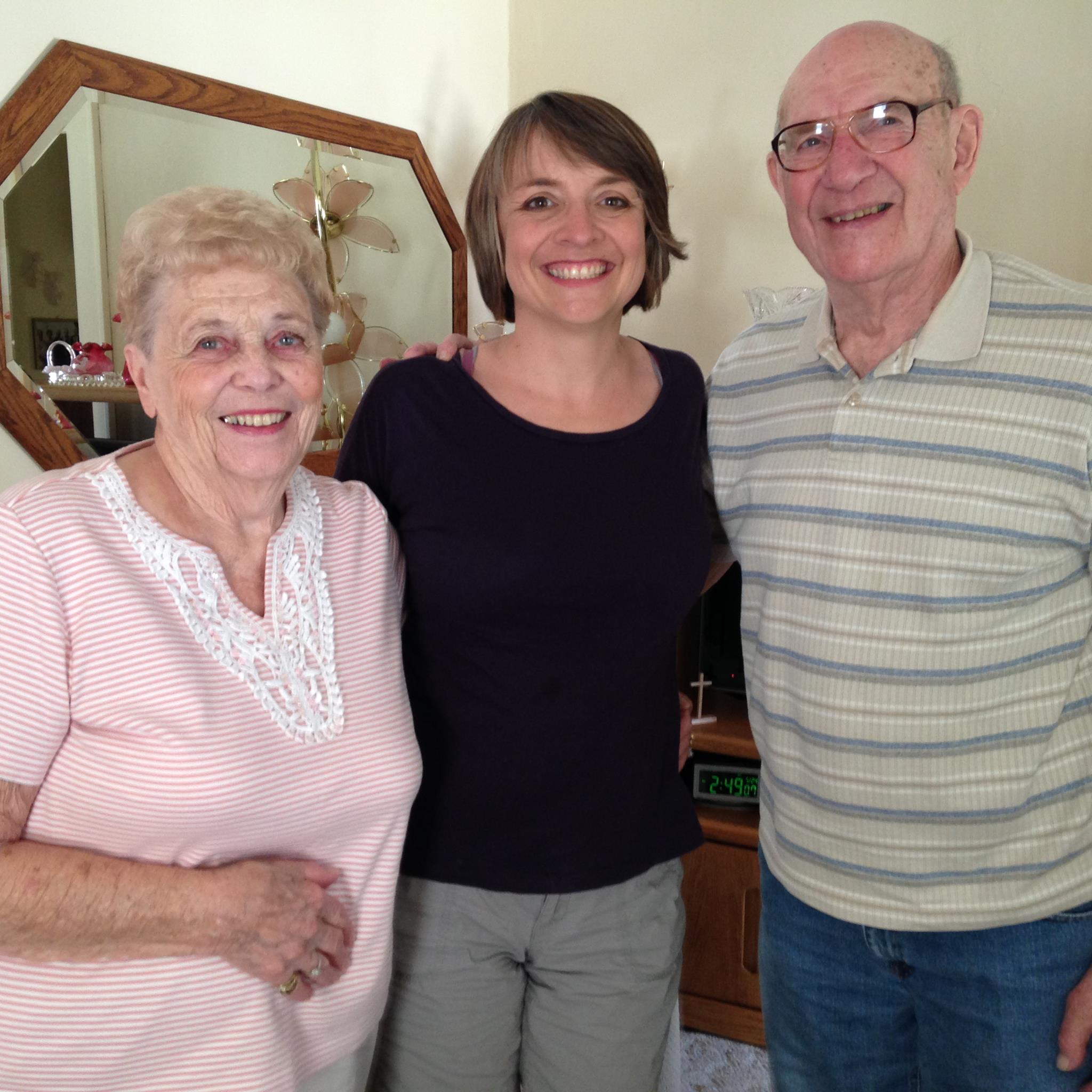
This morning was particularly special. I drove about an hour to visit my aunt and uncle — my father’s older brother and his wife. My godparents, Uncle Louie and Aunt Margaret, are the most precious of gems.
They have showed up for everything. Everything. My baptism. My confirmation. My birthdays. My wedding. My grandparents’ funerals — my mother’s parents, not just my father’s. None of this probably seems astounding, but let me tell you why it is.
My parents were divorced in the 1970s. Divorce was not very common back then, particularly not among ‘church folk’. In those days, when divorce happened, it was fairly common for the mother to get sole custody of the children and the father to fade into the background, sending financial support and visiting occasionally. This was way before shared custody.
To complicate matters, my parents divorced around the same time that my dad was relocating to take a new job several hours away.
My three siblings and I stayed with my mother, as was the usual course of events, while my dad moved. While I am thankful that during my childhood and adolescence we had the stability of one household and the ongoing involvement of the relatives on my mother’s side, I have been sad over the years because of the diminished relationship with my dad and his side of the family.
We saw my dad, but because he was several hours away, those visits were infrequent. We usually stayed with him in the summer for a week or two, talked on the phone regularly, and saw him around the holidays. Sometimes, when he came to Michigan , he would take us to see my grandmother, his mother, who for most of my childhood lived a nursing home, but of his five siblings, usually the only one we visited was my Uncle Louie, and his dear wife, Aunt Margaret.
Whenever we stopped by their house, Uncle Louie would pull out a cardboard box of toys that they kept just for our visits, and Aunt Margaret would magically produce some kind of sweet — cookies, cake, or maybe some donuts. They wanted to hear what we had to say. Aunt Margaret asked all the questions; Uncle Louis was pretty quiet, until he spoke in his soft bass voice. Whatever he said, he said with a smile and sparkling eyes.
Sometimes they told stories about their snowmobiling adventures, my Uncle Louie’s job as a postal worker, or my Aunt Margaret’s love for hand-painted china, but the best story they told was their love story. When they shared their ‘scandalous’ beginning, they both looked mischievous as they took turns in the telling, as though it were a scripted piece they’d been telling over and over for years.
The love story of Louie and Margaret began with a one-month courtship that quickly escalated one night right before they were both supposed to punch in for their second shifts at the factory where they worked. They were sitting in the car when Aunt Margaret suggested that they drive to Indiana instead of going to work. In Indiana, she said, right across the state line, they could get married the next day, without the waiting period required in Michigan. Uncle Louie, apparently no longer concerned about his factory shift, turned the car back on, drove home to borrow $20 from his mother, stopped to pick up two witnesses, and headed to Indiana. They changed into their wedding clothes in a cornfield and were married by the justice of the peace the next morning. They stayed married for 71 years.
They were always together, those two. They took lots of drives looking for antiques and visiting family. They had just one son who was a bit older than we were — he, his wife, and their three children were the lights of their lives, but they had space enough for all of us, too. Three out of four of us were their godchildren, although my Aunt Margaret always said, “I alway include your brother in all my prayers, too.” They took their role seriously, and weren’t going to drop off because of a divorce.
Instead, Uncle Louie and Aunt Margaret regularly drove an hour to come see us at our mom’s house. They said, “Your mom is still our sister; you are still our family.” It may not sound that remarkable now, but, believe me, it was very unconventional at the time.
They came to every birthday party and special event. They always hugged my mother when they came and when they left. They modeled for me how to treat family, even in the midst of brokenness. I never saw judgment or distance from them — just love.
When I grew up and had a family of my own, they would then drive two hours just to drop by and say ‘hello.’ Their big yellow Oldsmobile would pull into our driveway, and I would say, “What? You drove all this way?” They always hugged us — Uncle Louie with his big compression hugs — and said, “I love you.” Aunt Margaret wrote long letters and would share news from my dad’s side of the family, including family history that I didn’t know much about. I always felt loved and treasured by my godparents; I have been so thankful to have them.
As my husband and I have faced divorce and other brokenness in our own extended family, we have often referred to the example that Uncle Louie and Aunt Margaret set. While it is heart-wrenching to watch family members experience pain, it has given me some measure of comfort to know my role. My job is to show love, to give hugs, and to communicate belongingness, just like Uncle Louie and Aunt Margaret have done for me.
Of the many things in my life I am thankful for, Uncle Louie and Aunt Margaret are near the top of the list. I told them that this morning and reminded them of the special lesson they taught me.
since God loved us, so also we ought to love one another
1 John 4:11
postscript January 17, 2021: In the summer of 2018, my Uncle Louis fell in the yard, breaking his hip. He never returned home after that. He went from a hospital to a nursing home where he lived out the rest of his days, separated from the love of his life. It was a hard hit that came not too long after the death of their only son from cancer. My heart has ached these last two years watching these two gems finish their days apart, especially since Covid kept Aunt Margaret from sitting next to Uncle Louis for his last ten months. When he was admitted to the hospital a little over a week ago, Aunt Margaret said, I just wish I could hold his hand. Now I know she’s just longing to be with him again.