Coronavirus Diary #3: Feeling the funk.

I lost my sense of humor this week. I found myself walking around with a scowl on my face, side-eying the dog, and unintentionally snapping at my husband.

I can’t trace it back to any moment, any inciting event, or any offense.

Instead, the funk descended on me, as the sunny skies of last weekend turned gray and then started spitting — rain, then hail, then snow. My facial expressions tightened, my tone darkened, and my sensitivities heightened.

Maybe you’re feeling like this, too. We’ve been sheltering at home for a million days, the death toll keeps climbing, and we don’t know when this will end.

Maybe you’ve got other stuff going on in addition to dealing with a pandemic.

Maybe, like me, you’ve got family members who are aging or have health issues, and you feel the weight of not being able to take an active role in caring for them right now.

Maybe, like me, you now know one or two or more people who have contracted the virus, or worse, some who have died. The whole earth is practically groaning with the deaths of over 114,000 from coronavirus let alone all the deaths from other causes in recent weeks.

And if all that wasn’t enough, it’s Holy Week and we can’t be with our people.

I tried to “make the best of it” when we participated in the livecast of our congregation’s Palm Sunday worship service last Sunday. We ‘joined’ our small group on Facebook messenger video chat while we live-streamed the service; then we ‘stuck around’ after church for coffee hour with our friends. It was great to see everyone; it really was. We truly are making the best of a bad situation. Still, I want to be at church. I want to hear the babies crying and the papers rustling. I want to gather in a circle for the bread and the wine. I want to hear the voices of the communion of the saints singing “Hosannah!”

But not this year.

I felt deflated on Thursday afternoon as we prepared to virtually share our Seder meal with our community group. It would be different, too, this year — with each family scavenging their homes for whatever they might use to represent lamb, charoset, parsley, and horseradish. We’d hear the story of the Passover, asking “why is this night unlike any other”, and remind ourselves that “it would have been enough,” but somehow, it doesn’t feel like enough.

And then on Good Friday, I paused from work at lunchtime and sat on my couch to hear music come through our television and to listen to the story of Jesus’ arrest, crucifixion, and burial.

I couldn’t stay through the end — the stripping of the altar, the darkening of the room, the closing of the tomb — because I had to sign back in to work, to meet a student, to put on a smile and behave as though everything is as it should be.

But it’s not. Not this year.

I’ve been trying to shake this funk — I’ve been exercising, eating right, practicing yoga, and getting outside whenever I can. I roasted a turkey breast and shared bits with my husband and our dog while I sliced it for dinner, and still I was left feeling weighed down, irked, and out of sorts.

I don’t typically give up easily, so even on Saturday, I crawled out of bed, did my morning routine, finished a couple housekeeping tasks, and threw on some clothes. The sun had come out, and I felt a spring in my step as I ventured out to the grocery store clad in mask and gloves, got the few items we needed this week, brought them home, cleaned them, and put them away. I took an extra long walk, ate a delicious turkey sandwich, soaked in the tub, and read a good book. I was doing all the self care that would shift this mind, this heart, this attitude.

Since I had a block of time, I decided to make some progress on the medical masks I’ve been sewing for a local hospital. I had several prepped for sewing, it shouldn’t take long to zip them through the machine and finish this batch so they could be delivered. I had everything running smoothly and was beginning to move efficiently, when all of a sudden, ‘clunk’, my needle broke. I didn’t have a spare, so I checked online to see if I could pick one up from JoAnn’s or Target, but no, not when everyone in the world has turned to sewing projects and every store is open only for limited hours. So, I tossed a few packs of needles in my online shopping cart, clicked ‘purchase’, turned off my sewing machine, tidied my area, and walked away.

Sigh.

This morning I woke up — Easter morning. Not a jelly bean in the house, not one egg hidden, and no reason to put on a dress.

I started by doing what I do every morning, reading my Bible reading plan, writing three pages, practicing yoga, and taking a shower.

My husband handed me breakfast as we walked to our living room sanctuary and turned on our church’s Easter service. We sang a few songs, and I confessed to my husband that I wasn’t feeling it. I was still in a funk.

And as though he knew, our pastor started by saying that while some of us were excited by the resurrection, others of us “can’t shake the uneasiness, the ‘not-at-homeness,'” of this season — the coronavirus season.

I leaned in. You mean I’m not alone? I want to be excited — even Easter-level excited — but I can’t seem to shake this funk.

And as though just the two of us where having a conversation, the pastor replied, “You may be tempted to look at this situation through the lens of common experience, but God is at work.”

This is not a common experience. We don’t have a frame of reference for life during a pandemic, but we can trust that God is at work.

Our pastor said that we might feel like the disciples did when they went home on Friday, knowing that their friend, their leader, their Messiah lay dead in a tomb. They must have felt shaken, uncertain of their future, and a little light on hope.

So when they heard the stone was rolled away, they were surprised — even though Jesus had told them He would rise, even though they knew He was the Messiah. They had gotten lost in their grief for a bit — they had forgotten that while they could not see Him, Jesus was still at work.

And He’s at work right now — He is always at work to heal and restore all things. Even right now. Even during a pandemic. Even when I can’t shake this funk.

Our pastor ended by saying this:

It may seem like the coronavirus has ruined Easter, but Easter has ruined the coronavirus.

It may seem like death has ruined Easter, but Easter has ruined death.

It may seem like sin has ruined Easter, but Easter has ruined sin.

It may seem like this funk has ruined Easter, but Easter is right now ruining my funk.

“Hallelujah, praise the One who set me free!

“Hallelujah, death has lost its grip on me!

“You have broken every chain; there’s salvation in your name!

“Jesus Christ, my living Hope!”

**After the worship service, we chatted with our community group during our virtual coffee hour. We went for a walk, then I spent some time here processing my grief, my disappointment, and my hope. Then, as we spent our afternoon videoconferencing with our siblings and our children, I could feel the funk lift a bit. We laughed, we smiled, and we believed that God is indeed at work.

***I will link Pastor Gabe’s sermon here, in case you, too, need a little lifting of your funk.

Tempted by Despair; Choosing Hope

And just as I’ve set my resolve to Take Care and to Be Kind for the holidays, just as we’ve decked our halls humming fa-la-la-la-la, I find myself with a weight on my chest and a lump in my throat.

It’s December 1, the first Sunday in Advent, and I am sitting here talking myself away from the ledge of despair. Why? One innocent Instagram post suggested that my hopes might be disappointed — that all my resolve-setting, and hall-decking might not end up in joyful reunions, restored celebrations, or a meeting of healed hearts.

After all of our healing work and intentionality, we might still find ourselves broken.

I can’t bear to face that reality. I can’t imagine the possibility of another holiday sprinkled with tears and punctuated by slammed doors followed by hours of silence. But I am beginning to imagine it, just as I was beginning to have hope.

I was beginning to picture smiling embraces, laughter at the table, and intimate conversations filled with sustained eye contact. In my mind, I saw four generations sharing stories, sitting closely, leaning in. I imagined games and coloring and gifts and food. I saw tenderness, forgiveness, cuddling, and love.

These images were born out of longing — a longing for restoration, for healing, for reconciliation, for an end to a long, long season of grief.

All year, we’ve been removing layers of mourners’ clothing — a black veil here, a grey dress there — and we’ve been eyeing the party gowns in the closet. Do we dare to hope that we might be celebrating? That we might kill the fatted calf, invite all the neighbors, and make a feast to announce the return of joy?

We’ve prepared rooms — fluffed all the pillows, set out new towels, and lined the manger with straw — but what if no one comes? Or what if they come, and they leave disappointed?

What if the gifts are not right, the food too much (or too little), the conversations strained, and the accommodations inadequate? What if there is no joy?

I can’t, I won’t entertain those doubts.

I won’t feed my longing with manufactured images of despair. I won’t, sitting here hungry, imagine a table filled with rancid food. I will hold onto hope.

We’ll prepare the space, hold onto hope, and wait.

Sarah Bessey wrote on her blog this weekend: Advent simply means “coming” – so for me, it is about the waiting. When people talk about “living in the tension” I think of Advent. It’s the time when we prepare to celebrate his birth and we also acknowledge that we are waiting here still for every tear to be wiped away.

And as I’m waiting for them to be wiped away, they just keep coming.

We’ve come so far! We have seen evidence that all things are being made new — the blind receive their sight, the sick are made well, we’ve had good news preached to us, and then one Instagram post can send me reeling.

I spiral quickly from choosing hope to drowning in despair.

Like Sarah Bessey, I need my Saviour who suffers with us, my God who weeps, who longs to gather us to himself as a mother hen gathers her chicks.

I need to be gathered, just as I long to gather my own, to hold them close, to provide warmth and comfort, and to feel their warmth and their comfort.

I am longing for that warmth. That comfort.

Advent is for the ones who know longing, says Sarah Bessey.

And, if she’s writing about longing, she probably is familiar with it — that ache, that desire, that wake-you-up-in-the-middle-of-the-night hunger for wholeness, for healing, for restoration.

I’ve been so caught up — for actual years now — in longing for the restoration of my family and for healing for those I love, for peace in our world, for an end to violence, poverty, hunger, and pain. I’ve been feeling my brokenness.

We’re all broken — every last one of us.

We all are longing to be made whole, aren’t we? We’re longing for all things to be made new. We are watching in the distance for the arrival of a Savior who, we trust, is coming to gather us into His arms.

And He. Is. Coming.

In fact, He is here. He is already making everything new. We see evidence all around us — when long-lost friends reunite, when we share small kindnesses with strangers, when we realize we are forgiven.

We rejoice when we see these glimmers of hope, and we will celebrate even more when we finally see every broken piece put back into place.

We will see every broken piece put back into place.

And in the mean time, we’ll deck our halls, fluff our pillows, and make some room.

And I will continue to hope, even if reality doesn’t meet my expectation — if my gifts are all wrong, the food doesn’t turn out, and if everyone leaves disappointed. Because although I am longing for restoration, I know that it comes in ways that I don’t always expect and that I don’t always recognize.

Small glimmers accumulate over time…and then all at once, He wipes every tear from our eyes.

I will not lose hope, because Hope. Has. Come.

And He is coming again.

He who testifies to these things says, “Surely I am coming soon.” Amen. Come, Lord Jesus!

Revelation 22:20

Off the couch, at the table

Trying something new. Click above to listen to me read this post.

I recently wrote a post, On and Off the Couch, which was both an acknowledgement that I had been grieving some substantial losses for quite some time and an announcement that I was ready to move away from that period. A recent experience helped me take the first steps.

While I was still sitting on my dilapidated pleather couch, the University of Michigan reached out to me — would I be willing to participate in a study the Nursing School was conducting? The participation requirements were that you a) be over 50, b) have a chronic illness, and c) have a wifi connection. The study would take 6-8 weeks, and upon completion, I would receive a $150 gift card.

Well, why not? Since I’ve lived in this little house by the river, I have been open to experimentation. In fact, I once even called myself a lab rat! What did I have to lose? The goal of the study is to determine if ongoing nursing care can impact the lives of those with chronic illness. Let’s find out.

Going into the study, I was picturing that a nurse would come to my house, clipboard in hand, checking boxes to make sure that my home environment was safe. I was guessing that she would give me some tasks to do. I knew that I would be expected to make a voice recording every day and to meet with my nurse via video conference once a week.

I was not anticipating being nudged off the couch and supported into a new rhythm of life. I did not see that coming.

Yes, I was ready. The couch was sodden from all the tears I had shed on it and was practically disintegrating under me. I could see that I was going to have to stand up soon, but I gotta tell you, I was still pretty comfortable, so I was lingering for as long as possible.

Then in walked this nurse, who sat across the table from me, asking me some non-threatening questions and inviting me to set some goals. What types of change was I interested in making, she asked.

I told her all the changes I had already made — practicing yoga, avoiding gluten and dairy (and now corn), and writing every day. I said, “If there is any stone that has yet to be turned over, it is probably addressing my weight. Since chronic illness benched me from running in 2013, I have gradually put on about 10 pounds.”

I wouldn’t say I am overweight, but I am not overly thrilled with the way I look, even if by lifestyle I have diminished most of the symptoms of my illness and I feel the best I’ve felt in years. I keep trying to decide if I should just be content and accept this as how I look as a 50-something woman, or if I should try to make a change.

I don’t overeat. I do yoga usually five or more days a week, and I often go for a 20-30 minute walk sometime during the day. What more could I do to drop some of this weight?

“Maybe,” I suggested to the nurse, “my husband and I need to stop eating our dinner on the couch in front of the TV. Maybe we should go back to eating dinner at the table.”

I cringed as I said it. I didn’t want to make this commitment. We had established quite a rhythm during the Season of the Couch. Come home, utter a few words to one another, fill our plates, and plunk down in front a string of meaningless shows. It was quite comfortable. We were together, after all, and we didn’t need to say a lot. Couldn’t we just continue coexisting in our misery?

But I knew, I knew, it was a change that needed to happen.

We were the ones who, when our children were small, ate all our meals at the table. We all ate a big breakfast together before the kids left for school and he left for work. Those who were home with me ate lunch at the table. At dinner, we all gathered for a sit down meal — no matter how fatigued we were, how distressing the conversations got, or how many glasses of milk were spilled (typically three). Although it was sometimes stressful, we valued the face time this gave us as a family.

Even when the kids were teens, we still made an effort to eat breakfast in close proximity to one another (maybe standing with a bagel or a bowl of cereal in hand) and come together for dinner. I’d be lying if I said that every meal was blissful and meaningful — they were not. However, this rhythm allowed a check-in, a reading of the temperature of the room, a moment to gauge the health of the family and the individuals in it. It was sometimes difficult to look all that hurt straight on, but we continued.

I think when we moved — just the two of us — to this little house by the river, we started out at the table. It was natural. He was working all day, and I was taking some time off. Making dinner and setting the table gave me a project in the afternoon. We would sit across from one another, sharing a re-telling of the day, making plans for the upcoming weekend, or discussing a planned purchase or a current event.

But when our bottom fell out and we found ourselves scrambling for something to hold onto, we landed on the sectional in the living room, plates in hands, eating quietly, and watching Jeopardy or Law and Order. It was a comfort to be together, not talking, just existing in our grief.

So we stayed there.

Until I uttered those words, “maybe we need to stop eating our dinner on the couch in front of the TV.”

When I said them, the nurse asked me, “Will your husband be open to that?”

“Well,” I said, “I think he’ll initially grumble a little, but I think he knows we need this change, too. I think he’ll be on board,”

And he was. When I told him my goals, he gave a sigh, then said, “Yeah, I’m in.”

We started that evening. I made dinner, we filled our plates, and instead of walking toward the couch, we sat at the table, across from each other, and practiced having conversation over dinner.

“What was your day like?”

“Have you spoken to any of the kids today?”

“How are your parents doing?”

It was a little awkward at first, using those conventions that we hadn’t used in quite a while, but over time, we remembered how to have a conversation over dinner. We found the rhythm of clearing our plates and putting away leftovers together. We discovered that we can watch a television show or two in the evening rather than scrolling through several.

It might not seem like a big deal, but it was one of the first steps in getting us off the couch and out of the season of grieving.

I met my nurse, Karen, about six weeks ago. My husband and I have carried our plates to the living room three times since then. All of the other nights we’ve eaten together at a table, either at home together or out with friends or family.

We’re talking to each other; we’re laughing. It sometimes feels like we’re celebrating.

And, in a sense we are. Our reason for grieving hasn’t changed, but we have reason to hope that God is in the process of making all things new.

I haven’t lost any weight — not the kind that can be weighed on the scale. Instead, I’ve found some joy that I was beginning to think I wouldn’t feel again.

It seems to me that ongoing nursing care can make a difference in the lives of people with chronic illness (and chronic grief). I’m thankful to Karen and the University of Michigan Nursing School for giving me the opportunity to participate in this study.

I’m not sure this is the kind of change they were hoping to make, but it was the kind of change that we needed.

I will turn their mourning into joy;

    I will comfort them, and give them gladness for sorrow.”

Jeremiah 31:13

Puzzling, a Re-visit

Click the arrow to listen.

I first published this piece in April of 2019, after one episode in a now countless stream of gun violence. I had a puzzle on my table then; I have a puzzle on my table now. Anyone willing to come to the table and sort out the pieces and put an end to this problem? Isn’t it about time we did?

I like working on puzzles — dumping a thousand pieces or so onto a table, finding the border, sorting by color and shape, and beginning to bring order from chaos. I know there’s an image that’s been shattered, and I like the focus and intention it takes to put it back together.

It’s a broken I know how to fix.

Several years ago, I had a puzzle sitting on a small table in our family room. Our teenagers liked to watch television and movies, and, though I didn’t always like what they were watching, I did like being around them, so I would plunk myself down at the puzzle table and listen to the laughter and the commentary. I just liked being where they were.

But even though I was right in the room, bringing insignificant order to meaningless chaos, I was overlooking the broken pieces that had flung themselves on our couches. I was oblivious to the hemorrhaging from a brutal assault; I was ignoring simmering depression; and I was wishing away the striving for perfection. I was not hearing the silent crying and unspoken questions hanging in the room.

I just was just puzzling.

I’ve been sitting at a different puzzle table here in our house by the river — the nest that was emptied, probably too soon, of all the wounded who set off flapping, trying their best to soar.

I’ve been bent over this puzzle since January — sometimes for five minutes, sometimes for five hours — trying to find where each little piece goes.

Puzzling

It’s various shades of gray, black, and white, and the images on each piece are minuscule, so I actually have to examine each one closely, holding it very close to my eyes, so that I can see which way it is oriented and if it has any specific identifying marks. It’s a long process that won’t be rushed.

So I keep on puzzling.

Some might accuse me of trying to escape reality; I prefer to believe that I am embodying metaphor.

What if I approached every problem the way I approach puzzling — what if I dumped the whole mess on the table, examined each piece, and then, without rushing, sorted it all out and found something beautiful.

To be clear, this has not been my traditional approach to problem solving. No, I have often preferred what I call the slam-and-jam method.

Someone presents me with a problem — sick child, malfunctioning computer, or, say, gun violence — and I immediately spout out a list of strategies for solving the problem.

It looks like this:

Adult child: “Mom, I’m sick. My throat hurts, I’m tired, and I have a headache.”

Me: “Zyrtec, Motrin, rest, and fluids.”

Or this:

Co-worker: “Kristin, I keep losing my internet connection with my student.”

Me: “Refresh. If that doesn’t work, re-start. If that doesn’t work, have the student restart. If that doesn’t work, have the student re-set his wifi.”

Or this:

Everyday newscast: “One person was killed and three injured in yet another attack on a synagogue. The accused is said to have used an AR-type assault weapon.”

Me: “Get those damn assault weapons off the street, prohibit violent shooter video games, and provide more access to mental health services.”

Now, I’m not gonna lie. My rapid-fire reactions to these types of problems are pretty accurate and effective most of the time (although the gun violence solution has yet to be tested), but they are really just first-level responses. They are quick fixes. I am the master of quick-fixes — patch ’em up, move ’em out. But here’s the thing, most problems need more than quick fixes. They need a slow deep examination of each piece. They need committed folks pouring over the mess for five minutes or five hours every day…sitting, puzzling, searching, seeing.

Actually, many problems need a quick response — immediate attention– and a longer look. Once the initial crisis is somehow averted, we need to look at causes, repercussions, and long-term solutions.

Like this:

Me: “This is the fourth time you’ve called me not feeling well this month. Are you eating right? getting enough rest? How many days have you had to miss work? Do you think you should see a doctor? attend to more self-care?”

or this:

Me: “It seems you always have tech issues with this student. How much instructional time have we lost? Can we have IT evaluate the situation? Do we need a new computer?”

or this:

Me: “What causes a 19 year old kid to drive to a synagogue and shoot at people? Why did he have an automatic weapon? Why are there so many attacks on faith communities — Jewish, Muslim, Christian — lately? How many lives have been lost to gun violence since Columbine? What damage are these attacks doing to the fabric of our nation where “all men are created equal and endowed by their Creator with certain unalienable rights.” Which right is more important — the right to worship in safety or the right to own an automatic weapon? What would it take for Americans to come together and decide that enough is enough? What will it take?”

Sometimes you have to sit with these pieces, move them around on the table, look at them from different angles, and see them in ways that you never saw them before.

I had been working on my black and white puzzle for several months. Actually, I’d been kind of shuffling by it, nudging two or three pieces, and then walking away. I was getting nowhere. Finding little movement, I was beginning to consider tossing it back in the box unfinished. Was it really worth my time and trouble? Certainly I’d never finish this one.

Enter my brother-in-law, Jerry, who, with my sister-in-law, was staying with us for a few days. I jokingly said, as I say to everyone who comes in our home, “bonus points to guests who sit at the puzzle table and put in a few pieces.” He laughed and shook his head, “oh, man, that looks like a tough one.” Then he, like most people do, turned his back to the puzzle and chatted with me while I prepared dinner. Just as I figured, he wouldn’t bite. I was on my own.

A couple hours later, I was sitting in the other room, and Jerry walked in, “Hey, I got a couple pieces put in.”

“You did?” I said, standing and walking to the kitchen. At that point, it was hard to tell if any progress had been made. Two to three pieces out of 1000 do not a dramatic difference make, but Jerry stayed at our house for three days.

He developed a system and brought me in to collaborate. We spent twenty minutes here and twenty minutes there puzzling together. And guess what happened — we began to see progress.

Jerry at the puzzle table.

We sat together, looking at hundreds of black and white pieces, putting them in place, and watching an image slowly appear.

Now, did I craft this metaphor? Did I intentionally select an image of Abraham Lincoln, a great American liberator, to work on during a season of unprecedented gun violence? Did I consider that the black and white pieces might match the attitudes that I and many others have held about race, religion, and guns? Did I imagine the time it would take to sift, and sort, and examine before a coherent image would begin to appear? Did I understand that complicated problems often require collaboration? Did I know in advance that black and white and gray can come together to create something that has complexity and depth?

No.

Sometimes, this stuff is sitting right in front of us, and we don’t recognize it. Sometimes we get so frustrated we want to walk away. Sometimes we need to let others see the mess on our tables (or on our couches) and invite them to help us sort it out, see it in a different way, partner with us in finding solutions.

Are we willing to do that? Are we ready to come together, to work through the complexity, and to find immediate and long-term solutions? Isn’t it about time?

you take brokenness aside and make it beautiful, beautiful.

All Sons and Daughters, “Brokenness Aside”

Hey, Thanks

A year ago, my husband and I were at the beginning of a season of difficulty. We were experiencing impact from past trauma which was affecting our emotions, our health, our faith, and our finances. Each day, it seemed, revealed new levels of despair, and we felt powerless. So what did we do?

Well, we cried a lot. We sought counsel — pastoral and professional. We prayed — “in groans that words cannot express.” We enlisted a trusted group of prayer warriors — confidants in arms. We made tough decisions. And we watched hours and hours of The Great British Baking Show — no joke, that show was one of the best choices we made last year. So much pleasantry and punniness — you can’t not feel lighter after having watched it.

And yet no quick rescue came.

Instead, month after month we continued — in counsel, in prayer, in judicious adherence to the decisions we had made, and in periodic detachment from reality by way of Brits engaged in a battle of the bake.

And slowly, over time, we began to experience restoration.

I’m reflecting because some friends invited me away this past weekend to engage in some restorative practices. It seems we’re all always walking in brokenness, and sometimes a pause can allow for healing.

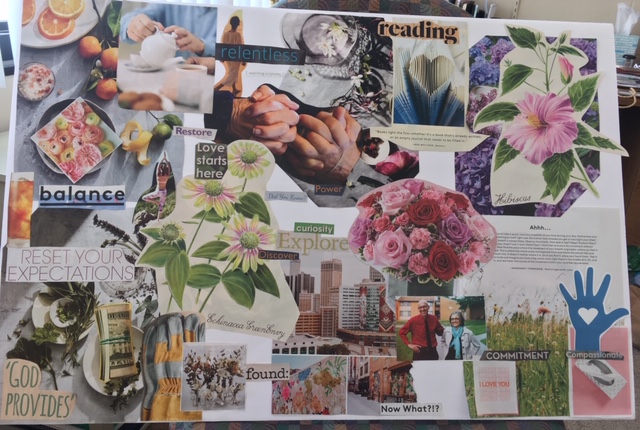
We ate great food and talked and laughed. We did yoga together. And then one friend pulled out presentation boards and a pile of magazines, scissors, glue, and markers — she had provided a project. Our goals were broad — to find words and images that could express who we are, where we have come from, or where we are hoping to go.

We sat at a large oval table in front of a window overlooking a frozen lake, quietly flipping through pages, clipping out words and images, and arranging and re-arranging them on our boards. Pandora was playing Lauren Daigle and Corey Asbury, and voices could be heard humming or singing along. We occasionally commented on what we were doing, but mostly we were focused and quiet.

After we had each gathered a pile of clippings, we began the process of arranging them on our boards.

the process

As I experimented with layering images, I discovered themes emerging. I began reflecting on the past year and how our difficulty had led to so. much. healing. One section of my board captures my continued physical healing with images of tea and yoga and aromatic flowers and fruits. Another reflects on the transformation of my spiritual life — praying hands, a solitary walk, and ‘searching the scriptures’. A roll of dollar bills sits on a plate near the words “Reset your expectations” and “God Provides” signifying financial healing.

I was surprised by the number of flowers on my board, particularly after such a long year of grief wherein I cared little about what I wore or how my hair looked, let alone the adornment of jewelry or flowers. But as each bloom grabbed my eye — roses, wildflowers, hibiscus, and lilacs — I tore and clipped. I lavished my board with flowers. I couldn’t seem to get enough, because, guys, I’m not mourning any more. I’m celebrating. I’m thankful.

As I arranged words and images on my board, I was overwhelmed with thanks — for physical healing over the last several years, for spiritual healing in the past several months, and for newly discovered financial healing.

I heard Pastor Brian Wolfmueller say recently that when we give thanks, we “shift our view from doing to reviewing.” That’s what this process of clipping and arranging was for me — an exercise in reviewing.

A long Margaret Townsend quote about the importance of breath sits in the lower right corner near a box of tissues, a hand, and a photo of my husband and me taken at the height of last year’s difficulty. We’re smiling in the photo, but I can assure you that tissues were not far away. I am thankful for this photo because it shows that despite the fact that we were desperate for most of last year, we were committed to being desperate together. In the midst of trauma, our marriage bond was strengthened. We learned the importance of breathing through difficult situations and sitting in them together. One of the reasons that we were able to grow through these very difficult circumstances was the support of loving friends who continually made their presence known in very tangible but unobtrusive ways. They were compassionate rather than judgmental. They loved us when we were hurting.

And I guess that leads me to the last set of images. Our story of unspoken broken is centered in a city. Most of our trauma happened there, so you would think we would want to run from all things urban, but the opposite is true. Although we are safely nestled in a little house on an idyllic little campus, in a cushioned community, our hearts continue to lean toward the city.

Just before Christmas, we traveled to Detroit. We hopped off the highway to get a view of the neighborhoods — to see the brokenness and abandonment and to witness the opportunity for transformation. As I was paging through magazines this weekend, I found images of Detroit and I couldn’t turn past them. We love our life in Ann Arbor — our church, our friends, our jobs. We have experienced so much healing here and are so thankful for all the opportunities we have been given. I don’t know why I was drawn to this photo, but I put the city in the center of my board. It seems to belong there.

finished product

When we were all finished creating, we each retreated to privacy — to soak in a tub, or nap, or write — and then we gathered again. As one-by-one we shared our boards and what we had discovered, I was reminded of one more thing to be thankful for — the community that surrounds me, supports me, weeps with me, and celebrates with me.

I am so, so, thankful. And the words of Pastor Wolfmueller remind me that I can sit here and be thankful to the One who is making all things new. I can review the blessings for a bit. I can focus on what what’s next some other day.

 I will give thanks to you, Lord, with all my heart; I will tell of all your wonderful deeds.

Psalm 9:1

Take Care for the Holidays, a Re-visit

Recorded in early morning voice for those who like to listen. Prefer to read? Read on.

As we head into the holidays, let’s gently remember that not everyone in our path is looking forward to reunions. I re-read the words of this blog this morning and remembered writing them through tears last year — we were broken and anticipating feeling all of that brokenness at the holidays. While much healing has happened in the past year, we are still tender enough to remember — and in that remembering, I want to be sure to take care.

Though we may not have admitted it — we are well on our way into the holiday season. It started with emails and phone calls early in October. Who is doing what for Thanksgiving? Who is hosting? Who will travel?

Discussions of Thanksgiving have already turned into talks about Christmas. Where will we meet? Who will gather? When will we worship? What gifts will we buy?

We begin our talking and planning early because holidays matter.

They have been historical points of connection. Even if they haven’t been perfect, they have had meaning. So, each year as we start early to anticipate reunions and traditions, fondly remembering caroling door to door, sledding down snowy hills, eating Christmas cookies, and unwrapping presents on Christmas morning, we are tempted to build expectation that our holiday gatherings will be Norman Rockwell perfection — even if they never have been.

All of this hope and expectation filters into our holiday conversations, which, if they haven’t already, will start this week. You’ll ask or be asked, “What are you doing for Thanksgiving?” expecting to hear something like, “I am going to my grandmother’s,” or “We host a huge feast every year,” or “I’m getting together with my friends.” These questions seem harmless or even polite, but you may be surprised to learn that they can be emotionally laden (and even triggering) for many among us.

  • For the young man estranged from his family because of differences in beliefs.
  • For the grieving parents whose only child lost the battle to cancer a few months ago.
  • For the recovering addict who isn’t up to managing the annual toast or maneuvering through family drama.
  • For the woman who was molested by a family member every holiday during her childhood.
  • For the newly widowed man who lost the love of his life last summer.
  • For the family who is recovering from years of dysfunction and trying to start new traditions.

They are all around us — these brave souls who are taking great pains to get out of bed every day, who struggle on an average Tuesday to shower, dress, get to work, and feed themselves. Regular days are hard.

Holidays?  Those are next-level difficult.

I was lying on a table last week as one member of my health care team was attending to my body. We entered into the pre-Thanksgiving questioning protocol benignly enough, but before I knew it, there were silent tears and flashes of memory. Holidays do that. They conjure up images of joy and pain — the full tables and the empty places. They invoke feelings of contentment and regret. They raise expectation and anxiety. Cordial exchanges that seem casual on the surface, may trigger an emotional reaction in those among us who are quietly struggling or suffering.

Am I saying that you shouldn’t ask the questions, or that you should veer away from discussions of family and Christmas and tradition and celebration? Not at all.

I’m saying, take care.

I’m saying look people in the eyes. Ask, and then listen. Don’t assume that every person in your world is looking forward to the holidays with joy. Rather, know that for many this is a very difficult time of the year. As you move through your pre-holiday interactions with the people in your life, you may be the only person to see the hard swallow or the averted gaze. You might be the only one to notice the dodged question or the avoidant joke.

And when you do, lean in. That hurting person needs to know that you saw, that you noticed, that you heard.

After I got up off that table last week, my provider and I exchanged a hug. That’s all. No prying. No awkwardness. Just a hug. The tears were seen and acknowledged. That was enough.

Yesterday, I began my search for gifts for the important people in my life. My focus was on the objects, of course. I was trying to find just the right items. A salesperson asked me if I was just looking; I said yes and then continued to browse. She kept talking, wanting to tell me about the sales. My initial reaction was to be annoyed, “Just let me shop; I said I don’t need any help.” I didn’t say it out loud, thankfully. Instead, I stopped, listened, and chatted with her a couple of times. I looked at her eyes. I listened to her voice.

I’m trying to live differently.

I think that’s where it starts, don’t you? If I just pause from churning through my to-do list for a moment, slow my roll a bit, I can see the other people around me. And when I see them, I will begin to notice the ones who just can’t wait to get home to be with their families and the ones who are aching and anxious and wish we would just knock it off with all the angels and bells and Santas already.

And when I notice, I can take care, lean in, and listen a little bit more, and perhaps, these small acts will begin to bring healing.

Be devoted to one another in love. Honor one another above yourselves.

Romans 12:10

Narrative threads, re-visit

This post, written almost exactly two years ago, speaks to my heart today. Though winter seems to keep blasting on, though we’re still quarantined inside our homes for almost a month now, all is not lost. My rhubarb has once again dared to break through the frozen ground to remind me that this plot has yet to fully unfold.

In Michigan this year, winter had stamina. It seemed to begin way back in October and continue halfway through April. The temperatures were low, the snow banks were high, the skies were gray, and all felt bleak.

My daughter once informed me, after I had been an English teacher for well over a decade, that when nature imitates the mood of the story, literary critics refer to the phenomenon as pathetic fallacy.  

We see it all the time in literature and movies: rain falls during funerals, the sun shines on parades, lightning flashes and thunder claps as the evil villain hatches his plan.  Writers use the setting of a story to create mood and to signal for readers how they might feel about the action of the narrative.

Sometimes it seems to happen in real life, too.

As the winter wore on this year in all its bleakness, and as circumstances in the narrative of my life unfolded, I took my signal from nature and wrapped myself in gray. I didn’t see any buds on trees, any new growth in my garden, or any other signals from nature that I should hope. I saw the earth hunkering down under the weighty blanket of snow, and I hunkered, too. I wrapped myself in crocheted afghans, drank cup after cup of tea, and waited for the earth’s axis to tilt once again toward the sun.

Some moments, I didn’t believe it would. I felt we were stuck in winter forever. Storm after storm raged. Winds blew. Temperatures dropped. The world outside was harsh and unforgiving.  I had no reason to believe that we would ever again see tulips sprout from the earth.

I didn’t, of course, spend the whole winter under covers. I did what everyone who lives in the north does in the winter. I slathered my body in moisturizers, layered on clothing, pulled on boots, hat, gloves, and coat, and trudged into the elements. Day after day after long, cold, dismal day, I drove over slushy roads, stepped in salty puddles, and scraped icy windshields. The cold gray weather was both real and symbolic.

The problem with pathetic fallacy — with letting the setting signal the mood — is that you can lose your frame of reference. All winter I was shrouded in gray, so all of the action in my narrative seemed to take on that hue. Now, to be honest, my life narrative is cluttered at the moment with conflict and unresolved tension. Villains too numerous to list are executing evil plans and threatening to harm those that I love. However, in the midst of the gray of winter, I failed to see that simultaneously, a parallel plot was unfolding — one in which battles are fought and won, victory parades are held, and loved ones are reunited.

All. is. not. gray.

It’s been hard to see that — what with winter lasting so long. It’s been easy to fall for the fallacy — the mistaken belief — that all of life is cold, dark, dormant. In fact, I have over the last several months been pathetic — filled with all kinds of emotion. I have leaned in and felt things that I have not allowed myself to feel for a very long time. I have cried and yelled and moaned because I have looked fully at one strand of the narrative. I’m not sorry; I needed to see it. But guys, winter is gone.

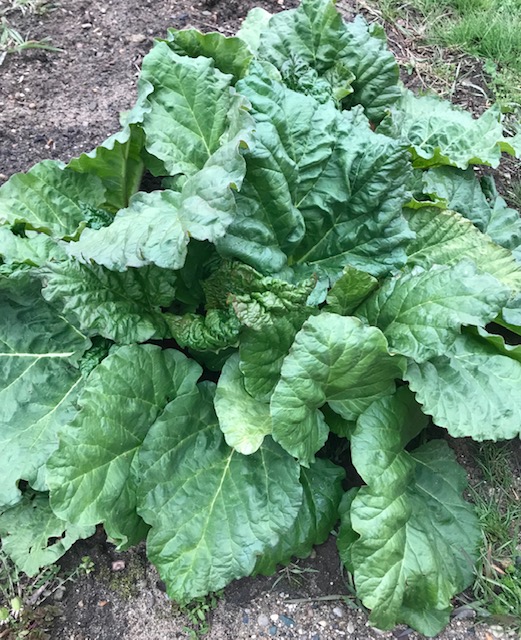
I have a rhubarb plant outside my back door that peeked through the soil on my birthday at the end of March. Since then, it’s been slammed with winter weather — snow, sleet, wind, and rain — and still it is thriving. My garden is a bed of weeds, my yard is a mole metropolis that is sorely in need of raking and mowing, but the sun is shining, and all I can look at is that rhubarb.

The villains haven’t dropped their weapons, the conflicts have not all been resolved, but one stubborn plant that pushed its way through frozen ground way before winter had subsided reminds me that there is more than one thread in my narrative.  I have reason to bake pie, to plant seeds, and to fold up my afghans.

Earlier this week when I arrived home from work, my husband said, “Before you sit down, go look at the patio.” I knew before I looked what I would find — the Adirondack chairs that my father-in-law made for us years ago had been put out after their long winter inside.

He had seen it, too: the sunshine, the rhubarb, the reason to hope. So hope we will, as we sit on our patio, faces tilted toward the sun, and we will let this season have a chance to direct our feelings about our narrative.

Psalm 27:13

I am confident in this: I will see the goodness of the Lord in the land of the living.

Bits of Truth, Re-visit

In Monday’s post, I shared how my pastor’s words on Sunday connected so strongly with me and how they were able to help me start to shake off the funk that had settled on me. I remembered what he said because I scratched down his words in a small notebook I carry with me to church for that purpose. I am continually writing down the words of others when they strike me as bits of truth. I share some of those with you here in a blog post originally written in April 2018.

Words matter so much to me. I realize this is pretty obvious: I do put a couple thousand on this page every week, and my chosen profession requires me to use tens of thousands  every day.

I love words; I’m drawn to them.

I typically read several hundred pages of fiction and/or non-fiction every week, and when I see words arranged in a way that resonates with me, I use my iPhone to snap photos of them. Whenever I gather with two or more, I arrive with a notebook and a pen, prepared to write down the meaningful and the trivial. I scratch out notes at work, at church, and in my small group.

I spend my life surrounded by words, and I tend to horde them. As I was making my way to this space today, I grabbed my phone, a notebook crammed with sermon notes, a book I’m reading, and scraps of paper strewn on my desk. What do these items have in common? They all carry words that I have gathered from one place or another and “carried home” with me. One bit of paper travelled all the way from my trip to St. Louis last November. Another is from a visit to Cincinnati about a month ago. (My shoes and toothbrush might not have made it home, but these scraps of paper not only survived the trip, they have remained on top of my desk through several frantic clutter-clearing purges.)

What could they possibly say that would validate my gripping them so tightly?

The one from November, which I scribbled while sitting in church with dear friends, says “I can have hope that He will redeem my loved ones and me and my community.”

The paper I shoved in my pocket after church last month in Cincinnati says,  “Lord, if you don’t do something here, we are in trouble.”

In my notes from our small group Bible study I find, “This life is unsettled and incomplete,” and “hope wins.”

Last night, I started Jodi Picoult’s small great things. I opened the cover and read these words from James Baldwin, “Not everything that is faced can be changed. But nothing can be changed unless it is faced.”

Pithy phrases all. Concise. Succinct. Power-packed.

Why do I store these clusters of words?

Because in the emotional haze in which I have been existing, I wander around searching for beacons of truth. And, for me, truth is usually found in print. I don’t write down every word I see, but when I see words that speak truth, I capture them. I hold them. I carry them around.

Here’s why. Emotions are powerful. They are expressions of deep feelings that need to be experienced, but they don’t always tell the truth. My emotions tell me that all is lost, that hope has died, that everything counts on me, that I’m the only one with problems, and that none of this will ever work out. I weep on my bed and get so carried away by my tears that I never want to stand up again. Overwhelmed with sorrow, I reach out my hand and grab something to read to quiet myself. Without fail, I find some shred of truth that breaks through my exaggerating and misled emotions.

I find myself speaking out loud:

All is not lost; God will redeem my loved ones and me and my community.

Everything does not count on me; Jesus is doing something here.

I am certainly not the only one with problems — despite what social media wants me to believe — but my only chance at working through the problems I have is to face them.

All of this will work out. Sure, life is unsettled, but hope wins.

My pulse slows. My breathing returns to regularity. I close my eyes and move toward sleep.

Yes, I feel dark things still — anger, sadness, grief, and pain. These feelings are valid,  and I will quash them no longer. I will sit with them. I will feel them. And, I will speak truth to them. I will not be overcome.

“I have said these things to you, that in me you may have peace. In the world you will have trouble. But take heart; I have overcome the world”

John 16:33

Carrying Sorrow and Finding Joy, Re-visit

I brought out this post, written in February 2018, on this weekend in July 2019 — a weekend where I simultaneously carried deep sorrow and experienced great joy.

Brené Brown says in Braving the Wilderness says we “can lean into pure joy without denying the struggle in the world” My husband says, “two realities can coexist.”

We can hold two things at the same time.

Photo Credit: Anna Rathje

This is hard for me to wrap my mind around. If I am really hurt, I want to really be sad. I want to grieve, mourn, and wail. I want to go all-out Old Testament and rend my garments, put on sackcloth, and smear my face with ashes.  I want to fully commit to my feelings.

Once in junior high, I came home at night feeling betrayed by a friend. I ran through the front door of my house, flew up the stairs to my bedroom, flung myself on my bed and wailed — audibly wailed. My mother came into my room, heard my tale of woe, rubbed my back, and commiserated with me.  She tried to get me to shake it off, I’m sure, but I would have nothing of that. I needed time and space for my grieving.

Of course, as is true of most middle school devastations, my grief was short-lived. In fact, in the words of my great grandmother, “everything looked better in the morning.” I likely laughed with my friends at the bus stop the next day.

However, life doesn’t stay as simple as middle school. Some devastations don’t right themselves overnight. Some griefs have staying power. I am thinking of the families of school shooting victims, for example. They will carry grief with them for the rest of their lives. I’m thinking of sexual assault survivors, too. That kind of devastation does not go away when the sun rises. And, I’m thinking of the kind of aches that many of us carry with us every day — the pain of childhood abuse, the darkness of abject poverty, the burden of overwhelming debt, the brokenness of divorce, and the cumulative scars from years of neglect and unintentional hurts.

What do we do with that kind of grief? How do we simultaneously hold that kind of pain and still find moments of joy?

Years ago we were very close with a family that had suffered great loss. The mother and father had had four children — their oldest child was killed in a motorcycle accident in his early adulthood and their youngest child died in an early-morning car accident during her senior year of high school. We met this family years after these devastating losses, and I can remember listening in stunned shock to the recounting of the stories. I felt the ache of our friends’ loss, yet I also noticed, as we spent more time with them, that the members of this family were often initiators of celebration, of gathering, of laughter. In fact, the patriarch of the family, the father of the four children, was known for his practical jokes and for his annual elaborate Easter egg hunts. The mother was one of the sweet grannies of the church where we belonged — she was a smiling presence in the kitchen for every function from Vacation Bible School to funeral luncheons to holiday gatherings. The remaining two sisters (mothers and grandmothers themselves) often hosted huge gatherings at their homes — hayrides, pool parties, picnics, and the like. The family embraced and even cultivated moments of joy, yet certainly they still carried the sorrow of loss.

Ann Voskamp says “There isn’t one of us not bearing the wounds from our own bloody battles.”  It’s true. I forget that sometimes, especially when I am walking around in sackcloth and ashes. I look at the people around me and I think, “look at that perfect life. Certainly they are not suffering.”  But everyone carries pain. Everyone. 

We don’t often see one another’s brokenness because we like to keep it under the thin veneer of our social media presence and the public faces that we wear.That’s not necessarily a bad thing. Pain can be paralyzing. Sometimes we have to put it away for a bit so that we can continue to live.

However, some losses seem so devastating that we are tempted to lose hope. We are tempted to stay on our beds wailing at the top of our lungs. Most of us don’t. Usually we find the wherewithal to wash our face, comb our hair, and get back to the business of life — work, school, groceries, and laundry. However, not all of us find a way, like my friends have, to simultaneously hold sorrow and experience joy — the joy of a birthday party, of a new baby, of a basketball win.

Even if we do find a way to be happy for a season, “old scars can break open like fresh wounds and your unspoken broken can start to rip you wide open and maybe the essence of all the questions is: how in the holy name of God do you live with your one broken heart?” (Voskamp 15).

How indeed?

I’m not entirely sure. I have my own unspoken broken and the only remedy I’ve found is a moment by moment lifting of it. It’s as though I’m a small child and I’ve just fallen with my most prized treasure in my hand. It has been marred beyond recognition and I am inconsolable. I cry. I weep. I wail. And then, in exhaustion, I hold it up as high as I can as though to say, “See? Do you see what happened? Can you fix it? Can you make it better?”

When I was a little girl, I would hold broken items up to my dad. He was over six feet tall and very calm. He didn’t react in anger or disappointment when something was broken. He quietly took it from my hands and said, “Well, let’s see.” I knew if it could be fixed, my dad would find a way. He would bring the situation in close, examine it thoroughly, and determine if indeed the item could be restored. He might grab a pair of pliers or some crazy glue. He might take off his glasses to get a better view. And usually, after a few moments, he would had back my treasure and ask, “how’s that?”

I can still feel wonder at my dad’s ability to make things whole again.

But, as we’ve all learned, some broken things can not easily be made whole.

And so I’m standing here holding my unspoken broken in my hand. I’m reaching up as high as I can and I’m saying, “Do you see this? Can you fix it?” And in the moments that I calm my desperate cries, I can almost hear a still small voice:

Behold, I am making all things new. 

I cup my hand around my ear and listen:

Sorrow may last for a night, but joy comes in the morning. 

“But what about right now?” I yell.

Fear not, I am with you. 

Yes. Yes, you are.  You have never left me nor forsaken me.  I’m sitting here trying to be strong and courageous because you are with me wherever I go, but this is a pretty dark and miserable place…

I know.  I see.  I’m here.  

And for that reason, today I will try to cultivate some joy.

I can hold two things at the same time.

You keep track of all my sorrows.

    You have collected all my tears in your bottle.

    You have recorded each one in your book.”

Psalm 56:8

Brown, Brené . Braving the Wilderness. New York: Random House, 2017.

Voskamp, Ann.  The Broken Way. Grand Rapids, MI: Zondervan, 2016.

For Us, re-visit

This post, written in September 2017 and polished for you here in June 2019, illustrates another instance of how sharing my skill-set with a friend worked to shape my growth. After I read the initial two chapters, Marv Fox and I spent the next 18 months or so reading, re-reading, writing, and re-writing. Marv is now truly a friend. If you’d like to read his book, Become, you can purchase it at this link.

A friend of mine is writing a book, and he asked me if I would read a couple of chapters. Actually, two weeks ago, ‘friend’ might have been assuming too much on my part. I knew this guy from church and from around the university, but other than a few standing-around-after-church conversations, we hadn’t spoken much. However, in one of those conversations, he mentioned a book that he is writing. He said he’d been giving chunks to people to read, and I casually said that I’d like to take a look.

Not long after that I found a stack of papers on my desk with a note on top that said, “Please call me before you take a look at this.” Last Monday, the day before the first day of fall classes, I called. We chatted about his goals in writing  and his purpose for my reading. The whole conversation lasted maybe fifteen minutes before I said, “You know, God’s timing is very interesting. I think this is a book I need to look at as I face yet another transition in my life.” He said, and I’m paraphrasing here, “If you are getting ready to step into something big, you’ve got to settle in your mind that God is for you. Obstacles are going to pop up and you need to see them as God preparing you, strengthening you, using those very obstacles in your favor. You have got to believe that Romans 8:28 is true; God will work all things together for good.”

Well, I hadn’t anticipated the conversation going there, but I heard those words as though they had been the main intention of the call, even though they were an impromptu 90-second add-on.

The rest of that day was a blur of activity —  helping my daughter prepare to go back to college and preparing myself for the first day of class.  The next morning I woke up early, checked and double-checked my schedule, my bag, my clothes, my hair. I ate my standard bowl of oatmeal and prepared my cup of green tea, my cup of black tea, and a tumbler of water. My daughter snapped my ‘first day of school’ pic which I quickly uploaded to Facebook and Instagram, and then, realizing that I had better get going if I wanted to rearrange the classroom into a circle before the students arrived, I tucked my Macbook, my notebooks, and my water tumbler into my school bag and grabbed both cups of tea because I hadn’t had time to drink either yet.

Yeah, that was a juncture.  You can see it coming, can’t you?

I mean, why? Why do I have to take all those drinks to a 75-minute class.  I end up drinking my tea at room temp most days anyway. Why not take one cup of tea in one hand and one tumbler of water in the other hand? Two drinks is plenty.

Nope. I had to have all three.

I  walked to class, set my bag down, placed all three cups on the teacher’s stand, and rearranged the classroom.  As the students filed in, I grabbed my Macbook and noticed that a few drops of water were on its cover.  I wiped them off casually as I opened it up. As it came to life, I also noticed that a few drops were on the keyboard and on the screen.  A little frantically, I wiped those away as I looked around the classroom and noted the students filling the seats. I clicked a couple keys to pull up attendance and noticed that my MacBook was not responding. I panicked a little, then set it aside; I had student relationships to establish and a lesson plan to complete.  The laptop would wait, but guys, I knew it was dead.

As I moved through my day — that first class, chapel, online chatting with Apple, a trip to a local computer store — I kept hearing my friend’s words in my head. You have got to settle in your mind that God is for you. Did I believe that?  Did I believe that God could be for me even when I made a very careless and very costly mistake? Could He be working even my mistakes together for my good?

Well, apparently I was intended to get this lesson settled because also during the same week, I lost a notebook that I was using as a model with my composition students, the lenses on my glasses became ‘crazed’, we lost both of the keys to our house, and let’s not forget that I am still dealing with compromised health and the stress of observing two adult children move out of our place and go back to school.

Of course you know that if I am willing to write about all of this, a few of the issues have been resolved — I have filed an insurance claim and my MacBook has been sent off for repairs, the university has given me a loaner to bridge the gap, the optical shop has ordered replacement lenses because mine were still under warranty, a student found my notebook in an adjacent classroom, and the keys? Well, the keys are still missing. We’re working on that.

But more importantly, I finished reading the chapters my friend had given me to read, and we agreed to meet to discuss them. I gave him my feedback on content and, less importantly, mechanical issues, and then I told him the story I just told you. I said that even when I was yelling, crying, and fighting my way through all these setbacks, I wasn’t without hope, because I kept hearing him say, You have got to settle in your mind that God is for you. I kept reciting Romans 8:28.

Marv Fox

He smiled and nodded as I told him everything that had happened, and he said something like this, “God is strengthening you because He is getting ready to use you. As you managed all these difficulties, He was building your stamina, getting you ready for what is coming next.”

He doesn’t know me.  He doesn’t know that for years I have told students that “God is always preparing us for what is coming next.” He doesn’t know that I have been kind of beaten down lately — grieving a bit, wallowing a bit. He doesn’t know that I needed a dramatic reminder that God is still God and that even in the midst of my failures He is for me.

But God knew.

It still blows my mind. Every time.

I’ve got a new friend, guys, and a fresh perspective.

God is for us.

Meanwhile, the moment we get tired in the waiting, God’s Spirit is right alongside helping us along. If we don’t know how or what to pray, it doesn’t matter. He does our praying in and for us, making prayer out of our wordless sighs, our aching groans. He knows us far better than we know ourselves, knows our pregnant condition, and keeps us present before God. That’s why we can be so sure that every detail in our lives of love for God is worked into something good.

Romans 8:26-28, The Message

26-28