Hey, Thanks

A year ago, my husband and I were at the beginning of a season of difficulty. We were experiencing impact from past trauma which was affecting our emotions, our health, our faith, and our finances. Each day, it seemed, revealed new levels of despair, and we felt powerless. So what did we do?

Well, we cried a lot. We sought counsel — pastoral and professional. We prayed — “in groans that words cannot express.” We enlisted a trusted group of prayer warriors — confidants in arms. We made tough decisions. And we watched hours and hours of The Great British Baking Show — no joke, that show was one of the best choices we made last year. So much pleasantry and punniness — you can’t not feel lighter after having watched it.

And yet no quick rescue came.

Instead, month after month we continued — in counsel, in prayer, in judicious adherence to the decisions we had made, and in periodic detachment from reality by way of Brits engaged in a battle of the bake.

And slowly, over time, we began to experience restoration.

I’m reflecting because some friends invited me away this past weekend to engage in some restorative practices. It seems we’re all always walking in brokenness, and sometimes a pause can allow for healing.

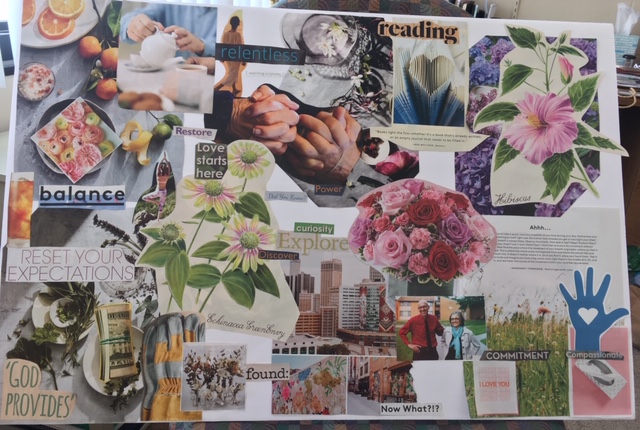
We ate great food and talked and laughed. We did yoga together. And then one friend pulled out presentation boards and a pile of magazines, scissors, glue, and markers — she had provided a project. Our goals were broad — to find words and images that could express who we are, where we have come from, or where we are hoping to go.

We sat at a large oval table in front of a window overlooking a frozen lake, quietly flipping through pages, clipping out words and images, and arranging and re-arranging them on our boards. Pandora was playing Lauren Daigle and Corey Asbury, and voices could be heard humming or singing along. We occasionally commented on what we were doing, but mostly we were focused and quiet.

After we had each gathered a pile of clippings, we began the process of arranging them on our boards.

the process

As I experimented with layering images, I discovered themes emerging. I began reflecting on the past year and how our difficulty had led to so. much. healing. One section of my board captures my continued physical healing with images of tea and yoga and aromatic flowers and fruits. Another reflects on the transformation of my spiritual life — praying hands, a solitary walk, and ‘searching the scriptures’. A roll of dollar bills sits on a plate near the words “Reset your expectations” and “God Provides” signifying financial healing.

I was surprised by the number of flowers on my board, particularly after such a long year of grief wherein I cared little about what I wore or how my hair looked, let alone the adornment of jewelry or flowers. But as each bloom grabbed my eye — roses, wildflowers, hibiscus, and lilacs — I tore and clipped. I lavished my board with flowers. I couldn’t seem to get enough, because, guys, I’m not mourning any more. I’m celebrating. I’m thankful.

As I arranged words and images on my board, I was overwhelmed with thanks — for physical healing over the last several years, for spiritual healing in the past several months, and for newly discovered financial healing.

I heard Pastor Brian Wolfmueller say recently that when we give thanks, we “shift our view from doing to reviewing.” That’s what this process of clipping and arranging was for me — an exercise in reviewing.

A long Margaret Townsend quote about the importance of breath sits in the lower right corner near a box of tissues, a hand, and a photo of my husband and me taken at the height of last year’s difficulty. We’re smiling in the photo, but I can assure you that tissues were not far away. I am thankful for this photo because it shows that despite the fact that we were desperate for most of last year, we were committed to being desperate together. In the midst of trauma, our marriage bond was strengthened. We learned the importance of breathing through difficult situations and sitting in them together. One of the reasons that we were able to grow through these very difficult circumstances was the support of loving friends who continually made their presence known in very tangible but unobtrusive ways. They were compassionate rather than judgmental. They loved us when we were hurting.

And I guess that leads me to the last set of images. Our story of unspoken broken is centered in a city. Most of our trauma happened there, so you would think we would want to run from all things urban, but the opposite is true. Although we are safely nestled in a little house on an idyllic little campus, in a cushioned community, our hearts continue to lean toward the city.

Just before Christmas, we traveled to Detroit. We hopped off the highway to get a view of the neighborhoods — to see the brokenness and abandonment and to witness the opportunity for transformation. As I was paging through magazines this weekend, I found images of Detroit and I couldn’t turn past them. We love our life in Ann Arbor — our church, our friends, our jobs. We have experienced so much healing here and are so thankful for all the opportunities we have been given. I don’t know why I was drawn to this photo, but I put the city in the center of my board. It seems to belong there.

finished product

When we were all finished creating, we each retreated to privacy — to soak in a tub, or nap, or write — and then we gathered again. As one-by-one we shared our boards and what we had discovered, I was reminded of one more thing to be thankful for — the community that surrounds me, supports me, weeps with me, and celebrates with me.

I am so, so, thankful. And the words of Pastor Wolfmueller remind me that I can sit here and be thankful to the One who is making all things new. I can review the blessings for a bit. I can focus on what what’s next some other day.

 I will give thanks to you, Lord, with all my heart; I will tell of all your wonderful deeds.

Psalm 9:1

Narrative threads, re-visit

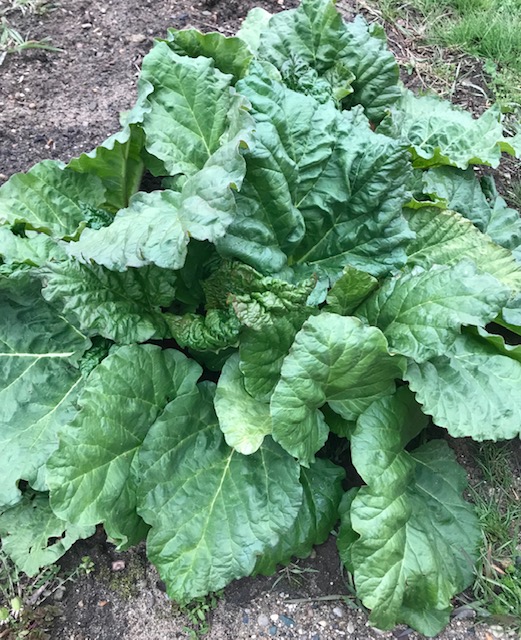
This post, written almost exactly two years ago, speaks to my heart today. Though winter seems to keep blasting on, though we’re still quarantined inside our homes for almost a month now, all is not lost. My rhubarb has once again dared to break through the frozen ground to remind me that this plot has yet to fully unfold.

In Michigan this year, winter had stamina. It seemed to begin way back in October and continue halfway through April. The temperatures were low, the snow banks were high, the skies were gray, and all felt bleak.

My daughter once informed me, after I had been an English teacher for well over a decade, that when nature imitates the mood of the story, literary critics refer to the phenomenon as pathetic fallacy.  

We see it all the time in literature and movies: rain falls during funerals, the sun shines on parades, lightning flashes and thunder claps as the evil villain hatches his plan.  Writers use the setting of a story to create mood and to signal for readers how they might feel about the action of the narrative.

Sometimes it seems to happen in real life, too.

As the winter wore on this year in all its bleakness, and as circumstances in the narrative of my life unfolded, I took my signal from nature and wrapped myself in gray. I didn’t see any buds on trees, any new growth in my garden, or any other signals from nature that I should hope. I saw the earth hunkering down under the weighty blanket of snow, and I hunkered, too. I wrapped myself in crocheted afghans, drank cup after cup of tea, and waited for the earth’s axis to tilt once again toward the sun.

Some moments, I didn’t believe it would. I felt we were stuck in winter forever. Storm after storm raged. Winds blew. Temperatures dropped. The world outside was harsh and unforgiving.  I had no reason to believe that we would ever again see tulips sprout from the earth.

I didn’t, of course, spend the whole winter under covers. I did what everyone who lives in the north does in the winter. I slathered my body in moisturizers, layered on clothing, pulled on boots, hat, gloves, and coat, and trudged into the elements. Day after day after long, cold, dismal day, I drove over slushy roads, stepped in salty puddles, and scraped icy windshields. The cold gray weather was both real and symbolic.

The problem with pathetic fallacy — with letting the setting signal the mood — is that you can lose your frame of reference. All winter I was shrouded in gray, so all of the action in my narrative seemed to take on that hue. Now, to be honest, my life narrative is cluttered at the moment with conflict and unresolved tension. Villains too numerous to list are executing evil plans and threatening to harm those that I love. However, in the midst of the gray of winter, I failed to see that simultaneously, a parallel plot was unfolding — one in which battles are fought and won, victory parades are held, and loved ones are reunited.

All. is. not. gray.

It’s been hard to see that — what with winter lasting so long. It’s been easy to fall for the fallacy — the mistaken belief — that all of life is cold, dark, dormant. In fact, I have over the last several months been pathetic — filled with all kinds of emotion. I have leaned in and felt things that I have not allowed myself to feel for a very long time. I have cried and yelled and moaned because I have looked fully at one strand of the narrative. I’m not sorry; I needed to see it. But guys, winter is gone.

I have a rhubarb plant outside my back door that peeked through the soil on my birthday at the end of March. Since then, it’s been slammed with winter weather — snow, sleet, wind, and rain — and still it is thriving. My garden is a bed of weeds, my yard is a mole metropolis that is sorely in need of raking and mowing, but the sun is shining, and all I can look at is that rhubarb.

The villains haven’t dropped their weapons, the conflicts have not all been resolved, but one stubborn plant that pushed its way through frozen ground way before winter had subsided reminds me that there is more than one thread in my narrative.  I have reason to bake pie, to plant seeds, and to fold up my afghans.

Earlier this week when I arrived home from work, my husband said, “Before you sit down, go look at the patio.” I knew before I looked what I would find — the Adirondack chairs that my father-in-law made for us years ago had been put out after their long winter inside.

He had seen it, too: the sunshine, the rhubarb, the reason to hope. So hope we will, as we sit on our patio, faces tilted toward the sun, and we will let this season have a chance to direct our feelings about our narrative.

Psalm 27:13

I am confident in this: I will see the goodness of the Lord in the land of the living.

Bits of Truth, Re-visit

In Monday’s post, I shared how my pastor’s words on Sunday connected so strongly with me and how they were able to help me start to shake off the funk that had settled on me. I remembered what he said because I scratched down his words in a small notebook I carry with me to church for that purpose. I am continually writing down the words of others when they strike me as bits of truth. I share some of those with you here in a blog post originally written in April 2018.

Words matter so much to me. I realize this is pretty obvious: I do put a couple thousand on this page every week, and my chosen profession requires me to use tens of thousands  every day.

I love words; I’m drawn to them.

I typically read several hundred pages of fiction and/or non-fiction every week, and when I see words arranged in a way that resonates with me, I use my iPhone to snap photos of them. Whenever I gather with two or more, I arrive with a notebook and a pen, prepared to write down the meaningful and the trivial. I scratch out notes at work, at church, and in my small group.

I spend my life surrounded by words, and I tend to horde them. As I was making my way to this space today, I grabbed my phone, a notebook crammed with sermon notes, a book I’m reading, and scraps of paper strewn on my desk. What do these items have in common? They all carry words that I have gathered from one place or another and “carried home” with me. One bit of paper travelled all the way from my trip to St. Louis last November. Another is from a visit to Cincinnati about a month ago. (My shoes and toothbrush might not have made it home, but these scraps of paper not only survived the trip, they have remained on top of my desk through several frantic clutter-clearing purges.)

What could they possibly say that would validate my gripping them so tightly?

The one from November, which I scribbled while sitting in church with dear friends, says “I can have hope that He will redeem my loved ones and me and my community.”

The paper I shoved in my pocket after church last month in Cincinnati says,  “Lord, if you don’t do something here, we are in trouble.”

In my notes from our small group Bible study I find, “This life is unsettled and incomplete,” and “hope wins.”

Last night, I started Jodi Picoult’s small great things. I opened the cover and read these words from James Baldwin, “Not everything that is faced can be changed. But nothing can be changed unless it is faced.”

Pithy phrases all. Concise. Succinct. Power-packed.

Why do I store these clusters of words?

Because in the emotional haze in which I have been existing, I wander around searching for beacons of truth. And, for me, truth is usually found in print. I don’t write down every word I see, but when I see words that speak truth, I capture them. I hold them. I carry them around.

Here’s why. Emotions are powerful. They are expressions of deep feelings that need to be experienced, but they don’t always tell the truth. My emotions tell me that all is lost, that hope has died, that everything counts on me, that I’m the only one with problems, and that none of this will ever work out. I weep on my bed and get so carried away by my tears that I never want to stand up again. Overwhelmed with sorrow, I reach out my hand and grab something to read to quiet myself. Without fail, I find some shred of truth that breaks through my exaggerating and misled emotions.

I find myself speaking out loud:

All is not lost; God will redeem my loved ones and me and my community.

Everything does not count on me; Jesus is doing something here.

I am certainly not the only one with problems — despite what social media wants me to believe — but my only chance at working through the problems I have is to face them.

All of this will work out. Sure, life is unsettled, but hope wins.

My pulse slows. My breathing returns to regularity. I close my eyes and move toward sleep.

Yes, I feel dark things still — anger, sadness, grief, and pain. These feelings are valid,  and I will quash them no longer. I will sit with them. I will feel them. And, I will speak truth to them. I will not be overcome.

“I have said these things to you, that in me you may have peace. In the world you will have trouble. But take heart; I have overcome the world”

John 16:33

Feel This, a re-visit

If you like to read, please do! If you’d prefer to listen, click the arrow above.

In Monday’s post, I described a new relationship I’m building with my emotions, one where I trust their warning flags and stop to listen to their message. The post that follows, from August 2018, comes from a time when I was mired in sadness. As I waded through the tears, I built the muscle that prepared me for this new way.

Barbara Brown Taylor, in Learning to Walk in the Dark, asks “What if I could learn to trust my feelings instead of asking to be delivered from them? What if I could follow one of my great fears all the way to the edge of the abyss, take a breath, and keep going? Isn’t there a chance of being surprised by what happens next?”

Gasp. Trust my feelings? That is not one of my internal constructs.

I received the message very early that I was supposed to control my emotions, not trust them. I’ve often been told that I laugh too loudly, cry too easily, and “wear my emotions on my sleeve.” Although many have tried to encourage me to rein in my feelings, I’m starting to understand that I have been designed to feel fully and express loudly.

My great grandmother, bless her heart, was possibly the first to encourage me to tame my emotions. She was of the pull yourself up by your bootstraps mentality that had enabled her to marry a widower, raise his daughter plus one of her own, run a household, and remain financially stable even when she herself became a widow at a fairly early age. I loved being around her. She was a feisty woman with a sparkle in her eye who always welcomed me into her life of baseball games, crocheting, gardening, and baking. She seemed to be at the center of  family gatherings where over twenty of us would eat, tell stories, laugh, and play. Often, near the end of these amazing get-togethers with all the people I loved, I would become tired and sad. Most people in my family just accepted the reality of going home; they grabbed their things, piled into cars, and left. Me? I bawled. I sobbed. I ugly cried. Ill-equipped to handle such unbridled expression, my great grandmother tried shame: “Stop that crying, do you want people to see you looking like that? What if I took a picture of your face right now?” Those words still sting, but because they came from a woman I loved and admired, I tried to learn how to hold in my tears and behave like the rest of my more reserved family.

That didn’t go well. Sadness turned in, in my experience, becomes anger. I can be found in many family photos glaring into the camera lens, because dammit, if I can’t cry, I’m at least gonna be pissed. And pissed I was.

When my parents divorced, my three siblings seemed to deal with their grief in much quieter ways. I don’t remember them yelling the questions I yelled, or crying the tears that I cried. Nor do I recall them throwing things at my stepfather across the kitchen table and stomping out the door to ‘run away’ over and over again.

My middle school memories include scenes of me sobbing in the hallway, yelling at classmates, and getting made fun of for my extra-obnoxious laugh. The reactions of students and teachers to my emotional expression gave me one consistent message — you’re too loud! Calm down!  So, I attempted to calm myself and to quietly soothe my hurts.

How does a preteen do that?  Hours and hours of television, libraries full of books, pounds of potato chips and dip, sodas by the million, and retreats into my room to listen to music and write.

I also tried creative elaboration (lying), academic achievement (perfectionism), and subtle coercion of my friends and classmates (bullying).  None of these strategies had the lasting effect of quieting me; they merely added more emotions — shame, pride, guilt — to the pile that I was already trying not to express.

All was not terrible, of course. I had friends with staying power and a family who loved me in spite of my emotionality. I was successful in school and well-connected at church. Nevertheless, my feelings were always simmering right at the surface.

High school, in my memory, was a blur of exploring the emotional spectrum. I felt everything — anger, sadness, joy, love, betrayal, embarrassment, jealousy, pride, fear. Those four years were a wild ride that involved laughing with friends, glaring at teachers, perfecting the art of sarcasm, breaking rules, being ashamed, and lashing out. Even in the emotional hotbed of adolescence — I stood out. Yes, ladies and gentlemen, I was voted “moodiest” by my classmates — a designation memorialized in my high school year book.

The transition to college allowed me an opportunity to be different — to be less emotional. I think I tried, but by the end of freshman year, my coping mechanism of eating had packed on some pounds, and my fear of “getting fat” caused an overcorrection that became an eating disorder. I turned my focus to restrictive eating to control my weight. Devoid of emotion, I moved through my routine, barely interacting with the people in front of me, and deeming each day a win or a loss on the basis of my total calorie count and the number on the scale.

I had finally controlled my emotions. I was terribly sad, but I didn’t cry. I just soldiered on until I collapsed, gasping for breath.

That was over thirty years ago.

Therapy and maturity have healed some hurts, and I have, of course, learned how to more appropriately manage my emotions. I was certainly going to get it right with my own children. I was going to let them feel what they felt — cry their tears and laugh their laughs. My intentions were good, but life gets complicated, and when it does, we fall back on old faithful patterns. Surely my children watched me hold back tears; they saw me swallow anger and soldier through difficulty. Despite my best efforts, my estranged relationship with my emotions has had an impact on the people who have shared a home and a life with me.  How could it not?

So when I consider Barbara Brown Taylor’s ‘what if’ question, I’m challenged to try a new strategy. She offers me an opportunity to feel what I am feeling, to lean in and explore sadness, regret, grief, and anger.

These are not pleasant feelings, but I’m learning that they must be felt. They don’t go away. If I paste on a smile, square my shoulders, and strengthen my resolve, I am only delaying the inevitable. And the inevitable eventually shows up at the front door with a summons, refusing to go away until you get in the car and ride to the place where you face all of your realities.

So now when I wake up in the middle of the night, heart beating quickly, franticly worrying over things that were or might be, I don’t wish myself back to sleep. I lie still for a while, looking my feelings straight in the face, and after a while of sitting with these strangers, I get out of bed, come to the keys, and write. Of all the strategies I have tried over the years, this is the one that allows me to tap deep into the well of feelings that have been locked deep inside, under armor and facades and lies.

Here, I tell the truth, and the truth is: I am hurting.

I am so sad. I have lost so much. And finally, I am going to cry.

It might be loud.  It might be messy.  I might attract attention.

I’m ok with that.

I have a feeling that I’m not the only one who needs permission to weep. I’m not the only one who needs a chance to be surprised by what happens next.

a time to weep, and a time to laugh;

a time to mourn, and a time to dance;

Ecclesiastes 3:4

Sumballo, a Re-visit

This post, written right after Christmas 2015, seems relevant today. As you gather all the pieces of your holiday celebration and ponder them in your heart, may God grant you the wisdom to see the big picture.

This morning, I opened my morning devotion from Beth Moore’s Whispers of Hope: 10 Weeks of Devotional Prayer and found this verse from Luke 2 — the Christmas story:

But Mary treasured up all these things and pondered them in her heart.

Luke 2:19

When I’ve read this verse in the past, I’ve pictured Mary holding baby Jesus in her arms kind of shaking her head in disbelief; I’ve imagined her saying, “Well, you weren’t kidding, were you? You said I would conceive and bear and son, and here he is!” I’ve imagined pondered to mean “wondered in astonishment.” However, Beth Moore, a biblical scholar, corrects my image a bit; she says pondered is translated from the Greek word sumballo which means “taking many things, casting them together, and considering them as one”. These words make me picture tossing many snapshots onto a table, discovering connections between them, and finding the theme of the collection.

Among Mary’s photos I see — her pregnant body on a donkey on that long journey to Bethlehem, her downcast eyes in the moment when her parents discovered her ‘situation’, her peaceful resolve during tense conversations with Joseph, and her brow beaded with sweat during the labor and delivery amid the straw and dung. I see images of the first glance at her child, I hear the knock on the wall of the stable when the shepherds arrived, I smell the frankincense when she opens the gifts from foreign dignitaries.

When she pondered those moments “as one” what did they add up to for her?

I’m sitting here three days after Christmas in my little house by the river, and I, too, am taking a moment to ‘sumballo’. I’m looking back at the events of the last few weeks — the parties, the visits with family, the gift buying and giving, the hopes, the disappointments, the laughter, and the tears — and I’m casting them together as one.

In fact, this whole blog — every post on every day –has been an attempt to ‘sumballo’. Since I started writing in the summer of 2014, I have been looking back over sections of my life: I’ve been ‘casting them together’ and ‘considering them as one’.

Sometimes we are  tempted to look at isolated moments as defining moments — that time that you lied to a trusted a friend, the year that your parents were divorced, the semester that you failed a class, that car accident that nearly claimed your life, the winning football championship, the Homecoming coronation, the birth of a child. Certainly these moments shape us, but they do not define us — not in isolation. They only offer hints until we sumballo  — until we put these moments into perspective as parts of a whole.

If I am going to look at the fact that for the ten soldiering years of my life I was way too busy, and I often overlooked the emotional needs of my family, if I am going to acknowledge that this behavior was costly to my physical, spiritual, and emotional health and to the physical, spiritual, and emotional health of my family, I can’t view that time in isolation. If I am going to truly sumballo, I need to look at other seasons as well. I need to remember that I also stayed at home with my children for almost ten years — nurturing, hugging, reading, teaching, correcting, and guiding. I need to acknowledge that for the past five years I have been recovering from soldiering and learning a new way. Within each of these periods have been awesome moments  — young children singing happily in the car on a road trip, teenagers rolling on the floor with laughter, and young adults gathering for the holidays. However, each period has also had moments of devastation — betrayal, trauma, and disappointment. If we grasp onto any one moment and let it define us, we get a a distorted view. In order to see the clearest picture, we have to cast all of the moments together. We must consider them as one. Only then, can we discover a theme.

And what is that theme? Way back in my twenties when someone challenged me to write my testimony, I wrote that the theme of my life was “rescued by grace”. Even in those early years, I knew that God had been protecting me, walking with me, holding his cupped hands beneath me to carry me through. He was overlooking mistakes, forgiving wrongs, and allowing me second and third and fourth chances. When I was careless, he protected me. When I was selfish, He was benevolent. When I was hateful toward others, He poured love on me.

He rescued me with grace.

As I am approaching fifty, I look back at all the events of my life, and I ponder them all in my heart. Time and again I see my  failed attempts to do things on my own followed by God’s miraculous provision. I see God transforming my pain into compassion for others. I see my pride falling into humility. I see the love of God.

I wonder what Mary thought as she pondered ‘all these things’ in her heart.  She had to see God’s miraculous provision in a faithful husband, a place of shelter, and safety from Herod. She had to see God transforming her pain and embarrassment into compassion for others. She had to feel humbled in the presence of the Christ child. She had to see the love of God for herself and for all of humanity.

Despite our weaknesses, our poor choices, our sin — He loves us. He has seen every moment — every victory, every failure, every injury and every recovery. None of it has been a surprise to Him. He has gone before us, and He has held us in the palm of His hand. He has cast all the events of our lives together and saturated them with grace.

That is the message that I find when I sumballo.

Don’t wait for Christmas, a Revisit

Back in December 2014 when I first wrote this post, I was just starting to recognize how hard the holidays can be — how isolating, how anxiety-producing, how uncomfortable. I’ve always loved Christmas, but I’ve had a taste of how celebration can feel during a season of grief. I’ve begun to understand how difficult it can be to be with family and friends — even when you love them. And I’ve been learning a new way.

We spend a lot of time and money getting ready for the holidays. Over the last month many of us have attended parties, dinners, and gift exchanges with family, friends, and coworkers. We have cooked special foods, decorated our homes, and dressed in finery in order to celebrate.

We celebrate the love of family. We celebrate that we get time off from work. We celebrate our friendships. We celebrate the birth of a Savior.

We celebrate by eating, drinking, laughing, and sharing. We celebrate by giving and receiving gifts, by sending Christmas cards, by calling those we love, and by worshipping with our church families.

But there are many among us who just can’t celebrate. And they probably aren’t telling you about it. They may decline invitations, bow out early, or just refuse to answer your calls. It’s not that they don’t want to be there. They really do want to be there. They just can’t. 

It would be easy if they had a contagious disease, were recovering from surgery, or had a compromised immune system that prohibited them from joining in the festivities. Then you would understand. “Oh, too bad Bobby can’t be here, you know he just had that surgery, and he’s recovering in the hospital.” Everybody gets that. In fact, many of us would load up our gifts and drive over to the hospital to bring the celebration to Bobby because we love him and don’t want him to be left out.

But some people can’t celebrate and it’s because of something that you can’t see — something you may not understand.

Kay Warren, wife of well-known pastor, Rick Warren, who lost a son to suicide in 2013, recently posted on Facebook and then wrote in Christianity Today about the pain she has endured over the last two Christmases as well-meaning friends and acquaintances have sent Christmas cards filled with photos of smiling families and newsletters proclaiming all the good stuff that has happened for them over the year. She received these celebratory cards and letters and got angry. She couldn’t possibly celebrate. How could she, knowing that her son had taken his own life? Even if she believed that Jesus was born in a manger to save the world from their sins, even if she trusted Him and believed that He held her in the palm of His hand, she couldn’t possibly smile, or laugh, or rejoice.

She’s not alone, guys. While we deck the halls and kiss under the mistletoe, many around us can’t fathom the “oh what fun it is”. Not today. Not yesterday. Not Christmas Day.

They’ve lost a child. They are in the middle of a divorce. A loved one has cancer. They just lost their job and can’t pay the mortgage. Their father is on life-support. They have experienced pain that they can’t even talk about. And the idea of joining you or me in our merriment, knowing the pain that they know, is unconscionable. It just can’t be. 

So they stay home, miserably wishing they could be there, wishing they could celebrate, wishing they could be part of the joy. Angry that you can be. 

Moving forward, I’m going to spend less time and money getting ready for the holidays. I’m going to try to shift my focus to the here and now — to little moments that I can be with those I love —  in their tears,  in their laughter,  in their anger. And if we get glimpses of celebration, we will seize them — we won’t wait for Christmas.

And, if they happen to come at Christmas, well then, we’ll be all the merrier.

Blessed are those who mourn, for they will be comforted.”

Matthew 5:4