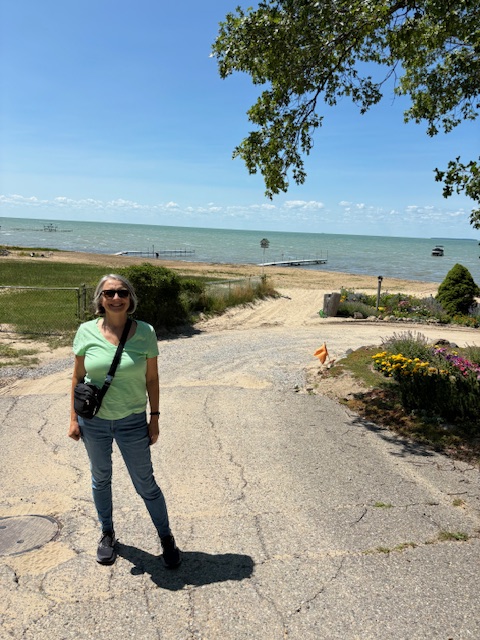
I went back to work this past week after what was a very unusual summer — a summer that started with a week of dish washing in the desert of Arizona, transitioned to supporting some of our parents through their health crises, included my 40th high school class reunion, and ended with me transitioning into a new position at my school.
It was such an unusual summer that my suitcase stayed in some state of “packed” for the entirety of June and July, our garden was given over to monstrous intertwined vines of squash and cantaloupe bordered by overgrown rhubarb and zucchini, and I was rarely able to move my writing from my morning pages– scribbles of to-dos and emotion — to anything resembling a blog. My regular rhythms were disrupted.
It probably needed to happen — this season of go with the flow that included so many trips up and down the state of Michigan — which is breathtakingly beautiful in the summer — lazy hours on the beach, playtime with our granddaughters, laughter with former classmates, dozens of phone calls with parents and siblings, and a looser hold on all the anchors I’ve been gripping for years in my physical recovery — regimented bed times, a consistent morning routine, strict dietary guidelines, and a deep commitment to not only writing every day but also posting every week.
I think I needed this summer’s less-regimented experience to see that a looser grip is ok. I can relax a little bit. If I generally follow the routines that I have found work best to keep my inflammation and pain at bay, I can veer off that path from time to time and be fine. I’ve been a little afraid of that since I’ve been dealing with autoimmunity — afraid that if I don’t do everything correctly, I’ll end up in a flare. It’s a valid fear, because that sometimes happens (and it did happen a couple of times this summer), but holding too tightly to systems and regimens can also cause the anxiety that might lead to a flare. Maybe, I’m learning, taking a breath and veering off the path for a moment can be ok.
Because I veered off the path, I had countless hours with my mother as she cleaned, organized, and prepared her home for my stepfather’s return from an extended hospital stay. I had the opportunity — many times — to sit in my stepfather’s hospital room — witnessing his vulnerability, providing some consistent communication (even if I got on his nerves a bit), and watching him become someone I didn’t recognize, and then, someone that I did. I had time with my in-laws who are also navigating difficult waters — joking a little with my father-in-law and sharing some private moments with my mother-in-law. We enjoyed a few precious days with our granddaughters, feeding alpacas and goats, walking to playgrounds, watching movies, and reading stories until we heard, “I’m so tired, can we go to bed now.” Finally, my husband and I enjoyed four quiet days away — alone, just the two of us — to explore nature, breathe clean air, and celebrate the miracle of thirty-four years of marriage.
I didn’t get every weed out of the garden. I didn’t, as I’d hoped, dive back into The Artist’s Way, and I didn’t meet my writing goals, but I logged so many memories that I will be carrying with me as I head into the school year.
This summer was all about remaining flexible — going with the flow, changing plans at the last minute, missing a day or two of yoga, living without a decent cup of tea once in a while, staying up a little later, getting up a little earlier, and being mostly ok.
And, when I haven’t been ok, I’ve used the tools I’ve learned over the last ten years to recover — epsom salt baths, lots of water, ice packs, Motrin, and rest.
I know the value of staying on the path, I’m learning the richness of wandering away from time to time, and I know the potential outcomes of both ways.
I’m mostly back on the straight and narrow; I need to be as I learn my new role at school — more on that next time.
My first impressions of Netta are fragmented. Hers was a name on my roster that I rarely marked present.
When she did show up during the first quarter, it was hard to get a read on her. At times she seemed withdrawn, introverted, like she preferred to be left alone. She sat in the back, by herself, and I didn’t often hear her speak. In fact, the sounds I usually heard from her were the sounds of deep contented sleep — the rhythmic breathing that is not easily disturbed, the kind that causes others around her to turn and look, to say, “Man, she is knocked out!”
I stopped fighting the sleep battle long ago. I have no idea what is going on with my students outside of my classroom, so if I nudge them once and encourage them to “come on, you’re here, you might as well get something for your efforts,” and I get no response, I am prone to let them sleep. Maybe it’s the only rest they’ll get today.
So, Netta was a show up once a week kind of gal who often spent that day in slumber, face pressed against the desk, eyes closed behind the very thick coke-bottle lenses of her glasses.
I didn’t know her well, but I got the impression that she wasn’t a meek, shy, introvert. No, she seemed more like a sleeping bear — completely content if left alone, but disturbed? You’d better run for your life.
Every so often during that first quarter, she would blow into the building like a force. Her hair would be done, her clothing would be intentional, she would sit up straight in class, she would feverishly take notes, and she would demand that I answer her questions about the assignment, never mind that she had missed the last two weeks of school.
It didn’t make sense to me. Why such apathy followed by such intentionality. Then I heard the rumor that Netta’s probation officer was scheduled to show up on that particular day, and Netta was going to make sure to leave a good impression.
I never did see the probation officer, and Netta reverted to her status quo.
I’d be lying if I said that I didn’t have my hackles up just a little bit every time she showed up. The fact that she was often reserved coupled with the fact that she could occasionally show up like it was game day put me off balance, and occasionally I’d see her — rather hear her — move through the hallway, strings of expletives bursting from her like machine gun fire. I presumed, if provoked, she could tear me to shreds. I wasn’t planning to provoke her, but I couldn’t be sure no one else would. So, I was often just a little hyper-vigilant when she came to class during that first quarter.
For some reason, she showed up on the first day of the second quarter, the day that I characteristically give each student a printed summary of their academic performance so far. It’s a simple sheet from PowerSchool that lists the student’s current grade, how many assignments they completed, how many times the student was tardy, and how many times the student was absent. I do this to provide information to my students — to allow them space to reflect — but also to reward what I have seen. If they have earned an A or a B, if they have had fewer than two tardies or fewer than two absences, I give them a “Rathje Ticket” that they can use to purchase items from my class store.
On this particular day, I was calling special attention to students who had been chronically absent — who had more than two absences per month for the first quarter. Raising attendance has been my classroom goal this year, and although attendance had definitely improved from previous years, students like Netta still had a way to go. So, because she was in class on that day, I handed her the report that I had marked with yellow highlighter, showing her double-digit absences and noting that she had been “chronically absent.”
Netta, typically quiet [or sleeping] Netta, said quite loudly, “Mrs. Rathje, this is terrible! Imma do better.”
And do you know what? She did.
She started coming to class, just in time for the unit on personal narratives. I wanted students to show themselves in a scene or several scenes that revealed to the reader who they were, what was important to them, or what their strengths were.
Netta dove in. In fact, she asked to move to the front row, smack-dab in the middle. She read the models I provided. She did the brainstorming, she chose a prompt, and she began to write.
I can see her now, totally honed in, bent over her desk, face inches away from the paper as she wrote and wrote.
“Mrs. Rathje, can you read this and tell me how I’m doing?”
The writing was rough — very rough — the kind of writing you might have if you only went to school one or two days a week for several years. The penmanship, the spelling, the grammar — not anywhere close to what I would call standard. But as I read, everything else in the room fell away. She was writing about the fact that her mom had died — during Netta’s birthday week — six weeks before the start of her senior year. Six weeks before she started sporadically showing up in my class to sleep in the back of the room.
“Wow, Netta. This just happened?”
She nodded, looking through those thick lenses into my eyes.
“This past summer?”
“Mm-hmm.”
“I’m so sorry. Thank you so much for sharing this. I’m so glad you chose this topic. I want you to write more. Give more detail.”
“Mrs. Rathje, I know it’s a mess. I want to make it better. Will you help me?”
“Of course. We’ll work on it together. That’s what this assignment is all about.”
And that was the beginning. Of Netta’s engagement in my class, of Netta showing up four to five days a week instead of one, of Netta communicating (if at the last minute and out of desperation) with our social workers before her next probation officer visit or court date.
She hadn’t ascended to a straight A student by any means, but I was watching her transform before my eyes.
Now, she NEVER enters my classroom quietly. No. How do I describe the self-confident force of nature that is Netta, that boldly proclaimed during our Intro to Racism unit this past week, “I know what my unconscious biases are, and I’m not changing them!”
“I guess you might say they are no longer unconscious then, am I right?” I grinned at her.
She crossed her arms, gave me the side eye, and said, “They are not. I am fully aware of my bias. And I am keeping it.”
She is not afraid to tell a classmate, “Shut the hell up, you talk too much, and you sound stupid,” and although I check the outburst, I can’t often disagree with her assessment.
On Friday, late in the afternoon, she was walking down my hallway and she shouted at me, “Mrs. Rathje, you would be so proud — I didn’t cuss at all in that class.”
“That’s amazing, Netta,” I said, smiling, as I watched her walk into a classroom.
Two. seconds. later. I heard the most profane stream of words come from her mouth halfway down the hallway.
I walked down to the room she was in, popped my head in the door, looked her in the face, and said, “Netta, did you not just say I’d be proud of you for not swearing?”
“Mrs. Rathje, I had to get it out of my system before this class started.”
I smiled, shook my head, and walked away.
Earlier that day, she had come into my room, dressed as though she had something important going on after school, sat down, and handed me a paper she had pulled from her purse, “You wanna see my momma, Mrs. Rathje?”
“Of course!” I said, taking the funeral program from her hand. Her mother’s face was on the front, and I said, “Netta, you look like her. This is so precious. I had forgotten that this just happened last summer.”
She looked at me, putting the coke bottle lens back in the broken frame of her glasses, “I don’t read the obituary,” she said. “It makes me cry.”
“Of course it does,” I replied. “I love that you carry this with you. Your mom would be very proud of you.”
“Yes, she would.”
We move through the class, past fires to put out, questions to answer, demands to respond to and then it was almost 3:15, time for me to take my post at the end of the hallway to make sure that students don’t leave their classrooms before the bell.
I saw a door open and then Netta as she stepped into the hall.
“OK, Netta, back it right up, the bell has not rung,” I say.
In slow motion, she puts herself in reverse, maintaining eye contact with me, and retreating into the classroom.
The action of it cracks me up. I laugh, and I say, “I just love you, Netta.”
I was sitting in the naivety of January, setting goals for the year when I thought, “I know what I’ll do this year — I’ll post a vintage blog each Thursday and new blog most Mondays. That sounds like a great way to mark ten years of consistent writing.”
It was easy to begin, in the newness of the year, in the freshness of possibility. I was sitting there in early January gazing into a new season with my husband retiring from public ministry and transitioning to a private counseling practice. I was anticipating a slower pace after over thirty years of busy-ness.
And the year did indeed begin with a tone of spaciousness and possibility.
But we never know what’s coming next, do we?
We didn’t know that in the next couple of weeks his mother would be diagnosed with stage four liver cancer, that my stepfather would be diagnosed with stage 2-3 bladder cancer, that one of our kids would have a serious medical episode, that another would be starting a new job, and that another would be in the midst of several major life transitions.
We couldn’t anticipate all of that.
And it’s hard to know the emotions that such realities will bring up — shock, sadness, grief, anger, fear, worry, excitement, anxiety, joy, and even pride. But that whole chorus shows up and begins to take space in one’s body.
As each reality fleshes itself out — the reality of hospice, of surgery, of chemo, of diagnostics and medical leave, of transition and opportunity, of waiting and adjustment, those emotions jostle and elbow at each other, struggling to claim territory.
And one can’t anticipate how all that internal jostling will impact one’s external capacity for resiliency, for patience, for empathy, for tenacity.
So this past week, now that I am sitting with all these emotions and still struggling to accept all of these realities, after two weeks of testing students and selecting two new cohorts of reading students, after transitioning them to my class, and after working intentionally and diligently to gain their buy-in, I got an email directing me to test more students. Although I had selected enough students to meet the 10-student capacity of both sections of this course and two alternates, two of those students had unexpectedly elected to move to virtual instruction making it impossible for them to join my class and another two, along with their parents, had opted not to join the class. Consequently, my classes were both at 9 students — each one short of capacity.
As I read the email, I became annoyed. My classes were already in progress. I was already building community and establishing expectations. Couldn’t we just proceed with 9 students in each class?
Couldn’t my administrators see that although my classes weren’t at capacity, I was certainly at capacity?
I, ever the dutiful employee, uncharacteristically ignored the directive for a beat. Then, I replied to my principal somewhat pointedly that if he wanted to identify a few more students for me to test, he could be my guest, but I didn’t think any others would qualify.
Yup. I had a tone. It was a warning flag, to be sure — I was past my limit.
I had too many emotions crammed inside of me, they could no longer jostle for space, so they started seeping out in irritability, in pettiness, in sarcasm.
I was in a funk, and I couldn’t see a way out.
Nevertheless, at the end of my school day, I decided to call my son to check in. I hadn’t spoken to him for a while, and after he gave me a quick update, he asked, “How are you doing, Mom?”
I signed out a deep breath and said, “I. am. weary.”
And he replied, “I bet you are.”
And that little sentence, that acknowledgement of all that is going on, that validation that I am in fact at capacity, created an opening.
He allowed me to share just a little bit, some of those emotions found a passageway, and others were allowed more space to dwell.
That small offload allowed me to move through the next day with civility, however, I still had no intention of adding students to my course. The issue wasn’t resolved, though. As I left the building on Thursday, I got a text from my principal that a directive had come again to add more two more students.
I shot off a text, trying to veil my annoyance with professionalism, “Please let me know if you want me to look at the data again. I am moving forward with planning instruction for these classes, but if you think I need to go back I will.,”
I really wanted him to respond with, “No, no. You’re right. Move forward,” but instead he said, “If you can; I am too. Maybe there are kids right on the cusp that would opt in. Thank you so much.”
Argh. My defiance had gone on too long. The responsible core of my self rose up.
I grudgingly sorted and resorted the data and found a group of kids that hadn’t yet been tested and that met our criteria for the class. I sent him the list, reluctantly offering to test the ones he thought I should
By the next morning, he had chosen his top three, but after a search of the building, it appeared none were present. It was Friday morning, typically our lowest attendance day of the week.
I met up with the principal in the hallway and he invited me into his office. He said he wanted to touch base — how was I really doing with the directive to test more?
“It’s fine,” I said. “I get it. I am just at capacity with stuff going on in my personal life, and it is leaving me less capacity for stuff here at school. Every little thing is annoying me — the chaos in the hallways, the broken up parking lot, my unswept classroom floors, and this directive to test more when I thought I was already done. Normally this stuff doesn’t get to me, but so much in my family is outside of my control, I think I am looking for ways to find control here.”
He already knew about some of the stuff going on in our family, and he said, “I get it. I’m sorry you are dealing with all of this in your family. Also, these work things are annoying. How can I be a support to you?”
There it was again, the acknowledgement that my feelings were valid, and really that was all I needed.
“I’m good for now. Thanks for hearing me. I’ll find a way to test these kids, and I won’t be a jerk to anyone.”
“Thank you,” he smiled.
I did find a way to test one of the students later that day. I had no way of knowing that she could barely answer comprehension questions at the first grade level. I couldn’t have known that she was more than willing to join my class. I couldn’t have known what a gentle spirit she was.
We never know what’s coming next. Sometimes when we take the next step, we get a pleasant surprise.
No matter what is coming next — no matter if our parents have cancer, if our kids are going through transitions, no matter how little control we feel that we have — we can trust that we are always being prepared for it — that is my experience — I’m always being prepared for what is next.
A few years ago, when my husband and I were in the midst of one of the most challenging seasons of our lives, we reached out to a dear friend in the early hours of the morning. We shared with him our current reality, he heard us, he paused, and then he said, “None of this is a surprise to God,” and that was a comfort to me. Even though I hadn’t known what was coming next, surely God had known, and He had been at work in our lives to provide in advance everything we would need for that season. Even though on that morning all seemed hopeless, God did carry us through that season and provided miraculously for us along the way, just as he had through every other difficulty in our lives.
And so, as we face this uncertainty — of caring for our parents in ways that we never imagined, of encouraging our adult children in their own uncertainties — we can trust that we are ready — everything that we’ve experienced up until this point has prepared us.
And we are not alone. We have people around us who will hear us, and we have a God who is going before us, making a way, andproviding everything we need. He who will be with us in everything that is coming next.
Do not be afraid or discouraged, for the LORD will personally go ahead of you. He will be with you; he will neither fail you nor abandon you.
You may have seen that I’m running a Thursday series called “10 Years Later” — a weekly reposting of something that I’ve written in this space over the last 10 years. This past Thursday, I re-posted We Don’t Know Everything, a reflection I wrote in January of 2015 about how if we knew everything that would happen in the wake of a major life decision, we might choose differently and how our limited vision allows us to step out in faith that God will provide for every eventuality.
I re-read that post again this morning, and it feels particularly apropos in this moment.
Over the years, we (like you) have made many major life decisions — the time I enrolled in graduate school, for example, or the time when we quit our jobs before securing new employment because it was just that important for us to move closer to our oldest son, whose other family had just relocated to the west side of the state.
When making these decisions, we look at the information we have in the moment, try to anticipate future needs, and make the choice that seems to make sense.
When I enrolled in graduate school in 2002, our younger children were in 1st, 3rd, and 4th grades. I thought that since I had been home with them for the last 10 years, it might be wise to ease in, maybe take one class at a time, in order to put less strain on the family. My husband disagreed. He said, “If you are going to do it, I suggest you go full time. Fully immerse yourself. We have no idea what is coming next.”
I was kind of surprised that he was willing to make that kind of commitment because I knew that in addition to his full-time ministry position, he would have to pick up more of the burden of caring for our children — after school pickups, homework, dinner, etc. But, if he was willing to do that, I was willing to — gulp — take three graduate courses at a time for two years.
We didn’t know at the time that we would, just two years later, be moving to St. Louis for him to attend the seminary. Turns out, I finished my program about one month before we moved. And because of that degree, I was situated to easily secure immediate employment, first teaching at a community college, then at a public high school (once I had obtained my Missouri teaching credential), and then in the Lutheran high school that would become such a formative place in my career.
When, in 2013, my health was very poor, and it was becoming clear that I could no longer sustain my role in that school, my husband was offered a position here in Michigan, and although it was our daughter’s senior year of high school, the position was such a good fit, that he decided to make the move ahead of us to not only take this new role but also to prepare a space for me to land when she was finished with high school and situated in college. We didn’t know how desperately I would need to convalesce, but that decision which was very difficult given that he would miss large portions of her senior year, set us up for a season of healing, not only for me but for our whole family.
It was that season that allowed me to learn new ways of living that supported my health, to process some trauma that could no longer be ignored, and to — after a while — be ready to land in the position I have now, a position that is incredibly fulfilling. We had no idea when I started this position if I would be able to sustain it, but for over three years I have, and this past fall it became apparent that we should consider a shift for my husband.
We had long discussed that he would one-day shift to private practice counseling, but we didn’t have a firm timeline, and we sure didn’t know what was coming when we sat down with our financial advisor this past fall to determine that this was indeed a good time for him to make that shift.
We just looked at the information that was available to us and made the choice that seemed to make sense.
We had no idea that the week before he intended to open his practice one family member would be diagnosed with cancer nor that the following week another one would. That’s right, two close family members in two weeks diagnosed with cancer.
We’ve had a little anxiety coming into this shift — what if he doesn’t get enough clients right away? What if he doesn’t get approved to take insurance for several months?
What would we do?
Well, we needn’t have been concerned. We didn’t know what was coming, but God did.
In these past weeks when he hasn’t had all the responsibility of his former position, he’s had time to rest, to take care of family details, to spend lots of time on the phone, to make extra trips, and to care for himself.
I don’t make it a practice to tell anyone else’s story in my blog, so I won’t right now share the details of those who are ill or go any further with what this transition has meant for my husband. That is his story to tell.
Suffice it to say, that I am noticing, once again, that God goes before us. He is always preparing us for what is next. He provides what we need at just the right time — even when we cannot see that that is true. He is always working on our behalf, always making a way.
This, my friends, is most certainly true.
Because of your great compassion you did not abandon them in the wilderness…[You] did not fail to guide them on their path
On December 21, 1989, my husband proposed to me, and when I accepted he said, “Things are going to get busy.” If I would have known then what ‘busy’ meant, I might have turned back.
But God orders life in such a way that He lets us see just a bit. At that moment, I could say yes, even knowing that my future husband was a divorced father of a four-year-old. But would I have said yes if I had known that we would live in eleven homes in twenty-four years? That we would ultimately be the parents of four children? That I was not only marrying a teacher, but a therapist, and a pastor, and a university administrator?
Maybe. I was a starry-eyed twenty-three year old when I said yes. I knew what was behind me — divorced parents, an eating disorder, my college education. I had survived so much already. How hard could this be?
Hard. You probably know all too well that life is hard — just when you think you are sailing smoothly, a storm pops up — a job change, an educational challenge, a health issue, financial trouble, extended family trouble, and the list goes on. Sometimes it feels as though we can’t handle even what this particular day holds — how on earth would we manage if we had the whole script in front of us from day one?
I was still a little starry eyed in 2004 when my husband said to me, “God is calling me to the seminary.” In six months’ time I finished coursework for my Master’s degree, prepared a house for selling, sold/gave away half of our possessions, packed up a family of five, and relocated three states away. I was excited because of what I knew — God had called my husband into ministry. Would I have been so excited if I had known, really known,the struggles our children would face in St. Louis? Would I have been happy to embrace a life of busy-ness, a busier busy-ness than we had ever known? What if He’d said, “You’re going to be there for 10 years, you are both going to experience significant health issues, and there is going to be plenty of family strife.” Would we have still signed up?
Maybe. I mean, back then we were still, in our minds, pretty invincible. We might have still signed up. But maybe not. We might have been scared. We might have wanted to protect our family from struggle. We might have wanted to protect ourselves from struggle.
And if we would have done that, the story would be much different than the story is today. We have been changed. I am not the starry-eyed twenty-three year old who agreed to marry my husband. I am not the optimistic ‘let’s do it!’ wife who moved mountains so that we could answer God’s call. I have been changed.
And I’m still changing, because life keeps happening — the good, the bad, and the downright ugly.
It’s pretty easy to thank God when He gives you a beautiful granddaughter to hold and adore. It gets a little more difficult when you, or the people who you love, are hurting. But I find assurance in knowing that even before 1989, God knew every little thing that He would bring into my life — even the stuff of today. He knew in advance that He would be with me through all of it — that He would be carrying me in the palm of His hand.
This morning the pastor at the church we were visiting recalled, through the genealogy in Matthew 1, God’s faithfulness, especially in light of the faithLESSness of man. He started with Abraham’s unfaithfulness, then Isaac’s, and so on. His point was that God knew, from before the creation of the world, that we (all of us) would screw it up. And yet he planned, from before the creation of the world, to keep a covenant with His people. The covenant did not depend on us doing the right thing, saying yes at the right time, or answering a call. It only depended on the faithfulness of God.
And He is faithful. Faithful to love me when I couldn’t have cared less about Him. Faithful to hold me when I felt all alone. Faithful to heal me when I was hurting. Faithful to carry me when I was too tired to walk on my own. He knew before time began that He would be faithful in all these things, even when I was faithLESS.
Back in 1989 I didn’t know what was in store for me, and today is no different. I have no idea what will come into our lives in the years to come, but I do know that God will remain faithful to us. He will continue to carry us in the palm of His hand.
Deuteronomy 7:9
Know therefore that the Lord your God is God;
He is the faithful God, keeping His covenant of love to a thousand generations…
When I wrote The Battle is On in August of 2014, I shared what I understood about autoimmune disease. I was new to the game (just a year or so in), and I was relying mostly on what doctors were telling me and what I was reading online. I wouldn’t say that I was wrong, but I would say that my understanding of autoimmune disease, from my perspective, based on my experience, has shifted greatly since that time. The longer I live in this body, the more I learn. In fact, my thoughts on the subject shifted again just yesterday.
Let me see if I can give you a picture of what I mean
I am confident that somewhere in the pages of this blog I have at least suggested that the current state of my body is a function not only of heredity and disease but also of the ways I have lived my life in these past fifty-seven years. Whether it came from my paternal grandmother, who had rheumatoid arthritis or from my mother, who has suffered with myriad maladies including persistent issues with her right hip (as do several other members of the family), I somehow inherited (and then passed on) the hla b27 genetic marker that is associated with spondyloarthritis which includes psoriatic arthritis, Sacroiliitis, and other autoimmune disorders.
Ok, so I had the genetic marker, but I also began a pattern of persistent emotional distress in my childhood and adolescence; such a pattern can heighten the likelihood that one develops autoimmune disease. Now, I wouldn’t say that I had a terrible childhood or that my parents subjected me to any kind of trauma. However, their divorce and the subsequent separation from my father was, to me, devastating. I did not know how to process the emotions I was feeling, and my adolescence was characterized by what I would now describe as raw, untended to emotion that was trying to find comfort or at least an outlet.
Over the years, I developed many strategies for dealing with that distress — lashing out, academic achievement, an eating disorder, and finally, a survival strategy emerged — my butt-kicking, name-taking persona. This girl set her jaw, clenched her fists, and got shit done. If emotional pain surfaced, she processed it through anger and aggression — at herself, at her family, at anyone who happened to get into her path. If things were moving smoothly, she was fine — reliable, productive, and focused — but toss in the unexpected — a change of plans, an alternate view, a noncompliant child or student — and she resorted to her soldier stance, bracing her body, lashing out with her words, and forcing everyone back in line.
It was a strategy that carried me through many years, but it led me to resist compassion, perspective, empathy — not only was I unlikely to give those things to others, I was less likely to receive them for myself. Now, let me say here that every soldier lets her guard down from time to time, and moments of vulnerability crept in — times when I held my children as they cried, when I recognized defeat in a student, when I allowed myself to share my pain with others — but those moments were the exception, I am afraid, and not as much the rule.
And while this soldiering lifestyle was an “effective” strategy, every choice has unintended consequences. I wish I was scientific enough to explain how my butt-kicking, name-taking persona required my body to produce adrenaline and cortisol and how, over time, the abuse of these hormones increased the likelihood that I would experience autoimmune disease, but I have an education degree, not a medical degree.
Suffice it to say, that what I have learned over the past 10 years, is that, at least in my body, the most effective strategies for reducing my experience of autoimmune symptoms are not medical, but they are a re-learning of how to manage my emotions, of how to live my life in a way that reduces or mitigates the adrenaline and cortisol in my body.
If you have followed my blog, you already know that pharmaceuticals were not the answer for me, although I tried many over the course of 3-5 years at great expense and with significant side effects. In fact, the only pharmaceutical I take now is one that I must take to prevent a flare of the ocular herpes I acquired while on a course of steroids. Sigh.
Because I was non-responsive to pharmaceutical interventions, all doctors except my ophthalmologist dismissed me as “not having autoimmune disease”. [For the record, my ophthalmologist shakes his head at this when he sees the evidence of autoimmunity in my eyes.] This dismissal, though, was a blessing, because it led me to explore other options for improving my health — options like submersing myself in a 95 degree salt-water therapy pool (which I highly recommend for those of you who are in the midst of a flare), practices like yoga and walking that allow my body to de-stress, habits like eating unprocessed foods that are free from gluten and dairy which often trigger symptoms in my body, and routines like seeing a therapist to learn how to more effectively deal with emotions.
And while I didn’t start this blog for the purpose of improving my health, it has had the unintended consequence of giving me a space to process so many of those emotions that little-girl-me felt, that soldier-me suppressed, that mom-me didn’t feel safe exploring. And, in the unearthing of these emotions, in the vulnerability of exposing them not only to whoever wants to read them, but more importantly to myself, I have created the space within my body to breathe.
And you’d be surprised the difference a little breath can make.
I’ve been learning about breathing since I started practicing yoga several years ago. At first I was like, what? we’re gonna just sit here and breathe? I was a former distance runner, if you remember, and I was used to pounding out 4-6 miles on a regular Tuesday, so this sitting still and breathing thing was very foreign. But, I was in a room full of people who were sitting there breathing, so … I breathed. Sitting still. For long periods of time. And, though I was unsure it was doing any good, I had to admit I felt better after yoga. And, I continue to practice yoga almost every morning for that reason.
But yesterday I took this breathing thing to the next level. A friend of mine, Lynnette Rasmussen, an experienced occupational therapist and PIlates instructor, was offering a virtual breathwork class and a handful of friends and I decided we would attend. I expected more relaxation but not much else.
I was surprised by the difference a little breath could make.
Lynnette guided us through an “ancient pranayama practice that uses an active 3 part breath that continues for 25-30 minutes, followed by a 10 minute relaxation” intended to “relax the mind and reach buried emotional or physical blocks and bring them to the surface.”
I was certainly unprepared for what I experienced — at first it was awkward, this weird breathing strategy, but then, once I found the rhythm, it was calming, and more natural, but then when we entered the relaxation — man, it takes great vulnerability to tell you this – I felt healing electricity coming through my hands as they rested on my body. I felt a deep understanding that God alone — not my practices, not pharmaceuticals, not pain clinics, not anything else — has the power to heal me. I rested on a yoga mat on the floor receiving any kind of healing that He had to offer me.
And that is what I have really wanted all my life — to receive the healing that only God can provide — and to accept that He will provide it in His time and in His way — not as I demand and not in a sense that I have to “believe to receive” but just in a way that He will surprise me with.
And over these last years, He has continuously surprised me — by closing medical doors, by tossing me in a warm salt water therapy pool, by showing me that my strength is not in a set jaw and a clenched fist but in vulnerability, by reminding me through a zoom room that He can, He is, and He will heal me day by day by day, sometimes with the simple power of breath.
I am overwhelmed by His grace.
Now to him who is able to do immeasurably more than all we ask or imagine, according to his power that is at work within us, 21 to him be glory in the church and in Christ Jesus throughout all generations, for ever and ever! Amen
It’s been 10 years since I wrote that first post, and since then I’ve written 652 more (653, if you count this one). In the beginning, I wrote almost every day. Having been instructed to be still after years of routine — first teaching, then parenting young children, then graduate school, then teaching and parenting combined — I needed something that would bring order to my day. So in those first months in the little house by the river, I woke every morning, made my tea, and wrote a post before I did anything else.
I think I began blogging because I needed a purpose, something that I could accomplish each day, something that I could produce — a physical representation that I could still do something. I didn’t really know what I was going to write each day, but an instinct — perhaps after years of journaling and teaching others the value of daily writing — pushed me to the keyboard every morning, and this writing became a lifeline.
Some of you began to read perhaps out of curiosity — why would someone daily post about their life? why would a teacher at the height of her career walk away? why were we moving to Michigan after years in Missouri? Some of you have told me that you resonated with the chronicling of my autoimmune disease. You, too, suffered with chronic health issues and my willingness to write about being stuck on the couch or lying on the bathroom floor writhing in pain let you know that you were not alone. Some of you read because you knew me as a child and wondered what I was up to. Some of you are my family and friends (or my husband) and you read out of care, concern, and solidarity.
Whatever the reason you read, the fact that someone — anyone — was reading gave me the encouragement I needed to keep going.
And when I kept going, kept writing, day after day after day, I dug deeper into my interior and discovered things about myself that had long been buried or that simply needed articulation — precious memories from my childhood that revolved around my grandparents and godparents, deep sadness over losses that had never been processed, my ongoing journey with autoimmune disease, my strong feelings about political issues, and probably more than anything my passion for educational equity.
I often tell my students (and my friends and anyone else who will listen) that I (and perhaps you) don’t know what I am thinking or feeling until I see what I have written on the page. Perhaps it is because I have spent a life in motion, constantly doing, producing, going, and moving, that I have pushed my thoughts and, even more so, my feelings deep down inside without taking the time to process them.
Having a health crisis and being forced to stop and be still provided the space in which I could — finally — pull up all those thoughts and feelings and begin to examine them, evaluate them, feel them, grieve them, and in some cases, move on from them.
So I’m sitting here, in my little home with the garden, ten years later, candle burning on my desk, still in my pajamas, reflecting on how far I (we) have come. In over 600 blog posts I’ve moved from debilitating pain and fatigue to manageable symptoms that remind me to move slowly and to routinely pause to take stock. I’ve transitioned from taking daily anti-inflammatory medication and monthly injectable biologics to mostly just daily vitamins and supplements with occasional Motrin added in. I’ve been growing in my ability to write and subsequently speak about my deepest hurts, greatest losses, daily struggles, and strongest passions. And, most tangibly, I’ve gone from my insecure 2014 self that felt like an invalid to my confident 2024 self, which my instructional coach recently described as “effortlessly dope”. (I think that’s the most treasured compliment I’ve ever been given.)
Do I owe it all to the writing? No, I wouldn’t say all, but I would say I wouldn’t be where I am today without the discipline of this blog. My commitment to write regularly and truthfully — sometimes painfully truthfully — has been not only the evidence of the miraculous growth and healing I have experienced in this next chapter, but also a primary instrument in that healing.
I don’t think I can unpack what I mean by that in one blog post, so the assignment I’m giving myself this year is to share a “vintage” post each Thursday and a new post most Mondays. The objective is to deeply reflect on the power of writing, of routine, of discipline, of transparency, of community, and of vulnerability. I can’t predict where this assignment will take me — I won’t know what happens until I see it on the page, but I invite you to come along with me.
If you dare, I challenge you to write along — you might just open a blank page and write for 5 minutes each morning to start. You might find that’s not enough. You might find it’s too much. But if you’ve read my blog for any amount of time, I hope you will see the possibility for transformation that might happen if you are willing to take a chance.
I’d love to hear from you — what you are finding out about yourself, what are you unearthing, what is happening for you as you write. It doesn’t have to be for the public eye as I am allowing here. Writing can be magical even if it is for your eyes only.
Whatever you choose — reading along on my journey, writing along with me, or doing something altogether different, I pray God’s blessing upon you — may 2024 be a year of growth, of healing, of transformation. May it be filled with love, with joy, and with a renewed sense of hope.
If you don’t believe that God can restore what is all but lost, let my blog be a testament that nothing is beyond His ability.
Behold, I am going to do something new, Now it will spring up; Will you not be aware of it? I will even make a roadway in the wilderness, Rivers in the desert.
We’re seven weeks into this school year, and I’m not sure who is learning more — me or my students.
This is always the case, of course, but I continue to be amazed. You would think that since I am fifty-seven years old, and my students are mere teenagers, that my maturity, at least, would exceed theirs. In some ways it does, for sure, but they are teaching me to receive feedback and to alter my approach.
Now, they don’t necessarily know they are doing this — they aren’t setting goals, writing lesson plans, or assessing my progress. No. They are just navigating their lives in the best ways that they know how, but when our paths cross, they are not afraid to give me the feedback that I need.
And I am not too stubborn to receive it. Not any more.
Recently, I was trying to get started with my fourth hour class — they come to me straight from lunch, and my expectation is that they would just walk in, grab their materials, sit down, and be ready to engage with learning. Yes, I do see, as I type those words that my expectations border on lunacy. For one, any teenager coming straight from lunch might be transitioning from a fun conversation with peers, from an attempt to engage with a person of romantic interest, or from a mild or moderate altercation with a staff member. To expect them to instantly shed those interactions and be fully engaged in English Language Arts is, although an appropriate academic posture, probably not entirely sensitive to adolescent development.
And I know that, and I prepare for it. Each period, I plan a “gathering” — some short activity to pull us all together. For example, I might display a slide showing that October 23 is National TV Talk Show Host Day and then ask my students, “if you could be interviewed by any TV Talk Show Host, who would it be, and what would you want to talk about?”
We might take a few minutes to discuss and laugh in an attempt to build a classroom culture and foster engagement before I try to deftly transition into the goals for the day.
On this recent day, the one I was starting to tell you about, I could tell that the majority of my students were not with me. I was having a hard time getting everyone to find their seats, to put their phones away, and to engage with our gathering. So, in the “kick butts and take names” fashion that I learned somewhere along the way, I started moving around the classroom in my ‘large and in charge’ type of way in an attempt to get them settled in.
I narrowed my proximity. I bantered with students, interjecting myself into their conversations, and trying to overpower them into submission. This strategy might have worked once upon a time, but my current students are not having it. The power play does not work with them. I know this, but on this particular day, I was frustrated enough with their lack of attention that I reverted to the muscle memory of raising my voice, getting an attitude, and using language that is not typically mine.
My students’ response? They kept doing what they were doing — they were unbothered — until the language that came out of my mouth elicited a “Whoa, Mrs. Rathje, you can’t say that,” and then the room went quiet. And I knew the student was right. My language had crossed a boundary. I had gotten their attention, for sure, but not in the way that I wanted.
I backpedaled.
“You’re right. That was inappropriate. I think I am feeling frustrated because we don’t seem ready to get started. But that is no excuse. I apologize. Can we start over?”
The room quieted, but some of the respect that I had spent weeks building inside of this space, had crumbled beneath my feet, and I instantly knew I would have to do some rebuilding. Nevertheless, my duty to instruction prevailed, and I began with our lesson. Just as we were finding our rhythm, one of my students jumped up and said, “Mrs. Rathje, I gotta take this call,” as she speedily went to the hallway.
Well, that irritated me, but I kept moving with the students whose minimal attention I was holding and then met her at the door when she returned.
“You can’t just walk out of class, ” I said, my attitude re-engaged, “You haven’t been here all week, and now that you’re back, you just jump up and take a phone call?”
I think I expected her to say, “You’re right. I’m sorry,” but instead, she looked me straight in the eye and said, “I am feeling a certain kind of way because of how you are talking to me. The reason I have been missing school is because I was at a party last weekend where my cousin was killed.”
I put my hands up in quiet surrender and took a step back.
“Wow. I didn’t know that. Thank you for telling me. You are right. I didn’t need to give you any attitude. I apologize. I am glad you are here. Will you let me know if there is anything I can do?”
“I will. Thank you.”
Sheesh! Twice inside of twenty minutes, I had had to apologize for defaulting to a power play and my students were the ones who gave me the feedback that allowed me to check myself and try a different way. I thought I was the one who was supposed to be doing that for them.
Each day, I have to remind myself that I am not the center of the universe; the behavior of my students is not directed at me. They are dealing with all kinds of things. For example, not one, not two, but three of my students reported “my aunt just died” this week! I have got students who are homeless, some who work over twenty hours a week, and some who are earning money to help their families pay the bills. I’ve got students who have family in jail or who are on probation themselves. I’ve got students whose families do not have a vehicle and can’t come to get them in the middle of the day if they are suddenly sick or injured or overwhelmed by the amount of loss in their lives.
And these are the things I know about. Many of the struggles my students face are too private to share.
So, instead of being annoyed when my students don’t walk in on time and enthusiastic for learning, I need to be curious.
What is going on that has everyone distracted today? I noticed you weren’t at school for several days, is everything ok? I can see that you are preoccupied with your phone — are you just caught up in scrolling? or is it deeper than that?
I don’t need to have an attitude. Asking a simple question can provide my students with the feedback that might allow them to a) provide me with information that explains what’s going on or b) check themselves and try a different way.
Life is complex and English Language Arts aren’t the top priority for a student who is reeling from crisis. However, it is my job to share the value of learning ELA for the purpose of having strong communication skills, succeeding in postsecondary learning, and for being prepared for future employment. I need to be compassionate in regard to my students’ reality while also engaging them in learning and holding them accountable to meet the learning standards that will give them access to spaces beyond my classroom.
It’s a big job. And sometimes I get tired, and I blow it.
However, I am noticing that the class of 2024 doesn’t have any trouble holding me accountable. They are not afraid to say, “Mrs. Rathje, you can’t say that.” or “I don’t like the way you are coming at me.” or “Mrs. Rathje, are you doing ok?” They are modeling for me the ways that might be appropriate to hold them accountable!
And, if I’m not too consumed with being in control, if I’m brave enough, I might just model for them the ways that they can respond to my feedback.
You’re right, that was harsh. Did that sound sarcastic? I apologize. Guys, can I be honest — I’m not feeling the best today. Can I just take a minute to gather myself? Can you all cut me some slack?
I love these kids so much, and I am so impressed by their ability to notice that something doesn’t feel right and, in that moment, to say something. In this way, they are worlds ahead of me. They are brave, and I want to honor their bravery in a way that seems counterintuitive — I want to be vulnerable.
Brene Brown in Atlas of the Heart says: ” In a world where perfectionism, pleasing, and proving are used as armor to protect our egos and our feelings, it takes a lot of courage to show up and be all in when we can’t control the outcome. It also takes discipline and self-awareness to understand what to share and with whom. Vulnerability is not oversharing, it’s sharing with people who have earned the right to hear our stories and our experiences” (14).
If what I’m trying to do is build transformative relationships with my students, what better way do I have than modeling vulnerability — welcoming feedback, admitting I was wrong, saying I’m sorry, and moving forward in a way that honors the humanity of the people in front of me.
Back in the early days of my teaching, the old pros used to advise us to “not smile before Thanksgiving.” Their philosophy was that teachers had to be hard asses for the first quarter if they wanted to maintain control of their classrooms. For many it worked.
But I’m not interested in control.
I’m in education because I have an insufferable belief in transformation, and in my experience, I have to let go of my need to control in order to create the space in which change is possible.
I can’t create that space through force. I need to be willing to step back — to be the one to create an opening.
If my students are brave enough to hold me accountable, I’m going to be brave enough to try a different way..
Do not conform to this world, but be transformed by the renewing of your mind.”
The Thursday before school started, we the staff of Detroit Leadership Academy took our stations around the building, preparing for the open house where students would come to get their schedules and chromebooks and begin to reconnect with the world of school after eight weeks away.
I was at the main entrance, checking students in. I didn’t know the freshmen, of course, they were new to our building, but I was watching for those students I recognized, especially the small group of students I had had in my reading class the previous year.
“Hey! How was your summer?” I said as I stood from my seat to receive a hug. “It’s so good to see you!”
I was also watching for last year’s juniors, who would be my new senior class. I knew some of their names, but we aren’t familiar enough for a hug.
“Are you ready for this?” I would say, “You ready to be a senior?”
The replies were varied: “Of course!” “Hell, yeah!” “I think so.” “I’m not sure.” “I’m scared.”
I’ve seen it from every group of seniors I’ve ever taught. Some things don’t change; others do.
The first day of school was predicted to be in excess of 90 degrees, and since our school doesn’t have air conditioning, our administration determined to have an early release. We would see each group of students for just 30 minutes, and then they would board their non – air conditioned busses for the sweltering ride home,.
I had two box fans and two ceiling fans blowing, and my two operational windows as far open as they go. I stationed a cooler full of water bottles covered in ice at the front of my room, and kept the lights off to keep the room as cool as possible.
When the bell sounded, my students met me at the door, got their seat assignments, and made their way to their desks. It took me a while — perhaps until this reflective moment — to register that something felt different.
This wasn’t the fall of 2020 where I met my students inside the small square of the zoom room.
It wasn’t the fall of 2021 where my students entered my room mask-clad, the vibration of anxiety among us palpable.
And it wasn’t the manufactured bravado and audaciousness of 2022 — the defiant swagger born of two years of persistent trauma.
No, this past week, the first week of school year 2023-24 felt….light…spacious…and maybe even hopeful.
As I shared the big picture goals for the year — the district-wide vision that all of our students would be accepted to a college, that 80% of them would enroll in some kind of post-secondary training, and that all of them would attend school more than 90% of the time — I watched the faces of my students, expecting the usual push-back, disinterest, or defiance, but what I saw was a collective subtle nod, an acceptance of this reality, and (an at least temporary) buy in.
Now, don’t be mistaken. I still saw seniors struggling to stay off their phones. I still had one student who, when I mentioned that we would be filling out the FAFSA together, stood up from his desk and said, “I ain’t doing that.” I still had at least one student who proclaimed his main post-secondary goal to be “making music”. It was a room full of high school seniors after all, but something felt different.
While our community regularly struggles with chronic absenteeism, the majority of my students attended all four days last week — even though the temps did crawl into the nineties and both my classroom and the busses were stiflingly hot. Not only that, all of my students made eye contact with me this week. All of my students, even on day one, responded to my call for attention. All of my students participated in gatherings, like the one below, where I asked them to stand and move to the four corners of the room to demonstrate their preferences and interests.
And all of my students participated in the making of our class contract, and when asked, every single student in my class stood up and signed their name in agreement to our class norms.
Some teachers may not think this is a big deal. Perhaps they get 100% buy in on every activity they do in their classrooms, but this has not been the case for me. Not since Covid. Not in my little charter school in Detroit. Not with seniors. Not in this demographic that has historically and recently suffered so much.
In the past few years, it has taken me quite a bit of time to build the relationships and trust that lead to this kind of engagement. When I first started at this school, I was some middle-aged white lady from Ann Arbor — how could I have any idea of what life was like on the other side of the zoom camera where an adolescent Black student sat on her bedroom floor trying to figure out what a URL was and how she was going to move from one zoom room to the other.
The following year, my giddiness at finally getting to be “in the flesh” with students was met with distrust, apprehension, and the layers of protectiveness that Covid and generations of systemic racism had produced. My students were stand-offish, skittish, and surly. It was well into the second semester before I had any meaningful relationships.
Last year, it took less time to build trust with most, but some still refused to engage for the entire year. Yes, the entire year.
So when I got 100% opting in on the first day last week, I was a little stunned.
I was even more surprised on Thursday when I collected the student survey I had handed out and started to read the vulnerable responses to my question: What are you concerned about as you start this year?
Do I have enough credits to graduate? Will I be able to fill out the FAFSA if I’m undocumented? Will I be able to stay focused?
I was in awe of their transparency with their answers to my question: What do you want me to know about you?
English is not my first language. I get mad easily. I am a hard worker. I am funny. I hate school.
And I was touched by their responses to my question, How can I support you this year?
Push me. Help me understand. Explain things when I am confused. Be patient with me.
I’ve just finished the first week of school and I know more about this year’s seniors than I have known about many of the grads for the last three years. Why is this? Is it a sign that the trauma from Covid is waning? Is this just a more self-aware and confident group? Have I been in this school long enough that I have built a reputation of being one who can be trusted? Or is this just evidence that God’s grace is flooding my classroom?
Perhaps it’s some of all of that, but I am not going to look away. I am sensing a rare opportunity with this group. It is smaller than any senior class I have ever had, and they have already opened themselves up so much. I am sensing that we just might become a little family, and I am here for it.
So pray for me, if you would. Pray that I would truly see these students, that I would hear them, and that I would be willing to share with them what I know about the English language, of course, but more importantly what I know about life, about vulnerability, and about change.
Because guys, one thing I know about people who are willing to open themselves up is that they are on the verge of transformation, and I am going to have a front row seat.
What types of changes do I think I’ll see? I’m not sure of all of them, but I have already told my students several times this week that “this is the year when we make the transition from childhood to adulthood.” And for many of these students that is more true than I know. One just had a baby. Some will move straight into the military. Some will go straight to work. And even those who are moving on to more education in college will be shifting to a world that they have never seen before — one where the students around them will be from vastly different backgrounds, one where they won’t necessarily be near the family they have been used to, one where they are going to feel potentially more vulnerable than they have ever felt before.
So the fact that they are already willing to bare a small bit of themselves to me gives me a lot of hope that they will be ready for all the change that is coming at them, and because of that I am sitting on the edge of my front row seat.
I will see the goodness of God in the land of the living.
In a little over a week, I’ll be standing at the door to my classroom, waiting to greet my new students. I have seniors for English Language Arts, and I’ll also have one section each of sophomores and juniors for the reading intervention I lead.
For the past few weeks I’ve been analyzing my scope and sequence, reviewing my summative assessments, and examining data from last year. Last week I met with colleagues to plan and prepare. This week I’ll be in my classroom arranging desks, putting up decor, and finalizing my lesson plans.
As I move closer and closer to being with my students, I am beginning to wonder what their summer has been like.
Mine was filled with family, wedding preparation, food, celebration, and time in the garden, with friends, and in long, luxurious reading sessions.
To be honest, with all the activity around here, I haven’t given much thought to what my students have been up to.
Have some of them had summer jobs? Have others been responsible to care for younger siblings at home?
Have they spent time with their friends or family?
Have they had plenty to eat? Have they been safe? Have they suffered a loss?
Are they ready to come back to our building — to the predictability, the routine, the familiar faces?
Do they have what they need to feel comfortable walking through those doors on day one?
I don’t know.
What I do know is that we’re changing things up for our students this year, and change is hard. When teachers learned last week that we’d changed from a block schedule (four 100-minute periods a day) to a traditional schedule (seven 50-minute periods a day), there was some scuttlebutt in the room. The rhythm in the building will be different — students will get up and move every hour, and seven times a day the halls will be teeming with the entire student body. The goal? That each student will interact with each of their teachers every day.
Ultimately, the change will benefit both teachers and students. Our data shows us that our students need more “at-bats” — they need to touch math every day, practice language arts principles every day, and get micro doses of science each day. We moved to the block schedule during Covid to simplify virtual instruction — to give teachers more time with each class to get connected, to build a sense of community, and to be able to touch base with each of the students within the confines of the zoom room. When we returned to in-person learning, we kept the block schedule to minimize the amount of change that our teachers and students were managing. We remained in the block schedule last year, but as June rolled around and the data came in — low attendance, low test scores, low family engagement — we had to take a look at making some changes.
We’ve got to see our students every day. We’ve got to build a stronger sense of community and belonging. We’ve got to strengthen connections with our families, to clearly convey the fact that we want their students to succeed — in high school, but more importantly, beyond high school. We’ve got to build strong relationships so that our students and their families can see the why of education — the possibilities it provides, the doors it opens.
And in order for our students and families to be able to buy in, they need to be able to trust us — their teachers, their staff, their administrators — they need to see that we are for them, and that can only happen over time and with plenty of reps.
The good news is that we have a strong, committed staff. We routinely retain over 90% of our teachers. Inside an environment like ours — one with 100% free and reduced lunch, 99% students of color, and a history of educational inequity — this kind of loyalty is rare. Our teachers function like a family — one that cares wildly for its kids.
These teachers and administrators, seeing the data and recognizing the work it would take to reconfigure their instructional plans into a different model, took a collective deep breath and got busy. They want their “babies” to have what they need — mastery of content, success in the classroom, an opportunity to move beyond the high school to other worlds they have not yet dreamed of. And because of that, they are willing to do the hard work — not only of reconfiguring their plans, but of communicating their buy-in to a few hundred teenagers who will likely have some opinions about this change.
I can see it now. I’ll be standing at my door next week wearing the stupid grin I always wear on the first day back to school — man I love love school! — and the students will start showing up at my door.
“Mrs. Rathje, what’s up with this schedule?”
“We’ve got seven classes every day?!”
“Ya’all doing too much!”
“I’m already ready to go back home!”
It’s the sound of discomfort around change. They had pictured what this first school day would look like, but when they arrived, reality didn’t match expectations. And if you’ve lived through some trauma, which most of our students have, the unexpected can be unsettling. So, I’ll want to hear my students. I’ll want to acknowledge that they are experiencing something new, and I’ll want to assure them that everything will be ok.
“Yes. The schedule is different this year. Yes. We’ve got seven classes every day. Yes. It’s going to feel like a lot for a minute. And, yes, I am sure you feel like going home. Let’s look at your schedule together. What period do you think you’ll enjoy the most? What time do you have lunch? When will I see you each day?”
I’ll want to come beside my students. I’ll want to let them know that although change can be intimidating, it can also bring a freshness, a new outlook, an opportunity for something different.
They won’t believe me right away. Life has taught the students of today to be wary — to be suspicious — to anticipate the other shoe to drop. So, I’ll have to encourage them to hang in there, to give it a try, to go through the motions, to watch and see.
They’ll grumble, but most will find a seat. They’ll engage in whatever silly gathering activity I lead them through, some rolling their eyes and exuding disinterest or annoyance. I’ll reward any tiny glimpse of compliance, engagement, or cooperation, and I’ll work hard to call each student by name beginning on the very first day. I’ll share my interests with them by showing this slide:
Then I’ll invite them to make something similar to share with the class. Some will love the opportunity to have the spotlight. Others will beg me to let them just show me — not the rest of the class.
I’ll begin to see who my students are, and they will begin to see me. That will be the start — of relationship, of trust, of finding a space in which to learn and grow.
My students might be uncomfortable with change — most of us are — but this teacher has been through enough change to know that possibility lives on the other side. I won’t get it all right, but hopefully I can be a reassuring voice as we move through this change together.
I’ll let you know how it turns out, of course, and I would love your prayers and encouragement along the way.
Therefore encourage one another and build up one another, just as you also are doing.
I Thessalonians 5:11
*If you are able, support or encourage a teacher in your life. If you would like to support me and my students, email me at krathje66@gmail.com and I’ll send you my wishlist.