Hey, Thanks

A year ago, my husband and I were at the beginning of a season of difficulty. We were experiencing impact from past trauma which was affecting our emotions, our health, our faith, and our finances. Each day, it seemed, revealed new levels of despair, and we felt powerless. So what did we do?

Well, we cried a lot. We sought counsel — pastoral and professional. We prayed — “in groans that words cannot express.” We enlisted a trusted group of prayer warriors — confidants in arms. We made tough decisions. And we watched hours and hours of The Great British Baking Show — no joke, that show was one of the best choices we made last year. So much pleasantry and punniness — you can’t not feel lighter after having watched it.

And yet no quick rescue came.

Instead, month after month we continued — in counsel, in prayer, in judicious adherence to the decisions we had made, and in periodic detachment from reality by way of Brits engaged in a battle of the bake.

And slowly, over time, we began to experience restoration.

I’m reflecting because some friends invited me away this past weekend to engage in some restorative practices. It seems we’re all always walking in brokenness, and sometimes a pause can allow for healing.

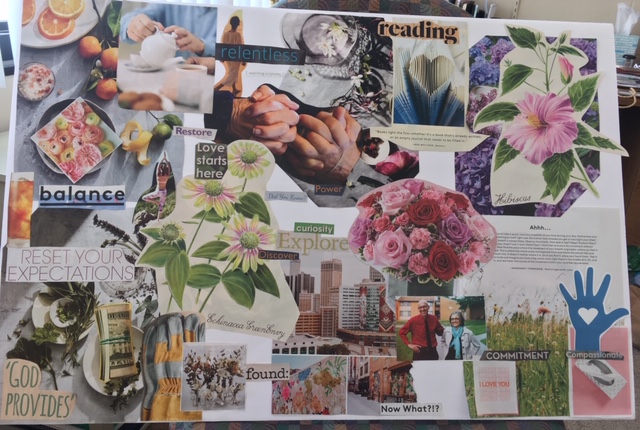
We ate great food and talked and laughed. We did yoga together. And then one friend pulled out presentation boards and a pile of magazines, scissors, glue, and markers — she had provided a project. Our goals were broad — to find words and images that could express who we are, where we have come from, or where we are hoping to go.

We sat at a large oval table in front of a window overlooking a frozen lake, quietly flipping through pages, clipping out words and images, and arranging and re-arranging them on our boards. Pandora was playing Lauren Daigle and Corey Asbury, and voices could be heard humming or singing along. We occasionally commented on what we were doing, but mostly we were focused and quiet.

After we had each gathered a pile of clippings, we began the process of arranging them on our boards.

the process

As I experimented with layering images, I discovered themes emerging. I began reflecting on the past year and how our difficulty had led to so. much. healing. One section of my board captures my continued physical healing with images of tea and yoga and aromatic flowers and fruits. Another reflects on the transformation of my spiritual life — praying hands, a solitary walk, and ‘searching the scriptures’. A roll of dollar bills sits on a plate near the words “Reset your expectations” and “God Provides” signifying financial healing.

I was surprised by the number of flowers on my board, particularly after such a long year of grief wherein I cared little about what I wore or how my hair looked, let alone the adornment of jewelry or flowers. But as each bloom grabbed my eye — roses, wildflowers, hibiscus, and lilacs — I tore and clipped. I lavished my board with flowers. I couldn’t seem to get enough, because, guys, I’m not mourning any more. I’m celebrating. I’m thankful.

As I arranged words and images on my board, I was overwhelmed with thanks — for physical healing over the last several years, for spiritual healing in the past several months, and for newly discovered financial healing.

I heard Pastor Brian Wolfmueller say recently that when we give thanks, we “shift our view from doing to reviewing.” That’s what this process of clipping and arranging was for me — an exercise in reviewing.

A long Margaret Townsend quote about the importance of breath sits in the lower right corner near a box of tissues, a hand, and a photo of my husband and me taken at the height of last year’s difficulty. We’re smiling in the photo, but I can assure you that tissues were not far away. I am thankful for this photo because it shows that despite the fact that we were desperate for most of last year, we were committed to being desperate together. In the midst of trauma, our marriage bond was strengthened. We learned the importance of breathing through difficult situations and sitting in them together. One of the reasons that we were able to grow through these very difficult circumstances was the support of loving friends who continually made their presence known in very tangible but unobtrusive ways. They were compassionate rather than judgmental. They loved us when we were hurting.

And I guess that leads me to the last set of images. Our story of unspoken broken is centered in a city. Most of our trauma happened there, so you would think we would want to run from all things urban, but the opposite is true. Although we are safely nestled in a little house on an idyllic little campus, in a cushioned community, our hearts continue to lean toward the city.

Just before Christmas, we traveled to Detroit. We hopped off the highway to get a view of the neighborhoods — to see the brokenness and abandonment and to witness the opportunity for transformation. As I was paging through magazines this weekend, I found images of Detroit and I couldn’t turn past them. We love our life in Ann Arbor — our church, our friends, our jobs. We have experienced so much healing here and are so thankful for all the opportunities we have been given. I don’t know why I was drawn to this photo, but I put the city in the center of my board. It seems to belong there.

finished product

When we were all finished creating, we each retreated to privacy — to soak in a tub, or nap, or write — and then we gathered again. As one-by-one we shared our boards and what we had discovered, I was reminded of one more thing to be thankful for — the community that surrounds me, supports me, weeps with me, and celebrates with me.

I am so, so, thankful. And the words of Pastor Wolfmueller remind me that I can sit here and be thankful to the One who is making all things new. I can review the blessings for a bit. I can focus on what what’s next some other day.

 I will give thanks to you, Lord, with all my heart; I will tell of all your wonderful deeds.

Psalm 9:1

The Teacher You Need, re-visit

This post, first written in January 2016 and updated in February 2019, is briefer than Monday’s “Can I Ask You a Question” and visits some of the same themes with a little humor thrown in.

Kristin's avatarNext Chapter

I’ve been teaching since I lined up my childhood friends in chairs or desks in any garage or basement we were allowed to play in and ‘taught’ them the lesson of the day.

Some might say I was ‘bossy’. I prefer the term ‘influential’. I had to start practicing early to hone the skills I would need to manage a classroom of teenagers and convince them that yes, they would write a three-page paper on the use of dashes in Emily Dickinson’s poetry.

Now that is not to say that I became “the boss” in the classroom. I canbe. Iwillbe if I need to be.

I prefer to be the Ellen DeGeneres of the classroom. I like to make students laugh. I like to learn about them.I like to showcase their strengths and celebrate them.That’s my sweet-spot. Kids need a little “Ellen” in their lives. They need…

View original post 443 more words

Can I ask you a question?, re-visit

This post, written in February of this year and tweaked just a bit for you here, unpacks my journey from telling to asking –a practice which informs my most recent post, Of passing laws and changing behavior.

I have an adult student with some cognitive challenges who has been learning how to read for as long as I’ve known her; the process moves very slowly. Each word is a labor, and ‘Kelly’ is on her own time table. She will work hard for a few minutes and then take a break to sing or tell a “knock, knock” joke. When she wanders off topic, it can be challenging to recapture her attention, but I’ve found a pretty reliable way to re-engage her. I sit quietly with my hand raised, student style.

She soon sees my hand, points at me, and says, “Yes, Kristin?”

I say, “Can I ask you a question,” she says, “What’s your question,” and just like that we’re back in business.

My husband and I have been challenging each other to ask questions. We started this dialogue shortly after we admitted that we didn’t know all the answers.

My personal recovery started something like this: “Hi, my name is Kristin. I’m a know-it-all.”

My journey as a know-it-all started early. I was a straight A student in every class that I cared about, which was all of them with just a few exceptions:

US Government my senior year of high school because 1) it was right after lunch and I’d been up since 5:30am, and 2) our teacher, bless his heart, didn’t really sell his content in a way that sparked my interest;

Anthropology my freshman year of college because 1) a cute ROTC guy (in uniform!) sat on the other side of the auditorium, and 2) the instructor, bless her heart, stood at the podium in the front of the lecture hall droning on and on as she clicked through slide after slide;

Principles of Fitness in college because 1) I was anorexic, and on day one I was shown how to use calipers to measure my body fat, and 2) the instructor, a soon-to-retire coach, bless his heart, seemed less than thrilled to be stuck teaching a required course.

See a pattern? If I had a reason not to learn it and the instructor didn’t engage me, I had better things to do with my time and energy.

And besides, as I said, I’m a know-it-all. I’m basically right about everything — education, parenting, marriage, writing. Just ask me. And if you don’t ask me, don’t worry, I’ll let you know what I think anyway, either by telling you, by showing you, or by wearing an all-knowing expression on my face.

Yeah, my know-it-all attitude has never really fostered communication, let alone transformation. Unchallenged for much of my life, I forged onward, knowing what I knew and operating from that core until — whoops! — I realized that I didn’t actually know everything.

Over the past few years, my husband and I have been faced with very difficult questions, and we haven’t had all of the answers. To complicate matters, we keep finding ourselves in conversations with people we don’t agree with. In similar situations in the past, I would’ve used my position, power, or sheer force of will to press my opinions and beliefs onto others, using words or actions to convince them that I was right — about ministry, marriage, parenting, or politics. But guess what — force-feeding doesn’t convince people to eat what you are serving. People don’t actually like to be told what to think, feel, or believe. They like to be challenged to find their own answers and invited into conversations.

I know — it’s mind-blowing!

So, as a recovering know-it-all, I have, with my husband, been considering an alternate strategy — asking questions. What if, instead of telling everyone I know the best way to teach writing, I ask other teachers what strategies they have found to be effective? What if instead of pushing one particular type of school, I ask parents what factors guided their educational choices? What if instead of insisting that the best treatment for chronic illness is homeopathy, I ask a friend what she has found to be most useful in dealing with her illness?

Do you see what happens? Telling keeps people at a distance. Asking brings them into your space! Telling keeps me isolated. Asking gives me community! Telling sets my feet firmly in the ground. Asking creates space for me to move!

Now, I will admit, that this new stance — asking — feels more vulnerable than my previous one — telling. When you bring people into your space, they have much more opportunity to hurt you, but I’m learning that they also have much more opportunity to love you and to be loved by you. 

I will also admit that because the former way was so well practiced, it has been difficult to re-train the muscle memory. Our quest to transition away from telling started in the theoreticalWhat if we asked people questions rather than debating the correct answers? It then moved to the pedagogicalCertainly asking questions invites others to join in conversation. But it has taken us a while to move from the theoretical and pedagogical to the practical — actually asking questions.

Coincidentally — hah! — at the same time that we’ve been exploring questions as a means of making conversation and building community, a member of our small group community has, in every discussion we have had, started each thought with, “Could I ask you a question?” Evidently, as an organizational change agent, he has developed this practice as an effective tool to facilitate group engagement. He asks questions and then explores the answers.

We’ve had a role model right in front of our eyes!

So, we had the theoretical discussion. We determined an appropriate action. A model was provided, and then the occasion appeared — the moment in which we met a challenge to our preferred way of thinking and living that produced personal transformation*.

It happened last weekend at a prayer conference we attended. One of the presenters, Chris Paalova, of All Nations Church in St. Louis, MO, spent his forty-five minutes asking us if we would be willing to change the way we pray from telling God what we want him to do to asking Him.

He built his case for this method by citing numerous passages where the big players of Scripture — David, Abraham, Paul, and even Jesus — prayed in questions — from David in the Psalms asking, “How long, Lord? Will you forget me forever?” (Psalm 13:1) to Jesus on the cross asking, “My God, my God, why have you forsaken me?” (Mark 15:34)

And as he gave example after example it dawned on me that even with God, I have been a know-it-all. I don’t ask, “What are you showing me through this illness?” Rather, I say, “Lord, please reduce my pain.” Instead of asking, “Lord, will you please encourage my kids and show them who you are?” I say, “Lord, encourage my kids and provide for their needs.” Instead of asking, “Lord, what am I missing here?” I say, “Lord, lead me through this circumstance.” It’s subtle, but in my prayers, I am calling the shots. I am not being vulnerable with God. I am telling Him what I want when I could be asking Him what I need.

Like ‘Kelly’, I’ve been working on this lesson for as long as I can remember. I’ve been trying to learn that God is God and I am not. He is the only one who knows everything. My stint as a know-it-all was all smoke and mirrors. He knew that. And because He wants to engage me, to draw me closer to Him and be in relationship with me, He keeps varying his instructional methods.

So, at last, I’m sitting here raising my hand, and I can almost hear Him say, “Kristin, what’s your question?”

I think we’re back in business.

Ask and it will be given to you; seek and you will find; knock and the door will be opened to you.

Matthew 7:7

*Kirkegaard, again.

The Occasion, revisit

More on process over product — this lesson I keep coming back to.

Kristin's avatarNext Chapter

This post, first written April 2018 and updated February 2019, is further exploration of the topic, the process.

As a student, I hated group assignments. I dreaded the moment when a teacher would put me with two or three other students and give us a task to accomplish. I would groan, shoot the instructor a micro-glare, and reluctantly join the others who were equally ‘enthusiastic’. Why did I hate it so much? Was it because every group has a slacker and I hated the imbalance of effort? Or was it the fact that I would have to approach a problem in a way that I was unfamiliar with? Because if a teacher gave me a page of math problems, I could fly through them pretty quickly and end up with fairly accurate results. If I had to answer comprehension questions on a chapter in US History, no problem. Zip, zap, zoop. However, if a task involved more complexity and I had…

View original post 1,176 more words

The Prize is in the Process

One of the things I like about the instruction I am doing right now is that we don’t give grades. We don’t design instruction to meet a finish line; instead, we celebrate every step of the process — every attempt, every mistake, every win. All day long, I cheer on my students (and my staff) for showing up, for trying hard things, for taking chances, and for participating in the process.

It’s scary to participate in a process that you have no guarantee of finishing or winning. Would you register for a 5K if you didn’t think you could at least finish? What if every time you have attempted a 5K you have collapsed before the first turn? Who of us would sign up for something that has — for us — repeatedly ended in failure?

That’s what my students do every day. Students typically come to Lindamood-Bell when other attempts at reading or comprehension or school in general have ended in failure or severe difficulty, and we ask them to work on the thing that is most difficult for them — five days a week, often two or more hours every day. Even showing up is difficult for most of our students, yet they do show up. So we celebrate even that. We greet them enthusiastically, and we clap and hooray when they try something — especially something that has seemed difficult. The instruction is more focused on the process than the product, and, unfailingly, each of us — the students and the teachers — are changed.

These kids have taught me that the prize is often in the process.

My friend, Marv Fox, says in his soon-to-be-released book, Become, that all things are necessary steps toward achieving our goal. He sees every challenge, every setback, as an opportunity to build muscle that will propel him forward. If he bombs at a public speaking engagement, he learns from that experience — he evaluates the steps he took in preparation and delivery and determines what he can tweak before the next opportunity he has to speak. He doesn’t stop speaking because he bombed; he sees the ‘bomb’ as an opportunity to learn and grow — to be changed by the process.

Marv is not alone in this belief, of course. Yesterday, I participated in a conference on prayer. One of the presenters, Connie Denninger, co-founder of Visual Faith Ministries, reminded participants that everything that happens in our lives is part of our spiritual formation. She said, “I wish I wouldn’t have had to go through some of the things that I have, but they have brought me to the place that I am.” Part of her story is that, as a pastor’s wife, she had never been comfortable praying. When Connie’s mother died at a relatively early age and Connie felt that she had lost her best prayer warrior, she was devastated. Who would pray for her now? In answer to her question, God put Connie on a journey toward a life of prayer that she now chronicles through her blog. In fact, this ministry, formed with friend, Pat Maier, now involves others in Visual Faith communities across the country. Connie and Pat have invited others to join them as they celebrate their process.

For the past several months, I have been reading and writing my way through a book called The Artist’s Way. Each chapter invites the reader to engage in a rhythm of writing every morning (the morning pages), and exploring activities that invite creativity (artist dates). I really did not want to read this book (in fact I wrote about it here), but committing to this process has been transformative. Each morning, as I show up, I find reason to celebrate. I am amazed at what I find myself writing on the pages and how my attitude shifts from the first line to the last. My morning pages have no goal. I have not determined that I will write for 30 days or 60 days or a year and then quit. I have just decided to enter the process of writing every morning and to watch and see what happens. The process alone has been the prize.

Several months ago, my husband was asked to help lead the prayer conference that I participated in yesterday. He is invited to all kinds of events, and I don’t always join him. I have to be judicious about what I say yes to; I always have to be mindful of how much gas I have in the tank. So, when he told me he was going to be part of the prayer conference, I didn’t initially intend to go. He was leaving on a Friday afternoon and would be gone until Saturday night. After a long work week — all that cheering and clapping and such — I knew I wouldn’t have gas in the tank to travel to Lansing and participate all day long on Saturday. I knew that for my weekend re-fuel, I would have to be on the couch.

However, a week or so ago, I discovered that the conference would be live- streamed! So, I sat in my pajamas, with my dog by my side, and joined the discussion of five individuals who have committed to the process of prayer. They shared what they’ve learned by choosing to make prayer — conversation with our Father — part of their everyday lives. They haven’t determined to try prayer for 30 days or 60 days or until their prayer gets answered. They have chosen to daily enter the process and see what happens.

None of the presenters said that they have discovered the key to prayer or that they have arrived at some destination in their prayer life. Rather, they celebrated the fact that they get to join in what God is doing because of the gift of prayer. They each acknowledged that they often have to overcome obstacles to continue in this commitment, but they all affirmed that the activity of prayer itself — the process — is transformative.

I won’t be able to share in one blog post everything I learned yesterday by sitting on my couch and joining others in listening, thinking, writing, and praying, but I will tell you that my choice to show up and invite the change that comes with entering a process was rewarded. I learned. I shifted. I grew.

Yes, commitment to the process takes time, but as I’ve learned from watching my students and from being a student, the process has power to create change. So I’ll continue to show up and to participate in yoga, in writing, in prayer, in life. I’ll sign up, even if I keep falling down, because the running, the falling down, and the getting back up are building muscle, preparing me for what’s next, and propelling me forward.

 Therefore, since we are surrounded by such a great cloud of witnesses, let us throw off everything that hinders and the sin that so easily entangles. And let us run with perseverance the race marked out for us,  fixing our eyes on Jesus,

Hebrews 12:1-2

Putting it in Practice, revisit

#TBT A Recycled Post that still resonates.

Kristin's avatarNext Chapter

Editors Note: This is a re-post. As part of my TBT series, I am following each Monday post with a Thursday re-post. This post, first written in May of 2017, looks at the same concept of “practicing” disciplines that I explored earlier this week. 

I’m beginning to think that lessons are never fully learned, or as we say in the field, mastered, but rather that ourlessons require continuing practice.

A child sits at a piano slowly fingering the do, re, mi, fa, so of a C-major scale. Over and over she plays, repeatedly faltering at one particularly tough spot where the thumb has to cross under two fingers in order to hit all eight notes in the octave. Sure, sure, after hours upon hours of practice, the scale becomes easier, therhythm more consistent and measured, but let that pianist take a month away from the keys, and almost assuredly…

View original post 1,126 more words

Practicing Yoga, a revisit

During a particularly difficult time a couple of years ago, a good friend reminded my husband and I, “none of this is a surprise to God.” He saw it coming, and He had prepared us in advance of the crisis and had carried us through it. As I isolate in my little house by the river, I have been reflecting on all the ways God has prepared me (us) for such a time as this. When I stumbled across this post this morning, I remembered all the training I have been through and how strong and resilient I have become. You have, too. We have been prepared in advance for this moment.

The first time I walked into a yoga studio, I looked around and did what the others were doing — got a mat, sat down cross-legged, and quietly waited for instruction. I hadn’t done any research, had no idea what I was getting into, and struggled to mimic the poses that were being demonstrated at the front of the class. I was a distance runner at the time, so I was in great shape for running, but I had little to no upper body strength, a poorly-developed core, and little to no flexibility — physical or mental. I ended the class feeling frustrated and nauseous. I didn’t try yoga again for a long time.

When chronic pain and fatigue ended my running career, I joined a gym. My regular routine included thirty minutes on an elliptical trainer, light weight lifting, and then some restorative movement in the warm saltwater therapy pool. Once in a while, I joined a pilates class. I stayed in that rhythm for a year or so, and when my daughter gave me a month-long membership at a yoga studio, I decided to give yoga another try.

Since I had only had one previous experience with yoga, and that had ended badly, I asked my friend to go with me. I’m so glad I did. Without her, I was the only ‘mature’ woman in a room filled with college students. The instructor was a young man whose body reminded me of the bendable figures our oldest son used to take with him on long car trips — I’d never seen such a strong and limber human. To make matters worse, it was an advanced vinyasa flow class. If you know what that means, you know that I was in the wrong room at the wrong time. I tried to keep up, but I didn’t know the poses, or the vocabulary, and I still had neither the strength nor the flexibility for much more than child’s pose.

Child’s Pose


Sure, my inner soldier made a valiant attempt. I tried to move through a vinyasa, even though the word was brand new to me. I tried to be any kind of warrior — I would’ve settled for one, two, or three. I pretended to be a mountain, but what that class taught me was that I needed to take the posture of a child — physically, mentally, and emotionally — and start to become comfortable with learning a new way.

That class was a few years ago. Since then, I’ve been practicing yoga. I’ve been learning how to breathe. I’ve been building core strength. I’ve developed some vocabulary and even some flexibility.

I often say, “God is always preparing you for what’s next.” In school, we first learn letters and sounds so that we will be prepared to read words. Once we have some vocabulary, we can begin to read sentences. Sentences lead to paragraphs which lead to stories which lead to all the ways that print can open up the world for us.

Menial jobs like babysitting or lawn mowing provide opportunities to learn the basic practices of showing up on time and finishing a task. They build experience, or muscle, that enables us to take on more difficult jobs such as food service or sales. These jobs teach us about working in teams and being able to adapt under pressure — they teach us flexibility.

All of life is preparing us for what’s next. When, as children, we learn how to line up and take turns, we are learning the basics of how to function with others. When, in adolescence, someone says something unfriendly about us, we feel the pain that reminds us to treat others with kindness. When we experience our first heartbreak and someone listens to us as we cry, we learn how important it is to be compassionate. When we face the many challenges of juggling finances and deadlines and friends and work, our core strength is being established. All of life is practice — practice for what’s next.

In advance of my soldiering years, I had several experiences that built up my stamina and developed a fearlessness that allowed me to step into responsibility and to manage difficult situations. God had given me what I needed; He knew what was coming. When those years were over, He provided an opportunity for me to learn a new way, but first He had to teach me how to be still. He had to remind me to breathe.

When I first started practicing yoga, I thought it was weird that the first 5-10 minutes and the last 5-10 minutes of the practice focused on stillness and breath. How could I get stronger by being still? How could bringing my attention to my breath have any lasting impact on my physical body? In my mind, exercise was about exertion, pushing the body, and burning the calories. These messages — remnants of the soldiering years — had to be put aside. Although the way of yoga seemed strange to me, I moved into child’s pose and began to learn to listen to the sound of my own breath, to watch the rise and fall of my body, and to pay attention to how I feel physically.

This way is new to me. I have long walked/trudged/powered through life giving attention to my body only when it cried out in pain or shut down in illness. Then, I have had it patched up as quickly as possible and resumed my forward motion. And my body has suffered, but not just my body. I have also ignored my emotions. And my spirit. I have put myself on a course with the goal of finishing. Period.

But in this chapter, I find myself over and over again in the posture of a child, often helpless and crying, needing to learn a new way. And, as my pastor said this morning, new ways are “not something we arrive at, but something that we practice”.

So I’ll continue to practice — yoga, yes, but also returning to my spiritual practices of prayer, Scripture, worship, and community. These are the practices that have been re-shaping me, re-wiring me, re-pairing me, and pre-paring me for whatever comes next.

 Therefore we do not lose heart. Though outwardly we are wasting away, yet inwardly we are being renewed day by day. For our light and momentary troubles are achieving for us an eternal glory that far outweighs them all.

2 Corinthians 4: 15-16

As we sit in this uncertain time of sheltering in place, perhaps you’ll join me in returning to those spiritual practices — prayer, Scripture, worship, and [virtual] community. Maybe we all have something more to learn.

Making Up for Lost Time, revisit

As I step back to my blog, I’ll be posting new content on Mondays and revisiting older, but still relevant, posts on Thursdays. This is the first in my #TBT series.

Kristin's avatarNext Chapter

Editor’s Note, January 24, 2019: I’m looking back at old posts and seeing how they resonate with me now. This one, in light of what I wrote on January 21, 2019, reminds me of all the ground work that God did in anticipation of 2018. While we were trudging through, my husband and I often reminded ourselves, “none of this is a surprise to God.” This post, originally written in 2017, is evidence that He knew what was coming and was preparing us in advance.

During all my years of soldiering — of butt-kicking and name-taking — I was in constant motion, often simultaneously cooking, doing laundry, answering email, talking on the phone, and granting or denying permission to one of my children. I got a lot done. It seems that I was able to keep a clean house, feed a family, teach hundreds of students, and arrive most…

View original post 763 more words

From Mourning to Hope, a re-visit

After posting on Monday about choosing hope over despair, I thought I’d revisit one of the first pieces I wrote this year, to remember how far we’ve come.

2018 was the year that I stopped rucking. I finally had to set down my pack.

According to my son, who served in the 82nd Airborne, “rucking” is a long march, 15-20 miles or more, with a heavy pack of gear strapped on your back.

Image result for ruck march
Ruck March

The soldier carries necessities — provisions, weapons, extra socks, and the like — and moves forward. The more he does this, the better he gets at it — the longer he can go, the more he can carry. Soldiers practice rucking, of course, so that when they have to go on a mission, they have the strength and endurance they need to endure.

I had gotten pretty good at rucking in my former life of soldiering — when I survived a season of high demand by butt-kicking and name-taking. That old lifestyle was built on the premise that I had the strength within myself to accomplish whatever task was put in front of me. It depended on bravado; I believed that by the force of my will I could solve all the problems and complete all the tasks. I could ruck.

I’ve learned a lot since then.

Over the last four and a half years, I’ve chronicled in this blog the retraining I’ve undergone to stop living the soldiering lifestyle. I’ve changed physical things like my diet, exercise, healthcare providers, and job, and emotional things like the taking time for therapy and daily writing and rest. Yet, while I have been very intentional about stepping away from soldiering, I am still prone to strapping on that backpack when the going gets tough.

And it does get tough, doesn’t it?

This past year was one of the toughest yet. And I might’ve gone back to soldiering, if it would’ve done any good. But even I couldn’t muster the strength to carry the kind of heavy that 2018 brought. The inner mantra I used to live by that said I could handle anything was silenced. The heaviness of 2018 was more than I could carry. I could no longer ruck.

I sat down, let my pack fall to the ground, and I cried. Over and over this year, I cried, and I cried, and I cried.

I grieved most of 2018. I grieved for many who are dear to me whose losses are great, and I grieved for myself — for all the losses I have failed to grieve over the years. Likely the biggest grief of all was realizing that — that I hadn’t felt all the feelings when I should have been feeling them; instead, I had been rucking. I’d been carrying a load of hurt shoved down deep in a bag, when I should have been spreading all the griefs out on a blanket, examining them one by one and recognizing the weight of each loss.

So, that’s where I started — I opened the bag, dug deep inside, and brought out all the hurts that lay crumpled deep inside. I spread them all out, sorted through them and described each piece in writing. I took stock of the damage, and I prayed and prayed and prayed. I invited others to pray with me. I spent hours and days and whole weeks talking with my husband — rehearsing forgiveness and grace. And, finally, I think it’s time: I think I’m ready to take a break from grief.

At the very beginning of our season of grief, as though to provide for me a literary symbol, the necklace I wear every day was broken. It’s a gold chain that carries a small heart charm– a baptism gift from my godparents that I wear to remember whose I am — and a butterfly charm that my mother gave me when I earned my master’s degree that I wear to remember that I have been transformed. I’m not big on jewelry. In fact, my skin rejects all but the finest of gold, so when the chain broke about a year and half ago, I didn’t find the wherewithal or the resources to deal with it.

But on Christmas morning, just a few weeks ago, as we started to believe that the gray fog of grief was lifting, my husband gave me my repaired gold chain. I’ve put it back on, because I need a physical sign that the season of mourning is over. I need a daily reminder that I am a child of God who has been transformed and that the times of refreshing have come.

Certainly 2019 will not be free of trouble. We may be devastated again today or next week or next month, but for now, I am going to acknowledge that we were carried through 2018 not by our own might, but by the Hands of God who saw every tear, heard every prayer, and who, right now, is turning our mourning into hope.

You have turned my mourning into dancing for me;

You have taken off my sackcloth and clothed me with joy”

Psalm 30:11-12

Take Care for the Holidays, a Re-visit

Recorded in early morning voice for those who like to listen. Prefer to read? Read on.

As we head into the holidays, let’s gently remember that not everyone in our path is looking forward to reunions. I re-read the words of this blog this morning and remembered writing them through tears last year — we were broken and anticipating feeling all of that brokenness at the holidays. While much healing has happened in the past year, we are still tender enough to remember — and in that remembering, I want to be sure to take care.

Though we may not have admitted it — we are well on our way into the holiday season. It started with emails and phone calls early in October. Who is doing what for Thanksgiving? Who is hosting? Who will travel?

Discussions of Thanksgiving have already turned into talks about Christmas. Where will we meet? Who will gather? When will we worship? What gifts will we buy?

We begin our talking and planning early because holidays matter.

They have been historical points of connection. Even if they haven’t been perfect, they have had meaning. So, each year as we start early to anticipate reunions and traditions, fondly remembering caroling door to door, sledding down snowy hills, eating Christmas cookies, and unwrapping presents on Christmas morning, we are tempted to build expectation that our holiday gatherings will be Norman Rockwell perfection — even if they never have been.

All of this hope and expectation filters into our holiday conversations, which, if they haven’t already, will start this week. You’ll ask or be asked, “What are you doing for Thanksgiving?” expecting to hear something like, “I am going to my grandmother’s,” or “We host a huge feast every year,” or “I’m getting together with my friends.” These questions seem harmless or even polite, but you may be surprised to learn that they can be emotionally laden (and even triggering) for many among us.

  • For the young man estranged from his family because of differences in beliefs.
  • For the grieving parents whose only child lost the battle to cancer a few months ago.
  • For the recovering addict who isn’t up to managing the annual toast or maneuvering through family drama.
  • For the woman who was molested by a family member every holiday during her childhood.
  • For the newly widowed man who lost the love of his life last summer.
  • For the family who is recovering from years of dysfunction and trying to start new traditions.

They are all around us — these brave souls who are taking great pains to get out of bed every day, who struggle on an average Tuesday to shower, dress, get to work, and feed themselves. Regular days are hard.

Holidays?  Those are next-level difficult.

I was lying on a table last week as one member of my health care team was attending to my body. We entered into the pre-Thanksgiving questioning protocol benignly enough, but before I knew it, there were silent tears and flashes of memory. Holidays do that. They conjure up images of joy and pain — the full tables and the empty places. They invoke feelings of contentment and regret. They raise expectation and anxiety. Cordial exchanges that seem casual on the surface, may trigger an emotional reaction in those among us who are quietly struggling or suffering.

Am I saying that you shouldn’t ask the questions, or that you should veer away from discussions of family and Christmas and tradition and celebration? Not at all.

I’m saying, take care.

I’m saying look people in the eyes. Ask, and then listen. Don’t assume that every person in your world is looking forward to the holidays with joy. Rather, know that for many this is a very difficult time of the year. As you move through your pre-holiday interactions with the people in your life, you may be the only person to see the hard swallow or the averted gaze. You might be the only one to notice the dodged question or the avoidant joke.

And when you do, lean in. That hurting person needs to know that you saw, that you noticed, that you heard.

After I got up off that table last week, my provider and I exchanged a hug. That’s all. No prying. No awkwardness. Just a hug. The tears were seen and acknowledged. That was enough.

Yesterday, I began my search for gifts for the important people in my life. My focus was on the objects, of course. I was trying to find just the right items. A salesperson asked me if I was just looking; I said yes and then continued to browse. She kept talking, wanting to tell me about the sales. My initial reaction was to be annoyed, “Just let me shop; I said I don’t need any help.” I didn’t say it out loud, thankfully. Instead, I stopped, listened, and chatted with her a couple of times. I looked at her eyes. I listened to her voice.

I’m trying to live differently.

I think that’s where it starts, don’t you? If I just pause from churning through my to-do list for a moment, slow my roll a bit, I can see the other people around me. And when I see them, I will begin to notice the ones who just can’t wait to get home to be with their families and the ones who are aching and anxious and wish we would just knock it off with all the angels and bells and Santas already.

And when I notice, I can take care, lean in, and listen a little bit more, and perhaps, these small acts will begin to bring healing.

Be devoted to one another in love. Honor one another above yourselves.

Romans 12:10