Of (not politics, but) Bullying

Some people don’t like it when I talk about politics….I get it. If, as Wikipedia* states, politics is “the set of activities that are associated with making decisions in groups, or other forms of power relations among individuals, such as the distribution of status or resources,” I can see why the topic might make some people feel uncomfortable.

I mean, why would you want to examine the reality of which folks hold the power, which groups benefit from the decisions of those folks, and which groups are historically and perpetually disenfranchised by those decisions. That examination could lead to unsavory images, to be sure, and we wouldn’t want anyone to have to see that, so, let’s not talk about politics.

Instead, class, today let’s talk about bullies.

Every single school I have been a part of has had its bullies.

They don’t have to be the stereotypical intimidatingly oversized thugs that might be populating on your brain screen. In fact the bully of my first class was quite undersized. Physicality is not essential to the bully. Rather what characterizes the bully is the behavior that seeks to dehumanize, belittle, embarrass, or otherwise harm others and the presence of, at first, a yes man, then a crew, and ultimately the compliance of the larger group in allowing the bully to continue harming others.

It often starts with the bully targeting someone who is demonstrably “weak”. The bully might make fun of the disabled, denigrate immigrants, or even make jokes about someone’s weight. He (or she) looks around for a target then slings a grenade with the intent to do harm. But the harm is not where the power lies.

No. The power lies in the reaction to the harm. He gets a laugh at the expense of the disabled, a snicker at the expense of the immigrant, a guffaw at the expense of the overweight. And those responses are the fuel for the next attack.

Still high from the reaction of the yes men, the bully begins to scope out his next target — maybe someone with a little more clout — maybe a classmate or a peer. First he spreads rumors to harm his target’s reputation, he engages in name-calling to dehumanize his foe, he might even accuse others of wrong-doing, whether or not there is credence to his claims.

Throughout all of this, those around him, seeing the power he is building, have to make a choice — do they want to land in the bully’s sites or take a position at his side?

That’s a tough call, especially if you are in middle school or still have the insecurities that you had when you were in middle school. You might not think you can handle humiliation. You might not think you could weather the name-calling. You might not think you could bear up under the rumors. So, you chuckle at his antics, you move to his side of the room, you excuse his behavior as harmless, and you turn your eyes away from the victim.

And you continue to live with that decision because it still feels safer than having him turn the attention on you.

But then the assaults escalate. The blows become physical. And he’s going after someone who is or who used to be your friend. He might even attack a member of your family. Then you have to face a crisis of identity — who do you want to be? Do you want to stand behind this guy, smiling for the camera in your suit, waving your flag of allegiance, as he takes shots at not only the least of these but also at your neighbor, your brother, your friend, or your mom?

This moment happens in every bullying movie you’ve ever watched — The Karate Kid, when Danny LaRusso takes the blows of Johnny Lawrence almost to his peril in the final match, Mean Girls when Cady, who was once part of Regina George’s crew, finds herself a target when the burn book is circulated — the individual who had chosen to capitulate or even join a bully has to decide if they are going to stand up.

The rare ones who, despite their inner terror, find the courage to say “Not here, not today,” rise up from their devastation and face the bully. In the movies, this usually results in the bully walking away in shame or, in the most ideal of scenarios, having a change of heart and determining to be a different kind of person.

This sometimes happens in real life, too, although not inside the space of 90 minutes, and certainly not when the bully has been allowed to gain control beyond the schoolyard and into the community. No, in those cases, one person standing up will not be enough. To stop a bully who has, through all the text-book tactics of instilling fear through intimidation, established a culture of systemic compliance to the most ludicrous of actions, the community must come together and take a collective stand. They must, united, shout “Not here, not today!”

One person might not stop a bully, but a lot of single people, together, can do almost anything.

The bully can’t continue unless the community lets him.

Certainly the community will wake up and put a stop to it — it’s not politics, after all, it’s just refusing to let one person dehumanize another.

Defend the weak and fatherless; uphold the cause of the poor and the oppressed. Psalm 82:3

A couple of notes:

*If you were a student of mine in the early 2000s and cannot believe that I actually cited Wikipedia, see also lecture #497 entitled “Anybody Can Change”**.

**And when I say “anybody can change”, I do mean even bullies.

Also, if you listened to this post, you might be interested to know that the text version has several embedded links.

It’s complicated

The seemingly unintelligle words of hospice — one month, a few days, 48 hours, probably today — all started making sense and then were undeniable. My stepfather took his last breath in the early morning hours last Saturday. In the days that followed, we gathered, made arrangements, gathered again, handled details, cared for our mom, and came to terms with the fact that my stepfather, Roger, is no longer here.

We’re still working on that last part, of course, and for me, the essence of our relationship makes it little complex.

While many found him charming, Roger and I had what was often a prickly relationship. We didn’t agree on hardly anything — politics, the setting on the thermostat, the way to wash dishes, vacuum a floor, wipe off a table, or do just about anything. I found him to be demanding, opinionated, and critical. I often felt great irritation toward him over our 50-year relationship, probably because I always felt that he usurped the position that should’ve been held by my father who I have long-adored and often idolized, likely because he and I haven’t had many opportunities to interact on politics, the thermostat, or dishwashing.

Because of this complicated relationship with Roger, it came as a great surprise to me when I found myself feeling tenderness, compassion, and love for this man as he declined, as he lost his agency, as he forgot where he was, as he was unable to breathe, as he was confined to bed — a man who rarely sat still, who worked and golfed and bowled and rode a motorcycle halfway across the country. I was stunned to watch my heart shift from irritation to caring, advocating for, and comforting this man who has been an annoyance in my life for most of my life.

When my mom married Roger, she had four kids aged 8-14. He had two kids aged 8 and 10. Together there were three boys and three girls — just like the Brady Bunch, which was in vogue at the time. For a few years, the eight of us took vacations together and hung out together, but as we turned into teens and then adults, we were rarely together. In fact, my three birth siblings and I have only managed to all be together on a dozen or so occcasions in the last 30 years, and the six of us “kids” hand’t been together in the same room for close to 40 years before we all gathered on a Monday night for pizza a year ago.

Who knows how this happens — people are busy with their own lives, and if one person doesn’t act with intention, folks never come together. But last year we did, and then, miraculously, Roger took his turn for the worst just as we were scheduled to all be in the same state again this past month.

We all worked together — getting him moved in to assisted living, taking phone calls, running errands, and sitting by his bedside. We took shifts. His daughter, who claimed the overnights, fell asleep holdng his hand that last night, saying, “Good night, Dad. I love you” and reading him the 23rd Psalm.

We crammed in a small room at the funeral home — writing an obituary, picking out flowers, deciding on printed materials, then shared a meal with our mom, who kept saying, “I can’t believe this is happening.”

And then, on Wednesday, we all rolled in — the six kids, and our kids, and even some of their kids. Because of the nature of this complex family, some cousins met each other for the first time. Some nieces and nephews met their aunts and uncles for the first time.

Families can be like this, can’t they? Frustrations can lead to fractures and before you know it, you’re meeting your brother’s kids for the first time, marveling at their kids, and watching your own kids (and nieces) interact with their new-found family with curiosity and grace.

I probably won’t ever understand the complexity of Roger — why he was the way he was — but I can celebrate the fact that despite my irritation with him, he remained invested. He cared for my mom to the end (even if that in itself was complicated) and he cared for all of us in his own way, too.

Mom and Roger married when I was 10, and maybe because of “ew — cooties” or that previously mentioned loyalty to my dad, I rarely let Roger touch me — not a hug or a pat on the back, let alone a kiss on the cheek. So imagine my surprise when near the end, I found my hands on his waist steadying him, or when I agreed to scrub his back when he couldn’t shower himself, or when he grasped my hand to say goodbye, or when I kissed his head to reassure him when he was afraid.

We don’t know the love we have inside of us that is sometimes buried under hurt or anger or a little girl’s longing for her actual dad, but it is there, and it surfaces when it matters — when you need to sit beside a hospital bed, empty a urostomy bag, or say “I’m sorry this is what’s happening right now. I know you want it to be different.”

It doesn’t mean I don’t love my dad or that you could ever take his place. It means that I saw you show up and hang in there, even when I found you to be annoying, critical, demanding, and cootie-infested.

It’s complicated, that’s true. Much of life is.

Rest well, Roger, I’m pretty sure it was complicated for you, too.

Love one another. John 13:34

Here’s the thing(s)…

*A quick note, sources and resources are linked in the text.

I’ve been kind of quiet in this space lately. It’s May, and I’ve only posted six times so far this year. For a girl who posted almost daily when this blog began, six times in four months is virtually silent.

But here’s the thing….

Just kidding…there isn’t one thing that is keeping me from putting words on the page (or rather the screen)…it’s more like a steady stream of things that seem to keep coming at me (at you?) in such a way that I can’t really focus. I can’t keep my eyes on one thing for long enough to form a thought, let alone an opinion.

At work, I’m down to just a few weeks with my seniors, and their excitement/ambivalence/annoyance would be a lot to process and respond to on its own, but we’ve also had Family Conferences and Decision Day. Each of these events takes a team effort to prepare for and execute. (You know the drill — communications, set up, station assignments, and the running of the actual event, and although neither is my responsibility, I am a member of the team.) I also have had the responsibility this year to recognize students of the month (one for each teacher in the building) and honor roll recipients. This entails identifying honorees, pulling them from class for a photo, and sending those photos to someone — preferably not myself — to have them loaded into a Canva document before they are printed out and posted in the hallways. In addition to all of this “normal” school activity, the authorizer of our school charter is visiting us this week for an educational program review that we learned about just several weeks ago. Such a visit, like school accreditation, requires the submission of countless artifacts such as lesson plans, IEPs, coaching trackers, professional development documents, etc. I was part of a team that pulled all those together and submitted them electronically. This past week leadership and staff met to prepare for the visit that will be spread over three days — all while school is in session, you know, the actual teaching and learning part. Spring is always busy at school, but this year is exceptionally so.

At home, things are a bit more relaxed –we have no major repairs pending, and we’re happily in the midst of installing our garden — but if home life includes extended family, then I have to disclose that my mother and stepfather have had some pretty difficult challenges for all of 2025 that just right now seem to be stabilizing if you don’t mention the fact that at least one of them is recently ready to start exploring assisted living facilities, which takes the coordination of six adult children to do lots of fact finding. I would also be remiss if I did not mention that my dear Aunt Margaret, after many years of relative health, has taken a sudden and recent decline.

All of this is, of course within the realm of “normal” adult life. You have also had busy seasons at work and at home — they come and they go — and although they are at times taxing to navigate, we somehow make it through to the other side in time for the next wave of whatever it is that is coming.

But these are not the things that are blurring my focus. No, they take time, of course, and energy, but they are manageable. I think what has me off balance may have many of us off balance — the continuous stream of government actions that may or may not impact us directly, but nevertheless are jarring to the brain and that lead us, at least me, to at times retreat, to dissociate, to not want to process or deal with any of it.

In 2018, presidential strategist Stephen K. Bannon bragged about that administration’s strategy to “flood the zone” with initiatives. The idea was to roll out a constant flow of orders and directives to throw “the opposition” (you know, other Americans) off balance so that they could not respond (Source). Since that administration regained the presidential office this past January, this strategy is being used again, only to the nth degree.

In the first 100 days of this administration (in just under four months) we have been overwhelmed by actions such as: the pardoning of those who invaded the US capitol on January 6, 2020; the freezing of funds for cancer research, Meals on Wheels, and disaster relief; the implementation of tariffs on every country in the world, the pause in tariffs, the subsequent roll-back of said tariffs, and currently, the exponentially high tariffs on China (which will certainly impact most of us); the firing of countless federal employees followed by the attempt to rehire some of them; the withholding of funds to public universities who refuse to comply with the administration’s agenda; the deportation of countless immigrants, some whom are legal residents, with some being sent to foreign prisons; the continuing and hard to follow involvement in the ongoing conflicts in Israel/Gaza and Russia/Ukraine; the president’s attendance at the funeral of the Pope followed by his posting of an image of himself dressed as the pope on social media; and this is just scratching the surface (Source). You might be shouting at me right now, “what about the…[fill in the blank].”

Frankly, I’ve got to look at what is happening on the national scene through a peep hole with one eye covered. I can’t look at it in full — and that’s exactly the idea. This administration is using the everything, everywhere, all at once strategy to keep us all in this state of slack-jawed disbelief.

And that is where I find myself, only I’ve moved from stunned to numb. I feel detached from reality, not wanting to engage because I can’t keep up. But that is what this administration has said it wants — to “flood the zone” so that we become overwhelmed.

But here’s the thing — the actual thing — we can’t do that.

We can walk away. We can take breaks. We can sit for two hours after a long day and work on a 1000-piece puzzle depicting van Gogh’s “Irises”, or take a walk through the park plucking lilac sprigs, inhaling their beauty on a glorious spring day, or lose track of time choosing the latest fiction from the library shelves, or binge-watch “The Four Seasons” on Netflix, but then we’ve got to re-engage.

We’ve got to notice the actions that are being proposed — such as cuts to education, to PBS, to NPR!! — we’ve got to let our voices be heard — through letter writing, phone calling, boycotting or participating in peaceful protests. What we tolerate, what we look away from, what we allow — these are the things we accept.

And, overwhelmed though I might be, I cannot accept funding cuts to public education — not when I see the inequities that already exist. I cannot accept the devaluing of other humans — not immigrants, not members of the LGBTQ+ community, not minorities, not women, not anyone. I cannot accept that as the profits of billionaires increase their taxes are not commensurate, especially not at the expense of the poor. I cannot accept a disregard for the fragility of the environment — when we know better we have to do better.

Together we can weather a flood.

Beloved, let us love one another. 1 John 4:7

Why boycott?

Note: If you are listening to this blog post, several links are embedded in the print if you are interested in reading further.

Many years ago, not long after I met my husband, we began discussing a topic I’d never really considered before — boycotting. As I’ve mentioned here before, I grew up in a family that rarely, if ever, discussed politics. I remember when the Watergate hearings were on TV, but I have no shred of memory of how my parents felt about Nixon or the scandal. I have no idea, even, how they voted..

So when I met my husband, it was a little surprising to hear open political discussions — in the back yard, over dinner, on a car ride — about elections, of course, but much more specific issues such as unions, public assistance, and even (gasp!) abortion.

When I learned that in my husband’s family everyone drove American made cars or were required to park across the street when visiting, it made sense to me. My father-in-law was a retiree of General Motors and brand loyalty mattered. However, when my husband said he didn’t want to shop at Walmart, I had to ask why. He explained that Walmart was anti-union, and as a child of an autoworker, he had learned the power of the union to protect and support workers. He preferred not to support a company that wouldn’t allow its employees to organize. I didn’t feel passionately about it at the time, but I could get behind it.

As the years have passed, I’ve learned more about how Walmart underpays its employees while the owners become billionaires, I’ve grown my own distaste for the company and have shopped elsewhere. (This Time article chronicles some of Walmart’s journey including attempts they have made — under pressure from boycotting! — to improve.)

Of course, Amazon is similar in its practices. While it has made moves to reform, well-documented accounts cite drivers not being able to stop on their routes to use the bathroom and how they adapt to this expectation by carrying urine receptacles in their vehicles or by wearing disposable undergarments. Other accounts cite unpaid overtime, unsafe working conditions, and low wages, all while corporate profits rose to $88 Billion in the first quarter of 2025.

Amazon, Walmart, and other large companies are known for using employees — many of whom are low income and/or people of color — working them just up to the number of hours that don’t require them to pay benefits like insurance and sick leave and hiring for “provisional” employment and firing before the employee qualifies for permanent status. As a result, many employees of these companies remain on state and federal assistance while their CEOs pay a lower tax rate than the average American.

I have seen many of my students lured into jobs at Walmart, Amazon, and McDonald’s, promised pay raises, promotions, and an actual future, only to realize just weeks or months later that they had been misled.

So, what’s a middle-aged, middle-income woman like me supposed to do? How can I show that I don’t stand for this kind of corruption, that I don’t agree with these unfair practices? I vote with my purse. I’ve been doing this for years — avoiding companies that I don’t want to support and purchasing from those that I do. For many years this has been an isolated act that helps me feel like I have integrity. I doubt that I’ve made much impact, but I’ve slept better at night.

But this year, in 2025, anything can happen! All kinds of everyday people, using the engine of social media, can rise up and say, “You’re not getting our money!” If you take away your DEI programs, “you’re not getting our money.” If you won’t pay your employees a fair wage, “you’re not getting our money.” If you stand behind causes that harm our fellow Americans, “you are not getting our money.”

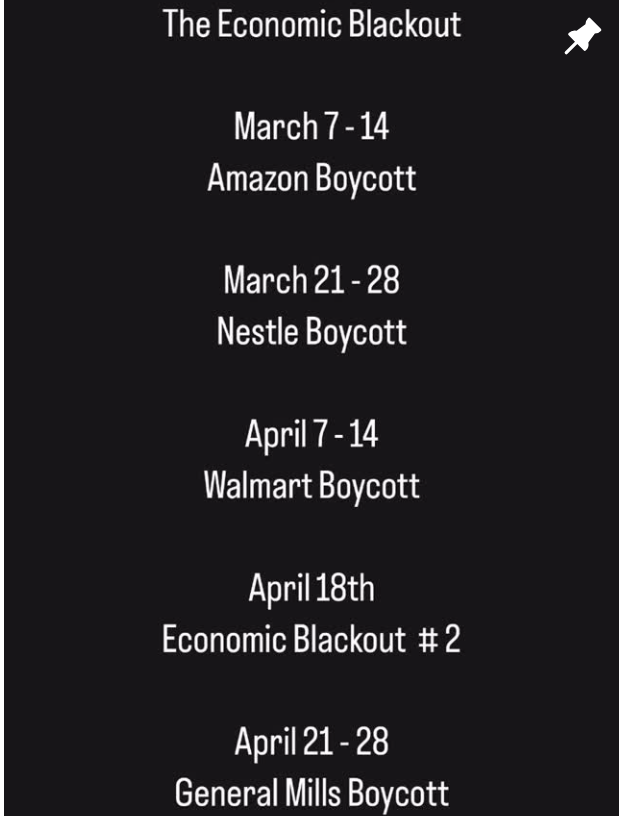
In 2025, I am not standing alone! People across the country are cancelling their Prime memberships and refusing to shop at Target, Amazon, Walmart, and other retailers. Last weekend, many refused to spend any money at all for 24 hours. This week, thousands are abstaining from Amazon purchases, and this is just the beginning!

Organizations like the People’s Union have coordinated efforts to systematically send a message to corporations that will hurt their bottom line without jeopardizing the jobs of those who currently work for these entities.

And the beauty of this protest is that it doesn’t cost anything, you don’t have to go anywhere, no one gets hurt, and if you don’t like it, you get to make your own choices. That’s what is great about living in the United States — we still have the freedom to say what we want, to spend what we want, and to support what we want.

For me, that means speaking up about inequity wherever I see it — in education, in health care, in commerce.

Now, I’m sure I still spend money, unwittingly, at businesses that have practices that don’t jive with my guiding principles, and if I learn about them, I will shift. It’s as easy as that.

What do I hope to accomplish? I truly hope the combined efforts of all those who are shifting their buying habits (some sources say 24% of Americans so far in 2025) will get the attention of these corporate giants and they will begin to change some of their policies. I think this could happen, because although the pen is mightier than the sword, money is what really talks.

If this movement can sustain itself long enough for these large corporations to notice changes in their quarterly earnings, we just might get their attention. And if we get their attention, they may hear our message — you can’t abuse people and still get our business.

It’s a small action of many that stands up for those whose voices are not being listened to; it’s an expectation that in a country that professes that all are created equal, that all would be given equal opportunity. Period

That’s reason enough for me to boycott.

uphold the cause of the poor and the oppressed; rescue the weak and the needy;
    deliver them from the hand of the wicked. Psalm 82:3-4

Home On Their Own

I’m at my parents’ house this weekend. I’ve been here quite a bit in 2025. In their early 80s, they have been having health issues for years, but this is the first year that we’ve seriously considered that living on their own might be just beyond their reach, especially since my mother fell and broke her femur last month.

However, nothing convinced my mother that she wants to stay in her own home more than two and a half weeks in hospitals and rehab. Although (or perhaps because) she worked in a hospital for over 40 years, she does not like being a patient, particularly not one who can’t get out of her bed unassisted.

So, she learned how to get up by herself, how to use a walker, how to transfer into the shower using a special bench, and how to pull on pants healing-leg-first. She allowed my brothers to carry her in a chair up the seven stairs into her house and acquiesced to hiring a home health aide to come to the house for four hours five days a week.

That lasted one week.

Having allowed this aide to make her breakfast, do her laundry, and clean her floors, my mother has determined that having her just two days a week will be adequate. She and my stepfather can manage the rest of the time on their own.

My husband continues to remind me that our parents are adults and can make their own decisions. And I’m working hard to stand back and let them.

It’s a little like parenting teenagers except I’m older and a little wiser. I think I know better than my parents, but I’m trying to be willing (along with my five siblings who seem much less controlling than I am) to let them call the shots and, as my oldest sister says, “let the changes be their idea”.

She’s right, of course.

When I look at my mother and her fierce determination to be at home and take care of herself, I know that I will be just like her in 20 years or so. I won’t want my kids calling the shots. I will need to see for myself when I’m out of my depth, and I’ll want to be the one to yell “help” when, and only when, I’m about to sink.

I don’t want them to get there, of course. I don’t want to watch my parents flounder, but who I am to determine how much struggle they can manage? Who am I to say when enough is enough?

I’m just a kid looking on, watching my parents navigate their reality.

And right now their reality looks like side by side rocker recliners in front of the TV watching cooking shows, Perry Mason, football, Jeopardy, and Wheel of Fortune. It looks like excitement over a chocolate shake or a delivered chicken chimichanga. It looks like rearranging the furniture to accommodate walkers and canes and oxygen machines. It looks like my brothers and sister-in-law dropping by several times a week to bring in mail and groceries, to pay bills, to manage household maintenance, and to simply check in. It looks like me coming on weekends to work on projects, to problem-solve, and to bear witness.

What it doesn’t look like right now is me taking charge, me kicking butts, me taking names.

It looks more compassionate than that — more understanding — more loving. It looks like running to Meijer two days in a row to get the items that weren’t on the list my sister-in-law took with her the day before. It looks like picking up a McDonald’s milkshake at 2pm and a Wendy’s Frosty at 5pm because I was asked and someone who is all but confined to a recliner doesn’t need my judgment. It looks like bringing all the towels in the house to the living room so that my mom can sit in a chair and identify which towels go upstairs, which go downstairs, and which go to the rag pile. It looks like making a pot of chili, instant chocolate pudding, and scrambled eggs and toast– “I’ll take mine with strawberry jelly.”

For a while last night I sat with my mom on the edge of her bed showing her how to operate the television my brother installed — how to use the remote, how to access Netflix, how to navigate with the Roku to watch her regular shows. She did a lot of nodding then asked me to write it down step by step, which I did. I placed the instructions, laminated with packing tape, on her bedside table under the remotes.

This morning I found them sleeping side by side in their recliners. Evidence suggests that my mom tried to sleep in her bed but just couldn’t get comfortable and so carried her pillow back to the chair where she finally nodded off. They were still sitting their unmoved at 11am when I finally decided to make them some breakfast, deliver their meds, and load my things into the car before my trip home.

My exit was made easier because my brother and his family showed up. I didn’t have to leave them alone in their chairs, even if I did know that that would be their eventual reality. I got to leave believing they were in good hands, not worrying if one of them would fall, if they would forget their meds or my stepfather’s breathing treatment.

I called, of course, when I got home. My mom picked up and said, “hold on a minute, let me get to my chair.” I felt myself get tossed into the bag attached to the front of her walker, heard the step-slide as she crossed the floor, and, moments later, she said, “OK, what’s up?”

I knew she’d have to get back out of her chair to heat up dinner, to change into pajamas, to go to the bathroom. I knew it was gonna be a struggle every step of the way.

Everything is going to be a struggle for a while, but they want to give it a try.

This is me trying to be ok with that.

Honor your father and mother. Exodus 20:12

In 2025…anything is possible

The turn of a calendar page, particularly from December to January over the line of a year, can signal a fresh beginning. We can get our hopes up that this year life will be different — the bills will all get paid, the friends will all get together, our health will improve, and we’ll witness less violence. But we weren’t even to the dawn of the first day of 2025 when we were reminded that terror still exists; we weren’t two solid weeks into this new year before we had to admit that tragedy will still come. Grief will be part of 2025 just as it was part of 2024.

It’s not what we want — we who make resolutions, who join gyms, who buy dot planners, who clean out our closets. We don’t want to read that teenagers were killed as they celebrated, that houses of thousands have burnt straight to the ground. We don’t want our loved ones to be sick, our friends to be overwhelmed, or ourselves to have anxiety about the future.

But reality is what we have. Our parents are admitted to the hospital, a strained relationship marches right into the new year, an appliance breaks down, work stress increases over night, and you suddenly notice a crack in your windshield.

Turning the page on a calendar isn’t magic. No. It’s just a moment in time.

So, shall we throw our hands in the air? give up hope? trudge on knowing that there’s nothing we can do?

You already know that’s not what I’m about here. You know I’m the one with an insufferable belief in restoration. You know I believe the pain could go away, the relationships could be renewed, the bills will get paid. You never know — your savings might grow in 2025. Your appliance might start working again. You just might figure out that impossible issue at work.

But it won’t happen just because you turned the page on a calendar. No. You might have to take action. You might have to start exercising and do the PT they showed you how to do. You might have to forgive someone and change your own behavior. You might have to stop buying that bougie coffee you love so much and put that money in the bank. You might have to call a repairman. You might have to ask for help.

We don’t love asking for help — we who like to pull ourselves up by our own bootstraps, we who kick butts and take names, we who take pride in getting shit done. We like managing things on our own, thank you very much.

We don’t love interruptions to our routine — broken equipment, illness, accidents. We like things to go as planned.

But in 2025, just like in all the years before, interruptions will happen. The sink will get clogged, a copier will get jammed, and the traffic will back up. In those moments, you might find a solution on your own, but you might have to network as a team with a spouse, a sibling, a coworker, a qualified professional.

Or, you may just have to wait it out.

But friends, don’t lose heart. Things are not worse than they have ever been. Nope. Since the dawn of time, the struggle has been exceptionally real. And people just like us have found a way to come together, to find solutions, to face the unexpected, to overcome difficulty, to not lose hope.

I am not sure how they did it in days of yore — I’ve heard tales of women gathering over quilts, of dinner parties where folk discussed issues and devised strategies, of community organizing in dusty offices under glaring light. I’ve read of sweeping movements that have made dramatic change in the culture, in policy, in the everyday lives of people.

I don’t know if I have the steam for all that, but I do have what it takes to get out of bed every morning, to write a few words on the page, to practice yoga, and to put this hopeful hunk of flesh in my car, drive 30 minutes east, and show up for my students. And, I can also find the wherewithal, when the unexpected happens, to pivot. When a call comes early in the morning, I can point my vehicle in a different direction and show up for my family.

I think that’s what I am bringing to 2025 — the knowledge that things are going to be as they always have been and the willingness to keep showing up anyway.

My goal is to show up without judgment and full of hope.This is the challenge, isn’t it? to show up without an attitude, without preconceived notions of what others should or should not be doing, with a heart that says anything is possible. Already this year I have shown up once or twice annoyed, irritated, and wringing my hands — this would all be different if only they would …fill in the blank.

But it’s still January, and I can’t expect to be hitting my goal with 100% accuracy from the jump.

It wouldn’t be a goal if I could already do it.

So here’s to 2025 — may we keep showing up full of hope. After all, anything truly is possible.

May the God of hope fill you with all joy and peace as you trust in Him. Romans 15:13

Ten Years Later #11: A String of Miracles

This is the last of the “Ten Years Later” series that I had intended to be a weekly feature in 2024. The year, as most are, was more than I had anticipated — more struggle, more loss, more healing, more restoration, more hope. This post, written and recorded in January 2023, sums up the vibe I want to carry into 2025 — the continuing hope that all things can be made new.

We purchased the gifts and wrapped them. We planned menus, purchased loads and loads of food, and baked ourselves silly. We cleaned the house and made all the beds, and then we waited.

As we sat on the coach, staring at Netflix, the texts started to come in.

“We’re checked in at the hotel! See you in the morning!”

“Our flight just landed!”

“We should be there in an hour!”

And then our family started rolling in — from Ohio, from Massachusetts, from Missouri.

We hugged, we laughed, and we ate.

We puzzled; we played games. We did crafts, watched movies, and traveled to celebrate with even more family.

It sounds like what most families do over the holidays, but I suppose many families, like ours, can get together like this only because of a string of miracles — only because of choosing forgiveness, of going to therapy, and of healing and time and the stubborn belief that things get better.

Didn’t you, too, have the holiday where everyone was yelling at each another?

And the one where no one spoke a word?

And the one where everyone walked out of church sobbing?

And the one where some decided they just. couldn’t. do it — not this year.

And then there was the covid year (or years — who remembers?) where we packed presents into flat rate boxes and stood in line for hours at the post office, hoping our parcels would get there before Easter. The year (or was it two?) where we sat in Zoom rooms with family members, some of us trying not to hog the air time, others trying to endure those who were hogging the air time.

It seems after all those difficult years we might have stopped believing that we could once again be all in one space, laughing, eating, agreeing on what to watch, moving upstairs to open the gifts, and leaning together over a puzzle, snacking on chips and rock candy and cookies.

But we didn’t stop believing — really — did we?

Didn’t we keep hoping for the day when all the therapy would pay off? Didn’t we long for the moment when we all laughed at the same joke, all smiled at the same memory, all managed to load ourselves and our gifts and bags full of food into cars only to discover most of the way there that we had left the main dish warming in the oven and no one lost their shit but we rebounded easily, picking up take out on the way?

Didn’t we imagine it could happen? Didn’t we dream it?

And so I’m sitting here pinching myself, trying to believe that it actually happened. And someone in the Christmas 2022 group chat sends a text checking on someone else who left the festivities feeling subpar. Another sends a pic of a present that broke upon opening, and everyone laughs. More pics are shared, more laughter, and then a commitment to what we will do next year.

They want to do it again next year.

I need a moment to just take that in.

Every family relationship doesn’t get this gift, does it? We don’t all get the moments we prayed for.

Don’t we all have at least one relationship where we do all the initiating? where tender topics are avoided? where our hearts ache with disappointment at the end of each phone call? where we can’t shake the feeling of being unwanted?

In fact, I was sitting in therapy the very day that the last of our family left, on the come down, for sure, and all I managed was, “our Christmas was amazing, but this one relationship over here still sucks and that’s all I can think about.”

And over the hour of belaboring the one less-than-stellar relationship I have spent most of my life bemoaning, my therapist offered suggestions, role-playing, expectation-setting, and the like, and near the end of the session, I began to realize that the beauty we experienced with our family at Christmas didn’t come without the hard work of many — of all of us, really.

I can’t expect this other relationship to magically transform on its own. If I want something different, I’ll need to return — to my knees, to forgiveness, to therapy, to the stubborn belief that things can get better.

It’s risky — even just the hoping for change — because happy endings or even happy moments are not guaranteed. I might experience disappointment — again.

But I might risk hoping, and a series of miracles might just happen. We might laugh at the same joke or smile at the same memory. We might play a game together or lean toward each other over a puzzle. We might agree on a movie. We might enjoy a meal.

And it might be amazing.

Witnessing the string of miracles that led to an amazing Christmas has me thinking that I just might risk hoping again.

[He] is able to do far more than we would ever dare to ask or even dream of”

Ephesians 3:20

2024, How Extraordinary!

From day one, 2024 suggested it would be one for the books, but never could I have imagined just how extraordinary it would turn out to be (and yes, I do realize I am writing this with six whole weeks remaining in this storied year).

Now, when I use the word extraordinary, I am not trying to say it has been wonderful or fantastic. I am sticking with the dictionary definition of very unusual. So much about this year — in my personal life, but also in the public realm — has been extraordinary.

It might have seemed ordinary that my 61 year old husband took his pension after a thirty-seven year long career and began a private practice — lots of people do that. But it was rather extraordinary that within two weeks of his new reality his mother was diagnosed with stage 4 liver cancer and my stepfather was diagnosed with bladder cancer. We couldn’t have known when my husband decided to make this major life transition that we would be stepping into more supportive roles with our parents for the next many months and that he would need the flexibility that his private practice has allowed.

It is pretty ordinary for an organization to go through transitions when key people leave, but it is rather extraordinary that within two months of my husband leaving his university role, the board of directors of that institution announced that it would be all but closing within the next academic year. It’s rather ordinary for institutions to have a life cycle, of course, but it is rather extraordinary that this life cycle would be ended when the university was as strong — or stronger — as it had ever been.

I could continue…the whole year has been like this. I mean, it’s ordinary to have family drama, and we’ve had some of the ordinary kind, but since it’s 2024, we’ve had some extraordinary family drama. A friend, early in the year made the observation that when families are under distress or trauma, all the dysfunction shows up to an exponential degree, and I can attest that it is so. (In fact, I may have been a little exponential myself on a couple occasions, truth be told.)

We had some extraordinary moments with my mother-in-law — some of the very good kind of extraordinary moments — before she passed away on October 1. And it was extraordinary to see the friends and family roll in to say goodbye and to honor her life.

I had a couple pretty extraordinary moments with my stepfather during his chemo, during a couple hospitalizations, and during his recovery. And since his chances were 50/50 with the type of cancer he had, it might be considered extraordinary that he is now cancer free!

As we ordinarily do, my husband and I prepared our garden in the spring, sowed seeds for lettuce, radishes, carrots, and beets and planted tomato plants and potatoes. And, as usual, the radishes and lettuce thrived, the carrots and beets struggled, and the potatoes and tomatoes gave a respectable yield. But what was extraordinary was that despite the fact that we didn’t plant pumpkins, have never planted pumpkins, we harvested dozens — yes, dozens — of pie pumpkins, many of which are still in my pantry.

I don’t ask questions. It’s 2024. Anything can happen.

I can take a new role and expect to transition away from teaching, only to find two weeks before school that I will be doing the new role and teaching. I can expect this to be overwhelming only to find that I am thriving — loving the opportunity to do both roles.

It’s very ordinary to have a presidential election every four years, but how ordinary is it that both candidates are basically octogenarians? how ordinary that one of them — the actual president — drops out of the race months before the election? how ordinary that a Black and Asian female would take his place? how ordinary that her opponent is a convicted felon under investigation for myriad crimes? how ordinary that she breaks all fund-raising goals on record? how ordinary that her opponent has two attempts on his life while campaigning? how ordinary that his running mate creates a racist narrative and admits to creating it? how ordinary that a candidate campaigns from a garbage truck, spends thirty minutes of a rally playing random songs from his playlist, and still — still — still gets elected?

That’s extraordinary. And then it just gets even more unusual when he selects someone else under criminal investigation for sex-related crimes to be the United States Attorney General and someone accused of “traitorous parroting of Russian propaganda” to be the Head of U.S. Intelligence!

But it’s 2024 — anything can happen!

I can fly to Philadelphia, visit dear relatives, attend a wedding on the Jersey Shore, fly back home, and test positive for Covid all within the span of a week. That might be pretty ordinary in these post-pandemic times, but is it also ordinary to follow a Covid isolation with food poisoning? Probably not.

This year has been anything been ordinary, and it’s not over yet.

What will the next six weeks bring? I wouldn’t dare to guess.

But I am not afraid — a little obsessive about self-care, but not afraid.

After all, “What has been will be again, what has been done will be done again; there is nothing new under the sun.” (Ecclesiastes 1:9). Since the dawn of time there has been disease, death, corruption, immorality. Perhaps the brazenness of 2024 is what is catching me off-guard, but that, too, is not new.

It’s especially not new to a high school teacher. No, we live in the realm of brazenness, of bravado, of actual crying out loud — these are the hallmarks of adolescent behavior. They are intended to intimidate, to gain control, to encourage onlookers on to “pay no attention to what is behind the curtain,” but don’t make the mistake I made in my earlier days of interacting with teens. Any seasoned teacher of adolescents will tell you that behind the curtain is exactly where you need to look. Usually what you find there is insecurity, loneliness, and perhaps even desperation.

Let’s not let the extraordinary of 2024 keep us from recognizing what is truly ordinary in all of this. Each of us longs for connection, for the ability to trust those around us with our most vulnerable parts, but there is no way we can make connection when we are distracted by name-calling, blaming, bravado, the extraordinary.

One by one we have to refuse to be intimidated in the face of bluster. We have to be willing to risk, to get close, to look behind the curtain.

People are hard to hate close up. Move in. Speak truth to bullshit. Be civil. Hold hands. With strangers. Strong back. Soft front. Wild heart.” — Brene Brown, Braving the Wilderness

Process-ing

I had been trying to get back into the swing of writing consistently, plopping down 300 words a day in front of all of you, following Anne Lamott’s suggestion to just get them on the page. Every day I was stumbling along obediently, in true teacher fashion, modeling what I hoped my students would do — dump out the story; clean it up later.

I wasn’t liking any of what I was writing, but I believed that if I kept at it, I would eventually get some gold.

About that time, the group of ladies that I meet with for breakfast suggested that we begin reading Julia Cameron’s The Artist’s Way.  I wasn’t with them when they made the decision, but I got a text with the title that the others had chosen. We’ve read many books together already: Ann Voskamp’s The Broken Way, Barbara Brown Taylor’s Learning to Walk in the Dark, and Brene’ Brown’s Braving the Wilderness among them. We often make our selection based on a hunch one of us has that a book going to be good. Without fail, each of the books has served almost as a guide to the narratives of our individual lives — just the thing we needed to hear at a particular time.

For example, when we read The Broken Way, one of us was walking her mother through her last days, another was hearing for the first time the brutal details of a horrible event in a family member’s history, and another was learning that her husband’s cancer had returned.  We were collectively broken, and Ann Voskamp helped us not run from it, but sit in it.

We read Braving the Wilderness against the backdrop of a highly divided nation and discussed how we could be open to conversations with people who don’t agree with us and how we must be brave enough to do this crucial work.

We’ve come to expect that when one of us suggests a book, we should all just jump on board because each of the books we’ve read have guided our conversations and shaped our hearts. Over and over, in the space of a morning-dark living room, we have together been changed.

So why, when I got the text about The Artist’s Way did I turn up my nose?  Well, besides being stubborn by nature, I hadn’t heard the reason for this choice.  And, to be honest, the word ‘artist’ in the title came with a whole bunch of associations that I didn’t feel connected to. Finally, my work schedule had been such that I figured, “Yeah, maybe my season with this group is done. This one probably isn’t for me.”

And so I didn’t buy the book.  I just kept tossing out three hundred words a day like magical seeds that might one day sprout into something.

Then a few weeks later, one Sunday morning at church, one of my breakfast club friends said, “Aren’t you loving this book?  I can’t believe how much I love all the writing!”

Wait. What?

“The writing?” I said.  “I’ve gotta admit, I haven’t bought the book yet, what kind of writing are you talking about?”

“Oh, my gosh, you’ll love it! You have to commit to writing three pages every morning. I keep getting up in the middle of the night, and I can’t believe all the things I’m putting on the page.”

As she’s talking, I’m opening the Amazon app on my phone, searching for the title, and clicking “purchase”.

“Really? I didn’t know it involved writing. I guess I thought it was going to be about art.”

“No!  It’s about the artist inside of all of us. Oh, Kristin, you’ve got to read this book. I’m telling you, you’re going to love it.”

“Well, I just purchased it. So, I’ll start this week.”

And then the book arrived.  I opened to the introduction, because I’m one of those people who reads introductions, and I just didn’t like the tone of the author. She sounded very know-it-ally, and I just couldn’t. So I set the book on the table next to where I usually write and walked away.

For a week I didn’t write anything. Granted, we were busy at work and I didn’t have a lot of steam left when I got home, and getting up extra early in the morning seemed out of the question.

Until I found myself writing this around 2am:

Technically it’s morning. It’s the middle of the night. Up with pain and brain again. I grumbled about this book today — didn’t want to get it in the first place — dumb title.  Irrelevant. Then the self-important tone of the intro made me want my money back. But I’m not even through the first chapter and I know that Julie Cameron is right. If I write — actually write — three pages every morning, I will create an opening.  

And I started getting up every day at 5:45 — yes, 5:45 — to use a pen and a notebook to write at least three pages. And, like my friend, I’ve been amazed at what has shown up on the page. I’m not censoring, because I’m not writing for an audience. Instead, I am letting whatever is in me come out. Some days I’m writing about things long past. Other days I’m scratching out my current to-do list. I’m writing anger and anxiety and regret and sadness and hope and prayer.  I’m filling my second spiral notebook with no intention of accomplishing anything other than creating an opening.

I met with the breakfast club girls this week. Four of the five of us are writing these pages each morning (or sometimes in the middle of the night).  The one who isn’t said, “So, you’re writing?”  And the rest of us practically pushed each other out of the way to share how profound the experience has been. Then, I sheepishly admitted, “I’m only on chapter two of the actual reading.”  Surely by now, I thought, two months later, everyone else would be almost finished with the book.

“Me, too!” one said.

“I’m only on chapter four,” said another.

And it dawned on me — getting through the book is not the point. This book is not about finishing, it’s about being open to the process. And that is the message of relevance this time around. Just like every other book we’ve read, this one is speaking into our individual narratives. One of us is learning how to be a widow. Another is walking into retirement in a new home in a new community. One is about to become a grandmother for the first time. Another is navigating the comings and goings of young adult children. Me? I’m discovering after thinking that my professional career was over, that I might just have another round in me.

We’re all in phases that aren’t really about arriving or finishing; they are more about being, practicing, living, and breathing through the process.

So, it’s 6:32 am, and I’m spending this morning’s time to reflect, because, writing three pages every morning isn’t so magical that I can’t take a break to put my fingers on keys. I’ve created enough space to see that I can allow myself space.  And that is some kind of gold.

Psalm 5:3

In the morning, Lord, you hear my voice; in the morning I lay my requests before you and wait expectantly.

Routine, revisit

I come back to this piece I wrote almost exactly a year ago, on August 8, 2018, because once again, I’ve gotten out of my routine, and I’m trying to get back away from the grumpiness and back to the rhythms that sustain my physical, emotional, and spiritual health.

I’m such a creature of habit.  Once I find a groove, I like to stay there. I like to wake at the same time, eat the same foods, listen to the same podcasts, drive the same roads, and watch the same shows. 

Lately, I’ve been getting up at 6am, doing a little yoga, showering, fixing some kind of breakfast egg scramble, listening to my daily Bible reading followed by a favorite podcast, and driving to work. At lunchtime, I take a walk and finish my podcast. Then, on the drive home, I listen to music, make a phone call, or simply drive in silence. Once home, I typically spend some time in the kitchen  — cooking or prepping food for the week’s lunches. My husband joins me for dinner, then we might take a walk or watch some TV.  We read, then we sleep. 

Now, of course, weekends are a little different, and sometimes I have an appointment or some other detour, but typically, the routine is pretty consistent.  

However, the last week has been a bit out of the ordinary. We had a couple of our kids over for visits. We accepted an offer on our Missouri home. We voted in the primary election. I attended a day-long training. We took a day trip to see my parents, and a few more out-of-the-ordinaries popped up. Most of these were welcome interruptions; nevertheless, my routine has been tampered with, and although I managed well for the first few days, the cumulative effect is grouchiness and irritability. 

I’m sitting on the couch in my pajamas right now, tapping at keys, though I am thoroughly exhausted, because I really need to process and shake off this funk before I ooze grumpiness on any more innocent bystanders. I “put myself to bed” around eight tonight because I was just that tired, but I’m still awake after 10 because the grumble just won’t be put down.  

I crave my rhythms that much!  I really need each moment of every shower, each breath of every yoga pose, each bite of every breakfast, and each step of every noontime walk. I can’t skimp — not for more than a couple days in a row.  

I’ve become high-maintenance; I admit it. I’d feel guilty if these rhythms didn’t contribute to my overall health, but they do! 

Life in this chapter has taught me that if I want to be kind and attentive to the people in my path, if I want to do my job well, if I want to reduce my pain and increase my stamina, I must oxygenate myself first every day. And, for me, oxygen is obtained in the purposeful rhythm of routines. 

One of the routines that sustains me is writing. It seems that my preferred rhythm is to write anywhere from 700 to 1400 words at a time. I think it takes me that long to dump out what’s building up, find out where it’s headed, then write myself back off the page. Perhaps that is what I am doing now. 

It took me the first several paragraphs (the blue text) to dump out my frustration. Only when I had fully expressed those initial emotions could I move on. The next few paragraphs (the green text) allowed me to analyze those feelings. And now (in gray) I’m working my way off the page.

I think I use this same model every time I write — I come to the page with some logjam of ideas and words that is just begging to be put down. I write and write until I see that I’ve shifted from expression to contemplation — figuring out why the logjam existed in the first place. I then keep on writing until I can find a way to end, because by the time I’ve gotten to this place, I feel better, I think I might be able to sleep, and I’ve remembered why this part of my routine is one of the most important of all. 

I need all of my routines — the sleeping, the eating, the exercising, and the relaxing — but perhaps the routine that holds all those other routines together, the one that allows me to understand all the others, is the writing.

Now let me go get some sleep.

In peace I will lie down and sleep, for you alone, Lord make me dwell in safety.”

Psalm 4:8