Back to School: Before and After

I write a post like this almost every year — scroll back, you’ll see! Each fall, I can’t stop myself! I’m still filled with the child-like wonder and excitement of going back to school. I mean, yeah, I had outfits picked out, bought a new pair of school shoes (okay, two pair!) and kept them fresh for day one (and two!). I had my classic teacher terror nightmare — only this year it wasn’t me showing up naked, late, and unprepared, it was my teaching cohort! And I’m here to tell you that the stress was not less!

I get so excited about the return to school because it holds so much possibility — imagine the potential for transformation!! And in any story of transformation you need the “before” pic. Let me see if I can paint it for you.

The students first showed up on the Thursday before Labor Day. I can spot the freshman from a mile away. They shyly and awkwardly accompany their parents and older or younger siblings. They stand quietly as their people sign them in, looking around to see who else is there, who is looking at them, who is judging them, who can see their insecurity.

Sophomores roll up with slightly more confidence, sometimes with a parent tagging along ten paces behind. These students steal glances, seeing what looks familiar — teachers, friends, anything.

Juniors have just a hint of swagger — they know the drill — they know who’s who, what’s what, and where’s where. They quickly run through the requisite stops — schedule pick-up, bus sign up, sports physical — then find their friends to take laps inside the building, check out new students, get into a little harmless mischief, or do a little peacocking.

Seniors? You can’t tell them nothin’. They have their hair done, are wearing a dope ‘fit, and have texted their friends to arrive at the same time. They run this place — they are beaming and bouncing. This is their year and they know it.

And that’s all on the Thursday before school even starts — before the three-day weekend, before reality hits, before they have to arrive on time, sit in an assigned seat, do the coursework, take notes, stand in lines, or listen intently.

But all that has begun now, too. We have finished a week of students being in the building, running to get to class before the bell, asking permission to use the bathroom, looking for a snack, trying to hide their phones, getting caught with their phones, turning over their phones, and waiting to get their phones back at the end of the day.

They came in on Tuesday, and we were ready for them.

Our teachers had on shirts emblazoned with our Activate Excellence motto, arriving early to put finishing touches on their rooms and man their stations in the gym for arrival. We had some teachers collecting phones, some handing out schedules, and some stationed as greeters. There were hugs and fist bumps and hand shakes with our returning students, so it wasn’t difficult to pick out those who are new to our building — freshmen, of course, but also quite a few transfers.

In Detroit, a district with over 50,000 students, most high schools have enrollments of over 700, and some have over 1000. Our charter high school is small — under 300 students — so we often get students who found those larger contexts to be untenable. Maybe they were overwhelmed. Maybe they didn’t find a connection or friend group. Maybe they got into a fight and are now dealing with the aftermath. Whatever the reason, we often end up with a unique collection of students who for whatever reason couldn’t or didn’t want to make it happen somewhere else.

We’re a charter school — so students choose to come to us. Granted, sometimes that choice is because they have run out of other options, but I like to think they choose us because we are a small community. Everyone knows everyone else — no one goes unseen. If you came to school without a jacket, someone saw that. If you look particularly down or quiet on a given day, a person noticed. You’re hungry? You know who to ask for a snack. You don’t have a ride home? Chances are you have a connection with a staff member who will help you figure it out.

Changed your hair? We saw it.

Grew up over the summer? We know.

Your ability to manage conflict is improving? We give you kudos.

Let me give you a glimpse at an “after” pic.

For the past four years, we have had a student in the building who was classified as “homeless” and qualified for resources under the federal McKinney-Vento Act. Last June, this student graduated despite having transportation challenges, learning difficulties, and very little family support. Staff at the school made it possible for him to attend prom and participate in all senior activities, and the young man was repeatedly overwhelmed with gratitude. When he walked into our decision day celebration in early May, he hugged several of us and wiped away tears. When he arrived at prom, he approached staff members, tearfully repeating, “I can’t believe this is actually happening!” and when he showed up for graduation, he could barely find words. He savored every moment, and his classmates and teachers saw it for what it was — the realization of a dream.

On that day, he didn’t know what his summer or future would look like. Because of his situation, he was having difficulty getting access to the documents that would make him work eligible, but late in summer we received word that he had what he needed and had found employment in a hospital. This past week, he reached out to one of our staff members and said he was working a lot of overtime and was looking for an affordable apartment.

The staff member reported this in our group chat, and I must say that in the middle of a school day at the end of the first week of school, when everyone is getting tired and ready to go home for the weekend, that little notification reminded us all what a special place we work in.

Just four years ago, this young man was one of our awkward freshmen — he missed a lot of school days, and we noticed. He often came unprepared to learn, and we said something. He had the support of a friend who got him to the building every day, but he came late and left early. It was frustrating, to be sure, but we found ways to work with him. He had the support of the social worker, the principal, the resource room teacher, and literally every single adult in the building. It was not uncommon to see him checking in with one of our custodians who might as well be everyone’s momma.

And now he’s a high school graduate, he’s got a job, and he’s looking for an apartment. If that’s not a transformation, I don’t know what one is.

I guess that’s why I get excited every September — that’s why I can’t stop writing about it. Every day is a miracle waiting to happen. I can’t believe I get to do this. Just like my student, “I can’t believe this is actually happening.”

[We] will see the goodness of God in the land of the living. Psalm 27:13

Job Postings at DLA!

DLA Wishlist

Rested and Ready for a new Rhythm

I wrapped up school year 2024-2025 –watched another group of seniors cross the stage into adulthood, entered final grades, and cleaned up my classroom.

Next, I joined my husband in clearing the clutter in our home.

Then we left town for two short treks — one to play with our granddaughters in Ohio and another to lie on the beach of Lake Huron. We crossed the miles listening to podcasts and chatting about everything from family to politics to music to our future. With our grand girls we lazed in the pool, played Uno and Skip-Bo, and were entertained by intricately choreographed dances. Near the beach, we ate well, slept long, took leisurely walks, and lost track of time.

They were luxurious and welcome — these two little trips back to back — and now we are re-entering real life. Since we’ve returned home we’ve been in the business of unpacking, doing laundry, tending to yard work, and taking stock of the new rhythms we are noticing since a) my husband transitioned from an almost four-decade-long career in church work to a private counseling practice and as b) I am making the shift from classroom teacher to full-time instructional coordinator. Some of the work each of us does in our new roles is similar to what we have done in the past, however, the routines and workloads are quite different. While he has been adapting to his new rhythm for over eighteen months, my real shift begins this week as I embrace the responsibilities of my new role.

How will it be the same? How will it be different?

What won’t change is my morning commute — I will still drive 30 minutes east from Ypsilanti to the edge of Detroit. I will park my car in the same spot, work with many of the same colleagues and students, and follow the same daily bell schedule and school year calendar. I will also continue to serve on our school’s leadership team, meeting at least weekly to plan initiatives and events, troubleshoot current issues, and collaborate toward best practices for our building.

However, many things will change — I will no longer have my own classroom. I will no longer have my own students or a grade book or lesson plans or the responsibility for all that happens inside a teacher’s classroom through the course of the day — behavior management, attendance, organizing materials, and managing the constant flow of information.

I will have plenty of new responsibilities on my plate. In addition to coaching the instructional moves of a handful of teachers like I did last year, I will also be partnering with those teachers to unpack curriculum, analyze assessments, and plan instruction. Further, I will be our building’s testing coordinator, responsible for all things PSAT/SAT, ACT Workkeys, and MSTEP.

All of this, of course, is in the interest of our students. I came to this position because I recognize the systemic inequities in American education that have benefitted some students (mostly white and affluent) and have disadvantaged others (mostly low-income and/or students of color). I wanted to lend my years of experience and expertise in service of closing the gap that continues to widen; I wanted to provide a high level of instruction and rigor for students who have, through no fault of their own, fallen multiple grade levels behind their peers who live sometimes just a few miles away.Over the past five years, I feel I have had limited success. I have, within my classroom, provided glimpses of rigor, moments of engagement, and small gains for individual students.

However, individual teachers in isolation cannot overcome centuries — literal centuries! — of harm. They do make a difference, of course, but for the sweeping change that is needed, we need a broader — a more systemic — solution.

I joined the team at my school in August of 2020. Covid had sent all of our students home the previous March, and because of the disproportionate impact on low income communities of color, particularly Detroit, our district provided instruction virtually for the entire 2020-2021 school year. The administrative team was making it up as they went along, and I — a teacher returning to the high school classroom after a six year hiatus — was enthusiastic about giving it my best. I popped into Zoom rooms, chatting with any students who would talk to me, leading lessons, and providing office hours every afternoon. We didn’t close any systemic gaps that year; we merely did what we could to slow the ever-widening distance between our students’ academic progress and that of those in neighboring districts.

The following year (2021-2022) , fully masked, we returned to in-person learning, bouncing back to virtual instruction several times throughout the year. It actually took us that year and the next (2022-2023) to re-establish routines within the building. We were on pretty solid footing as we started school year 2023-2024, but some mid-year leadership changes kept us from moving too far forward.

The standardized test scores told the story — about a tenth of our students were proficient in English Language Arts and none — 0% — were proficient in math. Our staff took in those realities as our newly appointed principal delivered them before the return of students in the fall of 2024. She gave us the hard truth and then cast a vision for us — we, the staff and our students, would activate excellence. We could no longer allow this to be the reality for the students in our building — things were going to change.

And, over the year I did see evidence of shift — in attitude, in practice, in thinking. However in order to overcome systemic inequities of the proportions that I have witnessed, we need a reimagining of what school likes like in our context. The principal sets the tone, and she has. The leadership team has come alongside our principal, supporting her vision, agreeing with the need, and implementing strategies. Staff members have also caught the vision, to a degree, but the kind of transformation that is needed is going to take the whole team — every teacher, every paraprofessional, every custodian, every social worker — to activate excellence, consistently and continuously, day in and day out.

Certainly in my own classroom, I have strived to provide excellent instruction, to have high expectations, and to inspire my students toward greatness, but I will admit that my efforts have sometimes been inconsistent. I have grown tired, and I have from time to time been merely mediocre. However, as I step into this role, I have been given an opportunity to activate excellence beyond my classroom — taking care to do my very best with the responsibilities I have been given, and to bring other staff members along with me.

I will push my team of teachers — some of whom are experienced, some who are brand new — toward excellence. Together, we will grow this year, beginning by building relationships, but then quickly moving into strategies, into accountability, into doing whatever it takes to activate excellence for our students — to give them the tools they need to move forward into their futures.

It’s a big job, but I’m rested, I have the vision, and I’ve been equipped. May God grant me the strength to persevere, the compassion to both see and inspire my team, and the heart to sustain my insufferable belief in restoration.

He is faithful, and He will do it. I Thessalonians 5:24

Here’s the thing(s)…

*A quick note, sources and resources are linked in the text.

I’ve been kind of quiet in this space lately. It’s May, and I’ve only posted six times so far this year. For a girl who posted almost daily when this blog began, six times in four months is virtually silent.

But here’s the thing….

Just kidding…there isn’t one thing that is keeping me from putting words on the page (or rather the screen)…it’s more like a steady stream of things that seem to keep coming at me (at you?) in such a way that I can’t really focus. I can’t keep my eyes on one thing for long enough to form a thought, let alone an opinion.

At work, I’m down to just a few weeks with my seniors, and their excitement/ambivalence/annoyance would be a lot to process and respond to on its own, but we’ve also had Family Conferences and Decision Day. Each of these events takes a team effort to prepare for and execute. (You know the drill — communications, set up, station assignments, and the running of the actual event, and although neither is my responsibility, I am a member of the team.) I also have had the responsibility this year to recognize students of the month (one for each teacher in the building) and honor roll recipients. This entails identifying honorees, pulling them from class for a photo, and sending those photos to someone — preferably not myself — to have them loaded into a Canva document before they are printed out and posted in the hallways. In addition to all of this “normal” school activity, the authorizer of our school charter is visiting us this week for an educational program review that we learned about just several weeks ago. Such a visit, like school accreditation, requires the submission of countless artifacts such as lesson plans, IEPs, coaching trackers, professional development documents, etc. I was part of a team that pulled all those together and submitted them electronically. This past week leadership and staff met to prepare for the visit that will be spread over three days — all while school is in session, you know, the actual teaching and learning part. Spring is always busy at school, but this year is exceptionally so.

At home, things are a bit more relaxed –we have no major repairs pending, and we’re happily in the midst of installing our garden — but if home life includes extended family, then I have to disclose that my mother and stepfather have had some pretty difficult challenges for all of 2025 that just right now seem to be stabilizing if you don’t mention the fact that at least one of them is recently ready to start exploring assisted living facilities, which takes the coordination of six adult children to do lots of fact finding. I would also be remiss if I did not mention that my dear Aunt Margaret, after many years of relative health, has taken a sudden and recent decline.

All of this is, of course within the realm of “normal” adult life. You have also had busy seasons at work and at home — they come and they go — and although they are at times taxing to navigate, we somehow make it through to the other side in time for the next wave of whatever it is that is coming.

But these are not the things that are blurring my focus. No, they take time, of course, and energy, but they are manageable. I think what has me off balance may have many of us off balance — the continuous stream of government actions that may or may not impact us directly, but nevertheless are jarring to the brain and that lead us, at least me, to at times retreat, to dissociate, to not want to process or deal with any of it.

In 2018, presidential strategist Stephen K. Bannon bragged about that administration’s strategy to “flood the zone” with initiatives. The idea was to roll out a constant flow of orders and directives to throw “the opposition” (you know, other Americans) off balance so that they could not respond (Source). Since that administration regained the presidential office this past January, this strategy is being used again, only to the nth degree.

In the first 100 days of this administration (in just under four months) we have been overwhelmed by actions such as: the pardoning of those who invaded the US capitol on January 6, 2020; the freezing of funds for cancer research, Meals on Wheels, and disaster relief; the implementation of tariffs on every country in the world, the pause in tariffs, the subsequent roll-back of said tariffs, and currently, the exponentially high tariffs on China (which will certainly impact most of us); the firing of countless federal employees followed by the attempt to rehire some of them; the withholding of funds to public universities who refuse to comply with the administration’s agenda; the deportation of countless immigrants, some whom are legal residents, with some being sent to foreign prisons; the continuing and hard to follow involvement in the ongoing conflicts in Israel/Gaza and Russia/Ukraine; the president’s attendance at the funeral of the Pope followed by his posting of an image of himself dressed as the pope on social media; and this is just scratching the surface (Source). You might be shouting at me right now, “what about the…[fill in the blank].”

Frankly, I’ve got to look at what is happening on the national scene through a peep hole with one eye covered. I can’t look at it in full — and that’s exactly the idea. This administration is using the everything, everywhere, all at once strategy to keep us all in this state of slack-jawed disbelief.

And that is where I find myself, only I’ve moved from stunned to numb. I feel detached from reality, not wanting to engage because I can’t keep up. But that is what this administration has said it wants — to “flood the zone” so that we become overwhelmed.

But here’s the thing — the actual thing — we can’t do that.

We can walk away. We can take breaks. We can sit for two hours after a long day and work on a 1000-piece puzzle depicting van Gogh’s “Irises”, or take a walk through the park plucking lilac sprigs, inhaling their beauty on a glorious spring day, or lose track of time choosing the latest fiction from the library shelves, or binge-watch “The Four Seasons” on Netflix, but then we’ve got to re-engage.

We’ve got to notice the actions that are being proposed — such as cuts to education, to PBS, to NPR!! — we’ve got to let our voices be heard — through letter writing, phone calling, boycotting or participating in peaceful protests. What we tolerate, what we look away from, what we allow — these are the things we accept.

And, overwhelmed though I might be, I cannot accept funding cuts to public education — not when I see the inequities that already exist. I cannot accept the devaluing of other humans — not immigrants, not members of the LGBTQ+ community, not minorities, not women, not anyone. I cannot accept that as the profits of billionaires increase their taxes are not commensurate, especially not at the expense of the poor. I cannot accept a disregard for the fragility of the environment — when we know better we have to do better.

Together we can weather a flood.

Beloved, let us love one another. 1 John 4:7

Educational Break

On Thursday afternoon, I tidied my classroom, finalized some grades, and walked away from school and toward my Spring Break. The mere thought of not having to set an alarm for 10 days would’ve put a pep in my step if I’d had any pep left at all, but I did not.

All teachers are exhausted by this time in the year. Even though we had Christmas break, even though we might’ve had a long weekend or even a full week off in February, we’ve been, since September, coordinating learning for our students, planning multiple presentations each day, keeping records, reporting to our supervisors, and (and this is the most draining part) making countless in-the-moment decisions:

What is the first thing I need to do when I walk in the door?

Do I have an extra stapler, know where more chart paper is, and can I laminate another hall pass for Room 117?

No, you can’t go to my classroom unattended; yes, I can get you a bandaid; no I don’t know where Mr. Smith is,

You can’t go to the bathroom right now, but ask me again in 10 minutes.

Yes, you can take that pencil, borrow that book, eat that snack.

You sit over here; you stay there.

Yes, your topic sentence is solid, but no, that is not an adequate example.

You’ve used AI here, and you must re-do the assignment.

You’ve used AI here, and you cannot re-do the assignment.

Yes, you can turn it in late. No, the deadline has passed.

Yes, you can work with a partner. No, you can’t get the answers from a peer.

This is non-stop all day long, but teachers, while keeping this decision-making machine running, must also, intervene in interpersonal conflicts, address misbehavior, meet demands for mandatory documentation, and, oh yeah, provide high quality instruction.

And most of us are happy to do all of this. We see each piece as necessary for supporting human development, for preparing the next generation of humans for meaningful life in our society. We’re teaching our students to co-exist with one another, to manage themselves, to hold themselves accountable, to read, to write, to identify a career, and to begin to take steps toward attaining that career. We’re in this work because we like kids but also because we believe in the power of education to create possibility for students of all backgrounds and abilities and to create a better future for all of us.

In the school where I work — a small charter school on the edge of Detroit, where 99% of my students are Black, where 100% of the students qualify for free breakfast and lunch, where almost all of the students are below the national average in reading and math scores by no fault of their own but because of centuries-long inequity in education–the teachers, like me, believe in the transformative power of education. We see it as an opportunity to not only change lives but to save lives.

In addition to the exhausting work that teaching is in any context, teachers in buildings like mine have the added weight of wondering if our kids have enough to eat, if they have a home to sleep in, if their home is safe, if they will have what they need for the next 10 days, or if they will be alone, hungry, cold, or in danger. Our students have the same needs as any students in the country, but they have additional needs as a result of poverty that stems from systemic inequities that go back through the history of our nation — school segregation, red-lining in real estate, unconscious bias in hiring practices, and other elements of historical and current systemic racism.

So, you might imagine how I am feeling, heading into a much-needed break while simultaneously worrying about my students’ welfare, to learn that the president of this country has ordered the Director of the Department of Education to dismantle it.

You may say, “Settle down, Kristin, most funding for education comes from the state.”

That is true, most money for education comes from the state — but do you know what does come from the federal government? Funds that make a difference for students like mine. For example, Title I, which provides $18 million to low-income districts. It’s not enough to make up for the economic disparity between neighboring districts, but it’s a start. The Department of Education also provides IDEA (Individuals with Disabilities Education Act) funds to the tune of $15 billion to help districts provide additional resources to students with learning disabilities, cognitive impairments, and other diagnoses such as autism. Source.

Furthermore, the US Department of Education manages Federal Student Aid for post-secondary education, providing over $120 billion annually in grants, loans, and work study that allows students like mine to dream of a career. And not just students like mine — I myself relied on federal money to get my degrees, didn’t you? Source

Can you imagine what might happen in communities across the country if high school seniors no longer have access to the FAFSA? if they can no longer apply for federal dollars to fund their education through grants and/or loans? Tuition alone for Michigan State University is over $16,000 a year. Add in room and board and your talking about $35,000+. Most students need at least four years to get a basic degree. Who among us can fund $140k without the aid of at least a student loan?

Now, the State of Michigan is prepared to fund up to two years of community college and up to $5,500 per year at state universities, but states rely on the federal mechanism of the FAFSA to distribute those funds. If the DOE is dismantled, how long will it take for states to pivot to their own systems to ensure that students who need these funds get them? And, where will students borrow the balance that is not covered by state funds if they don’t have access to federal student loans?

How many students will take post-secondary education right off the table — including trade school programs that prepare our electricians, plumbers, welders, builders, and the like?

As I consider the potential outcomes of such action, the faces of my seniors are appearing in my mind — J. who wants to be a programmer, who has already completed several summers developing coding skills, L. who plans to be a nurse, K. who wants to be a truck driver, and S. who plans to become a police officer. None of these students can take one more step without the FAFSA and right this minute the Secretary of Education (who has zero experience with issues that impact schools) is busy laying off DOE employees under a directive from the president.

I am exhausted, and it’s my Spring Break, but I can’t just sit by and watch this happen.

So, I’m doing two things: First, I’m writing this post, and second I’m committing to use the app “Five Calls” to involve myself in the American process.

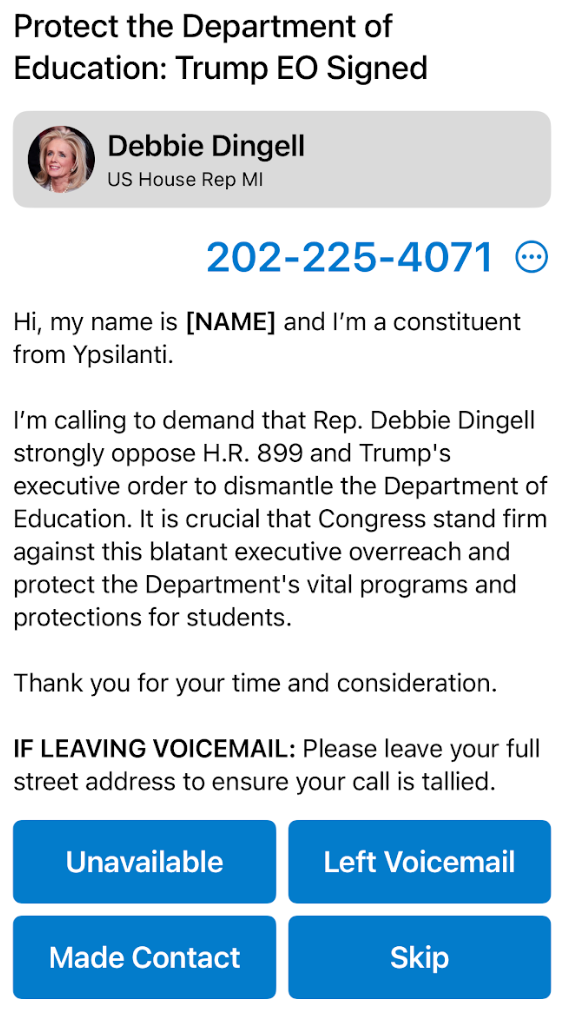
Here is how it works. Download the app, select the issue you are concerned about, and enter your zipcode. You will see a timeline of updates on that issue and a list of representatives from your district. One click later, you will see a page like this:

You click on the number, wait for an answer, read the script, and and click a blue button to register whether you left a voicemail or made contact, and the app sends you to the next number.

In just a few moments this morning I made three calls.

This may seem like something small — just like my boycotting may seem small and ineffectual to some –but if we truly believe that our government is of, by, and for the people, then we, the people, need to get involved. We need to do something when we see that our government is not representing all of the people — particularly when they are taking steps to further disenfranchise the most marginalized among us.

Look, you’re probably exhausted and overworked, too. You might feel like this is not worth your time, but perhaps you can take a journey back to your high school self, remember what it feels like to have a dream in front of you — of a career, a family, a whole adult life. Remember what that feels like? Don’t we want to make sure that every kid in America has an opportunity to pursue their dreams?

If you believe in the transformative power of education like I do, I urge you to make 5 calls — today, tomorrow, and until our voices are heard.

It’s a small decision you and I can make that could make a monumental difference for our kids, our country, our future.

Speak up … defend the rights of the poor and the needy. Proverbs 31:9

I told you so.

See? I told you so! Anything can happen in 2025!

You can have your whole week planned — your students will do a peer review on Friday, you’ll sleep in on Saturday, and then you’ll pack a bag and head south to your grand girls to play for the weekend.

But instead, since it’s 2025, your mother will fall down and break her leg on Thursday, you’ll put some sub plans together, pack a different kind of bag to head north. You’ll sit in a hospital room, watching the second hand click so that your mother’s turn for surgery will come at 5:00…no 6:30. Really, it’ll be at 7…we just got pushed to 8, but it’s still gonna happen…no sorry, an emergency brain surgery just bumped her place. We’re moved to 9am tomorrow.

You’re watching her writhe in pain even though they’ve given her NORCO and morphine, then you see her finally settle when they administer dilaudid.

You drive 45 minutes, picking up a chocolate shake on the way, then deliver it to your stepfather who has probably not left his recliner today. You tell him to take his meds, then put on your pajamas, crawl into bed, and set the alarm. You don’t ask if the cat has gone outside. You don’t remind him to put on his oxygen.

Meanwhile, your husband is following through on the initial plan, packing a bag and preparing to drive south.

The alarm blares and you jump up, do a little yoga, gather the items your mother asked for, tell your stepfather that no, you won’t be running to get a coffee, but he should take his meds, take his inhaler, and get himself some breakfast. The last you knew he was still driving, still running to get his own coffee, telling you he can manage on his own, but his wife of 48 years, his primary caregiver, just fell and broke her leg two days ago, he has memory issues, COPD, and a urostomy, and he is quite confused.

He takes his night meds instead of his morning meds. He doesn’t use his inhaler. He doesn’t go get coffee or something to eat. No.

So, while you are waiting through your mother’s surgery, chatting with your younger brother, reading a book, completing a crossword, your stepfather is home struggling.

You call to tell him that his wife is out of surgery, and he says great, but he’s having trouble breathing.

Part of you is worried, but part of you thinks he just wants some of the attention for himself. All of you just wants one moment that isn’t a crisis.

“Do you have your oxygen on?”

“I don’t think so.”

“Ok, put it on. Keith is headed your way soon.”

You and your brother grab a lunch then head to your mother’s room to see her post op. As she’s wheeled in, sound asleep, your brother’s phone rings. Your other brother is with your stepfather, trying to get his oxygen on him, administering an inhaler, making him something to eat.

You stay at the hospital. Your brother goes to the other crisis.

And it’s just Saturday afternoon.

Your husband will watch one grand girl play basketball. He’ll watch the other one play in a school hallway then throw up in the middle of the night. Then, he’ll watch their parents leave on vacation. He’ll go to procure gatorade, make toast, cuddle on the couch, and play games.

You’ll advocate for your mom over the next two days and slowly come to terms with the fact that your stepfather indeed cannot remember which meds to take, which inhaler to use when. He spends 23 hours a day in a recliner because that’s what he has the strength and capacity for, not simply because he’s a selfish asshole.

Although your fatigue is growing, so is your compassion. Your words get softer. You start putting the meds right in his hand. You refill his juice for the 17th time today, and you pick him up one more chocolate milkshake.

Although the experts point out the obvious — your parents need assisted living — and although you and your siblings are trying to make that happen, you also hear their desire to stay at home. Can’t they get chair lift for the stairs? Can’t they get in-home care?

So, you text in the group chat with your five siblings, each of whom are contributing in one way or another. You create a Google doc to keep track of everything that is happening and share it with the group. You assure your mom you won’t make decisions without their input. You’ll try to help them keep their cat. You know this is hard. You know it’s been hard.

Because she voted for the incoming president, you sit beside her and watch the inauguration. Because she’s frail you shut your mouth. You don’t react to the audacity, to the misrepresentations, to the falsehoods. Instead you watch her fall in and out of sleep while the crowd boos former presidents and then applauds the renaming of the Gulf of Mexico. You don’t so much as cuss under your breath or facepalm. You just quietly take it in.

And as you’re driving home, you don’t listen to news. No. You listen to the sermon you missed on Sunday. You sing along with worship music. You’re so exhausted you miss your exit and have to turn around. You pick up dinner, meet your husband — who has picked up groceries — at home, unpack, put on pajamas, eat dinner, and try to stay awake for a movie.

You’re not surprised when you wake up to see that a newly appointed government official used what looks like a Nazi salute. You’re not surprised by the immediate executive orders that have been made. No. We’ve seen this coming.

And, it’s 2025. Literally anything is possible.

A girl could grow compassion for her step-father. Six siblings who have spent little time as a group for the past 40 years could come together to care for their parents. An arctic blast could close school for a couple of days and give a girl a chance to do some laundry, to binge-watch a period drama, to put together a puzzle, to catch her breath.

…with God, all things are possible. Matthew 19:26

In 2025…anything is possible

The turn of a calendar page, particularly from December to January over the line of a year, can signal a fresh beginning. We can get our hopes up that this year life will be different — the bills will all get paid, the friends will all get together, our health will improve, and we’ll witness less violence. But we weren’t even to the dawn of the first day of 2025 when we were reminded that terror still exists; we weren’t two solid weeks into this new year before we had to admit that tragedy will still come. Grief will be part of 2025 just as it was part of 2024.

It’s not what we want — we who make resolutions, who join gyms, who buy dot planners, who clean out our closets. We don’t want to read that teenagers were killed as they celebrated, that houses of thousands have burnt straight to the ground. We don’t want our loved ones to be sick, our friends to be overwhelmed, or ourselves to have anxiety about the future.

But reality is what we have. Our parents are admitted to the hospital, a strained relationship marches right into the new year, an appliance breaks down, work stress increases over night, and you suddenly notice a crack in your windshield.

Turning the page on a calendar isn’t magic. No. It’s just a moment in time.

So, shall we throw our hands in the air? give up hope? trudge on knowing that there’s nothing we can do?

You already know that’s not what I’m about here. You know I’m the one with an insufferable belief in restoration. You know I believe the pain could go away, the relationships could be renewed, the bills will get paid. You never know — your savings might grow in 2025. Your appliance might start working again. You just might figure out that impossible issue at work.

But it won’t happen just because you turned the page on a calendar. No. You might have to take action. You might have to start exercising and do the PT they showed you how to do. You might have to forgive someone and change your own behavior. You might have to stop buying that bougie coffee you love so much and put that money in the bank. You might have to call a repairman. You might have to ask for help.

We don’t love asking for help — we who like to pull ourselves up by our own bootstraps, we who kick butts and take names, we who take pride in getting shit done. We like managing things on our own, thank you very much.

We don’t love interruptions to our routine — broken equipment, illness, accidents. We like things to go as planned.

But in 2025, just like in all the years before, interruptions will happen. The sink will get clogged, a copier will get jammed, and the traffic will back up. In those moments, you might find a solution on your own, but you might have to network as a team with a spouse, a sibling, a coworker, a qualified professional.

Or, you may just have to wait it out.

But friends, don’t lose heart. Things are not worse than they have ever been. Nope. Since the dawn of time, the struggle has been exceptionally real. And people just like us have found a way to come together, to find solutions, to face the unexpected, to overcome difficulty, to not lose hope.

I am not sure how they did it in days of yore — I’ve heard tales of women gathering over quilts, of dinner parties where folk discussed issues and devised strategies, of community organizing in dusty offices under glaring light. I’ve read of sweeping movements that have made dramatic change in the culture, in policy, in the everyday lives of people.

I don’t know if I have the steam for all that, but I do have what it takes to get out of bed every morning, to write a few words on the page, to practice yoga, and to put this hopeful hunk of flesh in my car, drive 30 minutes east, and show up for my students. And, I can also find the wherewithal, when the unexpected happens, to pivot. When a call comes early in the morning, I can point my vehicle in a different direction and show up for my family.

I think that’s what I am bringing to 2025 — the knowledge that things are going to be as they always have been and the willingness to keep showing up anyway.

My goal is to show up without judgment and full of hope.This is the challenge, isn’t it? to show up without an attitude, without preconceived notions of what others should or should not be doing, with a heart that says anything is possible. Already this year I have shown up once or twice annoyed, irritated, and wringing my hands — this would all be different if only they would …fill in the blank.

But it’s still January, and I can’t expect to be hitting my goal with 100% accuracy from the jump.

It wouldn’t be a goal if I could already do it.

So here’s to 2025 — may we keep showing up full of hope. After all, anything truly is possible.

May the God of hope fill you with all joy and peace as you trust in Him. Romans 15:13

Ten Years Later #11: A String of Miracles

This is the last of the “Ten Years Later” series that I had intended to be a weekly feature in 2024. The year, as most are, was more than I had anticipated — more struggle, more loss, more healing, more restoration, more hope. This post, written and recorded in January 2023, sums up the vibe I want to carry into 2025 — the continuing hope that all things can be made new.

We purchased the gifts and wrapped them. We planned menus, purchased loads and loads of food, and baked ourselves silly. We cleaned the house and made all the beds, and then we waited.

As we sat on the coach, staring at Netflix, the texts started to come in.

“We’re checked in at the hotel! See you in the morning!”

“Our flight just landed!”

“We should be there in an hour!”

And then our family started rolling in — from Ohio, from Massachusetts, from Missouri.

We hugged, we laughed, and we ate.

We puzzled; we played games. We did crafts, watched movies, and traveled to celebrate with even more family.

It sounds like what most families do over the holidays, but I suppose many families, like ours, can get together like this only because of a string of miracles — only because of choosing forgiveness, of going to therapy, and of healing and time and the stubborn belief that things get better.

Didn’t you, too, have the holiday where everyone was yelling at each another?

And the one where no one spoke a word?

And the one where everyone walked out of church sobbing?

And the one where some decided they just. couldn’t. do it — not this year.

And then there was the covid year (or years — who remembers?) where we packed presents into flat rate boxes and stood in line for hours at the post office, hoping our parcels would get there before Easter. The year (or was it two?) where we sat in Zoom rooms with family members, some of us trying not to hog the air time, others trying to endure those who were hogging the air time.

It seems after all those difficult years we might have stopped believing that we could once again be all in one space, laughing, eating, agreeing on what to watch, moving upstairs to open the gifts, and leaning together over a puzzle, snacking on chips and rock candy and cookies.

But we didn’t stop believing — really — did we?

Didn’t we keep hoping for the day when all the therapy would pay off? Didn’t we long for the moment when we all laughed at the same joke, all smiled at the same memory, all managed to load ourselves and our gifts and bags full of food into cars only to discover most of the way there that we had left the main dish warming in the oven and no one lost their shit but we rebounded easily, picking up take out on the way?

Didn’t we imagine it could happen? Didn’t we dream it?

And so I’m sitting here pinching myself, trying to believe that it actually happened. And someone in the Christmas 2022 group chat sends a text checking on someone else who left the festivities feeling subpar. Another sends a pic of a present that broke upon opening, and everyone laughs. More pics are shared, more laughter, and then a commitment to what we will do next year.

They want to do it again next year.

I need a moment to just take that in.

Every family relationship doesn’t get this gift, does it? We don’t all get the moments we prayed for.

Don’t we all have at least one relationship where we do all the initiating? where tender topics are avoided? where our hearts ache with disappointment at the end of each phone call? where we can’t shake the feeling of being unwanted?

In fact, I was sitting in therapy the very day that the last of our family left, on the come down, for sure, and all I managed was, “our Christmas was amazing, but this one relationship over here still sucks and that’s all I can think about.”

And over the hour of belaboring the one less-than-stellar relationship I have spent most of my life bemoaning, my therapist offered suggestions, role-playing, expectation-setting, and the like, and near the end of the session, I began to realize that the beauty we experienced with our family at Christmas didn’t come without the hard work of many — of all of us, really.

I can’t expect this other relationship to magically transform on its own. If I want something different, I’ll need to return — to my knees, to forgiveness, to therapy, to the stubborn belief that things can get better.

It’s risky — even just the hoping for change — because happy endings or even happy moments are not guaranteed. I might experience disappointment — again.

But I might risk hoping, and a series of miracles might just happen. We might laugh at the same joke or smile at the same memory. We might play a game together or lean toward each other over a puzzle. We might agree on a movie. We might enjoy a meal.

And it might be amazing.

Witnessing the string of miracles that led to an amazing Christmas has me thinking that I just might risk hoping again.

[He] is able to do far more than we would ever dare to ask or even dream of”

Ephesians 3:20

Last-minute Christmas Prep

You are all but ready for the holidays, but you’re starting to feel a little edgy because the gatherings are starting to happen? Me, too! Seeing all of our people can tricky — especially at the holidays.

It’s not because of the presents or the food or the clothing we choose to wear, it’s because of all the meaning we attach to the smallest of things. We come carrying the historical experiences we’ve had with each important person in our life, and our brains use some kind of warped algorithm to assign emotional value to every holiday interaction:

the language in that text,

the gesture she made when she said that thing about you know what,

the fact that she said nothing about you know what,

the size of the gift,

the absence of a gift,

the appropriateness of the gift,

the inappropriateness of the gift,

that phone call,

the lack of a phone call,

the food that was served,

the food that wasn’t served,

how much he ate,

how much he didn’t eat,

the church service,

the hymns we sang,

the hymns we didn’t sing,

the outfit they wore,

what they didn’t wear,

who showed up,

who didn’t show up…

It’s all laden with our individual and collective histories of hurt, joy, regret, longing, grief, love, loss, and all the other emotions that seem amplified around the holidays.

And why are they amplified? Maybe because holidays are times of expectation — we build them up to be the pinnacle of our human existence. When did you see your first holiday commercial or store display this year? When did you hear your first Christmas carol? When did you purchase your first Christmas present or attend your first holiday party?

For months we look forward to this season with expectation, creating scenarios in our minds, imagining who will be with us, how they will react to the gift that we bring, how we will embrace and enjoy one another’s company, and how perfect the experience will be. But when each of us arrives lugging our history and our expectation, there is bound to be disappointment.

I will be so busy tending to my historical hurt — the disappointment of Christmases past when I wasn’t with my father, the longing for the holidays my grandparents created, the belief that I didn’t fit in with my family — and trying to process my current reality — the work stresses, health issues, and dysfunction in relationships– that I don’t realize that you, too, are tending to your historical hurt and current reality, which may be very similar or very different from mine.

And, since my gaze is at least partially turned inward, I might say something that is less than thoughtful or even insensitive and you may feel hurt. And since it’s a holiday, you may contain your reaction to a mere shifting of your eyes, but I will see it, and, being focused on my own hurt, I won’t see that shift as you reacting to my insensitivity but will assign it some other type of meaning — I might assume the worst about you rather than taking accountability for my own actions.

And it doesn’t take many of these small interactions to lead to a tense and emotionally charged holiday gathering, even among the most civilized and emotionally evolved among us.

Before you know it, someone says, “What do you mean by that?” and storms away to a different room or out the front door. Or, they contain their hurt inside, plastering over it with a smile, but carrying the hurt to the car with them and taking it out to nurse and nurture in the privacy of their own home so that it can be brought back to the next holiday gathering. It’s not what we are hoping for, but it’s what we often do.

Hurt people hurt people, and if we are being honest, we are all hurting.

We are all longing for someone to say:

I’m really sorry about that thing that happened to you,

I didn’t mean what I said — I was angry when I said it,

I want to heal with you,

Will you forgive me?

Can we talk about it?

How can I help?

I’m proud of you,

I support you,

I love you.

We often approach holidays playing defense — putting up our guard, expecting the blows, preparing for the worst.

What if we tried a different way? What if we planned ahead and practiced checking in, listening, caring, and supporting? What if we processed our historical hurt through writing or therapy before we loaded up the car? What if we were vulnerable and admitted to a few at our gatherings, “I’m struggling. This season is hard. I’m sorry if I seem distracted.”

How might these little moves have a significant impact on our experience of the holidays?

And while we are at it, can we plan to overlook any insensitive comments someone else might make, any seemingly judgmental facial expressions, any downright rude comments? Can we chalk them up to the heightened emotions of the holidays and not give them too much weight? Can we decide in advance not to gather these infractions up in a bag to take home and examine under a microscope? Can we instead choose to sweep them up with the crumbs from the table and toss them in the trash, not because they are meaningless, but because we are not choosing to assign them any additional meaning?

Can we plan to check in with the oldest, the youngest, the quietest among us? Can we set out to embrace those we know are grieving? Can we provide space for those who need an ear? Can we offer to help? Can we turn our gaze away from ourselves?

Could we give that one extra gift?

…Love one another. (John 13:34)

What a Village!

About a month ago I wrote a post (linked here) about what a challenge 2024 has been — how personal and national events have left me feeling dumbfounded and scrambling to find glimmers of hope amidst the ordinary. Then, a little over a week ago, rather unintentionally, I invited you to tangibly produce evidence of that hope — and you did!

Facing the pronounced need of some of my students at the small Detroit charter school where I teach, I, with a few other colleagues, selected what ended up being twelve families and determined to furnish them with some kind of Christmas miracle. I knew our staff alone would not be able to supply what was needed, so I asked you to be a village for my students, and you circled up!

I posted my blog on a Friday, and by Sunday, Amazon packages from a high school classmate were sitting on my porch and a friend had sent me some funds to get the gift card fund started. And the packages kept coming! As I opened each box, I saw the faces of the villagers — a woman who was my camp counselor when I was a teen, a former co-worker, a few dear friends, the parents of a former student I taught in St. Louis, and a sister- and brother-in-law. I saw them coming together to encircle my students, and the image buoyed my spirits.

Any teacher will tell you that every day of teaching in December feels like a solid week. The students are tired of being in school, yet lessons still have to be taught and programs still need to run.

This past week was cram packed, and by the end, I had lost my sense of humor. It’s probably because I expect the same level of rigor on a Friday in December as I do on a Tuesday in October. After all, that rough draft won’t write itself and it’s due on Tuesday so that we have time for feedback and editing before the final drafts are dropped on Thursday.

I get myself so wound up that I forget — still, after decades in this game — that kids are kids are kids and the fact that the calendar says Friday just does something inside the brain. Make that a Friday in December and that “something” is x10.

Anyway, I made it through last week — preparing for and co-leading a two-hour professional development session, observing and coaching three teachers, and teaching two sections of senior English each day, and only lost my sense of humor on Friday.

When the final bell rang, I settled in to finish the grading for the week, to prepare for Monday’s class, and to straighten my room before leaving for the weekend. I’d been a little amped all day, almost resembling the butt-kicking, name-taking self of yesteryear, but as I moved through my tasks, my emotions started to right themselves, and then I noticed the total in my CashApp account. In addition to my blog post ask, I’d invited our teachers to pitch in to the fund for our kids, too. These particular villagers are boots on the ground day in and day out. They are weary, of course, but I watch them hug students, hold students accountable, feed students snacks that they paid for themselves, talk students down from their own high emotions, and even give them rides home, half of their own lunch, or even the literal coats off their own backs.

Still, I asked them to give more. And they did!

Several of our teachers adopted our homeless expectant mother, purchasing everything off her wish list — items such as a blanket, a towel, shoes, and underwear. Others sent the first few dollars of their paychecks straight to my CashApp so that our students will receive what they need.

Combining the gifts from the virtual village and the on-the-ground village along with some gift cards provided by our organization, twelve (yes, 12!) families would receive gift cards that they can use at their discretion to purchase food, gas, gifts, or necessities! Additionally our pantry is restocked with essentials (seen below) for students to use now or when needed.

My principal and I texted Saturday morning, finalizing plans for purchasing gift cards and other needed items for the fun week we have planned before the break, and then we both headed out shopping. When I arrived home on Saturday evening, I was very content with what we had accomplished, and then came Sunday.

Never underestimate the power of a Sunday morning.

My husband and I had arranged to meet friends for both breakfast and lunch — it’s the cram-packed holiday season after all — and at BOTH meals, members of my village pressed into my hands gift bags stuffed with MORE gift cards to distribute to my students.

I became overwhelmed.

The needs of my students on any given day can seem staggering, and in the bitter cold of December, they can seem impossible to meet — our students need coats and food and clothes and phone chargers and rides and deodorant and feminine supplies. They need patience and hugs and accountability and grace and correction and encouragement and attention.

One middle-aged teacher can feel all alone in the face of such need, but she is not alone.

She has a whole village — on the ground, of course, but also at a distance. She can see them showing up, and cheering, and bringing water bottles and blankets and snacks.

Just knowing they are there gives her what she needs to show up for another day. On a Monday. In December.

It may look like I’m surrounded, but I’m surrounded by you.” — Michael W. Smith, “Surrounded”

The Giving Season

Since seven (yes, 7!) of our immediate family members have December birthdays, our “season” starts a little earlier than most. We have said for years that we start partying on Thanksgiving and finish on New Year’s Day. This year is no different. The birthday gifts are all but purchased, at least one package has been shipped, and our our living room is staged with “gifts in process” for both birthdays and Christmas so that we don’t miss anyone.

And each morning, I leave my comfortable home that is well-stocked with food, clothing, and this somewhat moderate collection of gifts, cross 28 miles of metro Detroit, pull into a disintegrating parking lot, enter the building, and prepare to meet the reality of the students that I serve.

Today’s reality came in the form of Kaden*, one of my seniors. I was in the gym when he entered from the bus, scowling.

“Good morning, Kaden. Everything ok?”

“I don’t know why we had school today. I almost froze to death.”

“Hey, come here a minute. You only have on a hoodie. Do you need a coat?”

“I mean, I have a coat,” his demeanor was shifting, “we just don’t have a washing machine right now, so I can’t wash it.”

“Ok, but we have coats. I can get you one this morning. Would you be good with that?”

“Yeah, that would be good. I would take a coat.”

Later in the day, I found him, we walked to our clothing closet, and he chose one of several new coats that remained from a large donation we received last year.

We have a fairly decent supply in that closet — coats, shirts, hats, and some miscellaneous toiletries and nonperishable food items — but it goes away quickly because our students are continuously in need of something.

Each day I am asked if I have something to eat — often by students I’ve never even had in class. I try to always say yes and walk students to my stash where they can select a granola bar, some trail mix, or a package of cheese crackers. Most teachers of teenagers probably have a similar routine.

I also get requests for deodorant, for socks, for cough drops, band aids, a toothbrush, or a safety pin — again pretty typical requests for teenagers, and fairly easy to accommodate. These small items solve in-the-moment problems for my students and allow them to get back to learning. I have a pretty healthy stash that many in my village help keep stocked, but when the holiday season comes around, the depth of my students’ need comes into sharp focus.

Before coming to this school, I’d never met families who simply “don’t do Christmas” but here I have met many students for whom December 25 is just another day because their families simply don’t have the financial capacity to purchase anything extra, let alone the privilege many of us have to line their living rooms with gifts, to create an elaborate feast, to deck the halls, and to gather with friends and family.

I have students who are housing insecure — one young woman whose mother died during Covid and who is currently carrying her possessions with her and bouncing between two places to “find a place to sleep”. I have students whose families bounce from apartment to apartment — one young man I spoke to yesterday said “we are definitely moving in a couple of weeks, but I don’t know where yet.” We have families who don’t have reliable transportation — who can’t join the basketball team because they don’t have a ride home after practice and have to take the school bus that leaves at 3:15. I have students who, in addition to coming to school, work to help their parents pay the bills. I have a senior whose very demeanor and aptitude scream “engineer” who is in the manager training program at McDonald’s. He often closes the store and does inventory or other related tasks that keep him up well into the night rendering him incapable of staying awake in school the next day. He’s working this hard, yet he is wearing the same worn clothes and shoes I’ve been seeing him wear since I’ve known him, which is most of high school.

Our students and their families are barely getting by. How in the world can they dream of doing anything for Christmas?

Yet these students keep showing up. They come to school, they log onto their school-issued chromebooks, they complete independent modules to earn their financial literacy credit, they come to my class, bend over their notebooks scrawling out the purpose and audience for their next essay, practice the nuance of Standard Academic English while teaching their middle-aged English teacher the current vernacular. They have big dreams — of being nurses and engineers and game designers and ultrasound technicians — and they need a whole village to rise up around them to give those dreams every chance at reality.

I’m part of their village, and I’m raising my voice to invite you to be part of their village with me.

School leaders have selected nine families who are in dire need of support this holiday season. Because it is already December 6, and we have to get items to our students before they leave for break on December 20, we won’t be filling traditional wish lists. Instead, we have set a goal of giving each of these 9 families one grocery gift card, one department store (Target or Kohl’s) gift card, and one gas gift card. Additionally, I have created an Amazon wish list of items that our students frequently request.

Joining this initiative may be a small part of your holiday giving, but it could make all the difference for a struggling family — it could help them put food in the fridge, buy some new jeans for a child, and put gas in their car so that they can visit a friend. It won’t change their whole world, but it might just change their opinion about the people in it.

All of us have many opportunities to give at Christmas. If caring for my students in Detroit is something you are interested in doing, I invite you to check out that Amazon wish list or to make a donation to our gift card initiative. To do that, you can send a check to Detroit Leadership Academy, 5845 Auburn Street, Detroit, MI 48228 or donate via CashApp.

so in Christ we …form one body, and each member belongs to all the others. We have different gifts, according to the grace given to each of us. If your gift … is serving, then serve; if it is teaching, then teach; if it is to encourage, then give encouragement; if it is giving, then give generously. Romans 12: 5-8, selected portions