This post, written in October 2015, gets dusted off in October 2019 — I needed a reminder of my role.
The other day I was trying to explain the term ‘juxtaposition’ to a student. I think I said something like, “when we juxtapose two items, we set them side by side in an attempt to highlight their differences.”
I’m sitting here examining the glaring differences when I juxtapose my life with the life of Christ. It’s embarrassing, really. Especially when I consider myself to be not only a Christian, but a leader in the church. It’s humbling, and sobering, to think that others look to my husband and I as examples of what Christians should be. In a perfect world, we would be mirrors that merely reflect the love and grace of God to all those around us. In reality, this mirror is warped, cracked, and positioned in such a way that the reflection is sometimes unrecognizable.
For example, yesterday, I pridefully posted on Facebook that I had used inappropriate language to deal with a medical insurance agent regarding some services for one of our children. “I showed her who was boss, yes I did.” As people liked that post throughout the day, I had a mixture of feelings — the satisfaction that others had experienced the same emotions that I had in similar experiences, the pride that I had written a post that others ‘liked’ (yes, I am that shallow), and, a hint of shame. “Really, Kristin, you are celebrating the fact that you resorted to low means to achieve your goal? Would you have had the same outcome if you had remained calm and gracious? Was it really necessary to get so charged up?”
Now, to be fair, the situation I was confronted with was a bit ridiculous. A change in policy was, in my opinion, unjustified, irresponsible, and unnecessary. However, did my response also need to be ridiculous? And, after I had apologized to the innocent agent I was dealing with, did I really have to haughtily post my poor reflection of Christ for all the world to see?
Yeah, I’m often a poor reflection. Let’s juxtapose my behavior with an imagination of Christ’s reaction in a similar situation. He would be sitting in his office on the phone, calmly listening to the agent, asking questions, probably speaking directly into her life, picking up on nuances of her tone and reaching out to her need. He might ask who He could talk to about this recent policy change, but would He raise his voice? utter a vulgarity? or celebrate His breech of character on social media?
I doubt it.
When we juxtapose ourselves with perfection we find ourselves looking like a hot mess, because indeed we are hot messes. And that is why, my friends, God is the covenant keeper. (See my recent post “Didn’t He do it?”) We can’t keep the covenant. We can’t keep our commitment to be image bearers for Christ because we are a bunch of warped, cracked, misshapen mirrors. We reflect His image poorly. All the time. Even when we think we are getting it right.
And yet, every once in a while, He uses these imperfect mirrors, tips them at just such an angle so that others get a glimpse of His fabulousness. And in those moments, we don’t haughtily post on Facebook, but we drop to our knees in humble gratitude for having a front row seat. Because when we juxtapose ourselves with Christ, and take our eyes off of our own imperfection, we see what true perfection looks like. And we are amazed.
For now we see in a mirror dimly, but then face to face. Now I know in part; then I shall know fully, even as I have been fully known.”
I first wrote this piece in April 2015 after attending a Seder meal. Tonight, my husband and I are hosting one. As I mark my blessings in April 2019, I remember that any one of them would have been enough.
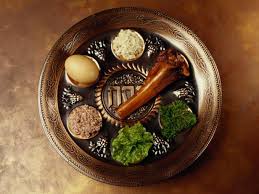
On Maundy Thursday, we attended a Messianic Seder. We have, in the past, been privileged to attended an authentic Jewish Seder in the home of friends. During the Seder, the story of the Passover is retold around a table where participants taste foods that signify the journey of the Israelites out of Egypt. The matzah reminds us that the Israelites had to flee so quickly that they didn’t even have time to add yeast and allow their bread to rise. The bitter herbs remind us of their suffering. The salty water reminds us of their tears. The lamb shank reminds us that the blood of the lamb was placed over their doorposts so that the angel of death would ‘pass over’ and not kill their firstborn sons.
Traditional Seder
I grew up listening to the story — as though it were mythical, as though it didn’t really happen. As though it didn’t have anything to do with me. As though I hadn’t been rescued, too. But I have been rescued from my own personal Egypt. I’ve been to real-life Israel. I recognize that the story is no myth, rather, it has a transcendent power that resonates with me.
The Jewish celebration of Passover, written in the Haggadah, includes a section titled ‘dayenu’ which literally means, “it would have been enough.” The leader of the family says, “If He had brought us out of Egypt,” and the family responds, “dayenu.” It would have been enough.
He says, “If He had executed justice against the Egyptians,”
“Dayenu.”.
“If He had split the sea for us,”
“Dayenu.”
“If He had fed us manna,”
“Dayenu.”
The sentiment, of course, is that God did so much more. He did bring the Israelites out of Egypt after hundreds of years of slavery. He did execute justice against the Egyptians — killing many with the rushing waters of the Red Sea as they pursued the Israelites who had made it safely to dry ground on the other side. He had provided manna so they never went without food. He rescued them. He provided for them. He made their descendants many. He took them to a land flowing with milk and honey. Any one of those actions would have been enough to elicit the thanks of the Israelites, but God did so much more.
Our Passover Seder on Thursday was different than the Jewish Passover we attended years ago, but very familiar. We shared the matzah. We ate the bitter herbs. We enjoyed the charoset — a sweet mixture of nuts, apples, honey, wine, and cinnamon. Those parts were just like I remembered. The difference was that our pastor highlighted all the areas of the Passover that pointed to the Messiah. Just as the matzah is broken and hidden away to be brought out later, the body of Jesus was broken for us, hidden for three days, and brought back. Just as Moses led the Israelites out of slavery to exacting task masters, Jesus has offered us freedom from slavery to sin and the need to earn God’s favor. Just as the blood of the lamb protected the Israelites from the angel of death, the blood of the Lamb covers our imperfections and protects us from our punishment — our death.
When we got to the ‘dayenu’ portion of our Seder on Thursday, I read along with the others from the Haggadah, but in my mind, I was thinking,
“If you had just rescued me from my own intentions,”
“Dayenu.”
“If you had just provided for my physical needs,”
“Dayenu.”
“If you had just given me a husband who is a partner,”
“Dayenu.”
“If you had just provided me with children,”
“Dayenu.”
My sentiment, of course, is that God has done so much more for me. He has saved me, and that would have been enough. But He also has blessed me beyond what I could have ever asked or imagined with family, friends, community, meaningful work, and so much more.
Blessed are You, O Lord our God, King of the Universe.
The Israelites, the Jewish people, demonstrate intentionality in marking their thankfulness for their rescue. They remember where they once were, and they have chosen never to forget who rescued them and by what means.
Having seen, we can go and do likewise.
Now to Him who is able to do immeasurably more than all we ask or imagine, according to His power that is at work within us, to Him be glory in the church, and in Christ Jesus, throughout all generations, forever and ever. Amen
Well, kids, this one goes back to February of 2015 — way back then our struggles were building our muscles and preparing us for today. Each of us faces different levels of difficulty, but for all of us, the struggle is real.
Last weekend I struggled with a high school senior who is trying to raise her ACT score a few points so that she can get into a college of her choice to become an event planner. Her struggle? Although her grades are As and Bs, her ACT score is at the 12th percentile — meaning that she scored better than 12 percent of all the students who took this test. Her goal is modest — she just wants to climb three points, which would put her at the 30th percentile. We’ve spent four hours together at this eleventh hour — two weeks before the February ACT. She is realizing, painfully, that her education has not prepared her for this test.
Last night I struggled with a different student — a high school junior who is also trying to raise his ACT score a few points to that he can get into the college of his choice and become a physician. His struggle? He goes to a premier private high school in Detroit and has been exceptionally well-prepared, but he ‘only’ scored at the 95th percentile, when he really needs to be at the 99th percentile. Again, it’s only a jump of three points. And he’s got a year to raise those points, but let me tell you, scoring in the 99th percentile doesn’t leave much room for error. And the elite schools that he and his family expect him to go to require that high score.
What do these two students have in common? They are both willing to meet a middle-aged English teacher in a public library in the evening or on the weekend to pour over grammatical rules and to talk test-taking strategy so that they can gain access to a dream. The pressure on each of them is significant. Their struggles are real.
Almost everyone I talk to has real struggles — illness, financial strife, marital conflict, employment issues, car trouble.
Struggle is not the exception to the rule. It’s the rule.
A friend and I were talking about our struggles — the things that have happened in our lives that we never would have expected. She said, “All these difficulties have given me perspective. I find it much easier to not sweat the small stuff.” Depending on how much ‘perspective’ you have been given, your ‘small stuff’ may be different than mine.
Early in our marriage, when we had very little disposable cash, I combed grocery ads to stretch my dollars as far as they could go. It might have given me undue stress, at that time, to find the money in our budget to make a meal for a friend. Today, after years and years of cutting the budget incredibly close and living to tell about it, making a meal for a friend is ‘small stuff’.
A few years ago I had to miss three days of school in a row because I had the flu followed by pink eye. I couldn’t believe I was ‘so sick’! I was distraught at having to lie in bed for three days with little to no energy. Now, after living for two years with chronic pain and fatigue, minor illness such as the flu has become ‘small stuff’.
And yet I am learning that my ‘big stuff’ is someone else’s ‘small stuff’. I know a woman about my age who is undergoing her second bone marrow transplant for cancer. She will not be able to return to her home for several months as she recovers from this procedure and re-gains her strength under the watchful eyes of her doctors. My chronic pain, in comparison with her life-threatening illness, is ‘small stuff’.
When we look at it that way, we might be tempted to think that we can’t feel badly about our ‘stuff’ because it really isn’t as bad as their stuff. But, guys, to each of us, at any given time, our ‘stuff’ is real.
Our struggles are real.
My struggling senior will likely lose sleep tonight and tomorrow worrying about the ACT on Saturday morning. She really needs her score to go up. And the fact that my struggling junior has a score that is over twice the score of my struggling senior doesn’t diminish the amount of pressure he feels. His score also really needs to go up. They each at this moment are experiencing a difficult struggle.
You may be in such a financial place that making dinner for a friend would be a hardship. That’s a difficult struggle.
You may be sick in bed with the flu and pink eye. That’s a difficult struggle.
You may have chronic pain and fatigue. That’s a difficult struggle.
Fill in the _________________. That’s a difficult struggle.
We’re all struggling together. I am convinced that we move through life from struggle to struggle. Those brief periods where we experience a lack of trouble should be breathed in and fully appreciated, because they are momentary. And so are the struggles. Yes, so are the struggles.
Each episode that we think is the worst thing that could possibly happen fades into that one thing that we lived through.
In two years, or possibly even two months, my students will be past the ACT and onto the struggle of living with roommates. And after that they will be struggling to pay back student loans, to find a job, to get into grad school, or to find an apartment. You will one day be able to make dinner for your friend. Your pink eye will heal. Your pain and fatigue will diminish. Your cancer will be no more.
This too shall pass. One way or another. So what do we do now? “Bear one another’s burdens and so fulfill the law of Christ,” (Galatians 6:2) for one thing.
Walk beside one another in hardship. Share ‘Trouble Talk.’ Help carry a load. Laugh when you can. And try to keep your perspective.
I have told you these things so you may have peace. In this world you will have trouble. But take heart, for I have overcome the world.
On Monday, I wrote about our recent cultural transition to social distancing in my post, Time Out. This post from January 2015, explores another time that I made a big transition.
My blender stopped working this morning. I think it got jealous of all the other items that have been leaving my house via the Minimalist Challenge and wanted to join them. It’s going to get its wish.
I filled the blender with all my healthy ingredients — almond milk, cashew butter, banana, etc. — then pressed the button that usually makes it whir and blend. Nothing. Absolutely nothing. This happened once last week, but I walked away, came back a few minutes later, and it miraculously worked. Not today. I walked away with the rest of the parade of beverages, did my Bible study, then came back. Still nothing.
Since I moved to Ann Arbor, I have embraced routines. Ok, let me honest, for my whole life, I have embraced routines. I like repetition. I like order. I like predictability. So, I usually go through the same motions each day — smoothie, tea, devotions, writing, exercise, etc.
My husband, a teacher turned therapist turned pastor turned dean of students, told me shortly after I moved here that “routines are one of the best ways to manage a transition.” I am in the middle of a pretty significant transition — moving from working full time to not working, moving from Missouri to Michigan, moving from city living to campus living.
We all spend our lives in transition, don’t we? We transition from childhood to adolescence to adulthood to middle age to old age. We transition from single to married and perhaps back to single again. We transition from summer to fall to winter to spring. We are always in transition. Perhaps that is why we crave routine.
In the past week or so I have heard many people say, fresh from the holidays, “I am looking forward to getting back to my routine.” Our days have beginnings, middles, and ends that are largely very repetitive. We like that. So what happens when something happens to disrupt our routine?
We sleep through our alarm. The power goes out. The basement floods. We lose our job. We get sick. Someone dies. Our blender stops working.
It’s a disruption. We have to stop in the middle of that beloved routine of ours and regroup. When we sleep through the alarm, we have to establish new priorities — shower or no shower? breakfast or no breakfast? notify the people who are waiting for us or break the speed limit to get there on time? When we lose our job, we have to reevaluate life and make some choices — find a new job? move to a new town? go back to school?
Our blender stops working and we have to decide what in the world are we going to eat for breakfast.
This morning I didn’t want to stop in the middle of my routine. I was already a little tight on time. I didn’t have a backup plan for something healthy to eat. And, guys, all the stuff was already in the blender! So what did I do? I kept moving for a bit. I went to my office and drank my other beverages, but without the smoothie, they were out of order!!! This ruffled me a little, but I pressed on. I got through my morning email-checking and devotion-reading and checked the clock. I had to leave soon if I was going to meet my friend for a Pilates class. Should I make a bowl of oatmeal? grab a Kind bar? I thought about it as I got dressed, washed my face, and put in my contacts. I walked back into the kitchen and pressed the button on the blender one more time. Nothing. Sigh. I couldn’t just leave all those precious ingredients sitting in the blender on the countertop, so I poured them into a bowl, mashed the banana with a fork, stirred and swished as blender-like as I could, and ate that stuff with a spoon. Bam. Problem solved.
I wish all disruptions were this easy to manage, don’t you? This small disruption didn’t shape the rest of my day or the rest of my week, but many disruptions do. Some disruptions change our lives forever — an unexpected illness, a death, a global pandemic. No amount of routine can prevent such disruptions or prepare us for their impact. So, we may all of a sudden find ourselves reeling, desperately searching for something to hold onto.
When I find myself in such a position — feeling out of control and a little terrified, I return to routines — regular wake up and bed times, daily exercise, consistent food choices, and regular Bible reading and prayer.
Today, as I anticipate unprecedented uncertainty, I am thankful for my routines. Last night I set up my home office in preparation for telecommuting which begins today and lasts for the foreseeable future. More now than ever, I will return to my routines. I’ll get up at the same time, read my Bible, write my pages, practice yoga, take a shower, eat breakfast, and report to work on time just as I have been doing. Over the years, I’ve found that patterns like these provide the structure that anchors me.
Routines remind me that as sure as the sun rises each day, so does God remain the same. His mercies are new every morning.
I wrote this piece in November 2014, very early in my blogging days, when I was still hitting the space bar twice after every period and when I could say all I wanted to say in 800 words or less. I stumbled across it this morning, and I needed to hear what it had to say about putting people in boxes, about judging, about remembering that all of us are loved by God.
I have a bad habit — I’m a labeler. I tend to put people in boxes and sort them — liberal, conservative, Christian, non-Christian, rich, poor, smart, stupid, white, black. It’s very limiting. When I place people in a box marked ‘liberal’, for instance, a whole bunch of stuff gets stuck on them that may or may not have anything to do with them. Same thing happens in the conservative box.
I like to hang out with people in some boxes, but not necessarily those in others. I feel comfortable when tossed in with ‘smart’ people, for example, but somewhat self-conscious when mixing with ‘rich’ people. When I mingle with ‘black’ people I feel cool, but when I mix with ‘white’ people (even though I, myself, am white) I feel boring. I have even created boxes such as ‘too-rich’, ‘too-white’, and ‘extremely conservative’. Those boxes are placed on very high, or very low, shelves so that my access to them is limited. I probably wouldn’t mix with ‘those people’ very well, now, would I?
This bad habit impacts the richness of my life. It keeps me away from many groups of people, from diverse opinions, and from new ways of thinking. It causes me to think that I am better than those who somehow don’t fit in the same boxes that I fit in. It sometimes even makes me feel afraid. I mean, if I have labeled others, certainly they have labeled me. Surely they have put me in a box full of stuff that doesn’t necessarily apply to me. Of course they have judged me.
I hate being labeled. I wish people would just get to know me and value me for the person I am, but it’s kind of hard for them to do that if I’ve already stuck them in a box, passed judgment on them, and shoved them far away from my reach. Isn’t it?
I guess if I want others to get to know the true me I may have to invest in getting to know the true them. After all, not all those I have dumped in the ‘Christian’ box think exactly the way I do, vote the way I do, or even worship the way I do. Not everyone in the ‘stupid’ box is actually ‘stupid’. In fact, probably no one that I have placed in that box is truly ‘stupid’, maybe I’ve put them there simply because they don’t see things the way I do.
Maybe I’m stuck in someone else’s box that they have marked ‘stupid’.
I think I’m going to have to recycle all my boxes. Once out of the boxes, everyone could be free to move around, mingle, and see the deep richness and complexity of God’s creation.We are so diverse, so multifaceted, so surprisingly creative, yet we all have one thing in common — we are created by and loved by God. It seems to me that everything else is irrelevant, don’t you agree? He created each of us. He loves each of us. He doesn’t rate us or sort us based on skin color, political orientation, body shape, or socio-economic status. He looks at His kids and He loves us, even when we actively announce that we under no circumstances love Him.
He doesn’t have a favorite. In fact, He would love it if we all tried to share our toys and get along with one another. He hopes that we will see Him in one another and grow to love one another. He has created us to complement one another and to encourage one another — not to judge one another, not to label one another, not to put one another in boxes.
So what do you say, want to take a trip to the recycling center with me? Want to try a new way — get rid of some boxes, destroy some labels, and have a cup of tea? First cup’s on me.
Dear friends, let us love one another, for love comes from God.
I wrote this post in my very early blogging days, when I was just starting to recognize others after my long period of mission-only focused soldiering. Now, as I finish just my second full week of staying home, sheltering in place to flatten the coronavirus curve, I’m doing it again — noticing what others are doing. Some of you are wishing you could help, others are drowning in the flood of responsibilities and activity you find yourselves surrounded with, and some of you are just plain lonely. Whether you are a medical professional, a displaced worker, or a parent of young children, whatever you are doing right now has value — so hang in thereand reach out for some support. We’re in this together.
Many of the conversations I have had with women lately have been about how we spend our time. It is probably no surprise that most of the women I have time to have lunch with or walk with are not working at the moment either, but let me tell you what some of these women do when they are ‘not working’.
One is homeschooling two children, aged 10 and 11, coordinating and leading worship at her church, and working as administrative support to its two pastors, one of which is her husband.
Another is teaching Pilates, leading Bible study, coordinating a MOPS group, working part-time at her daughter’s new business, maintaining two residences, and supporting her husband who is a physician.
Then there is the gal who is on a board that is trying to open a preschool for hearing impaired children, planning for a state-wide women’s conference, traveling with her husband, and maintaining several other projects.
And another woman who is helping her daughter and son-in-law relocate with their infant child, coordinating a state-wide event, cheering on three other adult children, and partnering with her executive pastor husband as he travels all over the country.
And guys, they all had time for me.
Each of these women shared a heart to do the work of God and to do it well.
Each of them have set their own needs aside for significant periods of time to care for others: one had a parent with cancer, another had a father-in-law with a degenerative disease who lived in her house for seven years (!), another had a child and husband with cancer — at the same time (!), and another had two children with hearing impairments. Yet none of them complained about the burden that they had carried, but rather, I am not kidding, rejoiced at the blessings that God had provided in their circumstances. They smiled as they shared their stories.
Pretty humbling, right?
Yet, just as humbling is the mother I was to meet with today. She has been raising three daughters for the last umpteen years, just started a part-time job, and is home today with the youngest who is sick. She is setting aside our time to walk and talk together, so that she can attend to her first calling — loving that little girl.
It’s not glamorous most of the time, is it? We clean up messes, kiss away hurts, wipe tears and noses. We shop for the exact see-through divided folder that every student has to have. We scurry to soccer practice in the rain and then wash the muddy uniform after. We hold a ponytail while a little girl throws up in the toilet. We bake a batch of cupcakes at 11 pm then clean up the kitchen afterward.
This is God’s work.
God’s work is also getting up early to go to work before your children are even out of bed. It’s caring for the children of others — in the classroom or the NICU. It’s tending to the sick, the elderly, the dying, and the lonely. It’s punching a clock, mopping a floor, preparing a meal, and balancing a column.
Whatever you have to do right now — stay at home, travel far away, go to school, or look for work — is God’s work. It’s His work in you, through you, and for you.
As we show up and do our best (or even our semi-best), He sees us and He supports us. He offers us His love and patience when ours is all but gone. When we blow it — lose our temper or say the wrong thing — He offers grace. He shows us the power of forgiveness, and we get to see first hand how God changes hearts. Maybe even our own.
Today my day is not likely to be glamorous. It’s another day of making a meal, folding a load, making some calls, and finishing some tasks. It’ll be nothing to write home about. Nevertheless, I’ll be doing God’s work, so I’ll give it my best shot.
Whatever you do, work at it with all your heart, as working for God not for a human master.
I wrote this post over six years ago, shortly after I’d moved back to Michigan. I was so excited to be back around extended family, and I had taken a trip to visit with some of them. I’m dusting it off today, because yesterday, my Uncle Louis died at the age of 92, on a Covid unit in a hospital. He was one of the sweetest men I have ever known.
I have been on a little excursion. I travelled to my childhood home on Saturday and have had one great moment after the other since.
It started with dinner on Saturday with my parents and my brothers followed by worship on Sunday with the whole family. After church, my niece and I saw a movie. I’ve eaten well, slept famously, and have had many walks down memory lane.
This morning was particularly special. I drove about an hour to visit my aunt and uncle — my father’s older brother and his wife. My godparents, Uncle Louie and Aunt Margaret, are the most precious of gems.
They have showed up for everything. Everything. My baptism. My confirmation. My birthdays. My wedding. My grandparents’ funerals — my mother’s parents, not just my father’s. None of this probably seems astounding, but let me tell you why it is.
My parents were divorced in the 1970s. Divorce was not very common back then, particularly not among ‘church folk’. In those days, when divorce happened, it was fairly common for the mother to get sole custody of the children and the father to fade into the background, sending financial support and visiting occasionally. This was way before shared custody.
To complicate matters, my parents divorced around the same time that my dad was relocating to take a new job several hours away.
My three siblings and I stayed with my mother, as was the usual course of events, while my dad moved. While I am thankful that during my childhood and adolescence we had the stability of one household and the ongoing involvement of the relatives on my mother’s side, I have been sad over the years because of the diminished relationship with my dad and his side of the family.
We saw my dad, but because he was several hours away, those visits were infrequent. We usually stayed with him in the summer for a week or two, talked on the phone regularly, and saw him around the holidays. Sometimes, when he came to Michigan , he would take us to see my grandmother, his mother, who for most of my childhood lived a nursing home, but of his five siblings, usually the only one we visited was my Uncle Louie, and his dear wife, Aunt Margaret.
Whenever we stopped by their house, Uncle Louie would pull out a cardboard box of toys that they kept just for our visits, and Aunt Margaret would magically produce some kind of sweet — cookies, cake, or maybe some donuts. They wanted to hear what we had to say. Aunt Margaret asked all the questions; Uncle Louis was pretty quiet, until he spoke in his soft bass voice. Whatever he said, he said with a smile and sparkling eyes.
Sometimes they told stories about their snowmobiling adventures, my Uncle Louie’s job as a postal worker, or my Aunt Margaret’s love for hand-painted china, but the best story they told was their love story. When they shared their ‘scandalous’ beginning, they both looked mischievous as they took turns in the telling, as though it were a scripted piece they’d been telling over and over for years.
The love story of Louie and Margaret began with a one-month courtship that quickly escalated one night right before they were both supposed to punch in for their second shifts at the factory where they worked. They were sitting in the car when Aunt Margaret suggested that they drive to Indiana instead of going to work. In Indiana, she said, right across the state line, they could get married the next day, without the waiting period required in Michigan. Uncle Louie, apparently no longer concerned about his factory shift, turned the car back on, drove home to borrow $20 from his mother, stopped to pick up two witnesses, and headed to Indiana. They changed into their wedding clothes in a cornfield and were married by the justice of the peace the next morning. They stayed married for 71 years.
They were always together, those two. They took lots of drives looking for antiques and visiting family. They had just one son who was a bit older than we were — he, his wife, and their three children were the lights of their lives, but they had space enough for all of us, too. Three out of four of us were their godchildren, although my Aunt Margaret always said, “I alway include your brother in all my prayers, too.” They took their role seriously, and weren’t going to drop off because of a divorce.
Instead, Uncle Louie and Aunt Margaret regularly drove an hour to come see us at our mom’s house. They said, “Your mom is still our sister; you are still our family.” It may not sound that remarkable now, but, believe me, it was very unconventional at the time.
They came to every birthday party and special event. They always hugged my mother when they came and when they left. They modeled for me how to treat family, even in the midst of brokenness. I never saw judgment or distance from them — just love.
When I grew up and had a family of my own, they would then drive two hours just to drop by and say ‘hello.’ Their big yellow Oldsmobile would pull into our driveway, and I would say, “What? You drove all this way?” They always hugged us — Uncle Louie with his big compression hugs — and said, “I love you.” Aunt Margaret wrote long letters and would share news from my dad’s side of the family, including family history that I didn’t know much about. I always felt loved and treasured by my godparents; I have been so thankful to have them.
As my husband and I have faced divorce and other brokenness in our own extended family, we have often referred to the example that Uncle Louie and Aunt Margaret set. While it is heart-wrenching to watch family members experience pain, it has given me some measure of comfort to know my role. My job is to show love, to give hugs, and to communicate belongingness, just like Uncle Louie and Aunt Margaret have done for me.
Of the many things in my life I am thankful for, Uncle Louie and Aunt Margaret are near the top of the list. I told them that this morning and reminded them of the special lesson they taught me.
since God loved us, so also we ought to love one another
1 John 4:11
postscript January 17, 2021: In the summer of 2018, my Uncle Louis fell in the yard, breaking his hip. He never returned home after that. He went from a hospital to a nursing home where he lived out the rest of his days, separated from the love of his life. It was a hard hit that came not too long after the death of their only son from cancer. My heart has ached these last two years watching these two gems finish their days apart, especially since Covid kept Aunt Margaret from sitting next to Uncle Louis for his last ten months. When he was admitted to the hospital a little over a week ago, Aunt Margaret said, I just wish I could hold his hand. Now I know she’s just longing to be with him again.
I started re-reading the Gospel of John last Sunday. I had read most of it last year with my small group in our home on Monday nights. I have found, though, that each time I read a passage of Scripture, I see something new, something different. One of my Bible teachers over the years made me memorize Hebrews 4:12, “The Word of God is living and active, sharper than any double edge sword.” I believe it.
So, I have been fumbling through John, again, with the disciples, shaking my head and thinking out loud, “what is he talking about!” But today, the living and active word clarified itself for me. In Chapter 8, Jesus is having a discussion with the Jews who believed in Him. They are having trouble understanding Him. (I know, right!) He’s telling them they are slaves and that they need to be ‘set free’. They don’t get it, they were never slaves! Then he explains that they don’t understand because they have a different father — Satan, the father of lies. (Oh, no he didn’t!) He says that Satan’s native language is lying!! And remember, Jesus is full of grace and truth — his native language is the truth of God, full of grace!
We don’t understand Jesus because we are learning His language. Because I was born in sin, my native language is sin. Since my baptism as an infant, I have been trying to acquire the language of Christ, sometimes more fervently than others, but let’s be honest, I really like to speak my native language the most.
I saw this in my international students in St. Louis. They had come to the United States to study in English to prepare for American universities. We had a rule that while they were at school, they could speak ‘English only’. However, it was very common to see Chinese students walking down the hall together, obviously speaking Mandarin. It was more comfortable, more accessible, more familiar. It felt like home. Speaking in English, for them, was often hard work. It was foreign, new, and hard to understand. I can’t count how many times I told students from China, Korea, or Vietnam, “the more you use it, the easier it will get.”
Sometimes I am such a slow learner, I amaze myself.
I am just like my students. I like to speak my native language. It just rolls off the tongue. Sure, a few people get hurt by the sharpness of my words, but man they feel good to say. And, really, they aren’t lies. I told you, I tell the truth…at least my version of the truth. And, to be honest, reading the Bible is difficult. I often don’t understand what Jesus is trying to say. He speaks in parables and metaphors. I know, I know, I’m an English teacher, I should love that stuff. But, I don’t get it all the time.
“The more you use it, the easier it will get.” Sigh.
Last Sunday I heard the challenge to spend more time in God’s truth, to become more familiar with his grace. I am going to stick with it. “The more I use it, the easier it will get.” I really do want to be fluent in truth and grace.
It’s a quiet Sunday morning. Sunny and sixty degrees. I’m sitting outside. The chapel bell just told me that it’s 9:00 a.m. Pairs of students walk by me, some going toward breakfast. Some dressed as though they are walking toward church.
We’ll be headed to church soon, too. This morning we are visiting the chapel at the University of Michigan. (Perhaps we should dress in mourning clothes after last night’s game. Yikes.) A few years ago some folks from this congregation visited us at our coffee house ministry in St. Louis. They wanted to follow the model of Crave and open their own coffee house. And, they did it. Today we will worship with them in their coffee house. That’s pretty cool.
Connections. You wouldn’t believe all the connections.
Yesterday we were at Concordia’s first home football game and my husband introduced me to a parent of a student. He said I had graduated from high school with his sister. Indeed, I had! In fact, this gentleman and I had actually attended the same congregation in a small town in Michigan in the early 1970s! We exchanged familiar names, smiled, and shook our heads in wonder at the connections.
Also at the game, I sat next to a man who went to Concordia with me in the 1980s. He was a basketball player, I was a bookworm, but we were in the same English class together. In fact, the professor who taught that class was also at the game!!! I am not making this up!
It’s amazing until you remember that we are all sitting in the palm of His hand. Wander around that palm long enough, talk to enough people, and you are bound to find some connections.
I made a new connection yesterday. I met a woman I had been hearing about for quite some time. She took my phone number and said she would call to arrange a ‘play date’ in Ann Arbor. How awesome does that sound?
I have been very busy for a very long time. I haven’t had the time or the energy to notice all the connections in my life. They’ve been there, I just haven’t sat back and appreciated them. I appreciate them now.
I am very thankful for this next chapter, for this moment to be still.
I Corinthians 12:27
Now you are the body of Christ, and each one of you is a part of it.
One of my roles in this next chapter is to be the wife of the Dean of Students. So far, that has meant smiling pleasantly as I have met dozens of people who were beginning to wonder if my husband really had a wife at all. He had been referring to me for close to a year with no physical evidence of my existence. So, many have shaken my hand and said, “so he really does have a wife.” Indeed.
I have made a couple official appearances — the faculty back-to-school picnic and a volleyball team dinner — and several informal ones — football scrimmages, a volleyball tournament, a community service day, a color run, and others. We are still in the honeymoon phase; I am still meeting new people everywhere I go.
Today, I will meet even more new people and hopefully see some old friends. It is the university’s first official home football game. The president of the university, the president of the Michigan District of the Lutheran Church, their wives, and other VIPs will be there. We have also invited alumni and friends that I haven’t seen in many years. The day will be full of smiles, handshakes, hugs, and hopefully a little football.
I sometimes wonder what God is thinking. I mean my husband is perfect for this position. He is kind, thoughtful, consistent, and the consummate professional. I’m a bit of a different story. Remember, I am the truth teller. Stuff just blurts out of my mouth whenever it wants to. I have gotten better over the years at holding my thoughts in, but my face, as I have mentioned, often tells the whole story.
So on days like today, I get a little nervous. I know I can greet people and make small talk. I will probably even evoke a little innocent laughter. But there is always a chance that my guard will drop and I will say something … true. Oy.
I never know what is going to trigger it. I am usually in the middle of innocent conversation. You know, relocation, the house, the kids, Ann Arbor, and then someone will ask a question or make a comment that triggers a sensitivity and — blurt — there it is. I have a few hot buttons — race, education, poverty, inner city, church, politics… People make comments that are fairly innocent, but they press one of those buttons and — whoops — it happens.
One time it looked like this. I was at church, mind you, several years ago. I was chatting lightly with another woman, another church worker’s wife.
Her: “Your high school always beats our high school in sports.”
Me: “I’ve noticed that. Especially football.”
Her: “Do you think that’s because your students are black?”
Me: “I’ve never thought about it that way.” (I was able to hold back what I was thinking: “Wow. That is such a racist comment. I have just changed my whole opinion of you.” However, I am pretty sure that my face registered my disgust.)
I have tried to coach myself. “When the button gets pushed, ask a question. You are not personally responsible to change the whole world today. You can just enter into dialogue. Try dialogue.” I re-envision that former conversation as this.
Her: “Do you think that’s because your students are black?”
Me: “Do you think that race determines athletic ability?”
But see, even then, I am pretty sure my face would have an aggressive stance. Or one that says, “Seriously? You think that race determines athletic ability? Really?”
See, I told you. I am all over the truth, but I forget the grace. Let me try one more time.
Her: “Do you think that’s because your students are black?”
Me: “Hm. I’ve never thought of that. I wonder if it’s because they are better athletes?” A little laughter. A smile. Still the truth. Not trying to hurt anyone. That wasn’t so bad, was it?
I’m on a journey, folks. I am a work in progress. And, I am the Dean’s wife. Lord, have mercy.
Psalm 34:13
Keep your tongue from evil, and your lips from speaking lies