Mutual Friendship, revisit

Kristin's avatarNext Chapter

This post, written in April 2017 and dragged back out in July 2019, was written before my current friendships really had a chance to show their strength. They’ve now proven themselves even stronger than I thought. I hope to one day reciprocate the kind of love and support I have received from my friends.

I have underestimated the power of friendship. If I sit and think about all the people I have loved or been loved by over the years, I have to admit that I have taken my friendships for granted. I have had the kind of friends who drive hours just to meet me for lunch. I have had the kind of friends who drop what they are doing to stay with my kids for the weekend. I have had the kind of friends who, after having not heard from me for months, will pick up the phone…

View original post 748 more words

The Great Crowd

When I was about twelve years old, I sat on a folding chair at a long table in confirmation class watching my pastor draw a line — probably 10 or 12 feet long — on the chalk board. He said, “Imagine all of eternity as this long, long line. If this line fully represented eternity, it would keep going beyond both ends of this board and never end.” I listened attentively and mentally extended the line and put little math class arrows on both ends. He then, with one quick dab of his chalk, touched the line and said, “your life is that dot.”

I have no idea, forty years later, what the context of this illustration was. He probably intended to convey the power of God to exist beyond my little arrows, but I missed all that. I had already, way before age twelve, lain awake at night pondering the vastness of eternity — how, I wondered, would I endure a never-ending life in heaven? What did never-ending even look like? I imagined myself floating in a vast black expanse and I was terrified.

Such thoughts kept me awake at night.

But this, this image of my dot-long-life compared to the expansive line of all eternity shifted the focus of my fear from that endless expanse of time to the insignificance of my life. I was one little dot. God must care very little for me — just one of many million dot-sized-lives. How in the world could he hear my prayers? Certainly my voice would be drowned in the cacophony.

Those thoughts could keep me awake, too.

Eternity and and my relative insignificance in its scope are difficult concepts to grapple with, so I learned over time to mentally place all such thoughts in a mental file marked, “to be understood later”. With those images safely tucked away, I have avoided wakeful nights fearfully spiraling alone in the dark expanse.

Not too long ago, my current pastor was teaching from Revelation (hear the sermon here). The content of Revelation, like the topic of eternity, has also been for me fairly daunting, what with all the beasts and horses and blood and fire. Unable (or perhaps unwilling) to wrap my mind around the imagery and symbolism, I typically place all Revelation-y thoughts in that same closed file folder –“to be understood later.”

So when our pastor said that he was going to “explain” a passage of Revelation and then share the application, I may have mentally rolled my eyes. I was already prepared to stash this sermon, too, in the file. However, as he used the language of Revelation to paint a new image of eternity, I felt compelled to take some notes.

An image that stood out was of the church — the collection of all believers in Christ — which he said is spread over time and space and is enduring into eternity, strong and clothed in majesty. As he spoke, I saw images of my grandparents and their parents and grandparents and all the parents and grandparents of all the people I know and love and many that I did not know, spreading out in all directions from me into time and space. I saw all these hundreds and thousands as though they were standing in the dark sky among the stars, a great cloud of witnesses — witnesses who had endured all the attacks of the evil one, all the traumas of their years, all the distractions of their days –bearing witness among the stars.

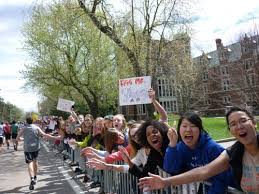
I imagined them cheering me on, like spectators that line the course at a marathon. They were standing resolute, watching my journey and saying together, “Come on! Come on!”

It dawned on me that they had already run this course — they knew what was coming, the challenges I would face, the relief that would be provided, and how far I was from the finish.

I shouted at them in disbelief, “Really? You finished? You made it?”

“Yes! Keep going! You can do it!”

“Easy for you to say! Can’t you see I’m struggling here?”

“We struggled, too!”

“You did?”

“Of course…sometimes for long stretches.”

“This has been a very long stretch. I’m tired.”

“He’s got you! You’ll make it!”

I turned my eyes back toward the road, pressed forward by their voices. Of course they were right. My difficulties are not beyond what is common to man, surely I have not be given more than I could bear.

“Keep your eyes up. Relief is coming!”

What had I been thinking, that I was the only one who struggled? Did I think my challenges were more difficult than those of anyone else?

I glanced to my right and saw an older man, sweat band across his forehead, eyelids at half-mast, jaw slack. His faded singlet exposed his thin, leathery arms. His feet, in worn trainers, pounded the pavement wearily, one step after the other.

In front of me, I saw a pony-tailed girl, clad in neon-orange and fresh kicks, trotting beside her dad who intermittently dispensed encouragement: “Gatorade just ahead….drop your shoulders and that cramp will go away…you’re doing great!” She determinedly pumped her arms, believing his words.

What had I been thinking? That the road would be easy? Hadn’t I expected that it would take work, focus, and determination? Hadn’t I realized that life is full of ups and downs, unexpected turns, and difficult paths? Where had I gotten the message that if I got it right, I could avoid trouble, tragedy, and pain?

Why hadn’t I realized that my focus should not be on avoiding trouble, but on responding to trouble? What kind of person would I be in the face of difficulty? The kind who stomps off the course? Or the kind who grabs a cup of Gatorade, leans into the encouragement of those who have gone before, and keeps stepping?

Anyone who’s run a long race knows that crowds gather at the starting line and at the finish. They also often show up at easily accessible mile markers, but on the steep inclines, the difficult hair pin turns, and the long desolate stretches, the sidelines are often empty. You might see others far ahead on the course or others way behind, but you can feel pretty lonely as you hear the sound of your feet hit the pavement and struggle to control your ragged breaths.

Yet at these times, when the cloud of witnesses has seemed to evaporate and the cheering has gone silent, a still small voice can be heard.

In the world you will have trouble. But take heart, I have overcome the world.

I will never leave you nor forsake you.

See, I have engraved you o the palm of my hands.

And before you know it, you’re rounding a curve and you can hear the roar of the crowd, “Come on, come on! You are almost there!”

Your knees start to lift, your face starts to smile, your pace picks up. You run to join those in front of you, as you turn to those behind yelling, “Come on, we’re almost there!”

This picture — this new picture — of a great crowd of those who have gone before cheering the rest of us on — this one I won’t tuck into that file. This one I will keep out on my desk, on the dashboard of my car, on the doorposts of my house.

I am not a solitary dot on the line of eternity. I am one of millions of dots forming a visible cloud — a collection of those to whom God has been faithful. The expanse of eternity is large enough for all of us, and not so large that I will feel alone.

That won’t keep me up tonight. Not at all. In fact, I plan to sleep in peace.

Therefore, since we are surrounded by so great a cloud of witnesses, let us also lay aside every weight and the sin that clings so closely, and let us run with perseverance the race that is set before us, looking to Jesus the pioneer and perfecter of our faith, who for the sake of the joy that was set before him endured the cross, disregarding its shame, and has taken his seat at the right hand of the throne of God. Consider him who endured such hostility against himself from sinners, so that you may not grow weary or lose heart.”

Hebrews 12: 1-3

Celebrating Freedom?

Kristin's avatarNext Chapter

Donned in red, white, and blue many of us today will find our way to picnics and gatherings; we’ll light sparklers and watch fireworks. It’s a national holiday to celebrate independence — freedom from tyranny, freedom to vote, and freedom to speak our minds.

What a privilege we have to live in a country that is free — that for hundreds of years has been a destination for those fleeing oppression, longing for liberty, hoping for a better life.

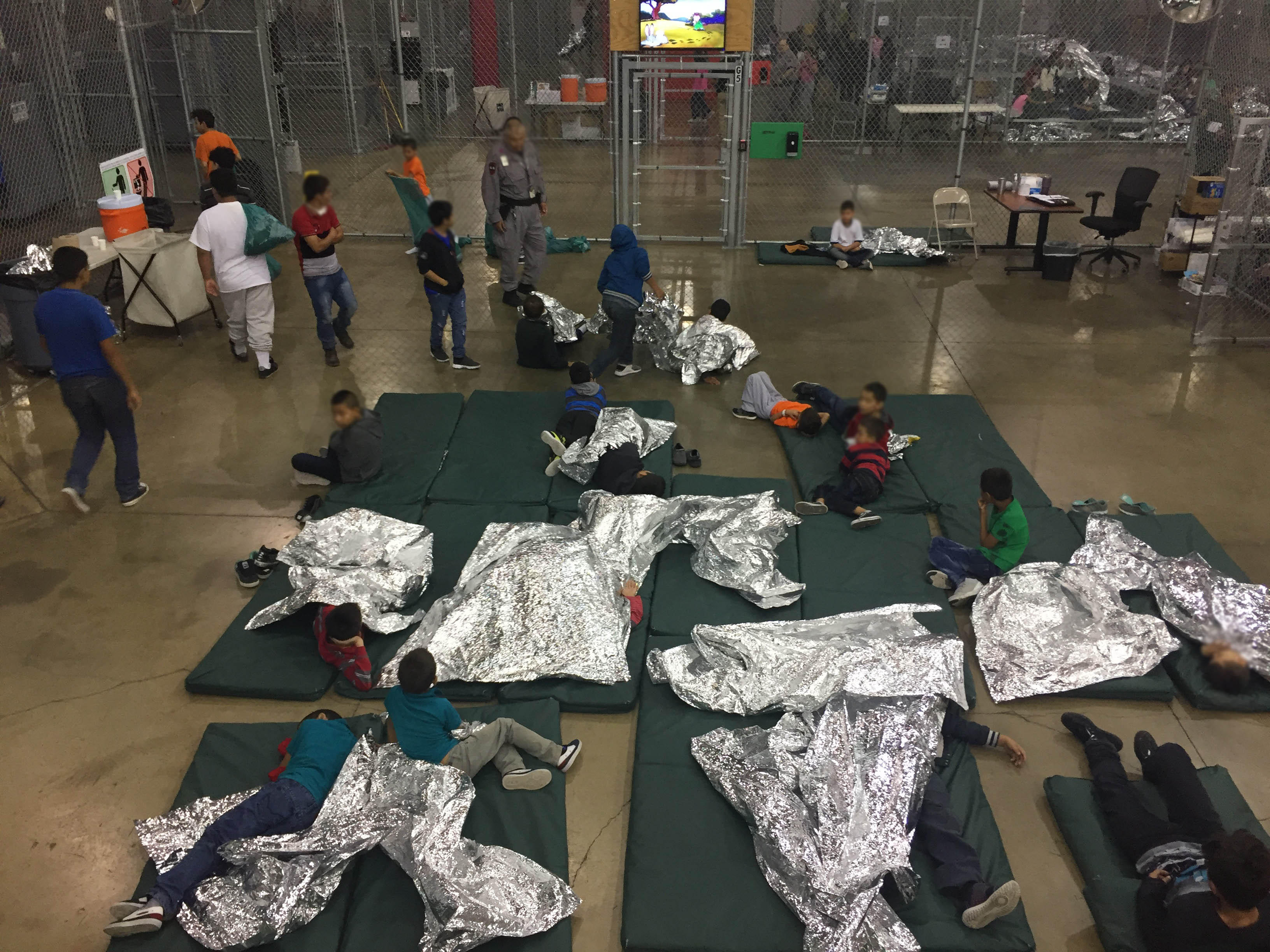
So, it seems a bit ironic to me that as we celebrate our freedom, hundreds of children whose parents dared to walk a road toward what they hoped would be a better life, are held in crowded rooms, clutching tinfoil blankets, unaware of when they will see their families again.

Source

It seems impossible that in the land of the free and the home of the brave, children going to…

View original post 588 more words

Celebrating Freedom? a re-visit

I wrote this piece last year on the Fourth of July, when one of the biggest concerns of our nation was the fact that children were being held in detention centers at the border. As of June 8, 2020, according this New York Times article, 124 children were still in being held in our country’s three family detention centers. A federal judge has ordered that they all be released by July 17 due to the danger of the coronavirus running rampant through these centers. These children won’t be able to celebrate this weekend. They are not alone — many Americans are still waiting for true freedom. As we celebrate differently this year, may we also think differently. What are we willing to do to ensure liberty and justice for all?

Donned in red, white, and blue many of us this weekend will find our way to picnics and gatherings; we’ll light sparklers and watch fireworks. It’s a national holiday to celebrate independence — freedom from tyranny, freedom to vote, and freedom to speak our minds.

What a privilege we have to live in a country that is free — that for hundreds of years has been a destination for those fleeing oppression, longing for liberty, hoping for a better life.

So, it seems a bit ironic to me that as we celebrate our freedom, hundreds of children whose parents dared to walk a road toward what they hoped would be a better life, are held in crowded rooms, clutching tinfoil blankets, unsure of when they will see their families again.

It seems impossible that in the land of the free and the home of the brave, children going to school, families attending church, or friends going to a concert can be gunned down in moments by an assailant with a semi-automatic weapon; that kindergartners learn how to Run, Hide, or Fight; and that whole webpages, programs, and organizations exist for the sole purpose of training people how to respond in the event of a violent attack.

One hundred fifty-six years after the end of slavery and fifty-five years after the Civil Rights Act outlawing discrimination based on race, color, religion, sex, or national origin, African Americans are 75% more likely to face a charge carrying a mandatory minimum sentence than white offenders committing the same crime (University of Michigan School of Law), Muslims are subject to travel restrictions and hate crimes, and women receive 80% of the pay men receive for comparable jobs (AAUW). Injustice persists for Native Americans, Hispanics, Jews, and members of the LGBTQ community.

Aren’t all men (and women and children) created equal and endowed by their Creator with certain unalienable rights?

In the United States, where someone is sexually assaulted every 92 seconds and 1 out of 6 women will be the victim of an attempted or completed rape in her lifetime (RAINN), where 84% of women and 43% of men experience sexual harassment in the workplace (NPR), who, I ask, is free?

Is this what our ancestors fought for? Is this their more perfect union?

Did they fight to give us the freedom to lock up children away from their families?

Did they consider only white Christian men to be created equal? not people of color, women, or children? Do we?

Did they ensure the right to bear arms so citizens could freely gun down innocents as they live their daily lives?

Did they include among our unalienable rights the freedom to take the innocence and safety of others?

Is that what freedom looks like?

Or can we do better? Is it possible to live in a society where all can experience the same freedoms? Or is that simply an American dream?

As we light our grills and watch our fireworks, can we pause to consider the high price that was paid for American freedom and the high price that some are still paying? Can we think about what we’d be willing to sacrifice to offer safe haven to the tired, the poor, the huddled masses yearning to breathe free?

Can’t we find a way to provide life, liberty, and the pursuit of happiness to all inside our borders? Wouldn’t doing so ensure domestic tranquility? provide for the common defense? promote the general welfare? ensure the blessings of liberty?

Wasn’t that the hope in creating one nation, under God — the God who created all men, women, and children, who loves all people?

The God who commanded that we not only “love the Lord our God with all our hearts, souls, and minds” but also “love our neighbor as ourselves”? The God who, when asked “who is my neighbor?” told a story of mercy to strangers and perceived enemies (Luke 10:25-37)?

The God who told us to “seek justice. Defend the oppressed. Take up the cause of the fatherless; plead the case of the widow” (Isaiah 1:17)?

The God who requires us “to act justly and to love mercy and to walk humbly with our God” (Micah 6:8)?

Aren’t we free to do just that?

It is for freedom that Christ has set us free.”

Galatians 5:1

I am just a human, being, revisit

Kristin's avatarNext Chapter

This post, written in July 2014 at the beginning of my quest to do less and be more, seems appropriate even in July 2019, at the end of a weekend where I hung out with my granddaughters, simply being.

Many have pointed out the irony of being called ‘human beings’ in a culture that is so focused on ‘doing’. We often find our worth, meaning, and identity through what we do. Strangers, upon meeting, ask one another, “so what do you do?” The child comes home from school, and the parent asks, “what did you do today?” The husband says to the wife, “what have you been doing?” It’s fine if what youdidwas close a million-dollar deal, get an A on a paper, or promote world peace, but not so great if what you did was file for bankruptcy, get in a fight with a friend…

View original post 739 more words

For Us, re-visit

Kristin's avatarNext Chapter

This post, written in September 2017 and polished for you here in June 2019, illustrates another instance of how sharing my skill-set with a friend worked to shape my growth. After I read the initial two chapters, Marv Fox and I spent the next 18 months or so reading, re-reading, writing, and re-writing. Marv is now truly a friend. If you’d like to read his book, Become, you can purchase it at this link.

A friend of mine is writing a book, and he asked me if I would read a couple of chapters. Actually, two weeks ago, ‘friend’ might have been assuming too much on my part. I knew this guy from church and from around the university, but other than a few standing-around-after-church conversations, we hadn’t spoken much. However, in one of those conversations, he mentioned a book that he is writing. He said he’d been…

View original post 1,135 more words

Of Gardens and Growth, a re-visit

On Monday, I wrote about what happened last weekend while we were preparing our garden for planting. This morning, I found this piece that I wrote last year — a reminder of what can happen when we dare to plant a couple seeds.

For Mother’s Day, when my husband asked what I would like for a gift, I asked if he would enlarge our garden, so out he went, shovel in hand, in the rain, to remove the sod layer. The next weekend, he and our son dumped a couple hundred pounds of top soil and manure on the newly exposed dirt and we began to plant.

We put in a few tomato plants, radishes, carrots, and some peas, along with yellow squash, cucumbers, and cantaloupe. We watered thoroughly then walked away.

Literally walked away. For two weeks.

We went on vacation and came back to find that everything had grown — the tomatoes had doubled in size, rows of radishes, carrots, and peas had surfaced, and even our mounds of cucumbers, squash, and melon had green fingers poking out of their tops.

If you’ve done any gardening, you know that other stuff surfaced as well — grass from the lingering roots, volunteer tomatoes from last year’s crop, and weeds. So many weeds.

I couldn’t get to the garden right when I returned, but last weekend, I put on my gloves, plugged in my headphones, and plunked myself down in the dirt. For over an hour I raked and pulled, shifted and sifted, then hauled the debris to the woods.

By the time I had finished, I had enlisted a couple of those volunteers into service and cleared some room for growth. I grabbed the hose, gave the garden a good long drink, and walked away.

A couple times this week, I bent down, pulled a weed or two, sprinkled some water, and harvested a few radishes, but mostly I assumed my typical gardening stance — watching in awe as seeds sprout, green appears, and red orbs emerge from the dirt.

My husband moved to Michigan a year ahead of me, and when I finally arrived, he was excited to show me that he had planted a couple of tomato plants in a small patch of land at the back of our house. He knew I’d want something to tend to make this place feel like home. Since that time we’ve moved the garden to a spot with more sun, transplanted rhubarb from my cousin’s yard, and experimented with different seeds and plants. Along the way, I’ve learned that growth happens in spite of us. Sure, I’d like to claim credit for the amazing cantaloupes we harvested a couple of years ago, but truly all we did is push seeds into the ground, spray some water, and watch sweet, buttery fruit appear.

As I’ve watched my garden over the seasons, I’ve experienced my own growth here, too. When I arrived, like a plant dug out of the ground, wrapped in burlap, and shipped across the country, I was wilted, frail, and in need of some attention. For several months I just sat here, recovering. Now, five years later, I’m stunned to discover a network of friends, a satisfying job, and, a whole different rhythm here in our house by the river.

This growth didn’t happen all at once. For a while, I sat buried in dirt and crap, taking in sunshine and water. For whole seasons, I waited for the first glimmer of green to break the surface, and just as I was losing hope, I discovered strength rising from the ground up. All of the energy had been developing roots — a deep, expansive network that would support the growth that was and is still yet to come.

This morning I took Chester out early for his morning relief walk, and I looked at my garden to see if, after some gentle care yesterday — some more weeding, a sundown drenching — my plants had miraculously doubled in size overnight. They hadn’t. It doesn’t usually happen like that. I can’t quite figure it out — when I am watching for the growth, my plants seem to be standing still, making no progress, but when I look away, when I get busy with life responsibilities and then turn back, ‘suddenly’ it is time to harvest.

All growth seems to work that way. Just a week or so ago, I was introducing a student to the vowels — the names and sounds of a, e, i, o, u. He was really struggling, so unsure of himself that he was tentatively whispering every answer. Then, on Friday, I noticed him swiftly reading words like pin and pine, easily maneuvering the vowel sounds and even taking chances like changing pin to pain to pan. He was high-fiving his instructor and running through the center celebrating his accomplishment. I turned my back for minute, and there it was — growth.

It happens in spite of us — though we often forget to water and we sometimes ignore the weeds — growth happens. You stick a tiny seed into dirt and manure and hope for the best. And typically, our hope does not disappoint us.

Now, I must concede that growth doesn’t always match expectation. One year I was working in the garden, and I pulled up what I thought was a rather large weed, only to find potatoes attached to the roots! I hadn’t even planted potatoes! (I guess they had grown from the previous year’s compost.) Another time I bought a kale plant and plunked it in the garden, thinking it would produce multitudes of kale to support our kale chip habit, but it actually only spit out two or three new leaves each week — hardly enough for a garnish.

When I moved to Michigan, I carried with me a seed of hope that I would get my health under control and maybe find a part-time gig working in a library. (I never dared to imagine that I would be able to work full-time as a teacher again.) I planted and prayed over that tiny seed, and it was transformed into a life I couldn’t yet see — one that was way beyond my expectation.

I have lots of little seeds of hope that I have clutched in my hand, watered with my tears, and dared, finally, to toss onto the ground. I have released them to the power that miraculously transforms the tiniest of seeds into beautiful realities. I am trusting that despite my carelessness these seeds will be transformed, in their own time, into extravagant fruit that we’ll be talking about for years.

We plant our seeds (of vegetables or of hope) and then we wait expectantly. We water. We watch. We pray.

I keep watching my garden. I am waiting for fresh shelled peas, warm tomatoes, and maybe a buttery cantaloupe. And while I wait, I continue to sow seeds of hope — and I pray that they also will transform into realities I don’t dare yet to dream.

Those who sow with tears will reap with songs of joy.

Psalm 126:9

“Trust Talks”, re-visit

Kristin's avatarNext Chapter

This post, written in January 2015, refers to a book I edited for a friend several years ago. The free e-book, which I will send you upon request, is an excellent tool to help you reveal and heal the hidden hurts that are getting in the way of communication in your relationships. I’m re-visiting the post in June 2019 to connect with my post “Both Sides” staying with the theme of improving communication.

In 2010 a friend called to ask if I’d be willing to accept an editing job. Asa therapist, he had discovered a strategy to use when communication had broken down in relationships; he felt led to share this tool through a free e-book. Would I be willing to sign on for this labor, he asked, knowing that my pay would be of the ‘eternal rewards’ kind?

I had met this man, Brad, and his wife, Lori, several…

View original post 1,118 more words

“Both Sides”, one more time for the people in the back

I wrote this piece last summer, and I ran it as a ‘re-visit’ in January, but as we head into the Democratic and Republican conventions over the next two weeks, perhaps we can take a moment to remember that although the US is largely a two-party system, the complexity of beliefs and political viewpoints in this country is vast. Would you be willing to challenge yourself to lay aside assumptions and create some space for discussions with people you might have previously assumed were on the other side?

The other day, a news reporter said that people on both sides of the immigration debate were upset by a recent decision. Senators from both sides of the aisle are contemplating impeachment, and both sides of the abortion debate are reeling from recent legislation. This language might lead us to the conclusion that many of our issues are binary — pro or con, Republican or Democrat, liberal or conservative, black or white.

But isn’t most of life more complicated than that?

Is it even possible to break the US population, which today is 331,002,651 strong, into “both sides”? Can we neatly fit three hundred million people into two (or even three!) groups that would be able to agree on a political stance, an ideological framework, a common belief system? To me it seems unlikely — I can’t even get consensus on what to put on a pizza.

Yet spurred on by this type of rhetoric and our own human nature, we continue with this binary thinking — this either/or mentality — that puts us one against the other, fingers pointing, heels dug in, and shouting. We have assumed a posture of opposition, and in my experience, opposing forces with no intention of bending can do little less that push against one another and cause damage.

Is that what we’re aiming for?

My coworkers and I were recently discussing strategies for shifting a student who is resistant to instruction. This is an important discussion where I work because most of our students have experienced failure after failure in the classroom, and we are asking them to do the thing that is most difficult for them, usually for several hours a day, five days every week. It makes sense that they start out resistant and often return to that resistant stance over and over again. It’s pretty easy to spot. Just this week I saw a little boy, lower lip hanging, eyes brimming, sitting across from an instructor, refusing to engage with the questioning that is at the core of our programs.

What’s an instructor to do?

Will yelling at this child inspire him to engage? “Tommy! You’ve got to do this instruction! You don’t know how to read! We’ve got to do this right now!” No. That just leads to more resistance.

How about guilt? “Tommy, your parents are paying a lot of money for your instruction. Right now you are wasting their money and wasting my time.” Effective? Hardly.

Begging? “Please, Tommy, please, will you read this word?” No; at best this is a short-term solution.

What I’ve noticed throughout my years of teaching is that relationship has to come first. The student needs to see that you like her, care about her, and want to have fun with her. She needs to see that you are willing to get in the trenches with her, that you care about what she has to say, that you are invested in the process, and that you are willing to be flexible.

Time and time again, I have seen a student on the first day of instruction, convinced that he will never improve his ability to read, sink into a chair, turn his eyes down, and prepare himself to resist. Just as many times, I have seen a well-trained instructor start by building rapport, explaining the steps simply and carefully, then setting the climate for teamwork and fun. Slowly, the student sees that he is not alone, that he can take a chance, that he can begin to believe differently. Maybe, just maybe, he really can learn how to read!

If we can create a space for our students to step into, if we can show them the possibility of a world in which they can, with our support, learn how to read, then they will more likely be willing to shift from their position of resistance to a position of cooperation.

What if we took that approach when speaking to people on the “other sides” of the discussions that we are having. What if we started by building rapport (which would require that we stop shouting)? What if we explained our positions simply and carefully (which might require that we think through the complexity of those positions and understand our own reasons for our beliefs)? What if we set a climate for peaceful, even fun, conversation (which might require that we refrain from blaming, oversimplifying, and name-calling)?

Could we, in this way, create a space for people to step into, where they might imagine not binary discussions that tend toward polarization, but complex discussions that can envision creative alternative solutions?

I’ve recently been part of a study of Ecclesiastes, a book of wisdom literature, which was specifically written to teach people to live wise lives. The study defines a “wise life” as one that makes right decisions because it’s willing to ask the right kinds of questions. If one is truly pursuing wisdom, she has to ask these questions with open ears, an open heart, and an open mind. She has to be open to the possibility that she might be wrong.

Gulp.

What would that look like?

What would it look like if all the sides were committed to making the right kinds of decisions because they considered the right kinds of questions? What would it look like if all the sides entered the conversation with open ears, open hearts, and open minds? What would it look like if all of the sides were open to the possibility that they might be wrong?

Would we approach one another with humility? Would we ask one another to help us understand the reasons behind our positions? Would we listen carefully without mentally forming rebuttal? Would we pause and think before we replied or asked for further clarification?

Would we first build rapport?

(Hi, my name is Kristin, I am happy to be having this conversation with you today. How are you?)

Would we explain our positions, after having considered our own reasons?

(I come from a Christian perspective, and my life experiences have complicated some of my earlier held positions on political matters. I am wondering if you would be willing to step into that complexity with me.)

Would we set a climate for peaceful, even fun, conversation?

(Would you join me for a cup of tea and maybe lunch. I am not expecting any solutions; I am just wanting to toss around some ideas. Maybe when we’re done being serious, we could get some ice cream or see a movie.)

What might shift if we created such spaces? if we created an environment where folks didn’t have to cling so tightly to positions that they may not even fully understand or agree with? if we could stop pointing fingers, look into the eyes of the person sitting across the table from us, and see their humanity?

It certainly wouldn’t be as simple as having two sides. That’s true.

Is it worth the time and energy to admit that we might be more complex than that?

Are we brave enough to try a different way?

Are we willing to make right decisions because we have considered the right questions?

Are we willing to stop believing that we are merely both sides?

It is better for a man to hear the rebuke of the wise

    than to hear the song of fools.”

Ecclesiastes 7:5

My Sweet Experience, re-visit

Kristin's avatarNext Chapter

Yes, it’s gushy, but since I just saw Dr. Sugar yesterday, and since he rescued me when I had a significant flare while I was in Utah last week, I decided it was time to polish this post from March 2018 and share the gushing one more time, in June 2019.

As a new volunteer for Patient and Family Centered Care at the University of Michigan, I have been asked to share part of my story at Kellogg Eye Center to a group of new Kellogg employees.What has my patient experience been like? Since I am more accustomed to writing than to speaking, I thought I’d share what I plan to say here.

In the summer of 2012, while my family and I were living in St. Louis, MO, I started experiencing joint pain.I had been, up until that time, a full-time teacher, school administrator, mother of four, and…

View original post 1,480 more words