Coronavirus Diary 16: Back to School Edition

Can you hear that? Can you hear the subtle hum? It’s the thrum of collective anxiety coursing through the nervous systems of every teacher, parent, and student who has already or who is about to start the school year either in person, online, or in some kind of hybrid format. The theme of the song? Uncertainty.

Never before have we approached a school year in such a “wait and see” posture. Schools and districts that have chosen to open in person have plans in place “just in case” a student or many students, a teacher or many teachers, a school or many schools get infected with Covid-19 mandating a move to partially or fully remote instruction. Schools that have chosen to open virtually have committed to several weeks or months of online instruction with plans in place to move to partial or full in-person models as soon as possible.

Teachers, students, and parents are facing the uncertainty about where they will do instruction this year.

Some schools have provided their teachers with training on using Zoom rooms, Google classroom, and myriad online instructional tools. Some have done this well and thoroughly, some have taken a more haphazard approach, and others have told their teachers to “figure it out”. Some teachers are very proficient with Internet technology, some manage just fine, and some have avoided using technology for as long as possible and have no idea what a URL is. While most students in middle- and upper-class communities have been raised with a device in their hands, many in lower-income communities are learning to access technology for academic purposes for the very first time. Whether they are technological novices or pros, they’ll be “doing school” much differently than ever before.

Teachers, students, and parents are facing uncertainty about how they will do instruction this year.

Some schools started the year early, to get in as much instruction as possible before another potential stay-at-home order. Some schools have students coming to school on alternate days to space out the number of bodies in classrooms. Some schools are having shorter instructional days to allow for added cleaning in buildings or to allow for time away from computer screens if students are learning from home.

Teachers, students, and parents are facing uncertainly about when they will do instruction this year.

Teachers are wondering about how we will build relationships, how we will have enough time together to get to know one another, when we will find time to share stories and tell all the corny teacher jokes that are critical to every classroom. We’re wondering where to pick up in the curriculum, knowing that our students’ learning was disrupted way back in March and that individual students managed that disruption and the virtual learning that followed much differently from one another. We’re wondering how to allow students the time and space to process trauma — the trauma of leaving school in the middle of the year, the trauma of losing a friend or loved one, the trauma of being continuously at home with a family that may or may not have fared well in the face of a global pandemic, the resulting economic crisis, and the concurring racial unrest.

We’re wondering how we’ll manage to reach students who we may only see in the gallery view of our Zoom rooms, how well we’ll adapt to distributing and collecting assignments via Google classroom, and how efficient we’ll be at transitioning from task to task, student to student, class to class, from in-person to online learning, or vice-versa.

Parents are wondering how safe their kids will be at school, how long they will stay there, and how they will manage to juggle all their responsibilities — again! — if their students are moved home. They are wondering if they’ll be able to keep their jobs — or find a job, if they’ll be allowed to work at home, if they’ll be able to find child care, and if they’ll have enough money to pay for it. They’re trying to explain the unexplainable and answer the unanswerable for their children who are also feeling the stress of the uncertain.

These children wonder who their teacher will be, when they will talk to their friends, if they’ll be able to have recess, and how they will eat their lunch. They are worried that they’ll have to keep learning at home, that they won’t understand the assignments, and that they’ll have have to sit in front of the computer for all of their lessons. They are asking when they’ll get to go to practice, will they have to wear their masks, and why they can only go to school on Tuesdays and Thursdays.

Where? When? How? Why?

All of the answers are, “Well, let’s wait and see.”

It’s so uncomfortable to live amid so much uncertainty when we’ve been following the same rhythms and patterns for so long. We just want to go back to ‘normal’ — to do things “the way we’ve always done them” — and to be beyond all this Covid-19 nonsense.

But we’re not there yet. We’re here, in the midst of a global pandemic, where we do things differently than we’ve ever done them before.

We wash our hands more, we wear masks, we stay home, we do family Zoom meetings, we send packages in the mail to loved ones we wish we could see in person. We stand further apart, we ask more questions, we decline more invitations. We become accustomed to the phrase, “we’ll have to wait and see.”

So dear friends, dear teachers, dear parents, dear students, I’m sorry that this is where we find ourselves, but alas, here we are. So, since we’re all in this together, can we find inside ourselves, under the hum of uncertainty, a way to extend a virtual hand of support — a cheering on, a forgiving smile, a gracious response? Can we find a way to see one another’s uncertainty with understanding and compassion? Can we hear one another’s worries, share our frustrations, and commit to being kind to one another in the midst of uncertainty?

Can we, as teachers, be patient with one another as we learn all the things, even if the fog of our Covid brains requires us to hear the instructions multiple times? Can we be gentle with our students who may not know how to submit an assignment online, answer an email, or right click on a hyperlink?

Can we, as parents, be supportive of our teachers and administrators who are trying very hard to meet the educational, social, and safety needs of our children and their teachers? Can we be respectful with our questions, offer our assistance, and send a note of encouragement? Can we remember that our kids are managing uncertainty, too, and that they may not always regulate their anxiety, their fears, their frustration, their anger? Can we give them an extra measure of grace as they navigate the “wait and see”?

Can we, as students, show up and do our best to attend to our teachers and let them know when we are getting lost or don’t know what to do next? Can we be patient when the technology doesn’t work right, when our teachers seem flustered, and when our parents are at their wits’ end? Can we try to communicate when we ourselves are at our wits’ end?

It’s gonna take all of us doing our best, assuming the best, and overlooking the less-than-best. We’re doing a lot here — trying to focus on the tasks in front of us while trying to drown out that insufferable hum of uncertainty. If we have any hope of success, it’s gonna be because we all leaned in to the uncertainty, saw it for what it is, and accepted the fact that we’ll have to do what we can and wait and see.

We can do this — together — we can do this.

Be kind to one another, forgiving one another, even as God for Christ’s sake has forgiven you.

Ephesians 4:32

Reality Setting In

I drove to Detroit yesterday, walked into a building I’ve only been in twice before, went to a room to see someone I’ve never met, to check out a laptop that’s different than any I’ve ever worked on before.

And reality started to sink in — this is all gonna be new.

I was struggling to type my name on a non-Mac keyboard when the principal walked in and greeted me. She’s a six-foot tall Black woman with red-orange hair, an air of confidence, and a gentle smile. I was so happy to see her. She wondered if I’d seen my room yet, and when I said I had not, she offered to take me there.

As we walked, she shared that Detroit Public School teachers were striking over safety concerns regarding in-person instruction. She (and I) understood the teachers’ concerns and also the reality a strike might mean for students across Detroit who’ve been out of school since March, who’ve missed the stability and routine that school can bring. We shared our compassion for teachers who have not been equipped with the time to plan, the tools they will need, or the training to use those tools in order to effectively teach remotely. Our understanding of a system in need of funding, reform, and repair remained unsaid as we walked down a newly polished hall and found my room.

“My name’s on the door!” I gushed.

“Yes.”

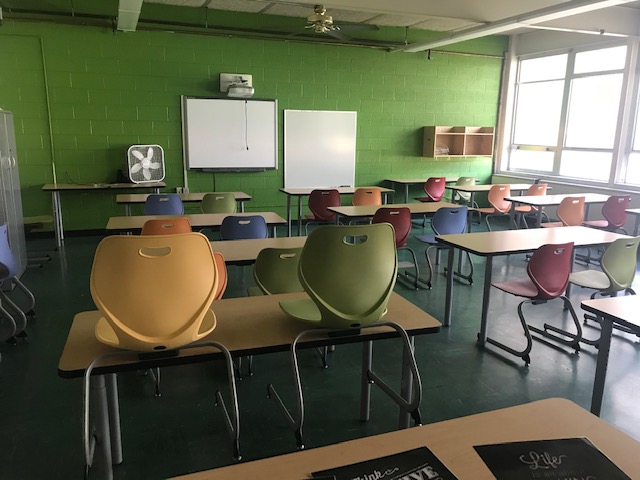
As I walked into the room, I saw the neatly arranged desks, the fresh green wall, a box fan near the front of the room, “Do I get to keep the fan?”

“Yes.”

“Do I get to keep the books?”

“Yes.”

“How about these supplies?”

“Everything in here stays.”

“It looks great!” I practically shouted as I took in all the shelving, the Smart Board, the white board, and the tape, stapler, and other supplies behind my desk area.

I began to picture myself working in this room, knowing that it would be me, alone, at least for the first quarter. All of our students will be remote — from their homes — on tablets and laptops that the school has been acquiring through the generosity of community partners, grants, and purchases. They’ll be able to come to the school to pick up supplies and food, which the school will continue to provide, but they will learn from home. I, on the other hand, will be in this bright classroom four days a week, and working from home on Wednesdays when my students will have assignments to complete, books to read, and journals to write while I meet with my colleagues, hold office hours, grade student work, and write lesson plans.

We left the room and she showed me who would be my hall neighbors — a new math teacher, a social studies teacher, and a master English teacher right next door to me, for ease in collaboration. The computer lab and several computer carts are a few steps away. I could picture myself moving down the hallway to the lab with my students, dropping into the classroom next door to ask a couple of questions, and moving back to my room for instruction. I had to keep editing my mental movie, which kept auto-populating all of the hallways, classrooms, and desks with students. I had to keep reminding myself that this year was going to be different.

I’m going to be in my classroom, in front of my laptop, greeting my students, providing instruction, responding to questions, and — hopefully — making a difference.

When I was offered this position, I agreed to teach freshman English, but on the day I accepted the offer, I was asked if I’d at all be interested in teaching seniors (Yes!) who need to be prepared for college (Yes!) who haven’t taken the SAT and need some preparation (Yes!), even if I have to help write the course (Are you kidding me, Yes!).

Then, last week, I was told that I would also have a section of freshmen (Let me at ’em!) and a section of just SAT prep, an elective, presumably for juniors (Hooray for juniors!). When I left Lutheran North, I had one section of freshmen along with juniors and seniors. This feels like home.

So, I’ve been dabbling in curriculum and reading Common Core Standards while also taking an online course called The No-Nonsense Nurturer, which all teachers at Detroit Leadership Academy (and many other schools across the country) take. Its focus is on setting the classroom climate for high expectations and academic achievement in communities that have historically been marginalized. The training is solid — through it I’m recognizing some of my tendencies toward enabling students because of my inherent biases, and I am also being affirmed in some of the strategies I’ve used in the past to build relationships that motivate students to excel. Taking this course is helping me shift from where I’ve been to where I will be.

And in all this preparation, though I am elated and so excited, I am starting to feel the hum of anxiety — am I really ready? can I really develop this new course in time? can I actually learn to go with the flow? will I really be able to make a difference in the lives of these students?

Yesterday, when I picked up my laptop, I also got a lanyard with keys, and a staff T-shirt emblazoned with the name of the organization that houses Detroit Leadership Academy — Equity Education. It’s just a black T with one word on the front, but that one word is a reminder of why I am taking this step — back to the classroom, back to the city, back to students who might not know that they matter.

I’m ready to put that shirt on — I’m ready to suit up! I’m a little nervous, a tiny bit terrified, but I am ready. I’m stepping into this role knowing that I might not get it all perfect, but I am going to show up each day for the sake of these students, for the sake of their futures, for the sake of equity, and, as I’m sure you’ve gathered by now, for the sake of myself. I know I’ve been prepared for this moment, and I am thrilled to step into it.

Be strong and courageous. Do not be frightened, and do not be dismayed, for the Lord your God is with you wherever you go.

Joshua 1: 9

Disruption and Transformation

My oldest granddaughter is starting kindergarten this week, and as we were celebrating this milestone over the weekend, I started thinking about the year I started kindergarten. I couldn’t wait to go to school, to meet new friends, to sit at a desk, and to raise my hand to speak (ok, let’s be honest, I never fully mastered that part).

Just as my mother and father had done when they were five, I got up early in the morning, ate my breakfast, brushed my teeth, and walked down the street to my neighborhood elementary school, where I greeted my teacher, Mrs. Cole (bless her heart), and met those who would become some of my lifelong friends.

From that point on, most of the years of my life, I have looked forward to the start of school. I’ve bought new pencils and pens, picked out the coolest lunchbox I could find, and selected my first day of school outfit days in advance. I went to school from 8am to 3pm Monday through Friday until I went off to college, where I continued on much the same calendar. I took breaks at Thanksgiving, Christmas, and Spring Break, and then enjoyed a long summer before I started the cycle all over again.

You could probably say the same, because we’ve been doing school this way since time immemorial.

Much has come to depend on this system. Parents count on the fact that their kids are going to school: it provides a place for kids to go while parents are at work, one or even two meals a day, and even transportation to and from school.

Schools provide social, cultural, and practical education. It’s in school that kids learn to share and take their turn, to appreciate music and the arts, and to follow processes like writing proposals and submitting applications. Our society depends on schools to prepare children to become members of society. It has for centuries by now.

And, for the most part, it’s been doing it the same way for all those years. Children have been starting kindergarten at age five since the 1870s (see a history of kindergarten here). Since long before that time, children across the country have gone to school Monday through Friday, from 8 to 3, or in many cases much longer with breakfast or before care tacked on early and sports, extracurriculars, or after care added at the end of the day.

Teachers arrive early and stay late, often working 10 or more hours a day, day after day, month after month, nine months out of the year. Year after year after year.

Until a pandemic arrives and disrupts that system.

Disruptions can freak us out — We panic, we stress, we yell at our friends and neighbors, we point fingers, and we demand that things go back to normal.

However, sometimes disruption can show us a better way.

If you’ve been following my blog since its inception, you will know that it was born out of disruption. After years and years of celebrating the start of the school year, a disruption pulled me out of that rhythm. Chronic illness, and the acute nature of its beginnings, forced me into quarantine — not a literal quarantine, but it might as well have been, because I was no longer able to be in the classroom, to rub elbows with my community, or to share space and oxygen with the students and colleagues that I had loved so deeply.

And it freaked me out. I cried. I grieved. I yelled at my family and friends. I spent long days and weeks on my bed wishing that things would go back to normal, but the disruption showed me a better way.

When I was forced out of the cycle that had felt like home for over 40 years, I had to take a long look at the time that was available to me, the resources I had at my disposal, the abilities I still had, and the goals I was trying to achieve. How, I wondered, could I still be involved in education with my new limitations?

And isn’t that where we are now? We’ve been forced out of a cycle that has provided structure for our society for well over two hundred years. We are freaking out. We’ve been freaking out. Parents who’ve been stuck at home trying to work while parenting their children and attending to their educational needs, are rightfully overwhelmed. They have not been prepared for this. They’ve been prepared, as all of us have, to send our kids to school. Now some, of course, have chosen to prepare themselves to school their children at home — and these folks right now, are certainly at an advantage. The rest of the country — and much of the world — has been thrown off balance by this curve ball.

And we’re reeling — when will we go back to normal?

Some are pressing the issue of going back to normal right this very minute, “The kids need to be in school!” And I get it. If we go back to school, we think, everything will feel right again. Wouldn’t it be great to be packing lunches, waving to our kids as they get on their busses, going to football games on Friday night, and bending over the kitchen table every night trying to complete school projects (ok, maybe not that one)?

But what if, what if, this disruption could show us a better way. What if we took a long look at the time and the spaces that are available to us, the resources we have at our disposal, the abilities we still have, and the goals we are trying to achieve? How can we still be involved in education with our current limitations?

Some are figuring this out right now, folks. Never before have students of all income levels had access to personal electronic devices, but community members are stepping up, donating, and making sure that all of our kids have a laptop or tablet they can work from. Never before has there been such a global push for equity in terms of Internet technology, but right now, many teachers are receiving training on Google Classroom, Zoom, and other methods of digitizing their content and delivering materials to students who will not be physically with them. Likewise, students from all kinds of backgrounds, will begin to navigate digital spaces like they never have before.

Could this be a leveling of one end of the playing field?

What if educators, who find themselves sitting around the scrap heap of their disrupted plans and schedules, were right now thinking and preparing to do things a different way? What if, in fact, they’ve been begging for this opportunity for years? What if they have been longing for more professional development, more support from their communities, and more resources, and this disruption was the catalyst for change?

You might think I sound like Pollyanna, unless you remember that just six years ago, I walked out of a classroom, convinced that I’d never go back, that I spent that summer and much of the fall in bed with pain and inflammation or in the bathroom throwing up, and that the last six years have been a slow healing and restructuring of my life, and that in that healing and restructuring I’ve discovered new strengths, new possibilities, new ways of thinking, and a new sense of hope.

I’m living proof that disruption can been an opportunity for restoration, rebirth, and ingenuity.

If you are so stressed by this disruption right now and can’t see a way that the coming days will work, I get that. If you are lying on your bed in pain, or shaking your fist in rage, I feel that. If you are hungry for hope, for change, for rebirth, I’m just saying, believe that it can happen.

I’m believing for you right now. Many of you have believed for me over the last six years, even when I didn’t believe for myself.

Transformation often comes in the midst of hopelessness — watch for it. I know I am.

How can I do anything else when I’m looking at this 5 year old beauty curiously examining wildflowers on a Sunday afternoon, knowing that she’s heading to kindergarten on Tuesday.

The whole world is ahead of her, and I have to be full of hope.

May the God of hope fill you with all joy and peace in believing, so that by the power of the Holy Spirit you may abound in hope.

Romans 15:13

You want to go back to the classroom? Now?

I keep hearing this question (even if it’s sometimes left unsaid): Why would I leave a perfectly decent job to go back to the classroom? why now — in the middle of a pandemic?

It’s a great question, and the most honest answer I have is that, if it weren’t for the pandemic, I don’t know if I would be going back to the classroom.

After two and a half years at Lindamood-Bell, I was finally learning all the ropes, and I had finally been granted the opportunity to work with the Lindamood-Bell for Schools program in its partnership with the Fort Smith, Arkansas schools. I’d been learning to use Zoom to join a teacher and her class to provide instructional coaching and in-the-moment changes to instructional plans, and I was loving this collaboration. It was reasonable to expect that if I stayed with the company I would be able to do more of this kind of work, and I was excited about that. Also, I had a solid caseload of students (and their families) who I’d been working with for a couple of years — designing and implementing instruction and even collaborating with the schools these students attended. I was finding a way to use my years of experience and to continue to grow.

The pay was fine, the work was challenging, and my body, which had rebelled in my former life as teacher, administrator, mother, wife, and denier of emotions, seemed to be able to manage the pace and the stress.

I really had no serious intention of pursuing anything different.

And then, in mid-March, it became apparent that we were going to take all of our equipment and materials home and we were going to work remotely until further notice. This was actually fine, too. In fact, Lindamood-Bell, I felt, did a great job of getting us all home, digitizing all of our resources, and providing (ahead of any mandates) additional sick time and vacation time. I probably could’ve continued to work with students remotely — from my home office — indefinitely.

Like everyone, I shifted my lifestyle — wore more comfortable clothing (which I lovingly refer to as my Covid uniform), went for more walks, cooked more meals to eat at home, and watched more television including the daily news reports.

I (like most quarantined humans) watched George Floyd die, and it looked too much like watching Michael Brown dying. I saw Ahmaud Arbery get gunned down, and he looked like people I know. I saw Rayshard Brooks shift from a man who’d fallen asleep in his car, to a man aware that his life was in jeopardy, to a dead man through the lens of someone’s cell phone, and I was horrified by the world we are living in — where in the space of a few weeks we repeatedly bore witness to the senseless killing of black men — black men who didn’t have to die.

Night after night my husband and I watched news reports and protests; every day I saw friends, former students, and my own children, posting on social media and reminding me that this is not new. Senseless deaths, not to mention broad and systemic mistreatment, of people of color happen every day in the United States, and they’ve been happening since the first slaves were dragged off boats onto the shores of this sweet land of liberty and beaten if they did not do the work that their white masters demanded they do.

In many ways, a white police officer kneeling on the neck of a black man, smiling toward the camera, is just one more slave owner demanding that the black man do what he says or pay the price and be punished within the gaze of all the other slaves so that they will know their place and learn to comply.

In this climate I was sitting in my home office every day, meeting with students, doing interventions that enable them to read, chatting with their parents about how they are coping during a pandemic with all the kids at home, trying to get their own work done, and wondering when things will go back to normal.

And I knew that I didn’t want things to go back to normal — not if normal means that some kids get safe schools with excellent resources that set them up for success while other kids (for not fault of their own) get substandard materials, ill-prepared teachers, and less access to a quality education, while white folks who commit crimes often get the benefit of the doubt and minimum sentences and black folks who commit crimes often end up dead or incarcerated far longer than is necessary or humane.

The disparity between schools that are predominantly white and those that are predominantly black is not a new revelation to me — I’ve been aware of these inequities since long before I taught for one measly semester in the St. Louis, Missouri public schools, but somehow being quarantined during Covid, working every day with students who have been given every resource, and then being barraged by data about the inequities (a substantially higher incidence of Covid and deaths related to Covid among people of color, the number of underfunded and understaffed schools in urban centers like Detroit), along with a resurgence of activism, especially among young people including my own children, my coworkers, and many former students, created an atmosphere in which I saw the opportunity I had to step in.

Meanwhile, many teachers are feeling the need to leave the profession because of Covid — they feel they are unsafe in the classroom, that their communities are asking them to risk too much, that they can’t afford to put their loved ones in danger — and I don’t blame them. These are valid concerns. And if you’ve been in the classroom for years or decades and you are already tired, and you feel unappreciated because you are underpaid, under-resourced, and under-valued by your administration, your students’ parents, and your community, then being asked to go into a crowded space for up to eight hours a day, five days a week in the middle of a pandemic just might be the last straw.

So why — why? — would I willingly put my name in the hat?

Because as dark as everything seems right now, I hold onto hope that this just might be the time for major change. Covid-19 might be providing us an opportunity to see — really see — racism, societal inequities, broken systems, and unjust practices. Because we’ve had to shut so many things down, we might be able to see different ways of doing things — ways to incorporate working from home, digital platforms, and content-sharing so that every American kid can have access to all the content and resources that are available in all the best districts. We can begin to imagine scenarios in which one highly qualified teacher in New York City, for example, provides a webinar on the poetry of the Harlem Renaissance, which students across the country and around the world can stream at a time that works best for them, submit a reflection to a digital discussion board, and then work collaboratively with other students from different neighborhoods, states, and even countries, to create a YouTube video to link to the original webinar for sharing with countless other students. Imagine how that experience might connect students to one another and impact their view of the world, themselves, and each other!

How might we re-shape education so that the neighborhood you live in, the color of your skin, and your parents’ income doesn’t determine your access to high quality content and educational experiences? Is Covid-19 providing us the space and the perspective to do this?

I think it might be!

Now, do I think I am going to single-handedly change the American educational system. You know I’m gonna try, but realistically, systems that are as established as our school system (or our prisons, or our government) don’t change quickly. In fact, if they have any hope of changing, they need the investment of participants whose voices are unafraid to offer new ideas, to challenge long-held beliefs, and to believe that things can be better.

And I believe they can.

So that’s why I want to go back to the classroom right now in the middle of a global pandemic.

If not now, then when? If not me, then who?

The Lord works righteousness and justice for all who are oppressed.

Psalm 103:6

Note: If you’d like to support my classroom and the work that I will do this year either in that classroom or from my home office, I am currently collecting composition books (one per student to start), highlighters (a set of three — yellow, pink, blue for each student), index cards for vocabulary work, and other classroom supplies. As soon as I get my school-issued email address, I will be posting a link for those who would like to support from a distance. Thank you so much for following me on my journey in this next chapter.

Facing Change

I don’t want to brag or make it seem like I’m an expert on change, but here are the facts:

Before I graduated high school, I had lived in six homes (ok, I only remember four of them). During and after college, I lived in nine locations (counting separate dorms). Since we’ve been married, we’ve had eleven homes. You might call me a moving expert, because I was Marie Kondo-ing way before Marie Kondo was a thing.

I’ve gone to two elementary schools, one middle school, one high school, two colleges for undergrad (transferring after freshman year), and have taken graduate courses at three universities.

Not counting babysitting, I’ve held at least 25, yes twenty-five, jobs in my life, and I’m sure I’m overlooking some gig-work like that one summer that my stepfather got me an “opportunity” handing out samples in the deli of the grocery store that he managed.

I’ve walked into plenty of new situations, and I’ve learned a few things along the way.

First, I always come with the gusto: This is gonna be great! Imagine all the possibilities! Won’t it be fun? I am at that point a glass-hall-full-and-expecting-more kind of girl. I come on full speed and give it my all. (Exhibit A: I’ve already organized and alphabetized my newly-forming classroom library, and I’m not even in my classroom yet.)

Because I come in with so much enthusiasm, I have been known to overlook critical details, such as, I don’t know, the fact that the people in my life are also feeling the shift of change and they might not be as enthusiastic as I am. My daughter recently reminded me that when we uprooted our family and moved to St. Louis, my husband and I full of gusto and optimism, our children were reeling with grief, anger, and fear. They were not thrilled to be clinging tightly to the flying capes of their superhero parents. They just wanted us to stop and hold them, which I will graciously remind myself that we did from time to time, but we were, I’m afraid, quick to resume our flight — to conquer our mission and save the day.

Another thing I’ve noticed is that I quickly adapt to culture and expectations. In a new setting, I will likely watch quietly for a few days or weeks, until I see how “we do things around here,” but once I have the lay of the land, I bring myself to that situation in the truest way that I can. I remember the faculty retreat where I met my coworkers at Lutheran North. We were at a camp about an hour away from the school, all in shorts and tennis shoes. We gathered for the morning in a conference room to “talk business,” but after lunch we made our way to a challenge course complete with a zip line. Since it was my first day or two with this community, I was in that ‘quietly watching’ phase of entry, so when my team (people I’d never met before!) needed to lift me over a chest-high obstacle, I let them, and when they asked me if I would like to climb a rock wall and do the zip line, activities which I would under normal circumstances politely (or not so politely) decline, I said ok, I would do it. I was trying to go with the flow and figure out the culture, so I went out of my comfort zone and wouldn’t you know, I climbed that wall and zipped that line, and I felt great! These early successes, and others like them, gave me confidence to take some other chances with that group that would soon become family. I thrived at Lutheran North, where I became a leader, and my team embraced me in my truest form which is always honest (sometimes to a fault), often loud, and frequently emotional.

I came into my experience at Lindamood-Bell much more quietly. Illness had sucked the confidence out of me, and the intentionally positive and congratulatory environment of the company culture seemed, although very welcoming, quite foreign. The first two weeks I sat in a room with a coworker (who was my first on-the-job bonus kid) learning the programs, quietly taking notes, and reluctantly participating in role plays. The job was very scripted to start, and I was thankful! Because I was still visibly struggling with autoimmune disease, my gusto was suppressed; I was happy to have clear expectations and structure. I wouldn’t have to lead in this position, well, not at first…not until I was much stronger.

Yes, I come in with gusto, I quietly learn the culture, and then I am who I am.

At Lutheran North, my students called me Momma Ratch. Two of my own children were students at the school, and though while they were in my class, they were students first and treated as such, they were also my children, who rode in my vehicle, dropped by my classroom for a snack, needed to be driven home when they were ill or forgot their running shoes, and invited their classmates to our home. My students who were not my children, saw me in my role as teacher and my role as mother. They came to understand that I was imperfect in both roles, but that I continued to show up and try. They could come to my room with difficulty or to share celebration. They could borrow a few dollars or raid my stash of feminine supplies without asking. I had a stockpile of notebooks, folders, pens, and books in my room that I collected each year when students cleaned out their lockers. Anyone in the school knew they could come get what they needed no questions asked. I had firm and high academic and behavioral expectations, but I also learned what I could let go, what I could negotiate, and what really didn’t matter much at all.

At Lindamood-Bell, my coworkers called me Momma K. This probably started because I am the age of the mothers of all of my coworkers. They are almost all in their twenties (the age of my children), and though I didn’t always feel like it, particularly in the beginning, I think they have valued my experience, my perspective, my age. Often, it was me who was asking them for support, for encouragement, for understanding, as I navigated some of the most difficult years of my life. They were mostly oblivious to the grief that I was carrying, but it seeped out in moments of unprofessionalism. I would snap in a moment of frustration or glare at a coworker who told me something I didn’t want to hear. Yet, they, too, accepted me for who I am, and even celebrated me. In fact, the culture of Lindamood-Bell, the clapping, the parties, the dancing and balloons, reminded me of the importance of celebration, of noticing small victories and big ones even (and especially) in the midst of grief and transition. My coworkers dress up in wigs and hot dog costumes on a Wednesday just to make learning more fun. They hide pictures of Guy Fieri inside a closet to surprise you and make you laugh. They help kids set a trap of plastic spiders to scare you when you walk into a room. They cry because you are leaving, but send you off with books for your new classroom, a gluten-free cookie for the road, and a bottle of Malbec for your next celebration.

As I’m gathering my gusto to walk into Detroit Leadership Academy I want to be mindful of those around me who in the midst of Covid-19 and all its uncertainties might not be feeling as enthusiastic as I am; I want to be sure I stop and attend to the needs of others instead of just powering through. I know I’ll take the confidence and flexibility I found at Lutheran North and the kindness and celebration I learned at Lindamood-Bell. I’ll walk in quietly, even though I’ve already stocked my closet with teacher wear and powerful shoes. This is a brand new culture, and I want to see how “we do things around here” before I find the expression of myself that will work best for these kids, these coworkers, this school, this season.

As in every other change I’ve navigated over my fifty-plus years, I know I am going to learn at DLA — I don’t know what yet, but if the lessons I learn are even half as impactful as the lessons I’ve learned at Lutheran North and Lindamood-Bell, I know I’ll be changed forever.

Have I not commanded you? Be strong and courageous. Do not be frightened, and do not be dismayed, for the Lord your God is with you wherever you go.

Joshua 1:9

Note: If you are in or near Ann Arbor and have surplus school supplies: notebooks, pens, folders, index cards, feminine supplies, etc. I would be happy to take them off your hands and put them in my new classroom so that students can come and take what they need no questions asked.

The Choice: Changing Course, pt. 5

For the past two weeks, I’ve been chronicling my decision to leave the position I’ve held for the past two and a half years to go back to the classroom — a move I thought I wouldn’t be able to make again. For the back story, you can read the following posts: Prepared for What’s Next, But Wait There’s More, Ready, and Getting Here.

Let’s see, where did we leave off — oh yes, the decision.

How do you make a decision that will potentially alter the course of your life? When presented with one option that is familiar, safe, and consistent, and two others that, while being exactly what you’ve been asking for, represent the unknown.

First, you pray. And for me, that means writing. I’ve filled a spiral notebook during this process that started sometime after Memorial Day with that conversation with my husband in the kitchen, which prompted applications, which turned into phone calls, which turned into interviews, which turned into offers. As I page through my notebook, I see lists of questions for interviewers (would you describe the culture of the school? what curriculum do you use?), I see brainstorming for how education might be restructured post-Covid (what if we shifted the schedule entirely? more broadly utilized technology? forever adjusted class size?), I see feelings about diving into something new (it’ll be amazing, I’m terrified, what if I can’t manage? what if I thrive?), and I see my processing of everything else I was managing throughout that process — my current students and their needs, a temporary health issue that flared up (of course) in the midst of the added stress, and plans to connect with family and friends. Within all the lines I wrote is a groaning, a pleading: Lord, I lift it up to you. What would you have me do? Will you guide my steps? Will you keep me from taking on too much? Will you show me the right fit? Will you provide for my current students if/when I choose to leave? Will you show me how to balance my love for my family and friends with my love for teaching? Will you show me how to give my best without giving my all?

And as I wrote and prayed, I continued through the process.

The first phone call came quickly — perhaps a day or two after I submitted the first round of applications. I had plugged in my headphones and headed out on my lunchtime walk when my phone began to ring. I looked — it was a Detroit area code. My heart sped up. The questions came — did I know this was an inner city, low income school? Did I feel comfortable teaching in such an environment? What were my salary requirements? In other words, was I sure I wanted an interview? Yes, I was sure.

In the next day or two, I had a preliminary video chat with that school, let’s call it School #1, and an informational session with another agency, let’s call it Agency #1, that places teachers in low income schools in several locations across the country. This non-profit organization obtains grants to fund training on equity, inclusion, and classroom management strategies, which they provide to teachers who are then placed in these schools. I was interested in both School #1 and Agency #1 and signaled my desire to move forward with both.

Soon after, I had a second video interview with School #1, this time with the head of instruction, who was similar to me in age and experience, and who articulated the philosophy of the school and some of the initiatives they were working on. She didn’t mince words, and neither did I. That’s the beauty of being 50-something; I feel the freedom to clearly articulate who I am from the start, because I want to make sure I get a good fit. So when she told me that they are working on rebuilding school culture, I asked what does that look like? how are you setting school climate? do you utilize police or safety officers? what are your priorities in terms of curriculum? how do you view your role in racial justice work?

Maybe that same day, or the day after, I had a preliminary video interview with Agency #1. This was a little different. I was given five minutes to introduce myself, share my journey in education, and communicate why I was interested in this particular agency’s work.

As you can imagine, simply being in this process was clarifying and invigorating. Having to articulate my ideas about education and equity, often with interviewers who were themselves most often people of color, was challenging and affirming. I feel strongly about providing high quality education to all students, but most specifically students who have historically been denied access, and the more I talk about it, the more passionate I feel.

Within a week, School #1 offered me a position teaching freshman English. I was elated! I immediately drafted a list of questions I wanted answered before I accepted the offer and sent them off in an email.

That same day, I got an email from Agency #2, which was hiring for School #2; would I be available for a 15-20 minute interview in the next few days. Of course! The next day on my lunch hour, my phone rang. It was a typical call, “Let me tell you a bit about what we do,” followed by “tell me a little about your journey.” The more we talked, the more kinship I felt. This school follows a “do no harm” model and values “restorative justice”. Its current initiatives are to 1) increase academic achievement, 2) decrease suspensions, and 3) increase attendance. While, as with School #1, 99% of School #2’s students are Black and qualify for free and reduced lunch, and though only 25% of graduating seniors go on to college, this interview was upbeat and full of hope.

I hung up thinking, “I sure hope they hurry up and give me an offer before I have to respond to School #1,” and then my lunch hour was over, and I went back to work.

Over the next few days, I checked my email for responses to the questions I’d sent to School #1 but saw nothing. Then, I got a phone call from School #2, asking me if I could do an in-person interview at the school, socially distanced, of course.

Then, I got a call from School #3, asking if I could do a virtual interview. And, I had an follow-up video interview with Agency #1.

Yes, it was moving very quickly — and it was affirming. Imagine that — not only might I have an opportunity to go back to the classroom, I might even be able to be selective. This privilege was not lost on me.

I did all the interviews, including the in-person interview at School #2, where I met with the hiring agent I had spoken with on the phone and with the principal, who I immediately saw as a champion of kids. Within a week of that interview, at the end of a holiday weekend, I received an offer.

As it turns out, although both offers (from School #1 and School #2) were for freshman English and both offered the exact same salary, the communication I received from School #2, Detroit Leadership Academy (DLA), was far more timely and thorough than what I received from School #1. Not only that, when I toured both schools, I saw evidence at DLA of intentionality that I did not see at School #1. I saw a plan in place to support students in their ownership of their education and their future, and evidence of DLA’s commitment to not only the students but their community as well. In fact, DLA is the school I mentioned in an earlier post that has been providing food not only to their students but to any community member throughout this Covid-19 season.

In the end, the choice was not difficult, even though I interviewed with Agency #3 on the day I accepted DLA’s offer. That same day, I put in my notice at Lindamood-Bell, and the goodbyes began.

Although those goodbyes were tear-filled, I am very excited about this coming school year at DLA, even with all the questions that Covid brings. I’m taking some time right now to rest up, but I’m also gathering supplies and dreaming big dreams of how this choice will change my life in this next chapter.

I’m sure I’ll have more to say about that next time.

Now to him who is able to do far more abundantly than all that we ask or think, according to the power at work within us, to him be glory in the church and in Christ Jesus throughout all generations, forever and ever.

Ephesians 4:20-21

Getting Here: Changing Course, pt. 4

I started teaching in the fall of 1989 at Lutheran Special Education Ministries (LSEM) in Detroit. I had a degree in Secondary Education with a major in English and a minor in psychology, and I’d taken a couple courses on the exceptional child, but I had no special education certification. I had at one time explored special education as a career, and my first job out of college was working as direct care staff at a group home for teenaged girls with emotional impairments, but I wasn’t really prepared for a self-contained classroom of 10 seventh-graders with diagnosed learning disabilities. I learned a lot from those kiddos; I can only hope they learned a few things from me, too.

I took a few graduate courses at the University of Detroit that year and the next when I moved to a resource room position at Lutheran High School North and Lutheran High School Northwest. And then, though my husband was thriving in a 3rd and 4th grade classroom and I was beginning to gain some skills in special ed, we abruptly changed course when our son, who lived with his mother and stepfather, relocated right before the start of kindergarten. Because we wanted to continue our frequent visits, we relocated, too. I started teaching middle school and high school emotionally impaired and learning disabled students English Language Arts in a residential school, The Manor Foundation.

While there, I took more courses toward special ed certification, this time focusing on emotional impairments. I stayed at the Manor Foundation a year and a half — until our daughter was born — and then I began ten years focusing on one, then two, then three young children at home.

When the youngest started preschool, I started substitute teaching; then when she was preparing to start first grade, I began exploring graduate school.

I landed in Michigan State University’s Critical Studies in the Teaching of English program. Writing had long been my passion — in fact, the whole time I was home with my young children, I had been working on writing projects: submitting small pieces to parenting magazines, writing devotions, songs, and chancel dramas for our church, and even writing all the content for a monthly newsletter for teachers. I felt strongly that I wanted to further explore writing and literature, but I had no idea how this one choice would impact the course of my life.

Through this program, my gaze was turned to African American literature, Native American literature, and the power dynamics that exist in writing, academics, and society. In each of my courses, I began focusing my projects on the ways language is used to assert power and gain access. The reading and writing I did for those courses laid the groundwork for the ways I have continued to grow in my understanding of academic language, home language, and the ways we navigate different settings through our use of language. I began to see the language of the home — whether it be African American Vernacular English, Spanish, or Chinese, or a mixture of many languages — as a strength and the ability to shift from that home language to the language of work or the classroom as an asset — a tool to gain access.

So, when I left MSU and taught first in a community college in Michigan and another in Missouri and began to observe my students who were struggling to make that shift day in and day out, I sought ways to provide supports and encouragement while also validating the strength of the home language. What this looks like is that rather than being the English teacher who corrects students’ grammar, I have become the teacher who instead invites variation in grammar, even trying it out playfully myself, and then modeling for students the times and places where making the shift from one language to another becomes a way to gain access and even power.

Over the next nine and a half years, both at Roosevelt High School and Lutheran North, these ideas that began to form at Michigan State became integral to my classroom. Through my collaborations with other staff members, I began to develop a strength-based approach to teaching literature and composition. My students walked in the door with strengths — their personality, their resiliency, the language that they used to navigate their lives in whatever contexts they found themselves in, and the fact that they had access to education. My job was to help them identify and articulate those strengths which often looked liked reteaching.

Some of my Black students, and some of my White and Hispanic students, reported that they spoke ‘bad English’ and they ‘couldn’t write’. Those messages are debilitating — they don’t provide a place from which to grow. In my classroom, I began to use language such as, “you use different kinds of language in different settings — the language you use gives you access to your community. Do you imagine that the language I use would give me access to your community?” When students pictured me trying to come to their homes or their neighborhoods speaking the way that I do, they could see that I would be at a disadvantage. When I played with their language, using phrases such as “See, what had happened was…” or when I asked my students to teach me slang using the strategies I used to teach ACT vocabulary, they saw me struggle to learn in the same ways that they were struggling to learn Standard English. We were all language learners; we were in this together. Students who said they ‘couldn’t write’, were affirmed by my words, “you are learning how to write.”

I wrote every assignment with them — from prewriting and journaling through revisions and final drafts. When we needed to understand a grammatical rule, we looked it up together. We practiced identifying adjectives, prepositions, and clauses in our own writing, and then we experimented with breaking the rules intentionally — for effect, to make a point, or to show emotion.

This is what gives me life — playing with language, learning how it works, breaking the rules, and showing my students that they have the power to do the same.

I didn’t get it all right. I am sure that I made mistakes such as — in the early days, insisting that my students speak Standard English in my classroom, but why? Isn’t the classroom the place where we are learning the purposes and audiences for which we need to use Standard English? where we gain the tools we need for whatever comes next? As a teacher, do I want to be the keeper of correctness or an agent of access?

I think you already know the answer to that.

I’ve spent a lifetime getting here — building this philosophy by way of special education, writing, graduate school, and hours and days and weeks and months in the classroom with students — students who come to the classroom with inherent value, built-in strength, and learned skills. Each kid I meet matters.

But many many students in Detroit and areas like Detroit, many of whom are Black, many of whom don’t speak Standard English, have received the message loud and clear that the ways that they arrive, the manner in which they dress, or wear their hair, or speak, are inadequate. They don’t match the Standard — a Standard that was created and is maintained by white people in positions of power. They’ve got to learn to match that standard, they’ve been told, or they won’t succeed. No wonder they feel angry, or rebel, or fight like their lives depend on it to deny who they are and take on what they believe will get them out of the spaces they are in. And what does that cost them?

I’m just one middle-aged white woman from Michigan, but if someone is going to give me an opportunity to step into a classroom full of kids, to play with language, to learn, and to break some rules, how can I refuse?

I’ve been preparing for this my whole life.

So, yes, I took a position in Detroit.

Yes, I’m going to be teaching English.

This decision meant saying no to my current coworkers, families, and students, no to another group of kids, and yes to another.

I’m trying to get to that. Maybe next time.

And who knows whether you have not come to the kingdom for such a time as this?

Esther 4:14

Ready, Changing Course, pt. 3

During the twelve weeks that I was working remotely, my husband and I developed some rhythms to break up the monotony. We walked a mile or so every day at lunch time to get away from our desks, we walked again at the end of the day to get our mail and talk about the events of our day, and we tuned in each night to watch the national and local news.

We’ve watched the numbers of Covid-19 cases continue to rise. We’ve watched reports of businesses closing, of economic stress, of overcrowded hospitals. For weeks, we caught the daily White House Task Force briefings, and then, when the eyes of the nation turned to the deaths of George Floyd, Ahmaud Arbery, Brionna Taylor, and Rayshard Brooks, our eyes turned, too. When we heard the nationwide sound of wailing and protest for the sake of Black lives, we leaned in to listen.

The sound was not new to us. We’d been aware of systemic racial injustice for quite some time — not because we heard it on the national news, but because the trajectory of our lives has given us relationships across racial and socioeconomic lines and we have seen the impact of school inequity, racial profiling in policing, red-lining in real estate, inequities in access to health care and quality food, and racist practices in institutional hiring. We haven’t done much about it, if I am going to be honest, other than bear witness and believe that these systems exist, but we have seen the impact on people that we know and care about.

So when thousands across the country took to the streets carrying signs emblazoned with Black Lives Matter, I Can’t Breathe, and Arrest Brionna’s Killers, we were not horrified. We were not surprised. We were looking for ways to support, ways to ally, ways to join their voices. How could we do otherwise? How can we sit quietly watching repeated senseless acts of violence upon people of color, knowing that these blatant killings and attacks are a symptom of a much more insidious disease. Racism in our country runs deep — it has surreptitiously found its ways into our thought lives as all ideologies do, so that even when we believe ourselves to be free of racism, we make judgements about others because of their language, their skin color, their clothing choices, and their hairstyles. We use people of color as it benefits us (for sports, for entertainment, and to prove ourselves to be non-racist), but we rarely come to their defense or speak up on their behalf.

So right now, when Covid-19 is disproportionately impacting communities of color, specifically because of the impact of inadequate access to healthcare, the wealth and educational gaps that keep people of color in service industries and on the front line, and the pre-existing conditions that disproportionately pervade these communities due to centuries old inequities, when even now people of color have to contend with incidents of injustice like the George Floyd killing, we must be moved to action.

So when my husband and I were standing in the kitchen one night in the middle of the stay at home order and he said, “Are you happy doing what you are doing right now?” I reflexively responded that what I really wanted was to be in a school where I could be part of the dialogue during this time that has potential for unprecedented transformation in the lives of communities of color. I felt ready. After a long journey back to health, I felt we were facing the moment I had been preparing for.

He said, “You’re right. Let’s do it. Toss your name in the hat. Let’s see what happens.”

I said, “Really? Even if it means I have to drive to Detroit?”

“Don’t be bound by geography. Apply broadly, and we’ll cross the next bridge when we get to it.”

Oh. My. Word. You’d have thought he had given me the keys to any car I wanted to drive off the lot! If he thought I was ready, then I knew I actually was ready!

I started combing Indeed and district websites like never before. I applied to positions in Ann Arbor, Ypsilanti, the Detroit metro area, and beyond. And though I’d been doing this to some degree for years, this time was different. Within a couple days of submitting applications early in the morning, on my lunch hour, and after work, I started getting phone calls and emails.

I was different. I felt different — healthy, strong, and impassioned like never before. While I had believed for quite some time that my career was over, I was beginning to believe that I might just have another round in me. Not only that, the landscape was different. Due to Covid-19, many teachers have been choosing to leave the profession, take a sabbatical, or move into a different sector — away from classrooms, particularly classrooms in hot zones like Detroit. While before I may have been passed over because my Master’s degree and years of experience put me a little higher on the salary schedule, suddenly I was a prime candidate. While many teachers were ill-equipped to manage the unavoidable transition from in-person to online learning, I have been using online platforms to work with students for the last several years!

As the interviews started, I could hear the skepticism in the voices of those questioning me. What is your experience with urban schools? Why are you interested in this position? How would you build classroom culture among students who are 99% Black? 99% of whom receive free or reduced lunch?

I could hear the subtext, “I can see, even over this video interview, that you are a middle aged white woman. Are you sure you are up to this? Do you know what you are getting into?” But guess what, kids, I’ve heard these questions before, and I was ready for them.

What I wasn’t ready for was learning that many of the schools I was applying to had been operating with long-term substitute teachers in core subject areas, because they could not find highly qualified teachers and they had to fill slots. I wasn’t ready to learn that many of the students in these schools did not have devices or internet in their homes when the stay-at-home order began. I wasn’t prepared to realize that because 5,000 people had died in Detroit and a disproportionate number of them were Black, chances are high that the students in these schools have experienced loss above and beyond the loss of their routine, the daily contact with teachers and friends, and life as we once knew it. They’ve likely lost people they love.

However, I was excited to learn that several of the agencies I was interviewing with were working to meet the needs of these students. They were delivering devices and personal hot spots — teachers and administrators getting in their own vehicles and driving to student residences across the Detroit metro. Not only that, all of the schools I interviewed with were still providing food to families — five days a week. One school was providing food not only to their own students’ families, but to anyone in the community who pulled into the parking lot to receive it. They were also working hard to secure more devices for the coming school year and making plans (state-mandated) for how to return to school fully in-person, fully online, and a hybrid option that would allow families to choose.

I met dedicated educators who care about kids — inner city kids, kids of color, kids who matter.

And one of these schools made me an offer.

And then another one did.

And I still had my position at Lindamood-Bell.

I had a decision to make, and it wasn’t going to be easy.

But I was ready. More on that next time.

He loves righteousness and justice; the earth is full of the steadfast love of the Lord.

Psalm 33:5

But Wait, There’s More, Changing Course, pt. 2

I have a confession to make: I like to apply for jobs. That might be an understatement. Applying for jobs has become sort of a hobby for me. I scroll through postings on Indeed and search school, district, and university websites to see what’s available, then I “throw my hat in the ring.”

Quite often.

I’ve been doing this for years — maybe close to thirty years, on and off, even when I had my most satisfying job ever at Lutheran North in St. Louis. I would burn off a frustrating day or month by applying at a community college or a public school. Typically nothing comes of all this applying, but once, about a year before I left Lutheran North, when I was quite sick with my first extended autoimmune flare, I applied for a job because I thought a different teaching position at a new school, in the city, closer to home, would lighten my load and be more doable in my weakened state. (I obviously was not thinking very clearly at the time.) I went through the interview process and received an offer but came to my senses and turned it down.

Shortly after that decision, my husband got an offer to take the position he has now, which afforded me an opportunity to take an extended break and begin healing.

When I was taking that break, I took applying for jobs to a whole new level. I did force myself to not apply for anything for the first four months, but then I started applying with abandon.

At first I applied for only part-time or gig work because that is what I felt up to. I applied to shelve books at libraries — can you imagine the bliss for an English teacher? I applied to fold towels at a gym — free membership included! I applied to proofread textbooks — I mean, come on — who’s got a better skill set?

While I cast a wide net, I found myself landing in jobs that have uniquely prepared me for what’s next.

I began by proofreading and tutoring which was like taking a course in grammar and MLA/APA style. I bent over ACT and SAT tests for hours with students, showing them patterns and strategies. I was constantly checking rules and then explaining those rules to students. I read and re-read college essays and coached students through AP literature and composition courses.

Then I worked a summer at Lindamood-Bell which gave me a framework and language for verbalizing my mental movie and teaching kids to do the same. It also helped me understand the nature of reading as two processes and how to spot which area was more difficult for a student.

I moved from there to the college classroom which not only let me apply some of my Lindamood-Bell language and skill to literature and composition courses, it also gave me a more realistic picture of university instruction, particularly through the lens of an adjunct instructor. I’d been romanticizing that role for a while, and I needed the reality check.

I worked two summers at the University of Michigan teaching students of means from all over the world how to write college essays. This experience reminded me that kids are kids are kids — whether they are from Manhattan or Turkey or Detroit. However, it also irked me — why should these kids get intense high-quality instruction in the summer when the ones who really need it don’t have access? Why should those who could easily pay for their college education get an extra leg up when it comes to admissions?

The next three summers I flew, along with thousands of other teachers, to score the AP Literature and Composition exam. I read over a thousand essays in the space of a week, each year, and the evidence of disparity in the United States educational system was palpable. Some students had been so well prepared — their analysis was mature and concise, their evidence vivid, their sentence construction well-developed. Other students wrote letters to whoever who end up reading their exams, “I don’t know what I’m doing. My teacher didn’t prepare me for this. We only read one book all semester.” I was reminded that while students who had excellent experiences in elementary and high school would inevitably go on to excellent college experiences, those from ill-equipped districts would not. Not without some kind of miracle.

I worked for another two and a half years at Lindamood-Bell. I went back when I realized that the adjunct instructor life wasn’t for me. Yes, it got me in the classroom, but unlike teaching in a high school, it didn’t allow me to form the kind of long-term relationships with my students that foster trust, growth, and transformation. Besides, it was a lot of work, and I felt isolated from other instructors who were all staying in their lanes, prepping their courses, grading their papers.

Lindamood-Bell was, once again, an excellent experience. This time around I was developed from an instructor into a leader. I took on more and more responsibility, had a caseload of students, and began mentoring other instructors. I was beginning to remember my skill sets — my ability to build strong rapport with students and families, my capacity to shift instructional gears in the moment based on student needs, and my deep empathy for students who struggle. Yet, it continued to eat at me that the students who were receiving this instruction — targeted one-on-one reading interventions — were mostly students of means whose parents could afford the high price tag of such instruction. What about all the kids whose parents could not? Who was helping them?

A couple of years ago, I was up late at night thinking such thoughts along with I just really miss the classroom! and I applied for a high school English position in Detroit. When I got an email asking me for an interview, I was ecstatic, so when I saw my husband at the end of the day, I blurted out, “I got an interview at a school in Detroit!” He looked at me dumbfounded and said, “What?” which is when it dawned on me that I hadn’t brought him along on the journey. He knew, everyone close to me knew, how I felt about inequity in education, but he didn’t know I had applied or that I was even considering the possibility of going back to the classroom. The days when I was so terribly ill were clear in his mind — he’d seen me lying on the floor writhing in pain, he’d watched all the experiments with treatments and medications, he didn’t want to see me go back there. How, he wondered, did I imagine that I could drive to Detroit every morning, teach a whole day, and then drive back home? Why did I think I wouldn’t end up right back in bed? Didn’t I remember the stacks of paper? the long days? the time on my feet?

Oh, yeah, I thought. He’s right. I probably can’t do that. What was I thinking?

But time passed. I continued to heal. I found myself working 40 hours a week at Lindamood-Bell, and though I got tired, I could feel my health beginning to stabilize, my stamina starting to build.

And then Covid happened.

And then George Floyd was killed by police. Ahmaud Arbery was murdered for running and being black. And Breonna Taylor died in her own home in her own bed. And people across the country walked out of their quarantine homes and said, “Enough is Enough.”

I looked at my husband and said, “I want to be part of this. I belong in the classroom. I belong with kids who have been told they don’t matter. I’m ready. I’m strong. I want to try.”

And he said, “You’re right. Let’s do it. Toss your name in the hat. Let’s see what happens.”

So, I tossed my name in some hats, and I can’t wait to tell you what happened.

The heart of man plans his way, but the Lord establishes his steps.

Proverbs 16:9

Prepared for What’s Next, Changing Course, pt.1

Six years ago this week, I said goodbye to my classroom in St. Louis. I was depleted and sick, and I was certain that I would never have a classroom again.

I’d been struggling with joint pain, systemic inflammation, and fatigue for a year and half — I had difficulty making it through a school day, let alone driving home at night. When I arrived home, I would plunk on the couch or in my bed and accomplish little else until I had to drag myself back to school the next day.

It was a difficult time. Our family had long been experiencing trauma that began with a drastic change in lifestyle caused by a geographical relocation during which my husband went to grad school and I began teaching full time. Our children entered a totally new culture with inadequate support from their parents who were doing their best to fill the demands of the new roles they had assumed. In the years after that major change, our family felt the first hand effects of bullying, social class disparity, eating disorder, depression, anxiety, and sexual assault. All the while, I just kept producing lesson plans, grading papers, and bringing my best to the classroom day after day after day.

Finally my body had had enough. If I wouldn’t sit down of my own free will and assess the damages, mourn the losses, and begin to soothe the hurts, my body would simply crash. And crash it did.

And when, in the midst of that crash, my husband took a new position in Michigan, my medical team suggested that rather than jump right into something else, I should take six months to rest.

Rest. Period.

So I did. I came here to his little house by the river near the end of a beautiful Michigan summer. I took long walks in the park, read books, watched too much TV, put together puzzles, organized and re-organized, and rested.

I didn’t prepare any lessons or grade any papers, but I did begin to write. It was during that period, six years ago, that I began this blog. In the beginning, I wrote every single day as though my life depended on it. In some ways, it did. I had to reacquaint myself with my internal life, had to start hearing my voice, had to start listening to what was happening in my innermost places.

I wrote about my illness, I wrote about coming back to Michigan, I wrote about loss. Many of my posts were a reflection of a renewed commitment to my faith journey, which had also been relegated to survival mode during what I’ve come to call the soldiering years.

It was my writing that started the healing, and through it I chronicled the other steps I began to take — exercise, dietary changes, building community, therapy, and myriad medical and peri-medical approaches like yoga, massage, and homeopathy. I wrote about the ups and the downs — the days when I felt strong and the days that I crashed. I’ve written about victories and grief, sorrows and joy.

And all the while I’ve been healing, and I’ve been preparing for what’s next.

I’ve often told my children and my students that all of life is preparing you for what’s next. Crawling prepares us for walking; school (at least in theory) prepares us for work. Warm-ups prepare you for exercise; practicing scales prepares you to make music. All of life’s experiences are preparing us for the experiences that are yet to come.

Before we moved to St. Louis, I completed my Master’s degree in English education which prepared me to take the position I held at Lutheran North for nine years. Before I met my husband, who had experienced divorce, I had had my own experience as a child of divorce which gave me empathy and prepared me for my role as a stepmother. God has a way of weaving our life experiences together, like a Master teacher, layering lesson upon lesson so that we are always equipped for what comes next.

* * *

It about killed me to wait six months to find a job, and I will confess that at about month four or five, I took a proofreading job for a guy working on his master’s in education. His research resonated with my heart for equity, and I loved speaking into his ideas. The feedback I got from that small job gave me the confidence to promote myself as a private tutor where I supported students who struggled with English — reading, writing, speaking.

Many of these students were English Language Learners or were raised in two-language homes, so they needed support with the nuances of English grammar. In order to meet their needs, I became much stronger in my ability to articulate the rules of sentence composition, the parts of speech, and the role of punctuation. This came in very handy when I found myself teaching a developmental composition course at Concordia University — a part-time gig — where I helped freshmen become more comfortable with writing paragraphs and essays.

After I’d been tutoring for a while, I randomly found a job posting on Craigslist to be a ‘tutor’ at Lindamood-Bell. That ‘tutoring’ position tutored me. It allowed me to start part-time while I continued to experiment with treatments for what was once called psoriatic arthritis but which I now refer to as ‘unspecified autoimmunity’. It gave me opportunities for advancement when I felt (and even when I didn’t feel) that I was ready. It challenged me, it stretched me, and it reminded me of the mettle within me that carried me through nine years of teaching high school juniors and seniors. By meeting with students one-on-one, by utilizing a variety of online materials and platforms, by writing instructional plans, by following instructional design, by mentoring other instructors, and by supporting my colleagues, I have been prepared for what’s next.

While I was tutoring, then teaching at the university, then working at Lindamood-Bell, my health slowly improved. As is chronicled in this blog, I have found the best health I’ve experienced in years through specific dietary choices, daily yoga and walking, weekly visits alternating between chiropractic care and physical therapy, monthly Hellerwork appointments, and twice yearly pain injections. I’m healthy, strong, and ready for what’s next.

This whole past six years has been preparing me for what’s next — first the pause, then the dabbling in tutoring and adjunct instruction, then a full-time job with ever-increasing responsibility.

So what’s next?

Could it be that God is planning to use everything I’ve been learning over this six year period of healing and growth in a position that is focused on educational equity — my long-time passion? Is God that good?

He’s that good; it’s almost as if He’d had it planned the whole time.

I’ll tell you more about that in my next blog post.

“For I know the plans I have for you,” declares the Lord, “plans to prosper you and not to harm you, plans to give you hope and a future.”

Jeremiah 29:11