The Wonder of Why

Each November my husband and I create a Google doc — a list of all the gifts we’d like to purchase in December. We’ve found this necessary because we have seven (yes, 7!) December birthdays in our immediate family. And all the birthday celebrating we do in December culminates, as you may know, in Christmas! For years we have spent Thanksgiving to New Year’s in a whirlwind of activity — purchasing, preparing, sending, and celebrating.

We can get so busy, so caught up in the details of all the festivities, that we can forget the why — the reason we celebrate.

We don’t often lose sight of why we celebrate the birthdays of our loved ones because they are (even if virtually) physically present in our lives, and even in the most difficult of years, we are thankful for that.

However, even with all the garland and bows and carols and gifts, or perhaps because of them, we can lose the wonder of why we are celebrating Christmas.

Why is it that most of the country — much of the world — stops what they are doing every year for at least a full day if not a full week or more? Why is it that retailers organize months’ worth of marketing, staging, and purchasing toward December? Why is it assumed that we will gather with family and friends, exchange gifts, and transform our homes for a month out of every year?

What could it be that aligns us all in a common activity, a common momentum, a common — dare I say — purpose?

It couldn’t be — could it? — the ages old myth-like tale of a woman, some angels, a donkey, a stable, and an infant? Is that story, which has been told and retold in various forms for generations, the why that propels us all toward a seemingly united series of activities — where we dress in red, light our trees, purchase stamps by the roll, bake dozens of sweets, and wrap our carefully chosen gifts in the wee hours of the night?
Is it possible that a centuries old story, one that some of us believe and some of us don’t, has the power to draw our eyes, dictate our spending, and determine our social calendars for weeks at a time. Does that seem odd, especially right now when we have trouble agreeing on most everything? We can’t get on the same page about climate change, gun violence, or even a global pandemic, but we all seem to be willing to purchase an ugly sweater and wear it on a prescribed day.

We give lavishly during this season — to our friends, our coworkers, our families, and even those we do not know. We are generous, we spread good cheer, we even dare to hold on to hope. All of us!

Why?

Is it because a baby was born over two centuries ago?

How could one baby born in a manger change anything?

It makes no sense at all.

Omnipotent, omniscient, eternal God distills Himself into infant form, becomes human, and lives among us? How can one life — one perfect sinless life — atone for all the harm we have inflicted on one another?

It’s simple: He’s the answer to our why.

He’s the only One.

He’s the only One who can heal the sick with His touch, calm the sea with His breath, and save us all with His life.

He’s the only One who is with us in the busyness, in the shopping, in the decorating, in the frantic checking off of tasks. He’s with us — God with us — even when we have lost our recognition of the why.

He, my friends, the baby, Jesus, is the why.

The whole earth rejoices — stars appear, angels sing, kings trek across the land — at His birth. And we long, we groan, we wait for His return.

Because until His return, we will lose sight of the why again and again — we will turn to ourselves and strive to create a perfect Christmas, a perfect experience for our families, a perfect celebration of love.

We will get a glimpse, because He — Jesus — is God with us, but we will not yet fully see the joy, the unity, the peace that He will bring.

Yet, even now, from His fullness — the beautiful fullness embodied in that infant — we have all received grace upon grace. Grace for when we overlook him, for when we get caught up in task completion, for when we have forgotten, or for when we have refused to believe that He is indeed God with us — Emmanuel.

How do we adequately pause — rush to the manger, bow down, and acknowledge the one who makes all things new? We start now, in this moment, putting down our list, lifting our eyes, and adoring the infant born in a manger long ago.

We, like the shepherds, bend our knees. We, like the angels, declare His glory. We, like the kings, bring Him our finest gifts. We, like Mary, ponder this miracle in our hearts.

The God of the universe put on flesh — in the form of an infant — to be with us.

That is our why — that is the reason we celebrate Christmas.

O Come Let Us Adore Him.

Open Wound, an allegory*

Stressed Woman At Home Headache Pain Female Portrait. Beautiful Girl Close  Up Face And Head With Hands Sitting Alone Sad. Drawn With One Line Royalty  Free Cliparts, Vectors, And Stock Illustration. Image
Source
Click arrow to listen.

*allegory, a symbolic fictional narrative that conveys a meaning not explicitly set forth in the narrative

Her wound was open. She sat, sobbing.

It wasn’t the first time. Although it had scabbed over time and again since the injury was first sustained, it could be torn open with the slightest impact, even now, decades later.

She’d been a child when the initial blow had been dealt and her still-young flesh had first been split open. The pain had been stunning — it had shoved her back, and she had sat, a child, weeping on the floor, holding her chest, trying to stop the hemorrhaging.

After she had tired from much sobbing and flailing about, it had subsided — the pain, the bleeding — receding to a dull but ever present ache.

Since then, she had carried it around with her, this bruised and tender flesh,

It was the kind of injury that never fully heals, the experts had said. Even when sustained during the growing years, the body — the heart — could not regenerate enough cells to fully heal the damage that had been done.

The injury would remain, opening up from time to time. Then, new cells would form to stop the bleeding, to cover over the gaping wound. She’d use caution, covering the tender area with a protective layer, shielding it from subsequent blows, learning to avoid danger, developing a keen defensive awareness.

She’d be so careful, so vigilant, that she could even believe the spirit-altering injury might actually be healing. The pain would subside, and she would become hopeful that she would never again shed tears, never again ache, never again sob with the pain or even the memory of the pain.

But then, from out of nowhere — but often from somewhere familiar — a pointed blade would find its way through her armor, past layers of clothing, beneath the dressings, to pierce the flesh. Just like that, the wound would be torn open and she would crumble again, down, down, down, weeping, sobbing, holding her heart, and begging for the pain to stop,

In the early years, not long after the wound had first been dealt, she would, in pain, lash out — swinging and flailing at those closest, begging them to join her in the misery. Over the years, however, she learned this strategy was ineffective — it did not diminish her own hurt, but rather multiplied it. Instead of joining her in her pain, the others turned away, kept their distance, isolating her, piling guilt and regret on top of pain, and leaving those she loved with their own wounds to tend.

Later, as she aged, when certainly, she thought, this decades-old injury had to be fully healed, she could still be brought low by a stray arrow, an unintended blow that nevertheless grazed the tender flesh, re-opening the wound.

It was open now. The middle-aged heart had been hit, and it was laid bare.

Seeping.

Throbbing.

Reminding her of the many years of pain, many years of tears, many years of swallowing feelings past a tightened aching throat.

She lay supine, futilely wiping away an unstoppable deluge of tears, fighting against the years of pain — still not wanting to feel it — still not wanting to admit I’m hit! I’m hurt! I’m bleeding! I’m suffering!

Those standing over her, observing her as she lie bleeding, sobbing, say her wound, her perpetually open wound, informs her compassion, gives her language to comfort others with the comfort she herself has received, but that is little consolation when the tenuous flesh has been recently sliced, when the blood is dripping on the floor, when she is doubled over, trying desperately to silence her own cries.

Nevertheless she hears.

She admits they are right.

Her pain does give her compassion for others.

She sighs in resignation, then does what she has always done.

She rises.

She sits up, dabbing at the now-congealing blood,

taking a sip of cool water,

applying fresh dressings,

washing her face,

combing her hair.

Then, as she examines herself in the mirror, she hears a still small voice, “Do not be afraid; do not discouraged, for I am with you wherever you go.”

“I know,” she says, nodding, wiping a tear from the corner of her eye, “I know.”

And she, carrying the open wound with her, steps back into the land of the living.

A drink of water

I was so excited last spring when I saw a crew replacing our hallway water fountains at school with filling stations.

As part-camel, I consume a couple quarts of water each day while I’m in the building. I’d been lugging in a large Igloo water jug all year; this would make my daily trek in from the car so much easier.

It made sense, in the times of Covid, that we would do away with traditional water fountains, the likes of which I’d stood in line at in my growing up years. It was the only way we got drinks of water back then, by bending over a shared porcelain bowl and glug-glugging until the person behind us got impatient and we stood up, wiped our dripping mouth on our sleeve, took a big gulp of air, and moved on.

Over the past few years, we’ve seen filling stations pop up everywhere — office buildings, airports, and, of course, schools, but in my little charter school in Detroit, which is on lease from the Archdiocese and in need of myriad repairs, I was surprised to see this improvement. Certainly, it was an expense mandated by Covid — I couldn’t imagine the funds would have been found otherwise.

However it came to be, I happily began to refill my water bottle and gladly left my Igloo at home.

I pictured my students doing the same — bringing a water bottle to school and carrying it with them all day, independently managing their thirst as countless students across the country do without thinking. No such thing happened. The students came, but they brought no bottles. They wanted drinks, but they had nothing to put them in.

“Mrs. Rathje, do you have a cup?”

“A cup?”

“Yeah, so I can go get a drink of water.”

“Oh, right. I guess you can’t get a drink of water unless you have something to put it in.”

The school could hardly let the students go thirsty, but what were we to do? The traditional fountains were gone. We certainly didn’t have a supply of water bottles lying around. Instead, as students became thirsty, they went to the office, asked for a paper cup, filled it at the filling station, and carried it back to class. Day after day after day.

It was a disruption to class and to the office staff, but even more, this paper cup carrying seemed like a step backward. Weren’t the filling stations supposed to be an improvement?

This whole situation really started to bug me, but in a world full of planning, teaching, grading, and managing the movements of hundreds of bodies of teenagers in a building, the water problem was not top priority, never mind Maslow.

We were about four weeks into the school year, four weeks in to the era of the paper cup, when a friend from our St. Louis days reached out to me. He said he’d read my blog and would like to support my students. How could he help? My first response was to say that although I had had a great deal of initial support that had allowed me to purchase snacks and prizes for my students, my supply would certainly need to be replenished in time. My reward system was working, and students were claiming prizes for their hard work, and the word was out — Mrs. Rathje has snacks — and the kids were making a bee-line for my classroom.

However, I had no sooner sent him that message when the water situation popped into my mind. I sent a follow-up: “Another project I’m thinking about starting soon is purchasing re-usable water bottles. We have those refillable water stations, but nobody has a bottle. Right now we are using paper cups. I’ve got 80+ seniors. I’d at least like to get each of them a bottle.”

Before too long, he replied that he’d like to support the water bottle effort and asked how he could get me some cash. As it turns out, he is the pastor of a church called Jacob’s Well. Do you remember Jacob’s well? The place where the Samaritan woman gave Jesus a drink, and He told her that He had water that would forever quench her thirst? (I really can’t make this stuff up.) It seems that Jacob’s Well wanted to make sure my students could get some drinks of water.

Within a day or two he had sent me enough money to purchase water bottles for the whole school. My mind was blown. I wanted to act as quickly as possible to put water bottles in my students hands, and since I was still preoccupied with planning, teaching, grading, and the like, I reached out to a few people who quickly got to work on ordering some pretty sweet water bottles — complete with the school logo — that would arrive within a week! I was telling a friend about this purchase, and she said she wondered if there would be confusion with 300 identical bottles all in the same building. Could she create and fund some custom name labels for the bottles? Before she could change her mind, I supplied her with the names of all of my seniors, and, guys, before I could blink twice, these were in the works.

Front side
Back side

Last week, we had just returned from two weeks of virtual learning due to a high number of Covid cases in our school, and I had brought in some new items to put in the prize bins. I was organizing these prizes Tuesday before I left for the day when one of our custodians said that UPS had just brought me a large delivery — the water bottles!

In my class, each time a student completes an assignment, he earns what I call a Rathje ticket (more on this here); on Wednesdays, students can use their tickets to purchase items in the Rathje Store. I have three bins of prizes that are worth 1, 3, or 5 tickets (almost all of this donated by friends). Additionally, each Wednesday, I hold a drawing; students can put a ticket in a cup, and I draw out the name of one person who can win a prize from the 5-ticket bin.

When my students walked in on Wednesday, tickets in hand, I couldn’t wait to show them that they could get a personalized water bottle for just 3 tickets.

“They have our names on them?”

“Yes!”

“I want one!”

“Me, too!”

It’s not a small thing to have a water bottle of your own, is it? It’s not nothing to be able to fill up your water bottle on the way into the building or in between classes — to take care of a vital need, to do it yourself, to not have to ask someone for a cup for your water every single time you want a drink, to know that this is something that belongs to you.

When people ask me what I mean by educational inequity, I cite examples like this. How can a student focus in class when he has to problem-solve to get a drink of water? And, let me be clear, this issue is not due to an uncaring or irresponsible school administration. I’m working with a very committed team of educators who are working hard each day to provide for our students. If lack of water bottles were the only inequity, it would’ve been handled already, but we’re also trying to ensure that all of our classes have teachers, that every student has a ride to school, that every student has a mask, that students have access to mental health care, winter coats, and all the other things that teenagers need.

Getting a drink of water is so basic, so ordinary, we might overlook the need. Having a water bottle is standard, isn’t it? Don’t we all have several in our homes? Don’t we assume that everyone does?

The fact is that everyone doesn’t. Everyone doesn’t have everything that they need — a water bottle, a warm meal every day, transportation to school, a home with electricity, or access to a quality education. But those of us who do can do something, We can turn the dial on societal inequities — one water bottle, one warm meal, one winter coat, one helping hand at a time. So thank you to my friend who asked how he could help, and thank you, Jacob’s Well, for quenching the thirst of my students.

I was thirsty and you gave me something to drink,”

Matthew 25:35

Supplied, Supported, and [almost] Ready

Click the arrow to listen to me read this post.

T minus eight days until the start of school and I’m like a 10 year old again — so excited!

Sure, Wayne County just announced that due to the recent uptick in Covid-19 cases, all teachers and students in the district will be fully masked throughout the school day.

Yes, a torrential downpour caused a flood in our school gym on Friday.

And, of course, we’re still looking to hire two staff members.

But am I bothered? No! I feel like the little girl whose mom just took her to the mall and bought her a first day of school outfit.

Why? Because I can hear you all cheering me on!

A few weeks ago, at the end of my post about Critical Race Theory, I shared that I had a wish list for my classroom. Several readers asked me to share it, and I have received almost everything on that list! I did not anticipate how much impact this would have on me emotionally! I feel buoyed your thoughtfulness and generosity!

For example, a couple of Lutheran educators from St. Louis, MO, who I have never met before, said they used to teach in Detroit and still have hearts for the kids in that community. They sent a check so that I could purchase 100 composition books!

Stacks of composition books and other supplies.

Each day, my students will spend 10 minutes of their 100 minute block writing in these composition books. I will put a prompt on the board and provide 10 minutes of silence during which I, too, will write. I will then share what I have written, to model, and then allow anyone else to share what they have written. This exercise, which takes a total of 20 precious minutes of class time, is invaluable. It not only builds writing muscle — the ability to put pen to paper for 10 solid minutes — it also exercises the students’ writing voices and, more importantly, cultivates community. When we share our thoughts and our stories with one another, we see one another’s humanity, and we begin to care for one another. This is critical in a classroom of developing writers who will have to share their writing often.

Another item on my wish list was highlighters. I asked for 90 sets of three colors — pink/blue/yellow, or green/orange/yellow. A friend texted that she wanted to purchase all of them, and that day, Amazon delivered a huge box to my door!

Bundles of highlighters.

These highlighters will be used in a couple of ways. For grammar instruction, I will have my students locate nouns, verbs, adjectives, or adverbs, for example, in their journals. They will highlight the word, label it, write a definition in the margin, then add several more examples. We will also use the highlighters to identify sentences, fragments, and run-ons. Later, when we are writing paragraphs and essays, students will identify their thesis and topic sentences in blue/green, their examples in pink/orange, and their explanation/elaboration in yellow.

Another item I asked for was individually wrapped snacks because teenagers are always hungry. They stop by before, during, and after school asking, “Mrs. Rathje, you got anything to eat?” I have always tried to keep something edible in my classroom because if you feed them, they will come. Seeing my request, a friend and a family member each dropped off Costco-sized boxes of granola bars and multi-packs of popcorn. A few other friends sent cash which will help me stay supplied.

My stash of granola bars.

I am not only stocked on snacks, but I was also able to use some of the cash that was donated to purchase large variety packs of candy which I will use as rewards/incentives for completing assignments, arriving on time, and quickly resolving conflict. I also always make sure I have plenty of chocolate to encourage other teachers in the building.

I hauled all this stuff to my classroom including several prizes donated by a family member — McDonald’s gift cards, some pop sockets, chapsticks, and the like — and found designated spaces to store it all. I was feeling pretty good about my supplies, and then, when I got home on Friday, I found a large package on my front porch.

A high school friend, who I don’t think I’ve seen in thirty-seven years, had said she was sending a few things; when I opened the box and laid its contents out on the office floor, I was overwhelmed.

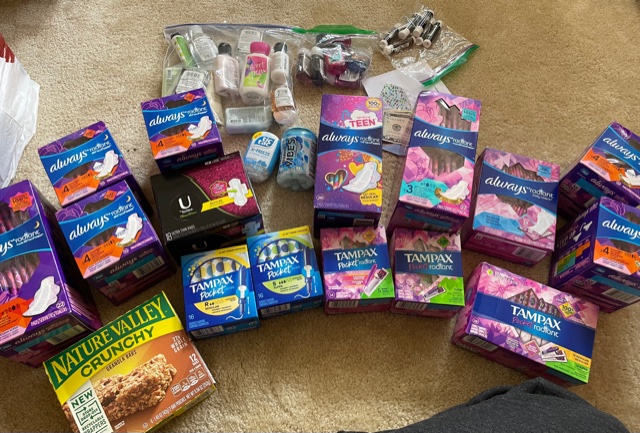
A huge supply of feminine hygiene products.

She had sent boxes and boxes of feminine hygiene products, dozens of trial sized lotions and hand sanitizers, several chapsticks, packages of gum, mints, and granola bars, and some cash, in case I needed anything else. She said she “had some things sitting around just waiting to be used” and that “kids deserve to have the necessities of life…whether their parents can afford it or not.”

They sure do.

This is the family of God, my friends. People from across the country — Wisconsin, Missouri, Minnesota, and Michigan — giving what they have to meet a need. My classroom is now more than well-stocked and ready to receive a group of seniors that haven’t seen the inside of a classroom since March of 2020. As they arrive, I want them to know that I, that we, have been thinking about them, that we have prepared for them, and that we are anticipating their needs before they even walk in the room.

You have helped me do that — you have partnered with me to show my students that they are valuable.

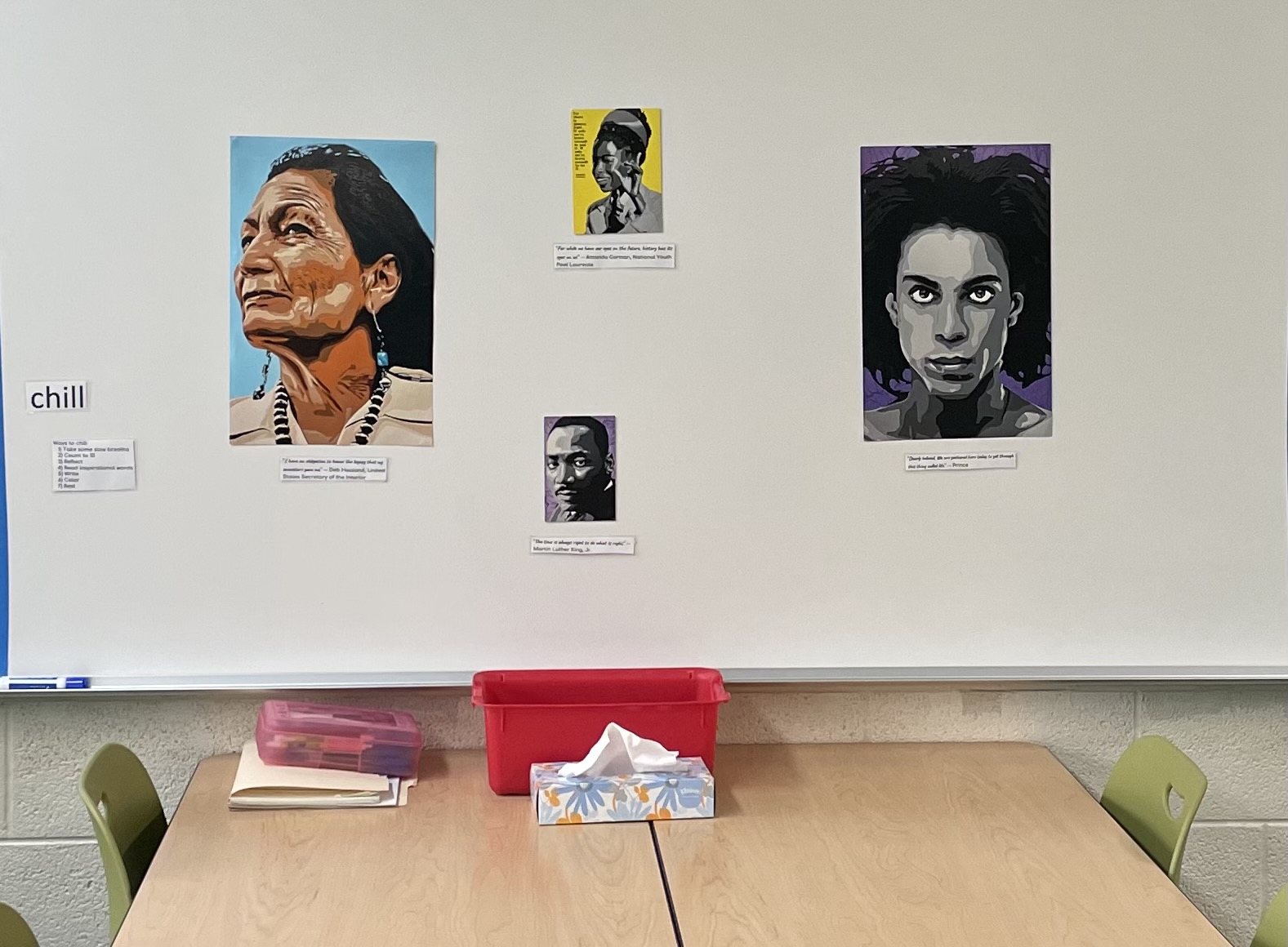
They don’t always get that message, to be sure. And in the last eighteen months, they have lived through more than their fair share of challenges. I know they are going to have some anxiety about coming back after such a long absence, so I’ve created a ‘chill’ spot at one end of my room.

My chill spot.

The chill spot is a place my students can move to if they are feeling anxious, angry, or upset in any way. It has tissue, paper, pens, crayons and colored pencils, coloring sheets, beautiful artwork from @mrjohnsonpaints, and some recommendations for how to regain calm. This idea is not mine; most of the teachers in my building have a chill spot. We operate under the assumption that all of our students have experienced trauma — now more than ever — so we are preparing in advance to make sure they can feel safe.

Providing for student needs — food, safety, school supplies — lays the foundation for learning. Job one is showing students that they matter, and as you have cheered me along, not only with gifts and donations, but also with so many words of encouragement and likes and shares of my blog post, you have agreed with me that they do.

My students matter, and this work matters.

They may come in grumbling and complaining. Why can’t we just stay virtual? Why is this classroom so hot? Why do I have to write in this stupid notebook? They are teenagers after all, and teenagers always grumble during change.

But I’m excited! I’ll put on my first day of school outfit and bounce into my classroom next week, ready to receive them, whether they are grumbling or not.

My enthusiasm may need to carry us for a while, so thanks for cheering me on. I didn’t know how much I need you.

…the Father knows what you need before you ask Him.

Matthew 6:8

P.S. If you know a teacher, send them a little extra love at any time, but especially during that first week of class this year. (A gift card to Starbucks or Target, some chocolate, or some fresh flowers just might make the difference.)

Why should white people care about racism?

Click the arrow to listen to me read this post.

As I’ve written about racism and posted about it on social media, I have been reminded that not all people believe that racism even exists.

You may be shaking your head, saying: Come on, Kristin! Why do you keep beating this drum! I’m not racist. Racism is a thing of the past. All this talk just serves to further divide us.

I disagree, and I think our denial of racism is further evidence of its insidious nature — proof that it is way beyond individual acts of prejudice to being deeply rooted in our collective ideology.

Over the past couple of weeks in this space, I have explored the use of Critical Race Theory in the classroom. Some may think I use this framework principally because I teach Black students, but that’s not true. I would use CRT and other antiracist strategies in any classroom — even if my students were all white.

Why? Because racism impacts all of us — most dramatically and tangibly people of color, to be sure, but no less tragically white people.

Think about it. Way back when European explorers came to this continent, they saw its beauty and expansiveness and determined to have it for themselves. Native Americans, of course, had been inhabiting this land for quite some time, and surely some colonists befriended them and sought to share the land peacefully. So, what happened? How did Native Americans end up being called ‘savages’? How did it happen that as this land was being ‘settled’, countless Native Americans were killed or displaced?

Do we ask these questions in school? Or do we take at face value the fact that colonists came to the continent, met the Indians, had Thanksgiving, and, yeah, there were a few massacres here and there, but ultimately the white people got the land and lived happily ever after?

Do we assume that the white people made out pretty well? Certainly, they got what they wanted. Whatever actions they might have taken toward the Native Americans — assimilation, displacement, or the decimation of an entire people group — had little negative impact on the white people, right? Or did they? Did the ‘success’ they found feed the belief among white people that if we want something and fight hard for it, it can be ours? Isn’t this the American Dream? Don’t we all aspire to dream big and succeed, just like the early explorers did? Does it matter if our success comes at someone else’s expense? Isn’t it a dog-eat-dog world, survival of the fittest and all that?

Are we proud of this characteristic of the American ethos? Do we want to perpetuate it further?

What if in teaching this history to American students we asked some questions? What if we sat at a table, map spread wide, and examined what happened? What were the Native Americans doing? What were the white people doing? Who had the right to be on the land? Who won? Who lost?

A question-based strategy such as this, which is informed by Critical Race Theory, encourages learners to ask questions that enable them to see a fuller picture of the story, from more than one perspective. In asking questions, students become critical thinkers. As they ask questions, they find they have more questions: What happened to the Native Americans next? What impact did the colonists’ actions have on their lives? What long-term effects did these events have on the Native American people as a whole?

In asking such questions, students might discover that colonization had a dramatic impact on Native Americans. They might discover the practices connected to Native American residential schools, legislation impacting Native American tribes, and statistics around addiction and suicide among Native American people. They might connect some dots and realize that when we ‘fight for what we want’ and ‘win’, almost without exception, someone loses.

They might develop empathy.

Are there other parts of history where racism played a role? Let’s consider slavery, the practice of kidnapping, buying, selling, beating, and exacting labor from another human. From as early as 1619, Black humans were brought on overcrowded ships by slave traders to the shores of this continent.

More information on slave ships here.

What happened next? Weren’t these ships unloaded at American docks where plantation owners bought and sold humans like cattle? Weren’t these humans forced to work to ensure the financial prosperity of their owners? Weren’t laws enacted to protect the slave owners and to allow them to use any means necessary to force these people to work for no money while living in uninhabitable conditions with little food, clothing, or health care? Weren’t most slave owners white? Weren’t most slaves Black?

Who benefitted from slavery? Who suffered? While Black people worked hard and endured abuse, were they the only ones who were adversely affected by slavery? Or did white people — slave holders, people of the community, citizens of our country — ‘learn’ through slavery that they were superior, that Black lives were expendable, that their own wealth was more important than human rights, that in order to keep and maintain their wealth, they would have to create systems and laws that safeguarded their practices, even if those practices were inhumane?

It can be hard to face the answers to these questions, unless we discover that things truly have changed. And have they?

How would you describe the experience of Black people today? Where do we see them working? Are they gaining wealth or do they continue to work hard to support the wealth of white people? In what ways has the experience of Black people changed in America? What evidence do you find for a shift in the beliefs and attitudes of white people? Do you see an acknowledgment of the impact of racism and slavery on our collective culture?

This Socratic questioning provides students an opportunity to look at the information that is presented and to interrogate it. When we ask questions, when we look for answers, we learn.

In our quest to discover how racism has shaped the American experience, we must start in the beginning with the treatment of Native Americans and Blacks imported through the slave trade, but we must then trace racism’s path through educational practices — what education has been provided for white children, Black children, Native American children, Latino children? Has any group of people received better or worse schooling simply because of their race?

We must continue to follow racism through voting practices — who first held the right to vote? When did others get to participate in elections? Are all groups of people equally able to participate in the electoral process? If not, how can it become more equitable?

We can continue our quest by exploring health care, law enforcement, the prison system, athletics, and higher education, and we can keep on going from there.

What happens when we encourage our students to interrogate both our history and our current practices, to ask: Who is benefitting? Who is hurting? Whose life is positively impacted by this action? Is anyone, intentionally or unintentionally, made to pay a price so that someone else can ‘win’?

When schools allow students to ask these types of questions, particularly about racism in our country, we will begin to see an unveiling of this sin that we often try to hide and deny. Saying that racism does not exist or that it is a thing of the past not only perpetuates the sin against people of color, it also further advances the sins of pride, selfishness, greed, and apathy among people who are white. Refusing to have compassion for all of humanity denies our own humanity.

Discussing race does not divide us — the division is already there. The only way toward healing is to expose the infection, see its pervasiveness, and get on a path toward healing. This work cannot be done in Black communities alone. White people must also acknowledge the impact of racism, the crime it continues to be against humanity, and work to expose it in all its forms and eradicate it. And the only path toward such acknowledgement is a willingness to ask some questions.

For what does it profit a man to gain the whole world and forfeit his soul?

Mark 8:36

Informed Instruction

Across the country and around the world, countless teachers and students are beginning to return to the classroom. After eighteen months of pandemic, some will be together in the flesh for the first time.

If you listen closely, you can hear the hum of anxiety.

In addition to the usual back-to-school jitters, teachers and students alike are also shouldering Covid 19 fears — do we have to wear a mask? will I get sick? will we return to remote learning? what will it be like to be in the building again? how can I be sure I will be safe?

The seniors who will walk into my classroom in just a few weeks have not been in a classroom since March of 2020 — their sophomore year. They have been zooming into class (or not) from their homes, their cars, and their workplaces for the last eighteen months. Many have rolled over in bed, still wearing pajamas, and logged into class; others haven’t joined online class at all.

So what will I do in the next few weeks to prepare for them — to create a space where they feel comfortable re-entering, where they feel safe, seen, and loved? How will I create a culture inside my classroom where students can trust, engage, and learn?

It’s gonna be a little trickier than usual, to be sure. All of my students live in Detroit, which has been ravaged by Covid. They have all experienced loss — loved ones, friends, a beloved teacher — and most have suffered economically, physically, socially, and emotionally because of Covid. I have to take this into consideration as I prepare for them. Also, 99% of my students are Black, Latino, or Middle Eastern. While the pandemic has changed life for all of us, the impact on communities of color has been disproportionately worse. I have to acknowledge that as I think about how I will create space for grief, for transition, and for learning.

I also have to acknowledge that the impact of racism is an every day reality for my students — their lived experiences are the result of systemic racism. I have to see and admit that my students have had less access to fresh foods, health care, high quality education, and safety. I have to believe that they have been pulled over by the police, followed in a store, or turned down for a job because of their skin color. I have to understand that because of their lived experience, they may not show up in my classroom “ready to learn”.

It’s not because they are less intelligent, or because they are “bad kids”; it’s because many have experienced poverty and most have experienced trauma. In fact, we recognize at our school that all of our students have likely experienced trauma — even before Covid — in the form of homelessness, neglect, abuse, or violence. Knowing this, our whole educational framework revolves around a model of trauma-informed instruction. And, since we know that much of this trauma is rooted in racism or the impact of systemic racism on our community, we also hold as a core value that we are anti-racist. We cannot fully care for our students who have been traumatized by racism if we do not actively work to dismantle racist systems that perpetuate this harm.

Our director of instruction says we need to ask ourselves in each moment, “am I replicating oppression or am I tearing it down?”

All of this, my friends, fits inside the framework of Critical Race Theory. The fact that I believe that my students have experienced loss at a higher rate than white kids, that they are more likely to experience poverty and trauma, that they are more likely to have an incarcerated family member, that they need a different educational approach because of their lived experience, all fits inside the CRT framework.

And how does this paradigm impact my instruction? Immeasurably.

First, the design of my classroom and the structure of our time together is based on the assumption that my students need to feel safe and supported. Our school uses a model called The No-Nonsense Nurturer so that in every classroom, students experience the same expectations, the same language, the same reinforcement as they learn how to be learners. My students can expect when they walk in my classroom, or any classroom in the building, that they will be given clear directions and held to high expectations. The model provides acknowledgement, praise, and rewards for those who are on track and redirection, one-on-one remediation, and further support for those who need it to get on track. Our teachers believe it is critically important that our students opt in to learning, that they earn a high school education, and that they go on to post-secondary education, the military, or work after high school. We believe it is literally a matter of life and death. We already know the trajectory for students of color who do not complete high school, get a job, or go to college — we already know that it doesn’t end well.

We can either replicate the experiences they have had in the past or we can try a different, research-informed practice.

I expect that most of my first week or two will be spent building culture and systems. After eighteen months outside of the classroom, our students (and our teachers) are going to need some time to re-acclimate to the ways of being in the classroom. How do we manage sitting next to each other? How do we function without watching our phones for notifications? How do we contribute to classroom conversations? How do we collaborate? How do we celebrate one another?

And, as we learn those ways of being together, I will slowly begin to integrate content — common core curriculum — using strategies that have high impact for my students. With this group of students, I will start almost immediately with journal writing which is useful not only for building writing muscle but also for developing student voice. Throughout the year, we will incorporate grammar instruction, reading, discussion, and more writing. As I get to know my students and their strengths and weaknesses, I will tailor instruction to best prepare them for what’s next — college, trade school, military, or a career.

I will be supported by a team — our college access counselor and other counseling staff — who will help our students identify their long term goals and explore ways of achieving those goals. Most of our learners, if they so choose, will be first-generation college students, so they need extra supports, and we provide them.

We meet our students where they are, support them as they envision where they might go, and then provide them with the tools they need to take steps toward that goal.

Why?

How can we do otherwise? If we can see with our two eyes that our students need love, support, and a path forward, how can we do anything else than use all the tools we have at our disposal to provide these things? If we know — and friends, we do know — that inequity is a fact in our experience as Americans, that people of color have long been feared, subjugated, controlled, and misrepresented, than it is unconscionable to do anything less than our very best to change this course.

We have replicated oppression in the past — knowingly or unknowingly — we must refuse to do so moving forward.

Our students are counting us. Their very lives depend on those who will stand up and insist on a new way.

The Lord God has told us what is right and what He demands: “See that justice is done, let mercy be your first concern, and humbly obey your God.”

Micah 6:8, Contemporary English Version

*If you would like to partner with me in this work, please request my wish list.

**If you’d like to read more about educational disparity, check out a post I wrote last year: “What World Are We Living In?”

***To learn more about my school, check out this video.

Critical Race Theory in my Classroom

Click the arrow to hear me read this post.

I was minding my own business, enjoying a summer full of family visits, sleeping in, and reading indiscriminately when not once, not twice, but several times, the words critical race theory or CRT were set in front of me.

How do I as a teacher feel about critical race theory?

or, more recently, If you are a teacher and believe in CRT, then you really need to stop teaching period.

To be honest, I was at first a little baffled. I was unsurprisingly aware of critical race theory because of my background and work as a teacher, but I was unsure why people outside the classroom were talking about it, and even more confused about why were they upset about it.

It didn’t take me long to figure out that Fox news has spent a sizable amount of time (and money) talking about CRT — one source says Fox has mentioned CRT 1300 times since March. What’s their point? Why do they care so much?

You may be asking yourself, “What is critical race theory, anyway?”

I’m glad you asked.

Critical Race Theory “is a theoretical and interpretive mode that examines the appearance of race and racism across dominant cultural modes of expression. In adopting this approach, CRT scholars attempt to understand how victims of systemic racism are affected by cultural perceptions of race and how they are able to represent themselves to counter prejudice” (Purdue Owl).

In simpler terms, CRT is a viewpoint or lens which acknowledges that racism exists not only in personal acts of prejudice but in established systems; it seeks to identify the impact of racism and to do something about it. The work of CRT is done in several contexts — education, sociology, the legal system, etc. Most familiar to me, as a teacher of students, most of whom are people of color, is its use in rhetorical analysis — examining texts such as To Kill a Mockingbird to see how racism impacted not only the action of the story but the telling of the story. In other words, it not only points out that the unjust conviction of Tom Robinson in TKAM was an outgrowth of the racist beliefs of the fictional community of Maycomb, Alabama, but it also examines the fact that the author, Harper Lee, was a wealthy white woman and questions the impact of her race and class on the telling of the story.

The story, you may remember, is told through the eyes of a young white girl, Scout, who learns that “You never really understand a person until you consider things from his point of view… until you climb in his skin and walk around in it.” Critical Race Theory might ask if Harper Lee, Scout, or any white person for that matter, is actually able to do that — to climb into the skin belonging to a person of color and actually experience what they experience.

The main reason why we can’t, CRT would suggest, is because white people are not impacted by the racism that is baked into many systems within which we must function — education, real estate, employment, law and public policy, and the like. Scout can’t understand what Tom Robinson experienced through the legal system because she would’ve been presumed innocent until proven guilty by virtue of her skin color, which is great for her. Unfortunately, Tom Robinson, a black man in mid-twentieth century Alabama did not have that privilege. He was assumed guilty the minute a white girl pointed her finger at him.

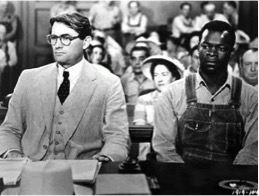
Atticus Finch and the Life Lessons of Moral Courage | Heroes: What They Do  & Why We Need Them
Atticus Finch with Tom Robinson

CRT is not only used to examine literary texts, but also to interrogate cultural practices. According to the Purdue OWL, CRT “scholarship traces racism in America through the nation’s legacy of slavery, the Civil Rights Movement, and recent events.” It looks at historical events and asks how race played a role, how were systems built, and how we got where we are today. Why is it, CRT asks, that a group of mostly Black people demonstrating at the steps of the Capitol are seen as ‘dangerous’ and dispersed by use of tear gas while a group of mostly white people, brandishing weapons and shouting racial epithets, are allowed to invade the US Capitol building during a legislative session with very little immediate consequences or threats to their bodies?

What is it that makes us see a group of Black people as ‘threatening’ and a group of white people as ‘exercising their right to protest’? CRT would say it is the racism that we have been raised with that teaches us that white people are safe and Black people are dangerous. White people are nice; Black people are menacing. These insidious messages are woven into policies that shape our schools, our neighborhoods, our legal system, our health care system, and even our entertainment and business practices. Racism is so deeply embedded in our culture that some of us deny its existence.

We claim, “I am not racist,” while acknowledging that Black students have less funding for education, fewer course options, and are less likely to be prepared for college than white students (UNCF). We say, “I stand for equal opportunities for all,” while knowing that the black unemployment rate has been consistently twice that of the white unemployment rate for almost fifty years (Center for American Progress). We say, “I love all kinds of people,” as we go on attending our all white churches, hanging out with mostly white friend groups, and shopping in predominantly white spaces. We benefit from the systems that keep Black people away from us — away from our schools, away from our jobs, away from our neighborhoods. We don’t like to admit that, because it sounds awful and makes us feel bad, but if we take a look through a lens shaped by critical race theory, it will be very difficult to deny.

So you might ask yourself, why is FOX news spending so much time telling its viewers to keep CRT out of the classroom? What is it afraid of? Is it afraid that our children, if they are taught to use critical race theory will see what we refuse to see? that they will change what we refuse to change? that our experience as white people in America might be transformed?

Might our children and their children actually work toward a more perfect union where all people are seen as equal and endowed by their Creator with certain unalienable rights? Might our brothers and sisters of color, yes, fellow members of the family of God, more freely and equitably experience life, liberty, and the pursuit of happiness?

Fox News can say whatever it wants; I am going to employ any tool necessary to dismantle racism in my classroom. I am going to teach my students to ask all the questions — even the ones that make me uncomfortable. Why? because for my students, it is a literal matter of life or death — prison or freedom — poverty or prosperity — despair or hope.

In the words of my school’s director of academics, “in each moment, I can either replicate oppression or tear it down.” If CRT is a tool I can use to identify racism and tear it down, then let me get to it.

My students are counting on me.

For the entire law is fulfilled in keeping this one command: “Love your neighbor as yourself.”

Galatians 5:14

**If you would like to partner with me in loving my students, please reach out to me at krathje66@gmail.com and I will share my classroom wishlist.

Coronavirus Diary #30: Emerging

It’s starting to happen. We’re opening our doors, stepping outside, and actually talking to people — sans mask.

At first it felt a little weird.

We were in the backyard of our new nest (still trying to settle on a name: the garden ranch? the house by the highway?) working in the dirt, plunking seeds in the ground, when first one neighbor then another walked toward the fence, introduced themselves, and stood to talk for a bit.

We were outside of course, where no masks have been required for quite a while, but we weren’t keeping six feet distance. We moved in close — close enough to see eye color. It felt good, but then my husband did something audacious: he breached the fence line, extending his hand to Bob, our backyard neighbor, and Bob, equally audacious, grabbed his hand and shook.

Emboldened by such recklessness, our son, too, walked forth and shook the hand of a man who we had never met. We didn’t know if he was vaccinated, Republican, Democrat, a masker, an anti-masker, or what! Yet, they each grabbed his hand, swapping epitheliels and such. I felt a rush of anxiety, and then I internally shrugged.

The mask mandate had been lifted, after all, for those who had been vaccinated, whether outdoor or indoor, and we had been vaccinated, so I guess hand shaking was the next step.

A few days later, we were walking into Lowe’s when we saw a sign that said, “masks are now optional for guests and employees of Lowe’s,” so we unstrapped our faces, walked in and began to hunt down the items on our list. Several minutes into our quest, my observant husband said, “Hey, I’m noticing that most everyone still has a mask on. Maybe we should, too.” So, with a sense of courtesy and care for others, we strapped them back on.

It’s no big deal, after all. We’ve been wearing masks for over a year. We have dozens in our home, in our car, and at work. It seems almost second nature now to cover our droplet-spewing exhales for the sake of others, but we’re seeing more spaces where we feel free not to.

Weddings, for example. Last weekend, we went to two weddings in one day. At the first, we sat in our car, watching others walk into the church without masks, so we decided to do the same tucking a mask for each of us in a pocket just in case. At the door to the church we saw a sign similar to the one at Lowe’s announcing that masks were not required for the vaccinated, so we dared to walk into the sanctuary naked-faced.

Inside, about 30% of the the guests wore masks. The ceremony commenced with the whole wedding party processing barefaced. Yes, the priest donned a mask before serving communion, but many remained unmasked for the service, even while singing. And the singing! After over a year of virtual church, the rich voices in the extravagant sanctuary felt celestial — a foretaste of things to come.

After the ceremony, as the guests rose to exit, most conservatively covered their faces, and we did, too. We’d tasted the freedom, but we hadn’t lost our minds. That would happen at the next wedding.

We’d received an email the night before that fully-vaccinated folk would not be required to mask at the second wedding. Still, we kept a mask in our pockets as we walked into the large, airy sanctuary. We found our seats and scanned the room. This was the wedding of someone we’ve known for decades, and several of the guests were dear to us. Not one mask was visible to me.

We slid over to let a couple join us. My husband shook a hand and gave a hug. I simply smiled and gushed, “It’s so good to see you!” I looked around and spotted a long-time friend I hadn’t seen in the last few years, then a couple who we love dearly. I wanted to cross the room to greet them, but I committed to the more socially-appropriate action of staying put for the duration of the ceremony.

The wedding was joyous — the joining of two fractured families who had found healing and hope in each other was filled with smiles, tears, and much rejoicing. The people gathered were reminded that God makes all things new — that He takes our brokenness aside and makes it beautiful.

Buoyed by restored hope, the wedding guests excitedly exited the sanctuary, nary a mask in the crowd, and continued to greet one another and comment on the just-witnessed miracle. Among them, my husband and I were chatting with another couple when I spotted, once again, that dear friend I hadn’t seen in years. My feet propelled me to her, and before I knew it, without first asking for permission, I wrapped her in a hug. I was suddenly emotional. Other than my husband, our son who lives locally, and my mother, I had hugged very few people in the last year. Very few indeed. And this friend, who I’ve known for over thirty years of highs and lows and another friend who I would track down moments later and enthusiastically embrace — again without thinking to pause for permission — were dear, dear friends who I might have at one time taken for granted, might have given a quick hug at a wedding reception and then moved on to the drinks, the food, and the dancing. but not now.

I’ve been changed — at least temporarily. As we emerge from almost fifteen months of separation from one another, isolation in our homes, and the alienation of wearing a mask — all for the sake of protecting one another out of love — I have a new perspective.

At times during the pandemic I have felt anxious, not wanting to be around people, feeling wary of moving through crowds, and venturing out only out of necessity to get groceries, see the doctor, or go to work. Even several weeks ago, when we went to church on Easter, after the worship services were over, after most of the people had cleared, I still felt uneasy walking up to the building to receive communion because a dozen or more people were standing outside the building without their masks.

It’s been strange, hasn’t it? To be afraid of getting close, of sharing air? Haven’t we been suspicious of those who came too near, who didn’t mask up, who didn’t seem to take the virus seriously? Or maybe you felt differently. Maybe you thought we’d all gone overboard what with the masks, and the quarantines, and the sanitizer, and such. Maybe you’ve not been isolating and distancing as much as we have. Maybe you don’t feel, like I do, that you are emerging from a bunker where you’ve been hunkered down, missing your people for over a year, but that’s how I feel.

Is the sun shining brighter? Have my friend Pat’s eyes always been that attentive and loving? Has Chris DuPont’s voice always sounded so angelic in a spacious cathedral? Have the hugs of friends like Heidi always been so life-giving and heart-swelling?

I don’t remember, but suddenly I am overwhelmed with emotion just just to see you — all of you.

I know the virus is still here and that it’s going to be here for a while, but right now, in the light of the sun, on these beautiful spring days, I feel free as I emerge from a long, long, hibernation that lasted much, much longer than a winter.

I missed you, my friends. I pray I get to see your face and hug you soon.

Be strong and take heart, all you who hope in the Lord.

Psalm 31:24

This just might work.

Click above to listen, or read on.

Last week I reminisced about our life in our little house by the river. Today, I share some of the journey to our next nest.

Even before we moved in, we knew we wouldn’t live in the little house by the river forever. It’s university property, after all, and one does not retire in university property.

Not that we are retiring. We’re not even close.

I’m just one year into my journey at Detroit Leadership Academy and have accepted the role of Master Teacher for next year. I will stay in the classroom, teaching English Language Arts to our seniors, working with my colleagues to close the educational equity gap and prepare our students for success in college, trade school, or the work world. This past year has more than affirmed my passion for teaching in Detroit, and I hope for many years of teaching ahead in this next chapter.

Similarly, John is as invested as ever in the students at Concordia. When he moved here eight years ago, he had a sense of what this position held, what his role and responsibilities would be, but now he fully understands how his gifts as an educator, a counselor, and a pastor work together to support college students as they develop into adulthood. He’s part of a strong team of leaders here who are committed to walking with students through both joys and challenges, and he’s excited about continuing in that role.

So why the change? Don’t we love living on campus? We sure do! I’ve written about how much we love it over the years. Even during the pandemic, when the campus was almost vacant, we enjoyed its beauty — the green of summer against the brick structures, the fall leaves beside the peaceful Huron River, the pure white expanses of snow in the open spaces, and always the lilacs, the tulips, and the peonies in the spring. We have loved living and literally walking beside students, faculty, and staff these past years — watching ultimate frisbee from our patio, hearing laughter outside our door, and chatting with members of this community as we move throughout our weeks. We have experienced many unique relationships as a result of living in the little house by the river, and we are sad to be leaving.

Nevertheless, from the beginning, we knew we would one day move out. We weren’t sure when or to where, but from the beginning, we’ve kind of had our eye on Ypsilanti. We love Ann Arbor — its parks, its restaurants, its cool campus scene — but when in Ann Arbor, I’ve always felt a bit like a tourist. I love to explore how beautiful, how smart, how impressive Ann Arbor is — I don’t get tired of it. However, when I visit Ypsilanti, I feel more at home — its edges aren’t polished; it’s not trying to impress anyone. Ypsilanti looks like it’s been through some stuff and lived to tell — and I resonate with that.

So last winter, when we were on month one million of Covid isolation and my husband’s plantar fasciitis got in the way of our long quarantine walks, we started taking drives around Ann Arbor, Ypsilanti, and their surrounding areas. We talked about what we liked and didn’t like. We discussed our future. We clarified our goals. Then one day, we called our friend who is a realtor and formalized our search.

Over the next few months, we looked at many, many houses. Our realtor’s patience with us allowed us to imagine what we were looking for — what kind of space would suit us in this stage of life and carry us forward into the next. The little house by the river definitely informed that vision. We have been very content in this simple home, and we could picture ourselves in something similar — three bedrooms, perhaps a second bathroom, a garage, and definitely space for a garden. We wanted to be in a community where we could mix with people whose journeys may have been different from ours, where we could build relationships that would challenge and enrich us. Our goal was to stick to a conservative budget so that we could easily pay our mortgage and continue to live our simple life and contribute to causes that matter to us.

This was a tall order in the current real estate market. Interest rates are at an all-time low, and we were not the only ones looking for a house during the pandemic. In fact, the first house we bid on had several other offers, and so did the second house. Buyers right now are offering well over asking price and some are paying fully in cash. In fact, the third house we made an offer on had twenty-six (26!) other offers. The winner paid in cash. We were starting to get discouraged and even said, “It’s fine. Let’s take a break; we don’t need to buy a house right now.”

Then, on a Friday, when I clicked through the latest listings in an email sent by our realtor, I noticed a little three bedroom with a garage in Ypsilanti Township. I pulled it up on Google Maps and thought, “We aren’t going to like it. It’s too close to the highway.” I wasn’t even going to go look, but as I left work that day, I thought, “I’m in the car anyway, and it’s kind of on the way.” I took the exit and drove the path that we had driven to so many others in the area, and then I found myself on a quiet street that was indeed extremely close to the highway, but for some reason didn’t feel like it was. I pulled up in front of a small blue ranch, put the car in park, lowered the windows, and listened.

It was so quiet. Across the street was a playground and what was once an elementary school but is now an alternative education center. The house seemed in good shape, and so did the garage. I drove up and down the street, looking at the other houses on the block.

“Huh,” I thought, “this just might work.”

I texted my husband and our realtor, “I know we just said we were going to take a little break, but I’m sitting in front of this house, and I think it might be worth a look inside.”

Two days later we were standing in the driveway, then we were walking around to the back where we saw the garden — an enormous garden, right at the back of the yard, adjacent to three other yards that also had their gardens right next to the fence. I could immediately see myself leaning on that fence, talking to the neighbors, sharing gardening tips, and passing produce. I saw mature well-cared-for rose bushes and a patio next to the house, where I imagined our Adirondack chairs might fit quite nicely. We walked inside and found a lovely well-lit living room, a small eat-in kitchen, and three small bedrooms on the main floor. Everything had been recently painted, and the flooring had all been replaced. It felt fresh and ready to be lived in. We made our way downstairs to the finished basement where we found a fourth bedroom, a family room, the laundry, and all the makings of a bathroom — toilet, shower, sink — minus the finishing touches of walls and a vanity.

I heard my husband saying, “This might just work”

We guarded our feelings and put in an offer — the fourth offer we had made in a little over a month — and then we waited.

We didn’t have to wait long. By Monday the sellers had accepted our offer, and less than a month later, we have closed on our next nest. We haven’t yet begun to move in, but we’ve already put seeds and seedlings in the garden, and I’ve already leaned on the fence and talked with the neighbors. They like to chat and linger, just like I was hoping they would.

As I’m packing boxes in the little house by the river, I continue to reminisce, but my gaze is starting to move forward. I’m imagining our things living inside their new spaces. I’m picturing us sitting in our living room watching children playing in the park. I’m looking forward to walks in our next neighborhood.

I think this just might work.

You open your hand and satisfy the desires of every living thing.

Psalm 145:16

The Trauma of Racism, Update 5.19.2022

Click the arrow to hear the audio recording of this blog.

Last Saturday night, an 18-year-old white man drove 3 hours to a predominantly black community with the sole intent of killing Black people; he succeeded. He, a self-proclaimed white supremacist, was peacefully detained before he could complete the rest of his plan, killing more Black folks at a neighboring Wal-Mart. The racism that has infected our nation since its inception continues to poison our minds — we are desensitized to this kind of violence and the more insidious systemic racism that plagues us. When the extreme happens, we wring our hands, shrug our shoulders, and go back to what we were doing.

That is not enough.

Here, I am re-posting a blog I wrote about a year ago, imagining a different way. I challenge you to consider what small steps you can take — today — to see, expose, and push back against racist ideas that certainly live deep in your (in my) DNA. We can — slowly and methodically — make change, but it’s going to take all of us.

Derek Chauvin was found guilty on all charges last week — he killed George Floyd and will serve time for this crime. As I was listening to the verdicts, I felt “At last — one small step toward justice.” And then I became aware that before the verdict had even been read, a fifteen year old girl in Columbus, Ohio had called the police for help and was instead shot and killed by an officer within moments of his arrival on the scene.

Yes, the girl had a knife.Yes, the scene was chaotic. Still, did a fifteen year old girl have to die?

Is there a way for police officers to arrive at a scene and de-escalate a situation, even after weapons have been drawn?Are law enforcement teams trained in trauma-informed procedures that they might utilize when responding to traumatic situations? Is their goal to control and subdue or de-escalate and restore? How might this scene have played out differently if the goal was restoration? Officers may still have arrived with their hands on their guns — a knife was drawn and visible after all — but might they have found a way, short of death, to separate the young women involved in the altercation? Might they have secured the knife? Could they then have found the space to ask, What happened? We got your call, and we’re here to help. Fill us in. What’s going on?

Might Ma’Khia Bryant have had a chance to say why she was holding that knife, why she was lunging at someone with it? Why she had reached out to the police for support?

Look, law enforcement can’t be easy. I can’t imagine how complicated and stressful — even traumatic — it must be to arrive at a scene where violence is in progress. I have no idea what it feels like to have a gun on one hip and a taser on the other. I can’t fathom the impact of such day in and day out stress on the body.

Researchers, however, have studied trauma and its impact — how cortisol and adrenaline, though crucial in moments of crisis, can wreak havoc on the body during periods of sustained or ongoing trauma — the kind that law officers witness every day. Costello, Wachtel, and Wachtel, three practitioner-researchers in the field of education (The Restorative Practices Handbook) have used such research to inform strategies that have been impactful in mitigating undesirable behavior and restoring problematic relationships. Is it possible that such strategies might be replicated or adapted for use in law enforcement and beyond?

Isn’t it safe to acknowledge at this point that large swaths of the general public have experienced trauma? Research has shown that one out of six women will be the victim of an attempted or completed rape in her lifetime, one in seven children has experienced child abuse or neglect in the last year, and one out of five students report being bullied in school. Trauma, it seems, is ubiquitous. Yet, even if we are aware of widespread trauma, it may be difficult to measure the pervasiveness of trauma in communities of color where many live with the daily fear of violence, the impact of systemic racism, and what trauma specialist Resmaa Menakem calls “the historical and current traumatic impact of racism on the body.” For generations — for centuries — nonwhites have been subjected to repeated traumas, many of which are recorded in history.

We could go back to colonial days to look at the ways in which Native Americans were traumatized by the colonists who showed up first needing assistance after a long and certainly traumatic sea voyage on the heels of their own traumatic othering experiences in Europe, having been persecuted themselves to the extent that they were willing to board a ship powered only by the wind to travel for months to a land where they hoped to find liberty but certainly no family, no existing structures in which they might live, and God only knows what dangers. Native Americans were at times helpful to the settlers but also subsequently used, dehumanized, brutalized, and all but exterminated in the colonists’ attempts to overcome their own trauma and secure their own livelihood.

In their further attempts to create and attain the American Dream, white Americans engaged in the slave trade by which they participated in or sanctioned the abduction of Africans from their own homes. These Black humans were shackled and chained like animals by white humans, the likes of which they had never seen before, crammed into overcrowded holds of ships, and transported via their own perilous and traumatic months-long journey. Once on North American soil, those who survived the journey were then bought and sold, beaten and abused, raped, and forced to work to secure the prosperity of their owners.

After hundreds of years of this type of existence, when slavery had been outlawed, the trauma persisted in the bodies of both white and Black Americans. The dehumanization — the othering — of Black bodies was hardwired into the fabric of the nation, and it was perpetuated through Jim Crow laws such as segregated schools, restrooms, bus seating, etc., not to mention the racist beliefs that fueled hateful speech, intimidation, lynchings, and the like.

Still today, in 21st century America, we see racist practices that persist in education, health care, criminal justice, housing, etc. Centuries after the colonists arrived on the shores of this continent, the mistreatment of people of color in the pursuit of the white man’s American dream continues to be elemental to this country. Not only Native American and Black, but also Asian and Hispanic blood has been shed; bodies of all kinds of colors have been dehumanized in the making of the land of the free and the home of the brave.

Resmaa Menakem suggests that these many traumas and others like them produced biological responses that continue to live in our bodies — not just Black bodies or brown bodies, but white bodies, too. We all carry the trauma of our collective history in our bodies. All of us have been shaped by the racism of this country. All of us believe and feel things about race as a result of the “historical and current trauma of racism”.

So when a police officer arrives on the scene to find a 15 year old black girl lunging at someone with a knife, he interprets that in his body much differently than he would if he arrived to find a 15 year old white girl lunging at someone with a knife.

Did you see the difference in your mind? I did. And that, my friends, is racism.

And because this racism — this dehumanization — lives in our bodies, in our minds, in our societal ethos, we continue to traumatize one another. And the impact of the trauma multiplies and spreads, a sickness hurting everyone it touches.

When are we going to decide it’s time to deal with this hundreds-years-old disease?

When are we going to create the space in which we can turn to take a different way? When will we take the time to come into a circle, to share openly with one another what happened, what we were thinking, what impact our actions had on one another, and what actions would begin to make things right (Costello, et al)?

Can you imagine the healing that might happen if we were willing, in small pockets across the country, to start this practice — not a one and done act, but an ongoing practice of confession, repentance, and restoration? Wouldn’t we be partnering with God in His work of reconciliation?

Isn’t that the most loving way we could spend our lives?

What does the Lord require of you, but to act justly and to love mercy and to walk humbly with your God.”

Micah 6:8