Educational Break

On Thursday afternoon, I tidied my classroom, finalized some grades, and walked away from school and toward my Spring Break. The mere thought of not having to set an alarm for 10 days would’ve put a pep in my step if I’d had any pep left at all, but I did not.

All teachers are exhausted by this time in the year. Even though we had Christmas break, even though we might’ve had a long weekend or even a full week off in February, we’ve been, since September, coordinating learning for our students, planning multiple presentations each day, keeping records, reporting to our supervisors, and (and this is the most draining part) making countless in-the-moment decisions:

What is the first thing I need to do when I walk in the door?

Do I have an extra stapler, know where more chart paper is, and can I laminate another hall pass for Room 117?

No, you can’t go to my classroom unattended; yes, I can get you a bandaid; no I don’t know where Mr. Smith is,

You can’t go to the bathroom right now, but ask me again in 10 minutes.

Yes, you can take that pencil, borrow that book, eat that snack.

You sit over here; you stay there.

Yes, your topic sentence is solid, but no, that is not an adequate example.

You’ve used AI here, and you must re-do the assignment.

You’ve used AI here, and you cannot re-do the assignment.

Yes, you can turn it in late. No, the deadline has passed.

Yes, you can work with a partner. No, you can’t get the answers from a peer.

This is non-stop all day long, but teachers, while keeping this decision-making machine running, must also, intervene in interpersonal conflicts, address misbehavior, meet demands for mandatory documentation, and, oh yeah, provide high quality instruction.

And most of us are happy to do all of this. We see each piece as necessary for supporting human development, for preparing the next generation of humans for meaningful life in our society. We’re teaching our students to co-exist with one another, to manage themselves, to hold themselves accountable, to read, to write, to identify a career, and to begin to take steps toward attaining that career. We’re in this work because we like kids but also because we believe in the power of education to create possibility for students of all backgrounds and abilities and to create a better future for all of us.

In the school where I work — a small charter school on the edge of Detroit, where 99% of my students are Black, where 100% of the students qualify for free breakfast and lunch, where almost all of the students are below the national average in reading and math scores by no fault of their own but because of centuries-long inequity in education–the teachers, like me, believe in the transformative power of education. We see it as an opportunity to not only change lives but to save lives.

In addition to the exhausting work that teaching is in any context, teachers in buildings like mine have the added weight of wondering if our kids have enough to eat, if they have a home to sleep in, if their home is safe, if they will have what they need for the next 10 days, or if they will be alone, hungry, cold, or in danger. Our students have the same needs as any students in the country, but they have additional needs as a result of poverty that stems from systemic inequities that go back through the history of our nation — school segregation, red-lining in real estate, unconscious bias in hiring practices, and other elements of historical and current systemic racism.

So, you might imagine how I am feeling, heading into a much-needed break while simultaneously worrying about my students’ welfare, to learn that the president of this country has ordered the Director of the Department of Education to dismantle it.

You may say, “Settle down, Kristin, most funding for education comes from the state.”

That is true, most money for education comes from the state — but do you know what does come from the federal government? Funds that make a difference for students like mine. For example, Title I, which provides $18 million to low-income districts. It’s not enough to make up for the economic disparity between neighboring districts, but it’s a start. The Department of Education also provides IDEA (Individuals with Disabilities Education Act) funds to the tune of $15 billion to help districts provide additional resources to students with learning disabilities, cognitive impairments, and other diagnoses such as autism. Source.

Furthermore, the US Department of Education manages Federal Student Aid for post-secondary education, providing over $120 billion annually in grants, loans, and work study that allows students like mine to dream of a career. And not just students like mine — I myself relied on federal money to get my degrees, didn’t you? Source

Can you imagine what might happen in communities across the country if high school seniors no longer have access to the FAFSA? if they can no longer apply for federal dollars to fund their education through grants and/or loans? Tuition alone for Michigan State University is over $16,000 a year. Add in room and board and your talking about $35,000+. Most students need at least four years to get a basic degree. Who among us can fund $140k without the aid of at least a student loan?

Now, the State of Michigan is prepared to fund up to two years of community college and up to $5,500 per year at state universities, but states rely on the federal mechanism of the FAFSA to distribute those funds. If the DOE is dismantled, how long will it take for states to pivot to their own systems to ensure that students who need these funds get them? And, where will students borrow the balance that is not covered by state funds if they don’t have access to federal student loans?

How many students will take post-secondary education right off the table — including trade school programs that prepare our electricians, plumbers, welders, builders, and the like?

As I consider the potential outcomes of such action, the faces of my seniors are appearing in my mind — J. who wants to be a programmer, who has already completed several summers developing coding skills, L. who plans to be a nurse, K. who wants to be a truck driver, and S. who plans to become a police officer. None of these students can take one more step without the FAFSA and right this minute the Secretary of Education (who has zero experience with issues that impact schools) is busy laying off DOE employees under a directive from the president.

I am exhausted, and it’s my Spring Break, but I can’t just sit by and watch this happen.

So, I’m doing two things: First, I’m writing this post, and second I’m committing to use the app “Five Calls” to involve myself in the American process.

Here is how it works. Download the app, select the issue you are concerned about, and enter your zipcode. You will see a timeline of updates on that issue and a list of representatives from your district. One click later, you will see a page like this:
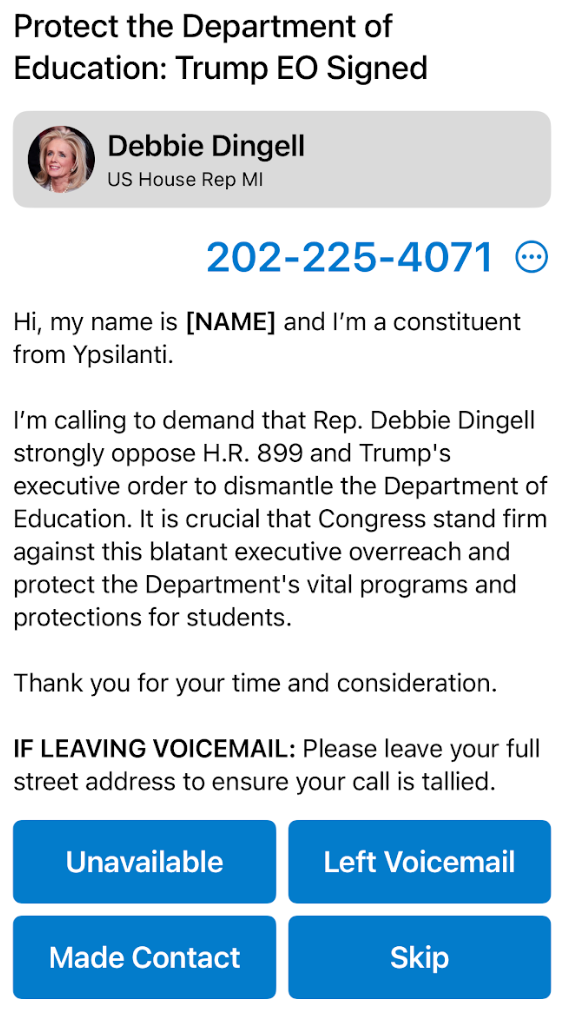
You click on the number, wait for an answer, read the script, and and click a blue button to register whether you left a voicemail or made contact, and the app sends you to the next number.

In just a few moments this morning I made three calls.

This may seem like something small — just like my boycotting may seem small and ineffectual to some –but if we truly believe that our government is of, by, and for the people, then we, the people, need to get involved. We need to do something when we see that our government is not representing all of the people — particularly when they are taking steps to further disenfranchise the most marginalized among us.

Look, you’re probably exhausted and overworked, too. You might feel like this is not worth your time, but perhaps you can take a journey back to your high school self, remember what it feels like to have a dream in front of you — of a career, a family, a whole adult life. Remember what that feels like? Don’t we want to make sure that every kid in America has an opportunity to pursue their dreams?

If you believe in the transformative power of education like I do, I urge you to make 5 calls — today, tomorrow, and until our voices are heard.

It’s a small decision you and I can make that could make a monumental difference for our kids, our country, our future.

Speak up … defend the rights of the poor and the needy. Proverbs 31:9

What a Village!

About a month ago I wrote a post (linked here) about what a challenge 2024 has been — how personal and national events have left me feeling dumbfounded and scrambling to find glimmers of hope amidst the ordinary. Then, a little over a week ago, rather unintentionally, I invited you to tangibly produce evidence of that hope — and you did!

Facing the pronounced need of some of my students at the small Detroit charter school where I teach, I, with a few other colleagues, selected what ended up being twelve families and determined to furnish them with some kind of Christmas miracle. I knew our staff alone would not be able to supply what was needed, so I asked you to be a village for my students, and you circled up!

I posted my blog on a Friday, and by Sunday, Amazon packages from a high school classmate were sitting on my porch and a friend had sent me some funds to get the gift card fund started. And the packages kept coming! As I opened each box, I saw the faces of the villagers — a woman who was my camp counselor when I was a teen, a former co-worker, a few dear friends, the parents of a former student I taught in St. Louis, and a sister- and brother-in-law. I saw them coming together to encircle my students, and the image buoyed my spirits.

Any teacher will tell you that every day of teaching in December feels like a solid week. The students are tired of being in school, yet lessons still have to be taught and programs still need to run.

This past week was cram packed, and by the end, I had lost my sense of humor. It’s probably because I expect the same level of rigor on a Friday in December as I do on a Tuesday in October. After all, that rough draft won’t write itself and it’s due on Tuesday so that we have time for feedback and editing before the final drafts are dropped on Thursday.

I get myself so wound up that I forget — still, after decades in this game — that kids are kids are kids and the fact that the calendar says Friday just does something inside the brain. Make that a Friday in December and that “something” is x10.

Anyway, I made it through last week — preparing for and co-leading a two-hour professional development session, observing and coaching three teachers, and teaching two sections of senior English each day, and only lost my sense of humor on Friday.

When the final bell rang, I settled in to finish the grading for the week, to prepare for Monday’s class, and to straighten my room before leaving for the weekend. I’d been a little amped all day, almost resembling the butt-kicking, name-taking self of yesteryear, but as I moved through my tasks, my emotions started to right themselves, and then I noticed the total in my CashApp account. In addition to my blog post ask, I’d invited our teachers to pitch in to the fund for our kids, too. These particular villagers are boots on the ground day in and day out. They are weary, of course, but I watch them hug students, hold students accountable, feed students snacks that they paid for themselves, talk students down from their own high emotions, and even give them rides home, half of their own lunch, or even the literal coats off their own backs.

Still, I asked them to give more. And they did!

Several of our teachers adopted our homeless expectant mother, purchasing everything off her wish list — items such as a blanket, a towel, shoes, and underwear. Others sent the first few dollars of their paychecks straight to my CashApp so that our students will receive what they need.

Combining the gifts from the virtual village and the on-the-ground village along with some gift cards provided by our organization, twelve (yes, 12!) families would receive gift cards that they can use at their discretion to purchase food, gas, gifts, or necessities! Additionally our pantry is restocked with essentials (seen below) for students to use now or when needed.

My principal and I texted Saturday morning, finalizing plans for purchasing gift cards and other needed items for the fun week we have planned before the break, and then we both headed out shopping. When I arrived home on Saturday evening, I was very content with what we had accomplished, and then came Sunday.

Never underestimate the power of a Sunday morning.

My husband and I had arranged to meet friends for both breakfast and lunch — it’s the cram-packed holiday season after all — and at BOTH meals, members of my village pressed into my hands gift bags stuffed with MORE gift cards to distribute to my students.

I became overwhelmed.

The needs of my students on any given day can seem staggering, and in the bitter cold of December, they can seem impossible to meet — our students need coats and food and clothes and phone chargers and rides and deodorant and feminine supplies. They need patience and hugs and accountability and grace and correction and encouragement and attention.

One middle-aged teacher can feel all alone in the face of such need, but she is not alone.

She has a whole village — on the ground, of course, but also at a distance. She can see them showing up, and cheering, and bringing water bottles and blankets and snacks.

Just knowing they are there gives her what she needs to show up for another day. On a Monday. In December.

It may look like I’m surrounded, but I’m surrounded by you.” — Michael W. Smith, “Surrounded”

The Choice: Changing Course, pt. 5

For the past two weeks, I’ve been chronicling my decision to leave the position I’ve held for the past two and a half years to go back to the classroom — a move I thought I wouldn’t be able to make again. For the back story, you can read the following posts: Prepared for What’s Next, But Wait There’s More, Ready, and Getting Here.

Let’s see, where did we leave off — oh yes, the decision.

How do you make a decision that will potentially alter the course of your life? When presented with one option that is familiar, safe, and consistent, and two others that, while being exactly what you’ve been asking for, represent the unknown.

First, you pray. And for me, that means writing. I’ve filled a spiral notebook during this process that started sometime after Memorial Day with that conversation with my husband in the kitchen, which prompted applications, which turned into phone calls, which turned into interviews, which turned into offers. As I page through my notebook, I see lists of questions for interviewers (would you describe the culture of the school? what curriculum do you use?), I see brainstorming for how education might be restructured post-Covid (what if we shifted the schedule entirely? more broadly utilized technology? forever adjusted class size?), I see feelings about diving into something new (it’ll be amazing, I’m terrified, what if I can’t manage? what if I thrive?), and I see my processing of everything else I was managing throughout that process — my current students and their needs, a temporary health issue that flared up (of course) in the midst of the added stress, and plans to connect with family and friends. Within all the lines I wrote is a groaning, a pleading: Lord, I lift it up to you. What would you have me do? Will you guide my steps? Will you keep me from taking on too much? Will you show me the right fit? Will you provide for my current students if/when I choose to leave? Will you show me how to balance my love for my family and friends with my love for teaching? Will you show me how to give my best without giving my all?

And as I wrote and prayed, I continued through the process.

The first phone call came quickly — perhaps a day or two after I submitted the first round of applications. I had plugged in my headphones and headed out on my lunchtime walk when my phone began to ring. I looked — it was a Detroit area code. My heart sped up. The questions came — did I know this was an inner city, low income school? Did I feel comfortable teaching in such an environment? What were my salary requirements? In other words, was I sure I wanted an interview? Yes, I was sure.

In the next day or two, I had a preliminary video chat with that school, let’s call it School #1, and an informational session with another agency, let’s call it Agency #1, that places teachers in low income schools in several locations across the country. This non-profit organization obtains grants to fund training on equity, inclusion, and classroom management strategies, which they provide to teachers who are then placed in these schools. I was interested in both School #1 and Agency #1 and signaled my desire to move forward with both.

Soon after, I had a second video interview with School #1, this time with the head of instruction, who was similar to me in age and experience, and who articulated the philosophy of the school and some of the initiatives they were working on. She didn’t mince words, and neither did I. That’s the beauty of being 50-something; I feel the freedom to clearly articulate who I am from the start, because I want to make sure I get a good fit. So when she told me that they are working on rebuilding school culture, I asked what does that look like? how are you setting school climate? do you utilize police or safety officers? what are your priorities in terms of curriculum? how do you view your role in racial justice work?

Maybe that same day, or the day after, I had a preliminary video interview with Agency #1. This was a little different. I was given five minutes to introduce myself, share my journey in education, and communicate why I was interested in this particular agency’s work.

As you can imagine, simply being in this process was clarifying and invigorating. Having to articulate my ideas about education and equity, often with interviewers who were themselves most often people of color, was challenging and affirming. I feel strongly about providing high quality education to all students, but most specifically students who have historically been denied access, and the more I talk about it, the more passionate I feel.

Within a week, School #1 offered me a position teaching freshman English. I was elated! I immediately drafted a list of questions I wanted answered before I accepted the offer and sent them off in an email.

That same day, I got an email from Agency #2, which was hiring for School #2; would I be available for a 15-20 minute interview in the next few days. Of course! The next day on my lunch hour, my phone rang. It was a typical call, “Let me tell you a bit about what we do,” followed by “tell me a little about your journey.” The more we talked, the more kinship I felt. This school follows a “do no harm” model and values “restorative justice”. Its current initiatives are to 1) increase academic achievement, 2) decrease suspensions, and 3) increase attendance. While, as with School #1, 99% of School #2’s students are Black and qualify for free and reduced lunch, and though only 25% of graduating seniors go on to college, this interview was upbeat and full of hope.

I hung up thinking, “I sure hope they hurry up and give me an offer before I have to respond to School #1,” and then my lunch hour was over, and I went back to work.

Over the next few days, I checked my email for responses to the questions I’d sent to School #1 but saw nothing. Then, I got a phone call from School #2, asking me if I could do an in-person interview at the school, socially distanced, of course.

Then, I got a call from School #3, asking if I could do a virtual interview. And, I had an follow-up video interview with Agency #1.

Yes, it was moving very quickly — and it was affirming. Imagine that — not only might I have an opportunity to go back to the classroom, I might even be able to be selective. This privilege was not lost on me.

I did all the interviews, including the in-person interview at School #2, where I met with the hiring agent I had spoken with on the phone and with the principal, who I immediately saw as a champion of kids. Within a week of that interview, at the end of a holiday weekend, I received an offer.

As it turns out, although both offers (from School #1 and School #2) were for freshman English and both offered the exact same salary, the communication I received from School #2, Detroit Leadership Academy (DLA), was far more timely and thorough than what I received from School #1. Not only that, when I toured both schools, I saw evidence at DLA of intentionality that I did not see at School #1. I saw a plan in place to support students in their ownership of their education and their future, and evidence of DLA’s commitment to not only the students but their community as well. In fact, DLA is the school I mentioned in an earlier post that has been providing food not only to their students but to any community member throughout this Covid-19 season.

In the end, the choice was not difficult, even though I interviewed with Agency #3 on the day I accepted DLA’s offer. That same day, I put in my notice at Lindamood-Bell, and the goodbyes began.

Although those goodbyes were tear-filled, I am very excited about this coming school year at DLA, even with all the questions that Covid brings. I’m taking some time right now to rest up, but I’m also gathering supplies and dreaming big dreams of how this choice will change my life in this next chapter.

I’m sure I’ll have more to say about that next time.

Now to him who is able to do far more abundantly than all that we ask or think, according to the power at work within us, to him be glory in the church and in Christ Jesus throughout all generations, forever and ever.

Ephesians 4:20-21

But Wait, There’s More, Changing Course, pt. 2

I have a confession to make: I like to apply for jobs. That might be an understatement. Applying for jobs has become sort of a hobby for me. I scroll through postings on Indeed and search school, district, and university websites to see what’s available, then I “throw my hat in the ring.”

Quite often.

I’ve been doing this for years — maybe close to thirty years, on and off, even when I had my most satisfying job ever at Lutheran North in St. Louis. I would burn off a frustrating day or month by applying at a community college or a public school. Typically nothing comes of all this applying, but once, about a year before I left Lutheran North, when I was quite sick with my first extended autoimmune flare, I applied for a job because I thought a different teaching position at a new school, in the city, closer to home, would lighten my load and be more doable in my weakened state. (I obviously was not thinking very clearly at the time.) I went through the interview process and received an offer but came to my senses and turned it down.

Shortly after that decision, my husband got an offer to take the position he has now, which afforded me an opportunity to take an extended break and begin healing.

When I was taking that break, I took applying for jobs to a whole new level. I did force myself to not apply for anything for the first four months, but then I started applying with abandon.

At first I applied for only part-time or gig work because that is what I felt up to. I applied to shelve books at libraries — can you imagine the bliss for an English teacher? I applied to fold towels at a gym — free membership included! I applied to proofread textbooks — I mean, come on — who’s got a better skill set?

While I cast a wide net, I found myself landing in jobs that have uniquely prepared me for what’s next.

I began by proofreading and tutoring which was like taking a course in grammar and MLA/APA style. I bent over ACT and SAT tests for hours with students, showing them patterns and strategies. I was constantly checking rules and then explaining those rules to students. I read and re-read college essays and coached students through AP literature and composition courses.

Then I worked a summer at Lindamood-Bell which gave me a framework and language for verbalizing my mental movie and teaching kids to do the same. It also helped me understand the nature of reading as two processes and how to spot which area was more difficult for a student.

I moved from there to the college classroom which not only let me apply some of my Lindamood-Bell language and skill to literature and composition courses, it also gave me a more realistic picture of university instruction, particularly through the lens of an adjunct instructor. I’d been romanticizing that role for a while, and I needed the reality check.

I worked two summers at the University of Michigan teaching students of means from all over the world how to write college essays. This experience reminded me that kids are kids are kids — whether they are from Manhattan or Turkey or Detroit. However, it also irked me — why should these kids get intense high-quality instruction in the summer when the ones who really need it don’t have access? Why should those who could easily pay for their college education get an extra leg up when it comes to admissions?

The next three summers I flew, along with thousands of other teachers, to score the AP Literature and Composition exam. I read over a thousand essays in the space of a week, each year, and the evidence of disparity in the United States educational system was palpable. Some students had been so well prepared — their analysis was mature and concise, their evidence vivid, their sentence construction well-developed. Other students wrote letters to whoever who end up reading their exams, “I don’t know what I’m doing. My teacher didn’t prepare me for this. We only read one book all semester.” I was reminded that while students who had excellent experiences in elementary and high school would inevitably go on to excellent college experiences, those from ill-equipped districts would not. Not without some kind of miracle.

I worked for another two and a half years at Lindamood-Bell. I went back when I realized that the adjunct instructor life wasn’t for me. Yes, it got me in the classroom, but unlike teaching in a high school, it didn’t allow me to form the kind of long-term relationships with my students that foster trust, growth, and transformation. Besides, it was a lot of work, and I felt isolated from other instructors who were all staying in their lanes, prepping their courses, grading their papers.

Lindamood-Bell was, once again, an excellent experience. This time around I was developed from an instructor into a leader. I took on more and more responsibility, had a caseload of students, and began mentoring other instructors. I was beginning to remember my skill sets — my ability to build strong rapport with students and families, my capacity to shift instructional gears in the moment based on student needs, and my deep empathy for students who struggle. Yet, it continued to eat at me that the students who were receiving this instruction — targeted one-on-one reading interventions — were mostly students of means whose parents could afford the high price tag of such instruction. What about all the kids whose parents could not? Who was helping them?

A couple of years ago, I was up late at night thinking such thoughts along with I just really miss the classroom! and I applied for a high school English position in Detroit. When I got an email asking me for an interview, I was ecstatic, so when I saw my husband at the end of the day, I blurted out, “I got an interview at a school in Detroit!” He looked at me dumbfounded and said, “What?” which is when it dawned on me that I hadn’t brought him along on the journey. He knew, everyone close to me knew, how I felt about inequity in education, but he didn’t know I had applied or that I was even considering the possibility of going back to the classroom. The days when I was so terribly ill were clear in his mind — he’d seen me lying on the floor writhing in pain, he’d watched all the experiments with treatments and medications, he didn’t want to see me go back there. How, he wondered, did I imagine that I could drive to Detroit every morning, teach a whole day, and then drive back home? Why did I think I wouldn’t end up right back in bed? Didn’t I remember the stacks of paper? the long days? the time on my feet?

Oh, yeah, I thought. He’s right. I probably can’t do that. What was I thinking?

But time passed. I continued to heal. I found myself working 40 hours a week at Lindamood-Bell, and though I got tired, I could feel my health beginning to stabilize, my stamina starting to build.

And then Covid happened.

And then George Floyd was killed by police. Ahmaud Arbery was murdered for running and being black. And Breonna Taylor died in her own home in her own bed. And people across the country walked out of their quarantine homes and said, “Enough is Enough.”

I looked at my husband and said, “I want to be part of this. I belong in the classroom. I belong with kids who have been told they don’t matter. I’m ready. I’m strong. I want to try.”

And he said, “You’re right. Let’s do it. Toss your name in the hat. Let’s see what happens.”

So, I tossed my name in some hats, and I can’t wait to tell you what happened.

The heart of man plans his way, but the Lord establishes his steps.

Proverbs 16:9

Pacing

Last semester I was teaching three classes — three different classes. I loved it.  I interacted with students almost every day.  I was teaching writing, literature, and even a methods class — a class of future writing teachers.   I was steeped in theory and practice and I was loving every minute of it.

I had agreed to teach the methods class first.  I considered it a great honor to work with students who would one day be teaching others how to write.  I had high expectations of myself for what I wanted to expose these future educators to — instructional strategies, cultural considerations, and personal practices that I feel are important to instruction.  From the moment I agreed to teach the class I was fully committed to creating a high quality experience.

I had cleared the month of August to prepare for this class when I received a request to also teach one section each of composition and literature.  I opened the envelope and instinctively said, “You’ve got to be kidding me! Three preps?! That’s too much!”  But, instead of saying, “Thank you so much, but I think it would be best if I just taught one or the other,” I signed on the dotted line saying to myself, “It’ll be fine!  I’ve taught these two classes before; they shouldn’t require too much preparation.”   I was then informed that the English department had adopted a new textbook for the literature class which would necessitate a new syllabus and a new plan.  And, once I wrapped my head around the fact that I was going to be essentially creating two courses from scratch, I went totally rogue and decided to re-craft the composition class, too.

It just snowballed from there.  As I read composition theory to prepare for the methods class, I discovered strategies that I wanted to try with my own writing students.  As I tried new strategies with my writing students, I convinced myself to alter instruction in my literature class, too.  That’s kind of how I am as a teacher; left to my own devices, I keep tweaking and re-tweaking.  I don’t ever really find a groove to settle into.

So, as you might expect, the whole semester I was reading, thinking, planning, reworking, teaching, scoring, and conferencing.  I think it’s as close as I’ve come to being fully in the classroom again.  I loved the relationships I was building with students, I loved speaking into their writing, I loved leading classes, but guys, I gotta admit, it was too much.

I don’t think I even acknowledged it was too much until November, when I was asked if I would take a couple of classes for this semester and I reflexively answered, “Nah, I don’t really like that schedule.” I was only being asked to teach two classes three days a week, but I was sitting in the midst a mountain of work of my own making, and I instinctively grabbed the white flag and started waving with all my might.

Of course, three weeks later, when the semester ended, I second-guessed that decision  and heard myself asking the same old question,  “Well, then, what will I do?”

[Stop laughing at me!]

A weird series of events involving a car ride to Detroit, phone conversations with both of my daughters, and a few emails with a friend landed me back at Lindamood-Bell where I worked in the summer of 2015.  Lindamood-Bell is a private agency where students get one-on-one intensive instruction.  The incredibly rewarding work is based on brain research.  It’s quite remarkable — I have watched students improve their reading and/or comprehension by several grade levels in a matter of weeks!  On any given day, I might work with four to six different students, for an hour each,  performing tasks that are prescribed by a learning consultant based on the Lindamood-Bell model of instruction.

You read that correctly — I implement the plan; I do not actually write the plans.  Further, I do not do any grading or scoring.  I punch in at the beginning of my shift, work with one student each hour, then I punch out and go home.  Once home, I work on puzzles, I read books, and I find time to write.

All last semester, I found it very difficult to get to my blog.  I wrote with my students, as I always do, but that is a different kind of writing. When I write with my students, I model the process and produce whatever type of writing that I am asking them to produce — a narrative, a research paper, an argument.  That kind of writing builds my skill, of course, but it isn’t the kind of writing that I produce for my blog.

The kind of writing I produce for my blog is very personal and very restorative.  It’s the kind of writing that grows from deep reading, purposeful thinking, and sitting. (I discuss this in an early blog post you can read here.) I can’t produce this type of writing when I am overcommitted.  It’s just not possible.

When I started back at Lindamood-Bell in early January, I  committed to working no more than 20-30 hours a week.  Almost immediately, I found that I had space in my days, so I returned to my blog.  As I began to write again, I saw, almost immediately, how God continues to work in my life.

He gave me the option last semester to commit to one, two, or three classes. I chose three.  He let me see, again, what it is like to fully commit to the classroom for a season.  He allowed me to run on all cylinders as I tend to do so that I could see what I exchange for that kind of pace.  And then, he allowed me to have a moment of clarity last fall to say “no” to more adjunct teaching so that I could stumble back into the pace that He has been offering me since I moved into this next chapter. Finally, He nudged me toward the keys.

God works through my writing.  He speaks to me.  He says, when you slow yourself down long enough to put your words on a page, you finally hear what I’m trying to tell you. And what is He telling me today?  I think He’s saying, settle in.  Enjoy this pace. And, you know, I think I’m gonna listen.

Psalm 46: 10

Be still, and know that I am God.


Moving into the School year

A few minutes ago, I sat down to read my Bible study.  Just as I was getting comfortable, I remembered what my husband said last night, “If we don’t move the car first thing in the morning, you won’t be able to get out of campus when you need to leave at 10:30.”

We live on a college campus.  Our home, a three-bedroom ranch,  is nestled between three residence halls.  One long, narrow driveway enters the east side of campus and winds past a large parking lot and between the buildings to land at our doorway.  We’ve got one way in and one way out.  This is typically not a problem.  Our campus is small, and most cars are required to park in the parking lot.  We’ve usually got a straight shot from our doorway to the highway.

But today is freshman move-in day.

When I leapt out of my seat a few minutes ago to go move the car, I walked outside and noticed that about a dozen student leaders clad in red “Welcome” t-shirts were gathered, waiting the arrival of the first students.  My path was clear, so I drove our little Suze-e Cruze-e straight to the  lot,  slipped in an end slot, and put her in ‘park’.  As I pulled the key from the ignition, I looked up and saw a line of cars snaking down the narrow drive from the entryway.

I was just in the knick of time.

All week, the excitement has been palpable. Our campus pastor embodies enthusiasm.  Even though I haven’t seen him in person since Sunday, I have ‘heard’ him over social media.  He has been posting pictures of dozens of student leaders meeting at his home. He’s been gushing over Twitter about how he and the leaders have prayed over every building on campus, how he witnessed the first class of nursing students gathering at our new North building, and how the campus is primed and ready for our newest students to arrive for a year that’s themed #togethersetapart.

And he’s not the only one who’s excited.  I’ve stopped by the Student Life Office a few times this week and have found bustling activity — the men and women in this office work hard all year, but this is one of their busiest times.  Not only do they make the housing assignments,  train the resident assistants, and coordinate the move-in, but they also plan multiple events for welcome week including meals, evening activities, and a campus-wide service event for Sunday.

The campus, that gets pretty quiet over the summer, is starting to pulse.  I’ve been sitting here now for about half an hour, but I know that when I get up and look out the window, I will see overloaded cars pulled close to residence halls.  Parents will be carrying Rubbermaid containers and laundry baskets and thinking to themselves, “What have we forgotten?”  Students will be bundles of emotion — excitement, fear, enthusiasm, wonder, anxiety — as they meet their roommates and urge their parents to leave, saying, “I’ve got it from here.”

My golden retriever is pacing from one end of our house to the other.  He’s pressing his nose against the glass because it’s just so exciting out there!!

All my life I have loved the start of the school year.  It’s a clean slate waiting to be written on, a blank planner begging to be filled, a new race waiting to be run.  A new school year screams possibility!  For the kids outside my door and the one sitting right here at this laptop, I pray for the fulfillment of dreams, the facing of challenges, and the opportunity to fully embrace what it means to be #togethersetapart.

John 17:21

that all of them may be one, Father, just as you are in me and I am in you. May they also be in us so that the world may believe that you have sent me.


Experimentation

Ladies and gentlemen, I am about to participate in an experiment.  After two years of limited part-time employment, I am gearing up for the next level of engagement.

As you may be aware, from 2005 to 2014 I was a full-time teacher and administrator at a small private high school in St. Louis, MO.  For at least seven of those years I was a very hard-charging,  responsible faculty member who worked long hours both at school and at home.  I managed that position while being married to a seminary student turned mission-planting pastor and parenting three teenagers.  It was a very busy life full of challenges and rewards.

When chronic illness started to impact my effectiveness in that position, my husband and I began to watch and pray for God to open a path to something different.  This blog began when God answered our prayers and transplanted us in Ann Arbor where he has been serving as the Dean of Students at a small Christian university for the past three years.

When I joined him two years ago, I rested for six months and then began to experiment with different levels of employment.  I started with occasional private tutoring.  I added a summer ‘internship’ at an educational agency before transitioning to adjunct instruction coupled with private tutoring.  I’ve been doing well for the past year balancing those two positions.  I have taught a few hours a week in the classroom while supporting several private students that I meet in homes, in libraries, or in coffee shops.  I’ve loved this combination.  So, I’m continuing it this fall — at the next level.

Starting next Monday I will have three sections of college composition. (All the writing instructors in the room just gasped.) Now, to be fair, two of those sections are small at just 12-13 students each.  The third section is a more average-sized class of twenty-one. So, do your math and you will find that I am going to have 46 composition students.  That’s a solid load.  Most English teachers would say, “That’s fabulous!  What a joy to have forty-six writing students!” (My last year in St. Louis, a staffing issue created a situation where I had about 80 writing students!)  And, indeed, I am thrilled.  I am also thrilled that entering my second year as a private tutor, I have a solid student base that easily yields 8-10 hours of tutoring per week.  God has indeed engineered a sweet gig for me.

However, I am a little anxious. My health is more stable than it has been in close to four years.  With the help of my medical team I have eliminated biologic and anti-inflammatory medications.  That’s right; I take nothing for pain!  I am also currently weaning off the anti-depressants that I started taking seven or eight years ago.  I walk, do Pilates, practice yoga, and get in the water regularly. I see a physical therapist and a chiropractor,  avoid gluten and dairy, and am following my doctor’s instructions for taking homeopathic and nutritional remedies. I’m doing all the things, yet I still have a measure of pain in my hips, neck, and back.  I still have psoriasis. I still have chronic eye issues. I still get knocked down if I do too much.

So how much is too much?

That’s why this fall is an experiment.  Can I teach forty-six students in the classroom and meet with a handful outside of the classroom without spending every weekend in bed? Will I still fit in exercise? physical therapy? time with friends?  time with family? What will happen if something unexpected pops up — an out-of-state emergency, a family crisis, a family celebration? I don’t know.  Have I created a schedule that allows for these variables?  We’ll see.

I do know that the success of this semester is more likely if I continue to practice the disciplines that I have re-discovered in this time of stillness — Bible study, blogging, prayer.   It seems I struggle to fit them in, when in truth, they are the most impactful moments of my day.  Writing the prayer reminders on my mirror and my fridge is a help, but I still need to choose to act on those prompts and actually pray. My devotional materials sit out in plain sight, but I have to move toward them and take the time to engage each day.  My blog is constantly percolating in my mind and begging to be let out through my fingers, and when I allow it the space and time, I become aware of all that God is working inside of me.  When I do these three things — prayer, Bible study, and blogging — I feel centered and purposeful.  I feel at peace.

So, on Monday, I’ll step feebly forth.  I won’t try to kick any butts or take any names, I will just show up and see what God has in store in this next chapter.

Luke 12:32

“Do not be afraid, little flock,

for your Father has been pleased to give you the kingdom.

Students of the Months

So it’s been a while, guys. If you’re my friend on Facebook, you may think I haven’t been writing simply because I’ve been putting together a particularly difficult 1000 piece puzzle.  That’s not really the reason.  The puzzle is my forced stillness in the midst of a pretty crazy summer lifestyle.

In addition to visiting family in Michigan, Indiana, and Ohio this summer, I have also had the opportunity to work with quite a few students.  While some of my regulars from the school year take the summer off, a handful have continued their lessons.  I have a Korean brother and sister who are transferring from a public school to a fairly rigorous private school this fall.  We are sharpening skills to ease the transition.  I have an Indian brother and sister who are entirely bi-lingual and whose parents choose to have regular English lessons to ensure that their English skills for academic purposes rival those of their native-speaking peers. I have a Romanian woman whom I’ve been working with for eighteen months now — we’ve done everything from grammar to pronunciation to reading to writing to nursing school assignments to spelling. I work with a young man, also bilingual, who has challenges in comprehension.  He and I work on vocabulary, test prep, and life skills including interviewing for jobs.  These ‘regulars’ are officially adopted into my heart and have become part of my the larger body I call “my kids”, but they aren’t my only students.

For a willing teacher, the summer also provides some temporary liaisons — opportunities for just a ‘touch’.  This summer I chose to be part of a program called Summer Discovery .  In this program, students from across the country and around the world, move to a university campus for 2-5 weeks to live in a dorm, experience campus life, interact with other students, and take some classes.  They don’t all take English.  In fact, of the hundreds of students who are attending the program at the University of Michigan, here in Ann Arbor, only 18 have chosen to take my “Essay Writing Workshop”.  I mean, they had over forty options — including  architectural design, business management, exploring medicine, sports management, and even a cooking class at Zingerman’s!   So, you can probably imagine that the seven students I had during the first three weeks of Summer Discovery and the eleven students I am working with during the last two weeks are pretty serious about improving their writing.  Most of them have one thing on their minds — completing and even perfecting the college essay that they will use in the admissions process this fall.

Although they have that goal in common, in many ways they are quite diverse.  I have met a competitive horse back rider from Chicago, one boy and one girl from Manhattan, a Japanese boy who happens to actually live in Switzerland, a Chinese boy who goes to high school in Korea, two IB school students — one from Turkey, one from Memphis, a poet from Southern California, a hippie from New Hampshire, and a bantam-weight Korean-American defensive lineman from Kansas City.

Our task?  Each needs to identify a dominant characteristic that he or she wants to convey through the college essay.  One chose ‘hard-working’, one chose ’empathetic’, one chose ‘creative’, etc.  Once each student has determined which characteristic to convey, he or she then has the job of creating a written ‘highlight tape’ in the form of a college essay that just happens to respond to one of five prompts required by the Common App.  Easy? Nope.  Possible? Absolutely.

Today, as part of our class, I invited students to read their first completed essay out loud to the class.  Keep in mind that we have read many models, we have examined the prompts, we have brainstormed and pre-written together, we have drafted, we have participated in peer review, and we have had opportunity for revisions.  Also keep in mind that ALL of these kids are high achievers.  They are planning on attending selective universities.  They have high expectations of themselves.  I just wanted them to read out loud the 500-650 words on the page in front of them.  I had a few volunteers, but most were reluctant.

I pulled out all the stops — I gushed over volunteers.  I gave specific praise.  I offered targeted tips to those who had taken the risk to read out loud.  And then the classic Rathje showed up, “I LOVE reading your essays.  On Monday you walked in eleven strangers that I would get to interact with for ten days, but as I read your writing, I get the inside view!  I get to see who you really are!”

I don’t know if they care, but I LOVE doing this!!  I love the privilege of meeting students from different backgrounds.  I love hearing their stories — of growing up in a family where everyone is taller than 5’10”, of organizing a fund-raiser to benefit children with autism, of interviewing Kevin Durant for a school newspaper, of the challenges of having one Arabic and one Jewish parent, of growing up in Puerto Rico where half of the classes are in English and half are in Spanish, of  experiencing prejudice, health issues, language barriers, and success.  Their stories, though very different from one another, remind me of what is common among humanity — the desire to be seen, the desire to be heard, the desire to be accepted, the desire to be loved.

For a teenager, these desires can feel like desperation.  Imagine the courage it takes to travel to a place you have never been, to live there for several weeks, to put yourself onto a piece of paper, and then to read it out loud in front of people you’ve known for just a short while.  For any of us that would daunting.  For a teenager, it can be terrifying.  Yet today, five students out of my eleven dared to expose themselves, because of that, they had an opportunity to be seen and to be heard, and quite possibly the opportunity to be accepted and loved.

Ephesians 4:32

Be kind and compassionate to one another.

You can learn a lot from a toddler

You can learn a lot from a toddler.

We spent last weekend with our sweet grand daughter.  As many grandparents will attest, there is nothing quite like the love one feels for a grandchild.  People had been telling me this for years, but it took gazing upon our own grandchild to give me the full picture.  In the fifteen or so months since she was born, I have spent a lot of time just observing her. I’m starting to compile a list of lessons that this wee one is teaching me.

  • Play is important.  And it’s fun!  I’ve spent so many hours of my life being serious; I have sometimes forgotten to play.  Not this little girl!  She makes everything into play — eating blueberries, getting her diaper changed, taking a bath, riding in the car, and waiting in line at a restaurant.  If she has a spare second, she’s playing peek-a-boo, chase-me,  let’s-knock-it-down, splash your Oma, or anything that will make her, and me, laugh.
  • Fun is contagious.  Every time this little one giggles, I giggle.  If she makes a silly face, I make a silly face.  I can’t hep myself.  She draws me in.  She walks right up to me, hands me a book, leans toward me with a smile, and I’ve just gotta smile back.  I don’t think I was serious for a single second all weekend, unless you count that moment when she face-planted at the mall.  At that moment she taught me another lesson.
  • If you’re hurting, you just gotta cry. In my almost fifty years of life, I have stuffed a lot of emotions.  I have concealed fear, subdued laughter, and swallowed pain.  Not my little girl; nope. When she feels something, she shows it.  When she face-planted, she cried loud and hard — the kind of crying that loses its breath and gets silent.  It was legitimate.  She bruised the very fleshy part over her cheek bone.  She hit hard. When she cried, no one tried to silence her; we let her cry.  We had seen the injury.  We felt her pain.  And she taught us another lesson.
  • When you’re really hurting, Dad is the safest place to turn.  Opa swooped her off the floor and rushed her right to her daddy who engulfed her in his extra-strong arms so that she could bury her face in his extra-large shoulder and wail.  He just held her and held her while she cried.  He kept her safe and secure while Mom checked out the injury, Opa found us a place to sit down, and Oma got some ice.  When the pain ebbed a bit, and Dad placed her in a booster seat at a table, her tear-filled eyes watched him as she drank her drink and ate her fries.  When he stood to get some ketchup, her eyes followed him to the restaurant counter and back.  She checked that we were all still sitting near her, but she didn’t smile until he was headed back toward her. It wasn’t long before she regained her composure and reminded us of another lesson.
  • When you fall down, you gotta get back up.  After the spill and the fries, our girl cautiously entered the children’s area, observed what the big kids were doing, and then tried out some of the toys herself.  Mom showed her how to push the buttons that lit up.  She ran from one end of the play area to the other. She looked up at the towering climbing apparatus and then showed us another important lesson.
  • You’ve gotta know your limitations.  She was clearly impressed by the kids who were climbing higher than their parents’ heads, but she recognized that she didn’t have the means, or perhaps the courage, to go where they were going.  She walked under the looming structure, but when she realized that none of her people had gone with her, she turned around and walked back out.  No one had told her she couldn’t go in there, she just knew that if we weren’t going with her, she wasn’t going to do it alone.  In fact, at that point, she’d had enough of the play area and was ready to go walking for a bit.
  • Exploring is interesting.  Our girl was happy to ride in the stroller as long as we were moving and changing her scenery.  We walked through the crowded mall and she had plenty to look at, but when we went into a store and the stroller stopped moving, she voiced her protest.  And there’s our next lesson.
  • Let your concerns be known.  This little girl does not shy away from communicating.  When she is ready to move, she makes some noise.  When she’s hungry, she goes to the kitchen cupboard where her snacks are stored.  When she wants up, she reaches; when she wants down, she leans.  When she’s happy, she talks and laughs. When she’s sad, she cries.  But my favorite of all is her way of communicating when she’s just tuckered out.  She goes to her Daddy, the keeper of all things safe, and gives the signal.
  • Because when you need a recharge, you go to Daddy.  She stands near him.  She rubs her eyes.  She might try to climb up in his lap.  Since he’s her dad, he recognizes the signals.  He lifts her up and holds her close.  She puts her head on his shoulder and just submits to his embrace.  She doesn’t necessarily sleep; often she just soaks up his love for five or ten minutes.   He holds her, enjoying this mutual love fest.  If she falls asleep, he lets her. If a brief charge is all that’s needed, he smiles, kisses her head, and lets her back down to go play and explore some more.

I probably don’t have to spell it out for you.  You’re smarter than that. You can see what I saw, can’t you?  You can learn from a toddler, too.

    and a little child will lead them.

Isaiah 11:6

still learning, re-visit

after writing about what some of my students are learning on Monday, I re-discovered this post, first written almost three years ago, about the lessons I have learned from my children and my students. re-examined on February 28, 2019

Parenting and teaching have changed me. At one time I was quick to pass judgment on apparent ‘misbehavior’, I often fell prey to either/or reasoning, and I saw most arguments as very black and white. However, through more than two decades of parenting and almost that many years of interacting with students, my firm — almost rigid — beliefs about almost everything have been challenged and re-shaped.

One of the lessons that my kids and students taught me is that there is always more to a situation than first meets the eyes. Let’s say a student walks into my class late, unprepared, and seemingly unengaged. It would be easy to assume that this student is apathetic about my class specifically, and perhaps education in general. However, a closer look might reveal that the student was doing everything he could to get to my class on time, but his parents had their own timetable — they made him take care of a younger sibling all night, they got home from work late in the morning, and then made my student wait while they showered before they brought him to school. My student wanted to complete the homework, but his sibling was demanding. He wanted to be on time, but he had no alternate way to get to class.

Or, let’s say one of my children is snarky, disrespectful, and seemingly bent on opposing every direction I give. I might assume that my role is to demand respect, give firmer demands, and heap on consequences, but a closer look, and some long hours of listening, may uncover some deep pain that the child is afraid, even ashamed, to share with me. Acting out is not the problem; it’s a symptom.

Another lesson I’ve learned from my kids and my students is that there is always a third option. “Mrs. Rathje, should I study education or medicine?”  “Mom, should I run track or play soccer?” “Would it be better if I took this job or if I didn’t work at all?” My answer — “Is there a third option?”  Why not consider a career as a nurse educator? Is there any other sport or activity that seems interesting to you? Is there a different job you could consider? more schooling? service learning?

Too often I have found myself trapped in either/or thinking:

  • Do I want to be a vegetarian or eat meat?
  • Am I a night person or a morning person?
  • Do I like contemporary or traditional worship?
  • Am I conservative or liberal?
  • Should I teach or write?
  • Am I a Spartan or a Wolverine.

Don’t be ridiculous, that last one was just to see if you were still paying attention.

In my earlier life, I found it safest to ‘choose a side’. I was forming my identity, after all. I wanted to find my place. It felt too risky to remain fluid. I wanted the security of saying that I was Lutheran or Republican. I wanted a box to check. I was anti-Disney, pro-Life, for the environment, and against dying my hair.

Here’s the thing: putting myself in those boxes positioned me against those who put themselves in other boxes. If I liked only wheat bread, I might judge someone who only bought white bread. If I only shopped at Kroger, I might look down on someone who only shopped at Wal-Mart. I didn’t want to talk about it. I didn’t want to listen to why they preferred white bread or Wal-Mart. I knew I was right. No discussion was needed.

My attitude limited me. I unwittingly cut myself off from all kinds of people and experiences.  

Enter my children. And my students. Early on they were willing to listen to whatever I had to say. They were pliable. They wanted to please me. But over time, as they developed minds of their own, they began to question my positions. They began to challenge my opinions.

How dare they? I did not like this at all!! After all, I had been being right for so long. If I allowed myself to think differently, I was admitting that I had been — gasp — wrong!

But not really. That was some more either/or thinking. Here is what I have come to believe: once upon a time I held certain opinions based on what I knew at the time. Over the years, I have had many experiences that have caused me to re-think those positions. Based on what I know now, some of my opinions have changed. That, my friends is called human growth and development.

And here is the most important thing that I have learned. Life is complex. We can hold conflicting truths. I can, for instance, like the story line of The Lion King and still hate the over- commercialization of Disney and its portrayal of female characters. These opinions can co-exist. I can understand the health benefits of whole grains and still appreciate a nice loaf of French white bread. I can appreciate Wal-Mart’s low prices and still object to the business practices of the Waltons. I can eat both meat and vegetables, just vegetables, or choose a third option — vegetarianism on the weekdays and carnivorism on the weekends.

The amazing human mind is capable of far more complexity than we give it credit for. We limit its capacity to grow when we compartmentalize ideology into false dichotomies.

You might think I feel afraid now that I’ve moved outside of my previously confining boxes. Not at all. I find more room to breathe out here.

I’m telling you — a mother can learn a lot from her kids, and a teacher often learns from her students.

It is not only the old who are wise,
    not only the aged who understand what is right.

Job 32:9