The Choice: Changing Course, pt. 5

For the past two weeks, I’ve been chronicling my decision to leave the position I’ve held for the past two and a half years to go back to the classroom — a move I thought I wouldn’t be able to make again. For the back story, you can read the following posts: Prepared for What’s Next, But Wait There’s More, Ready, and Getting Here.

Let’s see, where did we leave off — oh yes, the decision.

How do you make a decision that will potentially alter the course of your life? When presented with one option that is familiar, safe, and consistent, and two others that, while being exactly what you’ve been asking for, represent the unknown.

First, you pray. And for me, that means writing. I’ve filled a spiral notebook during this process that started sometime after Memorial Day with that conversation with my husband in the kitchen, which prompted applications, which turned into phone calls, which turned into interviews, which turned into offers. As I page through my notebook, I see lists of questions for interviewers (would you describe the culture of the school? what curriculum do you use?), I see brainstorming for how education might be restructured post-Covid (what if we shifted the schedule entirely? more broadly utilized technology? forever adjusted class size?), I see feelings about diving into something new (it’ll be amazing, I’m terrified, what if I can’t manage? what if I thrive?), and I see my processing of everything else I was managing throughout that process — my current students and their needs, a temporary health issue that flared up (of course) in the midst of the added stress, and plans to connect with family and friends. Within all the lines I wrote is a groaning, a pleading: Lord, I lift it up to you. What would you have me do? Will you guide my steps? Will you keep me from taking on too much? Will you show me the right fit? Will you provide for my current students if/when I choose to leave? Will you show me how to balance my love for my family and friends with my love for teaching? Will you show me how to give my best without giving my all?

And as I wrote and prayed, I continued through the process.

The first phone call came quickly — perhaps a day or two after I submitted the first round of applications. I had plugged in my headphones and headed out on my lunchtime walk when my phone began to ring. I looked — it was a Detroit area code. My heart sped up. The questions came — did I know this was an inner city, low income school? Did I feel comfortable teaching in such an environment? What were my salary requirements? In other words, was I sure I wanted an interview? Yes, I was sure.

In the next day or two, I had a preliminary video chat with that school, let’s call it School #1, and an informational session with another agency, let’s call it Agency #1, that places teachers in low income schools in several locations across the country. This non-profit organization obtains grants to fund training on equity, inclusion, and classroom management strategies, which they provide to teachers who are then placed in these schools. I was interested in both School #1 and Agency #1 and signaled my desire to move forward with both.

Soon after, I had a second video interview with School #1, this time with the head of instruction, who was similar to me in age and experience, and who articulated the philosophy of the school and some of the initiatives they were working on. She didn’t mince words, and neither did I. That’s the beauty of being 50-something; I feel the freedom to clearly articulate who I am from the start, because I want to make sure I get a good fit. So when she told me that they are working on rebuilding school culture, I asked what does that look like? how are you setting school climate? do you utilize police or safety officers? what are your priorities in terms of curriculum? how do you view your role in racial justice work?

Maybe that same day, or the day after, I had a preliminary video interview with Agency #1. This was a little different. I was given five minutes to introduce myself, share my journey in education, and communicate why I was interested in this particular agency’s work.

As you can imagine, simply being in this process was clarifying and invigorating. Having to articulate my ideas about education and equity, often with interviewers who were themselves most often people of color, was challenging and affirming. I feel strongly about providing high quality education to all students, but most specifically students who have historically been denied access, and the more I talk about it, the more passionate I feel.

Within a week, School #1 offered me a position teaching freshman English. I was elated! I immediately drafted a list of questions I wanted answered before I accepted the offer and sent them off in an email.

That same day, I got an email from Agency #2, which was hiring for School #2; would I be available for a 15-20 minute interview in the next few days. Of course! The next day on my lunch hour, my phone rang. It was a typical call, “Let me tell you a bit about what we do,” followed by “tell me a little about your journey.” The more we talked, the more kinship I felt. This school follows a “do no harm” model and values “restorative justice”. Its current initiatives are to 1) increase academic achievement, 2) decrease suspensions, and 3) increase attendance. While, as with School #1, 99% of School #2’s students are Black and qualify for free and reduced lunch, and though only 25% of graduating seniors go on to college, this interview was upbeat and full of hope.

I hung up thinking, “I sure hope they hurry up and give me an offer before I have to respond to School #1,” and then my lunch hour was over, and I went back to work.

Over the next few days, I checked my email for responses to the questions I’d sent to School #1 but saw nothing. Then, I got a phone call from School #2, asking me if I could do an in-person interview at the school, socially distanced, of course.

Then, I got a call from School #3, asking if I could do a virtual interview. And, I had an follow-up video interview with Agency #1.

Yes, it was moving very quickly — and it was affirming. Imagine that — not only might I have an opportunity to go back to the classroom, I might even be able to be selective. This privilege was not lost on me.

I did all the interviews, including the in-person interview at School #2, where I met with the hiring agent I had spoken with on the phone and with the principal, who I immediately saw as a champion of kids. Within a week of that interview, at the end of a holiday weekend, I received an offer.

As it turns out, although both offers (from School #1 and School #2) were for freshman English and both offered the exact same salary, the communication I received from School #2, Detroit Leadership Academy (DLA), was far more timely and thorough than what I received from School #1. Not only that, when I toured both schools, I saw evidence at DLA of intentionality that I did not see at School #1. I saw a plan in place to support students in their ownership of their education and their future, and evidence of DLA’s commitment to not only the students but their community as well. In fact, DLA is the school I mentioned in an earlier post that has been providing food not only to their students but to any community member throughout this Covid-19 season.

In the end, the choice was not difficult, even though I interviewed with Agency #3 on the day I accepted DLA’s offer. That same day, I put in my notice at Lindamood-Bell, and the goodbyes began.

Although those goodbyes were tear-filled, I am very excited about this coming school year at DLA, even with all the questions that Covid brings. I’m taking some time right now to rest up, but I’m also gathering supplies and dreaming big dreams of how this choice will change my life in this next chapter.

I’m sure I’ll have more to say about that next time.

Now to him who is able to do far more abundantly than all that we ask or think, according to the power at work within us, to him be glory in the church and in Christ Jesus throughout all generations, forever and ever.

Ephesians 4:20-21

Ready, Changing Course, pt. 3

During the twelve weeks that I was working remotely, my husband and I developed some rhythms to break up the monotony. We walked a mile or so every day at lunch time to get away from our desks, we walked again at the end of the day to get our mail and talk about the events of our day, and we tuned in each night to watch the national and local news.

We’ve watched the numbers of Covid-19 cases continue to rise. We’ve watched reports of businesses closing, of economic stress, of overcrowded hospitals. For weeks, we caught the daily White House Task Force briefings, and then, when the eyes of the nation turned to the deaths of George Floyd, Ahmaud Arbery, Brionna Taylor, and Rayshard Brooks, our eyes turned, too. When we heard the nationwide sound of wailing and protest for the sake of Black lives, we leaned in to listen.

The sound was not new to us. We’d been aware of systemic racial injustice for quite some time — not because we heard it on the national news, but because the trajectory of our lives has given us relationships across racial and socioeconomic lines and we have seen the impact of school inequity, racial profiling in policing, red-lining in real estate, inequities in access to health care and quality food, and racist practices in institutional hiring. We haven’t done much about it, if I am going to be honest, other than bear witness and believe that these systems exist, but we have seen the impact on people that we know and care about.

So when thousands across the country took to the streets carrying signs emblazoned with Black Lives Matter, I Can’t Breathe, and Arrest Brionna’s Killers, we were not horrified. We were not surprised. We were looking for ways to support, ways to ally, ways to join their voices. How could we do otherwise? How can we sit quietly watching repeated senseless acts of violence upon people of color, knowing that these blatant killings and attacks are a symptom of a much more insidious disease. Racism in our country runs deep — it has surreptitiously found its ways into our thought lives as all ideologies do, so that even when we believe ourselves to be free of racism, we make judgements about others because of their language, their skin color, their clothing choices, and their hairstyles. We use people of color as it benefits us (for sports, for entertainment, and to prove ourselves to be non-racist), but we rarely come to their defense or speak up on their behalf.

So right now, when Covid-19 is disproportionately impacting communities of color, specifically because of the impact of inadequate access to healthcare, the wealth and educational gaps that keep people of color in service industries and on the front line, and the pre-existing conditions that disproportionately pervade these communities due to centuries old inequities, when even now people of color have to contend with incidents of injustice like the George Floyd killing, we must be moved to action.

So when my husband and I were standing in the kitchen one night in the middle of the stay at home order and he said, “Are you happy doing what you are doing right now?” I reflexively responded that what I really wanted was to be in a school where I could be part of the dialogue during this time that has potential for unprecedented transformation in the lives of communities of color. I felt ready. After a long journey back to health, I felt we were facing the moment I had been preparing for.

He said, “You’re right. Let’s do it. Toss your name in the hat. Let’s see what happens.”

I said, “Really? Even if it means I have to drive to Detroit?”

“Don’t be bound by geography. Apply broadly, and we’ll cross the next bridge when we get to it.”

Oh. My. Word. You’d have thought he had given me the keys to any car I wanted to drive off the lot! If he thought I was ready, then I knew I actually was ready!

I started combing Indeed and district websites like never before. I applied to positions in Ann Arbor, Ypsilanti, the Detroit metro area, and beyond. And though I’d been doing this to some degree for years, this time was different. Within a couple days of submitting applications early in the morning, on my lunch hour, and after work, I started getting phone calls and emails.

I was different. I felt different — healthy, strong, and impassioned like never before. While I had believed for quite some time that my career was over, I was beginning to believe that I might just have another round in me. Not only that, the landscape was different. Due to Covid-19, many teachers have been choosing to leave the profession, take a sabbatical, or move into a different sector — away from classrooms, particularly classrooms in hot zones like Detroit. While before I may have been passed over because my Master’s degree and years of experience put me a little higher on the salary schedule, suddenly I was a prime candidate. While many teachers were ill-equipped to manage the unavoidable transition from in-person to online learning, I have been using online platforms to work with students for the last several years!

As the interviews started, I could hear the skepticism in the voices of those questioning me. What is your experience with urban schools? Why are you interested in this position? How would you build classroom culture among students who are 99% Black? 99% of whom receive free or reduced lunch?

I could hear the subtext, “I can see, even over this video interview, that you are a middle aged white woman. Are you sure you are up to this? Do you know what you are getting into?” But guess what, kids, I’ve heard these questions before, and I was ready for them.

What I wasn’t ready for was learning that many of the schools I was applying to had been operating with long-term substitute teachers in core subject areas, because they could not find highly qualified teachers and they had to fill slots. I wasn’t ready to learn that many of the students in these schools did not have devices or internet in their homes when the stay-at-home order began. I wasn’t prepared to realize that because 5,000 people had died in Detroit and a disproportionate number of them were Black, chances are high that the students in these schools have experienced loss above and beyond the loss of their routine, the daily contact with teachers and friends, and life as we once knew it. They’ve likely lost people they love.

However, I was excited to learn that several of the agencies I was interviewing with were working to meet the needs of these students. They were delivering devices and personal hot spots — teachers and administrators getting in their own vehicles and driving to student residences across the Detroit metro. Not only that, all of the schools I interviewed with were still providing food to families — five days a week. One school was providing food not only to their own students’ families, but to anyone in the community who pulled into the parking lot to receive it. They were also working hard to secure more devices for the coming school year and making plans (state-mandated) for how to return to school fully in-person, fully online, and a hybrid option that would allow families to choose.

I met dedicated educators who care about kids — inner city kids, kids of color, kids who matter.

And one of these schools made me an offer.

And then another one did.

And I still had my position at Lindamood-Bell.

I had a decision to make, and it wasn’t going to be easy.

But I was ready. More on that next time.

He loves righteousness and justice; the earth is full of the steadfast love of the Lord.

Psalm 33:5

Coronavirus Diary #11: Do Black Lives Matter?

Since the 2013 acquittal of George Zimmerman in the shooting death of Trayvon Martin, “Black Lives Matter” has been the rally cry of all those who seek equity for people of color. Some who are seemingly unfamiliar with America’s history of systemic racism, who minimize its impact, or who openly oppose broad cultural change often answer this cry with “All Lives Matter”. Right now, these battling cries are resounding, the latest shouting match between two sides dug into opposing positions, unwilling to budge.

This is happening, of course, in the midst of a global pandemic, where I find myself in the seat of privilege, safety, and comfort. I’m not feeling threatened or oppressed: I’ve continued to work from home; I have a solid health care plan; I’ve remained untouched by Covid-19 and by racial inequities.

I’ve been sitting here for almost six years now in an idyllic little house by a quiet little river. I’ve got acres of campus to roam, someone else to mow the lawn and repair the broken faucet, and I have little to no concern for my safety. I came here hoping to heal after years of soldiering — fighting my own internal battles, injuring others unintentionally, and sustaining my own soul-impacting wounds.

As I’ve healed, I have realized that although the soldiering years were tough on me and those I love most dearly, they were also some of the richest years of my life, mainly because they were lived largely in spaces of cultural intersection where my world view was challenged and expanded.

Shortly after we moved to St. Louis in 2004, I took a position teaching at Roosevelt High School. This enormous structure in the central part of the city was built almost a century earlier (1923) and was intended for the overflow of white students from two nearby high schools. By the time I walked in the doors, the once-majestic building was in poor repair and all but a few white students had begun learning their lessons in other, cleaner, brighter spaces.

At Roosevelt, most of my students were Black and Hispanic — born into a centuries old system in which they had limited access to cleaner, brighter spaces and from which they would emerge successful only by some mystery combination of hard work, miracle, and chance. They walked into my classroom exhausted from the struggle against poverty and the public gaze of suspicion, to find me — a thirty-something white woman in khakis — handing out overused and outdated textbooks and insisting that they engage in stories of American literature. I mean, I’m not insensitive. I saw the irony of teaching early American stories written by white men, many of whom owned slaves and engineered the system that would keep nonwhites in their places, of having my students read how Frederick Douglass gave his bread to poor white children so they’d teach him how to read, of showing my students how to analyze MLK’s dream of white children and black children playing together as they themselves sat in a school that was almost completely Black. I saw the irony, and I was uncomfortable.

The very structure they walked into every day, the materials they used, and the constantly revolving staff gave my students one message loud and clear: their Black lives did not matter.

I was there only a semester, not nearly enough time to build relationships founded on trust that might’ve led to educational transformation. I was one more teacher who left them to go work with students who were better resourced.

I, too, unwittingly, affirmed that their Black lives did not matter.

And, just as the principal who hired me away from Roosevelt promised, within the school that was well cared for, supplied with high quality materials, and staffed with well-qualified and committed professionals, I was able to build relationships with my students in classrooms that were a mixture of black and white. I was able to build trust and foster safety in my classroom. I was able to point out the irony in documents like the United States Constitution that declared all men to be free and equal, as long as they were indeed men, had white skin, and owned property; I was able to examine with my students the deep generational grief in the writing of Native Americans and Black Americans who had been denied their freedoms — their livelihoods — for the sake of free white men; we were able to interrogate the voices of white writers who seemed oblivious to the lived realities of their ‘darker brothers’; and we were able to dialogue about how our lives fit into the American story.

I was able to communicate — at least I hope I was — that these Black lives mattered.

When health challenges and a relocation took me away from those students, that community, that mission — I landed here in a nest of comfort, safety, and security.

I needed it. I really did. I’ve spent the last six years getting my health on track, experimenting with different ways of continuing my teaching career, of connecting with students through their reading, their writing, and their thinking. I’ve explored ways that I could continue the work of hearing, respecting, and valuing the lives of Black students, and yet, in this critical moment in our nation’s history — a moment that seems full of promise for change — I find myself working mostly with white children of means, whose parents can afford the one-on-one instruction that my company provides.

It doesn’t feel right.

Yes, I was able for a short time last spring, to Zoom into classrooms in another state, to provide remediation for students of color who were several years behind grade level, but it was just not the same as the day in and day out relationship-based journey that I was once able to take with a room full of students. Those students challenged me. They changed me. They won’t leave me.

I see them on social media — business leaders, heads of school, social workers, doctors, nurses, government workers, entrepreneurs, and educators — living testaments of what can happen when a student believes that their life — their Black life — matters.

They are having hard conversations right now — they are taking to the streets — they are raising their voices. They are shouting “Black Lives Matter! Black Lives Matter!” because they have too often seen their brothers, their sisters, and their friends on the ground, a knee in their backs or on their necks saying, “I can’t breathe.”

They, too, have found themselves in spaces occupied and controlled by whiteness where they felt they could not breathe.

I’m having a hard time sitting here in my safety, in my comfort, in my privilege right now, knowing that I care about Black lives, knowing that I know how to communicate that, knowing that I have what it takes to educate, to advocate for, and to elevate the voices of Black lives.

Because here’s the thing, all lives can’t matter until all Black lives matter.

When all Black students — even those at schools like Roosevelt — have the resources, the committed and well-compensated educators, the clean, bright spaces, and the opportunities to succeed without a miracle; when all Black students are educated with respect; when all students regardless of income, Zip code, or race, are given access to accurate histories, equitable opportunities, and even reparative measures to make up for all the time that has been lost; when all Black students have the opportunity and the supports to graduate from high school and even college and the freedom from worrying if they will be unjustly pulled over, arrested, or killed by police, then you might be able to convince me that all lives matter.

Until then, I’m gonna be looking for opportunities to walk beside and join the cries of those who are shouting as though their lives depended on it, “Black lives matter!”

Speak up for those who cannot speak for themselves, for the rights of all who are destitute. Speak up and judge fairly; defend the rights of the poor and the needy.

Proverbs 31:8-9

If you are interested in learning more about school inequity in America, check out this resource list published by Teach for America.

If you would like to read more about the Black Lives Matter movement, click here.

If you’d like to dig deeper into the history of racism in America, check out the New York TimesAnti-Racist Reading List.

Coronavirus Diary #2, And so we continue…

Now that we are who-even-remembers-how-many-days into our confinement, we’re settling in to some rhythms.

We were already getting up early every morning to read, pray, write, and exercise way before this all started; and we’ve continued. We had been going to work between 7 and 9 every morning, and that hasn’t changed. Our commutes are shorter, of course. My husband’s 300 yard walk to central campus has diminished to a mere 15 feet from bed to desk, and my four mile drive has shrunk to just a few steps across the floor.

His work focus has changed from supporting 1000-plus students on campus to continuing to meet their needs from afar while also keeping an eye on the physical campus and working with university leaders to respond institutionally, departmentally, and personally to in-the-moment changes.

My work has remained much the same. The company I work for has long provided remote instruction. I’ve worked with kids from Great Britain, California, Utah, Ohio, Florida, and Georgia. We have always preferred, of course, to have our students physically with us — close proximity allows us to more easily build rapport and create a culture of fun. However, I am seeing in this time of necessary distancing, that our staff is rising to the challenge to ensure that we don’t lose those elements. Last week two of my coworkers dressed as Wonder Woman to celebrate Superheroes day. Yesterday, during a break in an evaluation, four of my coworkers popped into my online “room” to greet the student I was working with — to say hi, be silly, and offer encouragement. For many of our families, the fact that we’ve been able to keep instruction going right on schedule and to continue to bring some elements of fun has been a stability in this otherwise disrupted season.

We both continue to work all day, but it seems that now that we are in the same space, we are finding time to go on more walks together — sometimes over lunch, often at the end of the day or on the weekend. We hear each other’s voices and perhaps have a better sense of what it is the other does all day long.

One change that I have welcomed is the decrease in the amount of time I spend in the car. To be fair, my commute was — during the height of rush hour — no more than 20 minutes, and even on a very errand-heavy day, I spent a relatively small amount of time behind the wheel. Still, now that I rarely leave my home, I wonder if just the act of getting in the car puts me in go mode more quickly than I am aware. When I jump in the driver’s seat, do I automatically start rushing — trying to get to work on time, squeeze in one more errand, and get home as quickly as possible?

I ask because I seem a little more chill these days. I don’t really get fired up on the five second commute from the kitchen to the home office. I might rush the last few minutes if I’ve spent too much time in the shower or if I’ve lingered over my writing a little longer than I’d planned, but it doesn’t feel the same. I don’t find myself arriving at work buzzing with adrenaline.

In fact, I feel less rushed and harried over all. I mean, I’m not gonna get caught in traffic, I don’t have to plan extra time to get gas, I won’t be rushing to the mall to walk on my lunch hour, and I don’t have to speed home to start dinner, because seriously, what’s gonna happen if we don’t get dinner made before 7pm?

My husband noticed that meal preparation has helped us both shift from the work day to the evening now that the lines between the two aren’t as obvious. We’re eating well. He’s enjoying building sandwiches every day for lunch. I’ve made fresh salads, roasted a large turkey breast, and made two kinds of soup. And after to all the work that goes into making sure that food is safe, we find ourselves appreciating each bite a bit more.

We — like many — have begun to handle our food much differently. I’ve become the designated shopper, and when I come home with bags of groceries, we do our best to “clean them” as we saw recommended in a video put out a couple of weeks ago. Once we’re done with that, I head straight to the shower and wash head to toe.

I went out early this morning to two different grocery stores where I, and all the other shoppers, practiced social distancing. Wearing masks and gloves, we walked down one-way-only aisles, stood at least six feet apart in line, and got what we needed and left quickly. When I got home, my husband met me at the door, and we removed boxes, wiped down plastic bags and bottles, and transported a mountain of produce to the kitchen he had sanitized in preparation. Then he began to wash and wash and wash.

By the time everything was clean and put away, we were wiped out and starting to question how much we actually need Brussel sprouts in our lives.

We’re reassessing a lot right now.

What do we really care about? Mostly family, friends, our health, and our faith.

How do we want to spend our time? Priority goes to self-care: Bible study, prayer, exercise, and healthful eating. Connecting and caring for others comes in a close second.

As we’ve Zoomed and chatted with others this week, consensus seems to be that we all feel a little powerless. We wish we could help those serving in hospitals, support those who are sick, and relieve those who are incredibly overwhelmed or lonely.

Last night as we “met” with a small group of friends, one man mentioned, “I just wish I could do something.” Another in the group, a physician, said, “If you are staying home right now, you are doing the most important thing. The only way to beat this is for us to distance ourselves from one another. This is your service right now.”

And so we continue.

And as we continue, we find little ways to help — phoning friends and family a little more often, tipping those who serve us a little more generously, offering one another a little extra grace as we get frustrated and grumpy, and praying that God will have mercy on us.

“Have mercy on us, Lord, have mercy on us.”

Psalm 123: 3

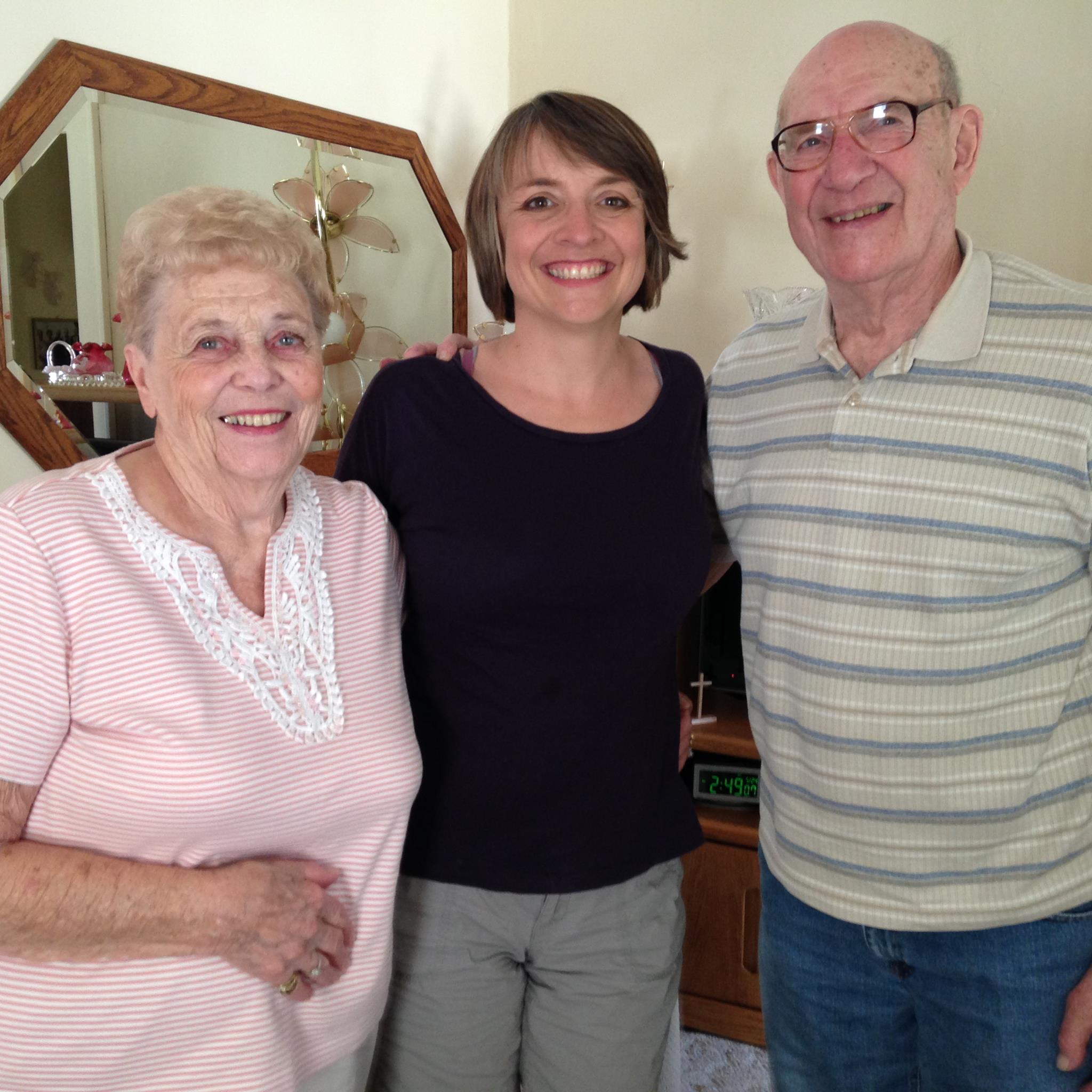
Uncle Louie and Aunt Margaret, a re-visit with much love

I wrote this post over six years ago, shortly after I’d moved back to Michigan. I was so excited to be back around extended family, and I had taken a trip to visit with some of them. I’m dusting it off today, because yesterday, my Uncle Louis died at the age of 92, on a Covid unit in a hospital. He was one of the sweetest men I have ever known.

I have been on a little excursion. I travelled to my childhood home on Saturday and have had one great moment after the other since.

It started with dinner on Saturday with my parents and my brothers followed by worship on Sunday with the whole family. After church, my niece and I saw a movie. I’ve eaten well, slept famously, and have had many walks down memory lane.

This morning was particularly special. I drove about an hour to visit my aunt and uncle — my father’s older brother and his wife. My godparents, Uncle Louie and Aunt Margaret, are the most precious of gems.

They have showed up for everything. Everything. My baptism. My confirmation. My birthdays. My wedding. My grandparents’ funerals — my mother’s parents, not just my father’s. None of this probably seems astounding, but let me tell you why it is.

My parents were divorced in the 1970s. Divorce was not very common back then, particularly not among ‘church folk’. In those days, when divorce happened, it was fairly common for the mother to get sole custody of the children and the father to fade into the background, sending financial support and visiting occasionally. This was way before shared custody.

To complicate matters, my parents divorced around the same time that my dad was relocating to take a new job several hours away.

My three siblings and I stayed with my mother, as was the usual course of events, while my dad moved. While I am thankful that during my childhood and adolescence we had the stability of one household and the ongoing involvement of the relatives on my mother’s side, I have been sad over the years because of the diminished relationship with my dad and his side of the family.

We saw my dad, but because he was several hours away, those visits were infrequent. We usually stayed with him in the summer for a week or two, talked on the phone regularly, and saw him around the holidays. Sometimes, when he came to Michigan , he would take us to see my grandmother, his mother, who for most of my childhood lived a nursing home, but of his five siblings, usually the only one we visited was my Uncle Louie, and his dear wife, Aunt Margaret.

Whenever we stopped by their house, Uncle Louie would pull out a cardboard box of toys that they kept just for our visits, and Aunt Margaret would magically produce some kind of sweet — cookies, cake, or maybe some donuts. They wanted to hear what we had to say. Aunt Margaret asked all the questions; Uncle Louis was pretty quiet, until he spoke in his soft bass voice. Whatever he said, he said with a smile and sparkling eyes.

Sometimes they told stories about their snowmobiling adventures, my Uncle Louie’s job as a postal worker, or my Aunt Margaret’s love for hand-painted china, but the best story they told was their love story. When they shared their ‘scandalous’ beginning, they both looked mischievous as they took turns in the telling, as though it were a scripted piece they’d been telling over and over for years.

The love story of Louie and Margaret began with a one-month courtship that quickly escalated one night right before they were both supposed to punch in for their second shifts at the factory where they worked. They were sitting in the car when Aunt Margaret suggested that they drive to Indiana instead of going to work. In Indiana, she said, right across the state line, they could get married the next day, without the waiting period required in Michigan. Uncle Louie, apparently no longer concerned about his factory shift, turned the car back on, drove home to borrow $20 from his mother, stopped to pick up two witnesses, and headed to Indiana. They changed into their wedding clothes in a cornfield and were married by the justice of the peace the next morning. They stayed married for 71 years.

They were always together, those two. They took lots of drives looking for antiques and visiting family. They had just one son who was a bit older than we were — he, his wife, and their three children were the lights of their lives, but they had space enough for all of us, too. Three out of four of us were their godchildren, although my Aunt Margaret always said, “I alway include your brother in all my prayers, too.” They took their role seriously, and weren’t going to drop off because of a divorce.

Instead, Uncle Louie and Aunt Margaret regularly drove an hour to come see us at our mom’s house. They said, “Your mom is still our sister; you are still our family.” It may not sound that remarkable now, but, believe me, it was very unconventional at the time.

They came to every birthday party and special event. They always hugged my mother when they came and when they left. They modeled for me how to treat family, even in the midst of brokenness. I never saw judgment or distance from them — just love.

When I grew up and had a family of my own, they would then drive two hours just to drop by and say ‘hello.’ Their big yellow Oldsmobile would pull into our driveway, and I would say, “What? You drove all this way?” They always hugged us — Uncle Louie with his big compression hugs — and said, “I love you.” Aunt Margaret wrote long letters and would share news from my dad’s side of the family, including family history that I didn’t know much about. I always felt loved and treasured by my godparents; I have been so thankful to have them.

As my husband and I have faced divorce and other brokenness in our own extended family, we have often referred to the example that Uncle Louie and Aunt Margaret set. While it is heart-wrenching to watch family members experience pain, it has given me some measure of comfort to know my role. My job is to show love, to give hugs, and to communicate belongingness, just like Uncle Louie and Aunt Margaret have done for me.

Of the many things in my life I am thankful for, Uncle Louie and Aunt Margaret are near the top of the list. I told them that this morning and reminded them of the special lesson they taught me.

since God loved us, so also we ought to love one another

1 John 4:11

postscript January 17, 2021: In the summer of 2018, my Uncle Louis fell in the yard, breaking his hip. He never returned home after that. He went from a hospital to a nursing home where he lived out the rest of his days, separated from the love of his life. It was a hard hit that came not too long after the death of their only son from cancer. My heart has ached these last two years watching these two gems finish their days apart, especially since Covid kept Aunt Margaret from sitting next to Uncle Louis for his last ten months. When he was admitted to the hospital a little over a week ago, Aunt Margaret said, I just wish I could hold his hand. Now I know she’s just longing to be with him again.