Living in the Tension

It’s hard, isn’t it? Living in the tension?

The tension of things not yet finished, of things that are uncertain, of things we need to do, of things that will probably work out in time, and of just all the things.

But isn’t that just life? Aren’t we always living in the midst of tension?

I certainly can’t be the only one who has a list of things I’d like to work on around the house — things that need to be cleaned on repeat, things that need updating, things that need repair, and things that just need to be maintained. It’s never finished all at the same time, so we learn to live with the tension of wanting things done but always having something undone.

Right now, I’ve got seedlings sprouted on the back patio, drinking in sunlight, waiting for the garden to be prepared, which will require several [more] rounds of weeding, an infusion of compost, some tilling, and then several days of meticulously moving the seedlings from their current location into the ground.

Sounds pretty normal, right? And isn’t it also normal that we are struggling to find the time to schedule the steps required to make that process happen. When do we have time to go pick up compost, to weed [again], to rototill, and to plant? Don’t we all have day jobs and groceries to purchase and laundry to keep up with and meals to prepare and family to visit and friends to have dinner with?

We will certainly get to the garden — we manage every year — but until we do, I feel this hum of electricity. It’s the tension.

And it’s not just the garden, of course. My seniors have four weeks of class remaining, and in that time I have ensured them that they will submit two more discussion board posts, write one more five-paragraph essay, and take a grammar and vocabulary quiz. When I say it all in one sentence like that, I hear the protests from the classroom. How could I expect them to do all that when they also have prom to prepare for, a cap and gown to procure, jobs to go to, and parties to attend. They (and I) know it will all happen, but until it does, we live in the tension.

Right now, in this season, my husband and I [and possibly you, too] have some extra life circumstances that are adding to the volume of tension we are experiencing. With one parent on hospice for stage 4 liver cancer and another finishing chemo and awaiting surgery for stage 3 bladder cancer, the tension around the unknown is palpable — I can feel the vibrations in my body.

What will the next weeks look like? Where will we be needed? Will this difficulty be addressed? Will this problem find a solution? What is our role? Who else can help?

I was sitting in therapy this past week, verbally processing all of this when my therapist said, as she often does, “This is a lot.” Looking back into the screen of our zoom room, I replied, “Yeah, it really is.” Then, because she’s known me for going on four years, and because she knows about my chronic health condition, she added “all of this stress is of course impacting your body, so you need to make sure that you are doing the things that off load some of the stress. Prayer can help. Yoga can help. Massage or acupuncture….”

“Oh, yes,” I replied, “that is a good reminder. In fact, just this week I noticed the first stages of psoriasis showing up on my elbows.”

“That’s a signal,” she said.

“Yes, it is,.” I replied, and then added, “I am still walking every day and doing yoga, I do pray, and my writing is essential, but with such a busy schedule, I have let some of the body work go. However, I think I can fit in some acupuncture this week. That’s a good thought.”

And when I closed out our zoom room, I went online to schedule an appointment.

Friday after school, I made my way to the airy acupuncture practice. I signed myself in, sat down, took off my shoes and socks, and waited for the practitioner. Diane, to come over to me. When she arrived, she said, “Hi, Kristin, how are you doing today?”

“Actually, I feel pretty good, but I’m under a lot of stress, and my therapist recommended that I receive some care.”

We chatted for a minute, and she said she is recommending that all her teachers watch a show called Rita on Netflix. She said it’s a fun Danish show about a badass teacher that I had to promise to check out. Smiling, I said, “I’ll watch it tonight.”

“Good,” she said, and then she checked my pulses and the appearance of my tongue, and had me lie down on a bed. She started inserting needles, first in my left ear, then my forehead, then my wrists, and finally my ankles. My eyes were already closed before she started, and I felt my body grow heavy and shift into a deep relaxation almost immediately.

I was aware of ambient piano music and of Diane speaking to other patients nearby, but I was definitely semi-conscious and allowing my body to receive some restorative care, to offload some stress, to release some of the tension.

Before I knew it, Diane was standing next to me, removing the needles, and welcoming me back to reality. “I let you go an extra five minutes; I hope that’s ok.”

“Oh, yes, I think I actually slept a bit.”

“You did,” she affirmed. “I’ll see you back in a week.”

A little surprised, I said, “You think I should be seen in a week?”

“Yes, I do, until this stressful period is over.”

“Oh, that makes sense,” I thought out loud.

I sat up, put my socks and shoes back on, and wandered slowly to my car. My husband was out of town, so needing a little dinner, I drove to the nearby food co-op and purchased a pre-made chicken curry and lemon rice, went home, opened the windows to let some fresh air in, tidied the house just a little bit, and sat down to enjoy my meal.

The warmth of the spices felt like a balm, and I ate every last grain of rice. I could feel the healing goodness seeping into my body, and I could no longer hear the electric hum of the tension.

I had almost forgotten the promise I made to Diane, but then I remembered, went to Netflix, and searched for Rita. Oh my, I thought, it really is Danish. It has subtitles. Am I really up for this at the end of a long week? Let me give it a couple of minutes.

And I was drawn in to the life of this teacher who has all kinds of tension of her own — a very demanding student, the student’s indignant parents, a complicated involvement with an administrator, and her relationships with her three grown children. She navigates it all — the messiness, the richness, the unsettledness, the tension.

I laughed, I smiled, and I finished the episode.

Then, I climbed the stairs, tucked myself in bed, and slept.

It’s just a normal amount of self care for one person on a Friday night — acupuncture, a delicious meal, therapeutic Danish television, and a good night’s sleep.

Did the tension so away? Of course not. Nothing has changed — the garden is as it was, the house is merely momentarily tidier, my seniors still have four more weeks of class, and our parents are still battling cancer—in fact, one is in the hospital right now.

Life is full of persistent tension.

And, because my body does really need a significant amount of self-care to stay healthy, I kept it going throughout the weekend — I practiced yoga, ate several healing meals, took long walks, got lost in a novel, met with our small group, worshipped, watched another episode of Rita, and got a pedicure. Perhaps it seems like a lot, but as the tension amps up, apparently so must the self care.

For now, my body is relaxed, the electric hum is quiet, but I will need to continue to find spaces to rest and restore, because life [and its tensions] will continue, and I want to be able to show up for it. I want to be able to dig in the dirt, congratulate my students as they walk across the stage, and support our parents as they move through this season.

I just scheduled my next acupuncture appointment, and it won’t be long before I watch my next episode of Rita.

We can’t get rid of the tension, but we can find ways to live in it.

The Buried Difficult

Dude.

Bruh . [or, Bro,]

That’s what the kids say these days when they just. can’t.

I think we used to say, “Ok, Ok!” And maybe our parents said, “Uncle!”

It’s what we say when we just don’t have a response because we are at the end of our rope.

I was trying to think of what to write today after several weeks of posting nothing, and all I could think was….

Dude.

Been there?

Have you been in those seasons when life is coming at you from all directions and you just. can’t. even?

I mean, this is definitely not the worst season of my life. In fact, the roughest seasons have given me so many tools that I am using to navigate this one — therapy, self-care, boundaries, yoga, music, laughter, and Netflix. [By the way, if you need something to carry you through difficulty, I have often recommended The Great British Baking Show; I now add to that Somebody Feed Phil (Netflix) and The Reluctant Traveler (Apple).]

But guys, there’s a lot going on right now. Some of it is great — my work, my husband’s new role as a private practice therapist, the fact that Spring is now here, our kids are doing great things and really stepping into their adulthood– but much of it is hard — the death of an extended family member, the cancer journeys of two others, and the uncovering of hidden realities that will need to be faced in the very near future.

And all I can say is…

Bruh.

It’s a lot.

It’s nothing uncommon to the human experience to be sure. Anyone reading this has navigated similar — illness, addiction, failure to communicate, and the accumulation of it all that someone eventually has to deal with.

And sometimes the ones who have to deal with it are the adult children of those who kept putting off the difficult.

Here’s the thing, though. The difficult doesn’t go away just because you don’t talk about it.

In fact, if you bury the difficult, keep it in a dark place, and even continue to water it from time to time, the damn thing grows. And often, it devours the beneficial, the beautiful, the healthy, the wonderful.

It just eats the good up and continues to grow until it bursts into the open — often at the most difficult of times — and somebody, finally, has to look it in the face, call it what it is, and give it its reckoning.

Dude.

I have been training for this moment my whole adult life, and still, I don’t wanna do it!

Just like my student didn’t wanna write a simple 300-600 word retelling of a day of his life where he learned a hard truth, I don’t want to look the difficult in the face.

But guys, the difficult thing has already surfaced. It’s sitting in the middle of the room, and everyone is trying to avert their eyes for just a little bit longer.

Fine. Look away if you must, but the difficult is not going anywhere.

It will not get easier to look at in a day or a week or a month.

I have been there.

Thing is, most things surface over time. Some of us learn this the hard way.

I’m not scared to look this thing in the face, but it’s not mine.

If it was mine, I might be throwing extra dirt on it right this minute.

But that would not keep it buried.

Nope.

It’s just a matter of time until all things surface.

So, here’s the thing. I have no judgment for the bury-er. Some anger, yes, but not judgment. I have no idea what led to the development of this difficulty. I don’t know the full story. I don’t even need to or want to. That is not my business.

It is truly none of my business to know about a “coming of age” moment that my student may or may not have had, but I always give the opportunity to students to tell their story, because telling about the difficult is where transformation happens.

But that kind of vulnerability is not for everyone. It can be downright terrifying to look the difficult in the eye.

But here’s the thing — once you have stared down the difficult, called it by name, navigated the ugly, grieved the devastating, and realized the freedom that comes with the uncovering, once you have tasted the power of transformation —

Dude.

You won’t wanna bury anything ever again.

I can almost guarantee it.

Coming of Age

When our kids were still at home, we’d hit an uncharacteristic lull in the chaotic banter at the dinner table and someone would say, “Mom, did anything interesting happen in school today?”

I’d quickly scan my short term memory and spit out the first thing that registered, “Well, one of my juniors got down on one knee and proposed to me today.”

“What??”

I’d either shrug or begin to retell the scene exactly as it happened. I never had to make anything up — the stories from my classroom have always been more fantastic than you might imagine.

There was the group of guys from the same era as the proposal who regularly spoke in ‘Pterodactyl” as they walked down the hallway. Yes, it was a high-pitched, loud, screechy “language” that could not be ignored — or understood.

I had one class that routinely swiped the remote control for my projector and would play around with the virtual pointer until I noticed what was going on and then had to determine who the culprit of the day was. One of the students from that same class occasionally, during after school hours, suspended a sandwich from a string so that it swayed in my doorway. I would arrive at school at 7am to find a cellophane wrapped ham and cheese waiting for me.

I consider these to be expressions of love from the hormone-intoxicated minds of teenagers. They can’t help themselves. They’ve just got to be weird.

You might, when I tell you I teach high school English, have visions of me standing, dressed in an A-line skirt and heels, hair neatly styled above my cardigan, leading my students through sentence diagramming. It never looks like that in my classroom. Never.

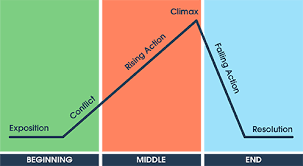
Instead, teaching high school, for me, is more like bearing witness to a handful of humans coming of age — making (or beginning) the transition from childhood innocence to adult experience.

On Friday, I was sitting on a desk, balancing a giant tablet of Post-It Note paper in front of me while my students and I collaborated to chart the similarities and differences between ancient and modern maps found in a passage we had read. I was holding a marker in one hand and the pad in the other, wrangling both the students, who were unsuccessfully “trying” to ignore messages from classmates on their phones, and the giant tablet so that we could complete the task. I was sweating, they were distracted, and we were getting nowhere fast. Finally I put the paper and the marker down, walked to my desk, took a drink of water, looked at my students, and said, “I’m working too hard here.”

“Mrs. Rathje can I go to the bathroom?” asked one student.

“Mrs. Rathje can I have a bottle of water?” asked another.

“Mrs. Rathje, you got anything to eat,” chimed a third.

I took a deep breath, surveyed the room, and said, “Here’s the thing. We said at the beginning of class that we had to complete this task before any of that happens. We’ve been working on this for quite some time, and we can’t seem to get it finished. I’m handing it over to you. You know what to do. You guys work together to finish this chart and then we’ll talk about snacks and water and bathroom breaks.”

It was a hail Mary, to be sure. And it could’ve gone either way, but those students got out of their seats, huddled around the incomplete chart, and worked together to finish it.

“Wow!” I said, “this is how we are mapping texts moving forward. You guys are going to do it on your own, and I am going to sit back and watch.”

“That’s what I’ve been telling you, Mrs. Rathje. Just let us do the work.”

“Heard,” I replied as I handed out cold water bottles and and opened my container of snacks.

We had three minutes left in class and the boys in the group spent the remaining time trying to bottle-flip their water bottles so that they would land on a small ledge of a ceiling beam. They couldn’t quite get them to land, so eventually, one 6’2″ student jumped straight up in the air to place the bottle on the ledge. The room erupted in shouts of joy just as the bell was ringing.

This is English class, ladies and gentlemen — a study in human development with moments of maturity interspersed with childhood play.

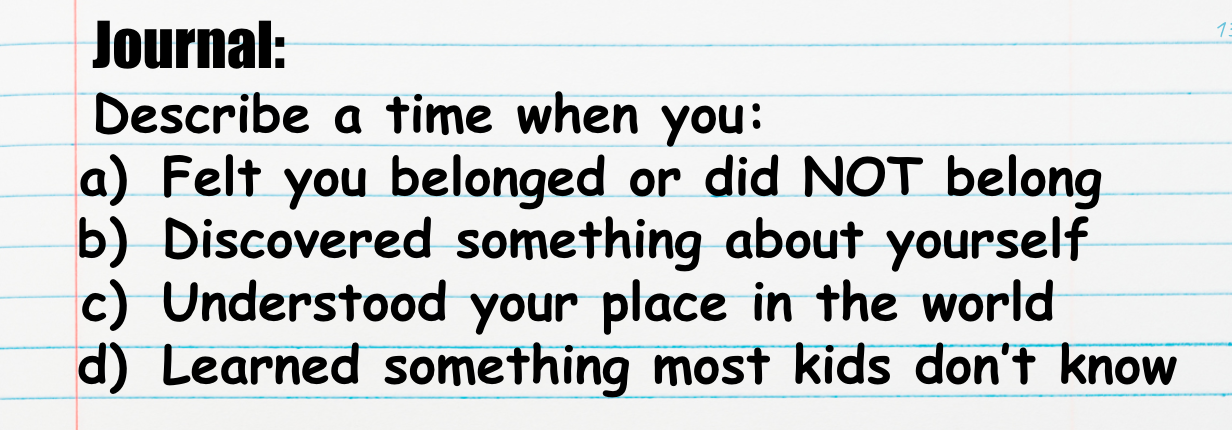
Earlier that day, I had a small group of senior “men” in my room. The class has “women” in it, too, but none of them were in attendance, so I just had the guys for a class in which we were building our understanding of “coming of age” so that they could write their own coming of age narratives for an assignment next week. We’re reading Trevor Noah’s Born a Crime., his memoir about growing up in South Africa during Apartheid, which includes anecdotes of pivotal moments where he lost his innocence or where he gained some kind of experience. We’re finding those moments, discussing them, and preparing to write our own.

So, as part of Friday’s activity, I posted a journal prompt on my screen.

I tell them to write for eight minutes straight, I start a timer, and — you’ll never believe it — they start writing. They write and they write, and I sit at my desk, writing, too. The room is silent except for the ambient music of the timer. When time is up, I say, “Anyone like to share what they wrote?” half expecting that they would all say “Nah.” Being that it’s just five senior guys, I wouldn’t have been shocked if they all wanted to keep their thoughts to themselves. But, they began to share, one by one, the things they’ve discovered about themselves, the things they’ve learned, the times they felt like they did not belong.

Then, somehow we found ourselves in a discussion about how much you should share with a girlfriend — how vulnerable you should be.

“You should never share your personal feelings with a girlfriend,” one man-child said.

“What?!” I asked.

“You don’t share your personal feelings because they’ll use them against you,” he replied.

“No. That’s not how it works,” I said. “You should be able to share your feelings with your girlfriend.”

“No you shouldn’t, because when you break up they’ll tell your business.”

“Oh, well, right. I can see that,” I said. “I guess it’s all about trust. You can only be vulnerable with someone you trust. For example, my husband and I have been together for thirty-five years, and we can tell each other anything.”

“That’s what Mrs. O (the Spanish teacher) said, too,” another student replied.

And then, we’re on to the next topic. These guys are moving through their day gathering tidbits of wisdom about relationships while loosely committing to completing their school work.

Earlier last week, I went to another classroom to grab a senior who is in danger of failing a couple of classes and not graduating on time. Each of the members of the leadership team have been assigned a couple such students in order to get them across the finish line.

As this “very cool” senior and I walked down the hall, I linked my arm through his, looked up into his face and said, “You and I are going to get together once a week to make sure you do what you need to do to graduate.” He looked down at me, seeming a little more concerned than his usual playful self, but he walked with me to my classroom, sat in the desk where I directed him, and looked with me at the screen of my laptop to see his current grades.

“You are at school every day, ” I said, “and you are very bright. I don’t see any reason why your grades should look like this other than the fact that they are not your priority.”

He looked me straight in the face.

“Your priorities, from where I’m sitting, seem to be your girlfriend and having fun.”

He nodded.

“I get it. I do, but dude, her grades are strong, and she’s gonna graduate. It would be a shame if she left you behind.”

“I’m gonna do better. You watch,” he said.

“I was hoping you’d say that,” I replied. “Let’s check in again next week so that I can see your progress.”

“OK.”

A few days later, the same student saw me in the hall. “You were right about my priorities,” he said.

“Was I?”

“Yup. But I’m doing better. You’re gonna see.”

“Amazing. I look forward to it,” I said, and we fist bumped and went our own ways.

Is this what I pictured my life would be like — interacting with adolescents, trying to enjoy their playfulness while also pressing them to dabble in maturity? No; I think I pictured the woman in the cardigan analyzing literature or poetry. I do get to do that sometimes, but more often than not, my role is less about English Language Arts and more about developing humans.

And, what an irony that I am developing right along with them. I, too, am coming of age.

Scenes from a holy week

Several times in my life, like this year, my birthday has occurred during Holy Week. Some of those years, I had been perhaps more devout and was observing a Lenten fast — from sweets, from junk food, or even — gasp! — from caffeine. Not this year, I’m a tad less devout than I have been in other seasons of my life. I’m currently in the come as you are phase. Perhaps I’m a little disenchanted with the ‘religious’ parts of faith

Having my birthday fall during Holy Week in some years has felt like a bummer — how can I celebrate me, after all, if Christ is hanging on the cross? Especially if you literally own lyrics like “It was my sin that held Him there,” for goodness sake. This year though having my birthday fall during Holy Week has felt like a screen play that has unfolded scene by scene.

It started last Saturday when my husband and I joined his brother and our sister-in-law for a birthday lunch at a local restaurant. My brother-in-law’s birthday is the day after mine, so for the last few years, we have celebrated together. We had a fabulous meal and exchanged gifts, and caught up on the details of life. While it was a celebration — the waiter even brought mini fireworks to our table top! –the tone was a little heavier than usual as the four of us at the table are all watching a parent make decisions and take action against a cancer diagnosis. This year’s conversation was a bit less about the birthday boy and the birthday girl, and a bit more focused on the heavy weight we all are carrying. Nevertheless, love was shared and laughs were had.

It’s a snapshot of life — four adults around a table sharing reality over delicious food.

The week was full of scenes like this. My husband and I sat in a coffee shop over beautiful lattes a couple days later, wearing thrift shop finds and discussing our plans for a trip we might take next year. We walked around an old oval dirt track holding our coats around us, bracing ourselves against a cold wind, chatting about our need to stay active, to keep talking, to keep finding ways to connect with our family and enjoy our life together.

The next day, I parked the car and ran into the library, returning some books and grabbing another so I’d have plenty to read over the long week with no students. Then, I drove to my parents’ home, through the rain and construction, so that I could help my mom into my car, buckle her seat belt, and accompany her to a medical appointment, drive her back home, help with dinner, vacuum the floors, schedule some appointments, and watch an episode or two of Jeopardy.

I can see each of these moments as though I am rewinding through the events of the week, analyzing the plot and trying to find some thematic thread.

As far as weeks go, it was rich with family connection — a long phone call with my sister where I got so lost in conversation that I forgot about the cookies I had in the oven; a warm bowl of chili with my brother, mother, and stepfather where we talked about photography, family life, and other mundane topics; a driveway conversation with my other brother that was heavy with responsibility, decision-making, and love for our parents; and phone calls with my father-in-law, a daughter, a son, and my dear ninety-two year old godmother.

She’s living in an assisted living facility, and when I called she was in her room coloring, “warming up” for the craft she would do with other residents in a few moments. Even though she didn’t want to be late, just like always, the goodbyes lingered:

“I love you and thank you for the call.”

“I love you, too! Have fun doing crafts.”

“Ok, and have a happy birthday.”

“I will! I hope I can see you soon,”

“Ok, my dear. I love you.”

“I love you, too, dear.”

“Goodbye.”

“Goodbye.”

Neither one of us wanting to be the one to hang up.

For some reason, each of these exchanges seem richer this year. It could be the fact that I am getting older — my fortieth high school reunion is this year, after all. It could be that the health realities of our older family members are causing me to take stock. It could be just that I am finally moving a little more slowly, taking in the richness that my life has afforded me.

I was sitting in church on Good Friday, trying to examine how I feel about this traditional observance in my current state. I’m singing the hymns, listening to the last words of Jesus, and smiling at the curly-headed toddler sitting next to me who is up past his bedtime and fluctuating between giggles and shrieks. I habitually reach to straighten my necklace, the necklace that I rarely take off, and it hits me that I’ve been wearing a version of this necklace on and off for fifty-eight years.

The gold heart charm was a gift at my baptism; it has my birthdate engraved on the back and my first initial engraved on the front. The butterfly was a gift when I earned my Master’s degree. I’m wondering, in the middle of this Good Friday service, why my mind has been drawn to this piece that never leaves my neck. Perhaps I’m realizing how loved I’ve been (in spite of human frailty, error, and circumstance) for my whole life; perhaps I’m noting the significance of the butterfly as a symbol of my insufferable belief in transformation; perhaps because my birthday falls during Holy Week, I’m acknowledging — again — that my whole life has been an object lesson in the power of grace to restore a life.

The toddler has been carried out of the service to spend the duration with his mother in the nursery, and the altar is being stripped as we sing the last song.

“How deep the Father’s love for us, how vast beyond all measure…His dying breath has brought me life…His wounds have paid my ransom.”

And it’s not the somberness or guilt that I often felt as a child on Good Friday. I don’t feel ashamed that Jesus died for my sins. No. I feel relieved, thankful…free.

And in that freedom, I lean into Saturday. I sleep in, do yoga, then make a pot of soup. I work on a puzzle and watch basketball and mindless television.

Sunday — Easter — I find myself in church again, surrounded by folks who have become family over these last few years. The pastor stands, says “Christ is risen!” and the congregants reply, enthusiastically, “He is risen indeed!” We sing, recite the creed, and listen to the reading of the Gospel.

I see Mary in the tomb, looking for Jesus, presuming she is speaking to the gardener, until He speaks her name, “Mary,” and she instantly knows that He is her risen Lord.

The sermon begins, and our pastor asserts that in our cynical culture, we have all become like Thomas, demanding proof that the resurrection is real, and I find myself longing for something — not exactly proof, I don’t think I need that, but I would love some kind of confirmation that these weekly services still have meaning, that they still matter, that my presence here still matters. And just then, the pastor says to the congregation — to me — “I have very good news for you, Jesus still calls you by name.” And I am reminded that He has always known me, from my birth to my baptism to my devout days to my come as you are days. He speaks my name, and I immediately recognize Him.

And I think I’ve found the theme. My whole life has been rich with connection, relationship, and meaning, even when I haven’t believed that to be true. I can see the evidence, my friends.

Christ is risen; He is risen indeed. Alleluia.

For a pair of shoes

I’d been watching the girls’ basketball team all season — from the first game of their first season ever, where very few showed any evidence of having played the game before, where one girl received a “traveling” call for carrying the ball football-style while running down the court, where our players froze in place as the other team stole the ball, where the referees pulled our girls aside to teach them the rules in the middle of the game. From that game forward, I had been encouraging the girls, both on the court and in the hallways, letting them know I was seeing their progress. They were not only learning the game –the skills, the rules, and the strategies — they were also building confidence, stamina, and resiliency.

Many on the team were girls I had had the previous year in my reading intervention class. They had been freshmen– freshmen who had spent most of middle school on Covid lock-down, freshmen who had missed some social development experiences, freshmen who had very little capacity to manage challenge, difficulty, or conflict. So when I saw them during that first game, barely hitting double digits on the score board, I wondered if they would make it the whole season. Could they take the losses they would certainly face? Could they [and their coach] see this for what it was — a building year. Could these young women show up every day, practice the basic skills of basketball, and arrive at the end of the season better for it?

Only time would tell.

But here I stood at the end of the season, watching this same group of girls prepare for one of the last games. As the other team was rolling into the building, our girls were practicing an inbounding strategy while the coach called cues from the sideline. The girl with the ball slapped it loudly, and the four on the floor quickly shifted to their new positions to receive the thrown in ball. I stood on the sidelines, recording the scene on my phone, grinning with pride.

I was there to sell concessions, so I was in a little room at the corner of the gym with one eye on the game and one eye on my concession window, when I noticed that one of the players, the center, was shuffle-jogging down the court. I had noticed that she wasn’t a very fast runner earlier in the season, but I had assumed it was as fast as she could move given that she was about 5’10” and probably close to 200 pounds or that she simply didn’t have the stamina to run up and down the court for an entire game. Being the first season, the team only had about ten team members total, and typically only six or seven of them were eligible to play on any given day. Whoever showed up typically played all four quarters — that’s a lot of running for anyone, even those who are are in top physical shape.

But for some reason on this day when I noticed her shuffle jogging, my eyes moved toward the floor and I noticed that her shoes appeared to be untied. When I looked a little closer, it appeared that they were not actually untied, but in a permanently knotted state of floppiness. She could neither tie nor untie them., so the laces flopped as she ran, and the shoes, a pair of high tops that appeared to have seen some days on and off the court, seemed to be of little support in her efforts to improve her pace.

Is this the pair of shoes she’s been wearing all season? Why didn’t I notice this before?

Now look, every day at my school I see need. I see students who need food, who need new clothing, who need a haircut, personal hygiene supplies, pens, pencils, or even a water bottle, but this pair of shoes got to me.

This girl, who against all odds shows up for school every day, goes to basketball practice every day, has a C average, and dares to put herself in front of an audience of classmates, teachers, and parents, has been doing so inside sneaker head culture where the shoes on your feet can be linked to your status, your belongingness, or your ridicule. (It would take another whole post to examine the complexity of sneaker head culture within the context of high poverty neighborhoods, so let me just say that yes, a student may have brand new Jordans and still experience housing insecurity or food insecurity. It is what it is.)

This girl, despite her classmates’ comments and/or ridicule, has enough grit and determination to continue to show up on the court in these beat up kicks for the entirety of the season. That should tell you something about her.

So, I’m standing, watching the game from the concession stand, a game in which an adult in the stands got in an insult contest with one of our sophomores that escalated into a fist fight that DID NOT disrupt the game play — nope, our girls kept right on playing as security officers wrangled a punching mass of bodies out of the gym–a game in which they were down by double digits, came back to tie and go into overtime, a game where they lost by two points at the buzzer, and I’m taking in the wonder of these young ladies who could barely bounce a ball at the beginning of the season, who were making eye contact and passing, who were boxing out under the boards, and I’m understanding the impact of it all on their development — their ability to overcome difficulty, their ability to stay the course, their ability to trust themselves in difficult times.

I was overwhelmed.

A couple weeks later, after the season had ended and track season was getting started, the same group of girls was walking down the hallway, headed to practice.

“Ya’all on the track team?” I asked.

“Yes, of course!” they replied.

“Excellent!” I said.

“Are you going to come to our meets?”

“Definitely!”

And during this quick exchange, I noticed that all of the girls had on the same shoes they had worn to run up and down the basketball court all season — including that beat up pair of high tops.

And something inside me snapped.

A few minutes later I saw the track coach, “Hey,” I said discreetly, ‘I notice that K’s shoes are not really appropriate for track. I’d be happy to anonymously fund a new pair for her. Is there a way to make that happen?”

“I’ll figure out a way,” she said.

A few days later, I mentioned the situation to our athletic director. “I don’t know how many students you have that could use running shoes or spikes for track, but if I gathered a few hundred dollars, could you put it to use?”

“I would love that,” she replied. “Let me take a little inventory and see how many pair of shoes we need.”

So here I am telling this story, friends, because this is what I know how to do. I know how to tell you that having athletics is transformational for all kids — but for my students, who have experienced poverty and trauma beyond what I can imagine, who have every reason to give up hope for a brighter future for themselves, sports can offer an opportunity to practice navigating low stakes wins and losses and build the muscle they need to weather bigger wins and losses outside of sports. For my students, the power of athletics is essential.

My school is doing what it can to build programs. Two years ago, the only sports we offered were boys’ basketball, football, and cheerleading. Last year we added track. This year we added girls’ volleyball and basketball. In the fall, we hope to have a cross country team.

Teachers show up to coach, to run a clock, and to sell concessions because we see the impact of these programs on the educational engagement and morale of our students. If they aren’t passing classes, they don’t get to play, so they get more invested in their classes. When they are invested in their classes, they learn more, their grades improve, and they have more opportunity for their future.

It’s not hard to connect the dots between athletic programs and successful adulthood. We’ve known this for decades. All students should have access to programs that lead to a hopeful future, and they should have everything they need to participate in such programs.

So I’m asking, friends. I’m asking you for help — again. If you love sports, if you love kids, if you have an insufferable belief in transformation, please consider joining me in building an Athletic Shoes Fund for my students. Funds will be used to provide athletic shoes for students like K who cannot otherwise purchase their own.

Email me at krathje66@gmail.com for details on how to give or simply send a check with “DLA Athletic Shoes Fund” in the memo line to Detroit Leadership Academy 5845 Auburn Street, Detroit, MI 48228.

And if this isn’t your project to give to, I hope you’ll keep cheering us on as I keep on sharing our stories.

Unlearning

Much of the work of my adult life has been unlearning the internalized messages I have picked up inadvertently. Messages about my identity, about how the world works, about the value of others, and even about my faith are regularly being viewed under a microscope to see if they hold up to scrutiny.

The first time I remember doing this was in the counselor’s office in the mid 80s where I was being treated for an eating disorder. Regularly in my sessions, my therapist would ask me questions that would confuse me. Why did I need to lose weight? Why did I believe I would be more attractive if I was thinner?

Why would he ask me such questions when the answers seemed obvious. Throughout my whole twenty year life, I had learned to believe that thin was better than fat, that I’d better watch my weight, that “those fat people over there” were disgusting, probably lazy, and not worth as much as “we” thinner people. I was ever anxious that I, in my body, which was just a tad larger than those of my friends and my sister, was ounces away from losing my status as one of “us” and becoming one of “them”.

In fact, in my freshman year of college, like many overwhelmed, depressed, and floundering college students, I did put on ten or fifteen pounds, and people I barely new — dorm mates and classmates — repeated the refrain I’d heard at home, I’d better be careful. I should get my weight under control. Did I really want to eat that dessert?

I believed their messages, and in fear and trembling, I overcorrected. I began a regimented way of life that escalated into anorexia nervosa. I lost all the weight I’d gained my freshmen year plus another 20 or so pounds over the summer before transferring to a much smaller school in the fall.

There, my excessively thin body soon gained its reward. That very fall, I was selected for the Homecoming court. I’m guessing I was selected solely based on my appearance because no one could have known the real me. When I wasn’t studying in the library, I was secretly writing down every food I ate, calculating calories, and sneaking to step on the industrial scale in cafeteria where I worked to make sure the number continued to go down — the only way I knew to measure my value.

I felt so out of place on the stage being crowned in one of the most ironic moments of my life. My cohort was apparently applauding my external worth, while I was trembling on the inside — afraid of being revealed as an imposter, knowing that what they saw was artificial, a fragile facade concealing a very broken interior.

That was close to 40 years ago, so you might think I have completely unlearned that lie. That might be true if everyone in the culture I live in had learned it, too. Alas, they have not. Messaging about the connection between thinness and beauty persists today. It has lost some of its power what with the greater diversity of representation of women in the media, the elevation of body positive messaging (if you are willing to look for it), and the shift in the fashion industry toward inclusivity, but the message remains among us — thin is better than fat, especially for women who live under continuous pressure to present themselves in flawless well-toned bodies despite genetics, health, or circumstance.

So, my unlearning continues. When I hear my mind say, You’ve put on a couple of pounds; you’d better be careful. I ask myself questions that I started hearing from my therapist years ago: Why are those pounds bad? What will change about you if you decide to keep them rather than lose them? Why are you connecting those pounds to your value as a person?

Why indeed.

What is true about my body is that it is strong — it has carried my children, it has finished half marathons, it has communicated with me when I have overworked, it has kept going when my mind has refused to rest. It is strong and beautiful and resilient. It has value at any size. Period.

Do you see how it works? It takes awareness, diligence, and intentionality to unlearn the messages we carry with us all the time, often unknowingly.

My students and I just started reading Born a Crime by Trevor Noah, a memoir of the comedian’s life growing up in South Africa during Apartheid. Before we read the book, we start with learning about unconscious bias — the beliefs that we have that shape the way we view the world. We talk about bias against people of other races of course, but we also talk about gender bias, religious bias, disability bias, and even weight bias.

The very nature of unconscious bias is that we don’t know that we have it. That’s why I was confused when my therapist asked me questions that challenged my unconscious bias– my beliefs were so ingrained, I accepted them as fact — didn’t everyone feel this way? didn’t everyone know that being overweight was bad?

So as my students and I learn about unconscious bias, I have them take the Harvard Implicit Associations Test. This is an ongoing study that gathers data from participants regarding their bias around a variety of topics. It takes about 10 minutes per topic such as race, age, weapons, or weight. The participant clicks on images in response to the directions, and the speed of the response reveals the participants’ unconscious associations. It’s fascinating.

Now, I will admit that this is uncomfortable work. In all my years of teaching students of color, I have been working to unlearn the racist beliefs that permeate our culture — the not always subtle implication that Black people are poor and dangerous and not as smart as white people. I know that these statements are untrue. I have countless examples of students, coworkers, and friends of color who are wealthy and brilliant and successful and generous and kind, and yet my unconscious bias still sometimes reveals itself. I don’t like when this happens.

Let me give you an example. I was venting to my instructional coach one day. She is a brilliant educator who, like me, is committed to educational equity. She has taught in Detroit Schools for thirteen years and has risen through the ranks because of her commitment to excellence and her undeniable ability to support other educators in instructional design and implementation. Also, she is Black. It had been a difficult school day and the halls were loud and unruly, and I said, “Man, it is zoo-y in here today.”

She replied, “Well, I wouldn’t use the word zoo-y.” She was matter of fact, not accusatory, not incriminating. She just said it, and gave me a beat to process.

“Oh, wow,” I said out loud. “I never considered that using that word implies that our students are animals. Yikes. I won’t say that again. Thank you for bringing it to my attention.”

Even typing the words right now, I have an ache in my chest. How could I have used such language when I work so hard to push against racist ideas?

My coach happened to be in my classroom a few weeks ago when I shared this example with my students. I said, “If we really want to uncover our unconscious bias, we have to give the people around us permission to point it out to us. It was brave of my colleague to say something to me. She did not know how I would react.”

“Wait, why is zoo-y a bad word,” one of my students asked.

My colleague stepped in, “For many generations, white people used language that made Black people seem like animals so that they could justify the way they treated them — with slavery, with separate bathrooms and water fountains, with unequal schooling, you name it. To say that the school feels zoo-y implies that you are animals. And, you are not.”

All eyes on her. Silence. Reprogramming in process. A moment of unlearning. Priceless.

I continued, “Maybe you have heard me say something that revealed my unconscious bias in this class. I am giving you permission right now to let me know when that happens. It is the only way I can bring these beliefs to my consciousness, put them under a microscope, and reveal them for what they are. That’s the only way I can hope to change.”

A few days later, one student, my boldest, most confident rising star, interrupted me when I was explaining the term “white privilege” and how I have benefitted from it. I’m not sure what I said, to be honest, but she challenged my delivery and said, “I wouldn’t say it like that again.” It takes a lot of courage for an 18 year old girl to challenge her teacher in the middle of a lesson, so I stopped, heard what she had to say, thanked her for her courage, and practiced rephrasing my thoughts.

It was an uncomfortable moment for me, to be sure, but I am hopeful that it was a moment of agency for her. Perhaps she, too, will start on a lifelong journey of unlearning the things she has picked up about herself, her world, and the ways that she can operate within it.

The alternative is staying where we are, holding fast to every lie we have ever believed, which for me has felt like a trap. The unlearning, although at times uncomfortable, is liberating. In fact, it’s a transformation.

Be transformed by the renewing of your mind

Romans 12:2

Gem of the Week: Netta*

My first impressions of Netta are fragmented. Hers was a name on my roster that I rarely marked present.

When she did show up during the first quarter, it was hard to get a read on her. At times she seemed withdrawn, introverted, like she preferred to be left alone. She sat in the back, by herself, and I didn’t often hear her speak. In fact, the sounds I usually heard from her were the sounds of deep contented sleep — the rhythmic breathing that is not easily disturbed, the kind that causes others around her to turn and look, to say, “Man, she is knocked out!”

I stopped fighting the sleep battle long ago. I have no idea what is going on with my students outside of my classroom, so if I nudge them once and encourage them to “come on, you’re here, you might as well get something for your efforts,” and I get no response, I am prone to let them sleep. Maybe it’s the only rest they’ll get today.

So, Netta was a show up once a week kind of gal who often spent that day in slumber, face pressed against the desk, eyes closed behind the very thick coke-bottle lenses of her glasses.

I didn’t know her well, but I got the impression that she wasn’t a meek, shy, introvert. No, she seemed more like a sleeping bear — completely content if left alone, but disturbed? You’d better run for your life.

Every so often during that first quarter, she would blow into the building like a force. Her hair would be done, her clothing would be intentional, she would sit up straight in class, she would feverishly take notes, and she would demand that I answer her questions about the assignment, never mind that she had missed the last two weeks of school.

It didn’t make sense to me. Why such apathy followed by such intentionality. Then I heard the rumor that Netta’s probation officer was scheduled to show up on that particular day, and Netta was going to make sure to leave a good impression.

I never did see the probation officer, and Netta reverted to her status quo.

I’d be lying if I said that I didn’t have my hackles up just a little bit every time she showed up. The fact that she was often reserved coupled with the fact that she could occasionally show up like it was game day put me off balance, and occasionally I’d see her — rather hear her — move through the hallway, strings of expletives bursting from her like machine gun fire. I presumed, if provoked, she could tear me to shreds. I wasn’t planning to provoke her, but I couldn’t be sure no one else would. So, I was often just a little hyper-vigilant when she came to class during that first quarter.

For some reason, she showed up on the first day of the second quarter, the day that I characteristically give each student a printed summary of their academic performance so far. It’s a simple sheet from PowerSchool that lists the student’s current grade, how many assignments they completed, how many times the student was tardy, and how many times the student was absent. I do this to provide information to my students — to allow them space to reflect — but also to reward what I have seen. If they have earned an A or a B, if they have had fewer than two tardies or fewer than two absences, I give them a “Rathje Ticket” that they can use to purchase items from my class store.

On this particular day, I was calling special attention to students who had been chronically absent — who had more than two absences per month for the first quarter. Raising attendance has been my classroom goal this year, and although attendance had definitely improved from previous years, students like Netta still had a way to go. So, because she was in class on that day, I handed her the report that I had marked with yellow highlighter, showing her double-digit absences and noting that she had been “chronically absent.”

Netta, typically quiet [or sleeping] Netta, said quite loudly, “Mrs. Rathje, this is terrible! Imma do better.”

And do you know what? She did.

She started coming to class, just in time for the unit on personal narratives. I wanted students to show themselves in a scene or several scenes that revealed to the reader who they were, what was important to them, or what their strengths were.

Netta dove in. In fact, she asked to move to the front row, smack-dab in the middle. She read the models I provided. She did the brainstorming, she chose a prompt, and she began to write.

I can see her now, totally honed in, bent over her desk, face inches away from the paper as she wrote and wrote.

“Mrs. Rathje, can you read this and tell me how I’m doing?”

The writing was rough — very rough — the kind of writing you might have if you only went to school one or two days a week for several years. The penmanship, the spelling, the grammar — not anywhere close to what I would call standard. But as I read, everything else in the room fell away. She was writing about the fact that her mom had died — during Netta’s birthday week — six weeks before the start of her senior year. Six weeks before she started sporadically showing up in my class to sleep in the back of the room.

“Wow, Netta. This just happened?”

She nodded, looking through those thick lenses into my eyes.

“This past summer?”

“Mm-hmm.”

“I’m so sorry. Thank you so much for sharing this. I’m so glad you chose this topic. I want you to write more. Give more detail.”

“Mrs. Rathje, I know it’s a mess. I want to make it better. Will you help me?”

“Of course. We’ll work on it together. That’s what this assignment is all about.”

And that was the beginning. Of Netta’s engagement in my class, of Netta showing up four to five days a week instead of one, of Netta communicating (if at the last minute and out of desperation) with our social workers before her next probation officer visit or court date.

She hadn’t ascended to a straight A student by any means, but I was watching her transform before my eyes.

Now, she NEVER enters my classroom quietly. No. How do I describe the self-confident force of nature that is Netta, that boldly proclaimed during our Intro to Racism unit this past week, “I know what my unconscious biases are, and I’m not changing them!”

“I guess you might say they are no longer unconscious then, am I right?” I grinned at her.

She crossed her arms, gave me the side eye, and said, “They are not. I am fully aware of my bias. And I am keeping it.”

She is not afraid to tell a classmate, “Shut the hell up, you talk too much, and you sound stupid,” and although I check the outburst, I can’t often disagree with her assessment.

On Friday, late in the afternoon, she was walking down my hallway and she shouted at me, “Mrs. Rathje, you would be so proud — I didn’t cuss at all in that class.”

“That’s amazing, Netta,” I said, smiling, as I watched her walk into a classroom.

Two. seconds. later. I heard the most profane stream of words come from her mouth halfway down the hallway.

I walked down to the room she was in, popped my head in the door, looked her in the face, and said, “Netta, did you not just say I’d be proud of you for not swearing?”

“Mrs. Rathje, I had to get it out of my system before this class started.”

I smiled, shook my head, and walked away.

Earlier that day, she had come into my room, dressed as though she had something important going on after school, sat down, and handed me a paper she had pulled from her purse, “You wanna see my momma, Mrs. Rathje?”

“Of course!” I said, taking the funeral program from her hand. Her mother’s face was on the front, and I said, “Netta, you look like her. This is so precious. I had forgotten that this just happened last summer.”

She looked at me, putting the coke bottle lens back in the broken frame of her glasses, “I don’t read the obituary,” she said. “It makes me cry.”

“Of course it does,” I replied. “I love that you carry this with you. Your mom would be very proud of you.”

“Yes, she would.”

We move through the class, past fires to put out, questions to answer, demands to respond to and then it was almost 3:15, time for me to take my post at the end of the hallway to make sure that students don’t leave their classrooms before the bell.

I saw a door open and then Netta as she stepped into the hall.

“OK, Netta, back it right up, the bell has not rung,” I say.

In slow motion, she puts herself in reverse, maintaining eye contact with me, and retreating into the classroom.

The action of it cracks me up. I laugh, and I say, “I just love you, Netta.”

“I love you, too, Mrs. Rathje.”

And who needs more of a gem than that?

The Unexpected

We never know what’s coming next, do we?

I was sitting in the naivety of January, setting goals for the year when I thought, “I know what I’ll do this year — I’ll post a vintage blog each Thursday and new blog most Mondays. That sounds like a great way to mark ten years of consistent writing.”

It was easy to begin, in the newness of the year, in the freshness of possibility. I was sitting there in early January gazing into a new season with my husband retiring from public ministry and transitioning to a private counseling practice. I was anticipating a slower pace after over thirty years of busy-ness.

And the year did indeed begin with a tone of spaciousness and possibility.

But we never know what’s coming next, do we?

We didn’t know that in the next couple of weeks his mother would be diagnosed with stage four liver cancer, that my stepfather would be diagnosed with stage 2-3 bladder cancer, that one of our kids would have a serious medical episode, that another would be starting a new job, and that another would be in the midst of several major life transitions.

We couldn’t anticipate all of that.

And it’s hard to know the emotions that such realities will bring up — shock, sadness, grief, anger, fear, worry, excitement, anxiety, joy, and even pride. But that whole chorus shows up and begins to take space in one’s body.

As each reality fleshes itself out — the reality of hospice, of surgery, of chemo, of diagnostics and medical leave, of transition and opportunity, of waiting and adjustment, those emotions jostle and elbow at each other, struggling to claim territory.

And one can’t anticipate how all that internal jostling will impact one’s external capacity for resiliency, for patience, for empathy, for tenacity.

So this past week, now that I am sitting with all these emotions and still struggling to accept all of these realities, after two weeks of testing students and selecting two new cohorts of reading students, after transitioning them to my class, and after working intentionally and diligently to gain their buy-in, I got an email directing me to test more students. Although I had selected enough students to meet the 10-student capacity of both sections of this course and two alternates, two of those students had unexpectedly elected to move to virtual instruction making it impossible for them to join my class and another two, along with their parents, had opted not to join the class. Consequently, my classes were both at 9 students — each one short of capacity.

As I read the email, I became annoyed. My classes were already in progress. I was already building community and establishing expectations. Couldn’t we just proceed with 9 students in each class?

Couldn’t my administrators see that although my classes weren’t at capacity, I was certainly at capacity?

I, ever the dutiful employee, uncharacteristically ignored the directive for a beat. Then, I replied to my principal somewhat pointedly that if he wanted to identify a few more students for me to test, he could be my guest, but I didn’t think any others would qualify.

Yup. I had a tone. It was a warning flag, to be sure — I was past my limit.

I had too many emotions crammed inside of me, they could no longer jostle for space, so they started seeping out in irritability, in pettiness, in sarcasm.

I was in a funk, and I couldn’t see a way out.

Nevertheless, at the end of my school day, I decided to call my son to check in. I hadn’t spoken to him for a while, and after he gave me a quick update, he asked, “How are you doing, Mom?”

I signed out a deep breath and said, “I. am. weary.”

And he replied, “I bet you are.”

And that little sentence, that acknowledgement of all that is going on, that validation that I am in fact at capacity, created an opening.

He allowed me to share just a little bit, some of those emotions found a passageway, and others were allowed more space to dwell.

That small offload allowed me to move through the next day with civility, however, I still had no intention of adding students to my course. The issue wasn’t resolved, though. As I left the building on Thursday, I got a text from my principal that a directive had come again to add more two more students.

I shot off a text, trying to veil my annoyance with professionalism, “Please let me know if you want me to look at the data again. I am moving forward with planning instruction for these classes, but if you think I need to go back I will.,”

I really wanted him to respond with, “No, no. You’re right. Move forward,” but instead he said, “If you can; I am too. Maybe there are kids right on the cusp that would opt in. Thank you so much.”

Argh. My defiance had gone on too long. The responsible core of my self rose up.

I grudgingly sorted and resorted the data and found a group of kids that hadn’t yet been tested and that met our criteria for the class. I sent him the list, reluctantly offering to test the ones he thought I should

By the next morning, he had chosen his top three, but after a search of the building, it appeared none were present. It was Friday morning, typically our lowest attendance day of the week.

I met up with the principal in the hallway and he invited me into his office. He said he wanted to touch base — how was I really doing with the directive to test more?

“It’s fine,” I said. “I get it. I am just at capacity with stuff going on in my personal life, and it is leaving me less capacity for stuff here at school. Every little thing is annoying me — the chaos in the hallways, the broken up parking lot, my unswept classroom floors, and this directive to test more when I thought I was already done. Normally this stuff doesn’t get to me, but so much in my family is outside of my control, I think I am looking for ways to find control here.”

He already knew about some of the stuff going on in our family, and he said, “I get it. I’m sorry you are dealing with all of this in your family. Also, these work things are annoying. How can I be a support to you?”

There it was again, the acknowledgement that my feelings were valid, and really that was all I needed.

“I’m good for now. Thanks for hearing me. I’ll find a way to test these kids, and I won’t be a jerk to anyone.”

“Thank you,” he smiled.

I did find a way to test one of the students later that day. I had no way of knowing that she could barely answer comprehension questions at the first grade level. I couldn’t have known that she was more than willing to join my class. I couldn’t have known what a gentle spirit she was.

We never know what’s coming next. Sometimes when we take the next step, we get a pleasant surprise.

No matter what is coming next — no matter if our parents have cancer, if our kids are going through transitions, no matter how little control we feel that we have — we can trust that we are always being prepared for it — that is my experience — I’m always being prepared for what is next.

A few years ago, when my husband and I were in the midst of one of the most challenging seasons of our lives, we reached out to a dear friend in the early hours of the morning. We shared with him our current reality, he heard us, he paused, and then he said, “None of this is a surprise to God,” and that was a comfort to me. Even though I hadn’t known what was coming next, surely God had known, and He had been at work in our lives to provide in advance everything we would need for that season. Even though on that morning all seemed hopeless, God did carry us through that season and provided miraculously for us along the way, just as he had through every other difficulty in our lives.

And so, as we face this uncertainty — of caring for our parents in ways that we never imagined, of encouraging our adult children in their own uncertainties — we can trust that we are ready — everything that we’ve experienced up until this point has prepared us.

And we are not alone. We have people around us who will hear us, and we have a God who is going before us, making a way, andproviding everything we need. He who will be with us in everything that is coming next.

Do not be afraid or discouraged, for the LORD will personally go ahead of you. He will be with you; he will neither fail you nor abandon you.

Deuteronomy 31:8

We Don’t Know Everything, a Reprise

You may have seen that I’m running a Thursday series called “10 Years Later” — a weekly reposting of something that I’ve written in this space over the last 10 years. This past Thursday, I re-posted We Don’t Know Everything, a reflection I wrote in January of 2015 about how if we knew everything that would happen in the wake of a major life decision, we might choose differently and how our limited vision allows us to step out in faith that God will provide for every eventuality.

I re-read that post again this morning, and it feels particularly apropos in this moment.

Over the years, we (like you) have made many major life decisions — the time I enrolled in graduate school, for example, or the time when we quit our jobs before securing new employment because it was just that important for us to move closer to our oldest son, whose other family had just relocated to the west side of the state.

When making these decisions, we look at the information we have in the moment, try to anticipate future needs, and make the choice that seems to make sense.

When I enrolled in graduate school in 2002, our younger children were in 1st, 3rd, and 4th grades. I thought that since I had been home with them for the last 10 years, it might be wise to ease in, maybe take one class at a time, in order to put less strain on the family. My husband disagreed. He said, “If you are going to do it, I suggest you go full time. Fully immerse yourself. We have no idea what is coming next.”

I was kind of surprised that he was willing to make that kind of commitment because I knew that in addition to his full-time ministry position, he would have to pick up more of the burden of caring for our children — after school pickups, homework, dinner, etc. But, if he was willing to do that, I was willing to — gulp — take three graduate courses at a time for two years.

We didn’t know at the time that we would, just two years later, be moving to St. Louis for him to attend the seminary. Turns out, I finished my program about one month before we moved. And because of that degree, I was situated to easily secure immediate employment, first teaching at a community college, then at a public high school (once I had obtained my Missouri teaching credential), and then in the Lutheran high school that would become such a formative place in my career.

When, in 2013, my health was very poor, and it was becoming clear that I could no longer sustain my role in that school, my husband was offered a position here in Michigan, and although it was our daughter’s senior year of high school, the position was such a good fit, that he decided to make the move ahead of us to not only take this new role but also to prepare a space for me to land when she was finished with high school and situated in college. We didn’t know how desperately I would need to convalesce, but that decision which was very difficult given that he would miss large portions of her senior year, set us up for a season of healing, not only for me but for our whole family.

It was that season that allowed me to learn new ways of living that supported my health, to process some trauma that could no longer be ignored, and to — after a while — be ready to land in the position I have now, a position that is incredibly fulfilling. We had no idea when I started this position if I would be able to sustain it, but for over three years I have, and this past fall it became apparent that we should consider a shift for my husband.

We had long discussed that he would one-day shift to private practice counseling, but we didn’t have a firm timeline, and we sure didn’t know what was coming when we sat down with our financial advisor this past fall to determine that this was indeed a good time for him to make that shift.

We just looked at the information that was available to us and made the choice that seemed to make sense.

We had no idea that the week before he intended to open his practice one family member would be diagnosed with cancer nor that the following week another one would. That’s right, two close family members in two weeks diagnosed with cancer.

We’ve had a little anxiety coming into this shift — what if he doesn’t get enough clients right away? What if he doesn’t get approved to take insurance for several months?

What would we do?

Well, we needn’t have been concerned. We didn’t know what was coming, but God did.

In these past weeks when he hasn’t had all the responsibility of his former position, he’s had time to rest, to take care of family details, to spend lots of time on the phone, to make extra trips, and to care for himself.

I don’t make it a practice to tell anyone else’s story in my blog, so I won’t right now share the details of those who are ill or go any further with what this transition has meant for my husband. That is his story to tell.

Suffice it to say, that I am noticing, once again, that God goes before us. He is always preparing us for what is next. He provides what we need at just the right time — even when we cannot see that that is true. He is always working on our behalf, always making a way.

This, my friends, is most certainly true.

Because of your great compassion you did not abandon them in the wilderness…[You] did not fail to guide them on their path

Nehemiah 9:19

10 Years Later #5

We don’t know everything

 ~ KRISTIN ~ 

On December 21, 1989, my husband proposed to me, and when I accepted he said, “Things are going to get busy.”  If I would have known then what ‘busy’ meant, I might have turned back.

But God orders life in such a way that He lets us see just a bit.   At that moment, I could say yes, even knowing that my future husband was a divorced father of a four-year-old.  But would I have said yes if I had known that we would live in eleven homes in twenty-four years?  That we would ultimately be the parents of four children? That I was not only marrying a teacher, but a therapist, and a pastor, and a university administrator?

Maybe.  I was a starry-eyed twenty-three year old when I said yes.  I knew what was behind me — divorced parents, an eating disorder, my college education.  I had survived so much already. How hard could this be?

Hard.  You probably know all too well that life is hard —  just when you think you are sailing smoothly, a storm pops up — a job change, an educational challenge, a health issue, financial trouble, extended family trouble, and the list goes on.  Sometimes it feels as though we can’t handle even what this particular day holds — how on earth would we manage if we had the whole script in front of us from day one?

I was still a little starry eyed in 2004 when my husband said to me, “God is calling me to the seminary.”  In six months’ time I finished coursework for my Master’s degree, prepared a house for selling, sold/gave away half of our possessions, packed up a family of five, and relocated three states away.  I was excited because of what I knew — God had called my husband into ministry.  Would I have been so excited if I had known,  really known, the struggles our children would face in St. Louis?  Would I have been happy to embrace a life of busy-ness, a busier busy-ness than we had ever known?  What if He’d said, “You’re going to be there for 10 years, you are both going to experience significant health issues, and there is going to be plenty of family strife.”  Would we have still signed up?

Maybe.  I mean, back then we were still, in our minds, pretty invincible.  We might have still signed up.  But maybe not.  We might have been scared.  We might have wanted to protect our family from struggle.  We might have wanted to protect ourselves from struggle.

And if we would have done that, the story would be much different than the story is today.  We have been changed.  I am not the starry-eyed twenty-three year old who agreed to marry my husband.  I am not the optimistic ‘let’s do it!’ wife who moved mountains so that we could answer God’s call.  I have been changed.

And I’m still changing, because life keeps happening — the good, the bad, and the downright ugly.

It’s pretty easy to thank God when He gives you a beautiful granddaughter to hold and adore. It gets a little more difficult when you, or the people who you love, are hurting. But I find assurance in knowing that even before 1989, God knew every little thing that He would bring into my life — even the stuff of today.  He knew in advance that He would be with me through all of it — that He would be carrying me in the palm of His hand.

This morning the pastor at the church we were visiting recalled, through the genealogy in Matthew 1, God’s faithfulness, especially in light of the faithLESSness of man.  He started with Abraham’s unfaithfulness, then Isaac’s, and so on.  His point was that God knew, from before the creation of the world, that we (all of us) would screw it up.  And yet he planned, from before the creation of the world, to keep a covenant with His people.  The covenant did not depend on us doing the right thing, saying yes at the right time, or answering a call.  It only depended on the faithfulness of God.

And He is faithful.  Faithful to love me when I couldn’t have cared less about Him.  Faithful to hold me when I felt all alone.  Faithful to heal me when I was hurting.  Faithful to carry me when I was too tired to walk on my own.  He knew before time began that He would be faithful in all these things, even when I was faithLESS.

Back in 1989 I didn’t know what was in store for me, and today is no different.  I have no idea what will come into our lives in the years to come, but I do know that God will remain faithful to us.  He will continue to carry us in the palm of His hand.

Deuteronomy 7:9

Know therefore that the Lord your God is God;

He is the faithful God, keeping His covenant of love to a thousand generations…