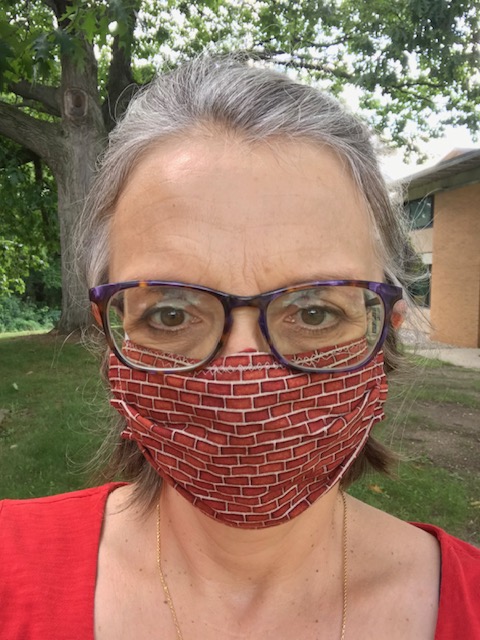
Ready, Changing Course, pt. 3

During the twelve weeks that I was working remotely, my husband and I developed some rhythms to break up the monotony. We walked a mile or so every day at lunch time to get away from our desks, we walked again at the end of the day to get our mail and talk about the events of our day, and we tuned in each night to watch the national and local news.

We’ve watched the numbers of Covid-19 cases continue to rise. We’ve watched reports of businesses closing, of economic stress, of overcrowded hospitals. For weeks, we caught the daily White House Task Force briefings, and then, when the eyes of the nation turned to the deaths of George Floyd, Ahmaud Arbery, Brionna Taylor, and Rayshard Brooks, our eyes turned, too. When we heard the nationwide sound of wailing and protest for the sake of Black lives, we leaned in to listen.

The sound was not new to us. We’d been aware of systemic racial injustice for quite some time — not because we heard it on the national news, but because the trajectory of our lives has given us relationships across racial and socioeconomic lines and we have seen the impact of school inequity, racial profiling in policing, red-lining in real estate, inequities in access to health care and quality food, and racist practices in institutional hiring. We haven’t done much about it, if I am going to be honest, other than bear witness and believe that these systems exist, but we have seen the impact on people that we know and care about.

So when thousands across the country took to the streets carrying signs emblazoned with Black Lives Matter, I Can’t Breathe, and Arrest Brionna’s Killers, we were not horrified. We were not surprised. We were looking for ways to support, ways to ally, ways to join their voices. How could we do otherwise? How can we sit quietly watching repeated senseless acts of violence upon people of color, knowing that these blatant killings and attacks are a symptom of a much more insidious disease. Racism in our country runs deep — it has surreptitiously found its ways into our thought lives as all ideologies do, so that even when we believe ourselves to be free of racism, we make judgements about others because of their language, their skin color, their clothing choices, and their hairstyles. We use people of color as it benefits us (for sports, for entertainment, and to prove ourselves to be non-racist), but we rarely come to their defense or speak up on their behalf.

So right now, when Covid-19 is disproportionately impacting communities of color, specifically because of the impact of inadequate access to healthcare, the wealth and educational gaps that keep people of color in service industries and on the front line, and the pre-existing conditions that disproportionately pervade these communities due to centuries old inequities, when even now people of color have to contend with incidents of injustice like the George Floyd killing, we must be moved to action.

So when my husband and I were standing in the kitchen one night in the middle of the stay at home order and he said, “Are you happy doing what you are doing right now?” I reflexively responded that what I really wanted was to be in a school where I could be part of the dialogue during this time that has potential for unprecedented transformation in the lives of communities of color. I felt ready. After a long journey back to health, I felt we were facing the moment I had been preparing for.

He said, “You’re right. Let’s do it. Toss your name in the hat. Let’s see what happens.”

I said, “Really? Even if it means I have to drive to Detroit?”

“Don’t be bound by geography. Apply broadly, and we’ll cross the next bridge when we get to it.”

Oh. My. Word. You’d have thought he had given me the keys to any car I wanted to drive off the lot! If he thought I was ready, then I knew I actually was ready!

I started combing Indeed and district websites like never before. I applied to positions in Ann Arbor, Ypsilanti, the Detroit metro area, and beyond. And though I’d been doing this to some degree for years, this time was different. Within a couple days of submitting applications early in the morning, on my lunch hour, and after work, I started getting phone calls and emails.

I was different. I felt different — healthy, strong, and impassioned like never before. While I had believed for quite some time that my career was over, I was beginning to believe that I might just have another round in me. Not only that, the landscape was different. Due to Covid-19, many teachers have been choosing to leave the profession, take a sabbatical, or move into a different sector — away from classrooms, particularly classrooms in hot zones like Detroit. While before I may have been passed over because my Master’s degree and years of experience put me a little higher on the salary schedule, suddenly I was a prime candidate. While many teachers were ill-equipped to manage the unavoidable transition from in-person to online learning, I have been using online platforms to work with students for the last several years!

As the interviews started, I could hear the skepticism in the voices of those questioning me. What is your experience with urban schools? Why are you interested in this position? How would you build classroom culture among students who are 99% Black? 99% of whom receive free or reduced lunch?

I could hear the subtext, “I can see, even over this video interview, that you are a middle aged white woman. Are you sure you are up to this? Do you know what you are getting into?” But guess what, kids, I’ve heard these questions before, and I was ready for them.

What I wasn’t ready for was learning that many of the schools I was applying to had been operating with long-term substitute teachers in core subject areas, because they could not find highly qualified teachers and they had to fill slots. I wasn’t ready to learn that many of the students in these schools did not have devices or internet in their homes when the stay-at-home order began. I wasn’t prepared to realize that because 5,000 people had died in Detroit and a disproportionate number of them were Black, chances are high that the students in these schools have experienced loss above and beyond the loss of their routine, the daily contact with teachers and friends, and life as we once knew it. They’ve likely lost people they love.

However, I was excited to learn that several of the agencies I was interviewing with were working to meet the needs of these students. They were delivering devices and personal hot spots — teachers and administrators getting in their own vehicles and driving to student residences across the Detroit metro. Not only that, all of the schools I interviewed with were still providing food to families — five days a week. One school was providing food not only to their own students’ families, but to anyone in the community who pulled into the parking lot to receive it. They were also working hard to secure more devices for the coming school year and making plans (state-mandated) for how to return to school fully in-person, fully online, and a hybrid option that would allow families to choose.

I met dedicated educators who care about kids — inner city kids, kids of color, kids who matter.

And one of these schools made me an offer.

And then another one did.

And I still had my position at Lindamood-Bell.

I had a decision to make, and it wasn’t going to be easy.

But I was ready. More on that next time.

He loves righteousness and justice; the earth is full of the steadfast love of the Lord.

Psalm 33:5

But Wait, There’s More, Changing Course, pt. 2

I have a confession to make: I like to apply for jobs. That might be an understatement. Applying for jobs has become sort of a hobby for me. I scroll through postings on Indeed and search school, district, and university websites to see what’s available, then I “throw my hat in the ring.”

Quite often.

I’ve been doing this for years — maybe close to thirty years, on and off, even when I had my most satisfying job ever at Lutheran North in St. Louis. I would burn off a frustrating day or month by applying at a community college or a public school. Typically nothing comes of all this applying, but once, about a year before I left Lutheran North, when I was quite sick with my first extended autoimmune flare, I applied for a job because I thought a different teaching position at a new school, in the city, closer to home, would lighten my load and be more doable in my weakened state. (I obviously was not thinking very clearly at the time.) I went through the interview process and received an offer but came to my senses and turned it down.

Shortly after that decision, my husband got an offer to take the position he has now, which afforded me an opportunity to take an extended break and begin healing.

When I was taking that break, I took applying for jobs to a whole new level. I did force myself to not apply for anything for the first four months, but then I started applying with abandon.

At first I applied for only part-time or gig work because that is what I felt up to. I applied to shelve books at libraries — can you imagine the bliss for an English teacher? I applied to fold towels at a gym — free membership included! I applied to proofread textbooks — I mean, come on — who’s got a better skill set?

While I cast a wide net, I found myself landing in jobs that have uniquely prepared me for what’s next.

I began by proofreading and tutoring which was like taking a course in grammar and MLA/APA style. I bent over ACT and SAT tests for hours with students, showing them patterns and strategies. I was constantly checking rules and then explaining those rules to students. I read and re-read college essays and coached students through AP literature and composition courses.

Then I worked a summer at Lindamood-Bell which gave me a framework and language for verbalizing my mental movie and teaching kids to do the same. It also helped me understand the nature of reading as two processes and how to spot which area was more difficult for a student.

I moved from there to the college classroom which not only let me apply some of my Lindamood-Bell language and skill to literature and composition courses, it also gave me a more realistic picture of university instruction, particularly through the lens of an adjunct instructor. I’d been romanticizing that role for a while, and I needed the reality check.

I worked two summers at the University of Michigan teaching students of means from all over the world how to write college essays. This experience reminded me that kids are kids are kids — whether they are from Manhattan or Turkey or Detroit. However, it also irked me — why should these kids get intense high-quality instruction in the summer when the ones who really need it don’t have access? Why should those who could easily pay for their college education get an extra leg up when it comes to admissions?

The next three summers I flew, along with thousands of other teachers, to score the AP Literature and Composition exam. I read over a thousand essays in the space of a week, each year, and the evidence of disparity in the United States educational system was palpable. Some students had been so well prepared — their analysis was mature and concise, their evidence vivid, their sentence construction well-developed. Other students wrote letters to whoever who end up reading their exams, “I don’t know what I’m doing. My teacher didn’t prepare me for this. We only read one book all semester.” I was reminded that while students who had excellent experiences in elementary and high school would inevitably go on to excellent college experiences, those from ill-equipped districts would not. Not without some kind of miracle.

I worked for another two and a half years at Lindamood-Bell. I went back when I realized that the adjunct instructor life wasn’t for me. Yes, it got me in the classroom, but unlike teaching in a high school, it didn’t allow me to form the kind of long-term relationships with my students that foster trust, growth, and transformation. Besides, it was a lot of work, and I felt isolated from other instructors who were all staying in their lanes, prepping their courses, grading their papers.

Lindamood-Bell was, once again, an excellent experience. This time around I was developed from an instructor into a leader. I took on more and more responsibility, had a caseload of students, and began mentoring other instructors. I was beginning to remember my skill sets — my ability to build strong rapport with students and families, my capacity to shift instructional gears in the moment based on student needs, and my deep empathy for students who struggle. Yet, it continued to eat at me that the students who were receiving this instruction — targeted one-on-one reading interventions — were mostly students of means whose parents could afford the high price tag of such instruction. What about all the kids whose parents could not? Who was helping them?

A couple of years ago, I was up late at night thinking such thoughts along with I just really miss the classroom! and I applied for a high school English position in Detroit. When I got an email asking me for an interview, I was ecstatic, so when I saw my husband at the end of the day, I blurted out, “I got an interview at a school in Detroit!” He looked at me dumbfounded and said, “What?” which is when it dawned on me that I hadn’t brought him along on the journey. He knew, everyone close to me knew, how I felt about inequity in education, but he didn’t know I had applied or that I was even considering the possibility of going back to the classroom. The days when I was so terribly ill were clear in his mind — he’d seen me lying on the floor writhing in pain, he’d watched all the experiments with treatments and medications, he didn’t want to see me go back there. How, he wondered, did I imagine that I could drive to Detroit every morning, teach a whole day, and then drive back home? Why did I think I wouldn’t end up right back in bed? Didn’t I remember the stacks of paper? the long days? the time on my feet?

Oh, yeah, I thought. He’s right. I probably can’t do that. What was I thinking?

But time passed. I continued to heal. I found myself working 40 hours a week at Lindamood-Bell, and though I got tired, I could feel my health beginning to stabilize, my stamina starting to build.

And then Covid happened.

And then George Floyd was killed by police. Ahmaud Arbery was murdered for running and being black. And Breonna Taylor died in her own home in her own bed. And people across the country walked out of their quarantine homes and said, “Enough is Enough.”

I looked at my husband and said, “I want to be part of this. I belong in the classroom. I belong with kids who have been told they don’t matter. I’m ready. I’m strong. I want to try.”

And he said, “You’re right. Let’s do it. Toss your name in the hat. Let’s see what happens.”

So, I tossed my name in some hats, and I can’t wait to tell you what happened.

The heart of man plans his way, but the Lord establishes his steps.

Proverbs 16:9

Prepared for What’s Next, Changing Course, pt.1

Six years ago this week, I said goodbye to my classroom in St. Louis. I was depleted and sick, and I was certain that I would never have a classroom again.

I’d been struggling with joint pain, systemic inflammation, and fatigue for a year and half — I had difficulty making it through a school day, let alone driving home at night. When I arrived home, I would plunk on the couch or in my bed and accomplish little else until I had to drag myself back to school the next day.

It was a difficult time. Our family had long been experiencing trauma that began with a drastic change in lifestyle caused by a geographical relocation during which my husband went to grad school and I began teaching full time. Our children entered a totally new culture with inadequate support from their parents who were doing their best to fill the demands of the new roles they had assumed. In the years after that major change, our family felt the first hand effects of bullying, social class disparity, eating disorder, depression, anxiety, and sexual assault. All the while, I just kept producing lesson plans, grading papers, and bringing my best to the classroom day after day after day.

Finally my body had had enough. If I wouldn’t sit down of my own free will and assess the damages, mourn the losses, and begin to soothe the hurts, my body would simply crash. And crash it did.

And when, in the midst of that crash, my husband took a new position in Michigan, my medical team suggested that rather than jump right into something else, I should take six months to rest.

Rest. Period.

So I did. I came here to his little house by the river near the end of a beautiful Michigan summer. I took long walks in the park, read books, watched too much TV, put together puzzles, organized and re-organized, and rested.

I didn’t prepare any lessons or grade any papers, but I did begin to write. It was during that period, six years ago, that I began this blog. In the beginning, I wrote every single day as though my life depended on it. In some ways, it did. I had to reacquaint myself with my internal life, had to start hearing my voice, had to start listening to what was happening in my innermost places.

I wrote about my illness, I wrote about coming back to Michigan, I wrote about loss. Many of my posts were a reflection of a renewed commitment to my faith journey, which had also been relegated to survival mode during what I’ve come to call the soldiering years.

It was my writing that started the healing, and through it I chronicled the other steps I began to take — exercise, dietary changes, building community, therapy, and myriad medical and peri-medical approaches like yoga, massage, and homeopathy. I wrote about the ups and the downs — the days when I felt strong and the days that I crashed. I’ve written about victories and grief, sorrows and joy.

And all the while I’ve been healing, and I’ve been preparing for what’s next.

I’ve often told my children and my students that all of life is preparing you for what’s next. Crawling prepares us for walking; school (at least in theory) prepares us for work. Warm-ups prepare you for exercise; practicing scales prepares you to make music. All of life’s experiences are preparing us for the experiences that are yet to come.

Before we moved to St. Louis, I completed my Master’s degree in English education which prepared me to take the position I held at Lutheran North for nine years. Before I met my husband, who had experienced divorce, I had had my own experience as a child of divorce which gave me empathy and prepared me for my role as a stepmother. God has a way of weaving our life experiences together, like a Master teacher, layering lesson upon lesson so that we are always equipped for what comes next.

* * *

It about killed me to wait six months to find a job, and I will confess that at about month four or five, I took a proofreading job for a guy working on his master’s in education. His research resonated with my heart for equity, and I loved speaking into his ideas. The feedback I got from that small job gave me the confidence to promote myself as a private tutor where I supported students who struggled with English — reading, writing, speaking.

Many of these students were English Language Learners or were raised in two-language homes, so they needed support with the nuances of English grammar. In order to meet their needs, I became much stronger in my ability to articulate the rules of sentence composition, the parts of speech, and the role of punctuation. This came in very handy when I found myself teaching a developmental composition course at Concordia University — a part-time gig — where I helped freshmen become more comfortable with writing paragraphs and essays.

After I’d been tutoring for a while, I randomly found a job posting on Craigslist to be a ‘tutor’ at Lindamood-Bell. That ‘tutoring’ position tutored me. It allowed me to start part-time while I continued to experiment with treatments for what was once called psoriatic arthritis but which I now refer to as ‘unspecified autoimmunity’. It gave me opportunities for advancement when I felt (and even when I didn’t feel) that I was ready. It challenged me, it stretched me, and it reminded me of the mettle within me that carried me through nine years of teaching high school juniors and seniors. By meeting with students one-on-one, by utilizing a variety of online materials and platforms, by writing instructional plans, by following instructional design, by mentoring other instructors, and by supporting my colleagues, I have been prepared for what’s next.

While I was tutoring, then teaching at the university, then working at Lindamood-Bell, my health slowly improved. As is chronicled in this blog, I have found the best health I’ve experienced in years through specific dietary choices, daily yoga and walking, weekly visits alternating between chiropractic care and physical therapy, monthly Hellerwork appointments, and twice yearly pain injections. I’m healthy, strong, and ready for what’s next.

This whole past six years has been preparing me for what’s next — first the pause, then the dabbling in tutoring and adjunct instruction, then a full-time job with ever-increasing responsibility.

So what’s next?

Could it be that God is planning to use everything I’ve been learning over this six year period of healing and growth in a position that is focused on educational equity — my long-time passion? Is God that good?

He’s that good; it’s almost as if He’d had it planned the whole time.

I’ll tell you more about that in my next blog post.

“For I know the plans I have for you,” declares the Lord, “plans to prosper you and not to harm you, plans to give you hope and a future.”

Jeremiah 29:11

Finding Common Ground, a re-visit

Kristin's avatarNext Chapter

On Monday, I posted a piece about wearing a face mask during this pandemic. Who could have predicted at the start of this year that such a topic would be polarizing? A simple piece of fabric across the face has come to represent a political position rather than an attempt to stop the spread of disease. We could’ve seen it coming. The piece that follows was written in January of this year, long after many of us had taken our political positions, formed teams, sunk in our heels, and declared war on one another. How long will we allow this go on? How long before we are willing to find some common ground?

January 2020 is the start of a new year and a new decade. It is also a leap year, and, in case you hadn’t noticed, an election year.

It’s been pretty hard not to notice, what with…

View original post 1,142 more words

Coronavirus Diary 15: Wearing a Mask

I’ve been back in the office for two weeks now. I’d been working from my office in our little house by the river for almost three months when our company determined that we should be back in our physical space, so I packed up all my materials — laptop, auxiliary screen, student files, and other materials, and lugged them to my car, drove them across town, hauled them up two flights of stairs, and started to acclimate.

The first couple of days were especially stressful. I don’t know if it was the daily screening paperwork that I had to fill out every morning, the taking of my temperature, the putting away of all those materials (which I still haven’t finished), the spontaneously self-generating list of regular tasks that didn’t pause for a second as I learned all the new protocols, or the fact that I now have to wear a mask.

Of course I’ve been wearing a mask for months. It started in the early days when the only time I left our home was to go to the grocery store. I made a few masks following a simple pattern and using some leftover fabric I had here at home. Our church was making them for a local hospital, and since I have a sewing machine and we suddenly had lots of time on our hands, I began to mass produce them along with a small group of women.

On my weekly treks out, I not only donned a mask, but I wore latex gloves. I carefully procured my groceries, following arrows on the floor and being careful to keep six feet away from others. Back in my car, I would remove the mask and gloves, sanitize my hands, and then drive home where my husband would receive and wash all the items I purchased while I stripped and headed straight to the shower. In fact, we’ve kept this routine all these months. We’ve developed quite a system.

We’ve adopted these behaviors to stay safe — to keep ourselves from getting sick.

In those early days, I probably wore the mask for a grand total of 3-5 hours per week, but now that I’m back in the office, I am supposed to wear it for 8 hours a day!

I get it. Mask wearing is very important. The data shows us that our chances of spreading or contracting Covid-19 are greatly reduced by social distancing and wearing a mask.

So, I’m wearing one, but let me just say that it is challenging!

Probably the biggest reason I find face mask wearing challenging at work is that it covers my face and most of my facial expressions. I am an educator, and right now I see most of my students online. Working with students virtually has its own challenges, not least of which is the ability to communicate clearly. Since all the students can see of me is from the torso up, I am continually checking to be sure that I am centered on the screen, that my student can hear me clearly, and that I am allowing appropriate time to hear his or her response. I rely heavily on facial expression and hand gestures such as “thumbs up” and “high five” to communicate encouragement. Now that I am in the center and required to wear a mask, I lose my smile and the student’s ability to use the visual support of watching my mouth to understand what I am saying. (You’d be surprised how much we rely on this.)

My employer has done a pretty decent job of separating staff members from one another. I am sharing a room with one coworker, but we have a divider between our work spaces and we give each other a wide berth when we are coming and going. Additionally, we each wear a mask for most of the day. However, we have both determined that we will remove our masks when working with our most severe/youngest students for whom the mask seems a distraction or hindrance to instruction.

I am fine with this because my coworker and I have a strong relationship and we are both communicating about the ways in which we are continuing to limit our exposure to others outside of work — avoiding social gatherings, and wearing our masks when in public spaces such as grocery stores, doctor appointments and the like. We trust one another to act responsibly and out of concern for one another, so we feel comfortable several times a day removing our masks to work with these students.

I also dash outside once in the morning, once in the afternoon, and over my lunch hour to take off the mask and breathe some fresh air because I am just tired of wearing it! It fogs up my glasses, makes me feel hot, and smashes my hairstyle.

Wearing a face mask is annoying, but I am going to keep wearing one.

Why? Because in my county 37 new cases were reported yesterday. Michigan’s seven-day average is 508. The United States’ rate of infection and cumulative death count still far outpaces any country, even adjusted for population, and though people are still arguing about whether Covid-19 can be transmitted by people who are asymptomatic (or pre-symptomatic), each day we learn of more people who were infected because they gathered in large groups and chose not to wear masks.

Over 135,000 people have died in United States in the last few months, and we have been given a few simple instructions for diminishing further spread and death: 1) We should wash our hands, 2) we should stay away from people, and 3) we should wear a mask.

It’s really not a big ask.

Is it annoying? Yes.

Would I prefer not to? Yes.

But am I willing to take one for the team and do my best to stop the further spread of the coronavirus while thousands of medical staff are doing their best to keep people alive while wearing not only a mask, but often a shield, and all manner of PPE? while thousands of researchers, clad in hazmat suits, are working around the clock to find a vaccine, a treatment, a cure? Yes.

I’m willing to be a little annoyed — a little uncomfortable — for the sake of keeping myself and others safe. And what if wearing a mask turns out to be ineffective? I won’t mind, because at the very least, my choice to wear a mask signals to those around me that I am willing to care for them, to keep any possible infection to myself, and to join a united effort against this pandemic.

I think that’s worth something.

If it is possible, as far as it depends on you, live at peace with everyone.

Romans 12:18

Blessed at the DMV, a re-visit

Kristin's avatarNext Chapter

On Monday I wrote about privilege; this post from December 2014 — way back near the start of this chapter — talks about privilege, too. Throughout my life I have considered myself to be blessed — to have abundance because of the generosity of God. I will render to God the praise that is God’s, but I will also acknowledge that I have privilege because I am white and Christian in a country that has historically benefitted white Christian people at the expense of others.

I am writing late today, and as I sit at my desk, the sun is setting over the river. I can see it right out my window. It. is. gorgeous.

Today was a pretty bleak day weather-wise — cold and gray –and the task on the to-do list was also pretty bleak: a trip to the Secretary of State’s office — the DMV.

If…

View original post 589 more words

Coronavirus Diary 14: Privilege

It’s a beautiful Michigan summer morning, and as I sit behind our home with a view of the woods — thick with bunnies and squirrels and deer and such — I can almost ignore the fact that we’re in the middle of a pandemic, that thousands continue to protest racial violence and inequity across the nation.

I made myself a cup of tea and walked right outside, mindless of the fact that over 2 million in our nation are incarcerated — over 500,000 of whom who have not yet been convicted but are merely awaiting trial (Prison Policy Initiative) — and can’t escape their cells, let alone take a leisurely stroll out the door to enjoy some fresh air.

Back here, next to my lush garden from which I pick lettuce and kale each evening for my dinner salad, I can forget that 1 in 5 households with children aged 12 and under are experiencing food insecurity right now (Brookings).

Sitting in my air conditioned home by the river in the middle of a summer heat wave, I can forget that latest estimates (prior to Covid-19) suggest over 8,000 people were homeless in Michigan alone (United States Interagency Council on Homelessness) with well over half a million nation-wide.

This is what privilege looks like: me, sitting in my backyard on a Sunday morning, having the time to type words on my MacBook Air, listening to the birds, admiring my garden, virtually immune to harm.

Privilege looks like a refrigerator and freezer full of more food than my husband and I can eat in a week, a stockpile of pantry items, and enough toilet paper for the next two months.

Privilege looks like both of us having jobs that we enjoy doing, never having missed a day due to the pandemic, never having missed a paycheck.

Privilege looks like closets and drawers full of clothing and the ability to donate the items we are tired of, that no longer fit, that have a stain we can’t remove, that we never liked in the first place.

Privilege looks like discussions over whether or not we want to run out and pick up a gas grill one day this week, if it’s time we purchased a new car, if we want to get dinner from a restaurant or make it here at home.

Privilege looks like both of us having all the medications we need, the insurance to cover the majority of our medical costs, and high quality practitioners who we are able to see often the same day we call.

Privilege looks like watching Hamilton on Disney + on Friday night, scrolling through home improvement shows on TLC on Saturday afternoon, and bingeing on Netflix on Sunday night.

Privilege looks like a quick stop at Whole Foods on the way home from church, a dash into the library to grab the books I reserved online, and a Zoom call with the family.

Why do I have all of this privilege? Why am I so fortunate? I haven’t made all the right choices. I haven’t utilized all of my resources. I haven’t done my best and worked my hardest.

Sure, I went to school. I got good grades. I’ve pursued jobs in my field. I’ve been a mostly honest, law-abiding citizen. However, I have broken speeding laws, I’ve lied to my friends, I’ve parked in no parking zones, I’ve used work time for personal business, I’ve yelled at my kids and spanked them too hard. I’ve shot off my mouth more times than I care to admit — sometimes at authority, my bosses, my coworkers. And yet, I have a pretty comfortable life.

My missteps have not cost me my privilege. The system works for me. I have the presumption of innocence. I have the benefit of the doubt.

I’m a middle-aged white woman in America, and people assume things about me — that I can be trusted, that I’m reasonable, that I’m responsible.

Not everyone gets that. That’s why it’s a privilege.

And because I have privilege, I have a responsibility to speak up for those who do not.

And not just speak up, but act up — write blogs, upset family and friends with my questions and comments, step into awkward work situations, give money to those who need it, and protest. If I can do more, if my privilege affords me the opportunity to be an agent of change, a worker for justice, I’ve got to do that, too.

Why? Because it’s the right thing to do. And further, it doesn’t cost me my privilege. It costs some time, some comfort, and likely some money, but it doesn’t take away my ability to enjoy my backyard, to move freely in society, to live and breathe without fear that my life will be unexpectedly cut short due to racial violence.

Rather, speaking up — and acting up — for the sake of equity, for the sake of someone else having an opportunity to sit in the cool breeze of a summer morning, sipping tea and watching bunnies frolic in the grass, for the sake of another human being feeding her children and expecting that they will all live into adulthood, that — that just might make me more fully human.

How can I do otherwise?

Speak up for those who cannot speak for themselves,

    for the rights of all who are destitute.

Proverbs 31:8

Coronavirus Diary #13: Vantage Point

When I was teaching high school composition, I used to have my students watch the movie Vantage Point (available on Amazon or YouTube), which tells the story of an assassination attempt on the US President as seen from the various vantage points of different characters. The goal of watching this film, which I assigned over Christmas break before the start of the semester, was to get my students thinking about point of view and the reliability of narration. I wanted them to see that depending on where you are standing, the story might look very different.

And isn’t that true right now?

I spoke to my mother this week. She lives in small town Michigan, very far removed from the cities where Covid-19 has run most rampantly. Her county has had 82 total cases and 13 deaths. She is unfamiliar with the impact of systemic racism; her county is 92% white and she has no reason to believe that systemic racism has impacted the few people of color that she knows. Because it’s tucked back from the highway running through town, she rarely considers the Level IV correctional facility which houses over 1000 inmates, most of whom are likely people of color. From her vantage point, not much in life has changed. She feels free to go out of her house to shop in the midst of a global pandemic, even if she does have leukemia and is 78 years old. She’s wearing a mask, after all, well, except for that one time when she went to a graduation open house when she didn’t wear a mask — because, well, nobody was.

My daughter called yesterday. She lives on The Common in Boston, a city where Covid has infected over 13,000 people and claimed the lives of over 900. She woke up yesterday to the sound of police putting up barricades on the sidewalk outside her window. As the day progressed, Black Lives Matter protestors assembled behind the barricades on one side of the street; Blue Lives Matter protestors with the support of white supremacists gathered on the other. In the middle of these two groups police officers in riot gear patrolled back and forth. She called because she was riled up. She had left her building through the back entrance to protect herself from a potential clash of protestors, wearing a mask to protect herself from Covid. From her vantage point, life is full of danger and opportunity. She sees her position of privilege and feels compelled to speak up, speak out, and engage in a dialogue to impact change. She grew up mostly in spaces occupied by people of diverse backgrounds. Her partner is a person of color. She belongs to a church that is made up of people from many nations, many backgrounds, many socioeconomic levels. She works for a government agency that is committed to equity for all citizens of Massachusetts. She is hyper-aware of the realities around her.

Over the past week, I have been preparing to return to the office where I was working before I started to quarantine at the end of March. My company has done extensive work to prepare our environment to meet the requirements of re-entry — creating social distance, requiring and providing masks, ensuring that extra cleaning will be done, and limiting the number of students who will be in the center at any given time. The parents of some of our students really want them to be able to come into the center — they believe instruction will be more effective there. From their vantage point, opening our center is a great idea. However, many of the staff, who have been working remotely for the last three months, sheltering in place, limiting their exposure to others, and watching the trends of communities who have opened ahead of us, do not want to go back to the center. They believe it is unsafe, and they want the opportunity to continue to work remotely, since we’ve been doing so effectively for three months now with great success. From their vantage point, the risk of going back into physical contact is not warranted. They are wiling to lose their jobs rather than take that risk.

Meanwhile, our country is experiencing the highest unemployment rate since the Great Depression of the 1920s. Many new college grads are spending their days alternating between applying for jobs and worrying about how they are going to pay their bills. They are taking jobs that have nothing to do with their degrees just to get a paycheck coming in. They are willing to take risks to work in environments that seem unsafe because they need money — that one little stimulus check way back in April has been gone for weeks, if they received it in the first place. From their vantage point, any work is better than no work.

Families are sitting in their cars in long lines to pick up free food because their money is gone. They worry they’ll lose their homes or that they will get Covid and need medical care that they can no longer afford because they lost their health care along with their jobs.

And each day we hear another story of a family and a community who have senselessly lost someone they love due to racial violence. We’ve heard about George Floyd, Ahmaud Arbery, and Breonna Taylor, but there have been many others. It’s not bad enough that these families are trying to manage the physical and financial ramifications of a pandemic, they are also grieving the loss of lives cut short for no good reason.

Most of us cannot imagine processing that kind of trauma on top of already overwhelming stress of all the change that we’ve undergone because of this pandemic. And we likely won’t have to. That kind of shit doesn’t happen in our communities, in our families. And we have this sense that we are invincibile. untouchable.

Yesterday, my daughter was out running in Boston and had her mask down around her neck until she saw someone approaching. At that point, she put her mask on out of respect for the other person, to reduce the risk of unknowingly contaminating him. He saw her put on her mask — he wasn’t wearing one — and he shouted at her angrily, “Really? Really?” as though he was offended by her gesture. From his vantage point, my daughter was protecting herself from him.

This morning in his rural church, my father-in-law who is 80+, was wearing a mask. A fellow congregant — without a mask — approached him and said, “Who are you protecting yourself from?” It was an indictment — didn’t my father-in-law trust the people he went to church with to be free of disease? From that man’s vantage point, my father-in-law’s mask was ridiculous, unnecessary, an affront.

We have difficulty understanding the the actions and words of those who are experiencing life right now from a different vantage point. We don’t understand why a septuagenarian with cancer would go to a social event without a mask, what would cause a white man to shout at a complete stranger for merely pulling on a mask, or why a person with a job would refuse to go to work while countless others are desperately looking for employment.

We don’t understand the kind of history and indoctrination that would lead someone to take the life of another simply because of the color of their skin or what it must feel like to lose everything that you have. We only see the story from our own vantage point.

Unless, unless, we are willing to look at the events from a different point of view. What might happen if we set down our bags full of belief and assumption and took one step to the left or the right and tried to view the world from a different vantage point? Might we be able to understand a person’s desire to move freely inside the community she has known for decades? Might we feel the fear and outrage of someone who can’t comprehend why centuries-long misconceptions about race can’t be finally put away? Might we see the horror of watching a loved one have the oxygen pressed out of him? Might we appreciate both the need for work and the need to feel safe going to work?

Life is very complex. When over 300 million people live inside one country, they can’t all be standing on the same piece of ground — they won’t all have the same vantage point. If we want to come together and build a more perfect union, we’re going to have to walk around a little bit and see how others view things. We’ll have to share our stories and blend them into a more reliable narrative.

Aim for restoration, comfort one another, agree with one another, live in peace.

I Corinthians 13:11