Supplied, Supported, and [almost] Ready

Click the arrow to listen to me read this post.

T minus eight days until the start of school and I’m like a 10 year old again — so excited!

Sure, Wayne County just announced that due to the recent uptick in Covid-19 cases, all teachers and students in the district will be fully masked throughout the school day.

Yes, a torrential downpour caused a flood in our school gym on Friday.

And, of course, we’re still looking to hire two staff members.

But am I bothered? No! I feel like the little girl whose mom just took her to the mall and bought her a first day of school outfit.

Why? Because I can hear you all cheering me on!

A few weeks ago, at the end of my post about Critical Race Theory, I shared that I had a wish list for my classroom. Several readers asked me to share it, and I have received almost everything on that list! I did not anticipate how much impact this would have on me emotionally! I feel buoyed your thoughtfulness and generosity!

For example, a couple of Lutheran educators from St. Louis, MO, who I have never met before, said they used to teach in Detroit and still have hearts for the kids in that community. They sent a check so that I could purchase 100 composition books!

Stacks of composition books and other supplies.

Each day, my students will spend 10 minutes of their 100 minute block writing in these composition books. I will put a prompt on the board and provide 10 minutes of silence during which I, too, will write. I will then share what I have written, to model, and then allow anyone else to share what they have written. This exercise, which takes a total of 20 precious minutes of class time, is invaluable. It not only builds writing muscle — the ability to put pen to paper for 10 solid minutes — it also exercises the students’ writing voices and, more importantly, cultivates community. When we share our thoughts and our stories with one another, we see one another’s humanity, and we begin to care for one another. This is critical in a classroom of developing writers who will have to share their writing often.

Another item on my wish list was highlighters. I asked for 90 sets of three colors — pink/blue/yellow, or green/orange/yellow. A friend texted that she wanted to purchase all of them, and that day, Amazon delivered a huge box to my door!

Bundles of highlighters.

These highlighters will be used in a couple of ways. For grammar instruction, I will have my students locate nouns, verbs, adjectives, or adverbs, for example, in their journals. They will highlight the word, label it, write a definition in the margin, then add several more examples. We will also use the highlighters to identify sentences, fragments, and run-ons. Later, when we are writing paragraphs and essays, students will identify their thesis and topic sentences in blue/green, their examples in pink/orange, and their explanation/elaboration in yellow.

Another item I asked for was individually wrapped snacks because teenagers are always hungry. They stop by before, during, and after school asking, “Mrs. Rathje, you got anything to eat?” I have always tried to keep something edible in my classroom because if you feed them, they will come. Seeing my request, a friend and a family member each dropped off Costco-sized boxes of granola bars and multi-packs of popcorn. A few other friends sent cash which will help me stay supplied.

My stash of granola bars.

I am not only stocked on snacks, but I was also able to use some of the cash that was donated to purchase large variety packs of candy which I will use as rewards/incentives for completing assignments, arriving on time, and quickly resolving conflict. I also always make sure I have plenty of chocolate to encourage other teachers in the building.

I hauled all this stuff to my classroom including several prizes donated by a family member — McDonald’s gift cards, some pop sockets, chapsticks, and the like — and found designated spaces to store it all. I was feeling pretty good about my supplies, and then, when I got home on Friday, I found a large package on my front porch.

A high school friend, who I don’t think I’ve seen in thirty-seven years, had said she was sending a few things; when I opened the box and laid its contents out on the office floor, I was overwhelmed.

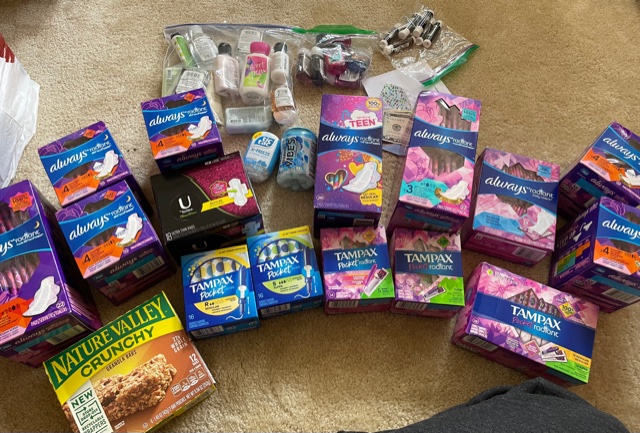
A huge supply of feminine hygiene products.

She had sent boxes and boxes of feminine hygiene products, dozens of trial sized lotions and hand sanitizers, several chapsticks, packages of gum, mints, and granola bars, and some cash, in case I needed anything else. She said she “had some things sitting around just waiting to be used” and that “kids deserve to have the necessities of life…whether their parents can afford it or not.”

They sure do.

This is the family of God, my friends. People from across the country — Wisconsin, Missouri, Minnesota, and Michigan — giving what they have to meet a need. My classroom is now more than well-stocked and ready to receive a group of seniors that haven’t seen the inside of a classroom since March of 2020. As they arrive, I want them to know that I, that we, have been thinking about them, that we have prepared for them, and that we are anticipating their needs before they even walk in the room.

You have helped me do that — you have partnered with me to show my students that they are valuable.

They don’t always get that message, to be sure. And in the last eighteen months, they have lived through more than their fair share of challenges. I know they are going to have some anxiety about coming back after such a long absence, so I’ve created a ‘chill’ spot at one end of my room.

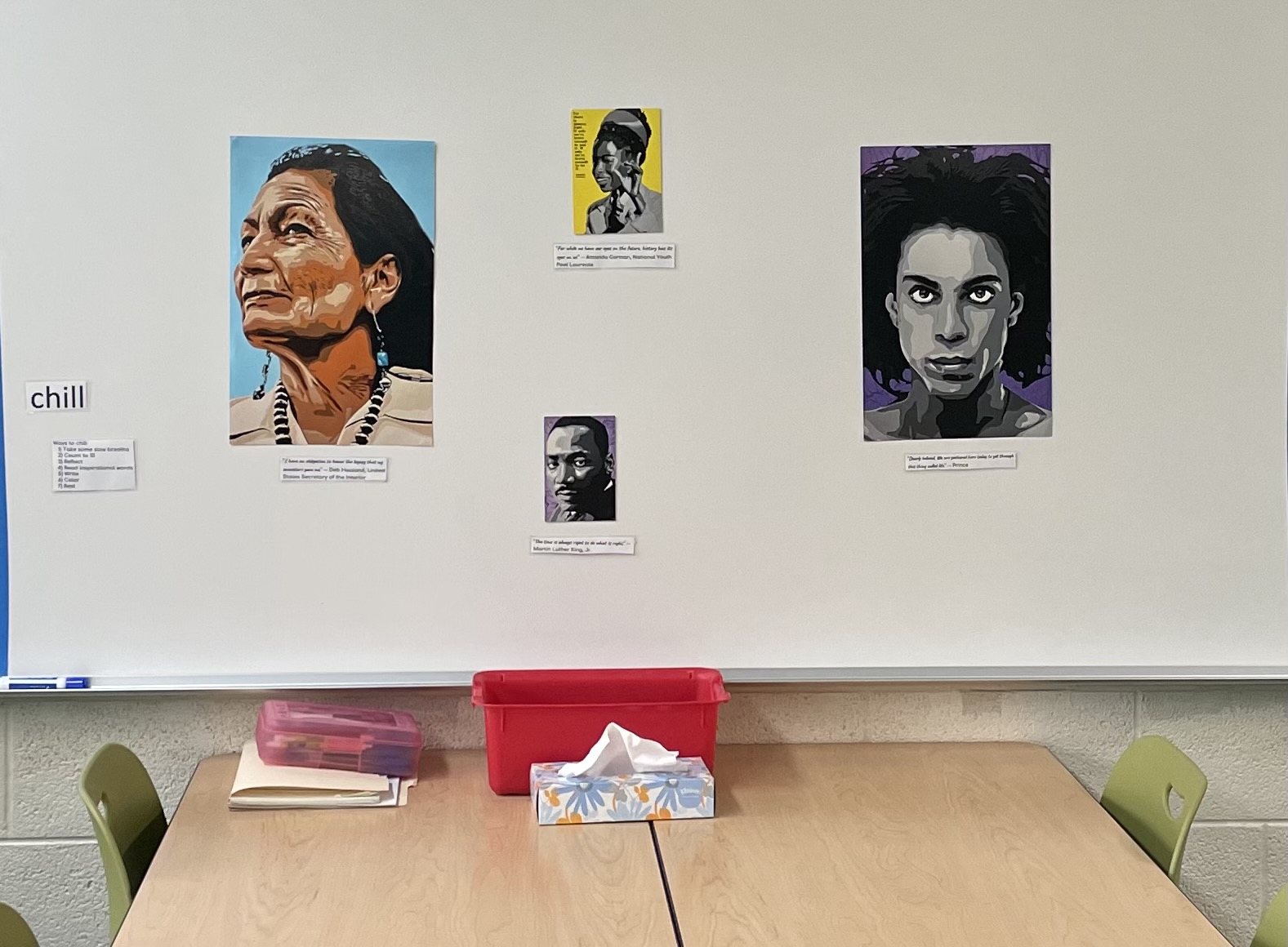
My chill spot.

The chill spot is a place my students can move to if they are feeling anxious, angry, or upset in any way. It has tissue, paper, pens, crayons and colored pencils, coloring sheets, beautiful artwork from @mrjohnsonpaints, and some recommendations for how to regain calm. This idea is not mine; most of the teachers in my building have a chill spot. We operate under the assumption that all of our students have experienced trauma — now more than ever — so we are preparing in advance to make sure they can feel safe.

Providing for student needs — food, safety, school supplies — lays the foundation for learning. Job one is showing students that they matter, and as you have cheered me along, not only with gifts and donations, but also with so many words of encouragement and likes and shares of my blog post, you have agreed with me that they do.

My students matter, and this work matters.

They may come in grumbling and complaining. Why can’t we just stay virtual? Why is this classroom so hot? Why do I have to write in this stupid notebook? They are teenagers after all, and teenagers always grumble during change.

But I’m excited! I’ll put on my first day of school outfit and bounce into my classroom next week, ready to receive them, whether they are grumbling or not.

My enthusiasm may need to carry us for a while, so thanks for cheering me on. I didn’t know how much I need you.

…the Father knows what you need before you ask Him.

Matthew 6:8

P.S. If you know a teacher, send them a little extra love at any time, but especially during that first week of class this year. (A gift card to Starbucks or Target, some chocolate, or some fresh flowers just might make the difference.)

Why should white people care about racism?

Click the arrow to listen to me read this post.

As I’ve written about racism and posted about it on social media, I have been reminded that not all people believe that racism even exists.

You may be shaking your head, saying: Come on, Kristin! Why do you keep beating this drum! I’m not racist. Racism is a thing of the past. All this talk just serves to further divide us.

I disagree, and I think our denial of racism is further evidence of its insidious nature — proof that it is way beyond individual acts of prejudice to being deeply rooted in our collective ideology.

Over the past couple of weeks in this space, I have explored the use of Critical Race Theory in the classroom. Some may think I use this framework principally because I teach Black students, but that’s not true. I would use CRT and other antiracist strategies in any classroom — even if my students were all white.

Why? Because racism impacts all of us — most dramatically and tangibly people of color, to be sure, but no less tragically white people.

Think about it. Way back when European explorers came to this continent, they saw its beauty and expansiveness and determined to have it for themselves. Native Americans, of course, had been inhabiting this land for quite some time, and surely some colonists befriended them and sought to share the land peacefully. So, what happened? How did Native Americans end up being called ‘savages’? How did it happen that as this land was being ‘settled’, countless Native Americans were killed or displaced?

Do we ask these questions in school? Or do we take at face value the fact that colonists came to the continent, met the Indians, had Thanksgiving, and, yeah, there were a few massacres here and there, but ultimately the white people got the land and lived happily ever after?

Do we assume that the white people made out pretty well? Certainly, they got what they wanted. Whatever actions they might have taken toward the Native Americans — assimilation, displacement, or the decimation of an entire people group — had little negative impact on the white people, right? Or did they? Did the ‘success’ they found feed the belief among white people that if we want something and fight hard for it, it can be ours? Isn’t this the American Dream? Don’t we all aspire to dream big and succeed, just like the early explorers did? Does it matter if our success comes at someone else’s expense? Isn’t it a dog-eat-dog world, survival of the fittest and all that?

Are we proud of this characteristic of the American ethos? Do we want to perpetuate it further?

What if in teaching this history to American students we asked some questions? What if we sat at a table, map spread wide, and examined what happened? What were the Native Americans doing? What were the white people doing? Who had the right to be on the land? Who won? Who lost?

A question-based strategy such as this, which is informed by Critical Race Theory, encourages learners to ask questions that enable them to see a fuller picture of the story, from more than one perspective. In asking questions, students become critical thinkers. As they ask questions, they find they have more questions: What happened to the Native Americans next? What impact did the colonists’ actions have on their lives? What long-term effects did these events have on the Native American people as a whole?

In asking such questions, students might discover that colonization had a dramatic impact on Native Americans. They might discover the practices connected to Native American residential schools, legislation impacting Native American tribes, and statistics around addiction and suicide among Native American people. They might connect some dots and realize that when we ‘fight for what we want’ and ‘win’, almost without exception, someone loses.

They might develop empathy.

Are there other parts of history where racism played a role? Let’s consider slavery, the practice of kidnapping, buying, selling, beating, and exacting labor from another human. From as early as 1619, Black humans were brought on overcrowded ships by slave traders to the shores of this continent.

More information on slave ships here.

What happened next? Weren’t these ships unloaded at American docks where plantation owners bought and sold humans like cattle? Weren’t these humans forced to work to ensure the financial prosperity of their owners? Weren’t laws enacted to protect the slave owners and to allow them to use any means necessary to force these people to work for no money while living in uninhabitable conditions with little food, clothing, or health care? Weren’t most slave owners white? Weren’t most slaves Black?

Who benefitted from slavery? Who suffered? While Black people worked hard and endured abuse, were they the only ones who were adversely affected by slavery? Or did white people — slave holders, people of the community, citizens of our country — ‘learn’ through slavery that they were superior, that Black lives were expendable, that their own wealth was more important than human rights, that in order to keep and maintain their wealth, they would have to create systems and laws that safeguarded their practices, even if those practices were inhumane?

It can be hard to face the answers to these questions, unless we discover that things truly have changed. And have they?

How would you describe the experience of Black people today? Where do we see them working? Are they gaining wealth or do they continue to work hard to support the wealth of white people? In what ways has the experience of Black people changed in America? What evidence do you find for a shift in the beliefs and attitudes of white people? Do you see an acknowledgment of the impact of racism and slavery on our collective culture?

This Socratic questioning provides students an opportunity to look at the information that is presented and to interrogate it. When we ask questions, when we look for answers, we learn.

In our quest to discover how racism has shaped the American experience, we must start in the beginning with the treatment of Native Americans and Blacks imported through the slave trade, but we must then trace racism’s path through educational practices — what education has been provided for white children, Black children, Native American children, Latino children? Has any group of people received better or worse schooling simply because of their race?

We must continue to follow racism through voting practices — who first held the right to vote? When did others get to participate in elections? Are all groups of people equally able to participate in the electoral process? If not, how can it become more equitable?

We can continue our quest by exploring health care, law enforcement, the prison system, athletics, and higher education, and we can keep on going from there.

What happens when we encourage our students to interrogate both our history and our current practices, to ask: Who is benefitting? Who is hurting? Whose life is positively impacted by this action? Is anyone, intentionally or unintentionally, made to pay a price so that someone else can ‘win’?

When schools allow students to ask these types of questions, particularly about racism in our country, we will begin to see an unveiling of this sin that we often try to hide and deny. Saying that racism does not exist or that it is a thing of the past not only perpetuates the sin against people of color, it also further advances the sins of pride, selfishness, greed, and apathy among people who are white. Refusing to have compassion for all of humanity denies our own humanity.

Discussing race does not divide us — the division is already there. The only way toward healing is to expose the infection, see its pervasiveness, and get on a path toward healing. This work cannot be done in Black communities alone. White people must also acknowledge the impact of racism, the crime it continues to be against humanity, and work to expose it in all its forms and eradicate it. And the only path toward such acknowledgement is a willingness to ask some questions.

For what does it profit a man to gain the whole world and forfeit his soul?

Mark 8:36

Informed Instruction

Across the country and around the world, countless teachers and students are beginning to return to the classroom. After eighteen months of pandemic, some will be together in the flesh for the first time.

If you listen closely, you can hear the hum of anxiety.

In addition to the usual back-to-school jitters, teachers and students alike are also shouldering Covid 19 fears — do we have to wear a mask? will I get sick? will we return to remote learning? what will it be like to be in the building again? how can I be sure I will be safe?

The seniors who will walk into my classroom in just a few weeks have not been in a classroom since March of 2020 — their sophomore year. They have been zooming into class (or not) from their homes, their cars, and their workplaces for the last eighteen months. Many have rolled over in bed, still wearing pajamas, and logged into class; others haven’t joined online class at all.

So what will I do in the next few weeks to prepare for them — to create a space where they feel comfortable re-entering, where they feel safe, seen, and loved? How will I create a culture inside my classroom where students can trust, engage, and learn?

It’s gonna be a little trickier than usual, to be sure. All of my students live in Detroit, which has been ravaged by Covid. They have all experienced loss — loved ones, friends, a beloved teacher — and most have suffered economically, physically, socially, and emotionally because of Covid. I have to take this into consideration as I prepare for them. Also, 99% of my students are Black, Latino, or Middle Eastern. While the pandemic has changed life for all of us, the impact on communities of color has been disproportionately worse. I have to acknowledge that as I think about how I will create space for grief, for transition, and for learning.

I also have to acknowledge that the impact of racism is an every day reality for my students — their lived experiences are the result of systemic racism. I have to see and admit that my students have had less access to fresh foods, health care, high quality education, and safety. I have to believe that they have been pulled over by the police, followed in a store, or turned down for a job because of their skin color. I have to understand that because of their lived experience, they may not show up in my classroom “ready to learn”.

It’s not because they are less intelligent, or because they are “bad kids”; it’s because many have experienced poverty and most have experienced trauma. In fact, we recognize at our school that all of our students have likely experienced trauma — even before Covid — in the form of homelessness, neglect, abuse, or violence. Knowing this, our whole educational framework revolves around a model of trauma-informed instruction. And, since we know that much of this trauma is rooted in racism or the impact of systemic racism on our community, we also hold as a core value that we are anti-racist. We cannot fully care for our students who have been traumatized by racism if we do not actively work to dismantle racist systems that perpetuate this harm.

Our director of instruction says we need to ask ourselves in each moment, “am I replicating oppression or am I tearing it down?”

All of this, my friends, fits inside the framework of Critical Race Theory. The fact that I believe that my students have experienced loss at a higher rate than white kids, that they are more likely to experience poverty and trauma, that they are more likely to have an incarcerated family member, that they need a different educational approach because of their lived experience, all fits inside the CRT framework.

And how does this paradigm impact my instruction? Immeasurably.

First, the design of my classroom and the structure of our time together is based on the assumption that my students need to feel safe and supported. Our school uses a model called The No-Nonsense Nurturer so that in every classroom, students experience the same expectations, the same language, the same reinforcement as they learn how to be learners. My students can expect when they walk in my classroom, or any classroom in the building, that they will be given clear directions and held to high expectations. The model provides acknowledgement, praise, and rewards for those who are on track and redirection, one-on-one remediation, and further support for those who need it to get on track. Our teachers believe it is critically important that our students opt in to learning, that they earn a high school education, and that they go on to post-secondary education, the military, or work after high school. We believe it is literally a matter of life and death. We already know the trajectory for students of color who do not complete high school, get a job, or go to college — we already know that it doesn’t end well.

We can either replicate the experiences they have had in the past or we can try a different, research-informed practice.

I expect that most of my first week or two will be spent building culture and systems. After eighteen months outside of the classroom, our students (and our teachers) are going to need some time to re-acclimate to the ways of being in the classroom. How do we manage sitting next to each other? How do we function without watching our phones for notifications? How do we contribute to classroom conversations? How do we collaborate? How do we celebrate one another?

And, as we learn those ways of being together, I will slowly begin to integrate content — common core curriculum — using strategies that have high impact for my students. With this group of students, I will start almost immediately with journal writing which is useful not only for building writing muscle but also for developing student voice. Throughout the year, we will incorporate grammar instruction, reading, discussion, and more writing. As I get to know my students and their strengths and weaknesses, I will tailor instruction to best prepare them for what’s next — college, trade school, military, or a career.

I will be supported by a team — our college access counselor and other counseling staff — who will help our students identify their long term goals and explore ways of achieving those goals. Most of our learners, if they so choose, will be first-generation college students, so they need extra supports, and we provide them.

We meet our students where they are, support them as they envision where they might go, and then provide them with the tools they need to take steps toward that goal.

Why?

How can we do otherwise? If we can see with our two eyes that our students need love, support, and a path forward, how can we do anything else than use all the tools we have at our disposal to provide these things? If we know — and friends, we do know — that inequity is a fact in our experience as Americans, that people of color have long been feared, subjugated, controlled, and misrepresented, than it is unconscionable to do anything less than our very best to change this course.

We have replicated oppression in the past — knowingly or unknowingly — we must refuse to do so moving forward.

Our students are counting us. Their very lives depend on those who will stand up and insist on a new way.

The Lord God has told us what is right and what He demands: “See that justice is done, let mercy be your first concern, and humbly obey your God.”

Micah 6:8, Contemporary English Version

*If you would like to partner with me in this work, please request my wish list.

**If you’d like to read more about educational disparity, check out a post I wrote last year: “What World Are We Living In?”

***To learn more about my school, check out this video.

Critical Race Theory in my Classroom

Click the arrow to hear me read this post.

I was minding my own business, enjoying a summer full of family visits, sleeping in, and reading indiscriminately when not once, not twice, but several times, the words critical race theory or CRT were set in front of me.

How do I as a teacher feel about critical race theory?

or, more recently, If you are a teacher and believe in CRT, then you really need to stop teaching period.

To be honest, I was at first a little baffled. I was unsurprisingly aware of critical race theory because of my background and work as a teacher, but I was unsure why people outside the classroom were talking about it, and even more confused about why were they upset about it.

It didn’t take me long to figure out that Fox news has spent a sizable amount of time (and money) talking about CRT — one source says Fox has mentioned CRT 1300 times since March. What’s their point? Why do they care so much?

You may be asking yourself, “What is critical race theory, anyway?”

I’m glad you asked.

Critical Race Theory “is a theoretical and interpretive mode that examines the appearance of race and racism across dominant cultural modes of expression. In adopting this approach, CRT scholars attempt to understand how victims of systemic racism are affected by cultural perceptions of race and how they are able to represent themselves to counter prejudice” (Purdue Owl).

In simpler terms, CRT is a viewpoint or lens which acknowledges that racism exists not only in personal acts of prejudice but in established systems; it seeks to identify the impact of racism and to do something about it. The work of CRT is done in several contexts — education, sociology, the legal system, etc. Most familiar to me, as a teacher of students, most of whom are people of color, is its use in rhetorical analysis — examining texts such as To Kill a Mockingbird to see how racism impacted not only the action of the story but the telling of the story. In other words, it not only points out that the unjust conviction of Tom Robinson in TKAM was an outgrowth of the racist beliefs of the fictional community of Maycomb, Alabama, but it also examines the fact that the author, Harper Lee, was a wealthy white woman and questions the impact of her race and class on the telling of the story.

The story, you may remember, is told through the eyes of a young white girl, Scout, who learns that “You never really understand a person until you consider things from his point of view… until you climb in his skin and walk around in it.” Critical Race Theory might ask if Harper Lee, Scout, or any white person for that matter, is actually able to do that — to climb into the skin belonging to a person of color and actually experience what they experience.

The main reason why we can’t, CRT would suggest, is because white people are not impacted by the racism that is baked into many systems within which we must function — education, real estate, employment, law and public policy, and the like. Scout can’t understand what Tom Robinson experienced through the legal system because she would’ve been presumed innocent until proven guilty by virtue of her skin color, which is great for her. Unfortunately, Tom Robinson, a black man in mid-twentieth century Alabama did not have that privilege. He was assumed guilty the minute a white girl pointed her finger at him.

Atticus Finch and the Life Lessons of Moral Courage | Heroes: What They Do  & Why We Need Them
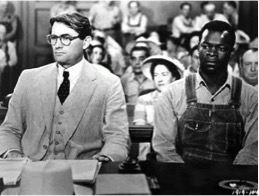
Atticus Finch with Tom Robinson

CRT is not only used to examine literary texts, but also to interrogate cultural practices. According to the Purdue OWL, CRT “scholarship traces racism in America through the nation’s legacy of slavery, the Civil Rights Movement, and recent events.” It looks at historical events and asks how race played a role, how were systems built, and how we got where we are today. Why is it, CRT asks, that a group of mostly Black people demonstrating at the steps of the Capitol are seen as ‘dangerous’ and dispersed by use of tear gas while a group of mostly white people, brandishing weapons and shouting racial epithets, are allowed to invade the US Capitol building during a legislative session with very little immediate consequences or threats to their bodies?

What is it that makes us see a group of Black people as ‘threatening’ and a group of white people as ‘exercising their right to protest’? CRT would say it is the racism that we have been raised with that teaches us that white people are safe and Black people are dangerous. White people are nice; Black people are menacing. These insidious messages are woven into policies that shape our schools, our neighborhoods, our legal system, our health care system, and even our entertainment and business practices. Racism is so deeply embedded in our culture that some of us deny its existence.

We claim, “I am not racist,” while acknowledging that Black students have less funding for education, fewer course options, and are less likely to be prepared for college than white students (UNCF). We say, “I stand for equal opportunities for all,” while knowing that the black unemployment rate has been consistently twice that of the white unemployment rate for almost fifty years (Center for American Progress). We say, “I love all kinds of people,” as we go on attending our all white churches, hanging out with mostly white friend groups, and shopping in predominantly white spaces. We benefit from the systems that keep Black people away from us — away from our schools, away from our jobs, away from our neighborhoods. We don’t like to admit that, because it sounds awful and makes us feel bad, but if we take a look through a lens shaped by critical race theory, it will be very difficult to deny.

So you might ask yourself, why is FOX news spending so much time telling its viewers to keep CRT out of the classroom? What is it afraid of? Is it afraid that our children, if they are taught to use critical race theory will see what we refuse to see? that they will change what we refuse to change? that our experience as white people in America might be transformed?

Might our children and their children actually work toward a more perfect union where all people are seen as equal and endowed by their Creator with certain unalienable rights? Might our brothers and sisters of color, yes, fellow members of the family of God, more freely and equitably experience life, liberty, and the pursuit of happiness?

Fox News can say whatever it wants; I am going to employ any tool necessary to dismantle racism in my classroom. I am going to teach my students to ask all the questions — even the ones that make me uncomfortable. Why? because for my students, it is a literal matter of life or death — prison or freedom — poverty or prosperity — despair or hope.

In the words of my school’s director of academics, “in each moment, I can either replicate oppression or tear it down.” If CRT is a tool I can use to identify racism and tear it down, then let me get to it.

My students are counting on me.

For the entire law is fulfilled in keeping this one command: “Love your neighbor as yourself.”

Galatians 5:14

**If you would like to partner with me in loving my students, please reach out to me at krathje66@gmail.com and I will share my classroom wishlist.

Chester and I — A Return to Best Practices

Chester woke up with tummy trouble. It was not the first time. He’s always been little sensitive. Even from an early age, he was always a little “eating disordered”. Sometimes he would eat his food; sometimes he wouldn’t. Throughout his thirteen years, he has eaten 70-80% of the meals set out for him. It used to worry us, but eight or nine years in, we accepted it.

When he was younger, he was also a puker. Once a month or so, we would find a disgusting pile on the stairway landing or hear him retching and run him to the door. Usually after he’d emptied himself and slept it off, he’d be fine.

Now that he’s geriatric and since we’ve moved into our new place, his tummy trouble has found a new expression — diarrhea. The first time it happened was a few weeks ago. Chester woke me in the middle of the night, demanding to go outside. Once in the yard, he showed me why he had been so insistent. The next few nights, it was like I had a small child again. I let his belly rest a bit, started a bland diet, and called the vet. By the time of our visit, the issue was resolving, but then it came back in full force.

The vet’s hypothesis? “Sometimes when we go through change, this happens.”

Poor Chester had lived his first six years in one home, his next seven years in another, and now, when he’s thirteen, we are changing his environment again. It was a little overwhelming for all of us, and I had to admit, my body was feeling it, too.

Our bodies are so strong. They perform for us physically — packing and moving boxes, walking up and down the aisles of Lowe’s and Target, and meeting with realtors, contractors, and vendors — while at the same time holding all of our emotions — excitement, stress, joy, and anxiety. They are resilient and adaptable, but after several weeks of ongoing demands, our bodies can become overloaded.

Chester’s been a real trooper — learning to walk up and down stairs again, adapting to a new environment, learning the new rules of where he can go and where he cannot go — but I think his tired body was finally ready for some TLC.

My own body was energized through all of the packing and moving, but a couple weeks into the settling — unpacking boxes, welcoming guests, and making major purchases of furniture, hardware, etc. — I started to feel a familiar hum — inflammation, fatigue, the signs of a flare. Thankfully, my body doesn’t cry out in the same way as Chester’s. Instead, I first notice sassy replies sprinkled with sarcasm. Then, I notice a psoriasis outbreak or a headache. I find myself sleeping 10 hours some nights and 2 hours on others.

Just as Chester was suffering, my body was aching, and I knew I had to start paying attention.

This cross-town relocation took some work, and in order to meet the demands of the move, I had put some of my “best practices” on hold. I wasn’t taking the time each morning to write three pages, really read my Bible, or get in my daily walk. I was surely moving a lot, but I wasn’t connecting with the rhythms that have kept me well. It was time to return.

So, in fits and starts, I have been returning, but I have been distracted. Since Covid restrictions have been loosened, we, like countless others around the globe, have also welcomed guests and traveled quite a bit lately. We’ve been to Ohio, Indiana, Massachusetts, and several points in Michigan. We’ve seen all of our children, our grandchildren, our parents, and several siblings, nieces, and nephews. All of this time with family has been sheer bliss, and we have loved every minute. However, in order to make it all happen, I have been less than consistent with my routine. I’ve fit in some yoga here and there, and I’ve gone on some walks, but I have learned over the past seven years, that if I want to stay healthy, I need to observe my best practices daily.

I was doing a pretty good job last week. I had about seven days running of eating the right foods, doing yoga, going on walks, and writing, and I was starting to feel pretty good. Chester was doing well, too! He was eating his food every time it was set out, he was going on short walks, and he even had a short meet and greet with a neighbor dog.

We were already seeing the pay off of our routine.

We were feeling great when our son, daughter-in-law, and two granddaughters pulled into our driveway last Thursday. We hugged, we played, we chased, and we snuggled. Then, we piled in two cars to go meet more family for a fun-filled beach weekend. Chester was safely secured at home under watchful care, so he would certainly be fine if we were gone for thirty-six hours or so.

What could be better for a body than a couple days on a beach, watching children play, drinking in fresh air, and soaking up sunshine? What difference would it make if we ate a few extra chips, sampled a gluten-rich cookie or two, or splurged on some onion rings? We were laughing and smiling and having the time of our lives.

Exhausted, we pulled back into our driveway late on Saturday night to find that Chester, who’d been fine while we were gone, just couldn’t hold it together until we got to his crate. The stench in the house was evidence of what had happened as he awaited our return. So, instead of falling into my bed to recover from the weekend, I found myself on hands and knees cleaning up feces, carrying soiled blankets to the wash, and lighting candles throughout the house.

Later, as I stood in the shower, I felt my clenched jaw, my burning eyes, and my aching joints. I toweled off, pulled on pajamas, and flopped into bed. Almost immediately, Chester sunk onto his bed beside me. We sighed. We were tired. We couldn’t keep up this pace any more.

We needed a return to our best practices.

This morning, he urged me out of bed and stood near me until I found my way to my desk, carrying a bowl of gluten-free oatmeal and a cup of green tea. When I was adequately positioned, he plunked on his rug at my feet, happy to be back in the routine and looking forward to feeling the benefits.

Later this week, I’m going to welcome my sister who is visiting from out of state. We’re going to spend an evening with friends, and I am going to participate in an event for my recently graduated students. It’ll be fine. It’s not too much. I just need to remember to keep returning to these best practices.

 I pray that you may enjoy good health and that all may go well with you, even as your soul is getting along well.

3 John 1:2

A time to embrace

It was a weird year to join a school staff. With Covid, all of our back-to-school meetings were virtual. We could see one another’s faces and occasionally hear one another’s voices, but we did not share physical space for those two weeks. Instead, each of us was safely distant from the others, working from our homes.

I wasn’t the only new hire, but I couldn’t be sure, just from looking at my Zoom screen, which staff members were veterans and which ones were rookies. The situation was complicated by the fact that two school staffs had come together for the 2020-2021 school year after one had closed, so even the teachers who had been on staff for three or five or ten years, might have been looking at new faces and wondering where they fit in.

And maybe that dynamic, the fact that none of us felt terribly grounded, created a situation in which no one felt superior; no one felt “new”. Or perhaps we all felt “new” in a way, since we were all learning how to do school online — learning how to use digital platforms for instruction, for behavioral incentives, for managing student work. I can’t know how everyone else was feeling, but from the beginning, I had a sense that we were all in this together. We were all uniting to meet the needs of our students during a pandemic — one that had decimated the community of Detroit in which our school is situated and where all of our students live.

From the beginning of the school year, our focus was to provide high quality instruction in a manner that was safe for our students and for our staff. We took every measure — providing our students with chromebooks and hot spots so that they could safely learn from home, upping the requirements for our all-star custodial staff who sanitized bathrooms and doorknobs on the hour, and allowing staff with health concerns to work from home. If a positive case of Covid was detected, everyone was sent home for two weeks while the building went through a deep clean and while everyone who had even remotely close exposure could get tested and watch for symptoms.

We were so careful, in fact — wearing masks in the building, staying six feet apart, sanitizing surfaces, and holding all meetings via Zoom — that even when a positive case occurred within the building, it was not spread. We were even offered weekly Covid testing every Monday, so when asymptomatic cases were diagnosed, the whole building could go home before any spread could take place.

Our leadership took every precaution to make sure our students and staff remained safe and healthy.

So what a shock it was, as we were all enjoying our summer break, knowing that we finished the year with minimal Covid impact, to receive a message from our principal that one of our coworkers, a well-loved teacher, just forty-four years old, had died very shortly after a cancer diagnosis.

It felt like a punch to the gut. I was stunned. How could this woman, who had volunteered to plan all the senior events (during a pandemic!) so that “our babies” would have a senior pinning, a prom, and an in-person graduation, have died? I had just been on zoom with her a few weeks earlier, discussing teaching strategies and sharing resources. She’d asked early in the year if I would mind talking with her from time to time as she was striving to be the best she could be for our students.

In the group chat where the news of her death had been shared, my colleagues instantly began sharing with one another how they were shocked and devastated. None of us could believe that just as we were planning to be physically with one another in the fall, this woman who leaned into every Zoom room, face fully on the screen, smiling and attentive, would not be with us.

Shortly after we learned of her passing, our principal sent out another note. We would have a candlelight vigil and balloon launch the following week to allow students and staff to grieve. I had heard of this practice just earlier in the year. Two of my former students from St. Louis and one of this year’s seniors all were killed by gun violence within weeks of one another between Christmas and Valentine’s Day. Each of them had been remembered in this way.

Our principal’s note said to bring pink balloons (our colleague’s favorite color) and to come to the school. On that evening, my husband and I cut a family trip short so that we could be there. We pulled up to the building and found the principal and one of the custodians setting up. As we got closer, both of them moved toward us. After a whole school year of giving one another a wide berth, my principal and I instinctively hugged. I turned to the custodian, and we held one another.

It was no longer safe to remain distant.

As each staff member arrived, the hugging continued. Friends who had stepped around one another all year long, were offering comfort in the only way that would do — touch.

And tears.

Tears dripped from our eyes as forty-four candles were lit and balloons were shared. Markers were passed so that we could write tributes on the balloons. One teacher, who also happens to be a police chaplain, offered Scripture, emotional support, a space for sharing memories, and prayer. He told the dozen or more students who had gathered on a weeknight in the middle of summer that whatever they were feeling was ok, that the staff was grieving, too, that we were all shocked. None of us had known she was sick, he said; she hadn’t known long herself. He offered support through our social worker, our counseling resources, and himself. “We are a family,” he said, “and family supports one another through difficult times such as this.”

Our colleague’s mother moved to the middle of our circled bodies and shared that her daughter had loved our students, had talked about them all the time. Even from her hospital bed, she regretted that she was missing prom. We all nodded, knowing this was true, knowing that her heart had been fully with our kids.

As one, we counted to three and released our balloons into the sky. The cluster of bodies on the ground gazed upward, silently, for many long moments, watching the pink balloons lift into the clouds.

And then we lingered. Staff and students spoke to one another, shared memories, and stood closely in the silence. Gradually we began to chat: how is your summer? what have you been up to?

A baby was passed from his mother to students to staff. As though he knew our hearts were hurting, he lay his head our shoulders then lifted his gaze to smile us, instinctively bringing joy to the mourning.

One by one, the gathered began to dissipate, moving to cars, waving goodbyes, holding eye contact a little longer than we might’ve before, promising to see each other soon, knowing that we were connected a little more now than we had been a few hours earlier.

I don’t know how next year will play out. It holds promise for more proximity, more gathering, more sharing, and I hope we get that. It was appropriate to keep our distance for a while to protect one another, but it seems the best way to care for one another now is to come back together.

[There is] a time to refrain from embracing, and a time to embrace.

Ecclesiastes 3: 5 (Order reversed by me.)

Reflections on Round Two, Year One

Last year at this time I was in the middle of interviewing with various high schools in the Ann Arbor/Detroit area. Amid the last Spring’s swell of cries for racial justice, my husband I and agreed it was time for me to pursue a return to the classroom. (I wrote all about that journey in a series of blogs starting with this one.) Now, a year later, I’m sitting in my office, sun shining through two corner windows, taking a moment to reflect on my first year back — what an unusual one it was!

Going back to the classroom during a global pandemic might seem like the worst idea in the world. However, the situation — a high need for teachers in light of Covid-related attrition — gave me an opening. I figured I could get my foot in the door to see if I was able to hack the demands given my health concerns. I soon realized that this year would give me only a partial answer to that question. With mostly online instruction, limited behavior management, and a large percentage of time spent working from home, I had the time and bandwidth to get re-acclimated to writing lesson plans, communicating with parents, and meeting deadlines without the long demanding days of managing teenaged bodies within the classroom, without interruptions in the middle of planning, without extra hours attending sporting events, and without the constant posture of supervision that teachers wear in a building teeming with students.

The building, in fact, was the opposite of ‘teeming’.

It was so quiet that every time I walked down the hall to the bathroom, the office staff could hear me coming because of the squeak of my shoes against the tile floor. The former Catholic elementary school that houses Detroit Leadership Academy held around a dozen people on a typical day this past school year. Some instructors worked from home the entire year due to health concerns. Only the custodians, office staff, and a handful of teachers came to the building each day, and we were all isolated from one another in our own classrooms. If I wanted to interact with anyone, I had to be intentional. I started leaving candy on the sign-in table every few days — hoping these treats would draw out the humans. I saw the candy diminish, but I rarely saw who was taking it or, as I had hoped, teachers clustered around the table chatting like I remembered from my pre-Covid teaching days.

Sometime mid-year, after weeks and weeks alone in my classroom, I started doing laps inside the building at lunch time in an effort to get away from the computer screen and get in some steps. I wore a mask, and sometimes I saw a person or two in my path, but never did we stop to talk. I resigned myself to a year of limited contact. Then, one day, after several weeks of lap walking, a colleague stopped by my room.

“I’ve seen you walking,” she said. “I’ve been running laps on the other side of the building. You want to walk with me at lunch time?”

“Yes!” I said, and before we knew it, we had another colleague join, and then another. Our walking club was born.

For the remainder of the year, whenever we were in the building, we walked — first inside, and then outside when it got warmer. We built friendships by chatting about students, the struggles of Zoom instruction, the engagement of one, and the graduate studies of another. It was a slice of collegiality in a sparsely inhabited space. I clung to those friendships like a lifeline, because building relationships with students was even more difficult.

In the beginning of the year, I could convince about 75% of my students to turn on their cameras in the Zoom room. By the end of the second semester, that number dropped to about 10%. I could hardly blame them. Most had been sitting on their beds for an entire school year, logging in to three classes a day, listening to their teachers present information, struggling to stay engaged, and trying to complete at least the minimal number of assignments in order to pass. While teenagers often complain about school, they typically enjoy the perks of seeing their friends, competing in sports, or at least getting away from their homes for several hours a day. This year had none of that.

This year was something different.

Looking back, I see a blur. The first few weeks of orienting my students to the online platform — using a Chromebook every day, checking their email, submitting documents in Google classroom — followed by a big push to get them somewhat ready for the SAT that they had missed at the end of their junior year. The actual testing day on which students I did not recognize came masked to my classroom and sat for six hours listening to instructions, filling in ovals, trying to stay awake, and waiting to be dismissed. The weeks of researching and applying to colleges, attending virtual college visits, and completing the FAFSA, followed by creating resumes, writing college essays, and attempting a virtual peer review.

After Christmas, we started the second semester. My students came to the building for senior photos in their caps and gowns then carried out Trevor Noah’s Born a Crime, a composition book, and a set of highlighters. In the following weeks, I tried to engage them in journal writing, joining clauses, and reading Noah’s book — a memoir of growing up in a racist society. We listened to Noah read his book on Audible, and my students completed reading guides, discussion posts, and written paragraphs to communicate their comprehension, their observations, and their processing of what they had read.

And then, all of a sudden, we were having a senior pinning ceremony, prom, and graduation rehearsal. In the blink of an eye, they lined up alphabetically, clad in caps and gowns, processed into the sanctuary to Pomp and Circumstance, stood in unison, moved their tassels, and walked out of the building, diplomas in hand.

Just like that, it was over.

Do I sound sad? I think I am sad — sad that I didn’t get to know these people a little better, sad that we couldn’t give them a little more — more contact, more encouragement, more content, more support, more everything. I am sad, but I am also impressed by these students who showed up, opted in, worked hard, and finished as strong as they could having had to walk a path that none of us had ever walked before.

And as I reflect on all that we did — together and apart — I am already looking forward to the next round. I am wondering how we might make the experience different for next year’s seniors. We’ll be in person — at least that’s the plan — so I’ll be entering phase two of my journey back to the classroom — all the stuff I did last year, plus bodies in the building, butts in seats.

It’ll be a transition for me to manage up to 30 students in a classroom at a time, but it’ll be a transition for them, too. They haven’t had their butts in seats since early March 2020. They’ve been logging in to Zoom rooms, on time or not. They’ve been joining class in their pajamas, hair combed or not. They’ve been at home, following house rules or not. And now, they are going to have to put on some clothes, get themselves to school on time, and follow school rules. We’re all in for some change, and it might not be easy.

So, for the seven weeks that I will not be in my classroom, I will be preparing for that change. I am going to start with some rest — some self care, some family time, some writing, and some sleep. I am going to sprinkle in some high quality instructional planning, and I plan to do some deep reading on educational equity, building a classroom culture, and fostering group trust, because that is where we need to start.

After the trauma of this pandemic — the loss of loved ones, the fear of contagion, the isolation, and whatever else my students have experienced in the last sixteen months — they are going to need some support, some anchors, some structure, some intentionality, some consistency..

I am not sure what that will look like, but our whole team is talking about it. We’re committed to giving our students what they need, which is likely very similar to what we all need — some grace, some time, some understanding, and some love.

Love one another.

John 13:34

Coronavirus Diary #30: Emerging

It’s starting to happen. We’re opening our doors, stepping outside, and actually talking to people — sans mask.

At first it felt a little weird.

We were in the backyard of our new nest (still trying to settle on a name: the garden ranch? the house by the highway?) working in the dirt, plunking seeds in the ground, when first one neighbor then another walked toward the fence, introduced themselves, and stood to talk for a bit.

We were outside of course, where no masks have been required for quite a while, but we weren’t keeping six feet distance. We moved in close — close enough to see eye color. It felt good, but then my husband did something audacious: he breached the fence line, extending his hand to Bob, our backyard neighbor, and Bob, equally audacious, grabbed his hand and shook.

Emboldened by such recklessness, our son, too, walked forth and shook the hand of a man who we had never met. We didn’t know if he was vaccinated, Republican, Democrat, a masker, an anti-masker, or what! Yet, they each grabbed his hand, swapping epitheliels and such. I felt a rush of anxiety, and then I internally shrugged.

The mask mandate had been lifted, after all, for those who had been vaccinated, whether outdoor or indoor, and we had been vaccinated, so I guess hand shaking was the next step.

A few days later, we were walking into Lowe’s when we saw a sign that said, “masks are now optional for guests and employees of Lowe’s,” so we unstrapped our faces, walked in and began to hunt down the items on our list. Several minutes into our quest, my observant husband said, “Hey, I’m noticing that most everyone still has a mask on. Maybe we should, too.” So, with a sense of courtesy and care for others, we strapped them back on.

It’s no big deal, after all. We’ve been wearing masks for over a year. We have dozens in our home, in our car, and at work. It seems almost second nature now to cover our droplet-spewing exhales for the sake of others, but we’re seeing more spaces where we feel free not to.

Weddings, for example. Last weekend, we went to two weddings in one day. At the first, we sat in our car, watching others walk into the church without masks, so we decided to do the same tucking a mask for each of us in a pocket just in case. At the door to the church we saw a sign similar to the one at Lowe’s announcing that masks were not required for the vaccinated, so we dared to walk into the sanctuary naked-faced.

Inside, about 30% of the the guests wore masks. The ceremony commenced with the whole wedding party processing barefaced. Yes, the priest donned a mask before serving communion, but many remained unmasked for the service, even while singing. And the singing! After over a year of virtual church, the rich voices in the extravagant sanctuary felt celestial — a foretaste of things to come.

After the ceremony, as the guests rose to exit, most conservatively covered their faces, and we did, too. We’d tasted the freedom, but we hadn’t lost our minds. That would happen at the next wedding.

We’d received an email the night before that fully-vaccinated folk would not be required to mask at the second wedding. Still, we kept a mask in our pockets as we walked into the large, airy sanctuary. We found our seats and scanned the room. This was the wedding of someone we’ve known for decades, and several of the guests were dear to us. Not one mask was visible to me.

We slid over to let a couple join us. My husband shook a hand and gave a hug. I simply smiled and gushed, “It’s so good to see you!” I looked around and spotted a long-time friend I hadn’t seen in the last few years, then a couple who we love dearly. I wanted to cross the room to greet them, but I committed to the more socially-appropriate action of staying put for the duration of the ceremony.

The wedding was joyous — the joining of two fractured families who had found healing and hope in each other was filled with smiles, tears, and much rejoicing. The people gathered were reminded that God makes all things new — that He takes our brokenness aside and makes it beautiful.

Buoyed by restored hope, the wedding guests excitedly exited the sanctuary, nary a mask in the crowd, and continued to greet one another and comment on the just-witnessed miracle. Among them, my husband and I were chatting with another couple when I spotted, once again, that dear friend I hadn’t seen in years. My feet propelled me to her, and before I knew it, without first asking for permission, I wrapped her in a hug. I was suddenly emotional. Other than my husband, our son who lives locally, and my mother, I had hugged very few people in the last year. Very few indeed. And this friend, who I’ve known for over thirty years of highs and lows and another friend who I would track down moments later and enthusiastically embrace — again without thinking to pause for permission — were dear, dear friends who I might have at one time taken for granted, might have given a quick hug at a wedding reception and then moved on to the drinks, the food, and the dancing. but not now.

I’ve been changed — at least temporarily. As we emerge from almost fifteen months of separation from one another, isolation in our homes, and the alienation of wearing a mask — all for the sake of protecting one another out of love — I have a new perspective.

At times during the pandemic I have felt anxious, not wanting to be around people, feeling wary of moving through crowds, and venturing out only out of necessity to get groceries, see the doctor, or go to work. Even several weeks ago, when we went to church on Easter, after the worship services were over, after most of the people had cleared, I still felt uneasy walking up to the building to receive communion because a dozen or more people were standing outside the building without their masks.

It’s been strange, hasn’t it? To be afraid of getting close, of sharing air? Haven’t we been suspicious of those who came too near, who didn’t mask up, who didn’t seem to take the virus seriously? Or maybe you felt differently. Maybe you thought we’d all gone overboard what with the masks, and the quarantines, and the sanitizer, and such. Maybe you’ve not been isolating and distancing as much as we have. Maybe you don’t feel, like I do, that you are emerging from a bunker where you’ve been hunkered down, missing your people for over a year, but that’s how I feel.

Is the sun shining brighter? Have my friend Pat’s eyes always been that attentive and loving? Has Chris DuPont’s voice always sounded so angelic in a spacious cathedral? Have the hugs of friends like Heidi always been so life-giving and heart-swelling?

I don’t remember, but suddenly I am overwhelmed with emotion just just to see you — all of you.

I know the virus is still here and that it’s going to be here for a while, but right now, in the light of the sun, on these beautiful spring days, I feel free as I emerge from a long, long, hibernation that lasted much, much longer than a winter.

I missed you, my friends. I pray I get to see your face and hug you soon.

Be strong and take heart, all you who hope in the Lord.

Psalm 31:24

This just might work.

Click above to listen, or read on.

Last week I reminisced about our life in our little house by the river. Today, I share some of the journey to our next nest.

Even before we moved in, we knew we wouldn’t live in the little house by the river forever. It’s university property, after all, and one does not retire in university property.

Not that we are retiring. We’re not even close.

I’m just one year into my journey at Detroit Leadership Academy and have accepted the role of Master Teacher for next year. I will stay in the classroom, teaching English Language Arts to our seniors, working with my colleagues to close the educational equity gap and prepare our students for success in college, trade school, or the work world. This past year has more than affirmed my passion for teaching in Detroit, and I hope for many years of teaching ahead in this next chapter.

Similarly, John is as invested as ever in the students at Concordia. When he moved here eight years ago, he had a sense of what this position held, what his role and responsibilities would be, but now he fully understands how his gifts as an educator, a counselor, and a pastor work together to support college students as they develop into adulthood. He’s part of a strong team of leaders here who are committed to walking with students through both joys and challenges, and he’s excited about continuing in that role.

So why the change? Don’t we love living on campus? We sure do! I’ve written about how much we love it over the years. Even during the pandemic, when the campus was almost vacant, we enjoyed its beauty — the green of summer against the brick structures, the fall leaves beside the peaceful Huron River, the pure white expanses of snow in the open spaces, and always the lilacs, the tulips, and the peonies in the spring. We have loved living and literally walking beside students, faculty, and staff these past years — watching ultimate frisbee from our patio, hearing laughter outside our door, and chatting with members of this community as we move throughout our weeks. We have experienced many unique relationships as a result of living in the little house by the river, and we are sad to be leaving.

Nevertheless, from the beginning, we knew we would one day move out. We weren’t sure when or to where, but from the beginning, we’ve kind of had our eye on Ypsilanti. We love Ann Arbor — its parks, its restaurants, its cool campus scene — but when in Ann Arbor, I’ve always felt a bit like a tourist. I love to explore how beautiful, how smart, how impressive Ann Arbor is — I don’t get tired of it. However, when I visit Ypsilanti, I feel more at home — its edges aren’t polished; it’s not trying to impress anyone. Ypsilanti looks like it’s been through some stuff and lived to tell — and I resonate with that.

So last winter, when we were on month one million of Covid isolation and my husband’s plantar fasciitis got in the way of our long quarantine walks, we started taking drives around Ann Arbor, Ypsilanti, and their surrounding areas. We talked about what we liked and didn’t like. We discussed our future. We clarified our goals. Then one day, we called our friend who is a realtor and formalized our search.

Over the next few months, we looked at many, many houses. Our realtor’s patience with us allowed us to imagine what we were looking for — what kind of space would suit us in this stage of life and carry us forward into the next. The little house by the river definitely informed that vision. We have been very content in this simple home, and we could picture ourselves in something similar — three bedrooms, perhaps a second bathroom, a garage, and definitely space for a garden. We wanted to be in a community where we could mix with people whose journeys may have been different from ours, where we could build relationships that would challenge and enrich us. Our goal was to stick to a conservative budget so that we could easily pay our mortgage and continue to live our simple life and contribute to causes that matter to us.

This was a tall order in the current real estate market. Interest rates are at an all-time low, and we were not the only ones looking for a house during the pandemic. In fact, the first house we bid on had several other offers, and so did the second house. Buyers right now are offering well over asking price and some are paying fully in cash. In fact, the third house we made an offer on had twenty-six (26!) other offers. The winner paid in cash. We were starting to get discouraged and even said, “It’s fine. Let’s take a break; we don’t need to buy a house right now.”

Then, on a Friday, when I clicked through the latest listings in an email sent by our realtor, I noticed a little three bedroom with a garage in Ypsilanti Township. I pulled it up on Google Maps and thought, “We aren’t going to like it. It’s too close to the highway.” I wasn’t even going to go look, but as I left work that day, I thought, “I’m in the car anyway, and it’s kind of on the way.” I took the exit and drove the path that we had driven to so many others in the area, and then I found myself on a quiet street that was indeed extremely close to the highway, but for some reason didn’t feel like it was. I pulled up in front of a small blue ranch, put the car in park, lowered the windows, and listened.

It was so quiet. Across the street was a playground and what was once an elementary school but is now an alternative education center. The house seemed in good shape, and so did the garage. I drove up and down the street, looking at the other houses on the block.

“Huh,” I thought, “this just might work.”

I texted my husband and our realtor, “I know we just said we were going to take a little break, but I’m sitting in front of this house, and I think it might be worth a look inside.”

Two days later we were standing in the driveway, then we were walking around to the back where we saw the garden — an enormous garden, right at the back of the yard, adjacent to three other yards that also had their gardens right next to the fence. I could immediately see myself leaning on that fence, talking to the neighbors, sharing gardening tips, and passing produce. I saw mature well-cared-for rose bushes and a patio next to the house, where I imagined our Adirondack chairs might fit quite nicely. We walked inside and found a lovely well-lit living room, a small eat-in kitchen, and three small bedrooms on the main floor. Everything had been recently painted, and the flooring had all been replaced. It felt fresh and ready to be lived in. We made our way downstairs to the finished basement where we found a fourth bedroom, a family room, the laundry, and all the makings of a bathroom — toilet, shower, sink — minus the finishing touches of walls and a vanity.

I heard my husband saying, “This might just work”

We guarded our feelings and put in an offer — the fourth offer we had made in a little over a month — and then we waited.

We didn’t have to wait long. By Monday the sellers had accepted our offer, and less than a month later, we have closed on our next nest. We haven’t yet begun to move in, but we’ve already put seeds and seedlings in the garden, and I’ve already leaned on the fence and talked with the neighbors. They like to chat and linger, just like I was hoping they would.

As I’m packing boxes in the little house by the river, I continue to reminisce, but my gaze is starting to move forward. I’m imagining our things living inside their new spaces. I’m picturing us sitting in our living room watching children playing in the park. I’m looking forward to walks in our next neighborhood.

I think this just might work.

You open your hand and satisfy the desires of every living thing.

Psalm 145:16