
Memorial Day, in the time of Covid-19

Click to hear this post read aloud.

On any other Memorial Day, we’d be packing up picnic baskets, putting the finishing touches on the potato salad, and donning festive red, white, and blue.

We’d be joining friends around picnic tables, under tents, next to pools.

We’d be driving to cemeteries to pay our respects, plant flags, and place flowers.

We’d be remembering those lost in wars, yes, and those we’ve lost, period.

But today, in the time of Covid, when almost 100,000 have died in the US from the Coronavirus alone over the last three months, let alone all who have died of heart failure, stroke, car accidents, cancer, violent crimes, or suicide… when gathering — even in groups no larger than ten — can bring a risk of transmission leading to even more illness or death, Memorial Day is going to look a little different.

Families who have lost loved ones in the last three months have not had the privilege of holding their loved ones’ hands as they have died. They have not gathered for funerals. They have not hugged one another and cried. They have not had a chance to grieve — to accept the reality of death. What does their Memorial Day look like this year?

The New York Times covered the front page with this image, and yet few of us can wrap our minds around the reality of — the “incalculable loss” — of nearly 100,000 deaths.

The Times ran this memorial perhaps as a way for us to remember, to conceptualize, to note, to grieve, to mourn. It’s a list of names of a fraction of those who have died complete with brief descriptions, epitaphs, if you will, that help us attach lives of real people to the numbers. People like:
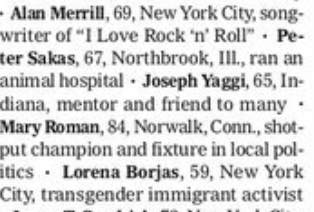
Alan, Peter, Joseph, Mary, and Lorena, loved by their friends and families, despite their weaknesses and flaws, will be missed, and mourned, and remembered, so will the other thousands upon thousands, as will those who have died in the last year from all things not Covid.

I don’t know how you are remembering today — if you are indeed visiting a cemetery, if you are gathering with a few friends, if you are isolating at home, if you are doing the same thing you’ve done every single day since somewhere in the middle of March, or if you will sit in your yard, on your porch, or on your couch, quietly remembering those you have lost.

We’ve spent the weekend visiting with those we have not lost — my in-laws, my parents, and my godmother — through porch visits and phone calls, taking care not to contaminate — keeping distance, wearing masks. We have laughed, smiled, and realized that life is precious.

We taught Ken, 85, Caseville, MI, who left home at thirteen and became a millwright and a father, how to use Google Duo to videochat with his kids and grandkids. We heard Dorothy, 83, Caseville, MI, a retired second grade teacher, talk about the time she helped her two sons transport a 17-foot aluminum canoe in a Chevette.

We greeted Margaret, 90, Bay City, MI, who after working on a factory line in the ’40s and ’50s loved collecting hand-painted china and now lives a few miles away from her husband of 70 years, unable to see him since they are in separate facilities that are both sheltering their residents.

We chatted with Harold, 81, Brownsburg, IN, retired businessman, who once hitchhiked from Michigan to California to buy a vehicle after serving his time in the Marines; we laughed with Joyce, (age withheld to protect myself from harm), Brownsburg, IN, a beloved fifth-grade teacher, who’s trying to figure out how to help others with her stimulus check.

Today we’ll see Roger, 75, St. Louis, MI, a butcher turned grocery store manager turned prison shopkeeper who enjoys riding his motorcycle and golfing, and Carol, 78 St. Louis, MI, a former hospital unit secretary who has spent most of her days finding ways to show love to her children and grandchildren.

And then we’ll head home, thankful that on this Memorial Day we have no fresh grief, other than the collective groaning of our nation.

And that groaning we will hold in our hearts as we continue to isolate at home, wear our masks when we venture out, and do our part to slow the spread, to reduce the casualties, so that we (and others) can spend more days with those we have not yet lost.

For those who are freshly grieving today, I extend my heart. May you find comfort in your mourning and joy for your soul.

I will turn their mourning into gladness; I will give them comfort and joy instead of sorrow.

Jeremiah 31:13

Coronavirus Diary: Thoughts from Confinement

I don’t even remember when all of this started, do you? The information has been coming in waves and the impacts on our lives seem to change in the moment.

I first heard about the coronavirus sometime in January. At that point it seemed so removed. I understood it was in China and that a whole city was on lockdown, but that information seemed very intangible at the time. What did I know about a city of 11 million on the other side of the world? How could I conceptualize what a shut down of that magnitude might look like?

On February 11, I must have been driving home from celebrating my mom’s birthday with her when I heard the news that the coronavirus had been given the name Covid 19, and still, though I knew that a whole cruise ship had been detained with 700 sick onboard, I couldn’t picture it impacting my life at all.

One month later, as I was driving back to my mom’s to support her recovery from surgery, President Trump was preparing to address the nation and announce a halt on all travel from Europe. This began a series of quickly escalating restrictions. That was March 11, 18 days ago.

By Friday, March 13, many schools had closed and many businesses began to send their workers home.

By Thursday, March 19, I, too, was working from home.

On March 24, Gretchen Whitmer, governor of Michigan, declared that all in the state should shelter in place.

And here we are.

How quickly we have all shifted into this new reality! We’ve moved our necessary supplies home, we’ve shifted all our meetings online, and we’re learning how to stay connected from a distance. And that’s the best-case scenario.

Some have lost their jobs, gotten sick, and even lost their lives. In fact, as I write this on Sunday afternoon, the grand total of those infected is over 700,000 world wide. Over 34,000 have died.

This past week, I was having a video chat with a parent when she shared that her father was in the hospital sick with the coronavirus. His health was declining, and he would likely not make it. The hardest part, she said, was that no one could be with him. He was suffering alone.

And many are — suffering alone.

Countless elderly spend their days in locked down facilities, confined to their rooms, restricted from visits. Many others live alone and are doing their best to care for themselves, get the supplies they need, and bide their time.

But the two populations that keep popping up in my imagination — the two groups that seem most vulnerable to me are the homeless and the incarcerated.

Last Monday night, as I was driving home from what would be last last medical maintenance appointment for who knows how long, I passed a homeless shelter. I was struck by a mass of people standing shoulder to shoulder at the entrance of the building. How are their needs being met? Do they have access to the news that suggests they keep six feet away from one another? Where can they shelter in place? How are our shelters providing food, supplies, and space for those who are in such desperate need while still protecting their staff and volunteers?

What must the inside of a jail or prison look like right now? I have to imagine that inmates are confined to their cells. Are they able to get outside at all? What kind of access do they have to health care? How terrified must they be?

Today an inmate in Louisiana became the first inside the American prison system to die after contracting the coronavirus; how quickly will it spread?

Some jurisdictions are releasing non-violent, aged, and chronically ill prisoners. Some cities are providing additional emergency housing for the homeless. However, I’m certain such undertakings are monumental and will result in further complications. Where do prisoners live when they are released? How will they support themselves? Who will follow the homeless and make sure that their needs are met?

How will we care for the most vulnerable?

What about those who are mentally ill, medically fragile, or ‘sheltering’ in place in abusive or neglectful homes?

How must they be suffering?

I’m sitting here in my house next to my dog, comfortable, well-fed, employed, and well. I have everything I need, and still I find myself struggling a bit — feeling crabby, wondering how long this will last, and disappointed that some of my plans have changed.

This pandemic has challenged us all — we’ve never lived this way before. We’ve never been so restricted, so isolated, so aware of one another and our struggling.

We’re communally groaning. And yet, we are not without hope. Not even close.

You don’t have to look far to be inspired.

Leaders and agencies are trying to meet the needs of the homeless, the imprisoned, and those who are in dangerous situations. (If you are able, financially support these efforts.)

Countless medical professionals are showing up to work everyday, donning personal protective equipment, and caring for the sick and dying with dedication, skill, and compassion. (Let’s all pray for their health, stamina, and encouragement.)

Teachers around the world are finding ways to connect with their students and provide learning opportunities in creative ways with whatever resources they have. (If you’ve got an awesome teacher in your life, send them an encouraging note or an e-gift card to Starbucks or Target.)

Grocery store employees are staying in the trenches — restocking shelves, disinfecting carts, adapting in the moment, and making sure we have everything we need. (Be sure to smile at them, thank them, and recognize their sacrifice.)

And what about those Shipt and Instacart drivers! It’s amazing that they’re willing to go to the stores for us, risking their health, so that we can stay put. (Make sure you tip them well!)

Companies are stepping up. The company I work for gave all employees 40 extra paid vacation hours and 80 extra paid sick hours. Verizon emailed me yesterday to tell me they’d given me an additional 15 GB of Personal Hotspot to help me stay connected. The founder of Zoom gave free access to educators and students. Other companies are stepping up to provide hand sanitizer, medical masks, ventilators, and the like. (Let’s shout out these companies and continue to patronize them!)

The United States government approved a relief package that will deliver cash payments to qualifying individuals and families, will provide extended unemployment benefits to displaced workers, and will support small and large businesses who have been impacted by virus-related restrictions and shut downs. (It wasn’t easy, but our leaders collaborated across party lines to make sure we are supported. Let’s urge them to continue working together!)

As we shelter in place, we are limited in how we can care — but we can support those who are on the front lines.

And we can pray.

Last Sunday, our pastor challenged our mid-sized congregation to a bold task — could we maintain a 24-hour prayer vigil for the duration of this crisis? He asked if individuals would sign up for 30-minute blocks of time around the clock to lift up our world, our nation, our state, our community, and each other in prayer. Since Sunday, March 22, every slot has been filled. Dozens are committed to calling on God to sustain us, protect us, heal us, and support us during this time.

And that’s just in our small church community. Undoubtedly, thousands are praying around the world — calling on God to have mercy, to provide for our needs, to heal the sick, to comfort the mourning, and to show us how to care for one another during this unprecedented crisis.

I wonder what that sounds like — thousands and thousands of voices calling out to God.

When I imagine us all praying together, I don’t feel alone or isolated or anxious — I feel connected, heard, and calm. I know He sees it all — me, the homeless, the imprisoned, the sick, the dying, the helpers — and that He holds us all in the palm of His hand.

if my people, who are called by my name, will humble themselves and pray and seek my face and turn from their wicked ways, then I will hear from heaven, and I will forgive their sin and will heal their land.

2 Chronicles 7:14