Stepping outside

What if I branched out and, in an attempt to put down 300 words a day, I wrote on my phone while taking my lunch time walk?

Would that be weird? Say, hypothetically, I left the office as I usually do, bag flung over my shoulder, name tag still affixed to my chest, and I simultaneously got in 2,000 steps and 300 words? Weird?

I mean, I rarely pass anyone else on my walks. Sometimes I catch up on a podcast; one day recently, my husband and I negotiated a counter-offer on the house we’re selling during my walk. It’s 60 minutes I have every day that get spent on something. Why not spend them on my blog?

The only problem is that on my phone, I can’t see a word count, so I’ve got to go by feel. I bet I’m getting close. I mean, the goal is just to get down 300 words a day until something happens, right?

Well, there you go.

Whatever you do, work heartily, as though for the Lord. Colossians 3:23

First Steps

It’s  really not hard to reach 300 words if I just start clicking keys.  I used to tell my high school students this.  I would put a prompt on the screen in my classroom and tell them they had ten minutes to fill a page.

Most of my students could easily fill a page (or two or three) in ten minutes, others routinely struggled to put down two lines.  Was it because they didn’t have anything to say?  Not likely — teenagers have lots on their minds. Was it because they had difficulty forming sentences? Probably not, because I had no requirements for spelling, grammar, punctuation, or syntax during free writes.  More often than not, if a student didn’t fill a page in the allotted time, it was because she had difficulty putting the first few words on the page.

It’s not too different from running.  If you want to run a 5k, you have got to first pull on your shoes and get out the door.  Nothing happens until you move your feet and take step after step after step.  The first few steps might take a sheer act of the will, but once the muscles start moving, they actually find comfort in the repetition, the movement, the rhythm.  That comfort somehow morphs into a sense of determination when the first mile is covered, “I think I can actually do this!” The arms pump to encourage the legs along; the mind travels down the halls of memory, sorting and filing images that lay strewn on the floor.  Suddenly, as though no time has passed, the finish line appears.

All is euphoric — applause and bagels and brand new t-shirts.

Until the next morning when you’re lying in bed thinking, “Ugh, do I really want to do that again today?” Then, with a sheer act of the will, you drag yourself from beneath the covers, tie on your shoes, and shove yourself back out the door.


James 1:4

Let perseverance finish its work so that you may be mature and complete, not lacking anything.


300 A Day

A friend texted me last week.

“Do you ever read Anne Lamott?”

“Of course.  She wrote one of my favorite books on writing, Bird by Bird.”

“She’s coming to Ann Arbor in October. Wanna go see her?”

“Yes!?!”

Then, I pulled Anne off the shelf and began to read.

I’ve been struggling to write for months.

I’m working more.

I don’t have the time.

And there’s too much to say.

So, I keep pushing it aside and saying, “I’ll be back.”

I mean, really, how do I put all this down on the page?

But I know that’s always where the sense starts.

For me.

Meaning appears through the words that show up when my fingers hit the keys.

It doesn’t happen on command, but unexpectedly, after days and days of discipline, word by word by word, I begin to see what I think, what I feel, what matters to me.

Anne Lamott reminded me that some days I’m not going to know what to put down.  I’m going to stare at blankness for a while.  And when I finally manage to write something , it’s going to look empty and useless.

“But don’t stop,” she says,  “Commit to getting three hundred words on the page every day.” This one is number two hundred eight.

I’ve been doing yoga for a few years.  The first time I tried, I could barely reach my toes when bending from the waist.  I couldn’t hold a down dog for more than a few seconds.  I just finished twenty minutes of practice — moving easily through a series of poses.

It didn’t happen quickly, but one day, about two years in, I noticed that I was strong.

So, I keep doing yoga, and I keep writing down word by word by word.


No discipline seems pleasant at the time, but painful.

Later on, however, it produces a harvest of righteousness and peace for those who have been trained by it.

Hebrews 12:11


Making it happen, for 28 years and counting, Revisit

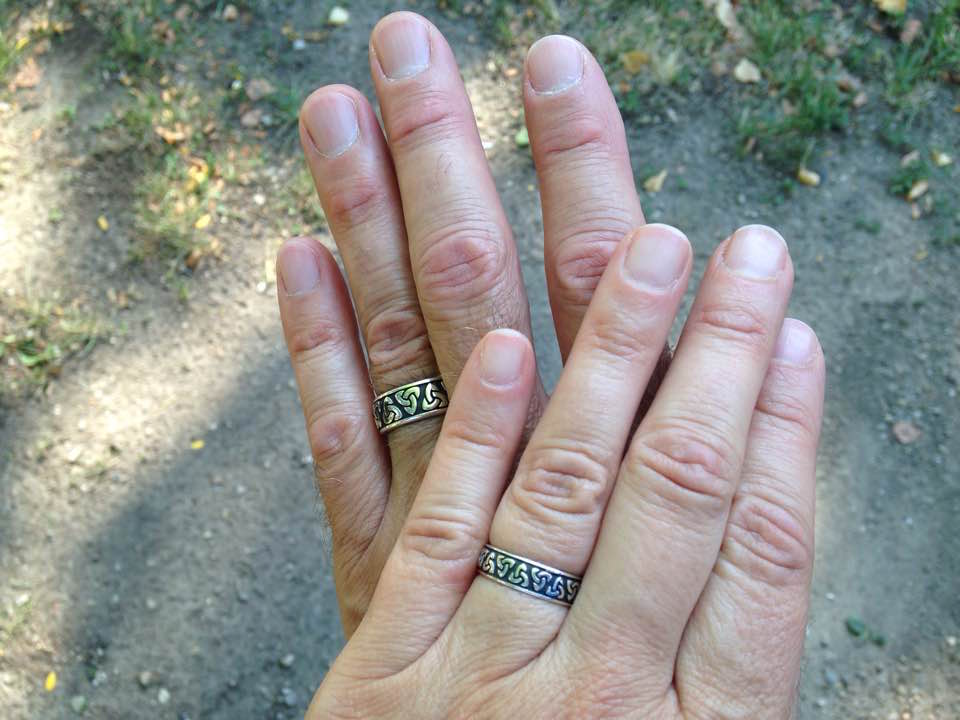
This weekend we will celebrate 29 years of marriage, so I thought I’d recycle this post from last year to remind myself of how blessed we are to be together in His hand.

Yesterday, when a friend heard that today was our twenty-eighth wedding anniversary, she said, “Sometime we’ll have to talk about how you made that happen…”

Yeah, so, that’s not exactly how I would characterize the last three decades.

I didn’t make anything happen.  What I’ve made are numerous mistakes, countless swift judgments, and repeated poor choices. I started off strong — making the assumption that I knew how to be the best wife and mother ever, and I’ve spent the last twenty-eight years learning humility. I’m not an expert at communicating, loving, being patient, or putting someone else first. The fact that we’re celebrating twenty-eight years of marriage is not a reflection of our success, but a testimony to the grace and steadfastness of God.

We got married in our mid-twenties both of us having been touched by divorce. We had little in our savings, and I was still paying off student debt. During the first year, we lived at three different addresses  — moving once when my job location changed and again when our son moved across the state. We changed jobs, too! My husband left teaching to be a full-time graduate student, and I switched from being a classroom teacher to a resource room teacher to a teacher in a residential school all before our first anniversary!

The stress of that first year alone might have done us in, but we were starry-eyed and convinced that we had won the lottery, and we were going to have the best life ever, even if we did have moments where insecurities led to worry that lead to yelling or tears or silence.

Because we did (and do) have those.

I remember one time, it had to be in the first month (or even week) of our marriage. Who even knew what started the squabble, but there we were in the kitchen, standing like two giant X’s, arms and legs splayed, chests out, voices raised, fingers pointing, spouting the kind of words we had never said toward one another before. It was terrifying. Ours was to be the perfect marriage — how could this happen? Doors were slammed; we fell to silence. And then we began to learn how to repair.

Undaunted, on the heels of that first year, before John had even finished his counseling degree and secured a salaried position, we decided that we’d like to start our family. Before our second anniversary, we’d moved again, he’d begun an internship, and we were expecting a baby!

Shortly after our third anniversary, he was settled into a position on a church staff, we had purchased our first home, and we were expecting another baby!

By our fifth anniversary, another was on the way!

It was the season of babies. We were elbow deep in diapers, blankies, and sippy cups. My husband worked long hours while I navigated days of feeding, reading, playing, and rocking. It was such a rich time what with all the cooing and snuggling, but the pure physicality of it all was exhausting. I was daily relieved when John joined me in the second-shift — the bathing, rough-housing, and putting to bed. We had established a partnership — he picked up where I left off and vice versa, but it wasn’t all hearts and flowers. Sometimes, utterly exhausted, I glared at him for arriving home five minutes late or for forgetting to pick up milk on the way home. Often, when he saw me hanging on by a frazzled thread, he pushed me out the door to catch a breath, take a break, or sit in silence. He’s always been quick to care for me — to see my needs often before I know I have them.

Throughout the years, we’ve shifted roles many times as we navigated five more moves, two more graduate degrees, various stages of parenting, and numerous professional positions. Recently, we’ve found the most cherished roles of our lives as Oma and Opa to our two precious granddaughters!

Photo Credit: Erin Rathje

We’ve walked many roads together. We’ve attended weddings; we’ve been eye-witnesses to divorce. We’ve visited hospitals to welcome new born babies; we’ve been in the room for the last breath of life. We’ve sat in conference rooms and court rooms, in churches and synagogues. We’ve traveled to Austin, Boston, Chicago, and Detroit. We’ve even been to Canada, Africa, Israel, and Haiti! We’ve heard the best news and the worst news — all of this,  together.

After twenty-eight years we’re still happy to sit across the table with one another and talk for hours or to share the couch as we watch a whole Netflix series in a weekend.  We can power clean our little house together in a just over an hour or spend an entire day organizing one storage closet. We are comfortable talking and laughing while surrounded by friends and coworkers or simply drinking tea on our patio in the quiet of the morning, each reading our own book and saying absolutely nothing.

How did we make that happen? How did we live through more than 10,000 days of groceries and schedules and arguments and chaos and laundry and car repairs and taxes and track meets and homework and work functions and insurance claims and health challenges and road trips and still want to spend the next twenty-eight years together?

We didn’t make that happen. None of our choices have sustained us for twenty-eight years. Except maybe one,. We decided, way back in 1989, that if we got married, we would stay married. We would make our marriage vows to God, and He, we trusted, would make it happen. Though we were young and ill-equipped, we knew already that if we were going to have a life-long marriage, God would have to carry us in the palm of His hand.

And He has.

Even to your old age and gray hairs I am He, I am He who will sustain you. I have made you and I will carry you; I will sustain you and I will rescue you.

Isaiah 46:4

Time Trial

You knew it was coming.  You read some blah, blah, blah I wrote about working 20-30 hours a week, and you rolled your eyes and thought to yourself, “Yeah, that’ll last.”

You think you know me?

Ok, fine.  I’m pretty predictable.

I was a few months into my current position when my supervisor asked me if I would be interested in doing a little more training to become a mentor to other instructors — newly hired clinicians who, by design, receive scheduled coaching. Well, yeah. I’d like to do that. I mean, 1) I’ll take any training you will give me. I love to learn;  2) I love observing  other professionals. It sharpens me as much as it sharpens them. So, bam, I became a mentor.

I was getting used to that position when I was approached again: would I be interested in being an instructional pacer. I’d have to get a bit more training regarding standardized tests and analyzing student scores. I’d also have to see how our instructional practices target the specific learning needs of each of our students. In other words, I’d have to understand the why and how of instruction.  Was I in? Definitely.

I was willing to step into these positions knowing that I would be called upon to work more than the hours I initially agreed to because although I’ve struggled with my health for six years now, I have been feeling fine since I started this job. Maybe it’s the fact that I had a series of steroid injections in my S/I joint in January (about the time I hired in), and my pain has been greatly decreased. Maybe it’s the consistency of the schedule — my work day never falls outside of standard 8-5 hours. Maybe it’s the positivity of the work environment — we clap, hooray, and celebrate all day long. Maybe it’s a combination of all these factors that have made this position a good fit for this time.

Whatever it is, I have decided that I’m willing to try full-time employment for the summer.  I’ll give it a shot and see how it works. If you’ve read my blog for any amount of time, you realize that I’m willing to experiment a little — I’ve followed an ultra simple diet, I’ve tried multiple medications, and I’ve worked a variety of jobs.  Each of these experiments has taught me something about myself and the ways that my body and mind function best. I’ve learned that my body prefers tea over coffee, that my skin breaks out almost immediately if I eat corn (even my much-loved popcorn!), that pharmaceuticals aren’t the best option for my super sensitive body chemistry, and that I work best in positions that provide boundaries that I wouldn’t normally observe on my own.

Let me tell you a little more about that.  Instruction at Lindamood-Bell is broken into hourly segments. Most of our students come in for four hours a day.  Each hour they receive 55 minutes of instruction followed by a five-minute break. The instruction — 55 minutes of highly focused cognitive work — is tiring. Our students work hard, and so do our clinicians! Because of this, everyone stops once an hour to take a break, get a snack, go for a walk, use the bathroom, play a game, juggle, laugh, or otherwise rest from the intense work of instruction. Likewise, once in the morning and once in the afternoon, everyone stops for a fifteen-minute break. Often during these longer breaks, we celebrate student accomplishments, have a group treat like ice cream, or engage in group play like the center-wide nerf gun war we had recently. Everyone works hard; everyone takes breaks. It is required.

This is not a rhythm I fall into on my own, but I’m learning from it.

This very healthy rhythm of work and rest is further emphasized by the expectation that employees are only to work while on the clock. For the first time in decades, I punch a clock before I meet with a student, answer a question, or even reply to an email! Last weekend, while on a short vacation with my husband, I logged into my work email and quickly replied to a question.  Not long after that, my supervisor emailed me and said, “Thank you for the response, now STOP CHECKING YOUR WORK EMAIL WHILE YOU ARE ON VACATION!”  I chuckled to myself,  logged out, and walked down to the beach. This position requires that I work while I’m at work and rest when I’m not. That’s a good rhythm for me, too.

The boundaries of my work environment make it a healthy place for me to work, and so does the climate. Because most of our students have experienced multiple educational roadblocks and frustrations, it is critical that we provide a positive climate. All day long we praise, give rewards, and slap high fives. Each time a student responds to a question, he receives a “good job” or a “great try”. If she masters something that has been tricky, bells ring and the whole center applauds. Instructors get celebrated, too!  If one staff member sees another staff member do something great, he writes it down, points it out, and gives recognition.  All day long, we work hard to create a culture that celebrates individual effort and achievement. We smile, we laugh, and we cheer.

This, too, is not natural for me.  I tend to analyze, criticize, and strategize. These skills have been necessary and useful in a variety of positions I’ve held, but they don’t necessarily build a positive culture. Rather, in isolation, they support a climate of striving and perfectionism. Anyone who’s lived in such a culture knows how stressful that can be. What I’ve learned though, is that I can quickly adapt to a culture of positivity, support, and celebration. In fact, just like many students who have struggled in other learning environments, I thrive here. I am even finding that my skills of analysis, critical thinking, and strategizing are welcome, as long as they are tempered by compassion. And, I’m remembering that compassion comes naturally to me, too.

Yes; this position seems to be a good fit for me, but will I be able to sustain these good feelings while working 8 to 5, Monday through Friday?  I’m not sure, but I hope so. It seems that I’m learning at least as much as my students are.

Let the favor of the Lord our God be upon us,
    and establish the work of our hands

Psalm 90:17

One mediocre blog post

I had three goals for today: 1) blogging, 2) planting my garden, and 3) cleaning up paperwork on my desk. My husband was leaving early in the morning, and I would be home alone all day; certainly I could accomplish these three tasks.

We fell asleep early last night, watching an episode of The Great British Bake-Off, so both of us were awake by six this morning.  My husband suggested we take the dog on a short walk before he headed out.  I agreed; certainly morning exercise would set me up for success. We stripped the bed, tossed the sheets into the washer, and headed out the door.

When we returned from our walk, I picked some rhubarb and then tidied the kitchen while he packed his bag. Since I was in the kitchen, I figured I might as well wash the tea cups and saucers that my mother-in-law had sent home with me yesterday, and since my husband had a drive ahead of him, I decided to make us a hearty but simple breakfast — sautéed summer squash, onions, and potatoes with a couple of fried eggs.

We ate our breakfast and then he loaded the car while I cleared the table and moved the laundry into the dryer. He kissed me goodbye, and I headed to my desk. I sent a few emails, moved a few papers around, and attempted to write a blog post.  I sat at the keys for a few minutes with not one thought in my mind except, “actually, it’s going to get hot today; maybe I should start with the garden.”

Before I knew it, I was pulling weeds, turning dirt, and discovering volunteer tomato plants sprouting from the remains of last year’s crop. I worked on the garden for about an hour before the heat became so oppressive that my thoughts turned to the watermelon in the fridge.  Maybe, I thought, if I eat some watermelon while reading Learning to Walk in the Dark, I’ll be inspired to write something.

As I read a chapter and enjoyed the cool melon, Barbara Brown Taylor’s words definitely inspired me to write something, so when I got to the end of the chapter, I moved again to my desk. I pushed a few more papers around and opened a fresh document on my laptop.  Again, I sat staring at the blank screen.  Nothing.

Maybe music would help.  I turned on Pandora and listened to David Crowder while I dusted my bedroom. I grabbed the vacuum and was midway through cleaning the entire house when I decided to go back outside and push a little more dirt around. I still hadn’t planted any seeds, but the garden, which had been overrun with weeds this morning was starting to look a little more intentional.  I got hot again — it passed 90 degrees in Michigan today — so I brought the dog outside and gave him a bath.

I talked to my dad on the phone while I did food prep for the week, then I talked to my daughter while I folded laundry.  By this point, I had pretty much concluded that I wasn’t going to be able to write today. That’s been happening a lot lately.  I’ve been having difficulty reading, too.  I can’t quite keep my focus. So, instead of going back to my desk, I ate a late lunch/early dinner then popped in my earbuds to listen to a podcast as I headed back out for a third go at the garden.

My podcast, On Being, was an interview with Elizabeth Gilbert, author of Eat, Pray, Love, who among myriad other topics, talked about writing — how it can be magical, like a meeting with the Divine. Sometimes a writer sits down and words fall on the page as though directly dictated from the mouth of God. Those times are sweet. However, she reminded me, “90% of almost everything interesting is pretty boring.”  Most of the time, writing is discipline, committing to sit down and put words on the page. Good words, mediocre words, and as Anne Lamott says, a lot of “shitty first drafts.”  I let the thoughts sink in as I built dirt mounds and poked holes for cantaloupe seeds. Then, I sprinkled grass seed on a dirt square that was a trial garden a few years ago. She’s right, I thought.  I tell students all the time that magic isn’t guaranteed. If you can’t think of something amazing to say, say anything.

Determined for the umpteenth time today to write,  I came inside, took a shower, and finally began to put some words on the page.

Here they are.  They are nothing to write home about, but they are part of what I set out to do today.  I began my garden, I cleared some paper from my desk, and I blogged. None of it was magical; it was all just mediocre.

A lot of life is like that, to be honest. It’s setting a goal, getting distracted, finding your way back, and doing the best that you can.  I’m ok with that. All of life isn’t meant to be fireworks and celebration.

In fact, I think I’ll go find something ok to watch on television, and then I’ll lie down for an average night’s rest. I’ll just stay with the current theme.

That each of them may eat and drink, and find satisfaction in all their toil—

this is the gift of God

Ecclesiastes 3:13

Trouble Drives the Narrative, re-visit

Written in May 2018, this post remains a favorite of mine. I’ve revisited it here — it’s a lesson I return to.

Every story worth reading is built around a problem –forbidden love, mistaken identity, murder, theft, robbery, and the like. I doubt many of us would even bother to read a story in which everything goes smoothly or in which the main character never faced a challenge. What would be the point?

If when Mayella Ewell accused Tom Robinson of violating her, someone had stepped up and said, “Come on now, you just want to accuse an innocent black man because it’ll make you feel better about yourself,” and Mayella had said, “Oh, you’re right. Sorry about that,” To Kill a Mockingbird wouldn’t have been a story. Sure, we all would’ve preferred Tom to have gone free — he was innocent after all, but Harper Lee builds her story around this fictional trouble to reveal a real-life trouble of the time. And that trouble drives her narrative.

In the story, Atticus Finch wrestles with racial injustice. We see him take risks to stand up to prejudice, shoot the symbolic rabid dog, and try to explain the harsh realities of life to Jem and Scout — and those are the reasons we love this story! We don’t love the ugliness of racism, the trial of an innocent man, his conviction, or his death. No, we like the character who recognizes and stands up to injustice, who doesn’t lose his head, who is able to speak truth and maintain hope. We don’t love the conflict, we love what the character does in the face of the conflict.

Without conflict a story hardly exists.

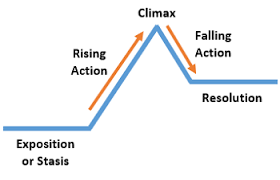
In fact, from early grades, we learn that stories have an arc — the exposition in which the writer provides context and sets the stage for the action, the rising action that introduces the conflict, the climax where the outcome of the conflict becomes evident, the falling action during which the loose ends get tied up, and the resolution that enables us to close the book and move on to the next story. The heart of every story is the conflict — the trouble drives the narrative.

The trouble, however, is not the story; the ways in which the character faces, weathers, endures, or learns from the trouble — that is the story.

Real life stories, too, consist of ups and downs, twists and turns, successes and failures, joys and disappointments. We expect these rhythms in the lives of fictional characters, but when we are living out our own life stories, we get can trapped in the mistaken belief that life is only good when it is free from trouble. When conflict is introduced — divorce, crime, illness, addiction — we can be tempted to believe that our story is over. Any writer knows that the introduction of conflict is the very beginning of the story.

The Wizard of Oz opens with a tornado that lifts Dorothy’s home off its very foundation, hurls it through the air, and lands it in a far away land with an impact that kills an evil witch. Talk about trouble! The story, however, is not about the tornado or the traumatic journey through the air or even about the witch, but it is about Dorothy’s ability to take step after step down the yellow brick road in a quest to find her way back to the people she loves.

The trouble is not the end of the story; it is the beginning.

Each of us has faced trouble. My close circle of friends could sit sipping coffee and share tales of betrayal, abuse, illness, financial ruin, scandal, and broken relationships. In fact, as we get to know one another, it is not typically our successes that we share but the troubles that have played out in our lives. Why? Because these times of trouble shape us. Just like Atticus’ defense of Tom Robinson revealed his integrity and his ability to keep his cool when an angry mob confronted him in the middle of the night, our experience with trouble exposes our inner grit — that strength that lies dormant inside of us until a moment of crisis requires it to surface. Dorothy would’ve never known that she was capable of standing up to the Wicked Witch of the West if she hadn’t been hurled through the air and found herself in completely foreign territory.

Trouble reveals what we are made of.

In the smooth sailing sections of my life, I have been tempted to think that I know all there is to know. I have lived with the mistaken belief that I have it all together — that I can handle life all by myself, thank you very much. I’ve even been prone to judge those whose lives are not sailing smoothly — certain that their trouble is the result of some fault of their own.

However, when crisis arrives in my life — and it surely does — I have to admit that I don’t know everything, that I can’t work things out by myself, and that trouble comes with or without my help.

One thing remains certain: times of trouble shape me.

That’s what conflict does. It allows the character in the story to be transformed — to be dynamic — to be reshaped. Dorothy arrives back home with a new gratefulness for the people in her life. Scout, having watched Atticus navigate the trial of Tom Robinson, gains a new compassion for those who have a different experience than she does. Me? I learn humility and reliance on God.

Trouble brings me to my knees and forces me to admit that I am poor and needy. From this position on the ground, heaving with sobs, I hear a still small voice: Be still. Know that I am God. I will never leave you or forsake you. My sobbing softens. I remember that I am but dust. I am not exempt from suffering. No crisis has afflicted me that is not common to man. And certainly this trouble is not the end of my story.

I whisper a thank you as I wipe my tears and push myself up to standing. I remember the words prayed over me many years ago, “Do not be afraid; do not be discouraged, for the Lord your God will be with you wherever you go.”  That is my grit. That is my inner strength that sometimes lies dormant but never fails to surface in times of trial. The strength of my character is not in my ability to have all the answers but in my realization that I have none of them. That realization keeps my pride at bay and allows me to turn for guidance and strength to the One who knew me before I was born and who has written every page of my story. He is not surprised by the trouble; He is using it to re-shape my character.

In this world you will have trouble. But take heart; I have overcome the world.”

John 16:33

Narrative threads, re-visit

This post, written almost exactly two years ago, speaks to my heart today. Though winter seems to keep blasting on, though we’re still quarantined inside our homes for almost a month now, all is not lost. My rhubarb has once again dared to break through the frozen ground to remind me that this plot has yet to fully unfold.

In Michigan this year, winter had stamina. It seemed to begin way back in October and continue halfway through April. The temperatures were low, the snow banks were high, the skies were gray, and all felt bleak.

My daughter once informed me, after I had been an English teacher for well over a decade, that when nature imitates the mood of the story, literary critics refer to the phenomenon as pathetic fallacy.  

We see it all the time in literature and movies: rain falls during funerals, the sun shines on parades, lightning flashes and thunder claps as the evil villain hatches his plan.  Writers use the setting of a story to create mood and to signal for readers how they might feel about the action of the narrative.

Sometimes it seems to happen in real life, too.

As the winter wore on this year in all its bleakness, and as circumstances in the narrative of my life unfolded, I took my signal from nature and wrapped myself in gray. I didn’t see any buds on trees, any new growth in my garden, or any other signals from nature that I should hope. I saw the earth hunkering down under the weighty blanket of snow, and I hunkered, too. I wrapped myself in crocheted afghans, drank cup after cup of tea, and waited for the earth’s axis to tilt once again toward the sun.

Some moments, I didn’t believe it would. I felt we were stuck in winter forever. Storm after storm raged. Winds blew. Temperatures dropped. The world outside was harsh and unforgiving.  I had no reason to believe that we would ever again see tulips sprout from the earth.

I didn’t, of course, spend the whole winter under covers. I did what everyone who lives in the north does in the winter. I slathered my body in moisturizers, layered on clothing, pulled on boots, hat, gloves, and coat, and trudged into the elements. Day after day after long, cold, dismal day, I drove over slushy roads, stepped in salty puddles, and scraped icy windshields. The cold gray weather was both real and symbolic.

The problem with pathetic fallacy — with letting the setting signal the mood — is that you can lose your frame of reference. All winter I was shrouded in gray, so all of the action in my narrative seemed to take on that hue. Now, to be honest, my life narrative is cluttered at the moment with conflict and unresolved tension. Villains too numerous to list are executing evil plans and threatening to harm those that I love. However, in the midst of the gray of winter, I failed to see that simultaneously, a parallel plot was unfolding — one in which battles are fought and won, victory parades are held, and loved ones are reunited.

All. is. not. gray.

It’s been hard to see that — what with winter lasting so long. It’s been easy to fall for the fallacy — the mistaken belief — that all of life is cold, dark, dormant. In fact, I have over the last several months been pathetic — filled with all kinds of emotion. I have leaned in and felt things that I have not allowed myself to feel for a very long time. I have cried and yelled and moaned because I have looked fully at one strand of the narrative. I’m not sorry; I needed to see it. But guys, winter is gone.

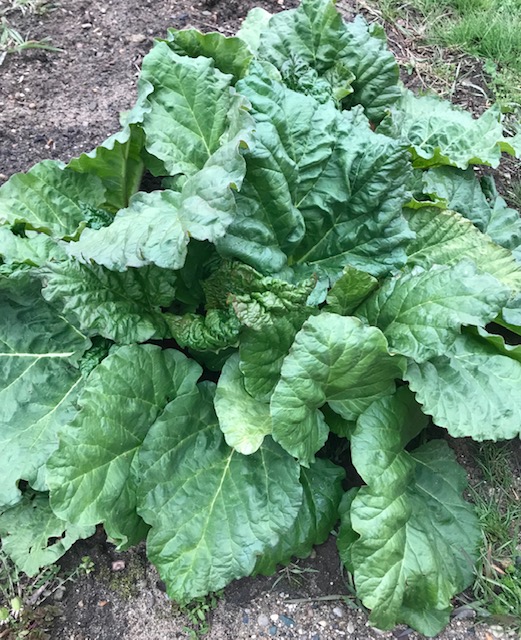
I have a rhubarb plant outside my back door that peeked through the soil on my birthday at the end of March. Since then, it’s been slammed with winter weather — snow, sleet, wind, and rain — and still it is thriving. My garden is a bed of weeds, my yard is a mole metropolis that is sorely in need of raking and mowing, but the sun is shining, and all I can look at is that rhubarb.

The villains haven’t dropped their weapons, the conflicts have not all been resolved, but one stubborn plant that pushed its way through frozen ground way before winter had subsided reminds me that there is more than one thread in my narrative.  I have reason to bake pie, to plant seeds, and to fold up my afghans.

Earlier this week when I arrived home from work, my husband said, “Before you sit down, go look at the patio.” I knew before I looked what I would find — the Adirondack chairs that my father-in-law made for us years ago had been put out after their long winter inside.

He had seen it, too: the sunshine, the rhubarb, the reason to hope. So hope we will, as we sit on our patio, faces tilted toward the sun, and we will let this season have a chance to direct our feelings about our narrative.

Psalm 27:13

I am confident in this: I will see the goodness of the Lord in the land of the living.

Corn chips, anyone?

Scrolling through Facebook this morning, I ran across a meme that said,

“Is anyone else just going through life like ‘I just gotta get past this last difficult week and then it’s smooth sailing from there!’ but like…every week?”

I chuckled.

I had just been reminiscing about how when we were first married every need we had seemed to cost $5.  We needed $5 for a last minute item from the grocery store to finish dinner for guests who would arrive in half an hour, $5 for the hardware to fix the door that wouldn’t latch quite right, $5 to contribute to the group gift at work.  Each item was just $5, but when we added them all up, the total pressed us.

Later, when our children were small, it shifted to $10.  A package of diapers was about $10, so was the team t-shirt, or enough burgers and fries at McDonald’s to feed three kids and justify their time in the Playland. It seemed we never had enough $10 bills to cover all the items on our list.

Before long, the price of ‘everything’ grew to $20.  Then it was $50, then $100. Each time we had an unexpected expense, we shifted, braced, ponied up, and prayed that if we just “got past this last difficult week” then it would be “smooth sailing.”

Back then ‘crises’ looked different than they look now, too. I remember the time, for instance, when my husband and I returned from a long day at our respective teaching positions, looking forward to the chicken dinner that had been roasting in the crockpot all day, only to find that I hadn’t turned the crockpot ‘on’ and that the chicken was still raw.  I thought the world had ended.  I had wasted “all that food”; certainly I was a failure as a wife.

Or the time when I had planned the menus for a three-day visit from out-of-town guests, budgeted carefully, brought all the groceries home, prepared the first meal, and discovered one of our guests snacking on the corn chips that had been purchased for the next day’s nachos. I dragged my husband into the bedroom and said, “What are we going to do? Now I don’t have everything I need for tomorrow’s meal!”  I was seriously distressed.

Over the years we have certainly weathered much worse that prematurely noshed nacho chips.  We have managed through many ruined meals, illnesses, broken hearts, car accidents, disappointments, and surprises.  And still, I keep hoping that this will be “the last difficult week” before we hit the period of “smooth sailing”.

We have had seasons of smooth sailing. Many. However, I haven’t seemed to grasp that “smooth sailing” isn’t what is promised.  In fact, it is far more likely that we will face “troubles of many kinds”.  The troubles are the given.  The reprieves are the unexpected blessings.  So why do I set myself up to believe the opposite?

I guess I want to believe the best. I am inherently a glass-half-full girl.  Yes, our finances are going to work out.  Of course, our children are going to be healthy.  Surely, we will be successful and well-liked.  Naturally, everyone will agree with us. I choose the path of hopefulness to a fault.

The problem with believing the best will happen in every situation is that I don’t always prepare for any alternative.  I don’t guard myself for the ‘given’ of disappointment.  I don’t store up for the days of famine. I believe that everything is going to run just how I planned. I don’t buy extra ingredients just in case; I buy exactly what I need. So, I’m often found standing, mouth agape, in shock that someone is standing there eating my corn chips.

But here’s the thing — people are going to eat the corn chips.

Now, I do realize that corn chips are not a big deal.  They are hardly even a $5 item. But the $5 items teach us what to do when we are one day faced with a $100 or a $1000 item (or even several of them all in the same week).  I can get pissed that someone ate my corn chips, I can ask them to run to the store and pick up another bag,  or I can simply say, “Oh, I’m glad you felt at home enough to help yourself!”

In trying out different responses to these $5 items, I am building resiliency–muscle–that will sustain me when I am hit with a more substantial crisis — someone I love is hospitalized, or we discover we owe Uncle Sam a lot. Again. Or we lose a loved one, or get a life-altering diagnosis.

We face troubles of many kinds. All of us do. All the time. My troubles seem huge to me right now. So do yours. Our hearts are broken in a million places and we are devastated. We’ve been lied to, cheated on, forgotten, abandoned, mistreated, and deceived.

The corn chips pale in comparison, don’t they?

But the $5 problem and the corn chip crisis have a lot to teach us.  I wish when I came home to the cold chicken in the crock pot my first response would have been, “Ok, God, what’s for dinner now? And what do you want me to learn from this?” Instead, if I remember correctly, I spouted lots of self-deprecating phrases, stormed around the house, probably cried, and ultimately got a pizza. It’s ok. I had a human response. However, I think that ultimately God wants more for me than self-blame, shame, and anger. I believe that in my $5 problems and my $100,000 problems, God longs for me to look to Him.

What if, in every decision, instead of mustering my resolve and believing that I myself will be able to manage every situation, I instead turned, raising my eyes and my hands to God, and admitted that all of it is too much for me?  What if I acknowledged that my pennies and my corn chips all come from God?  How would I experience life differently?  How would I weather crisis and even trauma?

I’m not too old to learn a different way.  Honestly, I’m given opportunities every day.

If you are in the habit, as I am, of kicking butts and taking names, of putting out fires on the fly, of keeping multiple plates spinning, of trying to handle everything on your own, this type of change will be a challenge.  The impulse in every difficult situation is to be a first-responder — to stop the gushing blood, provide oxygen, perform compressions, and avert any casualties.  Fighting that impulse is hard, especially if ultimately you are truly the only one who can help.  But here’s the thing: God has every situation in the palm of His hand. He’s got it. He can handle everything for the few moments it takes you to pause, look Him in the eyes, and ask, “Is there something you’d like me to do here?”

That’s all. Just pause and ask Him.  He may say, “Stand by. Help is on the way.”  He may say, “Yes, I really need you to stabilize this situation until help arrives.”  He may say, “Stand down.”

Mm.  This soldier certainly does not like to be told to “Stand down.”

But. If I trust that God has everything in the palm of His hand and that He alone knows the best course of action, don’t I want to check with Him before I act? Before I pay the $5? or before I lose my mind about a stinking bag of corn chips?

It sounds pretty simple when I put it like that, but I’m telling you, this is the lesson of my life. It’s about time I learned it.

John 16:33

I have told you these things, so that in me you may have peace. In this world you will have trouble. But take heart! I have overcome the world.”

Bits of Truth, Re-visit

In Monday’s post, I shared how my pastor’s words on Sunday connected so strongly with me and how they were able to help me start to shake off the funk that had settled on me. I remembered what he said because I scratched down his words in a small notebook I carry with me to church for that purpose. I am continually writing down the words of others when they strike me as bits of truth. I share some of those with you here in a blog post originally written in April 2018.

Words matter so much to me. I realize this is pretty obvious: I do put a couple thousand on this page every week, and my chosen profession requires me to use tens of thousands  every day.

I love words; I’m drawn to them.

I typically read several hundred pages of fiction and/or non-fiction every week, and when I see words arranged in a way that resonates with me, I use my iPhone to snap photos of them. Whenever I gather with two or more, I arrive with a notebook and a pen, prepared to write down the meaningful and the trivial. I scratch out notes at work, at church, and in my small group.

I spend my life surrounded by words, and I tend to horde them. As I was making my way to this space today, I grabbed my phone, a notebook crammed with sermon notes, a book I’m reading, and scraps of paper strewn on my desk. What do these items have in common? They all carry words that I have gathered from one place or another and “carried home” with me. One bit of paper travelled all the way from my trip to St. Louis last November. Another is from a visit to Cincinnati about a month ago. (My shoes and toothbrush might not have made it home, but these scraps of paper not only survived the trip, they have remained on top of my desk through several frantic clutter-clearing purges.)

What could they possibly say that would validate my gripping them so tightly?

The one from November, which I scribbled while sitting in church with dear friends, says “I can have hope that He will redeem my loved ones and me and my community.”

The paper I shoved in my pocket after church last month in Cincinnati says,  “Lord, if you don’t do something here, we are in trouble.”

In my notes from our small group Bible study I find, “This life is unsettled and incomplete,” and “hope wins.”

Last night, I started Jodi Picoult’s small great things. I opened the cover and read these words from James Baldwin, “Not everything that is faced can be changed. But nothing can be changed unless it is faced.”

Pithy phrases all. Concise. Succinct. Power-packed.

Why do I store these clusters of words?

Because in the emotional haze in which I have been existing, I wander around searching for beacons of truth. And, for me, truth is usually found in print. I don’t write down every word I see, but when I see words that speak truth, I capture them. I hold them. I carry them around.

Here’s why. Emotions are powerful. They are expressions of deep feelings that need to be experienced, but they don’t always tell the truth. My emotions tell me that all is lost, that hope has died, that everything counts on me, that I’m the only one with problems, and that none of this will ever work out. I weep on my bed and get so carried away by my tears that I never want to stand up again. Overwhelmed with sorrow, I reach out my hand and grab something to read to quiet myself. Without fail, I find some shred of truth that breaks through my exaggerating and misled emotions.

I find myself speaking out loud:

All is not lost; God will redeem my loved ones and me and my community.

Everything does not count on me; Jesus is doing something here.

I am certainly not the only one with problems — despite what social media wants me to believe — but my only chance at working through the problems I have is to face them.

All of this will work out. Sure, life is unsettled, but hope wins.

My pulse slows. My breathing returns to regularity. I close my eyes and move toward sleep.

Yes, I feel dark things still — anger, sadness, grief, and pain. These feelings are valid,  and I will quash them no longer. I will sit with them. I will feel them. And, I will speak truth to them. I will not be overcome.

“I have said these things to you, that in me you may have peace. In the world you will have trouble. But take heart; I have overcome the world”

John 16:33