Life These Days

The question of the moment around folks my age — and for the record, I’m just shy of 60– is “how much longer do you think you’re gonna work?”

My most frequent response is often something like, “I’m not in a hurry to be done. I love what I do. I hope I can stay at it a while!”

This is, of course, not how everyone feels. Many my age have put in a long, hard 40 or more years of work in jobs and careers that have taken a toll — physically, mentally, relationally, or in other ways that might make a person want to walk away.

Let’s be honest, if you’ve spent 30-40 years on an assembly line — you might be ready for a change of scenery. If you’ve led a corporation and had the weight of the bottom line, personnel challenges, and inventory management on your back, you might be ready to sit by a pool, sipping a cool drink. If you’ve been in a classroom for 40 years — attending to the needs of children, designing instruction, managing behavior, and adapting to continuously changing policies, cultural norms, and learning challenges, you might be ready to just have a day that doesn’t involve managing anything but yourself.

And while I have certainly had my challenges and seasons of disillusionment and burnout, none of those scenarios truly describe me. After working in many different settings over the years, I find myself in a role that feels like a culmination — the place I was intended to arrive at, so I don’t find myself asking how much longer I want to work, but rather: When I look back at all I have learned, what do I have to offer these days?

In the early years — the first 3-5 of my career — bravado carried me past insecurity so that I could survive in situations that were way outside my experience. A middle school special ed classroom in Detroit? No problem for this secondary English major from small town Michigan! A self-contained classroom inside a residential facility teaching not only ELA but also social studies, math, science — I got this! I faked my way through and while I can’t say that my students (or I) won any awards, everyone learned something — including me. I learned about being overwhelmed and about working with limited resources. I learned to lean into the uncomfortable and to try just about anything. Did I occasionally lose my shit and come undone in front of a classroom full of typically behaving students? Sure. Did I also take a van load of Detroit teenagers on a day-long adventure to Ann Arbor? Yes, I did! Did we overfill our day with activities? Absolutely! Did we arrive back to school late after dismissal? We sure did! Did those kids and I have a ball touring a college campus, going to a hands-on museum, and eating at Pizza Hut? Yes! Rookie me swung for the fences, folks.

The bravado only carried me so far into my years at home with my own children. In fact, I think it was day one home from the hospital when I called a friend emergency-style to come save me because nursing wasn’t working out according to plan. I wish I would’ve admitted right there and then that I was clueless about mothering, but faking it until I made it was my theme song, and I just kept singing. Before I knew it, I was sitting on the living room floor with three children of my own, reading stories, learning letters, and playing games. Those days were exhausting and precious to me! We had a lot of fun, but I was making it up as I went along, so I certainly made plenty of mistakes. I pushed myself and the kids way too hard, and I expected way too much, but in continuing to give it everything I had, I learned how to schedule out a day that included learning, adventure, rest, and play; how to turn a few hot dogs and some popcorn into a baseball watching party; and how to get through a puke-filled night with little to no sleep. I learned that I could manage much more than I imagined, that I had a lot of people who were willing to help, and that it wasn’t a weakness to ask them.

When I returned to the classroom the first time, it was to a position that was far bigger than my experience — the English Department Chair and Dual-Enrollment ELA teacher at a small private high school. Not only would I, once again, be faking it ‘til I made it, I would be doing so all day long in a new environment while I was also still —at home — learning how to parent my own children who were in the process of transitioning from childhood to adolescence in a new home in a new city in a new state.The lift in both arenas was immense, but I was gonna make it happen. I learned a curriculum, read dozens of books, short stories, poems, and essays and adapted to a modified block schedule and the world of Apple computers while I also navigated the needs and ever-changing emotions of a family that was struggling to find its footing. For nine years, it seems, I was in constant motion — either preparing to teach, teaching, or grading in one space or cooking, cleaning, driving, scheduling, or otherwise parenting in another. Those years seem like a blur as I look back, probably because I never stopped running.

And then, all the motion came to a halt. Readers of this blog know that those years ended in an autoimmune diagnosis and an exit from the classroom followed by convalescence and a [next chapter] of re-learning how to live which landed me where I am now.

I came into this season humbled by the knowledge that I did I have a limit, and that I did not indeed know everything. When I was offered the position to teach ELA at a small charter high school in Detroit, I was grateful to be in any classroom at all. The fact that it was familiar territory — teaching seniors about college and the skills they would need to be successful — meant that I would NOT have to fake it til I made it. I could just be the authentic me, sharing what I know and loving the students who were in front of me. Granted, I still had much to learn — our school has an instructional model that was new to me, and I would, for the the first time in my career, have a coach, but none of that was overwhelming. In fact, it was comforting to know that I had support and that I wouldn’t have to find all the answers on my own.

That was over five years ago, and now I’m no longer teaching but coaching other teachers who may be in their very first year or nearing their 10th or 20th year. Some of them are faking it until they make it, some are disillusioned, and some are managing a lot in other areas of their lives.

I have a front row seat to their experience and that’s why I’m asking myself this question: What have I learned and what do I have to offer these folks?

I’ve learned that showing up and doing your best goes a long way — even if your best isn’t amazing, it’s likely good enough.

I’ve learned that being brave can lead to remarkable opportunities that change you forever.

I’ve learned that others are willing to support you if you are willing to ask.

I’ve learned that family is much more important than work and that your health needs to take priority over any perceived deadline.

I’ve learned that who I authentically am is much more valuable to my students and the people I love than getting every decision right or accomplishing every task.

I learned these things the hard way over the last many years, and maybe these folks — the people I rub elbows with every day and those that I coach — will have to learn them the hard way, too.

I think what I have to offer right now is the empathy and compassion gained from my own journey. I have a rare opportunity to offer support and encouragement, and the wisdom that comes with each of these gray hairs.

I’ve got perspective — each day is important but no day is definitive.

I’ve got plenty of gas left in the tank to come alongside the members of my team, to see their passion, their frustration, their hope, and their fatigue. If they are willing to keep showing up, I will, too.

Maybe I’ll get a chance to share what I’ve learned. More likely, I, too, will learn something new.

Teach us to number our days, that we may gain a heart of wisdom. Psalm 90:12

Back to School: Before and After

I write a post like this almost every year — scroll back, you’ll see! Each fall, I can’t stop myself! I’m still filled with the child-like wonder and excitement of going back to school. I mean, yeah, I had outfits picked out, bought a new pair of school shoes (okay, two pair!) and kept them fresh for day one (and two!). I had my classic teacher terror nightmare — only this year it wasn’t me showing up naked, late, and unprepared, it was my teaching cohort! And I’m here to tell you that the stress was not less!

I get so excited about the return to school because it holds so much possibility — imagine the potential for transformation!! And in any story of transformation you need the “before” pic. Let me see if I can paint it for you.

The students first showed up on the Thursday before Labor Day. I can spot the freshman from a mile away. They shyly and awkwardly accompany their parents and older or younger siblings. They stand quietly as their people sign them in, looking around to see who else is there, who is looking at them, who is judging them, who can see their insecurity.

Sophomores roll up with slightly more confidence, sometimes with a parent tagging along ten paces behind. These students steal glances, seeing what looks familiar — teachers, friends, anything.

Juniors have just a hint of swagger — they know the drill — they know who’s who, what’s what, and where’s where. They quickly run through the requisite stops — schedule pick-up, bus sign up, sports physical — then find their friends to take laps inside the building, check out new students, get into a little harmless mischief, or do a little peacocking.

Seniors? You can’t tell them nothin’. They have their hair done, are wearing a dope ‘fit, and have texted their friends to arrive at the same time. They run this place — they are beaming and bouncing. This is their year and they know it.

And that’s all on the Thursday before school even starts — before the three-day weekend, before reality hits, before they have to arrive on time, sit in an assigned seat, do the coursework, take notes, stand in lines, or listen intently.

But all that has begun now, too. We have finished a week of students being in the building, running to get to class before the bell, asking permission to use the bathroom, looking for a snack, trying to hide their phones, getting caught with their phones, turning over their phones, and waiting to get their phones back at the end of the day.

They came in on Tuesday, and we were ready for them.

Our teachers had on shirts emblazoned with our Activate Excellence motto, arriving early to put finishing touches on their rooms and man their stations in the gym for arrival. We had some teachers collecting phones, some handing out schedules, and some stationed as greeters. There were hugs and fist bumps and hand shakes with our returning students, so it wasn’t difficult to pick out those who are new to our building — freshmen, of course, but also quite a few transfers.

In Detroit, a district with over 50,000 students, most high schools have enrollments of over 700, and some have over 1000. Our charter high school is small — under 300 students — so we often get students who found those larger contexts to be untenable. Maybe they were overwhelmed. Maybe they didn’t find a connection or friend group. Maybe they got into a fight and are now dealing with the aftermath. Whatever the reason, we often end up with a unique collection of students who for whatever reason couldn’t or didn’t want to make it happen somewhere else.

We’re a charter school — so students choose to come to us. Granted, sometimes that choice is because they have run out of other options, but I like to think they choose us because we are a small community. Everyone knows everyone else — no one goes unseen. If you came to school without a jacket, someone saw that. If you look particularly down or quiet on a given day, a person noticed. You’re hungry? You know who to ask for a snack. You don’t have a ride home? Chances are you have a connection with a staff member who will help you figure it out.

Changed your hair? We saw it.

Grew up over the summer? We know.

Your ability to manage conflict is improving? We give you kudos.

Let me give you a glimpse at an “after” pic.

For the past four years, we have had a student in the building who was classified as “homeless” and qualified for resources under the federal McKinney-Vento Act. Last June, this student graduated despite having transportation challenges, learning difficulties, and very little family support. Staff at the school made it possible for him to attend prom and participate in all senior activities, and the young man was repeatedly overwhelmed with gratitude. When he walked into our decision day celebration in early May, he hugged several of us and wiped away tears. When he arrived at prom, he approached staff members, tearfully repeating, “I can’t believe this is actually happening!” and when he showed up for graduation, he could barely find words. He savored every moment, and his classmates and teachers saw it for what it was — the realization of a dream.

On that day, he didn’t know what his summer or future would look like. Because of his situation, he was having difficulty getting access to the documents that would make him work eligible, but late in summer we received word that he had what he needed and had found employment in a hospital. This past week, he reached out to one of our staff members and said he was working a lot of overtime and was looking for an affordable apartment.

The staff member reported this in our group chat, and I must say that in the middle of a school day at the end of the first week of school, when everyone is getting tired and ready to go home for the weekend, that little notification reminded us all what a special place we work in.

Just four years ago, this young man was one of our awkward freshmen — he missed a lot of school days, and we noticed. He often came unprepared to learn, and we said something. He had the support of a friend who got him to the building every day, but he came late and left early. It was frustrating, to be sure, but we found ways to work with him. He had the support of the social worker, the principal, the resource room teacher, and literally every single adult in the building. It was not uncommon to see him checking in with one of our custodians who might as well be everyone’s momma.

And now he’s a high school graduate, he’s got a job, and he’s looking for an apartment. If that’s not a transformation, I don’t know what one is.

I guess that’s why I get excited every September — that’s why I can’t stop writing about it. Every day is a miracle waiting to happen. I can’t believe I get to do this. Just like my student, “I can’t believe this is actually happening.”

[We] will see the goodness of God in the land of the living. Psalm 27:13

Job Postings at DLA!

DLA Wishlist

Finding a Footing

At the end of the last school year, as I waved goodbye to students and wished my colleagues a safe and restful summer, I was envisioning long days of reading broken up by an hour here or there with my hands in the dirt — weeding our garden, tending to our plants, and bringing in the fruits of our labor. I saw days on the beach of a great lake and others poolside with our granddaughters.

While I did manage to experience all of that, much of my summer was not what I was expecting. At all. Particularly not when, just a month ago, I was searching for an assisted living facility for my stepfather, helping my brothers move him in, being present for his rapid decline, then processing with my mom and siblings through his passing.

The flurry of activity was unanticipated and un-mooring. I’ve felt a little tossed about for several weeks, so the return to the rhythms of back-to-school prep of the past many days has been a welcome and anchoring exercise.

As I’ve been walking the hallways of our school buildings, I’ve been wondering if our students, too, have felt a little at sea. What has their summer been like — have they been working? helping out at home? have they had plenty to eat? time and space to rest? have they experienced loss? or trauma? joy? or celebration? Has their summer been what they were expecting? Are they, too, in need of the rhythms that will bring stability?

Because I’m not teaching this year, but rather supporting our teachers and students from a more global perspective, I’ve been managing tasks all summer like updating scope and sequence documents for various courses, familiarizing myself with the curricula taught in our building, creating Google classrooms for all of our teachers, updating our school’s testing plan, organizing and auditing the curriculum I created, and managing several other tasks. Over the last couple of weeks, I’ve also been preparing presentations and materials for the teacher orientation that begins this week.

As I’ve been checking all these boxes, I’ve needed some support (and grace) from my supervisors to reconnect with the world of school, to remind me what each of the pieces are exactly, to steady me as I find my way back to the vernacular of academics — to norms and standards, to unit plans and instructional strategies, to engagement and discourse.

I’m guessing that our teachers and students are going to need support (and grace), too. Certainly their summers have been far from the academic realm — less structured or predictable. Sure, some of them have punched a clock or had regular eating and sleeping habits, but many will have had no routine at all. Surely few, if any of them, will have sat in a desk, attended to a slide deck, navigated to a Google classroom, or submitted a document for review.

Transitioning away from my erratic summer to more routine work has not been easy nor has my body been quick to adapt. While I’m being quite diligent in getting back to eating three meals a day at the designated times and observing my normal bedtime, my body is still on high alert after weeks of urgent phone calls, last minute trips, and unexpected decisions. My digestive tract is suffering from role confusion, and my sleep patterns remain inconsistent.

Perhaps the bodies of my students and teachers, too, will be a bit out-of-kilter. Perhaps they will find it difficult to endure a seven hour school day, to sit upright for long stretches, to use the restroom at designated passing times, to make it from breakfast to lunch without a snack, to remember to get a drink between classes, or to stay awake for the entire day.

I’m finding a few things helpful in my regulation. First is seeing my people. As I’ve gone into our buildings over the last few weeks, I’ve reconnected with my colleagues, many of whom have offered hugs both of “I’ve missed you” and “I’m sorry for your loss.” We’ve shared stories and laughter as we’ve navigated our tasks.

I’ve found stability in the familiar — the drive, the building, and the faces.

I’ve found comfort in the physical — walking into my office, arranging my supplies, moving books, and touring classrooms.

I’ve found security in doing what I know how to do — creating a document, sending an email, meeting a deadline, planning a presentation.

I’m thinking about how I can use my experience of re-entry, my realization of what I’ve needed to re-acclimate, to support my teachers and students as they move from what also may have been erratic to what is more routine.

We already engineer the first week to be less about curriculum and more about connection. We are a trauma-informed organization, after all, and we know that Maslow comes before Bloom. We have a system of delivering school-wide norms and expectations, and we support teachers in integrating warm-ups, games, and getting-to-know-you activities. The first week is all about learning names and building community. It’s an opportunity for our students to get a literal or metaphorical hug– to reconnect with their teachers and classmates.It’s a time to situate themselves inside of the familiar — not only the building and its classrooms but the bell schedule, the movement patterns, the physicality of being in the space, and the kind of routine assignments that warm up muscles and build confidence.

How can I normalize the weirdness of it all — how our bodies and minds take time to adapt, how we may feel irritated, foggy-headed, tired, and out-of-sorts? The best way I know is to name it — call it out — talk about it.

Our teachers and our students may need the leaders in the building to acknowledge the heavy lift of transition — of moving from the summer-realm to the world of school. These worlds are not the same, and the move can be jarring. For me, back to school has always been a comfort — school is a place where I know how to be, what to do, and how to succeed — but it’s not like that for everyone. For some, school is an increase in stress, a place of conflict, a world of insecurity.

So, in my new role, I think one thing I can be is present — observing what is happening for teachers and for students, being willing to acknowledge that what they are experiencing is real. Of course you’re tired! Coming back to school takes a lot of effort! Yes, this is a lot of information to take it all at once, and our summer brains are not used to it.

I can also offer compassion. I get it! My body is still adjusting to the school day, too! I can cover your class while you run to the restroom. How can I support you in getting your documents completed on time? Would you like to tell me about what you are experiencing?

That’s the benefit of my role — I’ve got a head start on my teachers and my students. I have had a preview of what they might experience in the coming weeks. Now that I am feeling a little more stable, I can lend some of that to them as they transition. I can be a reminder that they will soon be settled in as well.

That, and I can make sure that my snack drawer is full, because I can bet that soon I will be hearing both teachers and students say, “Mrs. Rathje, you got anything to eat?”

I’ll be ready for them; I’m getting closer each day.

put on compassion, kindness, humility, gentleness, and patience. Colossians 3:12

**If you’d like to support what we do at Detroit Leadership Academy, here is a current wish list

Rested and Ready for a new Rhythm

I wrapped up school year 2024-2025 –watched another group of seniors cross the stage into adulthood, entered final grades, and cleaned up my classroom.

Next, I joined my husband in clearing the clutter in our home.

Then we left town for two short treks — one to play with our granddaughters in Ohio and another to lie on the beach of Lake Huron. We crossed the miles listening to podcasts and chatting about everything from family to politics to music to our future. With our grand girls we lazed in the pool, played Uno and Skip-Bo, and were entertained by intricately choreographed dances. Near the beach, we ate well, slept long, took leisurely walks, and lost track of time.

They were luxurious and welcome — these two little trips back to back — and now we are re-entering real life. Since we’ve returned home we’ve been in the business of unpacking, doing laundry, tending to yard work, and taking stock of the new rhythms we are noticing since a) my husband transitioned from an almost four-decade-long career in church work to a private counseling practice and as b) I am making the shift from classroom teacher to full-time instructional coordinator. Some of the work each of us does in our new roles is similar to what we have done in the past, however, the routines and workloads are quite different. While he has been adapting to his new rhythm for over eighteen months, my real shift begins this week as I embrace the responsibilities of my new role.

How will it be the same? How will it be different?

What won’t change is my morning commute — I will still drive 30 minutes east from Ypsilanti to the edge of Detroit. I will park my car in the same spot, work with many of the same colleagues and students, and follow the same daily bell schedule and school year calendar. I will also continue to serve on our school’s leadership team, meeting at least weekly to plan initiatives and events, troubleshoot current issues, and collaborate toward best practices for our building.

However, many things will change — I will no longer have my own classroom. I will no longer have my own students or a grade book or lesson plans or the responsibility for all that happens inside a teacher’s classroom through the course of the day — behavior management, attendance, organizing materials, and managing the constant flow of information.

I will have plenty of new responsibilities on my plate. In addition to coaching the instructional moves of a handful of teachers like I did last year, I will also be partnering with those teachers to unpack curriculum, analyze assessments, and plan instruction. Further, I will be our building’s testing coordinator, responsible for all things PSAT/SAT, ACT Workkeys, and MSTEP.

All of this, of course, is in the interest of our students. I came to this position because I recognize the systemic inequities in American education that have benefitted some students (mostly white and affluent) and have disadvantaged others (mostly low-income and/or students of color). I wanted to lend my years of experience and expertise in service of closing the gap that continues to widen; I wanted to provide a high level of instruction and rigor for students who have, through no fault of their own, fallen multiple grade levels behind their peers who live sometimes just a few miles away.Over the past five years, I feel I have had limited success. I have, within my classroom, provided glimpses of rigor, moments of engagement, and small gains for individual students.

However, individual teachers in isolation cannot overcome centuries — literal centuries! — of harm. They do make a difference, of course, but for the sweeping change that is needed, we need a broader — a more systemic — solution.

I joined the team at my school in August of 2020. Covid had sent all of our students home the previous March, and because of the disproportionate impact on low income communities of color, particularly Detroit, our district provided instruction virtually for the entire 2020-2021 school year. The administrative team was making it up as they went along, and I — a teacher returning to the high school classroom after a six year hiatus — was enthusiastic about giving it my best. I popped into Zoom rooms, chatting with any students who would talk to me, leading lessons, and providing office hours every afternoon. We didn’t close any systemic gaps that year; we merely did what we could to slow the ever-widening distance between our students’ academic progress and that of those in neighboring districts.

The following year (2021-2022) , fully masked, we returned to in-person learning, bouncing back to virtual instruction several times throughout the year. It actually took us that year and the next (2022-2023) to re-establish routines within the building. We were on pretty solid footing as we started school year 2023-2024, but some mid-year leadership changes kept us from moving too far forward.

The standardized test scores told the story — about a tenth of our students were proficient in English Language Arts and none — 0% — were proficient in math. Our staff took in those realities as our newly appointed principal delivered them before the return of students in the fall of 2024. She gave us the hard truth and then cast a vision for us — we, the staff and our students, would activate excellence. We could no longer allow this to be the reality for the students in our building — things were going to change.

And, over the year I did see evidence of shift — in attitude, in practice, in thinking. However in order to overcome systemic inequities of the proportions that I have witnessed, we need a reimagining of what school likes like in our context. The principal sets the tone, and she has. The leadership team has come alongside our principal, supporting her vision, agreeing with the need, and implementing strategies. Staff members have also caught the vision, to a degree, but the kind of transformation that is needed is going to take the whole team — every teacher, every paraprofessional, every custodian, every social worker — to activate excellence, consistently and continuously, day in and day out.

Certainly in my own classroom, I have strived to provide excellent instruction, to have high expectations, and to inspire my students toward greatness, but I will admit that my efforts have sometimes been inconsistent. I have grown tired, and I have from time to time been merely mediocre. However, as I step into this role, I have been given an opportunity to activate excellence beyond my classroom — taking care to do my very best with the responsibilities I have been given, and to bring other staff members along with me.

I will push my team of teachers — some of whom are experienced, some who are brand new — toward excellence. Together, we will grow this year, beginning by building relationships, but then quickly moving into strategies, into accountability, into doing whatever it takes to activate excellence for our students — to give them the tools they need to move forward into their futures.

It’s a big job, but I’m rested, I have the vision, and I’ve been equipped. May God grant me the strength to persevere, the compassion to both see and inspire my team, and the heart to sustain my insufferable belief in restoration.

He is faithful, and He will do it. I Thessalonians 5:24

The Unexpected

We never know what’s coming next, do we?

I was sitting in the naivety of January, setting goals for the year when I thought, “I know what I’ll do this year — I’ll post a vintage blog each Thursday and new blog most Mondays. That sounds like a great way to mark ten years of consistent writing.”

It was easy to begin, in the newness of the year, in the freshness of possibility. I was sitting there in early January gazing into a new season with my husband retiring from public ministry and transitioning to a private counseling practice. I was anticipating a slower pace after over thirty years of busy-ness.

And the year did indeed begin with a tone of spaciousness and possibility.

But we never know what’s coming next, do we?

We didn’t know that in the next couple of weeks his mother would be diagnosed with stage four liver cancer, that my stepfather would be diagnosed with stage 2-3 bladder cancer, that one of our kids would have a serious medical episode, that another would be starting a new job, and that another would be in the midst of several major life transitions.

We couldn’t anticipate all of that.

And it’s hard to know the emotions that such realities will bring up — shock, sadness, grief, anger, fear, worry, excitement, anxiety, joy, and even pride. But that whole chorus shows up and begins to take space in one’s body.

As each reality fleshes itself out — the reality of hospice, of surgery, of chemo, of diagnostics and medical leave, of transition and opportunity, of waiting and adjustment, those emotions jostle and elbow at each other, struggling to claim territory.

And one can’t anticipate how all that internal jostling will impact one’s external capacity for resiliency, for patience, for empathy, for tenacity.

So this past week, now that I am sitting with all these emotions and still struggling to accept all of these realities, after two weeks of testing students and selecting two new cohorts of reading students, after transitioning them to my class, and after working intentionally and diligently to gain their buy-in, I got an email directing me to test more students. Although I had selected enough students to meet the 10-student capacity of both sections of this course and two alternates, two of those students had unexpectedly elected to move to virtual instruction making it impossible for them to join my class and another two, along with their parents, had opted not to join the class. Consequently, my classes were both at 9 students — each one short of capacity.

As I read the email, I became annoyed. My classes were already in progress. I was already building community and establishing expectations. Couldn’t we just proceed with 9 students in each class?

Couldn’t my administrators see that although my classes weren’t at capacity, I was certainly at capacity?

I, ever the dutiful employee, uncharacteristically ignored the directive for a beat. Then, I replied to my principal somewhat pointedly that if he wanted to identify a few more students for me to test, he could be my guest, but I didn’t think any others would qualify.

Yup. I had a tone. It was a warning flag, to be sure — I was past my limit.

I had too many emotions crammed inside of me, they could no longer jostle for space, so they started seeping out in irritability, in pettiness, in sarcasm.

I was in a funk, and I couldn’t see a way out.

Nevertheless, at the end of my school day, I decided to call my son to check in. I hadn’t spoken to him for a while, and after he gave me a quick update, he asked, “How are you doing, Mom?”

I signed out a deep breath and said, “I. am. weary.”

And he replied, “I bet you are.”

And that little sentence, that acknowledgement of all that is going on, that validation that I am in fact at capacity, created an opening.

He allowed me to share just a little bit, some of those emotions found a passageway, and others were allowed more space to dwell.

That small offload allowed me to move through the next day with civility, however, I still had no intention of adding students to my course. The issue wasn’t resolved, though. As I left the building on Thursday, I got a text from my principal that a directive had come again to add more two more students.

I shot off a text, trying to veil my annoyance with professionalism, “Please let me know if you want me to look at the data again. I am moving forward with planning instruction for these classes, but if you think I need to go back I will.,”

I really wanted him to respond with, “No, no. You’re right. Move forward,” but instead he said, “If you can; I am too. Maybe there are kids right on the cusp that would opt in. Thank you so much.”

Argh. My defiance had gone on too long. The responsible core of my self rose up.

I grudgingly sorted and resorted the data and found a group of kids that hadn’t yet been tested and that met our criteria for the class. I sent him the list, reluctantly offering to test the ones he thought I should

By the next morning, he had chosen his top three, but after a search of the building, it appeared none were present. It was Friday morning, typically our lowest attendance day of the week.

I met up with the principal in the hallway and he invited me into his office. He said he wanted to touch base — how was I really doing with the directive to test more?

“It’s fine,” I said. “I get it. I am just at capacity with stuff going on in my personal life, and it is leaving me less capacity for stuff here at school. Every little thing is annoying me — the chaos in the hallways, the broken up parking lot, my unswept classroom floors, and this directive to test more when I thought I was already done. Normally this stuff doesn’t get to me, but so much in my family is outside of my control, I think I am looking for ways to find control here.”

He already knew about some of the stuff going on in our family, and he said, “I get it. I’m sorry you are dealing with all of this in your family. Also, these work things are annoying. How can I be a support to you?”

There it was again, the acknowledgement that my feelings were valid, and really that was all I needed.

“I’m good for now. Thanks for hearing me. I’ll find a way to test these kids, and I won’t be a jerk to anyone.”

“Thank you,” he smiled.

I did find a way to test one of the students later that day. I had no way of knowing that she could barely answer comprehension questions at the first grade level. I couldn’t have known that she was more than willing to join my class. I couldn’t have known what a gentle spirit she was.

We never know what’s coming next. Sometimes when we take the next step, we get a pleasant surprise.

No matter what is coming next — no matter if our parents have cancer, if our kids are going through transitions, no matter how little control we feel that we have — we can trust that we are always being prepared for it — that is my experience — I’m always being prepared for what is next.

A few years ago, when my husband and I were in the midst of one of the most challenging seasons of our lives, we reached out to a dear friend in the early hours of the morning. We shared with him our current reality, he heard us, he paused, and then he said, “None of this is a surprise to God,” and that was a comfort to me. Even though I hadn’t known what was coming next, surely God had known, and He had been at work in our lives to provide in advance everything we would need for that season. Even though on that morning all seemed hopeless, God did carry us through that season and provided miraculously for us along the way, just as he had through every other difficulty in our lives.

And so, as we face this uncertainty — of caring for our parents in ways that we never imagined, of encouraging our adult children in their own uncertainties — we can trust that we are ready — everything that we’ve experienced up until this point has prepared us.

And we are not alone. We have people around us who will hear us, and we have a God who is going before us, making a way, andproviding everything we need. He who will be with us in everything that is coming next.

Do not be afraid or discouraged, for the LORD will personally go ahead of you. He will be with you; he will neither fail you nor abandon you.

Deuteronomy 31:8

We Don’t Know Everything, a Reprise

You may have seen that I’m running a Thursday series called “10 Years Later” — a weekly reposting of something that I’ve written in this space over the last 10 years. This past Thursday, I re-posted We Don’t Know Everything, a reflection I wrote in January of 2015 about how if we knew everything that would happen in the wake of a major life decision, we might choose differently and how our limited vision allows us to step out in faith that God will provide for every eventuality.

I re-read that post again this morning, and it feels particularly apropos in this moment.

Over the years, we (like you) have made many major life decisions — the time I enrolled in graduate school, for example, or the time when we quit our jobs before securing new employment because it was just that important for us to move closer to our oldest son, whose other family had just relocated to the west side of the state.

When making these decisions, we look at the information we have in the moment, try to anticipate future needs, and make the choice that seems to make sense.

When I enrolled in graduate school in 2002, our younger children were in 1st, 3rd, and 4th grades. I thought that since I had been home with them for the last 10 years, it might be wise to ease in, maybe take one class at a time, in order to put less strain on the family. My husband disagreed. He said, “If you are going to do it, I suggest you go full time. Fully immerse yourself. We have no idea what is coming next.”

I was kind of surprised that he was willing to make that kind of commitment because I knew that in addition to his full-time ministry position, he would have to pick up more of the burden of caring for our children — after school pickups, homework, dinner, etc. But, if he was willing to do that, I was willing to — gulp — take three graduate courses at a time for two years.

We didn’t know at the time that we would, just two years later, be moving to St. Louis for him to attend the seminary. Turns out, I finished my program about one month before we moved. And because of that degree, I was situated to easily secure immediate employment, first teaching at a community college, then at a public high school (once I had obtained my Missouri teaching credential), and then in the Lutheran high school that would become such a formative place in my career.

When, in 2013, my health was very poor, and it was becoming clear that I could no longer sustain my role in that school, my husband was offered a position here in Michigan, and although it was our daughter’s senior year of high school, the position was such a good fit, that he decided to make the move ahead of us to not only take this new role but also to prepare a space for me to land when she was finished with high school and situated in college. We didn’t know how desperately I would need to convalesce, but that decision which was very difficult given that he would miss large portions of her senior year, set us up for a season of healing, not only for me but for our whole family.

It was that season that allowed me to learn new ways of living that supported my health, to process some trauma that could no longer be ignored, and to — after a while — be ready to land in the position I have now, a position that is incredibly fulfilling. We had no idea when I started this position if I would be able to sustain it, but for over three years I have, and this past fall it became apparent that we should consider a shift for my husband.

We had long discussed that he would one-day shift to private practice counseling, but we didn’t have a firm timeline, and we sure didn’t know what was coming when we sat down with our financial advisor this past fall to determine that this was indeed a good time for him to make that shift.

We just looked at the information that was available to us and made the choice that seemed to make sense.

We had no idea that the week before he intended to open his practice one family member would be diagnosed with cancer nor that the following week another one would. That’s right, two close family members in two weeks diagnosed with cancer.

We’ve had a little anxiety coming into this shift — what if he doesn’t get enough clients right away? What if he doesn’t get approved to take insurance for several months?

What would we do?

Well, we needn’t have been concerned. We didn’t know what was coming, but God did.

In these past weeks when he hasn’t had all the responsibility of his former position, he’s had time to rest, to take care of family details, to spend lots of time on the phone, to make extra trips, and to care for himself.

I don’t make it a practice to tell anyone else’s story in my blog, so I won’t right now share the details of those who are ill or go any further with what this transition has meant for my husband. That is his story to tell.

Suffice it to say, that I am noticing, once again, that God goes before us. He is always preparing us for what is next. He provides what we need at just the right time — even when we cannot see that that is true. He is always working on our behalf, always making a way.

This, my friends, is most certainly true.

Because of your great compassion you did not abandon them in the wilderness…[You] did not fail to guide them on their path

Nehemiah 9:19

Supporting Change

In a little over a week, I’ll be standing at the door to my classroom, waiting to greet my new students. I have seniors for English Language Arts, and I’ll also have one section each of sophomores and juniors for the reading intervention I lead.

For the past few weeks I’ve been analyzing my scope and sequence, reviewing my summative assessments, and examining data from last year. Last week I met with colleagues to plan and prepare. This week I’ll be in my classroom arranging desks, putting up decor, and finalizing my lesson plans.

As I move closer and closer to being with my students, I am beginning to wonder what their summer has been like.

Mine was filled with family, wedding preparation, food, celebration, and time in the garden, with friends, and in long, luxurious reading sessions.

To be honest, with all the activity around here, I haven’t given much thought to what my students have been up to.

Have some of them had summer jobs? Have others been responsible to care for younger siblings at home?

Have they spent time with their friends or family?

Have they had plenty to eat? Have they been safe? Have they suffered a loss?

Are they ready to come back to our building — to the predictability, the routine, the familiar faces?

Do they have what they need to feel comfortable walking through those doors on day one?

I don’t know.

What I do know is that we’re changing things up for our students this year, and change is hard. When teachers learned last week that we’d changed from a block schedule (four 100-minute periods a day) to a traditional schedule (seven 50-minute periods a day), there was some scuttlebutt in the room. The rhythm in the building will be different — students will get up and move every hour, and seven times a day the halls will be teeming with the entire student body. The goal? That each student will interact with each of their teachers every day.

Ultimately, the change will benefit both teachers and students. Our data shows us that our students need more “at-bats” — they need to touch math every day, practice language arts principles every day, and get micro doses of science each day. We moved to the block schedule during Covid to simplify virtual instruction — to give teachers more time with each class to get connected, to build a sense of community, and to be able to touch base with each of the students within the confines of the zoom room. When we returned to in-person learning, we kept the block schedule to minimize the amount of change that our teachers and students were managing. We remained in the block schedule last year, but as June rolled around and the data came in — low attendance, low test scores, low family engagement — we had to take a look at making some changes.

We’ve got to see our students every day. We’ve got to build a stronger sense of community and belonging. We’ve got to strengthen connections with our families, to clearly convey the fact that we want their students to succeed — in high school, but more importantly, beyond high school. We’ve got to build strong relationships so that our students and their families can see the why of education — the possibilities it provides, the doors it opens.

And in order for our students and families to be able to buy in, they need to be able to trust us — their teachers, their staff, their administrators — they need to see that we are for them, and that can only happen over time and with plenty of reps.

The good news is that we have a strong, committed staff. We routinely retain over 90% of our teachers. Inside an environment like ours — one with 100% free and reduced lunch, 99% students of color, and a history of educational inequity — this kind of loyalty is rare. Our teachers function like a family — one that cares wildly for its kids.

These teachers and administrators, seeing the data and recognizing the work it would take to reconfigure their instructional plans into a different model, took a collective deep breath and got busy. They want their “babies” to have what they need — mastery of content, success in the classroom, an opportunity to move beyond the high school to other worlds they have not yet dreamed of. And because of that, they are willing to do the hard work — not only of reconfiguring their plans, but of communicating their buy-in to a few hundred teenagers who will likely have some opinions about this change.

I can see it now. I’ll be standing at my door next week wearing the stupid grin I always wear on the first day back to school — man I love love school! — and the students will start showing up at my door.

“Mrs. Rathje, what’s up with this schedule?”

“We’ve got seven classes every day?!”

“Ya’all doing too much!”

“I’m already ready to go back home!”

It’s the sound of discomfort around change. They had pictured what this first school day would look like, but when they arrived, reality didn’t match expectations. And if you’ve lived through some trauma, which most of our students have, the unexpected can be unsettling. So, I’ll want to hear my students. I’ll want to acknowledge that they are experiencing something new, and I’ll want to assure them that everything will be ok.

“Yes. The schedule is different this year. Yes. We’ve got seven classes every day. Yes. It’s going to feel like a lot for a minute. And, yes, I am sure you feel like going home. Let’s look at your schedule together. What period do you think you’ll enjoy the most? What time do you have lunch? When will I see you each day?”

I’ll want to come beside my students. I’ll want to let them know that although change can be intimidating, it can also bring a freshness, a new outlook, an opportunity for something different.

They won’t believe me right away. Life has taught the students of today to be wary — to be suspicious — to anticipate the other shoe to drop. So, I’ll have to encourage them to hang in there, to give it a try, to go through the motions, to watch and see.

They’ll grumble, but most will find a seat. They’ll engage in whatever silly gathering activity I lead them through, some rolling their eyes and exuding disinterest or annoyance. I’ll reward any tiny glimpse of compliance, engagement, or cooperation, and I’ll work hard to call each student by name beginning on the very first day. I’ll share my interests with them by showing this slide:

Then I’ll invite them to make something similar to share with the class. Some will love the opportunity to have the spotlight. Others will beg me to let them just show me — not the rest of the class.

I’ll begin to see who my students are, and they will begin to see me. That will be the start — of relationship, of trust, of finding a space in which to learn and grow.

My students might be uncomfortable with change — most of us are — but this teacher has been through enough change to know that possibility lives on the other side. I won’t get it all right, but hopefully I can be a reassuring voice as we move through this change together.

I’ll let you know how it turns out, of course, and I would love your prayers and encouragement along the way.

Therefore encourage one another and build up one another, just as you also are doing.

I Thessalonians 5:11

*If you are able, support or encourage a teacher in your life. If you would like to support me and my students, email me at krathje66@gmail.com and I’ll send you my wishlist.

Coronavirus Diary 16: Back to School Edition

Can you hear that? Can you hear the subtle hum? It’s the thrum of collective anxiety coursing through the nervous systems of every teacher, parent, and student who has already or who is about to start the school year either in person, online, or in some kind of hybrid format. The theme of the song? Uncertainty.

Never before have we approached a school year in such a “wait and see” posture. Schools and districts that have chosen to open in person have plans in place “just in case” a student or many students, a teacher or many teachers, a school or many schools get infected with Covid-19 mandating a move to partially or fully remote instruction. Schools that have chosen to open virtually have committed to several weeks or months of online instruction with plans in place to move to partial or full in-person models as soon as possible.

Teachers, students, and parents are facing the uncertainty about where they will do instruction this year.

Some schools have provided their teachers with training on using Zoom rooms, Google classroom, and myriad online instructional tools. Some have done this well and thoroughly, some have taken a more haphazard approach, and others have told their teachers to “figure it out”. Some teachers are very proficient with Internet technology, some manage just fine, and some have avoided using technology for as long as possible and have no idea what a URL is. While most students in middle- and upper-class communities have been raised with a device in their hands, many in lower-income communities are learning to access technology for academic purposes for the very first time. Whether they are technological novices or pros, they’ll be “doing school” much differently than ever before.

Teachers, students, and parents are facing uncertainty about how they will do instruction this year.

Some schools started the year early, to get in as much instruction as possible before another potential stay-at-home order. Some schools have students coming to school on alternate days to space out the number of bodies in classrooms. Some schools are having shorter instructional days to allow for added cleaning in buildings or to allow for time away from computer screens if students are learning from home.

Teachers, students, and parents are facing uncertainly about when they will do instruction this year.

Teachers are wondering about how we will build relationships, how we will have enough time together to get to know one another, when we will find time to share stories and tell all the corny teacher jokes that are critical to every classroom. We’re wondering where to pick up in the curriculum, knowing that our students’ learning was disrupted way back in March and that individual students managed that disruption and the virtual learning that followed much differently from one another. We’re wondering how to allow students the time and space to process trauma — the trauma of leaving school in the middle of the year, the trauma of losing a friend or loved one, the trauma of being continuously at home with a family that may or may not have fared well in the face of a global pandemic, the resulting economic crisis, and the concurring racial unrest.

We’re wondering how we’ll manage to reach students who we may only see in the gallery view of our Zoom rooms, how well we’ll adapt to distributing and collecting assignments via Google classroom, and how efficient we’ll be at transitioning from task to task, student to student, class to class, from in-person to online learning, or vice-versa.

Parents are wondering how safe their kids will be at school, how long they will stay there, and how they will manage to juggle all their responsibilities — again! — if their students are moved home. They are wondering if they’ll be able to keep their jobs — or find a job, if they’ll be allowed to work at home, if they’ll be able to find child care, and if they’ll have enough money to pay for it. They’re trying to explain the unexplainable and answer the unanswerable for their children who are also feeling the stress of the uncertain.

These children wonder who their teacher will be, when they will talk to their friends, if they’ll be able to have recess, and how they will eat their lunch. They are worried that they’ll have to keep learning at home, that they won’t understand the assignments, and that they’ll have have to sit in front of the computer for all of their lessons. They are asking when they’ll get to go to practice, will they have to wear their masks, and why they can only go to school on Tuesdays and Thursdays.

Where? When? How? Why?

All of the answers are, “Well, let’s wait and see.”

It’s so uncomfortable to live amid so much uncertainty when we’ve been following the same rhythms and patterns for so long. We just want to go back to ‘normal’ — to do things “the way we’ve always done them” — and to be beyond all this Covid-19 nonsense.

But we’re not there yet. We’re here, in the midst of a global pandemic, where we do things differently than we’ve ever done them before.

We wash our hands more, we wear masks, we stay home, we do family Zoom meetings, we send packages in the mail to loved ones we wish we could see in person. We stand further apart, we ask more questions, we decline more invitations. We become accustomed to the phrase, “we’ll have to wait and see.”

So dear friends, dear teachers, dear parents, dear students, I’m sorry that this is where we find ourselves, but alas, here we are. So, since we’re all in this together, can we find inside ourselves, under the hum of uncertainty, a way to extend a virtual hand of support — a cheering on, a forgiving smile, a gracious response? Can we find a way to see one another’s uncertainty with understanding and compassion? Can we hear one another’s worries, share our frustrations, and commit to being kind to one another in the midst of uncertainty?

Can we, as teachers, be patient with one another as we learn all the things, even if the fog of our Covid brains requires us to hear the instructions multiple times? Can we be gentle with our students who may not know how to submit an assignment online, answer an email, or right click on a hyperlink?

Can we, as parents, be supportive of our teachers and administrators who are trying very hard to meet the educational, social, and safety needs of our children and their teachers? Can we be respectful with our questions, offer our assistance, and send a note of encouragement? Can we remember that our kids are managing uncertainty, too, and that they may not always regulate their anxiety, their fears, their frustration, their anger? Can we give them an extra measure of grace as they navigate the “wait and see”?

Can we, as students, show up and do our best to attend to our teachers and let them know when we are getting lost or don’t know what to do next? Can we be patient when the technology doesn’t work right, when our teachers seem flustered, and when our parents are at their wits’ end? Can we try to communicate when we ourselves are at our wits’ end?

It’s gonna take all of us doing our best, assuming the best, and overlooking the less-than-best. We’re doing a lot here — trying to focus on the tasks in front of us while trying to drown out that insufferable hum of uncertainty. If we have any hope of success, it’s gonna be because we all leaned in to the uncertainty, saw it for what it is, and accepted the fact that we’ll have to do what we can and wait and see.

We can do this — together — we can do this.

Be kind to one another, forgiving one another, even as God for Christ’s sake has forgiven you.

Ephesians 4:32

Reality Setting In

I drove to Detroit yesterday, walked into a building I’ve only been in twice before, went to a room to see someone I’ve never met, to check out a laptop that’s different than any I’ve ever worked on before.

And reality started to sink in — this is all gonna be new.

I was struggling to type my name on a non-Mac keyboard when the principal walked in and greeted me. She’s a six-foot tall Black woman with red-orange hair, an air of confidence, and a gentle smile. I was so happy to see her. She wondered if I’d seen my room yet, and when I said I had not, she offered to take me there.

As we walked, she shared that Detroit Public School teachers were striking over safety concerns regarding in-person instruction. She (and I) understood the teachers’ concerns and also the reality a strike might mean for students across Detroit who’ve been out of school since March, who’ve missed the stability and routine that school can bring. We shared our compassion for teachers who have not been equipped with the time to plan, the tools they will need, or the training to use those tools in order to effectively teach remotely. Our understanding of a system in need of funding, reform, and repair remained unsaid as we walked down a newly polished hall and found my room.

“My name’s on the door!” I gushed.

“Yes.”

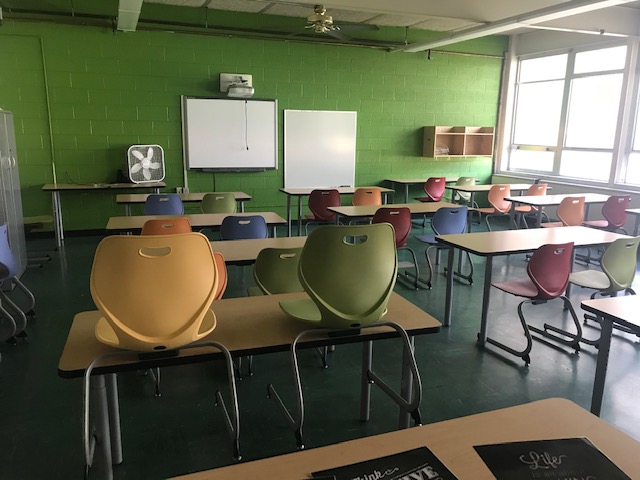
As I walked into the room, I saw the neatly arranged desks, the fresh green wall, a box fan near the front of the room, “Do I get to keep the fan?”

“Yes.”

“Do I get to keep the books?”

“Yes.”

“How about these supplies?”

“Everything in here stays.”

“It looks great!” I practically shouted as I took in all the shelving, the Smart Board, the white board, and the tape, stapler, and other supplies behind my desk area.

I began to picture myself working in this room, knowing that it would be me, alone, at least for the first quarter. All of our students will be remote — from their homes — on tablets and laptops that the school has been acquiring through the generosity of community partners, grants, and purchases. They’ll be able to come to the school to pick up supplies and food, which the school will continue to provide, but they will learn from home. I, on the other hand, will be in this bright classroom four days a week, and working from home on Wednesdays when my students will have assignments to complete, books to read, and journals to write while I meet with my colleagues, hold office hours, grade student work, and write lesson plans.

We left the room and she showed me who would be my hall neighbors — a new math teacher, a social studies teacher, and a master English teacher right next door to me, for ease in collaboration. The computer lab and several computer carts are a few steps away. I could picture myself moving down the hallway to the lab with my students, dropping into the classroom next door to ask a couple of questions, and moving back to my room for instruction. I had to keep editing my mental movie, which kept auto-populating all of the hallways, classrooms, and desks with students. I had to keep reminding myself that this year was going to be different.

I’m going to be in my classroom, in front of my laptop, greeting my students, providing instruction, responding to questions, and — hopefully — making a difference.

When I was offered this position, I agreed to teach freshman English, but on the day I accepted the offer, I was asked if I’d at all be interested in teaching seniors (Yes!) who need to be prepared for college (Yes!) who haven’t taken the SAT and need some preparation (Yes!), even if I have to help write the course (Are you kidding me, Yes!).

Then, last week, I was told that I would also have a section of freshmen (Let me at ’em!) and a section of just SAT prep, an elective, presumably for juniors (Hooray for juniors!). When I left Lutheran North, I had one section of freshmen along with juniors and seniors. This feels like home.

So, I’ve been dabbling in curriculum and reading Common Core Standards while also taking an online course called The No-Nonsense Nurturer, which all teachers at Detroit Leadership Academy (and many other schools across the country) take. Its focus is on setting the classroom climate for high expectations and academic achievement in communities that have historically been marginalized. The training is solid — through it I’m recognizing some of my tendencies toward enabling students because of my inherent biases, and I am also being affirmed in some of the strategies I’ve used in the past to build relationships that motivate students to excel. Taking this course is helping me shift from where I’ve been to where I will be.

And in all this preparation, though I am elated and so excited, I am starting to feel the hum of anxiety — am I really ready? can I really develop this new course in time? can I actually learn to go with the flow? will I really be able to make a difference in the lives of these students?

Yesterday, when I picked up my laptop, I also got a lanyard with keys, and a staff T-shirt emblazoned with the name of the organization that houses Detroit Leadership Academy — Equity Education. It’s just a black T with one word on the front, but that one word is a reminder of why I am taking this step — back to the classroom, back to the city, back to students who might not know that they matter.

I’m ready to put that shirt on — I’m ready to suit up! I’m a little nervous, a tiny bit terrified, but I am ready. I’m stepping into this role knowing that I might not get it all perfect, but I am going to show up each day for the sake of these students, for the sake of their futures, for the sake of equity, and, as I’m sure you’ve gathered by now, for the sake of myself. I know I’ve been prepared for this moment, and I am thrilled to step into it.

Be strong and courageous. Do not be frightened, and do not be dismayed, for the Lord your God is with you wherever you go.

Joshua 1: 9

Facing Change

I don’t want to brag or make it seem like I’m an expert on change, but here are the facts:

Before I graduated high school, I had lived in six homes (ok, I only remember four of them). During and after college, I lived in nine locations (counting separate dorms). Since we’ve been married, we’ve had eleven homes. You might call me a moving expert, because I was Marie Kondo-ing way before Marie Kondo was a thing.

I’ve gone to two elementary schools, one middle school, one high school, two colleges for undergrad (transferring after freshman year), and have taken graduate courses at three universities.

Not counting babysitting, I’ve held at least 25, yes twenty-five, jobs in my life, and I’m sure I’m overlooking some gig-work like that one summer that my stepfather got me an “opportunity” handing out samples in the deli of the grocery store that he managed.

I’ve walked into plenty of new situations, and I’ve learned a few things along the way.

First, I always come with the gusto: This is gonna be great! Imagine all the possibilities! Won’t it be fun? I am at that point a glass-hall-full-and-expecting-more kind of girl. I come on full speed and give it my all. (Exhibit A: I’ve already organized and alphabetized my newly-forming classroom library, and I’m not even in my classroom yet.)

Because I come in with so much enthusiasm, I have been known to overlook critical details, such as, I don’t know, the fact that the people in my life are also feeling the shift of change and they might not be as enthusiastic as I am. My daughter recently reminded me that when we uprooted our family and moved to St. Louis, my husband and I full of gusto and optimism, our children were reeling with grief, anger, and fear. They were not thrilled to be clinging tightly to the flying capes of their superhero parents. They just wanted us to stop and hold them, which I will graciously remind myself that we did from time to time, but we were, I’m afraid, quick to resume our flight — to conquer our mission and save the day.

Another thing I’ve noticed is that I quickly adapt to culture and expectations. In a new setting, I will likely watch quietly for a few days or weeks, until I see how “we do things around here,” but once I have the lay of the land, I bring myself to that situation in the truest way that I can. I remember the faculty retreat where I met my coworkers at Lutheran North. We were at a camp about an hour away from the school, all in shorts and tennis shoes. We gathered for the morning in a conference room to “talk business,” but after lunch we made our way to a challenge course complete with a zip line. Since it was my first day or two with this community, I was in that ‘quietly watching’ phase of entry, so when my team (people I’d never met before!) needed to lift me over a chest-high obstacle, I let them, and when they asked me if I would like to climb a rock wall and do the zip line, activities which I would under normal circumstances politely (or not so politely) decline, I said ok, I would do it. I was trying to go with the flow and figure out the culture, so I went out of my comfort zone and wouldn’t you know, I climbed that wall and zipped that line, and I felt great! These early successes, and others like them, gave me confidence to take some other chances with that group that would soon become family. I thrived at Lutheran North, where I became a leader, and my team embraced me in my truest form which is always honest (sometimes to a fault), often loud, and frequently emotional.

I came into my experience at Lindamood-Bell much more quietly. Illness had sucked the confidence out of me, and the intentionally positive and congratulatory environment of the company culture seemed, although very welcoming, quite foreign. The first two weeks I sat in a room with a coworker (who was my first on-the-job bonus kid) learning the programs, quietly taking notes, and reluctantly participating in role plays. The job was very scripted to start, and I was thankful! Because I was still visibly struggling with autoimmune disease, my gusto was suppressed; I was happy to have clear expectations and structure. I wouldn’t have to lead in this position, well, not at first…not until I was much stronger.

Yes, I come in with gusto, I quietly learn the culture, and then I am who I am.

At Lutheran North, my students called me Momma Ratch. Two of my own children were students at the school, and though while they were in my class, they were students first and treated as such, they were also my children, who rode in my vehicle, dropped by my classroom for a snack, needed to be driven home when they were ill or forgot their running shoes, and invited their classmates to our home. My students who were not my children, saw me in my role as teacher and my role as mother. They came to understand that I was imperfect in both roles, but that I continued to show up and try. They could come to my room with difficulty or to share celebration. They could borrow a few dollars or raid my stash of feminine supplies without asking. I had a stockpile of notebooks, folders, pens, and books in my room that I collected each year when students cleaned out their lockers. Anyone in the school knew they could come get what they needed no questions asked. I had firm and high academic and behavioral expectations, but I also learned what I could let go, what I could negotiate, and what really didn’t matter much at all.

At Lindamood-Bell, my coworkers called me Momma K. This probably started because I am the age of the mothers of all of my coworkers. They are almost all in their twenties (the age of my children), and though I didn’t always feel like it, particularly in the beginning, I think they have valued my experience, my perspective, my age. Often, it was me who was asking them for support, for encouragement, for understanding, as I navigated some of the most difficult years of my life. They were mostly oblivious to the grief that I was carrying, but it seeped out in moments of unprofessionalism. I would snap in a moment of frustration or glare at a coworker who told me something I didn’t want to hear. Yet, they, too, accepted me for who I am, and even celebrated me. In fact, the culture of Lindamood-Bell, the clapping, the parties, the dancing and balloons, reminded me of the importance of celebration, of noticing small victories and big ones even (and especially) in the midst of grief and transition. My coworkers dress up in wigs and hot dog costumes on a Wednesday just to make learning more fun. They hide pictures of Guy Fieri inside a closet to surprise you and make you laugh. They help kids set a trap of plastic spiders to scare you when you walk into a room. They cry because you are leaving, but send you off with books for your new classroom, a gluten-free cookie for the road, and a bottle of Malbec for your next celebration.

As I’m gathering my gusto to walk into Detroit Leadership Academy I want to be mindful of those around me who in the midst of Covid-19 and all its uncertainties might not be feeling as enthusiastic as I am; I want to be sure I stop and attend to the needs of others instead of just powering through. I know I’ll take the confidence and flexibility I found at Lutheran North and the kindness and celebration I learned at Lindamood-Bell. I’ll walk in quietly, even though I’ve already stocked my closet with teacher wear and powerful shoes. This is a brand new culture, and I want to see how “we do things around here” before I find the expression of myself that will work best for these kids, these coworkers, this school, this season.

As in every other change I’ve navigated over my fifty-plus years, I know I am going to learn at DLA — I don’t know what yet, but if the lessons I learn are even half as impactful as the lessons I’ve learned at Lutheran North and Lindamood-Bell, I know I’ll be changed forever.

Have I not commanded you? Be strong and courageous. Do not be frightened, and do not be dismayed, for the Lord your God is with you wherever you go.

Joshua 1:9

Note: If you are in or near Ann Arbor and have surplus school supplies: notebooks, pens, folders, index cards, feminine supplies, etc. I would be happy to take them off your hands and put them in my new classroom so that students can come and take what they need no questions asked.