In my many years of teaching, I have been “in charge” of delivering all kinds of content, mostly English Language Arts — everything from vocabulary to grammar to composition to poetry, drama, short stories, and novels. I’ve led lessons on irony, literary analysis, metaphor, meter, MLA documentation, and countless other ELA topics.
In some of my positions, particularly during the early years, I also led lessons on science, social studies, religion, sex education, PE, and yes, even math. I wouldn’t say I was amazing in these other content areas (if you are reading this and I was your teacher, please be kind!) but I muddled through. I understand the principles of teaching — the concept that first “I do,” then “we do,” then “you do,” so if I can figure something out, chances are, I can show you how to do it.
And, once upon a time, I could figure out math, but can I still?
In my new role, the plan is that I’ll be coaching eight teachers — two ELA, two social studies, two science, and two math. With each of these teachers, we will begin by looking at the curriculum — what are the broad goals for this year, how are those goals broken into units, how will each unit be assessed, what skills will students need to be successful, and what misconceptions might we be on the lookout for?
As I’m preparing for these discussions with my team, I’m diving into the curricula — this past week I dove into math.
At first glance I was like, how hard can it be — I can probably still do most of Algebra I, I mean 2x +5 = 25? No problem. But then I opened the first geometry lesson and thought, Oh, my, this is a whole different language, isn’t it? The first unit was all about triangles and parallel lines — Cool, cool, I remember this — the three angles of a triangle add up to 180 degrees, and if parallel lines bisect a transverse line, corresponding angles are equivalent – – yup, yup. But then I got to the part where you have to write the “proof” and I was immediately transported back to 1982 and Mr. Cronkright’s room. I was pretty sure my deodorant failed and a zit popped out on my nose. I shook myself — how hard can this be? You’ve got the teacher’s edition and supplemental videos! Walk through it! Figure it out.
And you know what? I did! I remembered all the things — with a little help from Great Minds Digital Learning — and was able to complete the unit assessment with flying colors! Thank you, ladies and gentlemen.
I was feeling pretty good about myself until the next day when I opened the first unit of Algebra II — Probability — this is an entirely different language, once again. I mean, suppose that a book store sells a book in both electronic and print format, and that customers can pay with either a gift card or a credit card. What is the likelihood that a random customer walks in the store and buys an electronic copy with a gift card.
I’m looking at the screen of my computer, scratching my head saying, Who in the world wants to know how to calculate this ? when the power in my house went out. What are the odds?
LOL. See what I did there? I’m telling math jokes.
The power literally did go out, but my computer had plenty of battery and I had plenty of daylight, so I pressed on. Certainly if I trudged through the lessons, even I could learn how to use a two-way frequency table. So trudge I did, and while the literal lights came back on while I was still hunched over my desk, the metaphorical light of understanading didn’t reach full strength. I’m not sure I comprehend enough about probability to pass the assessment — yet! — but I am confident that I can have a conversation about the unit with the instructor, and I am quite sure I will be able to identify some of the struggle areas that might take students [ahem, me] more time to digest.
Did I mention in last week’s post that I would be learning this year, too? I am certain of it.
That’s a large part of what teaching is, friends — it’s admitting that you might not know everything, but committing to getting on the bus anyway, deciding to show up, leaning over content that might be challenging, and using any means necessary to figure it out so that you can model it for your students, do it with your students, then release them to do it on their own.
This past year I had the privilege of watching someone do just that. Last August, when we realized that we would not be able to find an ELA teacher to fill the position I was vacating, I agreed to continue teaching two sections of seniors and to share the classroom with one of our paraprofessionals who would teach three sections of freshmen. Although this individual has been in our building for as long as I have, she is not a certified teacher and has no formal training in English Language Arts. Did that stop her? Not at all. She received coaching, read books, leaned into curricula, and announced to her students, “We’re going to figure this out together.” Day after day she showed up, implemented strategies, and learned lessons so that she could bring her students along with her. She knew she was responsible for what they were learning, and she took her role seriously.
And truly, that is what I plan to do with my team this year. I want to “figure it out together,” leaning over their content with them, modeling for them how to determine the best way to deliver a concept or a skill, partnering with them to try a new instructional strategy, then watching them take it from there.
The money in teaching is when the students [or this year, my teachers] take what we have learned together, personalize it, and go way beyond what the teacher could even conceive of. The student exceeds the teacher. That’s the goal.
What is the probability that it will happen this year? I’d say the odds are good.
“[He}is able to do more than we can ask or imagine.” Ephesians 3:20
P.S. We are still hiring for some of the positions on my team. If you or someone you know is interested, check out the postings here.
I wrapped up school year 2024-2025 –watched another group of seniors cross the stage into adulthood, entered final grades, and cleaned up my classroom.
Then we left town for two short treks — one to play with our granddaughters in Ohio and another to lie on the beach of Lake Huron. We crossed the miles listening to podcasts and chatting about everything from family to politics to music to our future. With our grand girls we lazed in the pool, played Uno and Skip-Bo, and were entertained by intricately choreographed dances. Near the beach, we ate well, slept long, took leisurely walks, and lost track of time.
They were luxurious and welcome — these two little trips back to back — and now we are re-entering real life. Since we’ve returned home we’ve been in the business of unpacking, doing laundry, tending to yard work, and taking stock of the new rhythms we are noticing since a) my husband transitioned from an almost four-decade-long career in church work to a private counseling practice and as b) I am making the shift from classroom teacher to full-time instructional coordinator. Some of the work each of us does in our new roles is similar to what we have done in the past, however, the routines and workloads are quite different. While he has been adapting to his new rhythm for over eighteen months, my real shift begins this week as I embrace the responsibilities of my new role.
How will it be the same? How will it be different?
What won’t change is my morning commute — I will still drive 30 minutes east from Ypsilanti to the edge of Detroit. I will park my car in the same spot, work with many of the same colleagues and students, and follow the same daily bell schedule and school year calendar. I will also continue to serve on our school’s leadership team, meeting at least weekly to plan initiatives and events, troubleshoot current issues, and collaborate toward best practices for our building.
However, many things will change — I will no longer have my own classroom. I will no longer have my own students or a grade book or lesson plans or the responsibility for all that happens inside a teacher’s classroom through the course of the day — behavior management, attendance, organizing materials, and managing the constant flow of information.
I will have plenty of new responsibilities on my plate. In addition to coaching the instructional moves of a handful of teachers like I did last year, I will also be partnering with those teachers to unpack curriculum, analyze assessments, and plan instruction. Further, I will be our building’s testing coordinator, responsible for all things PSAT/SAT, ACT Workkeys, and MSTEP.
All of this, of course, is in the interest of our students. I came to this position because I recognize the systemic inequities in American education that have benefitted some students (mostly white and affluent) and have disadvantaged others (mostly low-income and/or students of color). I wanted to lend my years of experience and expertise in service of closing the gap that continues to widen; I wanted to provide a high level of instruction and rigor for students who have, through no fault of their own, fallen multiple grade levels behind their peers who live sometimes just a few miles away.Over the past five years, I feel I have had limited success. I have, within my classroom, provided glimpses of rigor, moments of engagement, and small gains for individual students.
However, individual teachers in isolation cannot overcome centuries — literal centuries! — of harm. They do make a difference, of course, but for the sweeping change that is needed, we need a broader — a more systemic — solution.
I joined the team at my school in August of 2020. Covid had sent all of our students home the previous March, and because of the disproportionate impact on low income communities of color, particularly Detroit, our district provided instruction virtually for the entire 2020-2021 school year. The administrative team was making it up as they went along, and I — a teacher returning to the high school classroom after a six year hiatus — was enthusiastic about giving it my best. I popped into Zoom rooms, chatting with any students who would talk to me, leading lessons, and providing office hours every afternoon. We didn’t close any systemic gaps that year; we merely did what we could to slow the ever-widening distance between our students’ academic progress and that of those in neighboring districts.
The following year (2021-2022) , fully masked, we returned to in-person learning, bouncing back to virtual instruction several times throughout the year. It actually took us that year and the next (2022-2023) to re-establish routines within the building. We were on pretty solid footing as we started school year 2023-2024, but some mid-year leadership changes kept us from moving too far forward.
The standardized test scores told the story — about a tenth of our students were proficient in English Language Arts and none — 0% — were proficient in math. Our staff took in those realities as our newly appointed principal delivered them before the return of students in the fall of 2024. She gave us the hard truth and then cast a vision for us — we, the staff and our students, would activate excellence. We could no longer allow this to be the reality for the students in our building — things were going to change.
And, over the year I did see evidence of shift — in attitude, in practice, in thinking. However in order to overcome systemic inequities of the proportions that I have witnessed, we need a reimagining of what school likes like in our context. The principal sets the tone, and she has. The leadership team has come alongside our principal, supporting her vision, agreeing with the need, and implementing strategies. Staff members have also caught the vision, to a degree, but the kind of transformation that is needed is going to take the whole team — every teacher, every paraprofessional, every custodian, every social worker — to activate excellence, consistently and continuously, day in and day out.
Certainly in my own classroom, I have strived to provide excellent instruction, to have high expectations, and to inspire my students toward greatness, but I will admit that my efforts have sometimes been inconsistent. I have grown tired, and I have from time to time been merely mediocre. However, as I step into this role, I have been given an opportunity to activate excellence beyond my classroom — taking care to do my very best with the responsibilities I have been given, and to bring other staff members along with me.
I will push my team of teachers — some of whom are experienced, some who are brand new — toward excellence. Together, we will grow this year, beginning by building relationships, but then quickly moving into strategies, into accountability, into doing whatever it takes to activate excellence for our students — to give them the tools they need to move forward into their futures.
It’s a big job, but I’m rested, I have the vision, and I’ve been equipped. May God grant me the strength to persevere, the compassion to both see and inspire my team, and the heart to sustain my insufferable belief in restoration.
He is faithful, and He will do it. I Thessalonians 5:24
Click to listen. Sources and resources linked in text.
My husband and I just completed the minimalist challenge. For the month of June, each of us found items around the house that we were willing to toss, donate, or sell — one item on the first, two items on the second, three items on the third, and so on. (The last time I did this — in 2014 — is chronicled here in my blog, starting with this post.) As we’ve been purging — through our clothes, our kitchen, our books, our garage, and our storage — our kids, our friends, and our siblings have said, “How? You guys are already minimalists!”
And it’s true! We moved halfway across the country twice — paring our possessions each time — and we are pretty committed to hanging on to only what we use, but still we were able to find [over] 465 items each. No, we didn’t count sheets of paper or even individual pens and pencils, but we did count individual books, unused kitchen utensils, extra T-shirts, pairs of shoes, decades old journals, dusty trophies, and extra picture frames. The first 10 days we hardly had to move beyond our bedroom closets to find items we were no longer using!
So what inspired us to do this now? It’s a good question that could probably be answered by looking back at our experiences over the last year or so.
Maybe it began when we started spending more time with our aging parents. As their health declines, we’ve heard them say over and over, “What is going to happen to all this stuff?” We look around the room, around the house, around the garage, and we wonder the same thing — what indeed will happen to it? Last summer, I was staying with my mother while my stepfather was in the hospital, and I posted two treadmills that hadn’t been used in decades on a Facebook free group . Within a day someone had come to get them, and I registered the relief on my mother’s face — she was so glad to be rid of them! A few months ago, as we made room for a hospital bed, we found a new home for a large desk. Again, my mother said, “I’m so glad someone else could use it!”
While I have been with my mother seeing all her “stuff”, my husband, in the aftermath of his mother’s passing, has been sorting through all of her stuff. He’s touched countless items that had accumulated in 88 years of life and has often come back to our place with treasure or two but also with an intent desire to eliminate excess — to rid ourselves of anything that we do not need.
After all, extraneous stuff leads to clutter that can prevent us from seeing the things that are important to us.
This “stuff processing” has been happening against a political backdrop that is itself cluttered with a different shocking headline seemingly every day. It can be hard to sift through all the noise to find the issues — particularly the ones that seem meaningful to us. From the recent bombing of Iran and the role of the US in Gaza and the Ukraine, to the pending legislation that threatens to cut Medicaid, raise the debt limit by $5 Trillion, and increase the budget deficit by 2.4 trillion all while providing tax cuts to the wealthy (5 Calls), we find ourselves wanting to register our protest, and one way that we are able to do that is by considering where we want to spend our money and what we want to spend it on. What do we need? What companies do we want to use to meet those needs? What do we want our money to support?
We have been re-evaluating almost every expenditure, and it turns out that when you take a step back and look carefully at your life, you truly don’t need much.
Living in America has taught us otherwise, hasn’t it? We are barraged with ads from morning to night showing us “stuff” that we “need” that we can purchase with a single click. We don’t even have to leave our homes — a package will arrive sometimes the very same day! Wouldn’t our lives be just a little bit better with that new outfit, better shoes, handy tool, or sweet technology?
Purchasing is so easy that we don’t often consider the cost — to our bank accounts (a mere $20 once a day adds up to $600 a month) or to the environment (A report by Oceana estimates that Amazon alone created 208 million pounds of packaging waste in 2022.) Further, we don’t often look at who is profiting — is the handy new travel bag I’m considering made in the US? in China? What are the workers being paid? Who is getting the majority of the money I am spending? What are the other impacts of this purchase? What materials were used? Do the materials hurt me or the environment?
Each purchase, though easy to make, can have complex meaning, if we are willing to take the time to consider it. And I guess that is what we have been doing — considering each possession, each purchase. We want to be careful that our lives don’t become so cluttered that we fail to see what is important.
Each of us, in sorting through our stuff will deem different items to be of value.
What does it say about me that I still (after eliminating over 900 items from our house) have a few dozen writing implements on my desk, a stack of empty notebooks waiting to be written in, and more greeting cards than I could ever possibly send?
Why did I choose to hold on to those things and not the journals I have written in for more than thirty years? Why did I feel ok about letting go of crystal that we got for our wedding but not a jar of paper clips? Why did I keep baby blankets that haven’t been used over 25 years but toss plastic mixing bowls that I used last month?
It’s interesting to see what matters when you start combing through the stuff.
This latest round has trimmed away some excess, but I feel there is more that needs to go — but what leaves next likely won’t be possessions, those are fairly easy to eliminate. No, next might be attitudes and judgments, habits and pastimes.
It’ll be easier to see what needs to go next now that we have cleared some of the clutter.
Let us lay aside every encumbrance…and run with perseverance the race that is set before us. Hebrews 12:1-2
On Thursday afternoon, I tidied my classroom, finalized some grades, and walked away from school and toward my Spring Break. The mere thought of not having to set an alarm for 10 days would’ve put a pep in my step if I’d had any pep left at all, but I did not.
All teachers are exhausted by this time in the year. Even though we had Christmas break, even though we might’ve had a long weekend or even a full week off in February, we’ve been, since September, coordinating learning for our students, planning multiple presentations each day, keeping records, reporting to our supervisors, and (and this is the most draining part) making countless in-the-moment decisions:
What is the first thing I need to do when I walk in the door?
Do I have an extra stapler, know where more chart paper is, and can I laminate another hall pass for Room 117?
No, you can’t go to my classroom unattended; yes, I can get you a bandaid; no I don’t know where Mr. Smith is,
You can’t go to the bathroom right now, but ask me again in 10 minutes.
Yes, you can take that pencil, borrow that book, eat that snack.
You sit over here; you stay there.
Yes, your topic sentence is solid, but no, that is not an adequate example.
You’ve used AI here, and you must re-do the assignment.
You’ve used AI here, and you cannot re-do the assignment.
Yes, you can turn it in late. No, the deadline has passed.
Yes, you can work with a partner. No, you can’t get the answers from a peer.
This is non-stop all day long, but teachers, while keeping this decision-making machine running, must also, intervene in interpersonal conflicts, address misbehavior, meet demands for mandatory documentation, and, oh yeah, provide high quality instruction.
And most of us are happy to do all of this. We see each piece as necessary for supporting human development, for preparing the next generation of humans for meaningful life in our society. We’re teaching our students to co-exist with one another, to manage themselves, to hold themselves accountable, to read, to write, to identify a career, and to begin to take steps toward attaining that career. We’re in this work because we like kids but also because we believe in the power of education to create possibility for students of all backgrounds and abilities and to create a better future for all of us.
In the school where I work — a small charter school on the edge of Detroit, where 99% of my students are Black, where 100% of the students qualify for free breakfast and lunch, where almost all of the students are below the national average in reading and math scores by no fault of their own but because of centuries-long inequity in education–the teachers, like me, believe in the transformative power of education. We see it as an opportunity to not only change lives but to save lives.
In addition to the exhausting work that teaching is in any context, teachers in buildings like mine have the added weight of wondering if our kids have enough to eat, if they have a home to sleep in, if their home is safe, if they will have what they need for the next 10 days, or if they will be alone, hungry, cold, or in danger. Our students have the same needs as any students in the country, but they have additional needs as a result of poverty that stems from systemic inequities that go back through the history of our nation — school segregation, red-lining in real estate, unconscious bias in hiring practices, and other elements of historical and current systemic racism.
So, you might imagine how I am feeling, heading into a much-needed break while simultaneously worrying about my students’ welfare, to learn that the president of this country has ordered the Director of the Department of Education to dismantle it.
You may say, “Settle down, Kristin, most funding for education comes from the state.”
That is true, most money for education comes from the state — but do you know what does come from the federal government? Funds that make a difference for students like mine. For example, Title I, which provides $18 million to low-income districts. It’s not enough to make up for the economic disparity between neighboring districts, but it’s a start. The Department of Education also provides IDEA (Individuals with Disabilities Education Act) funds to the tune of $15 billion to help districts provide additional resources to students with learning disabilities, cognitive impairments, and other diagnoses such as autism. Source.
Furthermore, the US Department of Education manages Federal Student Aid for post-secondary education, providing over $120 billion annually in grants, loans, and work study that allows students like mine to dream of a career. And not just students like mine — I myself relied on federal money to get my degrees, didn’t you? Source
Can you imagine what might happen in communities across the country if high school seniors no longer have access to the FAFSA? if they can no longer apply for federal dollars to fund their education through grants and/or loans? Tuition alone for Michigan State University is over $16,000 a year. Add in room and board and your talking about $35,000+. Most students need at least four years to get a basic degree. Who among us can fund $140k without the aid of at least a student loan?
Now, the State of Michigan is prepared to fund up to two years of community college and up to $5,500 per year at state universities, but states rely on the federal mechanism of the FAFSA to distribute those funds. If the DOE is dismantled, how long will it take for states to pivot to their own systems to ensure that students who need these funds get them? And, where will students borrow the balance that is not covered by state funds if they don’t have access to federal student loans?
How many students will take post-secondary education right off the table — including trade school programs that prepare our electricians, plumbers, welders, builders, and the like?
As I consider the potential outcomes of such action, the faces of my seniors are appearing in my mind — J. who wants to be a programmer, who has already completed several summers developing coding skills, L. who plans to be a nurse, K. who wants to be a truck driver, and S. who plans to become a police officer. None of these students can take one more step without the FAFSA and right this minute the Secretary of Education (who has zero experience with issues that impact schools) is busy laying off DOE employees under a directive from the president.
I am exhausted, and it’s my Spring Break, but I can’t just sit by and watch this happen.
So, I’m doing two things: First, I’m writing this post, and second I’m committing to use the app “Five Calls” to involve myself in the American process.
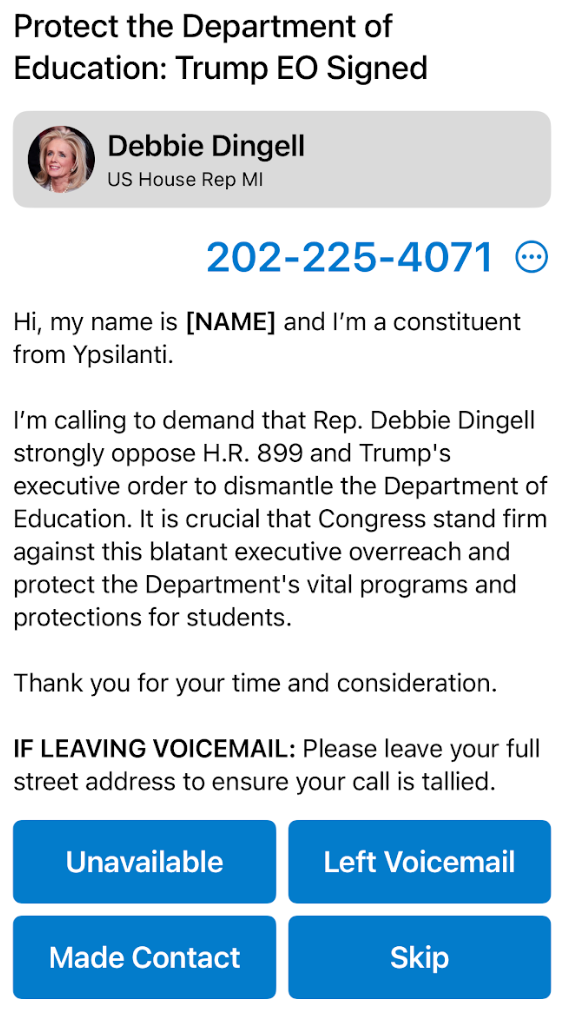
Here is how it works. Download the app, select the issue you are concerned about, and enter your zipcode. You will see a timeline of updates on that issue and a list of representatives from your district. One click later, you will see a page like this:
You click on the number, wait for an answer, read the script, and and click a blue button to register whether you left a voicemail or made contact, and the app sends you to the next number.
In just a few moments this morning I made three calls.
This may seem like something small — just like my boycotting may seem small and ineffectual to some –but if we truly believe that our government is of, by, and for the people, then we, the people, need to get involved. We need to do something when we see that our government is not representing all of the people — particularly when they are taking steps to further disenfranchise the most marginalized among us.
Look, you’re probably exhausted and overworked, too. You might feel like this is not worth your time, but perhaps you can take a journey back to your high school self, remember what it feels like to have a dream in front of you — of a career, a family, a whole adult life. Remember what that feels like? Don’t we want to make sure that every kid in America has an opportunity to pursue their dreams?
If you believe in the transformative power of education like I do, I urge you to make 5 calls — today, tomorrow, and until our voices are heard.
It’s a small decision you and I can make that could make a monumental difference for our kids, our country, our future.
Speak up … defend the rights of the poor and the needy. Proverbs 31:9
This is the last of the “Ten Years Later” series that I had intended to be a weekly feature in 2024. The year, as most are, was more than I had anticipated — more struggle, more loss, more healing, more restoration, more hope. This post, written and recorded in January 2023, sums up the vibe I want to carry into 2025 — the continuing hope that all things can be made new.
We purchased the gifts and wrapped them. We planned menus, purchased loads and loads of food, and baked ourselves silly. We cleaned the house and made all the beds, and then we waited.
As we sat on the coach, staring at Netflix, the texts started to come in.
“We’re checked in at the hotel! See you in the morning!”
“Our flight just landed!”
“We should be there in an hour!”
And then our family started rolling in — from Ohio, from Massachusetts, from Missouri.
We hugged, we laughed, and we ate.
We puzzled; we played games. We did crafts, watched movies, and traveled to celebrate with even more family.
It sounds like what most families do over the holidays, but I suppose many families, like ours, can get together like this only because of a string of miracles — only because of choosing forgiveness, of going to therapy, and of healing and time and the stubborn belief that things get better.
Didn’t you, too, have the holiday where everyone was yelling at each another?
And the one where no one spoke a word?
And the one where everyone walked out of church sobbing?
And the one where some decided they just. couldn’t. do it — not this year.
And then there was the covid year (or years — who remembers?) where we packed presents into flat rate boxes and stood in line for hours at the post office, hoping our parcels would get there before Easter. The year (or was it two?) where we sat in Zoom rooms with family members, some of us trying not to hog the air time, others trying to endure those who were hogging the air time.
It seems after all those difficult years we might have stopped believing that we could once again be all in one space, laughing, eating, agreeing on what to watch, moving upstairs to open the gifts, and leaning together over a puzzle, snacking on chips and rock candy and cookies.
But we didn’t stop believing — really — did we?
Didn’t we keep hoping for the day when all the therapy would pay off? Didn’t we long for the moment when we all laughed at the same joke, all smiled at the same memory, all managed to load ourselves and our gifts and bags full of food into cars only to discover most of the way there that we had left the main dish warming in the oven and no one lost their shit but we rebounded easily, picking up take out on the way?
Didn’t we imagine it could happen? Didn’t we dream it?
And so I’m sitting here pinching myself, trying to believe that it actually happened. And someone in the Christmas 2022 group chat sends a text checking on someone else who left the festivities feeling subpar. Another sends a pic of a present that broke upon opening, and everyone laughs. More pics are shared, more laughter, and then a commitment to what we will do next year.
They want to do it again next year.
I need a moment to just take that in.
Every family relationship doesn’t get this gift, does it? We don’t all get the moments we prayed for.
Don’t we all have at least one relationship where we do all the initiating? where tender topics are avoided? where our hearts ache with disappointment at the end of each phone call? where we can’t shake the feeling of being unwanted?
In fact, I was sitting in therapy the very day that the last of our family left, on the come down, for sure, and all I managed was, “our Christmas was amazing, but this one relationship over here still sucks and that’s all I can think about.”
And over the hour of belaboring the one less-than-stellar relationship I have spent most of my life bemoaning, my therapist offered suggestions, role-playing, expectation-setting, and the like, and near the end of the session, I began to realize that the beauty we experienced with our family at Christmas didn’t come without the hard work of many — of all of us, really.
I can’t expect this other relationship to magically transform on its own. If I want something different, I’ll need to return — to my knees, to forgiveness, to therapy, to the stubborn belief that things can get better.
It’s risky — even just the hoping for change — because happy endings or even happy moments are not guaranteed. I might experience disappointment — again.
But I might risk hoping, and a series of miracles might just happen. We might laugh at the same joke or smile at the same memory. We might play a game together or lean toward each other over a puzzle. We might agree on a movie. We might enjoy a meal.
And it might be amazing.
Witnessing the string of miracles that led to an amazing Christmas has me thinking that I just might risk hoping again.
[He] is able to do far more than we would ever dare to ask or even dream of”
Since seven (yes, 7!) of our immediate family members have December birthdays, our “season” starts a little earlier than most. We have said for years that we start partying on Thanksgiving and finish on New Year’s Day. This year is no different. The birthday gifts are all but purchased, at least one package has been shipped, and our our living room is staged with “gifts in process” for both birthdays and Christmas so that we don’t miss anyone.
And each morning, I leave my comfortable home that is well-stocked with food, clothing, and this somewhat moderate collection of gifts, cross 28 miles of metro Detroit, pull into a disintegrating parking lot, enter the building, and prepare to meet the reality of the students that I serve.
Today’s reality came in the form of Kaden*, one of my seniors. I was in the gym when he entered from the bus, scowling.
“Good morning, Kaden. Everything ok?”
“I don’t know why we had school today. I almost froze to death.”
“Hey, come here a minute. You only have on a hoodie. Do you need a coat?”
“I mean, I have a coat,” his demeanor was shifting, “we just don’t have a washing machine right now, so I can’t wash it.”
“Ok, but we have coats. I can get you one this morning. Would you be good with that?”
“Yeah, that would be good. I would take a coat.”
Later in the day, I found him, we walked to our clothing closet, and he chose one of several new coats that remained from a large donation we received last year.
We have a fairly decent supply in that closet — coats, shirts, hats, and some miscellaneous toiletries and nonperishable food items — but it goes away quickly because our students are continuously in need of something.
Each day I am asked if I have something to eat — often by students I’ve never even had in class. I try to always say yes and walk students to my stash where they can select a granola bar, some trail mix, or a package of cheese crackers. Most teachers of teenagers probably have a similar routine.
I also get requests for deodorant, for socks, for cough drops, band aids, a toothbrush, or a safety pin — again pretty typical requests for teenagers, and fairly easy to accommodate. These small items solve in-the-moment problems for my students and allow them to get back to learning. I have a pretty healthy stash that many in my village help keep stocked, but when the holiday season comes around, the depth of my students’ need comes into sharp focus.
Before coming to this school, I’d never met families who simply “don’t do Christmas” but here I have met many students for whom December 25 is just another day because their families simply don’t have the financial capacity to purchase anything extra, let alone the privilege many of us have to line their living rooms with gifts, to create an elaborate feast, to deck the halls, and to gather with friends and family.
I have students who are housing insecure — one young woman whose mother died during Covid and who is currently carrying her possessions with her and bouncing between two places to “find a place to sleep”. I have students whose families bounce from apartment to apartment — one young man I spoke to yesterday said “we are definitely moving in a couple of weeks, but I don’t know where yet.” We have families who don’t have reliable transportation — who can’t join the basketball team because they don’t have a ride home after practice and have to take the school bus that leaves at 3:15. I have students who, in addition to coming to school, work to help their parents pay the bills. I have a senior whose very demeanor and aptitude scream “engineer” who is in the manager training program at McDonald’s. He often closes the store and does inventory or other related tasks that keep him up well into the night rendering him incapable of staying awake in school the next day. He’s working this hard, yet he is wearing the same worn clothes and shoes I’ve been seeing him wear since I’ve known him, which is most of high school.
Our students and their families are barely getting by. How in the world can they dream of doing anything for Christmas?
Yet these students keep showing up. They come to school, they log onto their school-issued chromebooks, they complete independent modules to earn their financial literacy credit, they come to my class, bend over their notebooks scrawling out the purpose and audience for their next essay, practice the nuance of Standard Academic English while teaching their middle-aged English teacher the current vernacular. They have big dreams — of being nurses and engineers and game designers and ultrasound technicians — and they need a whole village to rise up around them to give those dreams every chance at reality.
I’m part of their village, and I’m raising my voice to invite you to be part of their village with me.
School leaders have selected nine families who are in dire need of support this holiday season. Because it is already December 6, and we have to get items to our students before they leave for break on December 20, we won’t be filling traditional wish lists. Instead, we have set a goal of giving each of these 9 families one grocery gift card, one department store (Target or Kohl’s) gift card, and one gas gift card. Additionally, I have created an Amazon wish list of items that our students frequently request.
Joining this initiative may be a small part of your holiday giving, but it could make all the difference for a struggling family — it could help them put food in the fridge, buy some new jeans for a child, and put gas in their car so that they can visit a friend. It won’t change their whole world, but it might just change their opinion about the people in it.
All of us have many opportunities to give at Christmas. If caring for my students in Detroit is something you are interested in doing, I invite you to check out that Amazon wish list or to make a donation to our gift card initiative. To do that, you can send a check to Detroit Leadership Academy, 5845 Auburn Street, Detroit, MI 48228 or donate via CashApp.
so in Christ we …form one body, and each member belongs to all the others. 6 We have different gifts, according to the grace given to each of us. If your gift … is serving, then serve; if it is teaching, then teach; 8 if it is to encourage, then give encouragement; if it is giving, then give generously. Romans 12: 5-8, selected portions
I’m not really a hugger.. I wouldn’t say I am anti-hug, I honestly just don’t have the impulse — I never think to myself, You know what I could use right now? A hug!
I wasn’t always this way, of course. I remember being quite affectionate as a child. I would run, yelling, “Dad!” and fling myself into my father’s arms when he arrived home from work or a trip or even if I was broken-hearted about something.
I would also, upon arriving at my grandparents’ house, spring from the car and sprint to their waiting arms to get big bear hugs. I was so sure they would be there to receive my affections, so sure they would reciprocate, so sure they would lavish their love upon me.
But life teaches us, doesn’t it, that not everyone loves like a grandparent. Not everyone consistently beams in your presence, overlooks your quirks, or forgives so effortlessly. So, over time, we lose that abandon — that ability to fling ourselves into the arms of another. We learn, instead, to guard, to protect, to hold back.
This is a useful skill for a high school teacher. You have to simultaneously let students know that you love them and that you don’t need them to love you in return. My love for my students is not dependent on their behavior, their mood-of-the-day, or whether or not they even like me.
I’ve grown into this, too, of course. In the early days of teaching, I really did want students to like me. I was fiercely committed to telling them the truth about life, but I was also quite sensitive to their reactions to me. I even, at times, wanted their approval. But over the years, my tough exterior has developed and I am quite impervious to derogatory comments, rude behavior, or the occasional “I can’t stand you, Mrs. Rathje.”
I mean, I’m not going to win them all.
This persona — the I’m fine; you can’t hurt me persona — is effective most of the time. Most days I motor through pretty well accomplishing my tasks, completing deliverables, and managing life without really thinking about my emotions.
Just writing that sentence made me stop for a minute. Is it true that Kristin Rathje, once voted ‘moodiest’ by her senior class because of her inability to self-regulate is now for the most part functioning from a pretty level emotional state? I think it really is. And that is likely true for you, too. Most of us manage most of life — the ups, the downs — from a pretty stable place. Of course we smile when something pleases us. Our eyebrows crinkle up when something doesn’t make sense,. We get annoyed in traffic, and we feel overwhelmed by our workload, but truly, we tend to manage all of that without even thinking about it.
Certainly there are larger emotions under the surface — ongoing hurts that we unpack with close friends or in therapy — but typically, in our daily lives we function in circles that are oblivious to our personal realities because we have developed strategies for keeping them to ourselves.
And for me, the I’m fine; you can’t hurt me persona has worked as a self-regulation strategy. And this persona is not one who would typically want a hug.
When I taught in St. Louis several years ago, some of my students would come into the building each day and hug one another — I didn’t love it. It seemed excessive. You just saw each other yesterday. What’s with the hug? And typically, if students approached me and asked for a hug, the answer was No. I’m not a hugger. They were not impacted by my resistance to hug them. They just found the next dozen people in the hallway and hugged them instead. I felt no shame.
And when I started teaching in Detroit, we were in the midst of the Covid 19 pandemic. We were wearing masks, social distancing (remember that?) and having anxiety about being in the same room with twenty other people. Certainly no one was interested in hugging.
And for the past four years, the only students I have hugged have been graduates who have come back for a visit. Feeling sincere joy upon seeing them after a year or two or three, I hold out my arms, they walk to me, and we embrace. I look them in the eyes, ask, How are you? What are you doing now? and then I listen. Other than that — no hugs. Lots of fist bumps, a few carefully choreographed hand shakes, but no hugs. Thank you, I’m fine.
But guys. The last few months have been different. I might be converting to some type of huggable person — even when I am at school!
It started in the most unlikely of situations. We have a new policy this year in which students have to turn in their phones when they enter our building. Phones are returned at the end of the day. Because of this policy, two other staff members and I set up each morning in the gym to receive students. They walk through a metal detector, have their bag searched, and then report to our station. They hand us their phones, and we place them in pre-labeled envelopes. It’s all pretty systematic, just as we expected.
What we didn’t expect is the relationship capital this system is supporting. Don’t get me wrong — most students are not happy to hand over their phones, and many are finding ways to sneak them past us and to keep their phones with them throughout the day. But relationship capital is being built by our consistency in the same position in the gym every morning. We greet each student with Good morning and their name, we make eye contact, we encourage students to get a breakfast, and then the magic happens — students tell us what happened last night or on their way to school, they share what is annoying them at the moment, or they come up beside us to get their daily hug.
That’s right — I’m giving out morning hugs. They aren’t theatrical, but a small number of students come to each of us daily to get a little one-armed side hug before moving into their day. Also, I have one senior who stops at my door every day on his way into class to give me a hug before entering. It’s not cheesy; it’s not manipulative; it’s just a hug.
And I’m here for it.
Earlier this month, my mother-in-law passed away on a Tuesday morning after a months-long illness. I helped my husband pack his bag and sent him to be with his father and siblings, then determined I’m fine and went to school. I texted my principal to let her know I would likely need Friday off but that I was good for the day.
And I was good — I participated in a day-long training, I texted with family members who were managing the details of travel, and I interacted with students in the hallways. It wasn’t until the end of the day that reality hit me. My principal saw me, met my eyes, and opened her arms. I walked to her and felt the love in her embrace, and the emotions leaked past my persona and out of my eyes.
I was totally into that hug.
When Friday arrived, so did my adult children, one after the other. Each one of them and their partners greeted me with an embrace that said I love you. I know this hurts. We are here. It’s ok to have feelings.
And I trusted that; I leaned in.
When I arrived at the funeral home, the family had just entered the room to see my mother-in-law for the first time since her passing. I walked in to see my husband stepping up to the casket. I joined him, reached for his hand, and silently told my mother-in-law goodbye. From there, I moved to my father-in-law, hugging him cheek to cheek, whispering, I’m so sorry. I then embraced each of my sisters-in-law and my brothers-in-law.
We each reached for each other, saying with words or without, I love you. I’m sorry. I am so glad you are here.
The hugs kept coming all weekend long — Hello. I’m sorry. So good of you to come. Thank you for being here. I love you. Goodbye.
I treasured each and every one of those hugs. I leaned in. I held on. I breathed deeply. I let go slowly.
I think I’m changing, letting down my guard, beginning to trust the people in my life, and it’s good.
Because apparently underneath my tough exterior is a little girl who could still sometimes really use a hug.
“…whatever is pure, whatever is lovely…think about such things.” Philippians 4:8
I wish I had a documentary film crew that had followed me over the last 30 plus days, because there is no way I can adequately communicate the amount of training, preparation, planning, sweat equity, and problem-solving I have witnessed and participated in to prepare for this the school year. Nor could I paint a full picture of the first interactions my team and I have had with our students as they have returned to our building over the last week. How could I ever show what I’ve seen with nuance and love and candor? And what is my point in doing so, anyway?
My point, I think, is that I want to both process what I’m experiencing and also share my experience — the ways that my lived reality continues to shape my thinking around education [and educational inequity] and how that thinking connects to my life as a believer in the power of the grace of God to transform lives.
The last thirty days or more has been powered by that belief. I didn’t return to work on July 31 to maintain the status quo. No. I returned with my leadership team a month before my students because this team actually has as one of its core values to be transformative. We all choose to stay with this organization because we believe that the status quo is perpetuating inequitable practices that limit the opportunities for our students and other students in communities across the country. We spent the past month reviewing the data from the past few years that shows us how far we have yet to go to close learning gaps caused by these inequities, situating ourselves within our teaching framework, building strong relationships with one another, and managing the unexpected.
I want to share a glimpse at the intentionality that goes into such work but also to show all the pivots that have to be made to function within and reform a structure that is inherently broken — kind of like trying to re-tool a machine that is continuously in production. The whole works can’t be shut down so that we can fix it. We’ve got to fix it while it’s running.
So I am going to scroll back through my mental camera roll and share a few images to show what this looks like.
In one shot, the teaching staff gathers on their first day together after the summer break. They are munching on breakfast snacks, hugging, laughing, sharing vacation stories, then finding their seats to hear network-wide updates: the fact that student phones will be “away for the day” — collected in the morning at arrival and returned to students right before dismissal — and the “new” dress expectations that students will wear school colors every day — a return to pre-Covid expectations with no hoodies, no hats, no pajama pants, no house shoes. Then, when the large group breaks into smaller teams, our high school teachers hear from our new principal who was once a teacher and then a coach in our building. She shares her vision for the school year — we will activate excellence in all that we do, holding ourselves and our students to a high bar from day one.
I’m seeing our staff show up the Thursday before school starts, many quite early in the morning, to put last minute touches on classrooms and hallways before families start arriving to pick up class schedules, sign up for transportation, obtain supplies and a free haircut, and reconnect with school life. Teachers call students by name, often running to wrap them in hugs. Students, in loud smiling groups, walk through the hallways, fist-bumping, hand-shaking, and laughing.
I’m picturing the hot, sticky day I showed up at our building almost a month ago, dressed fairly professionally because my principal and I were scheduled to interview a teaching candidate. We met to discuss which questions we each would ask and then chatted about other building-related issues while we waited. The time for the interview arrived and passed — still no candidate. Eventually, HR informed us that our candidate was no longer coming. This happened over and over this past summer. It would have been a mere frustration if we eventually found all the staff we needed to fill our classrooms. Unfortunately, it became a necessary pivot point when we realized we would start the school year three teachers short.
Pivot we did. In the last days before school started, we enlisted two ancillary staff to facilitate two classrooms where students will receive instruction in math and science via live online instruction over zoom. We also persuaded a paraprofessional to teach freshman English Language Arts each morning in the same classroom where I will teach two sections of senior ELA in the afternoon [in addition to my instructional coach duties]. In this way, all classrooms are “covered” until we can find certified teachers to add to our team.
The next shot in my camera roll is of students reluctantly turning in their phones in the morning (while some sneakily hide theirs on their person claiming, “I didn’t bring my phone today”).
Another is students struggling to know what to do with their hands, asking frequently what time it is, and clamoring to be first in line when the phones are returned at the end of the day.
In between those two scenes, I’m seeing students attend more to learning. I’m watching them find ways to talk to their classmates at lunch. I’m noticing frustration, resignation, and adaptation. And, I’m also noticing some who are not adapting — they are choosing to transfer to another school, to move to our self-paced online platform that will allow them to earn high school credits from home, or they are staying in the building and acting out. And we’re finding ways to manage each of those scenarios, too.
I’m seeing first-week fatigue — emotional outbursts, heads on desks, and students walking slowly to their busses at the end of the day, but I’m also seeing excitement — when the principal provides teachers with new t-shirts and free lunch on the first Friday, when the football team and cheerleaders wear jerseys for their first game, when the stands at the game are full of staff, students, and families [is it possible that they’ve never been this full before?]. I’m seeing our cheerleaders looking sharp and our team bringing home a win.
I’m remembering the one fight I heard in the hallway outside my room at the end of day two, but I’m also thinking about the three students who were brave enough to demonstrate their singing ability in my class while the rest of the room [instead of jeering or laughing] snapped and clapped along in support.
We aren’t fully staffed, we’ve got a busted up parking lot, lunch doesn’t always arrive on time, and next week our classrooms are going to be uncomfortably warm, but I’ve got a good feeling about this year — about the students who are showing up every day, about little [and big] moments of excellence, and about a front row seat to transformation.
I’ll try to share more snapshots with you along the way.
If you are interested in supporting the work that we do at Detroit Leadership Academy, check out my wishlist.
It’s been a politically charged few weeks — an assassination attempt on a former president followed by the Republican National Convention followed by the withdrawal of the current president from the presidential race followed by the nomination for president of the first women of color ever followed by the Democratic National Convention.
If you missed any of that, you certainly have not been on the Internet.
The country is fully engaged (at least virtually) in the conversation around who will be our next president. I’ve seen mentions on my social media streams supporting Trump, others supporting Harris, others bashing Trump, others bashing Harris. This seems to be the way we do politics in America now. It can leave a girl feeling a little icky, if I’m going to be honest.
I sat down the last two mornings with my journal to do some processing around where I am in this conversation and it turned into a recounting of where I started as a voter, where I am now, and why. When I finished with my journal, I intended to write a post called “Evolution of a Voter”, but before I did, I did a quick search of previous posts to see if I had ever written about voting, and boy was I shocked! Almost everything I had written in my journal yesterday and today I’d already written before the election in 2020, and I’d even called it “Evolution of a Voter”!
I read it through and thought, “wait, has my view expanded at all since that time? Has anything shifted further?”
And I think the main thing that has become more a part of my everyday life since 2020 is a deeper commitment to doing something.
For a long time, I was a citizen who voted. And, full-disclosure, I voted almost exclusively pro-life. Other than that, I carried on with my life not really making the connection between what I do with my time and my money and how those choices impacted those in my community. Politics seemed very removed from my daily reality. I voted in every regular election and typically even primaries, but I was not making intentional moves that aligned with my vote, other than to once a year attend a pro-life march in my community.
It was probably in my graduate studies from 2002-2004 when I began to question some of the choices I was making. I started to dig into my motives and to begin to understand the impact of my actions. For example, our decision to place our children in parochial schools was intended to “bring them up in the nurture and admonition of the Lord” (Ephesians 6:4), but an unintended consequence was that they were isolated from children from different backgrounds — not only religious, but socioeconomic, racial, and cultural. We wanted our children to be raised in the Christian faith, but we also wanted them to have a diverse group of friends. We wanted to have a diverse group of friends. Our choice to work for the church and send our children to a Christian school was keeping us in a silo, oblivious to the complexity around us.
Our move to St. Louis in 2004, where our children attended public schools — both in an affluent suburb and in the city of St. Louis itself — and also two parochial schools, and where I taught in the St. Louis Public Schools and then a racially diverse suburban Lutheran high school, exposed us all to more complexity — a broader view of the culture within which we lived. We regularly interacted with Christians, Jews, and people of other faiths or no faith tradition at all. We had friends, classmates, and colleagues who were white, Black, Hispanic, and Asian. We encountered people who were in the top 1% financially and those who struggled to feed themselves from day to day. Our church was attended mostly by white people who drove in from neighboring suburbs to the mostly Black neighborhood in which both our home and the church were situated.
Our ten years in St. Louis were transformative. If we had once been siloed, we no longer were. We regularly witnessed financial and racial disparity and the ways in which those disparities were tied to education, health care, crime, and the general quality of life.
That exposure and my current role teaching in Detroit and residing in Ypsilanti have broadened my view of the sanctity of life. If all life is holy, why are some lives devalued and others elevated? And why are those valuations tied to income, race, education, and gender? I’ve come to the conclusion that the best way I can continue to vote “PRO-life” is to get behind candidates that support ALL life.
Now, I hear some of you shouting at me, “What about the lives of the unborn? They can’t speak for themselves! We must speak for them!”
Well…
First, we must speak up for ALL of those whose voices cannot currently be heard — the orphan, the widow, the sojourner (Deuteronomy 14:29) — but also the immigrant, the child in foster care, the homeless, and the felons who are no longer able to vote.
But also, outlawing abortion doesn’t necessarily protect the unborn, in fact, since the Dobbs Decision which overturned Roe v. Wade, abortions in this country have actually increased (source). I suspect a better way to decrease the number of women who obtain abortions, 75% of whom are low income (source) is to do a better job of providing sex education, affordable (or free) mental health care, affordable (or free) child care, and other resources such as paid maternity leave.
If the goal is demonstrating that every life has value, perhaps simply voting pro-life isn’t the best strategy.
Maybe we need to go beyond voting to taking action. Some donate to a local food bank, to women’s shelters, or to pregnancy clinics, and that’s a great start! I wonder what is next. Are any of us committed enough to valuing the lives of others that we might be willing to advocate for policy change, to participate in a demonstration, or to write a member of congress? Even more, are we willing to engage with communities of need, to come alongside those who can’t find affordable housing, who struggle to put food on the table, or who can’t go to work because they can’t afford child care?
I’m wondering if we are willing to go beyond disparaging remarks on social media to actually doing something with our money, our time, and our lives.
I’m just wondering. I’m not doing a great job at the moment. I’m not really going out of my way.
I vote, of course, and we’re making contributions to support our preferred candidates and their initiatives, but I think its time to look for ways to increase my political engagement, my activism, my involvement in the community that might demonstrate my belief that ALL life is valuable.
It’s a little scary. Most things worth doing are.
Speak up for those who cannot speak for themselves, for the rights of all who are destitute. Proverbs 31:8
On Monday I wrote a post about inequity in schools. It’s not the first time. In the fall of 2020, I wrote a piece called “What World Are We Living In” when I first started commuting from Ann Arbor to Detroit to teach in a small charter school and began to daily witness the disparity between the two communities. In the spring of 2023, I wrote the following after a day spent in a suburban school district. I’m posting it again because I’ve spent the last three weeks facing the realities of life in my school — inadequate staffing, building issues, and a paucity of resources — and I feel compelled to share these realities and to call for change.
Last Wednesday, instead of driving to Detroit first thing in the morning, I drove to Oakland County to participate in a day of professional development along with a dozen other teachers who use the Adolescent Accelerated Reading Intervention. I’ve been using the program for a little over a semester with great results, but I have been aware that I might not be crossing all my t’s and dotting all my i’s. Having the opportunity to be a fly on the wall of two separate classrooms as other teachers implemented this intervention would hopefully help me see what I’ve been missing.
The beginning of my commute looked largely the same as it does on my daily trip to Detroit — interstate highway merging onto surface streets. However, I noted that while my regular route takes me past fast food, gas stations, minimarts, and older working class neighborhoods, this route into Oakland County took me past Starbucks, Trader Joes, and nicer restaurants before it led me through residential sections with large suburban homes. And then, when I took the final turn, I saw the school where I would begin the day.
It was a sprawling two-story building on a large piece of property surrounded by multiple well-lit and freshly-lined parking lots. I found a spot, grabbed my stuff, and made my way to the guest entrance at the front of the building. I approached a door, pushed a button, and looked into the camera before I was buzzed in to a glass-enclosed foyer.
There, a staff member looked me over and buzzed me through the second door. She knew why I was there and directed me to room “two-oh-something or other”.
“Which way is that?” I asked.
“Up those stairs and follow the signs.”
I walked up the open carpeted stairway in the expansive atrium to the second floor, also carpeted, and found the group of teachers already in conversation.
They sat in a semicircle in the [also] carpeted classroom. I found a seat in the back of the room in a bar stool height chair next to a tall table. The students had not yet arrived, and the teachers were discussing what was on the agenda for the class this day — one of the final steps of reading a book in the AARI program, mapping the text.
I heard the bell ring in the hallway, and the students started coming in, finding their resources in a strategically placed filing system, then making their way to the table where I was sitting. I relocated myself and began to observe.
Right away I noticed a t I hadn’t been crossing when I looked at the big piece of butcher paper where they had started their text map. My students and I had mapped our own text the day before, and it looked somewhat similar to, if noticeably messier than, the one I was looking at, but there was one big difference — ours was written all in black on white paper. The map in this classroom was color-coded to illustrate its organization — sections of the book written in sequential order were outlined in pink, those written in a compare/contrast format were outlined in green, etc. I mentally thunked my forehead with my palm and said, “the colors! why do I always forget the colors!” And then I noticed the posters hung on the wall in this spacious classroom. At both the front and the back of the room, the teacher had full-color posters representing each of the eight text structures. Oh, I’d like to have those, I thought. If I had full color posters in my classroom instead of the black-and-white print outs I have, I might remember to use the color coding system!
One teacher asked, “Where did you get the posters?”
“Oh, I just printed them on our poster printer!”
Oh, I thought, they have a poster printer.
The class functioned mostly as my class does. The teacher had seven students around the table; one was absent. I have ten on my roster right now; typically one is absent. She used the socratic questioning that I use, and her students engaged as much as mine do, if slightly more politely, but then again, when I had a guest in my room last semester, my students were on their A game, too.
The second building was a literal carbon copy of the first, down to the same double buzzered entryway and carpeted stairs. We gathered in a classroom that “isn’t currently being utilized” where we found flexible seating — restaurant like booths, chairs on wheels at tables, and the one I chose, a rocking pod-like chair, where I noticed I could quietly shift my weight and stay better engaged in the discussion we were having before our second observation. Wow, I thought, I have some students who would benefit from chairs like these.
When the bell rang, we walked down the hall where our second teacher met us at the door and invited us first into her classroom and then across the hall to another room that “isn’t currently being utilized” so that she and her students could map their text.
Like me, she had a projection system where she displayed a slide that she used for her gathering — the time when we engage with our students to set the climate and build community. Her students were seated, much like mine are, around the room at desks. The difference I saw was, again, the carpeted floor, the colorful text-structure posters, and stacks of resources in every corner of the room.
In the room across the hall, we again found flexible seating — bar-height chairs with optional attached desks, lower seats on wheels, and one other form of desk-like seating. Again, full-color posters on the wall illustrating each of the text structures and some key questions to ask during the AARI process.
The students again were on their A-game, and I wondered if that was the case every day, even when they didn’t have a dozen teacher-y observers. I mean, what would get in the way of their learning in an environment like this?
As I drove home, I continued wondering, why do these schools look so different from my school? Why do students in Oakland County walk into a brand spanking new building every morning, pick what kind of chair works best for them, experience the warmth of carpeting, the advantage of full-color visual aids, and, when it’s hot outside, the benefit of air conditioning, while my students just thirty minutes down the road are bussed onto a crumbling parking lot, walk into an aging building with an inadequate gym, some windows that open and some that don’t, no air conditioning, no rooms that “aren’t currently being utilized”, one seating option whether it is appealing or not, and a jillion other obstacles to learning on any given day.
Is it just a case of money?
I spent some time this morning trying to figure out Michigan’s formula for school funding that might explain this disparity — why one child’s experience is so different from another’s when they both reside in the same state. But guys, I don’t understand the model.
It’s complicated and based on per student funding from the state, property taxes, income taxes, and even cigarette taxes! Low-income (and underperforming) districts like mine are supposed to get supplemental funding from the state — which is earmarked, but historically not always allocated. And even when it is allocated, why are most Detroit schools in disrepair, lacking in resources, and understaffed when schools in higher income districts are well maintained, richly resourced, and fully staffed with high quality instructors?
Why do they get the cool rocking pod chairs and my students don’t?
Is it because those students deserve better?
No! All students deserve better! Yet these disparities continue to exist — for going on centuries now.
And why?
The simple answer is systemic racism — in education, yes, but also in real estate, in health care, in hiring, in so many sectors of our society. It’s the historical practice of separating those who have from those who don’t to ensure that those who have will always have and those that don’t never will. And the remedy is anything but simple. It begins with recognizing that selfishness and greed have created the structures in our country that enable some to have a lovely experience and to guarantee that others do not.
Now, if you are in the camp that thinks I am completely off base and that the difference in schools is sheer economics and not based in historical racism at all, I ask you why the establishment is so up in arms about our students learning African American history or looking at history through the lens of Critical Race Theory? If there is nothing there to see, why not let our kids take a look for themselves? Maybe you’d like to take a look for yourself. If so, I recommend you check out the 1619 Project* which is available through The New York Times, on Apple podcasts, or in video form on Hulu. And if you still think I’m out of my mind, come spend a day with me at my school. Get to know my students and decide for yourself if you think they deserve more.
Yes, I feel pretty strongly about this.
It probably won’t come as a surprise that my seniors and I just finished learning about systemic inequities in preparation for reading Trevor Noah’s Born a Crime, where we see through the lens of his experience the structural racism of Apartheid and how it impacted his childhood experience. We learned terms like unconscious bias, prejudice, racism, and systemic racism, and my students created posters to illustrate disparities in health care, generational wealth, criminal justice, and education.
When I returned to my students on Thursday and we started our class with a review of terms, I saw that not everyone understood that Apartheid was like the systemic racism we see in the US. In order to help them fully make the connection, I asked them to recall examples of where we experience inequities in our community. As they started to list them off, I told them about my experience in the Oakland Schools.
I wondered if it was necessary — to point out the details I had experienced. Would I be rubbing it in their faces?
But then I thought, Don’t they deserve to know what the experience of students 30 minutes away is like? especially as we prepare to read this book? especially since some of them are about to go to college and may study beside some of these very students who are walking carpeted hallways, sitting in rocking pods, and enjoying an air conditioned full-sized gym? (Let alone taking AP classes, music, and other electives we are unable to offer.)
I described what I had seen, and I could see their faces register the reality — the reality that their experience is not equal to the students I observed just 24 hours before.
“This is educational inequity,” I said. “It is one aspect of systemic racism. And why do you suppose it’s not easy to change?”
“Because,” one student answered, “it’s part of so many systems — not just education. And they don’t want it to change.”
“Who doesn’t want it to change?”
“The people in power.”
“Yes.” I gulped. “I suppose you are right. The people in power don’t want it to change.”
Pretty astute observation for a kid from Detroit? No. Kids from Detroit have this down, folks. They understand disparity; it’s the world they live in.
And the people in power can do something to change it. We are the people in power, my friends — people who vote, people in education, people in the church, white people — we can make choices that begin to make a difference for my students and their children and grandchildren. If we do nothing, this pattern will continue for more generations, and we shouldn’t be ok with that.
It’s not enough to fight for what’s best for our kids; we have to do what’s best for all kids.
As we established in my last post, I have “an insufferable belief in restoration.” The first step in restoration is acknowledging that our stuff is broken down, dilapidated, and no longer working, so I’m gonna keep talking about what’s broken to those who have the power and resources to fix it.
I hope you’ll start talking (and doing something) about it, too.
Do not withhold good from those to whom it is due, When it is in your power to do it. Proverbs 3:27




 Next Chapter