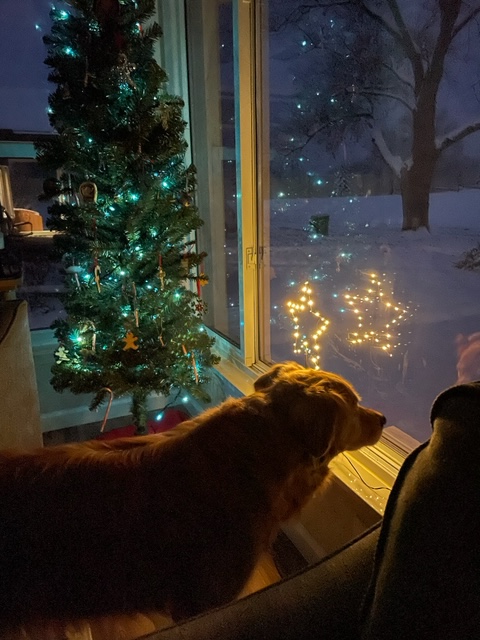
Goodbye to a good, good boy

He began as a promise.

When we left Michigan in 2004 to move to St. Louis so that my husband could begin his seminary studies, we left our golden retriever Mikey with my brother. She couldn’t live in the on-campus housing we were moving to; she couldn’t come with, so we said goodbye.

We comforted our sobbing children with a promise, “We’ll still get to see her.”

However, not long into our time in St. Louis, Mikey was hit by a car, and we lost her.

So, another promise: “When we finish seminary, we will adopt another golden.”

My husband finished seminary in 2008. We bought a house and moved in, traveled to Michigan for his ordination, took a family vacation, then returned to Missouri, and started looking for a dog. We contacted a golden retriever rescue in the greater St. Louis area and said we were looking for a puppy, preferably a female. They had a female, one of a litter of three, did we want to see them all?

Ok, sure.

When we arrived at the house where the puppies were being fostered, we found wall to wall goldens — in my memory there were about nine! The little blond girl we had come to see was rather rambunctious. She ran around the yard and bossed her brothers, one of whom was blond, the other red. We weren’t sure we were looking for her kind of energy. Instead, we were drawn to two others — an older golden named Bruno who plunked all 80+ pounds of himself on our son’s lap, licked his face and made him laugh and the little red brother who sat at our feet, looking up as though to say, “do you see what I’m dealing with here?’ We visited with the pack of goldens for about half an hour, and when we left, though we hated saying goodbye to Bruno, we knew the red boy would be ours.

A few days later, we picked up our little guy, who was just 4 months old at the time. They had been calling him Irish because he’d been born in March and had a red coat. He was crate trained and house trained, yet he allowed us to cradle him like a baby. We adored him from day one — he was instantly part of the family. It took us a few days, some poster board, and a ranked-choice voting system to settle on the same Chester Murphy.

Ches has been with us ever since. For close to 14 years, he cuddled with us on the couch, barked at the neighbors, ran with us, bore witness to our reality, and embodied unconditional love.

He saw our love for one another and for him, but he also witnessed a struggling family that not too many saw — one that had a lot to learn. In his early years, when he saw miscommunications, hurtful comments, silence, isolation, anger, yelling, sadness, tears, he stood right in the middle of it — watching, unafraid, moving in close.

He seemed to know who needed the most attention at any given moment. When one was assaulted and couldn’t tell the others, he climbed in her bed each night and kept her safe. When another got sick, he moved to her bed and kept watch. When one felt unlovable, he pressed his body in close. When one needed companionship, he willingly joined as they walked or ran for miles and miles. If one had been gone for a season, he met them upon return, tail wagging, ready to run and play. He was consistently loyal, loving, and accepting.

For almost 14 long years.

If you have followed this blog, you know that Chester has been a star from the start, mainly because, I have continued learning from him. When, we packed up and left St. Louis, Chester was teaching me how to feel about it. Since we’ve been back here in Michigan, he’s been by my side, showing me how to rest, reminding me of the importance of routine, and just recently, showing me his resilience when he was injured in a fall.

These last several weeks, he’s been showing us how to care for him. We’ve had to slow down, cancel some plans, adjust our routines, and even rearrange our space so that we could provide what he’s needed in his final days. And when it became obvious that these were indeed the most final of the final days, we gathered his people and watched as he showed us how to say goodbye, lying among us, letting us hold him, encouraging us to cry together, to sit together, to acknowledge, even out loud, all that he’s been through with us.

And now, the house is empty, although I swear, I just heard his toenails clicking on the hardwood floor. I keep looking for him, thinking it’s time to go outside, time to get a treat, time to cuddle up. When I realize, again, that he’s gone, my eyes fill, my throat aches, and I reach for the tissues.

I’m going to be sad for a while — really, really sad. We’ve lost a member of the family who loved us all so well, and we’ll never be the same. He taught us a lot, up to the very end.

Chester, you were a good, good boy.

God made the wild animals according to their kinds, the livestock according to their kinds, and all the creatures that move along the ground according to their kinds. And God saw that it was good.

Genesis 1:25

Pieces of Quiet

The house is quiet, I’ve brewed some tea, and I am alone with nothing on the schedule.

Why do I never get tired of days like this?

I’ve had so many!

I had a five-day weekend for Thanksgiving followed by two weeks off at Christmas. Then, shortly after returning from that break, we had three snow days in a row! I leaned into the space, read a book, watched movies, and slept long sleeps. We weren’t even back in the classroom for two weeks when this week’s weather brought us home from school for two days of remote learning followed by a four-day weekend.

We’d had plans — again — to get away, to go north, but Chester, our golden retriever who will turn 14 next month, needs an increasing amount of care and attention, and our old ways of having someone come stay for the weekend, don’t quite seem doable.

Having canceled our plans, my husband went to visit his parents, and I volunteered to stay at home with Chester.

Here I am luxuriating in the quiet expanse of time. I didn’t have to pack a bag or traverse the miles, I merely needed to close my laptop and move to rest. I’ve been reading, washing our bedding, baking some gluten-free bread, making soup, and bingeing season two of Love is Blind (I care not, in this blissful state, iffest thou judgest me.)

Last night I had popcorn for dinner then hoisted Chester onto the bed beside me. We slept spine to spine through the long, cold night. Outside the wind whipped the snow, building drifts across the driveway that our neighbor had not so long before blown clean. Nevertheless, we slept snugly and soundly, tucked safely together.

Chester rousted me early for the necessary, and then we returned to our nest to drift back to sleep. We woke later, took another trip outside, and then sat with the first cup of tea, reading in the sun-filled living room,

Image credit

After some yoga, I managed a shower and then layered on leggings and sweaters, bundling myself up. I’m sans makeup, of course, because the only beings who will see me today are Chester and a few neighbors who are growing accustomed to my pajama-clad dog walks. I’m not trying to impress anyone. I am leaning in to rest.

How many times I have written about rest in this space? I’ve shared stories of being on the couch, in the bed, and the general stillness I try to practice now. I’ve told the tales of my soldiering years — the nonstop pace of going and doing and my attempts at being everything for everyone only to find that if I wasn’t taking care of myself, no one would really get me anyway.

I’ve recited the story of how all that motion came to an abrupt stop against my will, and how that ending was the beginning of a deep and thorough healing that is still in the works.

For a long time, I was in intensive care — unemployed and tending only to my healing. Then I was moved to a general ward — where I managed part-time work in addition to a full schedule of doctors, meds, and learning a new intentionality, a way of working rest into my rhythms. For a few years now, I’ve been ambulatory. I am free to move about — even teach in a classroom full time! — as long as I continue to return to my care. And, boy, have I learned to love to return to my care.

Probably the most important piece of my wellness, the piece that is hard for others to fully understand, is a regular insistent return to quiet and rest.

Each day, I start with a now automatic routine of writing, reading, and yoga. This daily beginning with stillness is a reminder that I must oxygenate myself first. I am best for my students, my colleagues, my friends, and my family when I have first checked in with myself and attended to my own emotions, my own body, my own spirit.

Midway through each day, I step away from work, thanks to my reliable work buddy who daily walks about a mile with me. We may talk nonstop or not at all as we join each other in breaking from our work to once again check in with ourselves and to rest from being in charge, on task, and fully engaged.

At the end of the day, I pack up my bags, load them in my vehicle, and drive home. There, I transition to home life by taking a walk or quietly preparing a meal. Again, I find the quiet, the slowing, to be a healing balm.

In the evenings, I join my husband, who is also in need of rest. We share a meal, catch up on the day, watch a show or two, put a few pieces in a puzzle, then move to our bed early, where we again find the quiet, reading before we drift off to sleep.

On weekends we set the expectations bar low. After a week of work interacting with others, we know that our capacity is spent, so we prioritize down time, knowing our bodies, our minds, our spirits need time to heal, to recover, to restore.

It may seem like a lot — all this resting and quiet and down time — but for some reason, I always crave more. Perhaps I’m still recovering from the soldiering years, perhaps I still need the time and space to grieve all that I missed when I was moving so quickly, perhaps this is just a better rhythm of life.

I’m certainly reaping the benefits. After several years of life-limiting pain, fatigue, and bouts of autoimmune flare, I am stable. People who work with me now would hardly suspect that I spent a few years limping around, lying in bed, and lacking the energy to do what now seems routine.

And the benefits aren’t just physical — I have a broader emotional capacity, too. I have the capacity to see my students’ behaviors as messages to me rather than assaults on me. I can find the space to feel regret and sorrow and even pride and joy.

I have the space to consider how others are feeling rather than using all my energy to keep my own feelings in check.

I have the room to apologize, to imagine, to restore, and to dream.

I hardly thought this was possible when I was walking away from my career, when I couldn’t get off the couch, when we were suffering through a devastating family trauma, when we first started praying for healing.

But if I am nothing else, I am a walking testimony to the power God to transform a life, to bring beauty from ashes, to bind up a broken heart.

So, when He says that we can find our rest in Him, I believe Him like I’ve never believed before. When He says I can cease striving, I stop what I am doing and say, “You’re right. My soldiering ways were not meant to sustain me; they were meant to bring me straight to You.”

I celebrate these days — these pieces of quiet. I lean in, gratefully, and find rest for my soul.

Return to your rest, my soul,

    for the Lord has been good to you.”

Psalm 116:7

An Emotional Legacy

I don’t know about you, but I grew up not knowing how to manage or speak about my emotions.

It’s no one’s fault really.

My parents grew up without much permission to feel their emotions, much less talk about them. It was a symptom of the times, I guess. Their parents, my grandparents, had been born circa World War I and had come of age during the Depression. Their lives were marked by national trauma, but certainly they were not given the space to express their feelings, let alone get therapy or any kind of professional support.

In fact, their parents, my great grandparents, or their parents before them, had experienced trauma of their own, having immigrated from Germany, some by way of Russia, to the US. Imagine what that must’ve been like — traveling by ship across the ocean, not knowing what you would find on the other side! My grandparents were raised by folks who had what it took to take huge risks but who likely didn’t put words to their feelings — the courage they must’ve had, the fear, the excitement, and the exhilaration. And they didn’t likely have the time or wherewithal to explore the devastation they experienced once they were settling and growing their families during the uncertainty of World War I and the Depression, so my grandparents learned from their parents how to survive, how to do without, how to make do; they did not learn how to explore their emotions. They likely tucked them deep inside.

They carried residual trauma and latent emotions into their marriages where they had baby after baby and worked their keisters off to provide house and home and a better life than they had had. They put a meal on the table and clothes on their children’s backs, and for that, those children ought to be grateful. End of story.

My parents, the ones who ought to be grateful, were born circa World War II, another national trauma. My grandmother, my mom’s mom, once showed me the ration books she had kept that allowed her just so much coffee, sugar, and stockings while she was raising small children, wearing a dress and heels, mind you, and keeping her house just so. Having stuffed her own childhood traumas deep inside, she was ill-equipped to provide much empathy or compassion to her own children. Her husband, one of eleven children raised by sugar beet farmers, became a successful salesman who brought home the bacon and often last-minute dinner guests. Little Grandma, as we called her, was responsible for being always ready with a picture-perfect house, an exquisite meal, and well-behaved children. If those children had feelings, they’d better check them at the door. My mother tells stories of high expectations and little tolerance for not rising to meet them.

My dad was one of six children. His father worked for the same company my maternal grandfather worked for. My grandmother stayed home, making homemade lye soap, and attending to the needs of all those open mouths and hands. She, too, had lived through her own childhood traumas, though she never spoke of them. Her clinical depression was so severe that she had endured shock treatments. When I knew her, she was mostly silent, mostly bedridden, with a quiet smile covering God only knows what buried emotions. My dad was the youngest of those six. He tells stories of playing in the neighborhood, of having a paper route, of going off to the Marines, but not too much about his interactions with his parents or siblings. He has been, most of my life, successful, content, and optimistic. I’ve seen little evidence of negative emotions or hurt.

Nevertheless, I suspect that my mom and dad, raised by parents with few emotional tools, endured their own childhood traumas, although they wouldn’t call them that, and likely would deny even now that anything they experienced was “all that bad.”

They married young, of course, and had a houseful of kids. They worked hard to provide for their needs as their parents had done for them and to create a home and family. Alas, generations of trauma were coming home to roost. Ill-equipped to process their latent emotions along with the growing demands of four small children, they managed in their own ways and ultimately divorced.

I was in elementary school when they split, and life as I perceived it — nuclear family, ranch-style house down the street from my school, neighbors I’d know all my life — was disassembled. This was, of course, the largest disruption of my life. We didn’t really talk about it as a family, at least not in my memory. No one knew how. How could they?

Here’s the thing though, whether we talk about it or not, trauma has an impact. We have emotional and physical responses whether we can articulate them or not. I can’t speak for my siblings, but I know I felt all kinds of things. I was stunned with disbelief. I remember telling a classmate “My parents will never get a divorce” just weeks before I found out that they were, in fact, divorcing. I had to figure out what my new reality meant. I remember a conversation with my older sister where I told her that I didn’t have a dad any more. She assured me that I would “always have a dad.”

I had all kinds of feelings for years and years. I could flip from extremely happy to extremely angry in seconds. I could spend whole days brooding. I cried easily, laughed loudly, loved fiercely, and got devastatingly hurt, but I didn’t know what to do with all those emotions.

The message I got from my family and friends was that I needed to quiet down, quit crying so much, and get over it, but no matter how hard I tried, those feelings weren’t going anywhere.

I tried a few coping strategies — drinking, anorexia, and academic overachievement — but those only temporarily numbed the feelings which I would eventually have to take out, examine, and process many years later.

Unfortunately for my children, some of that unpacking is happening now, after they are gone living their lives, trying to find words and expression for their own emotions and their own childhood traumas.

I’m sure I’m not alone — growing up with limited emotional vocabulary to process myriad emotional experiences — but it doesn’t have to be this way. We can, in the midst of our own international crisis find the language and the space to loosen up generations of tamped-down trauma, drag it out into the open, examine it carefully, and give it — finally — some language.

Why would we want to do this? Why would we want to dredge up old hurts, expose old wounds, and revisit decades-old losses? Because in seeing, in speaking, in acknowledging the devastation, there is healing, connection, restoration, and hope.

How do I know? I’ve been on this journey for a while now, and I have found myself coming into wholeness, of being able to feel deeply from a whole menu of emotions — joy, sadness, anger, happiness, sorrow, disappointment, and the like. I’ve been learning Emotions 101 in my fifties, and then recently, a friend suggested I read Brene’ Brown’s Atlas of the Heart, and only two chapters in, I know I’m moving into an advanced course. I’m pulling experiences out of my rucksack again and I’m seeing more complexity, finding deeper understanding, and moving through another wave of grief and recovery.

It’s hard. I’ve been triggered this past couple of weeks. I’ve had some painful flashbacks. I’ve connected some dots that I hadn’t even noticed before. I’ve found myself aching.

But, look, generations have not had the ability to look at individual or collective pain — they’ve not been able to fully grieve. They’ve merely shoved their hurts aside and ‘gotten on’. And we’re the worse for it, aren’t we?

Isn’t it time we tried a different way? Can’t we imagine a richer life for those who come along after us? Wouldn’t it be lovely to start a new legacy?

He heals the brokenhearted and binds up their wounds.”

Psalm 147:3

Challenging Routines

Click the arrow to listen.

It’s a quiet, cold Sunday morning, and I’m sitting here in our office that is filled with natural light. I’ve brewed a strong cup of tea, and I’m ready to write.

I have had the rhythm for several months now of coming to my blog on Saturday or Sunday morning with an idea — some notes from my morning pages or an idea that’s been floating around in my mind all week long, but today I have nothing.

To be honest, I’m kind of in a covid-fatigue slump.

One day runs into another.

I spend up to 5 hours a day in a zoom room.

To fight utter lethargy, I force myself to go out for a midday walk, no matter how cold it is — and it has been cold. You should see me, I layer pants over leggings, long sleeves over short sleeves, pop a stocking cap on my head, and top it all with a robin’s egg blue parka and some winter walking boots. I put my earbuds in and listen to a podcast while I walk the 1.25 miles down the walking path to the corner and back.

Other highlights of my day include a bowl of oatmeal in the morning, a load or two of laundry some time during the day, some ongoing games of Words With Friends, and some kind of television in the evening.

I check the mail once or twice, and usually what I find is some promotional mail from a casino addressed to the former owner of the house, the weekly grocery fliers, and some kind of bill or statement.

I do yoga and write every morning and listen to my daily Bible reading on the YouVersion app followed by The New York Times The Daily Podcast almost without fail.

Day after day after day looks pretty much the same, and I must not be alone in this because last Sunday our pastor, Gabe Kasper, started a sermon series, Rule of Life , which is an examination of the current rhythms we live in and a challenge to interrogate the impact of those rhythms and perhaps switch them up a little.

Pastor Gabe cited Justin Whitmel Earley, the author of The Common Rule, who said, “We have a common problem. By ignoring the ways habits shape us, we’ve assimilated to a hidden rule of life: The American rule of life. This rigorous program of habits forms us in all the anxiety, depression, consumerism, injustice, and vanity that are so typical in the contemporary American life.”

Well, if that didn’t just stop me in my tracks. What habits have we all formed? What do we do in a typical day? What consumes our time? And how is that activity, that behavior, that habit, that rhythm shaping us?

Now I love a daily rhythm. When our children were little, I actually had a daily schedule. We had a wake up time (you will not get out of your bed before this alarm goes off at 6am), a ‘school’ time (where this teacher/mom provided intentional lessons on letters, numbers, colors, etc.), a play time (“No guys, we can’t play in the back yard at 6am. We will go out at 9), and a break time (everyone to your own spaces — we all need some time alone). Of course once they were in school, that schedule pretty much dictated our days, as work does for me now, but even when I don’t have to be anywhere, it is a rare day that I don’t have some kind of time map laid out and a list of things I want to accomplish, including the morning rhythm that gets me started every day.

But Pastor Gabe wasn’t asking me to examine my to-do list or my wellness routine, he was asking me to consider the ways I fill my time in the spaces around that schedule. How much time do I spend on my phone — yes, I do know that number because the phone tells me every week. How much time do I spend mindlessly watching Netflix or Peacock or AppleTV every night? He was also asking me to check my intentionality. How much time do I spend reaching out to friends and family members? How much time to I spend talking with my husband? How much time do I spend in prayer?

These are good questions — especially two years into Covid when most of us have binged every show on TV, we’ve become overly attached to social media, and — let’s be honest — we’re eating our meals on the couch wearing yoga pants, sweats, or pajamas. We’ve lost whole days, weeks, and months.

Time has become a very ambiguous concept — When did that happen? I don’t know, some time during Covid.

So, this sermon series is tapping me on the shoulder, saying, Hey, I know it’s been a rough go, but I think you’ve got the capacity to switch a couple things up, and you know, I think I’m ready.

Last week’s encouragement was relatively easy. Pastor Gabe asked us to consider adding a few pieces to our routines:

The first piece is daily prayer. This might seem like a no-brainer, but a habit of prayer has been a little squishy for me. I do pray. I find that my morning writing is often a prayer, or it makes its way to prayer. I also am starting to build a habit of praying when I first start to wake in the morning and before I fall asleep at night, but for all the order and structure in my life, prayer is one place that has remained more ad libbed. I’m considering that rule of my life right now as part of this congregational journey.

The second piece is weekly worship. My husband and I already have this as a rule because we love worship. It is a time of peace and healing for us — a time of community and belonging. Since the beginning of Covid, we have at times chosen to worship virtually, and we are thankful to have that option.

The third piece is monthly fasting. Now, since the idea of fasting may produce some anxiety, let me say as a former anorexic, that fasting does not need to be from food. It can be, but since this re-set for me is more about how I spend my time, I am considering a couple options — 24 hours without technology or maybe just social media or possibly 24 hours without my phone. It’ll be a challenge, so I haven’t put anything on the calendar yet, but I am thinking about it. (And now I’ve put it in print, so the likelihood that it will happen just went up a notch.)

Considering change, especially to rhythms that have sustained (or at least distracted) us during a time of crisis, is not easy. It takes intentionality. It takes a desire and a commitment to take a new way even when muscle memory wants to take the familiar route. But what might be the benefits? What might be the pay off? What might we notice if we change a few steps in our daily routine?

This morning, in the second sermon in the series, Pastor Marcus Lane said that following the Rule of Life is not a prerequisite to get to God but an opportunity to be transformed by His grace.

That’s what me might gain, friends, a greater experience of the grace of God and His transformational power.

What might be changed? What might we experience? How powerful is the grace of God?

In my experience it can turn mourning to joy, pain to healing, and despair to hope. It really can.

I might be willing to make a few changes for that. How about you?

discipline yourself for the purpose of godliness; for bodily training is just slightly beneficial, but godliness is beneficial for all things, since it holds promise for the present life and also for the life to come.

I Timothy 4:7-8

Open Wound, an allegory*

Stressed Woman At Home Headache Pain Female Portrait. Beautiful Girl Close  Up Face And Head With Hands Sitting Alone Sad. Drawn With One Line Royalty  Free Cliparts, Vectors, And Stock Illustration. Image
Source
Click arrow to listen.

*allegory, a symbolic fictional narrative that conveys a meaning not explicitly set forth in the narrative

Her wound was open. She sat, sobbing.

It wasn’t the first time. Although it had scabbed over time and again since the injury was first sustained, it could be torn open with the slightest impact, even now, decades later.

She’d been a child when the initial blow had been dealt and her still-young flesh had first been split open. The pain had been stunning — it had shoved her back, and she had sat, a child, weeping on the floor, holding her chest, trying to stop the hemorrhaging.

After she had tired from much sobbing and flailing about, it had subsided — the pain, the bleeding — receding to a dull but ever present ache.

Since then, she had carried it around with her, this bruised and tender flesh,

It was the kind of injury that never fully heals, the experts had said. Even when sustained during the growing years, the body — the heart — could not regenerate enough cells to fully heal the damage that had been done.

The injury would remain, opening up from time to time. Then, new cells would form to stop the bleeding, to cover over the gaping wound. She’d use caution, covering the tender area with a protective layer, shielding it from subsequent blows, learning to avoid danger, developing a keen defensive awareness.

She’d be so careful, so vigilant, that she could even believe the spirit-altering injury might actually be healing. The pain would subside, and she would become hopeful that she would never again shed tears, never again ache, never again sob with the pain or even the memory of the pain.

But then, from out of nowhere — but often from somewhere familiar — a pointed blade would find its way through her armor, past layers of clothing, beneath the dressings, to pierce the flesh. Just like that, the wound would be torn open and she would crumble again, down, down, down, weeping, sobbing, holding her heart, and begging for the pain to stop,

In the early years, not long after the wound had first been dealt, she would, in pain, lash out — swinging and flailing at those closest, begging them to join her in the misery. Over the years, however, she learned this strategy was ineffective — it did not diminish her own hurt, but rather multiplied it. Instead of joining her in her pain, the others turned away, kept their distance, isolating her, piling guilt and regret on top of pain, and leaving those she loved with their own wounds to tend.

Later, as she aged, when certainly, she thought, this decades-old injury had to be fully healed, she could still be brought low by a stray arrow, an unintended blow that nevertheless grazed the tender flesh, re-opening the wound.

It was open now. The middle-aged heart had been hit, and it was laid bare.

Seeping.

Throbbing.

Reminding her of the many years of pain, many years of tears, many years of swallowing feelings past a tightened aching throat.

She lay supine, futilely wiping away an unstoppable deluge of tears, fighting against the years of pain — still not wanting to feel it — still not wanting to admit I’m hit! I’m hurt! I’m bleeding! I’m suffering!

Those standing over her, observing her as she lie bleeding, sobbing, say her wound, her perpetually open wound, informs her compassion, gives her language to comfort others with the comfort she herself has received, but that is little consolation when the tenuous flesh has been recently sliced, when the blood is dripping on the floor, when she is doubled over, trying desperately to silence her own cries.

Nevertheless she hears.

She admits they are right.

Her pain does give her compassion for others.

She sighs in resignation, then does what she has always done.

She rises.

She sits up, dabbing at the now-congealing blood,

taking a sip of cool water,

applying fresh dressings,

washing her face,

combing her hair.

Then, as she examines herself in the mirror, she hears a still small voice, “Do not be afraid; do not discouraged, for I am with you wherever you go.”

“I know,” she says, nodding, wiping a tear from the corner of her eye, “I know.”

And she, carrying the open wound with her, steps back into the land of the living.

Time for Refreshing

Chester and I relishing the end of a restful week.
Click the arrow to listen.

A thick blanket of wet snow covers our yard, our driveway, and the playground across the street. It’s almost 7:30 am, but the heavy winter clouds overhead are allowing just a soft gray glow to light the neighborhood. It’s a quiet ending to a quiet week.

In the months leading up to our Thanksgiving break, my husband and I had imagined all kinds of scenarios — flying someplace warm to sit in the sun for a few days, driving across the border to Canada to “flee the country” for the day or even a few hours, dining out, going to a movie, or possibly visiting with family. We scrolled through flight options, investigated Airbnbs, read restaurant menus, and discussed possibilities. We really wanted to get away. I had had a busy fall, but his had been even more taxing. We knew we needed a break and possibly even an escape.

For weeks we ran scenarios and dreamed dreams, but it seems each time we got close to a plan, we ran into a difficulty. Flight costs had skyrocketed, all of our usual caregivers for our aging golden retriever were unavailable, and I had to attend a virtual professional development on Monday and Tuesday, so the escape to a sunnier climate was off the table.

Still, a day trip to Windsor seemed doable, so my husband scouted out some restaurants and began to plan our day, but then we realized we’d need a negative Covid test 72 hours prior to our visit. That wouldn’t be a problem, but then, as we started to investigate a little further, we noticed from the New York Times Covid Map that Michigan was one of the hottest spots in the nation. Would it really be responsible to head across the border, especially since both of us spend our days in a petri dish surrounded by teens and young adults? What might we carry with us?

As we were coming to terms with our reality, my brother reached out. He was hosting Thanksgiving at his house, and he was inviting us to join. My mother and stepfather would be there along with my other brother and his family. That sounded lovely. We were not able to do Thanksgiving or Christmas with family last year. The idea of driving “over the river and through the woods” to enjoy a feast surrounded by loved ones sounded amazing. However, it wasn’t long into our discussion of this possibility when we realized that that, too, would be irresponsible. My mother, although fully vaccinated, has chronic myeloid leukemia (CML), and while she is in remission, her health is still quite compromised. We are fully vaccinated, and even boosted, but we still didn’t feel like it would be wise with the current spike in cases to gather and bring any traces of virus we might be carrying into her midst.

So, it was around last weekend when we determined that we should probably just stay home, roast our own turkey, binge on some Netflix and football, and get some rest. It was disappointing at first, but, as you might have guessed, it turns out it was just what we needed.

On Monday and Tuesday, I had a couple faculty meetings, and then I was afforded the time I needed to write detailed lesson plans for when I return tomorrow. Often that work is squeezed into my prep period or in the before or after school time, so having hours to imagine how my lesson might play out, to design an instructional activity, and to create a detailed rubric was luxuriant.

Between meetings on Monday, I popped a turkey into the oven, then at the end of the work day I threw together a couple of sides, and we welcomed a couple dear friends who already navigate within our work and social bubbles to share it with us. Then, because I didn’t think to send leftovers home with our guests, we ate turkey for the rest of the week — first in the form of reheated leftovers and then in bowl after bowl of yummy soup.

With days at our disposal, and nowhere to be, we were able to manage a car repair, sewing machine servicing, some quick dashes to pick up birthday and Christmas gifts, and a long walk in a county park nearby. We lost track of time, ate when we got hungry, and napped when we felt tired. Every once in a while, I would default to my schedule-checking mindset, “What nights next week do we have plans? Am I all set for teaching on Monday? What do I need to take with me?” and then I would remember that it wasn’t even the weekend yet. I could keep relaxing.

I crocheted, and I mended. We put up and decorated our little Christmas tree. We zoomed and Facetimed with family, and we did a lot of sitting around. I finished one book and started another, and we completed three jigsaw puzzles!

And still we had more time. Time to do yoga, to write, and time to just rest, sipping tea, and gazing out the window into the snowy day. This is what we needed — not a flight to sunny spot, not a run for the border, just some quiet, uncommitted time. We are thankful to have had it because tomorrow we will suit up, grab our bags, and head back into our work.

We are breathing fresh air, our bodies are restored, and we are ready to greet our students and colleagues.

Buckle up, kids, here I come!

I will refresh the weary and satisfy the faint.

Jeremiah 31:25

Health Check

A friend asked me recently, “How are you doing with pain now that you’re back in the classroom?”

I appreciated her asking — it was an acknowledgement that she remembered how far I had come and that my move back to the classroom was not taken without much prayerful consideration regarding the impact such a move could have on my health after the years-long journey I have just taken.

It’s a good time to ask because a) last year wasn’t a real test since the students were learning from a distance and the physical demands were not as great and b) we’re now back in person, and the first quarter will end on Friday.

It’s an important question, too, because this blog started when I had to leave my teaching career due to health issues. I was struggling with pain, fatigue, and issues with my skin and eyes, and I just couldn’t bring quality care and instruction to my students in that condition.

My body, it seems, had gone on strike after years of overwork complicated by a failure to process my emotions or take care of myself. Inflammation was so prevalent in my body that I could feel it– it bubbled into my joints making them hot and stiff, it irritated my skin causing scaliness and itching, it inflamed my eyes sending me time and time again to a specialist for treatment.

Many times I’d landed on the couch or in my bed for days at a time. In the early years of my recovery, I had to lie down several times a day even though I slept 8-10 hours a night. I often found myself limping through the house or lying on the bathroom floor waiting to throw up. I was miserable, and I couldn’t imagine a time when I would be able to return to the rigor of the classroom.

However, over six long years, I learned strategies that began to reduce those symptoms and that have kept me on a path to improved health. Among those strategies is a diet that is rich fruits, vegetables, chicken, rice, and fish, and that avoids gluten, dairy, beans, and corn. I also exercise every day, write every day, and see a therapist, a physical therapist, a chiropractor, and a masseuse. When I do all of these things on a regular schedule, and get plenty of rest, I mostly stay well.

The progress has been slow and incremental, just as my return to working has been.

If you’ve been tracking the saga, you know that I didn’t work at all for six months, then I started by tutoring and proofreading. I moved on to part-time work in an educational agency, then progressed to teaching part-time as a college adjunct instructor. From there, I moved back to the agency and eventually worked full-time in a leadership role, but I still didn’t believe I would ever have the capacity to teach in a classroom full of students, managing their learning, their emotions, and their movements five days a week.

It was at this time, about almost six years into recovery, that Covid hit. We as a nation were knocked down by this highly contagious pandemic, and, as we social distanced from one another, we had some time and space within which other ailments — widespread poverty, systemic racism, educational inequity, and the like — became more evident.

The situation looked familiar to me because I had just lived through something similar — autoimmunity had knocked me down and forced me to take some time and space to recognize that I hadn’t been attending to my mental or physical health or to that of my family. I had to acknowledge that they were suffering, too.

And as I observed our nation’s symptoms in real time, something just clicked. It was like I had been training and preparing for this moment. I was in good shape and ready to step back in the ring, and if I was going to do it — if I was going to put myself out there and see if I still had the juice — I was going to do it in a place where I could turn the dial, be it ever so slightly, by identifying and using strategies that might reduce the impact of poverty, racism, and trauma for students who had been knocked down the hardest.

If you’ve been reading along for the last year, you know that I am intoxicated by the opportunity I’ve been given at Detroit Leadership Academy — I can’t keep my mouth shut about it.

But that didn’t answer my friend’s question, did it? How am I doing with pain now that I am back in the classroom full time?

I’d say I’m doing better than I might’ve hoped for. As I’m writing this, I’m tired, and I’m on the second day of a headache. I’m not surprised. It’s the weekend before the final week of the first quarter. We are still short one staff person, plus we’ve had one out due to Covid for over a week. I’m working in a setting that is rich with trauma and the impacts of trauma, and it shows. The students are tired, and worn, and often quite raw. I see all of this, and it weighs on my heart.

And, if I’ve learned anything through this journey, it’s that emotions are stored in the body. My students’ bodies show it, and my body shows it.

So, yes, I do have some pain — in my heart, but also almost always in my right sacroiliac joint, often in my low back, a little less in my hips and neck, and today in my head, and much to my dismay, my left eye.

That left eye — he’s the lookout — he always lets me know when I have pushed too far, when I need to take a down day, when I need to attend to self-care. Today I think he’s shouting because on top of a long week, I pushed a little further on Friday night, went out to dinner with my husband and a coworker, then travelled through a downpour to an away football game where my students were playing against a team with far greater resources — a well-lit turf field, cheerleaders, a marching band, and stands that were 1/3 full even in the downpour. Our side of the field had about a dozen fans including us. Our guys, after arriving late because the contracted transportation was late picking them up, fought hard, but they were outmatched; the final score was 42-6. The other team was jubilant — they had claimed their victory. Our team was despondent — their hopes were dashed. It felt emblematic of the divide in our country — the inequity of resources and opportunity I see in my work every day and the impact that inequity has on the lived experiences of students like mine. It was hard to watch.

We got home after 10:30, damp and chilled, and I crawled into bed to sleep. Through the night I felt a headache and some nausea. This morning, my body has the hum of inflammation — the heat and a quiet vibration that calls for my attention. Less subtly, my eye is shouting, “For the Love of God, take a break!”

So, I’m spending my morning writing and doing some yoga. Next, I’ll eat a breakfast of non-inflammatory foods, slowly go pick up some groceries, then come home, sit on the couch, and watch some football.

I’ll take the weekend to rest, recover, worship, and see some friends, and by Monday, I should be ready to step back into it again.

It takes vigilance to stay well — everyday attention to self care that puts the oxygen mask on myself before it dares to assist the person next to me. It’s counterintuitive to how I always imagined I was supposed to live — squaring my shoulders, gritting my teeth, muscling through, grinning and bearing it — and it’s a better, richer way.

I have way more gas in my tank, way more capacity to put my work down when students gather in my room like they did on Friday morning — a bunch of seniors huddled around my desk, asking for snacks, chatting, busting on each other, making me laugh.

Pain? Sure, I have pain; my students do, too. Somehow, we’ve landed in the same space, and we are learning how to be together, how to learn from each other, and, on the richest of days, how to laugh with one another.

For this, I am so thankful, and so committed to staying the course and attending to my wellness so that I can keep on showing up for these kids.

He picked me up

And He turned me around

And He placed my feet

On the solid ground

Hallelujah, hallelujah

Corey Asbury, “So Good To Me”

Rose-colored Glasses and Reality

Click the arrow to hear me read this post.

Since I re-entered the classroom last fall, I think I have been annoying some folks on my staff a bit. At least that’s the vibe I’m starting to pick up. Perhaps I’m a little too positive, a little too gung-hung, a little too happy-clappy.

I’ve not always been this way. I haven’t always interrupted staff meetings to say, “I really appreciate the thoughtfulness the leadership put into this decision,” or “Wow! Thank you so much for this meaningful professional development,” but after being away from the high school classroom for six years, thinking I’d never be back, I came to my little charter school in Detroit carrying an unbridled enthusiasm and wearing a lovely pair of rose-colored glasses.

You can almost hear the other teachers, most of whom have been trudging away in understaffed, under-resourced environments for most of their careers and who had recently closed out a school year that ended in an unanticipated three months of virtual instruction, saying, “Who is this woman? And why is she so happy?”

They didn’t ever say that out loud. In fact, I didn’t have any idea anyone was feeling that way until this fall when one teacher I’m growing closer to subtly implied that perhaps my positivity wasn’t firmly grounded in reality.

How could it be? I had been given a second chance at my career during a world-wide moment when everything was virtual. Reality was hard to get a grip on.

All last school year, I sat in my classroom alone, meeting with students who chose to log in to my Zoom room.Those who didn’t want to be there didn’t show up at all. I didn’t have to navigate noisy crowded hallways; I didn’t have to interact up close with the sometimes volatile emotions of high school students. I didn’t have to clean up messes, make copies on machines that sometimes get jammed, stand in line to use the faculty restroom, or cover a class when another teacher was out sick.

My first year back was a challenge, don’t get me wrong, but it wasn’t the typical Sisyphean grind that most teachers experience day after day, year after year. I was able to prepare, teach, and grade within the hours of the school day with very few exceptions. The classes I taught were similar to those I had taught in the past, and I was able to use my own materials that I had been developing for years. Other staff who had chosen to work from the building became my friends, joining me for walks on our lunch breaks. Every part of my position seemed tailor-made for me, and I was thrilled to be back!

I got excited every time a student logged into my classroom. The few rare times that we actually had students in the building, I gushed with enthusiasm, handing out gifts and prizes to anyone who crossed my path. I looked forward to faculty meetings and gladly answered the phone when anyone related to school — principal, coworker, parent, or even student — happened to call. I volunteered for opportunities such as a curriculum audit and mindfulness sessions, and I agreed to participate in a program for graduates over the summer.

I have been a cheerleader, literally clapping my hands, shouting “hooray”, and doing celebration dances for students and staff. I know, I know — perhaps it’s been a bit much.

But my colleagues can relax, because lately the rose-colored glasses haven’t been doing the trick. We started this school year in the flesh, and shit has been decidedly real.

I think we were “fully staffed” for four whole days, and that was before school even started. We lost one staff member before the students arrived and another within the second week. Not only did we have two fewer staff than we had planned on for the year, but we had a sudden need for an additional staff member when our freshmen class ended up being one and a half times as large as we thought it would be. Our HR department had just replaced the first two staff members that we lost early in the year and was still trying to find the additional teacher when another staff member resigned on the spot last week.

Why so much turnover? Because most teachers don’t experience what I had the privilege of experiencing last year. Most teachers work hard — very hard — with few, if any, breaks, and they do it for insubstantial pay. Teachers are leaving the profession in droves, and few young people are interested in entering the field. Our nation is experiencing a teacher shortage, which is especially felt in districts like mine where teaching can be even more challenging due to systemic inequities.

So, we’re still down two teachers, and Covid starts picking off first students and then staff. By the middle of last Monday, three key staff members had tested positive. Out of concern for student and staff safety, the decision was made to move to virtual instruction for two weeks. This news was to be communicated to students during the day on Tuesday.

When I walked into the building at 7:30 that morning, I felt wobbly. I think all of us did. We were extra short-staffed, and we all knew we’d be covering an extra class or two. The students, it seemed, were feeling it, too. The halls seemed louder, the classes a little more electric than usual.

About midday, as students got notification of the pending move to online instruction, the questions started coming. Why are we going to virtual? What about Homecoming — the dance is supposed to be this weekend?! The anxiety started building. I know it’s going to last longer than two weeks. I ‘m not coming to virtual class. I can’t do it again.

During the last period of the day, I was subbing for a class in which most of the seniors in the room were already disengaging. I tried, in futility, to get them to complete some of their work, to “get done what you can now before you are at home and don’t have the support.” Another teacher, whose room we were in, brought in a small group of underclassmen who were involved in “some trouble” in another room and needed to be removed. Since the vice principal was already backed up with other behavioral issues, we would have to house them until he had time. The two of us talked with students, answered questions, and tried to keep the atmosphere light until the final bell.

When it finally rang, and the students were dismissed, a handful of us teachers gathered in the hallway for a collective sigh. We hadn’t stood there long when we heard the yell of a staff member saying there was a fight in the parking lot and all of us were needed.

We ran out of the building to find chaos — a small cell of students involved in the actual fight and dozens of students moving about the parking lot instead of getting on their busses. What we had hoped would be a smooth transition to virtual instruction was anything but.

It made sense to me. The whole day had felt tenuous — not enough staff, impending change, and uncertainty about the future. I, a grown adult with years of therapy under my belt, had felt wobbly. How were teenagers, most of whom had experienced trauma after trauma after trauma, supposed to find any ground beneath their feet? How were they supposed to think logically, get on their busses, and go home trusting that we would indeed be back together in a couple short weeks?

The fight was soon dispersed, but not without injury, not without drama, not without the adrenaline and cortisol rush that witnessing chaos produces. Students who had missed their busses were picked up by parents or brought inside to wait for their rides, and staff wandered back to their rooms to hop on a Zoom meeting to discuss the details of Count Day which would coincide with our move to virtual instruction.

When the meeting was over, the same staff member who had gently chided me for my rose-colored glasses stopped by my room and pulled up a chair. We processed what had happened, shared our dismay, and acknowledged the reality within which we function, within which we have chosen to teach, within which we both believe we can make a difference — the messy, unpredictable, and sometimes volatile reality. Then, we loaded our computers into our cars and headed home.

The next day I sat in our home office, logged into my zoom room, and greeted each student who showed up with my overenthusiastic grin. I applauded the students who turned on their cameras, and I literally happy danced when a student told me that she had decided that she was going to go away to college after having resolved some personal issues that she had thought might keep her at home.

I think my happy-clappy self showed up not because I am wearing rose-colored glasses, but because I have fully acknowledged the reality within which my students live and move and have their being. Despite the fact that the challenges are many and varied, I am still a glass-three-quarters-full kind of gal. I think I have to be in order to see a path toward educational equity in spite of what I know to be true, to think that I can make a difference in the lives of my students and their families, and to believe that my experiences have brought me to this place for such a time as this.

The joy of the Lord is your strength.”

Nehemiah 8:10

Chester and I — A Return to Best Practices

Chester woke up with tummy trouble. It was not the first time. He’s always been little sensitive. Even from an early age, he was always a little “eating disordered”. Sometimes he would eat his food; sometimes he wouldn’t. Throughout his thirteen years, he has eaten 70-80% of the meals set out for him. It used to worry us, but eight or nine years in, we accepted it.

When he was younger, he was also a puker. Once a month or so, we would find a disgusting pile on the stairway landing or hear him retching and run him to the door. Usually after he’d emptied himself and slept it off, he’d be fine.

Now that he’s geriatric and since we’ve moved into our new place, his tummy trouble has found a new expression — diarrhea. The first time it happened was a few weeks ago. Chester woke me in the middle of the night, demanding to go outside. Once in the yard, he showed me why he had been so insistent. The next few nights, it was like I had a small child again. I let his belly rest a bit, started a bland diet, and called the vet. By the time of our visit, the issue was resolving, but then it came back in full force.

The vet’s hypothesis? “Sometimes when we go through change, this happens.”

Poor Chester had lived his first six years in one home, his next seven years in another, and now, when he’s thirteen, we are changing his environment again. It was a little overwhelming for all of us, and I had to admit, my body was feeling it, too.

Our bodies are so strong. They perform for us physically — packing and moving boxes, walking up and down the aisles of Lowe’s and Target, and meeting with realtors, contractors, and vendors — while at the same time holding all of our emotions — excitement, stress, joy, and anxiety. They are resilient and adaptable, but after several weeks of ongoing demands, our bodies can become overloaded.

Chester’s been a real trooper — learning to walk up and down stairs again, adapting to a new environment, learning the new rules of where he can go and where he cannot go — but I think his tired body was finally ready for some TLC.

My own body was energized through all of the packing and moving, but a couple weeks into the settling — unpacking boxes, welcoming guests, and making major purchases of furniture, hardware, etc. — I started to feel a familiar hum — inflammation, fatigue, the signs of a flare. Thankfully, my body doesn’t cry out in the same way as Chester’s. Instead, I first notice sassy replies sprinkled with sarcasm. Then, I notice a psoriasis outbreak or a headache. I find myself sleeping 10 hours some nights and 2 hours on others.

Just as Chester was suffering, my body was aching, and I knew I had to start paying attention.

This cross-town relocation took some work, and in order to meet the demands of the move, I had put some of my “best practices” on hold. I wasn’t taking the time each morning to write three pages, really read my Bible, or get in my daily walk. I was surely moving a lot, but I wasn’t connecting with the rhythms that have kept me well. It was time to return.

So, in fits and starts, I have been returning, but I have been distracted. Since Covid restrictions have been loosened, we, like countless others around the globe, have also welcomed guests and traveled quite a bit lately. We’ve been to Ohio, Indiana, Massachusetts, and several points in Michigan. We’ve seen all of our children, our grandchildren, our parents, and several siblings, nieces, and nephews. All of this time with family has been sheer bliss, and we have loved every minute. However, in order to make it all happen, I have been less than consistent with my routine. I’ve fit in some yoga here and there, and I’ve gone on some walks, but I have learned over the past seven years, that if I want to stay healthy, I need to observe my best practices daily.

I was doing a pretty good job last week. I had about seven days running of eating the right foods, doing yoga, going on walks, and writing, and I was starting to feel pretty good. Chester was doing well, too! He was eating his food every time it was set out, he was going on short walks, and he even had a short meet and greet with a neighbor dog.

We were already seeing the pay off of our routine.

We were feeling great when our son, daughter-in-law, and two granddaughters pulled into our driveway last Thursday. We hugged, we played, we chased, and we snuggled. Then, we piled in two cars to go meet more family for a fun-filled beach weekend. Chester was safely secured at home under watchful care, so he would certainly be fine if we were gone for thirty-six hours or so.

What could be better for a body than a couple days on a beach, watching children play, drinking in fresh air, and soaking up sunshine? What difference would it make if we ate a few extra chips, sampled a gluten-rich cookie or two, or splurged on some onion rings? We were laughing and smiling and having the time of our lives.

Exhausted, we pulled back into our driveway late on Saturday night to find that Chester, who’d been fine while we were gone, just couldn’t hold it together until we got to his crate. The stench in the house was evidence of what had happened as he awaited our return. So, instead of falling into my bed to recover from the weekend, I found myself on hands and knees cleaning up feces, carrying soiled blankets to the wash, and lighting candles throughout the house.

Later, as I stood in the shower, I felt my clenched jaw, my burning eyes, and my aching joints. I toweled off, pulled on pajamas, and flopped into bed. Almost immediately, Chester sunk onto his bed beside me. We sighed. We were tired. We couldn’t keep up this pace any more.

We needed a return to our best practices.

This morning, he urged me out of bed and stood near me until I found my way to my desk, carrying a bowl of gluten-free oatmeal and a cup of green tea. When I was adequately positioned, he plunked on his rug at my feet, happy to be back in the routine and looking forward to feeling the benefits.

Later this week, I’m going to welcome my sister who is visiting from out of state. We’re going to spend an evening with friends, and I am going to participate in an event for my recently graduated students. It’ll be fine. It’s not too much. I just need to remember to keep returning to these best practices.

 I pray that you may enjoy good health and that all may go well with you, even as your soul is getting along well.

3 John 1:2

Coronavirus Diary #30: Emerging

It’s starting to happen. We’re opening our doors, stepping outside, and actually talking to people — sans mask.

At first it felt a little weird.

We were in the backyard of our new nest (still trying to settle on a name: the garden ranch? the house by the highway?) working in the dirt, plunking seeds in the ground, when first one neighbor then another walked toward the fence, introduced themselves, and stood to talk for a bit.

We were outside of course, where no masks have been required for quite a while, but we weren’t keeping six feet distance. We moved in close — close enough to see eye color. It felt good, but then my husband did something audacious: he breached the fence line, extending his hand to Bob, our backyard neighbor, and Bob, equally audacious, grabbed his hand and shook.

Emboldened by such recklessness, our son, too, walked forth and shook the hand of a man who we had never met. We didn’t know if he was vaccinated, Republican, Democrat, a masker, an anti-masker, or what! Yet, they each grabbed his hand, swapping epitheliels and such. I felt a rush of anxiety, and then I internally shrugged.

The mask mandate had been lifted, after all, for those who had been vaccinated, whether outdoor or indoor, and we had been vaccinated, so I guess hand shaking was the next step.

A few days later, we were walking into Lowe’s when we saw a sign that said, “masks are now optional for guests and employees of Lowe’s,” so we unstrapped our faces, walked in and began to hunt down the items on our list. Several minutes into our quest, my observant husband said, “Hey, I’m noticing that most everyone still has a mask on. Maybe we should, too.” So, with a sense of courtesy and care for others, we strapped them back on.

It’s no big deal, after all. We’ve been wearing masks for over a year. We have dozens in our home, in our car, and at work. It seems almost second nature now to cover our droplet-spewing exhales for the sake of others, but we’re seeing more spaces where we feel free not to.

Weddings, for example. Last weekend, we went to two weddings in one day. At the first, we sat in our car, watching others walk into the church without masks, so we decided to do the same tucking a mask for each of us in a pocket just in case. At the door to the church we saw a sign similar to the one at Lowe’s announcing that masks were not required for the vaccinated, so we dared to walk into the sanctuary naked-faced.

Inside, about 30% of the the guests wore masks. The ceremony commenced with the whole wedding party processing barefaced. Yes, the priest donned a mask before serving communion, but many remained unmasked for the service, even while singing. And the singing! After over a year of virtual church, the rich voices in the extravagant sanctuary felt celestial — a foretaste of things to come.

After the ceremony, as the guests rose to exit, most conservatively covered their faces, and we did, too. We’d tasted the freedom, but we hadn’t lost our minds. That would happen at the next wedding.

We’d received an email the night before that fully-vaccinated folk would not be required to mask at the second wedding. Still, we kept a mask in our pockets as we walked into the large, airy sanctuary. We found our seats and scanned the room. This was the wedding of someone we’ve known for decades, and several of the guests were dear to us. Not one mask was visible to me.

We slid over to let a couple join us. My husband shook a hand and gave a hug. I simply smiled and gushed, “It’s so good to see you!” I looked around and spotted a long-time friend I hadn’t seen in the last few years, then a couple who we love dearly. I wanted to cross the room to greet them, but I committed to the more socially-appropriate action of staying put for the duration of the ceremony.

The wedding was joyous — the joining of two fractured families who had found healing and hope in each other was filled with smiles, tears, and much rejoicing. The people gathered were reminded that God makes all things new — that He takes our brokenness aside and makes it beautiful.

Buoyed by restored hope, the wedding guests excitedly exited the sanctuary, nary a mask in the crowd, and continued to greet one another and comment on the just-witnessed miracle. Among them, my husband and I were chatting with another couple when I spotted, once again, that dear friend I hadn’t seen in years. My feet propelled me to her, and before I knew it, without first asking for permission, I wrapped her in a hug. I was suddenly emotional. Other than my husband, our son who lives locally, and my mother, I had hugged very few people in the last year. Very few indeed. And this friend, who I’ve known for over thirty years of highs and lows and another friend who I would track down moments later and enthusiastically embrace — again without thinking to pause for permission — were dear, dear friends who I might have at one time taken for granted, might have given a quick hug at a wedding reception and then moved on to the drinks, the food, and the dancing. but not now.

I’ve been changed — at least temporarily. As we emerge from almost fifteen months of separation from one another, isolation in our homes, and the alienation of wearing a mask — all for the sake of protecting one another out of love — I have a new perspective.

At times during the pandemic I have felt anxious, not wanting to be around people, feeling wary of moving through crowds, and venturing out only out of necessity to get groceries, see the doctor, or go to work. Even several weeks ago, when we went to church on Easter, after the worship services were over, after most of the people had cleared, I still felt uneasy walking up to the building to receive communion because a dozen or more people were standing outside the building without their masks.

It’s been strange, hasn’t it? To be afraid of getting close, of sharing air? Haven’t we been suspicious of those who came too near, who didn’t mask up, who didn’t seem to take the virus seriously? Or maybe you felt differently. Maybe you thought we’d all gone overboard what with the masks, and the quarantines, and the sanitizer, and such. Maybe you’ve not been isolating and distancing as much as we have. Maybe you don’t feel, like I do, that you are emerging from a bunker where you’ve been hunkered down, missing your people for over a year, but that’s how I feel.

Is the sun shining brighter? Have my friend Pat’s eyes always been that attentive and loving? Has Chris DuPont’s voice always sounded so angelic in a spacious cathedral? Have the hugs of friends like Heidi always been so life-giving and heart-swelling?

I don’t remember, but suddenly I am overwhelmed with emotion just just to see you — all of you.

I know the virus is still here and that it’s going to be here for a while, but right now, in the light of the sun, on these beautiful spring days, I feel free as I emerge from a long, long, hibernation that lasted much, much longer than a winter.

I missed you, my friends. I pray I get to see your face and hug you soon.

Be strong and take heart, all you who hope in the Lord.

Psalm 31:24