not perfect

I’m not perfect, but sometimes I try to be.  It’s not really a conscious decision; in fact, if you ask me, I will tell you that I have many faults. I know I am not perfect, yet when I make mistakes, which I am bound to do, I am pretty hard on myself.

For instance, I met a new student last Wednesday night.  I had made some assumptions about her ethnicity based on the name she used on her online profile.  I met her in person and began to talk about her language issues.  I asked, “Is English your first language?” “No.” “Chinese?” “No, Korean.” Ouch.  That’s the second time inside of a month that I had mistakenly assumed that a Korean student was Chinese.  Of course both times I apologized, but that didn’t release me from the guilt, judgment, and reprimands that I heaped upon myself for hours —  ok, days –afterward.

Shall we continue? My husband and I had been planning a trip to Cincinnati for Valentine’s Day.  We had offered to watch our granddaughter so that our kids could get away overnight.  He adjusted his schedule so that we could leave as soon as my class ended at 2pm.  I had a test scheduled for my class, so that should be no problem.  I would give them the test, then we would be on our way. Well, my test required a lot of writing.  The class is only fifty minutes long.  I spent the first five minutes discussing the next assignment.  Then, I passed out the test and gave instructions. As I sat there, I realized that my test was taking much longer than I had planned.  Only ten minutes remained in the class when the first speedy student turned his in.  At the end of the allotted time, I still had about ten students writing.  I probably should’ve cut them off.  Class time is class time.  However, I was doubting my ability to gauge how much time it should take to complete this test, so I let them continue.  Some students just needed an extra minute — no big deal.  However, a couple continued writing.  Against my better judgment, I allowed one student to continue writing long past the scheduled class time.

Then, when he finally turned it in, I felt so uneasy, that I stopped to ask a senior professor what he would have done.  With no thinking whatsoever he said he would’ve cut the student off.  The allotted time is the allotted time.  So then I felt awful.  I had forced some students to rush in order to get to their next class on time while this student had the luxury of writing and writing.  Add to that the fact that my husband was now waiting to leave on our trip — bags packed and loaded, coat on, car running — and I felt like I had made a pretty substantial goof.

But that’s not all, folks.  We started driving amid what looked like flurries.  Well, the flurries got pretty intense.  Visibility was limited.  Traffic was heavy. The first portion of the trip which usually takes about one hour, took an hour and forty-five minutes.  We decided to pull over and re-group.  As we approached the exit, we had a mere twenty yards of visibility.

Now some of you  may think, “Bummer.  Bad weather.”  That would be logical.  However, after we decided to turn back for safety’s sake and forfeit our weekend with our granddaughter, I did the shoulda, coulda, woulda game.  I shoulda cut that student off.  Why did I let him take that long?  We coulda left right at 2 like we planned and been ahead of the storm (although I don’t know that to be true.) If I woulda written a better test, we could be in Cincinnati right now.

Been there? Guilt inhibits logic.  Regret twists the facts. Self-condemnation clouds judgment. And then we wallow.  And, as an experienced wallower, let me just share that wallowing is not of God.

As it turns out, my ‘bad test’ was effectively handled by all of my students.  Not one of them failed it.  In fact, the majority made it out with As and Bs. Further, our kids got their weekend away after all when a sibling stepped in to care for the baby.  The husband and I got a much needed weekend at home with no obligations.  And, we got to worship together at the church that we are now calling home.

Making lemonade? Nope, just being beloved.

Let me explain.  I often find myself still on that treadmill of trying to do the right thing — of trying to be-perfect.  It’s silly.  I know. But I do it.  And when I fail, I beat myself up.  But when I listen, I hear the words of God.

I heard them this morning.  I sat down to work through my Bible study on Hosea and I read these words, “God has not called you to be the ‘be-perfect;’ He has called you to be the ‘beloved’!”

Did you hear it? We are not perfect; we aren’t expected to be.  We are beloved — this is evidenced by the fact that in the midst of my faults, the Lover of my soul turned us around, carried us home, gave us a weekend of rest, and most importantly whispered into my self-condemning thoughts, “You are my beloved.”

I’ll take that.

Jeremiah 31:3

…I have loved you with an everlasting love;
    I have drawn you with unfailing kindness.


Sharing oxygen

Did you ever think about how many you share oxygen with during the week? Some weeks the number is higher than others.  This has been one of those weeks!

On Sunday we were with my in-laws in the Thumb of Michigan.  We worshipped with them at their little Lutheran church. In that small space we shared oxygen with about a hundred people — among them were a former college classmate, two additional relatives, and a young woman who is looking for her first job after college.

On Monday I got to share oxygen with an eye doctor who is doing his fellowship at the University of Michigan, a nurse, and a cornea specialist.  Then, I was able to share food and laughter with several of my husband’s coworkers.

Tuesday I had the blessing of inhaling hope at my physical therapist’s office, exhaling stress at the gym, and then breathing calmly over a table at a library where I leaned in with two students — a woman from Romania who is studying to become a nurse and a man from China who is an automotive engineer.

Wednesday the sweet aroma of my Bible study battalion filled me up before I headed to meet three more students — all children of Indian professionals, eagerly breathing and learning with me.

Thursday, back at the gym, I panted and sweat among many I do not know. Then, I was refreshed by sharing space with my chiropractor and his office manager before I headed to meet another student — a  Chinese man who shared the aroma of my tea and his goals for improving his English.

This morning, my dog and I are sharing space and oxygen.  We are snuggled in together on the futon. He’s been patient with me as I have read my Bible study, chatted on Facebook, and responded to emails.  He knows that in a while I will leave him so that I can sit beside two more students this afternoon — an International college student and an American high school student.

Then tomorrow I will be surrounded again at the gym before I share space, ideas, and air with, first, a Jamaican woman and , then, an Indian young man.

Many times throughout the week, my husband and I have sat side-by-side, often exhausted after very full days, breathing deeply, drinking in each other’s quiet company.

I’ve shared a lot of oxygen this week.   And in all of my encounters, I have not had one single conflict.  I have not felt betrayed. I have not been abused.  I have not been taken advantage of.  I have not been intimidated or afraid. Rather, I have been encouraged, inspired, enriched, and blessed.

It’s worth noticing, don’t you think? It’s worth reporting on a life so blessed.

Let everything that has breath praise the Lord.

Psalm 150:6


Just add this to the pot

So, do you know what simmering does?  It cooks slowly and gently so as not to damage.

Yesterday, a lot of ingredients were tossed into my brain.  I was thinking about pain and illness.  I was wondering about healing. I encountered the idea of spiritual warfare.  I read about pride, identity,  and temptation.  All of these ingredients were sitting there in my brain, and I didn’t know what to do with them.

Often, the recipe is clear — knead, bake, slice, serve. But yesterday, I had no idea what I was ‘making’.  Probably because I wasn’t intended to ‘make’ anything at all.  I felt the nudge to put the pot on simmer and walk away.

Sometimes I do this in our house.  I have a lovely crock pot that I fill with a pale chunk of pork or chicken, a couple tablespoons of slimy olive oil, some sea salt and other dry pungent spices.  I turn the dial to ‘simmer’, and I walk away.  It’s lazy cooking, yes, but’s it’s pretty effective.  Those ingredients, which look less than appetizing at the start, start to simmer, and as they do, they give off a pleasing aroma that fills my house and greets my husband when he walks into the house after a long day.

So, yesterday, as I was taking in some thoughts that were less than pleasing — pain, illness, temptation, spiritual warfare, pride, sin — instead of tossing them all into the trash, I decided to allow them to simmer for a while.  I mean, it couldn’t hurt.

While they were simmering, I went to the gym and walked on the treadmill for a half an hour or so.  Then, I submersed myself in the warm bubbling waters of the jacuzzi.  I showered, dressed, then drove to meet with two students in a neighboring town.

I drove home, ate some dinner, watched some television, crocheted, read, and went to bed.  And the ideas were still simmering.  I didn’t open the pot to stir.  I didn’t turn the heat up or down.  I just let them cook slowly and gently.

This morning, the battalion met to continue in our study of Hosea. I think I was hoping that I would be able to open the crock pot and see that all the ingredients were ‘done’ simmering.  That didn’t happen.

Instead, as they continued to simmer, I observed this sisterhood that I have been plunked down into.  I watched as they cared for one another — observing a swollen toe, praying for an ailing husband, applauding successful surgeries, and joining in to sing together.

Today’s topic was the idea that we often wander from God because we don’t truly know Him — really know His character and appreciate His love for us.  We acknowledged together that we are “prone to leave the God we love,” and learned together that this is because we know of God, but we don’t fully know Him.

Yet, in spite of our wandering ways, God continuously pursues us.  He puts obstacles in our self-destructive paths so that we will turn around and wander back toward Him.  Sometimes when we are redirected in this way, we get close enough to see His face beaming with love for usHis beloved.  And if we can get our eyes off the distracting shiny objects long enough, we can look into His eyes and see ourselves reflected there.  And that, my friends, is when we get a glimpse at our identity.  Not our estimation of ourselves in relationship to our peers, but our true identity as children loved by God.

I think I’ll let that simmer a little longer.

“I have loved you with an everlasting love;

therefore I have continued my faithfulness to you.”

Jeremiah 31: 3

Let it simmer

So today is a ‘let it simmer’ kind of day.  You know what I mean?

I rolled out of bed rather reluctantly, muttering under my breath something about, “I am so sick and tired of being sick and tired…” I made my smoothie and my tea.  I got in the car and drove to the physical therapist.  When she asked me how I was doing, I admitted that I was feeling frustrated, defeated, and maybe even hopeless.

In her gentle physical therapy whisperer way, she put her hands on me, played an audio recording that spoke directly to my need, and spoke directly to my body, soul, and spirit.

Her words, and the words on the recording, reminded me that I had just celebrated in this blog yesterday the fact that I have been blessed by this illness. Blessed to pause.  Blessed to process.  And, as I see in the first paragraph I wrote above, I have been blessed with a home,  a rather comfortable bed,  tea,  the luxury of a smoothie every morning,  a vehicle, and the privilege of going to physical therapy once a week.

And not just any physical therapy — a physical therapy session wherein my therapist speaks Biblical words of truth into my life.

And it’s not oppressive. Or preachy.  Or false.  It is true.

How do I know it’s true?  Because as I am lying on the table, feeling her hands on my head, hearing her utter simple words of truth, I feel tears — soft, quiet, tears — dripping down my face.

She’s known me for two months, yet God’s spirit inhabiting her could see the need in my spirit and speak directly to me.  I don’t even remember what she said to tell you the truth.  All I know is that in those moments on that table I was reminded that He loves me, He pursues me, and He will heal me.

Yeah, I’m just gonna let that simmer for a bit today.

Psalm 107:43

Let the one who is wise heed these things
    and ponder the loving deeds of the Lord.

Bent on turning, re-visit

Click to listen to this post.

On Monday, when I wrote about Finding Space to Turn, I mentioned that I am bent on turning. If that phrase left you scratching your head, here is the rest of the story, that I wrote way back in January of 2016. As we enter this season of Lent, may we be willing to stop and re-turn.

Why am I amazed every single time that God reveals Himself. I mean, He does it so often, you would think I would begin to expect it. Yet, I am always surprised.

Consider this: Way back in November, my Wednesday morning battalion was discussing what we would study next. Several books were suggested, so we considered each of them before we decided on Jennifer Rothschild’s Hosea: Unfailing Love Changes Everything. Well, that was November, and then Christmas happened.

God took me on a journey through December that landed me in January, longing to turn back to my good practices of Bible study, prayer, and blogging (see ‘Turn at any Time’). This idea of turning starting churning around in my head over a year ago when a couple of friends and I were meeting once a week for what I’ll call ‘prayer talking’. Each of us was embracing the idea of repenting, or turning. We were deciding together that we had been walking the wrong way and that we were willing to turn around and walk back toward God.

Among many of the topics that recur in this blog, like healing and soldiering, I often explore the idea of repenting — of turning. Perhaps you, like me, find yourself learning the same lessons over and over again. Learning and forgetting. Straying and re-turning.

So, when I joined the battalion this morning to start our study, the one that we chose last November, I could hardly keep myself from gasping when our leader paraphrased Hosea 11:7: My people are bent on turning away from Me. I almost audibly shouted, “Yes, Lord, I am! I am bent on turning, and you see it! You’re speaking to that tendency in me!”

God used Hosea to speak to this trend that is common to humans — our habit of turning away. He knows us! He knew that we would take his love for granted, that we would wander to look at any shiny little thing that caught our eyes. He knew I would continually try to soldier my way through, believing myself to be capable of handling life on my own, thankyouverymuch. He knew that when I did this I would end up feeling guilty, helpless, unloveable, and beyond hope.

So, He gave us Hosea.

Short story, even shorter: Hosea was a man of God who sought out Gomer, a prostitute, and continued to love her despite her perpetual unfaithfulness. This, my friends, is a picture of God’s covenant relationship with us. God, who is God, seeks out the perpetually unfaithful and continues to love us! He keeps both sides of the covenant!

Hosea is a love story, friends. It’s a tale of the unconditional love of God for His people. A love that pursues the wanderer. A love that steps into squalor to find us. It’s a story of God’s love that is bent on turning away from anger in order to save us. A love that welcomes us back and embraces us every single time we re-turn.

“Return, O Israel, to the Lord your God, for you have stumbled…return to the Lord…I will love [you] freely, for my anger has turned from [you]…[You] shall return and dwell beneath my shadow; [you] shall flourish like grain.”

Hosea 14, selected verses

As I re-visit this post today, in February of 2020, I’ve just come from Ash Wednesday service where a bunch of the perpetually unfaithful stood together singing, “there’s no shadow you won’t light up, mountain you won’t climb up, coming after me. There’s no wall you won’t kick down, lie you won’t tear down, coming after me.”

He continually pursues us; there is nothing He won’t do for us us. He keeps coming after us.

Why wouldn’t we want to stop turning away and re-turn?

Sumballo, a Re-visit

This post, written right after Christmas 2015, seems relevant today. As you gather all the pieces of your holiday celebration and ponder them in your heart, may God grant you the wisdom to see the big picture.

This morning, I opened my morning devotion from Beth Moore’s Whispers of Hope: 10 Weeks of Devotional Prayer and found this verse from Luke 2 — the Christmas story:

But Mary treasured up all these things and pondered them in her heart.

Luke 2:19

When I’ve read this verse in the past, I’ve pictured Mary holding baby Jesus in her arms kind of shaking her head in disbelief; I’ve imagined her saying, “Well, you weren’t kidding, were you? You said I would conceive and bear and son, and here he is!” I’ve imagined pondered to mean “wondered in astonishment.” However, Beth Moore, a biblical scholar, corrects my image a bit; she says pondered is translated from the Greek word sumballo which means “taking many things, casting them together, and considering them as one”. These words make me picture tossing many snapshots onto a table, discovering connections between them, and finding the theme of the collection.

Among Mary’s photos I see — her pregnant body on a donkey on that long journey to Bethlehem, her downcast eyes in the moment when her parents discovered her ‘situation’, her peaceful resolve during tense conversations with Joseph, and her brow beaded with sweat during the labor and delivery amid the straw and dung. I see images of the first glance at her child, I hear the knock on the wall of the stable when the shepherds arrived, I smell the frankincense when she opens the gifts from foreign dignitaries.

When she pondered those moments “as one” what did they add up to for her?

I’m sitting here three days after Christmas in my little house by the river, and I, too, am taking a moment to ‘sumballo’. I’m looking back at the events of the last few weeks — the parties, the visits with family, the gift buying and giving, the hopes, the disappointments, the laughter, and the tears — and I’m casting them together as one.

In fact, this whole blog — every post on every day –has been an attempt to ‘sumballo’. Since I started writing in the summer of 2014, I have been looking back over sections of my life: I’ve been ‘casting them together’ and ‘considering them as one’.

Sometimes we are  tempted to look at isolated moments as defining moments — that time that you lied to a trusted a friend, the year that your parents were divorced, the semester that you failed a class, that car accident that nearly claimed your life, the winning football championship, the Homecoming coronation, the birth of a child. Certainly these moments shape us, but they do not define us — not in isolation. They only offer hints until we sumballo  — until we put these moments into perspective as parts of a whole.

If I am going to look at the fact that for the ten soldiering years of my life I was way too busy, and I often overlooked the emotional needs of my family, if I am going to acknowledge that this behavior was costly to my physical, spiritual, and emotional health and to the physical, spiritual, and emotional health of my family, I can’t view that time in isolation. If I am going to truly sumballo, I need to look at other seasons as well. I need to remember that I also stayed at home with my children for almost ten years — nurturing, hugging, reading, teaching, correcting, and guiding. I need to acknowledge that for the past five years I have been recovering from soldiering and learning a new way. Within each of these periods have been awesome moments  — young children singing happily in the car on a road trip, teenagers rolling on the floor with laughter, and young adults gathering for the holidays. However, each period has also had moments of devastation — betrayal, trauma, and disappointment. If we grasp onto any one moment and let it define us, we get a a distorted view. In order to see the clearest picture, we have to cast all of the moments together. We must consider them as one. Only then, can we discover a theme.

And what is that theme? Way back in my twenties when someone challenged me to write my testimony, I wrote that the theme of my life was “rescued by grace”. Even in those early years, I knew that God had been protecting me, walking with me, holding his cupped hands beneath me to carry me through. He was overlooking mistakes, forgiving wrongs, and allowing me second and third and fourth chances. When I was careless, he protected me. When I was selfish, He was benevolent. When I was hateful toward others, He poured love on me.

He rescued me with grace.

As I am approaching fifty, I look back at all the events of my life, and I ponder them all in my heart. Time and again I see my  failed attempts to do things on my own followed by God’s miraculous provision. I see God transforming my pain into compassion for others. I see my pride falling into humility. I see the love of God.

I wonder what Mary thought as she pondered ‘all these things’ in her heart.  She had to see God’s miraculous provision in a faithful husband, a place of shelter, and safety from Herod. She had to see God transforming her pain and embarrassment into compassion for others. She had to feel humbled in the presence of the Christ child. She had to see the love of God for herself and for all of humanity.

Despite our weaknesses, our poor choices, our sin — He loves us. He has seen every moment — every victory, every failure, every injury and every recovery. None of it has been a surprise to Him. He has gone before us, and He has held us in the palm of His hand. He has cast all the events of our lives together and saturated them with grace.

That is the message that I find when I sumballo.

Immeasurably More

Often in the classroom I have witnessed what I will call ‘reluctant learners’.  If you are a teacher, you might be able to recognize this student.  He grumbles as he shuffles into class, slumps in his chair, complains about every assignment, disputes every grade, and rues the fact that he even ‘has to take this class’.  As a teacher, it is tempting to write this student off — to say, “his loss; I’m doing the best I can here!”  It’s tempting to do that, that is, until you recognize that you have been that ‘reluctant learner’.

This past week I got a full dose of the ‘aha’ moment as I recognized the reluctant learner in me.  It probably started on Friday morning.  I got a phone call from a dear pastor friend (if you’ve been following my blog, this is the man who gave me the book on healing). He wanted to check in, walk down memory lane a bit, and pray for me.  He reminded me, as he often does, of a day way back in 1990 when my husband and I were planning to relocate to Jackson, Michigan — just temporarily — so that my husband could complete his internship in professional counseling.  We spotted a Lutheran church on a hill as we drove into Jackson to sign our six-month lease.  We had a little extra time, so my husband pulled up the long drive, and we decided to see if anyone was inside.  Indeed, this same pastor was inside.  As he tells the story, he had been praying and praying for someone to come partner with him in ministry to work with the broken families in the congregation.  He wanted someone who could walk with these families through times of divorce recovery and other personal issues they were facing.  We walked into his church and said we were moving to town temporarily and were looking for a place to worship while we were there. This pastor, who is now in his 80s, says that at that moment, he knew his prayers were answered.

Now, when I look back on that moment, I think, “Wow, he must have been desperate!”  We were, at that time, two young, selfish, immature individuals who were on a path to something — who knows what! Certainly we could not be the answer to anyone’s prayers.  In fact, the first time we worshipped at that church, I leaned over to my husband and said something like, “I don’t see myself here at all!”

That’s pretty funny when you consider that we ended up staying for twelve years!  Yes, I reluctantly shuffled into the place that would become my classroom. I learned a lot of lessons in that place — many of the lessons that I have written about in this blog!

I learned that God provides — not in ways that I demand that He provide, but in His own breathtaking ways.  Just after we joined the church, before we knew many people at all, I was getting close to delivering our first daughter.  We didn’t have much income at the time and didn’t really know how we were going to meet all the needs of a new baby.  But God knew.  Over forty women who had just met me gathered to throw me the baby shower of all baby showers.  Their gifts barely fit in my car!  They gave us everything we could have ever needed for that baby!  On the day she was born, my husband left me at the hospital with a heavy heart.  He knew what our bank account looked like — empty.  How was he going to put food in the fridge before we got home?  He had no idea.  But God did.  When my husband dropped by the counseling office that day, he found a check for over $500 in his mailbox from insurance payments that had ‘just come through’.  On the day he brought me home, members from our church met us with a footlocker full of groceries and stocked our fridge to bursting.  I could tell story after story of how God used that body to teach us that He would provide.

I also learned that I didn’t know everything.  That lesson involved a very long series of painful mini-lessons.  I learned that I didn’t know everything about parenting when I judged other parents and then watched my own children misbehaving — even biting and hitting other kids!  I learned I didn’t know everything about teaching when my Bible studies flopped and I offended some of my students who just happened to be members of the church!  I learned that I didn’t know everything about event planning when I planned a women’s retreat that lasted too long, didn’t give women enough time to relax, and didn’t honor the people who served.  I learned I didn’t know a lot about forgiveness when I was put in the position time after time after time to need it so desperately.

I learned that God is gracious at this church.  I learned this lesson because despite all of my failures and ugliness, these people continued to lavish love upon us.  I mean– lavish.  Eleven years ago when my husband announced that we would be leaving that church to go to the seminary, that body simultaneously wept and celebrated.  They planned a send-off to top all send-offs! They helped us pack up our house.  One member, a realtor, listed and sold our house, refused to take a commission, and then gave us a monetary gift! Another member came over, took all the items off my walls, wrapped them in paper and packed them in boxes.  Dozens showed up on moving day to load all of our possessions, Tetris-style, into a U-haul truck. Then, they paid my husband to go to the seminary.  Yes, that’s right.  They covered our medical insurance for a long time, and they sent monthly support to help us with living expenses.  When I had unexpected surgery, they paid our share of the cost! They prayed for unceasingly! Dozens trekked to St. Louis to encourage us while we were there. And, when it was time for my husband to be ordained, they threw open the doors and hosted the ceremony and a meal to follow.  I am telling you, these people can lavish the love!

Well, yesterday we went back to that church to worship again. It had been a few years since we had seen many of them, but from the moment I walked in the door I didn’t stop hugging people.  It felt like we had returned home after a long time away.  So many smiles.  So many memories.  As my husband preached a message of God’s ability to do ‘immeasurably more than we can ask or imagine,’ I looked around the sanctuary and was reminded of time after time when He did just that.

That first time I walked into Redeemer, Jackson back in 1990, my imagination was very limited.  I didn’t see how in the world God could bless us in that place.  Maybe it would be ok for six months, I guessed, but stay for twelve years?  Come on, that was not gonna happen.

Thankfully, God is able and willing to take a reluctant learner like me, hold me in the palm of His hand and guide me through lesson after lesson to give to me a life that is immeasurably more than I could ever ask or imagine.

Thanks, Redeemer, for allowing Him to use you to touch this reluctant learner.

Ephesian 3:19-20

 Now to him who is able to do immeasurably more than all we ask or imagine, according to his power that is at work within us, 21 to him be glory in the church and in Christ Jesus throughout all generations, for ever and ever! Amen.

Juxtaposition, re-visit

This post, written in October 2015, gets dusted off in October 2019 — I needed a reminder of my role.

The other day I was trying to explain the term ‘juxtaposition’ to a student. I think I said something like, “when we juxtapose two items, we set them side by side in an attempt to highlight their differences.”

I’m sitting here examining the glaring differences when I juxtapose my life with the life of Christ. It’s embarrassing, really. Especially when I consider myself to be not only a Christian, but a leader in the church. It’s humbling, and sobering, to think that others look to my husband and I as examples of what Christians should be.  In a perfect world, we would be mirrors that merely reflect the love and grace of God to all those around us. In reality, this mirror is warped, cracked, and positioned in such a way that the reflection is sometimes unrecognizable.

For example, yesterday, I pridefully posted on Facebook that I had used inappropriate language to deal with a medical insurance agent regarding some services for one of our children. “I showed her who was boss, yes I did.” As people liked that post throughout the day, I had a mixture of feelings — the satisfaction that others had experienced the same emotions that I had in similar experiences, the pride that I had written a post that others ‘liked’ (yes, I am that shallow), and, a hint of shame. “Really, Kristin, you are celebrating the fact that you resorted to low means to achieve your goal? Would you have had the same outcome if you had remained calm and gracious? Was it really necessary to get so charged up?”

Now, to be fair, the situation I was confronted with was a bit ridiculous.  A change in policy was, in my opinion, unjustified, irresponsible, and unnecessary.  However, did my response also need to be ridiculous?  And, after I had apologized to the innocent agent I was dealing with, did I really have to haughtily post my poor reflection of Christ for all the world to see?

Yeah, I’m often a poor reflection. Let’s juxtapose my behavior with an imagination of Christ’s reaction in a similar situation. He would be sitting in his office on the phone, calmly listening to the agent, asking questions, probably speaking directly into her life, picking up on nuances of her tone and reaching out to her need. He might ask who He could talk to about this recent policy change, but would He raise his voice? utter a vulgarity? or celebrate His breech of character on social media?

I doubt it.

When we juxtapose ourselves with perfection we find ourselves looking like a hot mess, because indeed we are hot messes. And that is why, my friends, God is the covenant keeper. (See my recent post “Didn’t He do it?”) We can’t keep the covenant. We can’t keep our commitment to be image bearers for Christ because we are a bunch of warped, cracked, misshapen mirrors. We reflect His image poorly. All the time. Even when we think we are getting it right.

And yet, every once in a while, He uses these imperfect mirrors, tips them at just such an angle so that others get a glimpse of His fabulousness.  And in those moments, we don’t haughtily post on Facebook, but we drop to our knees in humble gratitude for having a front row seat.  Because when we juxtapose ourselves with Christ, and take our eyes off of our own imperfection, we see what true perfection looks like. And we are amazed.

For now we see in a mirror dimly, but then face to face. Now I know in part; then I shall know fully, even as I have been fully known.”

I Corinthians 13:12

Dayenu, re-visit

I first wrote this piece in April 2015 after attending a Seder meal. Tonight, my husband and I are hosting one. As I mark my blessings in April 2019, I remember that any one of them would have been enough.

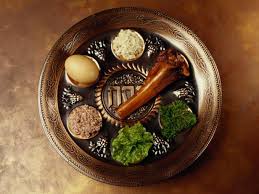
On Maundy Thursday, we attended a Messianic Seder. We have, in the past, been privileged to attended an authentic Jewish Seder in the home of  friends. During the Seder, the story of the Passover is retold around a table where participants taste foods that signify the journey of the Israelites out of Egypt. The matzah reminds us that the Israelites had to flee so quickly that they didn’t even have time to add yeast and allow their bread to rise. The bitter herbs remind us of their suffering. The salty water reminds us of their tears. The lamb shank reminds us that the blood of the lamb was placed over their doorposts so that the angel of death would ‘pass over’ and not kill their firstborn sons.

Traditional Seder

I grew up listening to the story — as though it were mythical, as though it didn’t really happen. As though it didn’t have anything to do with me. As though I hadn’t been rescued, too. But I have been rescued from my own personal Egypt. I’ve been to real-life Israel. I recognize that the story is no myth, rather, it has a transcendent power that resonates with me.

The Jewish celebration of Passover, written in the Haggadah, includes a section titled ‘dayenu’ which literally means, “it would have been enough.” The leader of the family says, “If He had brought us out of Egypt,” and the family responds, “dayenu.” It would have been enough.

He says, “If He had executed justice against the Egyptians,”

“Dayenu.”.

“If He had split the sea for us,”

“Dayenu.”

“If He had fed us manna,”

“Dayenu.”

The sentiment, of course, is that God did so much more. He did bring the Israelites out of Egypt after hundreds of years of slavery. He did execute justice against the Egyptians — killing many with the rushing waters of the Red Sea as they pursued the Israelites who had made it safely to dry ground on the other side. He had provided manna so they never went without food. He rescued them. He provided for them. He made their descendants many. He took them to a land flowing with milk and honey. Any one of those actions would have been enough to elicit the thanks of the Israelites, but God did so much more.

Our Passover Seder on Thursday was different than the Jewish Passover we attended years ago, but very familiar. We shared the matzah. We ate the bitter herbs. We enjoyed the charoset — a sweet mixture of nuts, apples, honey, wine, and cinnamon. Those parts were just like I remembered. The difference was that our pastor highlighted all the areas of the Passover that pointed to the Messiah. Just as the matzah is broken and hidden away to be brought out later, the body of Jesus was broken for us, hidden for three days, and brought back. Just as Moses led the Israelites out of slavery to exacting task masters, Jesus has offered us freedom from slavery to sin and the need to earn God’s favor. Just as the blood of the lamb protected the Israelites from the angel of death, the blood of the Lamb covers our imperfections and protects us from our punishment — our death.

When we got to the ‘dayenu’ portion of our Seder on Thursday, I read along with the others from the Haggadah, but in my mind, I was thinking,

“If you had just rescued me from my own intentions,”

“Dayenu.”

“If you had just provided for my physical needs,”

“Dayenu.”

“If you had just given me a husband who is a partner,”

“Dayenu.”

“If you had just provided me with children,”

“Dayenu.”

My sentiment, of course, is that God has done so much more for me. He has saved me, and that would have been enough. But He also has blessed me beyond what I could have ever asked or imagined with family, friends, community, meaningful work, and so much more.

Blessed are You, O Lord our God, King of the Universe.

The Israelites, the Jewish people, demonstrate intentionality in marking their thankfulness for their rescue. They remember where they once were, and they have chosen never to forget who rescued them and by what means.

Having seen, we can go and do likewise.

Now to Him who is able to do immeasurably more than all we ask or imagine, according to His power that is at work within us, to Him be glory in the church, and in Christ Jesus, throughout all generations, forever and ever. Amen

Ephesians 3:20

Struggle is real, Re-visit

Well, kids, this one goes back to February of 2015 — way back then our struggles were building our muscles and preparing us for today. Each of us faces different levels of difficulty, but for all of us, the struggle is real.

Last weekend I struggled with a high school senior who is trying to raise her ACT score a few points so that she can get into a college of her choice to become an event planner. Her struggle? Although her grades are As and Bs, her ACT score is at the 12th percentile — meaning that she scored better than 12 percent of all the students who took this test. Her goal is modest — she just wants to climb three points, which would put her at the 30th percentile. We’ve spent four hours together at this eleventh hour — two weeks before the February ACT.  She is realizing, painfully, that her education has not prepared her for this test.

Last night I struggled with a different student — a high school junior who is also trying to raise his ACT score a few points to that he can get into the college of his choice and become a physician. His struggle? He goes to a premier private high school in Detroit and has been exceptionally well-prepared, but he ‘only’ scored at the 95th percentile, when he really needs to be at the 99th percentile. Again, it’s only a jump of three points. And he’s got a year to raise those points, but let me tell you, scoring in the 99th percentile doesn’t leave much room for error. And the elite schools that he and his family expect him to go to require that high score.

What do these two students have in common? They are both willing to meet a middle-aged English teacher in a public library in the evening or on the weekend to pour over grammatical rules and to talk test-taking strategy so that they can gain access to a dream. The pressure on each of them is significant. Their struggles are real.

Almost everyone I talk to has real struggles — illness, financial strife, marital conflict, employment issues, car trouble.

Struggle is not the exception to the rule. It’s the rule.

A friend and I were talking about our struggles — the things that have happened in our lives that we never would have expected. She said, “All these difficulties have given me perspective. I find it much easier to not sweat the small stuff.” Depending on how much ‘perspective’ you have been given, your ‘small stuff’ may be different than mine.

Early in our marriage, when we had very little disposable cash, I combed grocery ads to stretch my dollars as far as they could go. It might have given me undue stress, at that time, to find the money in our budget to make a meal for a friend. Today, after years and years of cutting the budget incredibly close and living to tell about it, making a meal for a friend is ‘small stuff’.

A few years ago I had to miss three days of school in a row because I had the flu followed by pink eye. I couldn’t believe I was ‘so sick’! I was distraught at having to lie in bed for three days with little to no energy. Now, after living for two years with chronic pain and fatigue, minor illness such as the flu has become ‘small stuff’.

And yet I am learning that my ‘big stuff’ is someone else’s ‘small stuff’.  I know a woman about my age who is undergoing her second bone marrow transplant for cancer. She will not be able to return to her home for several months as she recovers from this procedure and re-gains her strength under the watchful eyes of her doctors. My chronic pain, in comparison with her life-threatening illness, is ‘small stuff’.

When we look at it that way, we might be tempted to think that we can’t feel badly about our ‘stuff’ because it really isn’t as bad as their stuff. But, guys, to each of us, at any given time, our ‘stuff’ is real.

Our struggles are real.

My struggling senior will likely lose sleep tonight and tomorrow worrying about the ACT on Saturday morning. She really needs her score to go up. And the fact that my struggling junior has a score that is over twice the score of my struggling senior doesn’t diminish the amount of pressure he feels. His score also really needs to go up. They each at this moment are experiencing a difficult struggle.

You may be in such a financial place that making dinner for a friend would be a hardship. That’s a difficult struggle.

You may be sick in bed with the flu and pink eye. That’s a difficult struggle.

You may have chronic pain and fatigue. That’s a difficult struggle.

Fill in the _________________. That’s a difficult struggle.

We’re all struggling together. I am convinced that we move through life from struggle to struggle. Those brief periods where we experience a lack of trouble should be breathed in and fully appreciated, because they are momentary. And so are the struggles. Yes, so are the struggles.  

Each episode that we think is the worst thing that could possibly happen fades into that one thing that we lived through. 

In two years, or possibly even two months, my students will be past the ACT and onto the struggle of living with roommates. And after that they will be struggling to pay back student loans, to find a job, to get into grad school, or to find an apartment. You will one day be able to make dinner for your friend. Your pink eye will heal. Your pain and fatigue will diminish. Your cancer will be no more.

This too shall pass. One way or another. So what do we do now? “Bear one another’s burdens and so fulfill the law of Christ,” (Galatians 6:2) for one thing.  

Walk beside one another in hardship.  Share ‘Trouble Talk.’ Help carry a load. Laugh when you can. And try to keep your perspective.

I have told you these things so you may have peace. In this world you will have trouble. But take heart, for I have overcome the world.

John 16:33