Scenes from Room 106

Click to listen to this post.

After twelve days at home, I headed back to my classroom in Detroit last Monday.

I lugged in snacks and prizes, two laptops, and my lunch, then prepared to meet my students who had been on winter break. Some of our students love breaks — time to sleep, work at their jobs, and scroll on their phones. Others dread breaks — more time in somewhat chaotic or hostile environments, less food security, and less predicability. I try to keep that in mind as I stand at my door watching them walk down the halls. My students, unlike students in other districts, did not go to Cancun or Miami over their break; they likely spent their time in their bedroom, behind the counter of a Subway or a Panera, or in a car with a family member, attending to medical appointments, groceries, or other family responsibilities.

I can’t know or imagine what they experienced on their “winter break”. Instead, I try to keep my eyes and ears open to see and hear what my students are saying [and not saying] to me so that I can respond with care, and “care” can look like a lot of different things.

One of the first to enter my room last Monday was Damon*. Damon has been in two of my classes all year — required senior English class and an elective writing class. He’s not always motivated; in fact, he often falls asleep. My approach with him has been mostly compassionate and firm. At the end of the first semester, after he had procrastinated on the major project for the quarter and asked me in front of the whole class in the Zoom room to walk him through the past three weeks of instruction so that he could finish the work on time, I came down a little more than firm. “Damon, this is not how it works. You can’t opt out of three weeks worth of instruction and then expect me to use class time in one-on-one support to carry you through. This is a habit that I have seen in you that will not fly in college. You’ve got to get it together.” I stopped speaking for just long enough to hear him leave the Zoom meeting. I’d come down a little too hard, even if all I’d said was true. He didn’t return to class that day, and he didn’t turn in the assignment. When he came to class the following week, I pulled him aside, apologized, and urged him to fully opt in moving forward. He mostly has, with intermittent gentle shoulder shoves and admonitions from me.

Last Monday morning, as he met me at my threshold, he said, “Mrs. Rathje, I won’t be here tomorrow. I’m going to Ferris State to register.” I enthusiastically put up my hand for a high five and said, “Way to go, Damon! That’s amazing!” because even though he often struggles to stay engaged even at the high school level, he is believing [and so is his mom] that he can take this next step. Now is not the time for me to tell him how hard it’s going to be, how many supports he’s going to have to reach out for, or how likely it is that he might actually fail this first attempt. Not today– today is for high-fives and encouragement.

Later that same day, I was wrangling my last hour class into some semblance of order so that we could tackle the days’ content. By the time this class starts at 1:20pm, I’ve already had 200 minutes worth of seniors, so I’m running low on gas. This group challenges me. Thy are tired, too. They talk too much, they play too much, they can’t find their seats, and they certainly don’t want to learn about the context in which Trevor Noah’s Born a Crime was written. Nevertheless, I set my expectations and acknowledge those who are following instructions. However, several are still not with me, and then one too many disrespectful comments later, I hit my limit and start in: “This is unacceptable. Your phones need to be down; your eyes need to track me. This is not just for this class. Right now is your opportunity to build muscle for whatever you are facing next. This type of behavior will not be allowed on a job site or in a college classroom. You will be asked — you’ll be told — to leave. Your behavior is disrespectful and childish. You can do better, and I am insisting on better.” The eyes roll, and the derogatory comments leak out quietly, but the room has quieted a bit. I proceed with the lesson. I walk through the notes, instruct my students to open a document in Google classroom, then break them into groups and tell them to get started. I hear James* who sits near the front of the room, say “This internet sucks,” under his breath as he tries to open the document on his phone. Where his laptop is I don’t have the strength to ask right now.

I walk around the room supporting as most work to find contextual information about South Africa, apartheid, Nelson Mandela, and Trevor Noah, when James looks at me beaming, “Mrs. Rathje, guess what I just did?” I am not sure I want to engage since he’s still holding his phone and his answer may include information about high school drama, Tiktok, or something else I don’t care to know about, but he seems so excited that I ask, “What did you do?” He replies, “I just paid my phone bill! Now I don’t have to use this terrible wifi.”

“James!” I say, forgetting any frustration I felt just a few minutes ago, “that’s impressive! You must feel so accomplished. Paying a phone bill is no small thing!”

He replies, “Oh, I been paying my phone bill since I was twelve. That ain’t new.” And that comment reminds me that sometimes my students act childishly perhaps because they’ve handled adult responsibilities way too early. I can still insist they meet my expectations, but I can do so with the knowledge that they are already carrying a lot — much of which I remain unaware.

On Thursday, I handed out Born a Crime, Trevor Noah’s memoir about growing up in South Africa during and after apartheid. I directed my students to the opening pages, clicked an arrow on Audible, and we followed along as Trevor Noah began his story. I moved around the room, pointed out where we were, and stopped frequently to direct my students to a reading guide so they could answer questions to check for understanding, We were about half way through the first chapter when I noticed that they were engrossed. I could tell because they turned their pages in unison, laughed at the funny parts, and began to move easily between the book and the reading guide. I was beaming. Though this might seem like a baseline expectation for a classroom full of seniors, in my classroom, it is notable.

Even more notable were the comments as we wrapped up for the day, “This is a good book!” and “I can’t wait to hear what happens next.”

I can’t possibly in 1500 words or less convey to you the complexity of simultaneously holding seniors accountable for being mature and responsible while cheering them on as they navigate the difficult and celebrating when they engage in the ordinary. I can’t describe how full my heart feels when they share themselves with me — their anticipation for a college visit, their pride in paying a bill, their enjoyment of a story. I can’t expect you to understand how blessed I feel to share space with these developing humans. You’ll have to take my word for it.

establish the work of our hands for us— yes, establish the work of our hands.

Psalm 90:17

Coronavirus Diary #33: Back to School…Again

Since January 6, I have been teaching from the comfort of our home office, wearing yoga pants and T-shirts, 13 year old Chester the golden retriever at my feet. Monday we return to the school building. This is Return to the Building #4, and if I’m going to be honest, I’m losing enthusiasm for all the back and forth.

I don’t disagree with any of the moves to remote or in-person learning that my school has made. In fact, when many schools last year were providing both in-person and remote learning in stereo, my school was strictly virtual, which at that period of the Covid-19 pandemic seemed prudent. Our school serves mostly low income families of color who reside in Detroit, one of the hardest hit communities and populations. Staying remote for the 2020-2021 school year protected not only our staff, but our students. In fact, most of our families were thankful to be remote during that period; most of our staff was, too.

However, our physical safety came at a cost. Many of our students (and students across the nation) suffered academically, emotionally, and socially during that first year and a half of the pandemic, whether they were in school or remote. Some would argue that large swaths of the population aged 18 and under (and many above that age) have suffered a trauma or even PTSD as a result of the pandemic, depending on the individual hardships they faced in terms of finances, food supply, family illness, and death. Being remote for the whole year meant that while our students were struggling through this very difficult time, we had limited access to them and a limited ability to provide supports such as social work, academic accommodations, food, and all the structure that students experience while in the physical school building.

Return #1 Last fall, when we determined to start the year fully in-person, our staff was fully on board. Of course we wanted our students back. We had access to vaccinations, we would all be wearing masks, and we would be taking all other CDC recommended precautions. Please, we said, bring the students back! And, back they came. Of course, they returned as though they’d been learning from home for a year and a half. Some came in loud and unruly. Some came in timidly, avoiding eye contact. Some came in carrying a palpable anxiety that sometimes gushed out in exclamations like, “I can’t be sitting so close to all these people!” We, nevertheless, stayed the course, providing structure, academics, and a return to routine. Day by day, week by week, we could see the students settling in, getting comfortable, returning to more typical teenaged behavior, beginning to engage in classroom activities, beginning to trust that we were “getting back to normal”.

Alas, in October, several staff tested positive — too many staff to cover with substitutes — so we had to move to remote learning for two weeks. We loaded our cars with ancillary screens and materials and changed into sweatpants and baseball caps. We logged into zoom rooms, were greeted by black boxes labelled with student names, and began screen sharing, communicating through the chat feature, and trying to incentivize attendance and participation.

Return #2 When the coast was clear, we lugged all our stuff back to the building and once again greeted our students. It had been a short break, one in which many students opted for a full vacation from academia. At this return, we jumped right back in, and students had to choose whether they were going to make up missed work, or just join the program already in progress. They settled in fairly quickly, but we continued to have a revolving door of students and staff coming and going due to Covid exposure or sickness. Nevertheless, we managed to pull off a Homecoming dance and a spirit week before we were once again sent home in early December.

It’s all become a blur, to tell you the truth. My students were writing college essays, I know that, and I was simultaneously keeping all my teacher plates spinning while also managing a gazillion family December birthdays and preparing for Christmas. To be honest, it was a blessing to be at home — to sleep a half an hour longer in the morning, to not have to drive, to receive packages when they were delivered, and to spend my days with Chester at my feet. Again, many students opted to start their Christmas vacation early, but some logged in each day and completed their assignments on time. All of us were pleased to take a two-week break for the holiday.

Return #3 Around Christmas the Omicron variant of Covid was spreading widely. By New Year’s Day, the buzz among educators was will we go back or not? Detroit Public Schools announced that they would delay their start for a couple of days to assess the situation and prepare a plan. Ann Arbor also delayed and then made a virtual start. It seemed prudent to proceed with caution since the case numbers were growing quickly, however, our leadership made the decision to start in person. Our students, like all students, do best when they are in the building. We had already been virtual for most of December; we really wanted to see if we could make in-person learning work.

We started on Monday with a professional development day. Tuesday was quite cold when we teachers took our stations at our doors, ready to go. Students arrived, but attendance was low. It wasn’t really a surprise. Many of our families had expressed concern about returning given the rise in cases and chose to keep their students at home. We came to school on Wednesday and Thursday, too, and then the decision was made, due to low in-person attendance and a high number of teachers who were calling off due to exposure, positive cases, or their own children needing to learn from home — we would return to virtual instruction that first Friday in January.

Cue the carrying of screens and materials to our cars.

We’ve been virtual for the remainder of January. We finished the first semester in the Zoom Room. Thanks to our incredible attendance team, our overall attendance in this virtual space was high — I’d say over 75% which is remarkable in our context. Engagement, of course, was everywhere across the spectrum. A few students showed up, turned on their cameras, and even unmuted to participate. Others joined faithfully off screen, contributed via the chat, and completed all of their assignments. Some attended sporadically. Some merely logged in and went back to sleep. Some never joined at all.

On Friday, I taught my last class of the semester, finalized my grades, and clicked submit. I loaded my laptop into a bag, prepared new seating charts for semester 2, tidied my home desk from three weeks’ worth of debris, and started wrapping my mind around heading back into the building.

Return #4 I have mixed emotions. I am happy I will get to see my students — the ones who faithfully logged on throughout January and the ones who I haven’t heard a peep out of since December. I’m encouraged that I will get to be with my colleagues — sitting at home alone in front of a screen for three weeks isn’t my idea of community. I am excited for the opportunity we have to finish the school year in person — Please, God, let it be so.

Also, I am tired. I am tired of the transitions. I am tired of the uncertainty. I am tired of re-setting expectations for my students every time we come back to the building — Stow your phones, put your mask over your nose and mouth, bring your laptop charged and ready to go, show up, opt in, work hard, and finish strong.

And, after a month (plus most of December) with our aging Chester, who has recently been on the decline, I am apprehensive about putting him in his crate, walking away, counting on his walker to visit midday, and only seeing him again in the late afternoon.

But overall, I am determined. I am determined, with all my complex emotions, to get up at 5 o’clock tomorrow morning, to prepare for my day, to put on professional clothing, to comb my hair, to warm up my vehicle, to drive twenty-eight miles, to lug my gear back into my classroom, to plug in all my devices, to project my Google slides on the screen, to play a little music, to stand at my door, and to welcome my students back.

I’m guessing they have complicated emotions, too. I’m not sure what they are, but perhaps we’ll start tomorrow with a little space to come together, to share, and to sit in the complexity together.

Cast your cares on the Lord and he will sustain you

Psalm 55:22

Teacher Tired

Click the arrow to listen to me read this post.

It was a long first quarter.

We started school on September 7 and went straight through without a break. Outside of a week and a half of virtual instruction due to a high number of Covid cases, we were in the building with our students, following Covid protocols, managing the movements of a few hundred teenagers who are struggling to re-acclimate to the structures of school, and — oh, yeah — trying to provide high quality instruction.

Then, this past week was extra busy.

Monday, I drove home after school to log on to a short informational meeting about a Social-Emotional Learning pilot program we are starting next week. Would I be willing to be a participating instructor? Tuesday, I left school early so that I could be home for an online training from 3:30-5:00. Then, Wednesday, when we see all of our classes on a shortened schedule of seven forty-minute periods, we stayed late for in-person parent-teacher conferences. The school provided pizza and salad at 2pm, then we stationed ourselves at tables in the gym, and met with parents to discuss their students’ progress.

I had arrived at school at 7:30am; I left the building at 6:15 pm.

Thursday, I was up at 5 to do my morning routine, wanting to be in the right headspace before I taught three 100-minute blocks. I arrived at school at my usual 7:30 and was making last-minute preparations in my classroom when I saw my principal at my classroom door.

“Rathje, let me talk to you for a minute,” she said, as she pulled two other colleagues from across the hall to join us. “I just want to let you know,” she said, “that tomorrow we will be virtual. Be sure to take everything you need with you tonight. We won’t be back in the building until after Thanksgiving.”

“That’s amazing!” I blurted, and I kind of surprised myself. I have so loved being back with the students. We have learned more together in one quarter of in-person instruction than we learned in the whole of last year. I know every face and every name. I’m familiar with personalities, quirks, strengths, and challenges. I can anticipate which class is going to be a challenge to keep awake and which class is going to be a challenge to keep in their seats, on-task, and engaged.

If I love it so much, why was I so happy to be going virtual for the last day before the break? Because I was exhausted.

I’m not the only one. Teachers across the country are wiped out. We knew this year would be challenging, but we could not have know what all would be entailed. We knew that we would be re-acclimating students to schedules, to classrooms, to mask-wearing, and to seven-hour school days, but I’m not sure we fully pictured the volatility of emotions we would see in a school full of teenagers who have lived through the multiple traumas of a pandemic — how quick these kids would be to lash out, to cry, to completely check out. We knew in-person teaching, talking through a mask for the full day, would be a different kind of tired, but I, for one, never imagined that we would be short-staffed for the entire first quarter. Could I have guessed that my prep periods would sometimes be used to cover the class of another teacher? that we would fully employ not one but two building substitutes? that other schools would be cold-calling teachers on our staff, enticing them away with signing bonuses, higher pay, and grass that is much, much greener than ours?

Not even a little bit.

And though we started the year hoping and praying that Covid was winding down, officials are now saying that Michigan is in the “fourth surge” of the pandemic that “could last 4-5 months” (Fox 2 Detroit).

Teaching under these circumstances is stressful, and we are tired, folks. Teachers are tired.

So tired, in fact, that Detroit Public Schools have determined to be virtual every Friday in the month of December.

In a special announcement on the district’s website, Superintendent Nikolai Vitti said the decision was made “after listening and reflecting on the concerns of school-based leaders, teachers, support staff, students, and families regarding the need for mental health relief, rising COVID cases, and time to more thoroughly clean schools.” CBS Detroit.

School leaders are getting creative in order to hear the concerns of teachers and respond so that they can hang on to the ones that they still have. Our school, for example, announced before the school year began that they were issuing retention bonuses to all returning staff — the longer you’ve been on staff, the higher the bonus. Then, last week, they announced a mid-year pay bump for all staff, paid out in two installments over the coming months. Additionally, to discourage absenteeism, our school leaders offered a raffle wherein each teacher receives an entry for each day they attend and those with perfect attendance receive 25 bonus entries. Next week during our two professional development days, three names will be drawn, and winners will receive $100, $40, or $25. To build collegiality and team spirit, our building principal initiated a team-based contest — daily challenges encourage teacher teams to complete tasks, take photos, and share them in our group chat, earning points toward a team prize.

Do teachers need all of this? Yes, we need every bit of it.

Teaching is not easy. For each 100-minute block with my students, I spend at least that much time in intellectual preparation, thinking about behavioral strategies to increase engagement and decrease undesirable behaviors, procuring incentives, meeting with other staff, attending professional development, and myriad other tasks. That’s in a normal year.

This year, we’ve had the added stress of Covid. In the beginning of the year, some students needed daily assurance that it was indeed safe to sit next to peers, masked, for an entire class period, and that we were doing everything we could to stop the spread. Other students (and some staff) needed constant reminders to keep their mask over their nose and mouth throughout the school day. All teachers have had to keep seating charts to enable contact-tracing when students test positive, which has happened continuously since school started. Then, when students are quarantining, teachers have the added load of making sure all assignments are posted online and that students who return to school having done no school work at all get caught back up. And perhaps the most stressful for me have been the almost daily group chats informing staff how many teachers, behaviorists, or administrators will be out for the day, because any time a team is down one man, the rest of the team has a larger load to carry, and sometimes we’ve been down four, or five or six staff members on a single day.

It’s been stressful, to be sure, but let me reiterate that I love my job. I seriously do. I believe that most teachers who are still showing up, still standing, still delivering instruction to their students, and still opening their doors before school or during lunch so that students can drop in desperately love their students. They drive home thinking about how a lesson went well or how it tanked. They lie awake at night creating new strategies for content delivery. They write long blog posts sharing what’s going on so that others will care about their kids, too.

And while certainly the public is aware that teachers have a hard job and that teachers are essential to our communities and society as a whole, it seems that rather than offering support, encouragement, or suggestions that might lighten the load, public discussion about education often misses the point. Before this school year started the public was up in arms about the alleged insidious introduction of Critical Race Theory into the curriculum and whether or not schools had the right to issue mask mandates. These discussions and the enflamed and politically-charged emotion around them did nothing to improve the actual day-to-day experience of teachers, let alone students. The problems in eduction aren’t that easy to solve.

Problems in education are complex and often grow out of inadequate funding, inequitable resources, and societal systems that need to be restructured because they are outdated, ineffective, and designed for an economy, a culture, that no longer exists. Nevertheless, teachers continue to show up to buildings in need of repair, to use materials that are out of date, and to give what they have for children that they care about. And we need them to.

We’ve been moving toward a teacher shortage for years, and Covid has exacerbated the problem. The teachers who are left in classrooms want to be there, but they won’t stay unless they are given what they need — community support, parental cooperation, adequate pay, and the kind of respite that comes from a Friday of virtual learning, a week off at Thanksgiving, and two more at Christmas. Teachers need us to acknowledge that the load is heavier than anyone thought, that continuing to teach and learn in the wake of widespread trauma is taxing, and that we don’t know what in the world we would do if every last teacher woke up tomorrow morning and said, “That’s it. I can’t do this any more.”

I’m not anywhere near that breaking point. I’m still glowing with joy over the fact that I get to be back in the classroom. However, countless teachers are standing on the edge, wondering how many more times they can show up for our kids. If you know teacher, even if he or she seems to be doing just fine, grab them a cup of coffee, a bottle of wine, or a dinner out. Let them know you appreciate the work they are doing. You just might get them through to Christmas.

Do not withhold good from those to whom it is due when it is in your power to act.

Proverbs 3:27

Health Check

A friend asked me recently, “How are you doing with pain now that you’re back in the classroom?”

I appreciated her asking — it was an acknowledgement that she remembered how far I had come and that my move back to the classroom was not taken without much prayerful consideration regarding the impact such a move could have on my health after the years-long journey I have just taken.

It’s a good time to ask because a) last year wasn’t a real test since the students were learning from a distance and the physical demands were not as great and b) we’re now back in person, and the first quarter will end on Friday.

It’s an important question, too, because this blog started when I had to leave my teaching career due to health issues. I was struggling with pain, fatigue, and issues with my skin and eyes, and I just couldn’t bring quality care and instruction to my students in that condition.

My body, it seems, had gone on strike after years of overwork complicated by a failure to process my emotions or take care of myself. Inflammation was so prevalent in my body that I could feel it– it bubbled into my joints making them hot and stiff, it irritated my skin causing scaliness and itching, it inflamed my eyes sending me time and time again to a specialist for treatment.

Many times I’d landed on the couch or in my bed for days at a time. In the early years of my recovery, I had to lie down several times a day even though I slept 8-10 hours a night. I often found myself limping through the house or lying on the bathroom floor waiting to throw up. I was miserable, and I couldn’t imagine a time when I would be able to return to the rigor of the classroom.

However, over six long years, I learned strategies that began to reduce those symptoms and that have kept me on a path to improved health. Among those strategies is a diet that is rich fruits, vegetables, chicken, rice, and fish, and that avoids gluten, dairy, beans, and corn. I also exercise every day, write every day, and see a therapist, a physical therapist, a chiropractor, and a masseuse. When I do all of these things on a regular schedule, and get plenty of rest, I mostly stay well.

The progress has been slow and incremental, just as my return to working has been.

If you’ve been tracking the saga, you know that I didn’t work at all for six months, then I started by tutoring and proofreading. I moved on to part-time work in an educational agency, then progressed to teaching part-time as a college adjunct instructor. From there, I moved back to the agency and eventually worked full-time in a leadership role, but I still didn’t believe I would ever have the capacity to teach in a classroom full of students, managing their learning, their emotions, and their movements five days a week.

It was at this time, about almost six years into recovery, that Covid hit. We as a nation were knocked down by this highly contagious pandemic, and, as we social distanced from one another, we had some time and space within which other ailments — widespread poverty, systemic racism, educational inequity, and the like — became more evident.

The situation looked familiar to me because I had just lived through something similar — autoimmunity had knocked me down and forced me to take some time and space to recognize that I hadn’t been attending to my mental or physical health or to that of my family. I had to acknowledge that they were suffering, too.

And as I observed our nation’s symptoms in real time, something just clicked. It was like I had been training and preparing for this moment. I was in good shape and ready to step back in the ring, and if I was going to do it — if I was going to put myself out there and see if I still had the juice — I was going to do it in a place where I could turn the dial, be it ever so slightly, by identifying and using strategies that might reduce the impact of poverty, racism, and trauma for students who had been knocked down the hardest.

If you’ve been reading along for the last year, you know that I am intoxicated by the opportunity I’ve been given at Detroit Leadership Academy — I can’t keep my mouth shut about it.

But that didn’t answer my friend’s question, did it? How am I doing with pain now that I am back in the classroom full time?

I’d say I’m doing better than I might’ve hoped for. As I’m writing this, I’m tired, and I’m on the second day of a headache. I’m not surprised. It’s the weekend before the final week of the first quarter. We are still short one staff person, plus we’ve had one out due to Covid for over a week. I’m working in a setting that is rich with trauma and the impacts of trauma, and it shows. The students are tired, and worn, and often quite raw. I see all of this, and it weighs on my heart.

And, if I’ve learned anything through this journey, it’s that emotions are stored in the body. My students’ bodies show it, and my body shows it.

So, yes, I do have some pain — in my heart, but also almost always in my right sacroiliac joint, often in my low back, a little less in my hips and neck, and today in my head, and much to my dismay, my left eye.

That left eye — he’s the lookout — he always lets me know when I have pushed too far, when I need to take a down day, when I need to attend to self-care. Today I think he’s shouting because on top of a long week, I pushed a little further on Friday night, went out to dinner with my husband and a coworker, then travelled through a downpour to an away football game where my students were playing against a team with far greater resources — a well-lit turf field, cheerleaders, a marching band, and stands that were 1/3 full even in the downpour. Our side of the field had about a dozen fans including us. Our guys, after arriving late because the contracted transportation was late picking them up, fought hard, but they were outmatched; the final score was 42-6. The other team was jubilant — they had claimed their victory. Our team was despondent — their hopes were dashed. It felt emblematic of the divide in our country — the inequity of resources and opportunity I see in my work every day and the impact that inequity has on the lived experiences of students like mine. It was hard to watch.

We got home after 10:30, damp and chilled, and I crawled into bed to sleep. Through the night I felt a headache and some nausea. This morning, my body has the hum of inflammation — the heat and a quiet vibration that calls for my attention. Less subtly, my eye is shouting, “For the Love of God, take a break!”

So, I’m spending my morning writing and doing some yoga. Next, I’ll eat a breakfast of non-inflammatory foods, slowly go pick up some groceries, then come home, sit on the couch, and watch some football.

I’ll take the weekend to rest, recover, worship, and see some friends, and by Monday, I should be ready to step back into it again.

It takes vigilance to stay well — everyday attention to self care that puts the oxygen mask on myself before it dares to assist the person next to me. It’s counterintuitive to how I always imagined I was supposed to live — squaring my shoulders, gritting my teeth, muscling through, grinning and bearing it — and it’s a better, richer way.

I have way more gas in my tank, way more capacity to put my work down when students gather in my room like they did on Friday morning — a bunch of seniors huddled around my desk, asking for snacks, chatting, busting on each other, making me laugh.

Pain? Sure, I have pain; my students do, too. Somehow, we’ve landed in the same space, and we are learning how to be together, how to learn from each other, and, on the richest of days, how to laugh with one another.

For this, I am so thankful, and so committed to staying the course and attending to my wellness so that I can keep on showing up for these kids.

He picked me up

And He turned me around

And He placed my feet

On the solid ground

Hallelujah, hallelujah

Corey Asbury, “So Good To Me”

A drink of water

I was so excited last spring when I saw a crew replacing our hallway water fountains at school with filling stations.

As part-camel, I consume a couple quarts of water each day while I’m in the building. I’d been lugging in a large Igloo water jug all year; this would make my daily trek in from the car so much easier.

It made sense, in the times of Covid, that we would do away with traditional water fountains, the likes of which I’d stood in line at in my growing up years. It was the only way we got drinks of water back then, by bending over a shared porcelain bowl and glug-glugging until the person behind us got impatient and we stood up, wiped our dripping mouth on our sleeve, took a big gulp of air, and moved on.

Over the past few years, we’ve seen filling stations pop up everywhere — office buildings, airports, and, of course, schools, but in my little charter school in Detroit, which is on lease from the Archdiocese and in need of myriad repairs, I was surprised to see this improvement. Certainly, it was an expense mandated by Covid — I couldn’t imagine the funds would have been found otherwise.

However it came to be, I happily began to refill my water bottle and gladly left my Igloo at home.

I pictured my students doing the same — bringing a water bottle to school and carrying it with them all day, independently managing their thirst as countless students across the country do without thinking. No such thing happened. The students came, but they brought no bottles. They wanted drinks, but they had nothing to put them in.

“Mrs. Rathje, do you have a cup?”

“A cup?”

“Yeah, so I can go get a drink of water.”

“Oh, right. I guess you can’t get a drink of water unless you have something to put it in.”

The school could hardly let the students go thirsty, but what were we to do? The traditional fountains were gone. We certainly didn’t have a supply of water bottles lying around. Instead, as students became thirsty, they went to the office, asked for a paper cup, filled it at the filling station, and carried it back to class. Day after day after day.

It was a disruption to class and to the office staff, but even more, this paper cup carrying seemed like a step backward. Weren’t the filling stations supposed to be an improvement?

This whole situation really started to bug me, but in a world full of planning, teaching, grading, and managing the movements of hundreds of bodies of teenagers in a building, the water problem was not top priority, never mind Maslow.

We were about four weeks into the school year, four weeks in to the era of the paper cup, when a friend from our St. Louis days reached out to me. He said he’d read my blog and would like to support my students. How could he help? My first response was to say that although I had had a great deal of initial support that had allowed me to purchase snacks and prizes for my students, my supply would certainly need to be replenished in time. My reward system was working, and students were claiming prizes for their hard work, and the word was out — Mrs. Rathje has snacks — and the kids were making a bee-line for my classroom.

However, I had no sooner sent him that message when the water situation popped into my mind. I sent a follow-up: “Another project I’m thinking about starting soon is purchasing re-usable water bottles. We have those refillable water stations, but nobody has a bottle. Right now we are using paper cups. I’ve got 80+ seniors. I’d at least like to get each of them a bottle.”

Before too long, he replied that he’d like to support the water bottle effort and asked how he could get me some cash. As it turns out, he is the pastor of a church called Jacob’s Well. Do you remember Jacob’s well? The place where the Samaritan woman gave Jesus a drink, and He told her that He had water that would forever quench her thirst? (I really can’t make this stuff up.) It seems that Jacob’s Well wanted to make sure my students could get some drinks of water.

Within a day or two he had sent me enough money to purchase water bottles for the whole school. My mind was blown. I wanted to act as quickly as possible to put water bottles in my students hands, and since I was still preoccupied with planning, teaching, grading, and the like, I reached out to a few people who quickly got to work on ordering some pretty sweet water bottles — complete with the school logo — that would arrive within a week! I was telling a friend about this purchase, and she said she wondered if there would be confusion with 300 identical bottles all in the same building. Could she create and fund some custom name labels for the bottles? Before she could change her mind, I supplied her with the names of all of my seniors, and, guys, before I could blink twice, these were in the works.

Front side
Back side

Last week, we had just returned from two weeks of virtual learning due to a high number of Covid cases in our school, and I had brought in some new items to put in the prize bins. I was organizing these prizes Tuesday before I left for the day when one of our custodians said that UPS had just brought me a large delivery — the water bottles!

In my class, each time a student completes an assignment, he earns what I call a Rathje ticket (more on this here); on Wednesdays, students can use their tickets to purchase items in the Rathje Store. I have three bins of prizes that are worth 1, 3, or 5 tickets (almost all of this donated by friends). Additionally, each Wednesday, I hold a drawing; students can put a ticket in a cup, and I draw out the name of one person who can win a prize from the 5-ticket bin.

When my students walked in on Wednesday, tickets in hand, I couldn’t wait to show them that they could get a personalized water bottle for just 3 tickets.

“They have our names on them?”

“Yes!”

“I want one!”

“Me, too!”

It’s not a small thing to have a water bottle of your own, is it? It’s not nothing to be able to fill up your water bottle on the way into the building or in between classes — to take care of a vital need, to do it yourself, to not have to ask someone for a cup for your water every single time you want a drink, to know that this is something that belongs to you.

When people ask me what I mean by educational inequity, I cite examples like this. How can a student focus in class when he has to problem-solve to get a drink of water? And, let me be clear, this issue is not due to an uncaring or irresponsible school administration. I’m working with a very committed team of educators who are working hard each day to provide for our students. If lack of water bottles were the only inequity, it would’ve been handled already, but we’re also trying to ensure that all of our classes have teachers, that every student has a ride to school, that every student has a mask, that students have access to mental health care, winter coats, and all the other things that teenagers need.

Getting a drink of water is so basic, so ordinary, we might overlook the need. Having a water bottle is standard, isn’t it? Don’t we all have several in our homes? Don’t we assume that everyone does?

The fact is that everyone doesn’t. Everyone doesn’t have everything that they need — a water bottle, a warm meal every day, transportation to school, a home with electricity, or access to a quality education. But those of us who do can do something, We can turn the dial on societal inequities — one water bottle, one warm meal, one winter coat, one helping hand at a time. So thank you to my friend who asked how he could help, and thank you, Jacob’s Well, for quenching the thirst of my students.

I was thirsty and you gave me something to drink,”

Matthew 25:35

Rose-colored Glasses and Reality

Click the arrow to hear me read this post.

Since I re-entered the classroom last fall, I think I have been annoying some folks on my staff a bit. At least that’s the vibe I’m starting to pick up. Perhaps I’m a little too positive, a little too gung-hung, a little too happy-clappy.

I’ve not always been this way. I haven’t always interrupted staff meetings to say, “I really appreciate the thoughtfulness the leadership put into this decision,” or “Wow! Thank you so much for this meaningful professional development,” but after being away from the high school classroom for six years, thinking I’d never be back, I came to my little charter school in Detroit carrying an unbridled enthusiasm and wearing a lovely pair of rose-colored glasses.

You can almost hear the other teachers, most of whom have been trudging away in understaffed, under-resourced environments for most of their careers and who had recently closed out a school year that ended in an unanticipated three months of virtual instruction, saying, “Who is this woman? And why is she so happy?”

They didn’t ever say that out loud. In fact, I didn’t have any idea anyone was feeling that way until this fall when one teacher I’m growing closer to subtly implied that perhaps my positivity wasn’t firmly grounded in reality.

How could it be? I had been given a second chance at my career during a world-wide moment when everything was virtual. Reality was hard to get a grip on.

All last school year, I sat in my classroom alone, meeting with students who chose to log in to my Zoom room.Those who didn’t want to be there didn’t show up at all. I didn’t have to navigate noisy crowded hallways; I didn’t have to interact up close with the sometimes volatile emotions of high school students. I didn’t have to clean up messes, make copies on machines that sometimes get jammed, stand in line to use the faculty restroom, or cover a class when another teacher was out sick.

My first year back was a challenge, don’t get me wrong, but it wasn’t the typical Sisyphean grind that most teachers experience day after day, year after year. I was able to prepare, teach, and grade within the hours of the school day with very few exceptions. The classes I taught were similar to those I had taught in the past, and I was able to use my own materials that I had been developing for years. Other staff who had chosen to work from the building became my friends, joining me for walks on our lunch breaks. Every part of my position seemed tailor-made for me, and I was thrilled to be back!

I got excited every time a student logged into my classroom. The few rare times that we actually had students in the building, I gushed with enthusiasm, handing out gifts and prizes to anyone who crossed my path. I looked forward to faculty meetings and gladly answered the phone when anyone related to school — principal, coworker, parent, or even student — happened to call. I volunteered for opportunities such as a curriculum audit and mindfulness sessions, and I agreed to participate in a program for graduates over the summer.

I have been a cheerleader, literally clapping my hands, shouting “hooray”, and doing celebration dances for students and staff. I know, I know — perhaps it’s been a bit much.

But my colleagues can relax, because lately the rose-colored glasses haven’t been doing the trick. We started this school year in the flesh, and shit has been decidedly real.

I think we were “fully staffed” for four whole days, and that was before school even started. We lost one staff member before the students arrived and another within the second week. Not only did we have two fewer staff than we had planned on for the year, but we had a sudden need for an additional staff member when our freshmen class ended up being one and a half times as large as we thought it would be. Our HR department had just replaced the first two staff members that we lost early in the year and was still trying to find the additional teacher when another staff member resigned on the spot last week.

Why so much turnover? Because most teachers don’t experience what I had the privilege of experiencing last year. Most teachers work hard — very hard — with few, if any, breaks, and they do it for insubstantial pay. Teachers are leaving the profession in droves, and few young people are interested in entering the field. Our nation is experiencing a teacher shortage, which is especially felt in districts like mine where teaching can be even more challenging due to systemic inequities.

So, we’re still down two teachers, and Covid starts picking off first students and then staff. By the middle of last Monday, three key staff members had tested positive. Out of concern for student and staff safety, the decision was made to move to virtual instruction for two weeks. This news was to be communicated to students during the day on Tuesday.

When I walked into the building at 7:30 that morning, I felt wobbly. I think all of us did. We were extra short-staffed, and we all knew we’d be covering an extra class or two. The students, it seemed, were feeling it, too. The halls seemed louder, the classes a little more electric than usual.

About midday, as students got notification of the pending move to online instruction, the questions started coming. Why are we going to virtual? What about Homecoming — the dance is supposed to be this weekend?! The anxiety started building. I know it’s going to last longer than two weeks. I ‘m not coming to virtual class. I can’t do it again.

During the last period of the day, I was subbing for a class in which most of the seniors in the room were already disengaging. I tried, in futility, to get them to complete some of their work, to “get done what you can now before you are at home and don’t have the support.” Another teacher, whose room we were in, brought in a small group of underclassmen who were involved in “some trouble” in another room and needed to be removed. Since the vice principal was already backed up with other behavioral issues, we would have to house them until he had time. The two of us talked with students, answered questions, and tried to keep the atmosphere light until the final bell.

When it finally rang, and the students were dismissed, a handful of us teachers gathered in the hallway for a collective sigh. We hadn’t stood there long when we heard the yell of a staff member saying there was a fight in the parking lot and all of us were needed.

We ran out of the building to find chaos — a small cell of students involved in the actual fight and dozens of students moving about the parking lot instead of getting on their busses. What we had hoped would be a smooth transition to virtual instruction was anything but.

It made sense to me. The whole day had felt tenuous — not enough staff, impending change, and uncertainty about the future. I, a grown adult with years of therapy under my belt, had felt wobbly. How were teenagers, most of whom had experienced trauma after trauma after trauma, supposed to find any ground beneath their feet? How were they supposed to think logically, get on their busses, and go home trusting that we would indeed be back together in a couple short weeks?

The fight was soon dispersed, but not without injury, not without drama, not without the adrenaline and cortisol rush that witnessing chaos produces. Students who had missed their busses were picked up by parents or brought inside to wait for their rides, and staff wandered back to their rooms to hop on a Zoom meeting to discuss the details of Count Day which would coincide with our move to virtual instruction.

When the meeting was over, the same staff member who had gently chided me for my rose-colored glasses stopped by my room and pulled up a chair. We processed what had happened, shared our dismay, and acknowledged the reality within which we function, within which we have chosen to teach, within which we both believe we can make a difference — the messy, unpredictable, and sometimes volatile reality. Then, we loaded our computers into our cars and headed home.

The next day I sat in our home office, logged into my zoom room, and greeted each student who showed up with my overenthusiastic grin. I applauded the students who turned on their cameras, and I literally happy danced when a student told me that she had decided that she was going to go away to college after having resolved some personal issues that she had thought might keep her at home.

I think my happy-clappy self showed up not because I am wearing rose-colored glasses, but because I have fully acknowledged the reality within which my students live and move and have their being. Despite the fact that the challenges are many and varied, I am still a glass-three-quarters-full kind of gal. I think I have to be in order to see a path toward educational equity in spite of what I know to be true, to think that I can make a difference in the lives of my students and their families, and to believe that my experiences have brought me to this place for such a time as this.

The joy of the Lord is your strength.”

Nehemiah 8:10

Road Trip

Click the arrow to listen to me read this post.

My principal called me and my partner, the college access counselor, into her office. We’d received an invitation from Central Michigan University, our charter school’s authorizer, for our seniors to attend a college visit on Wednesday, September 29.

The event was free for our students, but it was only a few weeks away, and we’d have to hustle to pull it together — communicate with students and parents, get permission slips, and coordinate chaperones and transportation.

“What do you guys think? Do you want to take them?”

Almost simultaneously, my colleague and I said, “Absolutely!”

Last year we provided virtual college visits for our students. Each Wednesday, students would log into a zoom room and an admissions rep from a university would pop in and share a presentation, often with slides or a video. We provided incentives for students to show up, turn on their cameras, and ask questions. It was the best we could do, and for some of our students it was enough.

For most, though, it was hard to imagine what college life might be like by merely watching a slide show on the screen of their chromebooks while lying in bed in their pajamas. To be honest, it was very hard a year ago to imagine life beyond the isolation of Covid period.

Last year, virtual visits were the only choice we had. Now that we were being offered an opportunity to actually put our seniors’ feet on a college campus, we couldn’t pass it up. We had to give them a clearer vision of college.

My colleague got busy on a flyer and a permission slip, and our vice principal/athletic director quickly secured us a bus. A few days later, I started meeting with seniors one-on-one.

“You’ve been invited,” I said, “to go on a field trip to Central Michigan University next Wednesday. We’ll leave at 6:45 am and return at 6:45 pm.” I paused after this information each time I said it to allow students a moment to process. Each of the students looked me in the eyes and nodded before I continued. “Here is the agenda. You’ll tour the campus, attend a class, and get a T-shirt. There is no cost for you, but you need to return this permission slip by Monday.”

Each of my students — students who sometimes grumble and complain about school, who often want to sleep or eat in my class, who struggle to stay engaged from time to time — each of these students responded with a measured excitement.

“Ok. Thank you. I’ll bring in the permission slip.”

Over the next couple of days, I heard doubt surface.

“Mrs. Rathje, are we going to have to ride on a yellow school bus?”

“No,” I replied, “we’ll be on a charter bus.”

“What about the lunch? What are they gonna give us — some bologna sandwich and chips?”

“I imagine it will be a regular college dining room meal. I don’t think you’ll be disappointed.”

“Why do we have to leave so early?”

“CMU is a couple hours away. The event starts at 10am. We don’t want to miss anything.”

We started with a list of 48 students we were willing to invite — those who, despite Covid, are on track for graduation, have consistent attendance, and are mostly engaged in the journey toward college. Several opted out for various reasons, and we ended up with 31 students and four chaperones on a plain vanilla charter bus.

The students were excited and, I think, a little anxious. The questions kept coming.

Mrs. Rathje, are we all going to stick together all day today?”

“No. We’ll be together for parts of it, but you will each go to the class you signed up for. We’ll be separated for that.”

“What if I don’t like my class? Can I just leave?

“No. You are going to give it a chance. You’re going to stay with your group. You’re going to survive. I promise.”

“Mrs. Rathje, you better be right about the food.”

“Trust me.”

After we left the Detroit metro area, Lansing was virtually the only sign of “city” life amid miles and miles of farm land. The students, on their phones or sleeping, were mostly oblivious, but as we neared Mt. Pleasant, which is not far from my childhood home, I woke them and called their attention to the surroundings.

“If you look out your windows, you’ll see mostly farmland, but in the next few minutes, on your left, you will see the CMU Chippewas’ football stadium.”

They looked out the windows as I continued to narrate.

“On the right you see everything you need within walking distance — restaurants, groceries, a pharmacy. As we turn left here, you are officially on campus.”

The phones were mostly down as students looked out the windows.

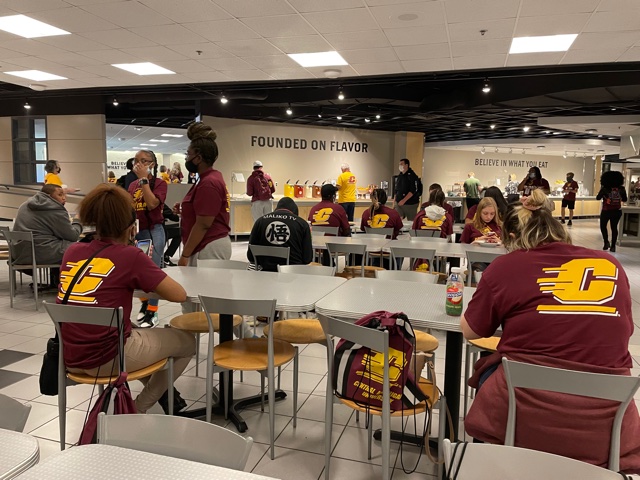
We pulled up in front of the Student Activities Center where someone in a maroon and gold shirt was waving us in. Inside, more people in maroon and gold were calling the names of our students, handing out backpacks and T-shirts, and encouraging us to change into them to designate that we were part of the group.

I heard just a little grumbling, “Mrs. Rathje, do I have to wear the shirt?”

“Yes.”

Then compliance. They quickly changed, grabbed a donut or a juice that had been set out for them, and then walked en masse into the basketball arena where the opening session was in progress.

The stands on one side of the gym were filled with students — I’d say about 300 or so — from charter schools across the state. Perhaps 80% or more of those students were Black, and most were from Detroit.

In this opening session, the students learned about the culture of CMU — “Fire up, Chips!” — and some of the programs. Next, we were broken into groups for a campus tour and lunch.

I was proud of our students as they followed our tour guides, asking questions, and checking out the campus, and I was probably as excited as they were when they got to lunch and realized they could pick what they wanted and eat as much as they liked. I got my own lunch and sat down at a table with some young men from our school. They weren’t embarrassed or trying to avoid me as some teenaged boys might do. They spoke to me. They asked me questions. In fact, other students sought me out during that lunch time. They, too, had questions and just wanted to check in. They were relishing a full hour of lunch and the freedom to move about among actual college students.

When I saw some of the students who’d expressed concern about lunch, I asked “How was your food?”

“It was great! You were right, Mrs. Rathje!”

After lunch, we moved into class sessions. We were separated into even smaller groups, and students attended sessions based on their interests. It was fun later to hear students report on their experiences.

“I learned about exercise science. It was about how the muscles work,” one said as he massaged his own bicep.

“We were in the TV station learning about how films are made,” said another.

But my favorite was the one that I read on a reflection assignment completed after the event: “We had to do an egg experiment where we dropped it from a certain height to see if it cracks or not. My egg was the only one that did not crack, and I got a mug for it.” He hadn’t said a word the whole trip home. He had held that little victory to himself.

As we wrapped up at the event, I questioned our students. “Well, what did you think? How was your day? What did you learn?”

I got all kinds of responses.

The understated: “It was alright.

The tired: “It was a lot of walking.”

And the excited: “This is my dream school. I’m applying this month.”

As we walked to our bus, we met up with one of our grads from last year who is currently attending CMU. He shook the hands of some of our seniors who, in the fog of Covid, hadn’t known he had chosen to go to college at all. My colleague and I asked if he would come speak to our students when he is home; we’d like him to share his experience with our seniors. He said he would and added, “going to college has changed the way I think about everything.”

The bus ride home was hot. The air conditioning on our bus quit working as though to remind us that our fantastical day of hope was over. We were headed back to our school in Detroit where we wouldn’t go on tours, have hour-long all-you-can-eat lunches, or be bathed in images of possibility.

However, the next day in class, my students wanted to share with those who had not gone. They didn’t mention the hot ride home, but they wanted to share what they’d seen, what they’d done, and most importantly, what they had eaten.

“Mrs. Rathje, are we going to visit more colleges like that? “

“If it’s up to me, we sure will, but right now let’s get back to our college research. Who is adding CMU to their college comparison chart?”

A few hands in the room went up into the air.

“Excellent. Let’s find out even more than we learned yesterday.”

Perhaps I imagined it, but it seemed to me that my seniors were a little more engaged, a little more motivated, a little more interested in the possibilities of college.

Bring on the next road trip.

For I know the plans I have for you,” declares the Lord, “plans to prosper you and not to harm you, plans to give you hope and a future.

Jeremiah 29: 11

The Rewards of Learning

I arrived at school Tuesday morning early — well before my 7:50am required arrival time — and the parking lot was already full. Like me, the rest of the staff wanted a jump on the day. They were scurrying around their rooms putting on finishing touches, in the teachers’ lounge making copies, and stationed in the gym to receive any new students planning to register on the first day of school.

Our rosters had been set since the previous week, and teachers had been charged with creating seating charts that would allow for easy Covid tracking should a positive case be identified. I was in my room numbering my desks to correspond with my chart.

The halls were quiet. Unlike other schools where I have taught, this school holds all students in the gym until a bell releases them to their classrooms. Then, students start walking down the hallways, searching for their rooms, while teachers stand positioned at their doorways, greeting students one by one, and allowing them to enter.

It’s all intentional — a way to bring order. A way to establish rhythms. People who have experienced trauma do better when they know what to expect. Routine is very important to the way we do everything in our school.

Once the second bell rings, and all students are in my classroom. I give them a direction to follow — grab a pencil and follow the directions on the screen, for example — while I take attendance. As I begin to mark attendance, I look up and note those who are following my directions, “Jamar is writing his name on his paper. Devon is reading the directions on the screen.” This affirms those who are following through and reminds those who are unclear on the directions of what they are supposed to be doing. When I have finished taking attendance, I walk around the room, confirming that all students are completed, and I give them a class point saying, “One hundred percent of you grabbed a pencil and followed the directions on the screen — that’s a class point.”

On the first day of class, one senior said, “Why are we still getting class points? We are seniors! This is stupid.”

“I’m glad you asked,” I said. “For some of you, the class points may seem stupid. I get it. However, I just want to acknowledge that we have all just been through a lot. For the past 18 months, we’ve been at home, sitting in our beds, logging in to Zoom rooms, or not,”

Some chuckles can be heard around the room.

“…some of you may feel a little uncomfortable being here today,” I continued, “because Covid is still real, and we are sitting fairly close to each other, and there are going to be, when everyone is here, twenty-eight bodies in this class,”

Groans and grumblings replace the chuckles.

“…so even though the points seem dumb, I want to in some way acknowledge that you are here — that you showed up — that you are choosing to opt in to this school year. So, I’m going to give class points. Roll your eyes if you must, but the class with the most points each week will get some kind of prize on Wednesday. It might be a piece of candy, some small prize, listening to music while you work on your assignment, or something else that you all choose. It might be stupid, but that’s what we’re going to do.”

I looked around the room and saw a few blank stares and a few heads nodding. I hadn’t planned it, but I ended up giving the same speech almost every block that day. Before the end of the week, students were watching the tally on the board, telling me, “Shouldn’t we have gotten a class point for that?” and finally, the last hour on Friday, “Hey, don’t give our point to first block! We’re sixth block!”

I think they are on board with the stupid class points.

In fact, they seem to be on board with most everything we are doing. We have had 100% engagement in every activity, every go-around, every assignment. When I told them to write on a sticky note a way in which they committed to respecting others in the class and to stand up and stick it somewhere on the walls of our classroom, they did. When I said to write for five minutes in their journal about the communities they belong to, they did. When I had them complete an online grammar and writing diagnostic which took them close to half an hour, they did it, and, rather than grumbling about how stupid it was, they confessed their feelings of inadequacy and their need to develop their skills.

When I heard their insecurities, I felt compassion.

“Guys, let’s not be too hard on ourselves here. This is just a diagnostic — a tool to tell us where we are. Remember, we have been away from each other for a year and a half! We have not been focusing on grammar and writing. This diagnostic is going to tell us where we need to start so that we can build these skills.”

I was impressed with their ability to honestly look at their scores and to identify the areas where they were proficient and the areas where they were struggling. They verbalized it, too. “I need to work on verb tenses.” or “I need to practice building compound sentences.”

As they finished the diagnostic, I walked around the room, handing out little white raffle tickets I picked up at Office Depot. Every time they complete an assignment, they receive a “Rathje Ticket”. Once a week, I will open the Rathje Store and they can use their tickets to purchase items that I have been stockpiling. One ticket will get them a pen, a lanyard, a trial-sized bottle of hand sanitizer, or a travel pack of tissue. Three tickets can get them a fabric mask, a small bottle of lotion, a snack bar, or a box of tic tacs. Five tickets might get them a collapsible water bottle, a college t-shirt, a pair of sunglasses, or a flash drive. The prizes will vary because most of this loot has been donated or scavenged from somewhere. I don’t have an unlimited budget for such inventory, but I do have a lot of great friends.

The students have been stacking up tickets all week — they’ve gotten tickets for completing assignments, for downloading apps, for logging into websites — and they are trying to find ways of keeping them until the store opens.

“Mrs. Rathje, do you have something for me to keep my tickets in? I don’t want to lose them.”

And they are looking forward to the store opening.

“Mrs. Rathje, I have five tickets. Can I buy something from the store?”

You might be wondering if this is a waste of time, money, and resources. Shouldn’t high school seniors just be able to do whatever you tell them to do? Isn’t the learning reward enough for the hard work they put in?

Your experience might lead you to think so. You might’ve been able to show up to school every day, follow directions, do all your assignments, and be successful without really thinking about it. Your experience, however, may not be the same as the experience my students are having.

I don’t know all of their stories yet, but I do know that during this first week of school, the highest attendance I had in any class was 65%. I know that many students don’t have the resources for school supplies, lunch, or clothing that they want to be seen in. I know that all of these kids have just been made to learn from home for a year and a half. I know they are unfamiliar with being at the school by 8am, with following a bell schedule, with sitting at a desk, with putting a pencil to paper. I know that just showing up each day is, right now, a very heavy lift.

So until it’s not, every kid who does the work of showing up is going to get something tangible — a point on the board, a ticket in her hand — for doing so. I am going to do my best to stay stocked on prizes that are appealing and to stay prepared with activities that are meaningful, relevant, and engaging.

“Everything we do in this classroom,” I tell my students every day, “is to prepare you for whatever you have planned next. I will do my best to prepare and show up for you. I am expecting you to show up and get all that you can so that you will be ready.”

This is not going to be an easy year. We’ve got a lot of work to do under difficult circumstances — making up for missed instructional time, wearing masks, avoiding Covid infections, and having limited resources. My students and I are going to need to celebrate each tiny step along the way.

I don’t know, maybe they will learn enough this year that the learning itself will be a reward, but until we get there, we’re going to need some cheering along the way.

So, wherever you are, start cheering, because we’re making a comeback, baby. Just watch us and see!

Encourage one another and build one another up.

1 Thessalonians 5:11

Coronavirus Diary #31: Back to School Edition

Click the arrow to hear me read this post.

My phone rang while I was watching TV last Sunday night. It was the director of HR from my school. I’d been in back-to-school professional development meetings the previous week, and she was informing me that I had had close contact with someone who had tested positive for Covid-19. I’d need to get a negative test before I reported for more meetings the next morning.

The students weren’t even back yet. Certainly this didn’t bode well.

Monday morning I got up and drove to a nearby CVS where I purchased two self-administered tests. I climbed back in my vehicle, cracked open a swab, and did what we’ve all learned to do over the last many months. I prepped my sample, set a timer on my phone, and started driving in the general direction of my school. If it was positive, I’d return home; if it was negative, I’d continue on to school.

I was slightly worried, because although I’m vaccinated, so was the person who tested positive. If I had Covid-19, I’d have to stay home for 10 days, and I would miss the first day of school. I didn’t even want to entertain that possibility.

Our students haven’t been in school since March of 2020. The last thing I want them to find on the first day of school is a substitute teacher because I’m out due to Covid.

As I waited for the fifteen minutes to tick away, I consoled myself. Kristin, you weren’t within 3 feet of anyone for over 15 minutes, but then I remembered that I had been in a coaching meeting with my mentor where we had sat desk-to-desk, masked of course, for thirty minutes. It was possible, if she was the positive case, that I had truly been exposed.

But surely since we were both wearing masks and both of us are vaccinated, our risk is very low. And that is what I held onto until the timer went off and I saw that I was indeed negative.

Phew! Thank you, God!

I have a feeling this won’t be the last time this year that I will have to swab and sit. My classroom is set up with 27 desks, and for most of the day, every desk will be full. Each 100 minute period, around 27 seniors will roll into my room, find their assigned seats, and hopefully engage in learning until the dismissal bell rings.

Typically during such a long class (we’re on a block schedule), I would move students into groups, have them working at the board or somehow getting out of their seats to break up that long time period and move around the room.

My classroom

Things have to look a little different in the times of Covid. Each room must have assigned seats and a seating chart printed out and kept in a plastic pocket near the door. If a student or a teacher tests positive for Covid, all students who have been within 3 feet of that student for fifteen minutes or longer will be considered ‘close contacts’. If those within close contact are not vaccinated, they will then quarantine for 10 days, receiving their lessons asynchronously via Google classroom. For this reason, we want to limit the number of close contacts each student has.

Can my students move around the room? Yes, but I need to keep that movement to a minimum. Can they work in small groups? Yes, if I keep those small groups within their already-established close contacts or if the small groups last less than 15 minutes. Can I rearrange my seating chart? Yes, but only at the start of the week because for Covid we trace close contacts two days prior to the onset of symptoms or the positive test, so re-sets need to happen over the weekend.

Are you confused yet? Exactly.

And we’re only, so far, talking about the seating chart!

All students and teachers must wear masks at all times inside the building, except for when they are eating. Breakfast will be served in first hour classrooms, fifteen minutes before class starts. Lunch is served in the lunch room, half of the 300-member student body at a time.

Windows will be open as much as possible, and rooms will be equipped with air filtration systems. All rooms are well-stocked with hand sanitizer and disinfecting wipes and will be treated each night with a Clorox Total 360 electrostatic sprayer. Custodians will routinely and endlessly disinfect doorknobs, bathrooms, and other high-traffic areas.

But guys, Covid or not, we are going back to school!

Thursday, all staff started work a little later than usual because we were hosting our Back to School night from 3:30-6:30. As I was driving in to work, I wondered how many of our students would show up to get their schedules, to pick up their school-issued Chromebooks, and to sign up for their bus routes. After 18 months at home, how many would opt in to an in-person learning experience? We had no way of knowing.

However, when I arrived at school at 10am, the place was already buzzing with activity. Teachers were arriving to participate in active shooter training, the trainers were setting up in a classroom, a couple of new teachers were being oriented to their new surroundings, and….and we had parents and students touring the building, filling out registration forms, and preparing to be at school!

After a very weird year — arriving to a silent building each morning, walking to my classroom, and signing into my zoom room — this felt very back-to-school normal. Could it be?

I dared not hope that this buzz could sustain itself throughout the day and into the Back-to-School night. So, I leaned in to our training — active shooter, fire drill, and round three of Covid protocols. I put finishing touches on my classroom, and I printed and copied day one paperwork for my students — boldly making enough copies for everyone on my roster. If I print them, they will come.

As it got closer to 3:00, I ate the lunch I packed, cracked open a can of green tea to re-caffeinate, and started heading to the gym with my colleague to get our assigned roles before the students started showing up. We peeked in the principal’s office on our way. She said, “Please get all the teachers to the gym right now; parents are already arriving!” What? It was only 3:00. We weren’t supposed to start until 3:30!

My colleague and I split up and went down separate hallways to round up teachers, and when we got to the gym, we found clusters of people moving about, trying to get what they needed. We scrambled to each take a station and begin assisting parents.

Our principal directed families to please step back outside the gym, form a line, and wait their turn — we would get to everyone. And for the next three hours, families stood in lines, shuffled forward, got what they came for, and chatted with teachers and administrators.

Yes, everyone wore a mask. Yes, it was difficult to hear one another. Yes, it was a struggle to identify students who claimed they had been in my class last year, but guys, that gym stayed buzzing until after 6pm.

Is it going to be a challenging year? Of course! Are we going to have students and teachers who test positive for Covid or have to quarantine due to exposure? Undoubtedly! Will we be exhausted by protocols on top of instruction on top of adapting to ever-changing circumstances? Without question.

However, the activity in that crowded gym told me that we — teachers, students, and parents — are ready to give in-person instruction a try. So take that, Covid. We are going back to school!

Be strong and courageous. Do not be afraid; do not be discouraged, for the Lord your God will be with you wherever you go.”

Joshua 1:9

Supplied, Supported, and [almost] Ready

Click the arrow to listen to me read this post.

T minus eight days until the start of school and I’m like a 10 year old again — so excited!

Sure, Wayne County just announced that due to the recent uptick in Covid-19 cases, all teachers and students in the district will be fully masked throughout the school day.

Yes, a torrential downpour caused a flood in our school gym on Friday.

And, of course, we’re still looking to hire two staff members.

But am I bothered? No! I feel like the little girl whose mom just took her to the mall and bought her a first day of school outfit.

Why? Because I can hear you all cheering me on!

A few weeks ago, at the end of my post about Critical Race Theory, I shared that I had a wish list for my classroom. Several readers asked me to share it, and I have received almost everything on that list! I did not anticipate how much impact this would have on me emotionally! I feel buoyed your thoughtfulness and generosity!

For example, a couple of Lutheran educators from St. Louis, MO, who I have never met before, said they used to teach in Detroit and still have hearts for the kids in that community. They sent a check so that I could purchase 100 composition books!

Stacks of composition books and other supplies.

Each day, my students will spend 10 minutes of their 100 minute block writing in these composition books. I will put a prompt on the board and provide 10 minutes of silence during which I, too, will write. I will then share what I have written, to model, and then allow anyone else to share what they have written. This exercise, which takes a total of 20 precious minutes of class time, is invaluable. It not only builds writing muscle — the ability to put pen to paper for 10 solid minutes — it also exercises the students’ writing voices and, more importantly, cultivates community. When we share our thoughts and our stories with one another, we see one another’s humanity, and we begin to care for one another. This is critical in a classroom of developing writers who will have to share their writing often.

Another item on my wish list was highlighters. I asked for 90 sets of three colors — pink/blue/yellow, or green/orange/yellow. A friend texted that she wanted to purchase all of them, and that day, Amazon delivered a huge box to my door!

Bundles of highlighters.

These highlighters will be used in a couple of ways. For grammar instruction, I will have my students locate nouns, verbs, adjectives, or adverbs, for example, in their journals. They will highlight the word, label it, write a definition in the margin, then add several more examples. We will also use the highlighters to identify sentences, fragments, and run-ons. Later, when we are writing paragraphs and essays, students will identify their thesis and topic sentences in blue/green, their examples in pink/orange, and their explanation/elaboration in yellow.

Another item I asked for was individually wrapped snacks because teenagers are always hungry. They stop by before, during, and after school asking, “Mrs. Rathje, you got anything to eat?” I have always tried to keep something edible in my classroom because if you feed them, they will come. Seeing my request, a friend and a family member each dropped off Costco-sized boxes of granola bars and multi-packs of popcorn. A few other friends sent cash which will help me stay supplied.

My stash of granola bars.

I am not only stocked on snacks, but I was also able to use some of the cash that was donated to purchase large variety packs of candy which I will use as rewards/incentives for completing assignments, arriving on time, and quickly resolving conflict. I also always make sure I have plenty of chocolate to encourage other teachers in the building.

I hauled all this stuff to my classroom including several prizes donated by a family member — McDonald’s gift cards, some pop sockets, chapsticks, and the like — and found designated spaces to store it all. I was feeling pretty good about my supplies, and then, when I got home on Friday, I found a large package on my front porch.

A high school friend, who I don’t think I’ve seen in thirty-seven years, had said she was sending a few things; when I opened the box and laid its contents out on the office floor, I was overwhelmed.

A huge supply of feminine hygiene products.

She had sent boxes and boxes of feminine hygiene products, dozens of trial sized lotions and hand sanitizers, several chapsticks, packages of gum, mints, and granola bars, and some cash, in case I needed anything else. She said she “had some things sitting around just waiting to be used” and that “kids deserve to have the necessities of life…whether their parents can afford it or not.”

They sure do.

This is the family of God, my friends. People from across the country — Wisconsin, Missouri, Minnesota, and Michigan — giving what they have to meet a need. My classroom is now more than well-stocked and ready to receive a group of seniors that haven’t seen the inside of a classroom since March of 2020. As they arrive, I want them to know that I, that we, have been thinking about them, that we have prepared for them, and that we are anticipating their needs before they even walk in the room.

You have helped me do that — you have partnered with me to show my students that they are valuable.

They don’t always get that message, to be sure. And in the last eighteen months, they have lived through more than their fair share of challenges. I know they are going to have some anxiety about coming back after such a long absence, so I’ve created a ‘chill’ spot at one end of my room.

My chill spot.

The chill spot is a place my students can move to if they are feeling anxious, angry, or upset in any way. It has tissue, paper, pens, crayons and colored pencils, coloring sheets, beautiful artwork from @mrjohnsonpaints, and some recommendations for how to regain calm. This idea is not mine; most of the teachers in my building have a chill spot. We operate under the assumption that all of our students have experienced trauma — now more than ever — so we are preparing in advance to make sure they can feel safe.

Providing for student needs — food, safety, school supplies — lays the foundation for learning. Job one is showing students that they matter, and as you have cheered me along, not only with gifts and donations, but also with so many words of encouragement and likes and shares of my blog post, you have agreed with me that they do.

My students matter, and this work matters.

They may come in grumbling and complaining. Why can’t we just stay virtual? Why is this classroom so hot? Why do I have to write in this stupid notebook? They are teenagers after all, and teenagers always grumble during change.

But I’m excited! I’ll put on my first day of school outfit and bounce into my classroom next week, ready to receive them, whether they are grumbling or not.

My enthusiasm may need to carry us for a while, so thanks for cheering me on. I didn’t know how much I need you.

…the Father knows what you need before you ask Him.

Matthew 6:8

P.S. If you know a teacher, send them a little extra love at any time, but especially during that first week of class this year. (A gift card to Starbucks or Target, some chocolate, or some fresh flowers just might make the difference.)