What is Needed

Often in this space, I write about the students at my small charter high school in Detroit. From time to time, I share their needs and invite you to partner with me in meeting them. One time I mentioned the need for athletic shoes, and a handful of you helped me purchase about twenty (yes, 20!) pairs for our track athletes! Other times, I’ve asked for support at Christmas, and some of you have sent items from an Amazon wish list, purchased gift cards, or simply sent cash. It’s not always the same people — some of you are local to me, some are friends from way in the past, and some of you I’ve never even met — but when I ask, the needs of my students always get met.

This past week, not having the time or inspiration for a complete blog post, I just flung out a request via social media. I said we had 8-10 families with extraordinary hardship that we’d like to send on their holiday break with grocery and gas gift cards. I’ve been coordinating efforts like these for five years or more, and my school community has come to count on the fact that “I’ve got a lot of great friends.” However, every time I ask, I momentarily wonder if the magic will continue — will people see my request? will they want to contribute? Then I usually remind myself that “before I am asking, He is answering,” and trust that God will provide.

This week was no different. That Facebook ask was just a week ago and we have plenty of donated cash and gift cards to support ten families in ways that they are not expecting — what a fun day our principal will have later this week, handing fat envelopes over to families who have no idea they are coming! I can’t know the impact your gifts will have!

So, first, let me say thank you to those who stop by to read my posts about education, my health, politics (gasp), and the things I am learning, but also to those who choose to contribute to students they have never met. I am astounded by your generosity that keeps showing up at just the right time. Even sometimes when I haven’t asked, a need is just around the corner, and you have met it in advance. Thank you for your heart, for your thoughtfulness, for your care.

Now, let me tell what I learned this week about what kids really need.

A few weeks ago, a teacher who is somewhat new to our district, a woman who just has a way of connecting with kids — the kind of teacher who kids show up to school for, the rare one who can get a whole room to lean in and listen as she walks step by step through a procedure, the kind who can glance up from a demonstration and silence a chatterbox without saying a word — this teacher mentioned to me that she’d like to put on a Christmas event for our students, did I think that would be ok?

I, thinking of our students’ physical needs, immediately (and wrongly) assumed that she wanted to coordinate the giving effort I have just described, and I directed her to speak with our principal. I thought it would be a great idea to pass the baton. LOL. It took me a couple of weeks to realize that what she was planning was very different than what I was assuming. She had a vision for a night of games and fun for a select group of students — a meal, prizes, and gaiety. No presents, nope. Instead, these students would “pay” the entry fee of a donated hat or mittens for someone less fortunate than themselves.

You heard me. She wanted our students — all of whom qualify for free breakfast and lunch — to make a sacrifice to be there. And not just anyone could attend. It was invitation only — kids who consistently come to school, kids who lean into learning, kids who lead, kids who volunteer, kids who do the right thing.

This was so far off my radar that I couldn’t picture the impact until I actually showed up.

The teacher asked her church to donate a meal, and churches being what they are, they had a crew walking in with wings, fries, mac and cheese, and green beans in chafing dishes that they placed over sterno pots.

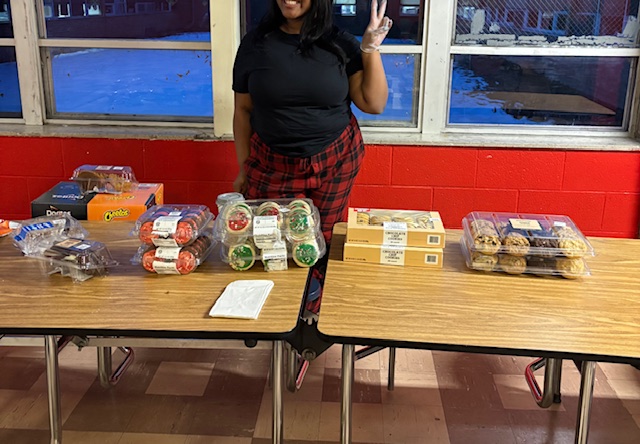
She asked our staff to donate water, cookies, and prizes for the games — each category filled a table.

“What can I bring,” I asked around Tuesday when most of the above had already been donated.

“I have hot chocolate. Would you bring toppings?”

“Toppings? Like whipped cream?” I asked.

“Yeah, and I like mini chocolate chips, and sprinkles, and marshmallows…you know, to make a self-serve hot chocolate bar.”

“Ok, I can do that.” I said.

Since I was headed to the grocery anyway to pick up gift cards with the cash that some of you had sent me, it was easy to throw a few more things into the cart.

“Oh,” she said, “one more thing. Would you go around to the classes on Friday and hand out tickets to the ones who can attend?”

“Sure. Whatever you need,” I said — before I realized that this would mean handing them out in front of kids who were not invited. This was a struggle for me — little miss equity this and access that — but, I did it. It was uncomfortable saying, “I’m sorry, you are not on the list. This is an invitation-only event,” but I had to trust my colleague’s vision.

School was dismissed at 3:30 and a crew of students moved to the gym to set up. They were in charge of decorating and setting up the space for the meal, the games, the celebration. While they were doing that, I retreated to my office to finish an administrative task. When I arrived shortly after 5:00, students clad in Christmas pajamas were personalizing their hot chocolate, greeting their friends, chatting at tables, and listening to Christmas music. You might expect this at any Christmas party, but in this community’s world of scarcity, it felt different.

Teens who are normally just trying to get through the day — to get a ride to school, to find something to eat, to stay warm, to manage all the expectations of all the people around them — were free just to be.

And then, the silly Christmas games began!

Asked to find a partner and line up in the gym, students who typically display reluctance to engage, jumped out of their seats, grabbed hands, and ran to the designated location. They tossed miniature Christmas ornaments into cups, they played a version of Head, Shoulders, Knees, and Toes, and they raced to steal Christmas bows that were stuck to each other’s shirts (the one who ends up with the most wins)!

They laughed. They played. For a few moments on a Friday evening, they were allowed to be kids.

Students who typically have to put up a hard exterior — who have to save face — in this small group of students felt safe enough to put their guard down and be silly.

And that my friends was exactly what our students needed. They needed a safe space, they needed to feel like contributors, they needed the extravagance of a meal prepared just for them, of a hot chocolate bar, of games with prizes, of a fun Friday night with their friends. I sat and took it in — smiling, laughing, snapping photos — and realizing that I need to broaden my view of what is essential.

Friends, I am likely going to keep asking for contributions, so thank you in advance for tolerating my boldness and joining when you choose, but I am also going to open my eyes to what else my students need. I’m going to look for more opportunities to acknowledge all of Maslow’s hierarchy (not just the the foundation) because the sense of connection, of respect, of fulfillment are just as essential to developing teens as food, as transportation, as shelter, as safety.

Hats off to my colleague for leveraging her community to meet these needs. In doing so, she also challenged me.

God will meet all your needs. Philippians 4:19

Typical, 2025 version

It’s been a pretty typical week for 2025– a virtual genocide continues in Gaza (albeit with talks of a coming ceasefire and hostage release, all of which we’ve heard before), the US government is shut down, four people were killed in a church shooting an hour away, and Jane Goodall — a universal treasure– passed away. Oh, and I’ve spent the week trying to provide an equitable educational opportunity to six sections of high school science students.

Here’s what’s going on — I am the instructional coordinator in a small charter school on the border of Detroit and Dearborn. You could drive right by us and not know we are there. We operate out of a run-down former Catholic elementary school which we rent for a rumored gasp-worthy sum from the Archdiocese of Detroit. The parking lot of this building, which our busses have to traverse twice a day, is literally crumbling under our feet/wheels. To come onto the property each day, I have to ignore the willful negligence that would allow a literal lake to form in the center of the asphalt, but I digress.

We aren’t glamorous is my point. The building is too hot in the fall and spring because we have no air conditioning and too hot in the winter because of the antiquated boiler system we use to heat it. Windows need repair, and the gym, which we use as cafeteria, gym, and auditorium, is way too small to host any kind of athletic competition. If you could, based on facilities, choose to teach anywhere else, you probably would. Or, if you could choose to teach students who read at grade level or who have involved parents or who come to school prepared to learn every day, you would probably choose to do that.

But we aren’t that school.

Nevertheless, we have almost 300 students who deserve a high quality education. And we can’t provide that — we can’t get them up to their current grade level, we can’t adequately prepare them for postsecondary education or the work world, we can’t give them an opportunity to change their circumstances — without well-trained teachers, and I’m not sure if you’ve heard, but there isn’t a surplus of those lying around.

This is my 6th year at my school, and every single year we’ve had at least one, if not two or three, classes covered by long term substitute teachers or, more recently, online alternatives, and that’s not because we aren’t doing everything we can to find teachers — we are!

So here’s what happens — each spring we post all of our openings, then we interview all summer, we make offers to the most qualified people, we believe we are fully staffed for the fall, then days before school starts, we realize that one or more of our teachers has changed their mind and moved on — maybe for more pay, maybe for a different environment, maybe for a promotion. The reason doesn’t matter. We suddenly find ourselves with a hole to fill.

Now, because this is our reality, we do always staff 2-3 permanent building substitutes. These folks are salaried employees who come into the building every day. They are typically not certified teachers or subject matter experts, but they are committed members of our team who know and love our students. We also have a creative leadership team that has found myriad work-arounds over the years.

This year’s shortages were looming all summer — we found and hired multiple math and science teachers only to have each of them move on before the first day of school, so in the final hours we made a plan. Our Geometry and Algebra II courses would be staffed by a returning qualified educator. Our financial literacy course would be taught by a permanent employee who also runs his own business. Algebra I, Principles of Physics, and Chemistry would be covered by a company called Elevate K-12. This company hires certified teachers who live in other locations to zoom into our classrooms and provide high quality instruction. For these classes, we provide an in-person facilitator — a member of our team who knows the students and manages all on-location needs such as attendance, providing physical materials, and managing any student behavior issues. This is our second year using Elevate, and although last year’s start was bumpy, I must say that we have found our rhythm.

With all of those classes covered, we still had three sections of Biology and three sections of Earth Science to cover with days remaining before students would arrive. With no applicants in the hiring stream, we turned to an agency that provides long-term subs to area schools. (You read that right — the teacher shortage is so profound that agencies exist solely to provide long-term substitutes.) That agency sent us two people to interview. We chose the one who had some experience in a high school science classroom, and she started right away.

She did a good job of getting to know the people, finding her way around the building, fostering relationships with our students, and showing up for work everyday…until she didn’t.

And now we are looking again.

The students have not had a teacher now for seven school days. They have had members of our team covering, and I have been providing assignments (without instruction) and grading papers. Even if I could stay in the classroom every day, I don’t know enough about population dynamics or the chemical composition of the sun to guide these young minds through their learning. And I can’t stay in the classroom anyway — I have a whole job of coaching and supporting the other teachers in the building in their quest to meet the needs of our students who have profound knowledge gaps and who nevertheless have dreams and goals and deserve every opportunity to make them happen.

No, we need to find someone qualified to teach these classes.

My principal sent me a calendar invite to join her for an interview on Thursday — someone the agency sent to take over these courses. He was a career scientist — full of content knowledge. However, although he’d done some one-on-one tutoring over the years, he’d never been in a classroom, never kept a grade book, never presented with a slide deck. We’re starting week six of classes on Monday and we need someone to jump in there, hit the ground running, and salvage what is left of this semester for these kids.

So we’re still looking, and I’m still giving assignments and grading and encouraging students and their substitutes to stay the course. This is where we are, and this is what we have.

Meanwhile, a few states away, grown men who have their education can’t agree on how to fund the government while they are simultaneously allowing millions to be spent rounding up undocumented immigrants.

I wonder if they care that 411,549 teaching positions in the US remain unfilled or filled by folks not fully certified. I wonder if they care about the students impacted by those vacancies, many of whom are from low-income homes that struggle to meet their everyday needs for food, housing, and transportation. I wonder if they think about that when they are deadlocked on their decision over spending for healthcare that will most certainly impact these same families.

I wonder who we have become and how this has become just another typical week.

Do you wonder, too?

Seek justice. Defend the oppressed. Isaiah 1:17

If you or someone you know (certified or not) has a background in science and a heart for kids, click on this link and tell them I sent you. (We have openings at our elementary school, too.)

Back to School: Before and After

I write a post like this almost every year — scroll back, you’ll see! Each fall, I can’t stop myself! I’m still filled with the child-like wonder and excitement of going back to school. I mean, yeah, I had outfits picked out, bought a new pair of school shoes (okay, two pair!) and kept them fresh for day one (and two!). I had my classic teacher terror nightmare — only this year it wasn’t me showing up naked, late, and unprepared, it was my teaching cohort! And I’m here to tell you that the stress was not less!

I get so excited about the return to school because it holds so much possibility — imagine the potential for transformation!! And in any story of transformation you need the “before” pic. Let me see if I can paint it for you.

The students first showed up on the Thursday before Labor Day. I can spot the freshman from a mile away. They shyly and awkwardly accompany their parents and older or younger siblings. They stand quietly as their people sign them in, looking around to see who else is there, who is looking at them, who is judging them, who can see their insecurity.

Sophomores roll up with slightly more confidence, sometimes with a parent tagging along ten paces behind. These students steal glances, seeing what looks familiar — teachers, friends, anything.

Juniors have just a hint of swagger — they know the drill — they know who’s who, what’s what, and where’s where. They quickly run through the requisite stops — schedule pick-up, bus sign up, sports physical — then find their friends to take laps inside the building, check out new students, get into a little harmless mischief, or do a little peacocking.

Seniors? You can’t tell them nothin’. They have their hair done, are wearing a dope ‘fit, and have texted their friends to arrive at the same time. They run this place — they are beaming and bouncing. This is their year and they know it.

And that’s all on the Thursday before school even starts — before the three-day weekend, before reality hits, before they have to arrive on time, sit in an assigned seat, do the coursework, take notes, stand in lines, or listen intently.

But all that has begun now, too. We have finished a week of students being in the building, running to get to class before the bell, asking permission to use the bathroom, looking for a snack, trying to hide their phones, getting caught with their phones, turning over their phones, and waiting to get their phones back at the end of the day.

They came in on Tuesday, and we were ready for them.

Our teachers had on shirts emblazoned with our Activate Excellence motto, arriving early to put finishing touches on their rooms and man their stations in the gym for arrival. We had some teachers collecting phones, some handing out schedules, and some stationed as greeters. There were hugs and fist bumps and hand shakes with our returning students, so it wasn’t difficult to pick out those who are new to our building — freshmen, of course, but also quite a few transfers.

In Detroit, a district with over 50,000 students, most high schools have enrollments of over 700, and some have over 1000. Our charter high school is small — under 300 students — so we often get students who found those larger contexts to be untenable. Maybe they were overwhelmed. Maybe they didn’t find a connection or friend group. Maybe they got into a fight and are now dealing with the aftermath. Whatever the reason, we often end up with a unique collection of students who for whatever reason couldn’t or didn’t want to make it happen somewhere else.

We’re a charter school — so students choose to come to us. Granted, sometimes that choice is because they have run out of other options, but I like to think they choose us because we are a small community. Everyone knows everyone else — no one goes unseen. If you came to school without a jacket, someone saw that. If you look particularly down or quiet on a given day, a person noticed. You’re hungry? You know who to ask for a snack. You don’t have a ride home? Chances are you have a connection with a staff member who will help you figure it out.

Changed your hair? We saw it.

Grew up over the summer? We know.

Your ability to manage conflict is improving? We give you kudos.

Let me give you a glimpse at an “after” pic.

For the past four years, we have had a student in the building who was classified as “homeless” and qualified for resources under the federal McKinney-Vento Act. Last June, this student graduated despite having transportation challenges, learning difficulties, and very little family support. Staff at the school made it possible for him to attend prom and participate in all senior activities, and the young man was repeatedly overwhelmed with gratitude. When he walked into our decision day celebration in early May, he hugged several of us and wiped away tears. When he arrived at prom, he approached staff members, tearfully repeating, “I can’t believe this is actually happening!” and when he showed up for graduation, he could barely find words. He savored every moment, and his classmates and teachers saw it for what it was — the realization of a dream.

On that day, he didn’t know what his summer or future would look like. Because of his situation, he was having difficulty getting access to the documents that would make him work eligible, but late in summer we received word that he had what he needed and had found employment in a hospital. This past week, he reached out to one of our staff members and said he was working a lot of overtime and was looking for an affordable apartment.

The staff member reported this in our group chat, and I must say that in the middle of a school day at the end of the first week of school, when everyone is getting tired and ready to go home for the weekend, that little notification reminded us all what a special place we work in.

Just four years ago, this young man was one of our awkward freshmen — he missed a lot of school days, and we noticed. He often came unprepared to learn, and we said something. He had the support of a friend who got him to the building every day, but he came late and left early. It was frustrating, to be sure, but we found ways to work with him. He had the support of the social worker, the principal, the resource room teacher, and literally every single adult in the building. It was not uncommon to see him checking in with one of our custodians who might as well be everyone’s momma.

And now he’s a high school graduate, he’s got a job, and he’s looking for an apartment. If that’s not a transformation, I don’t know what one is.

I guess that’s why I get excited every September — that’s why I can’t stop writing about it. Every day is a miracle waiting to happen. I can’t believe I get to do this. Just like my student, “I can’t believe this is actually happening.”

[We] will see the goodness of God in the land of the living. Psalm 27:13

Job Postings at DLA!

DLA Wishlist

Finding a Footing

At the end of the last school year, as I waved goodbye to students and wished my colleagues a safe and restful summer, I was envisioning long days of reading broken up by an hour here or there with my hands in the dirt — weeding our garden, tending to our plants, and bringing in the fruits of our labor. I saw days on the beach of a great lake and others poolside with our granddaughters.

While I did manage to experience all of that, much of my summer was not what I was expecting. At all. Particularly not when, just a month ago, I was searching for an assisted living facility for my stepfather, helping my brothers move him in, being present for his rapid decline, then processing with my mom and siblings through his passing.

The flurry of activity was unanticipated and un-mooring. I’ve felt a little tossed about for several weeks, so the return to the rhythms of back-to-school prep of the past many days has been a welcome and anchoring exercise.

As I’ve been walking the hallways of our school buildings, I’ve been wondering if our students, too, have felt a little at sea. What has their summer been like — have they been working? helping out at home? have they had plenty to eat? time and space to rest? have they experienced loss? or trauma? joy? or celebration? Has their summer been what they were expecting? Are they, too, in need of the rhythms that will bring stability?

Because I’m not teaching this year, but rather supporting our teachers and students from a more global perspective, I’ve been managing tasks all summer like updating scope and sequence documents for various courses, familiarizing myself with the curricula taught in our building, creating Google classrooms for all of our teachers, updating our school’s testing plan, organizing and auditing the curriculum I created, and managing several other tasks. Over the last couple of weeks, I’ve also been preparing presentations and materials for the teacher orientation that begins this week.

As I’ve been checking all these boxes, I’ve needed some support (and grace) from my supervisors to reconnect with the world of school, to remind me what each of the pieces are exactly, to steady me as I find my way back to the vernacular of academics — to norms and standards, to unit plans and instructional strategies, to engagement and discourse.

I’m guessing that our teachers and students are going to need support (and grace), too. Certainly their summers have been far from the academic realm — less structured or predictable. Sure, some of them have punched a clock or had regular eating and sleeping habits, but many will have had no routine at all. Surely few, if any of them, will have sat in a desk, attended to a slide deck, navigated to a Google classroom, or submitted a document for review.

Transitioning away from my erratic summer to more routine work has not been easy nor has my body been quick to adapt. While I’m being quite diligent in getting back to eating three meals a day at the designated times and observing my normal bedtime, my body is still on high alert after weeks of urgent phone calls, last minute trips, and unexpected decisions. My digestive tract is suffering from role confusion, and my sleep patterns remain inconsistent.

Perhaps the bodies of my students and teachers, too, will be a bit out-of-kilter. Perhaps they will find it difficult to endure a seven hour school day, to sit upright for long stretches, to use the restroom at designated passing times, to make it from breakfast to lunch without a snack, to remember to get a drink between classes, or to stay awake for the entire day.

I’m finding a few things helpful in my regulation. First is seeing my people. As I’ve gone into our buildings over the last few weeks, I’ve reconnected with my colleagues, many of whom have offered hugs both of “I’ve missed you” and “I’m sorry for your loss.” We’ve shared stories and laughter as we’ve navigated our tasks.

I’ve found stability in the familiar — the drive, the building, and the faces.

I’ve found comfort in the physical — walking into my office, arranging my supplies, moving books, and touring classrooms.

I’ve found security in doing what I know how to do — creating a document, sending an email, meeting a deadline, planning a presentation.

I’m thinking about how I can use my experience of re-entry, my realization of what I’ve needed to re-acclimate, to support my teachers and students as they move from what also may have been erratic to what is more routine.

We already engineer the first week to be less about curriculum and more about connection. We are a trauma-informed organization, after all, and we know that Maslow comes before Bloom. We have a system of delivering school-wide norms and expectations, and we support teachers in integrating warm-ups, games, and getting-to-know-you activities. The first week is all about learning names and building community. It’s an opportunity for our students to get a literal or metaphorical hug– to reconnect with their teachers and classmates.It’s a time to situate themselves inside of the familiar — not only the building and its classrooms but the bell schedule, the movement patterns, the physicality of being in the space, and the kind of routine assignments that warm up muscles and build confidence.

How can I normalize the weirdness of it all — how our bodies and minds take time to adapt, how we may feel irritated, foggy-headed, tired, and out-of-sorts? The best way I know is to name it — call it out — talk about it.

Our teachers and our students may need the leaders in the building to acknowledge the heavy lift of transition — of moving from the summer-realm to the world of school. These worlds are not the same, and the move can be jarring. For me, back to school has always been a comfort — school is a place where I know how to be, what to do, and how to succeed — but it’s not like that for everyone. For some, school is an increase in stress, a place of conflict, a world of insecurity.

So, in my new role, I think one thing I can be is present — observing what is happening for teachers and for students, being willing to acknowledge that what they are experiencing is real. Of course you’re tired! Coming back to school takes a lot of effort! Yes, this is a lot of information to take it all at once, and our summer brains are not used to it.

I can also offer compassion. I get it! My body is still adjusting to the school day, too! I can cover your class while you run to the restroom. How can I support you in getting your documents completed on time? Would you like to tell me about what you are experiencing?

That’s the benefit of my role — I’ve got a head start on my teachers and my students. I have had a preview of what they might experience in the coming weeks. Now that I am feeling a little more stable, I can lend some of that to them as they transition. I can be a reminder that they will soon be settled in as well.

That, and I can make sure that my snack drawer is full, because I can bet that soon I will be hearing both teachers and students say, “Mrs. Rathje, you got anything to eat?”

I’ll be ready for them; I’m getting closer each day.

put on compassion, kindness, humility, gentleness, and patience. Colossians 3:12

**If you’d like to support what we do at Detroit Leadership Academy, here is a current wish list

Rested and Ready for a new Rhythm

I wrapped up school year 2024-2025 –watched another group of seniors cross the stage into adulthood, entered final grades, and cleaned up my classroom.

Next, I joined my husband in clearing the clutter in our home.

Then we left town for two short treks — one to play with our granddaughters in Ohio and another to lie on the beach of Lake Huron. We crossed the miles listening to podcasts and chatting about everything from family to politics to music to our future. With our grand girls we lazed in the pool, played Uno and Skip-Bo, and were entertained by intricately choreographed dances. Near the beach, we ate well, slept long, took leisurely walks, and lost track of time.

They were luxurious and welcome — these two little trips back to back — and now we are re-entering real life. Since we’ve returned home we’ve been in the business of unpacking, doing laundry, tending to yard work, and taking stock of the new rhythms we are noticing since a) my husband transitioned from an almost four-decade-long career in church work to a private counseling practice and as b) I am making the shift from classroom teacher to full-time instructional coordinator. Some of the work each of us does in our new roles is similar to what we have done in the past, however, the routines and workloads are quite different. While he has been adapting to his new rhythm for over eighteen months, my real shift begins this week as I embrace the responsibilities of my new role.

How will it be the same? How will it be different?

What won’t change is my morning commute — I will still drive 30 minutes east from Ypsilanti to the edge of Detroit. I will park my car in the same spot, work with many of the same colleagues and students, and follow the same daily bell schedule and school year calendar. I will also continue to serve on our school’s leadership team, meeting at least weekly to plan initiatives and events, troubleshoot current issues, and collaborate toward best practices for our building.

However, many things will change — I will no longer have my own classroom. I will no longer have my own students or a grade book or lesson plans or the responsibility for all that happens inside a teacher’s classroom through the course of the day — behavior management, attendance, organizing materials, and managing the constant flow of information.

I will have plenty of new responsibilities on my plate. In addition to coaching the instructional moves of a handful of teachers like I did last year, I will also be partnering with those teachers to unpack curriculum, analyze assessments, and plan instruction. Further, I will be our building’s testing coordinator, responsible for all things PSAT/SAT, ACT Workkeys, and MSTEP.

All of this, of course, is in the interest of our students. I came to this position because I recognize the systemic inequities in American education that have benefitted some students (mostly white and affluent) and have disadvantaged others (mostly low-income and/or students of color). I wanted to lend my years of experience and expertise in service of closing the gap that continues to widen; I wanted to provide a high level of instruction and rigor for students who have, through no fault of their own, fallen multiple grade levels behind their peers who live sometimes just a few miles away.Over the past five years, I feel I have had limited success. I have, within my classroom, provided glimpses of rigor, moments of engagement, and small gains for individual students.

However, individual teachers in isolation cannot overcome centuries — literal centuries! — of harm. They do make a difference, of course, but for the sweeping change that is needed, we need a broader — a more systemic — solution.

I joined the team at my school in August of 2020. Covid had sent all of our students home the previous March, and because of the disproportionate impact on low income communities of color, particularly Detroit, our district provided instruction virtually for the entire 2020-2021 school year. The administrative team was making it up as they went along, and I — a teacher returning to the high school classroom after a six year hiatus — was enthusiastic about giving it my best. I popped into Zoom rooms, chatting with any students who would talk to me, leading lessons, and providing office hours every afternoon. We didn’t close any systemic gaps that year; we merely did what we could to slow the ever-widening distance between our students’ academic progress and that of those in neighboring districts.

The following year (2021-2022) , fully masked, we returned to in-person learning, bouncing back to virtual instruction several times throughout the year. It actually took us that year and the next (2022-2023) to re-establish routines within the building. We were on pretty solid footing as we started school year 2023-2024, but some mid-year leadership changes kept us from moving too far forward.

The standardized test scores told the story — about a tenth of our students were proficient in English Language Arts and none — 0% — were proficient in math. Our staff took in those realities as our newly appointed principal delivered them before the return of students in the fall of 2024. She gave us the hard truth and then cast a vision for us — we, the staff and our students, would activate excellence. We could no longer allow this to be the reality for the students in our building — things were going to change.

And, over the year I did see evidence of shift — in attitude, in practice, in thinking. However in order to overcome systemic inequities of the proportions that I have witnessed, we need a reimagining of what school likes like in our context. The principal sets the tone, and she has. The leadership team has come alongside our principal, supporting her vision, agreeing with the need, and implementing strategies. Staff members have also caught the vision, to a degree, but the kind of transformation that is needed is going to take the whole team — every teacher, every paraprofessional, every custodian, every social worker — to activate excellence, consistently and continuously, day in and day out.

Certainly in my own classroom, I have strived to provide excellent instruction, to have high expectations, and to inspire my students toward greatness, but I will admit that my efforts have sometimes been inconsistent. I have grown tired, and I have from time to time been merely mediocre. However, as I step into this role, I have been given an opportunity to activate excellence beyond my classroom — taking care to do my very best with the responsibilities I have been given, and to bring other staff members along with me.

I will push my team of teachers — some of whom are experienced, some who are brand new — toward excellence. Together, we will grow this year, beginning by building relationships, but then quickly moving into strategies, into accountability, into doing whatever it takes to activate excellence for our students — to give them the tools they need to move forward into their futures.

It’s a big job, but I’m rested, I have the vision, and I’ve been equipped. May God grant me the strength to persevere, the compassion to both see and inspire my team, and the heart to sustain my insufferable belief in restoration.

He is faithful, and He will do it. I Thessalonians 5:24

Educational Break

On Thursday afternoon, I tidied my classroom, finalized some grades, and walked away from school and toward my Spring Break. The mere thought of not having to set an alarm for 10 days would’ve put a pep in my step if I’d had any pep left at all, but I did not.

All teachers are exhausted by this time in the year. Even though we had Christmas break, even though we might’ve had a long weekend or even a full week off in February, we’ve been, since September, coordinating learning for our students, planning multiple presentations each day, keeping records, reporting to our supervisors, and (and this is the most draining part) making countless in-the-moment decisions:

What is the first thing I need to do when I walk in the door?

Do I have an extra stapler, know where more chart paper is, and can I laminate another hall pass for Room 117?

No, you can’t go to my classroom unattended; yes, I can get you a bandaid; no I don’t know where Mr. Smith is,

You can’t go to the bathroom right now, but ask me again in 10 minutes.

Yes, you can take that pencil, borrow that book, eat that snack.

You sit over here; you stay there.

Yes, your topic sentence is solid, but no, that is not an adequate example.

You’ve used AI here, and you must re-do the assignment.

You’ve used AI here, and you cannot re-do the assignment.

Yes, you can turn it in late. No, the deadline has passed.

Yes, you can work with a partner. No, you can’t get the answers from a peer.

This is non-stop all day long, but teachers, while keeping this decision-making machine running, must also, intervene in interpersonal conflicts, address misbehavior, meet demands for mandatory documentation, and, oh yeah, provide high quality instruction.

And most of us are happy to do all of this. We see each piece as necessary for supporting human development, for preparing the next generation of humans for meaningful life in our society. We’re teaching our students to co-exist with one another, to manage themselves, to hold themselves accountable, to read, to write, to identify a career, and to begin to take steps toward attaining that career. We’re in this work because we like kids but also because we believe in the power of education to create possibility for students of all backgrounds and abilities and to create a better future for all of us.

In the school where I work — a small charter school on the edge of Detroit, where 99% of my students are Black, where 100% of the students qualify for free breakfast and lunch, where almost all of the students are below the national average in reading and math scores by no fault of their own but because of centuries-long inequity in education–the teachers, like me, believe in the transformative power of education. We see it as an opportunity to not only change lives but to save lives.

In addition to the exhausting work that teaching is in any context, teachers in buildings like mine have the added weight of wondering if our kids have enough to eat, if they have a home to sleep in, if their home is safe, if they will have what they need for the next 10 days, or if they will be alone, hungry, cold, or in danger. Our students have the same needs as any students in the country, but they have additional needs as a result of poverty that stems from systemic inequities that go back through the history of our nation — school segregation, red-lining in real estate, unconscious bias in hiring practices, and other elements of historical and current systemic racism.

So, you might imagine how I am feeling, heading into a much-needed break while simultaneously worrying about my students’ welfare, to learn that the president of this country has ordered the Director of the Department of Education to dismantle it.

You may say, “Settle down, Kristin, most funding for education comes from the state.”

That is true, most money for education comes from the state — but do you know what does come from the federal government? Funds that make a difference for students like mine. For example, Title I, which provides $18 million to low-income districts. It’s not enough to make up for the economic disparity between neighboring districts, but it’s a start. The Department of Education also provides IDEA (Individuals with Disabilities Education Act) funds to the tune of $15 billion to help districts provide additional resources to students with learning disabilities, cognitive impairments, and other diagnoses such as autism. Source.

Furthermore, the US Department of Education manages Federal Student Aid for post-secondary education, providing over $120 billion annually in grants, loans, and work study that allows students like mine to dream of a career. And not just students like mine — I myself relied on federal money to get my degrees, didn’t you? Source

Can you imagine what might happen in communities across the country if high school seniors no longer have access to the FAFSA? if they can no longer apply for federal dollars to fund their education through grants and/or loans? Tuition alone for Michigan State University is over $16,000 a year. Add in room and board and your talking about $35,000+. Most students need at least four years to get a basic degree. Who among us can fund $140k without the aid of at least a student loan?

Now, the State of Michigan is prepared to fund up to two years of community college and up to $5,500 per year at state universities, but states rely on the federal mechanism of the FAFSA to distribute those funds. If the DOE is dismantled, how long will it take for states to pivot to their own systems to ensure that students who need these funds get them? And, where will students borrow the balance that is not covered by state funds if they don’t have access to federal student loans?

How many students will take post-secondary education right off the table — including trade school programs that prepare our electricians, plumbers, welders, builders, and the like?

As I consider the potential outcomes of such action, the faces of my seniors are appearing in my mind — J. who wants to be a programmer, who has already completed several summers developing coding skills, L. who plans to be a nurse, K. who wants to be a truck driver, and S. who plans to become a police officer. None of these students can take one more step without the FAFSA and right this minute the Secretary of Education (who has zero experience with issues that impact schools) is busy laying off DOE employees under a directive from the president.

I am exhausted, and it’s my Spring Break, but I can’t just sit by and watch this happen.

So, I’m doing two things: First, I’m writing this post, and second I’m committing to use the app “Five Calls” to involve myself in the American process.

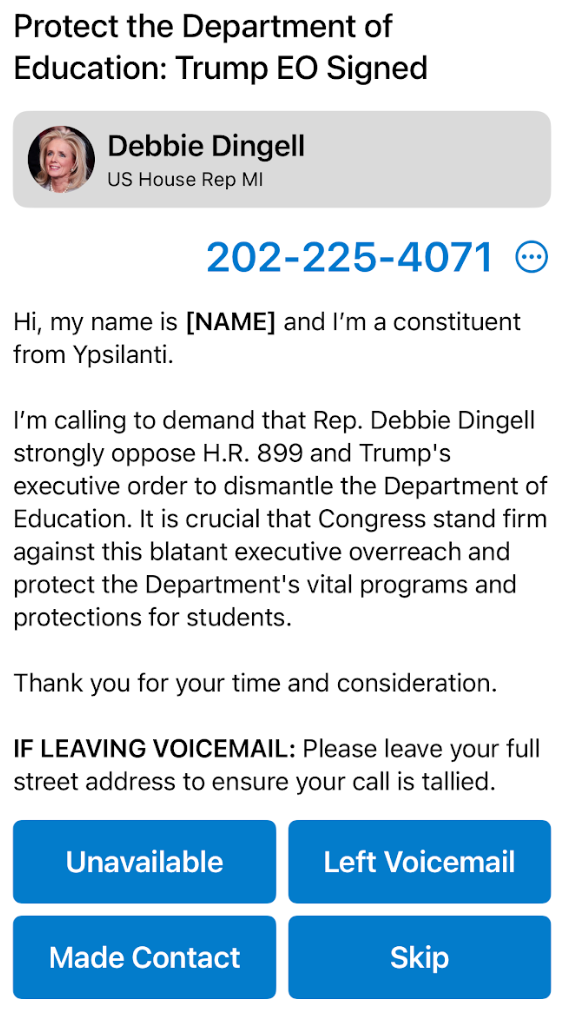
Here is how it works. Download the app, select the issue you are concerned about, and enter your zipcode. You will see a timeline of updates on that issue and a list of representatives from your district. One click later, you will see a page like this:

You click on the number, wait for an answer, read the script, and and click a blue button to register whether you left a voicemail or made contact, and the app sends you to the next number.

In just a few moments this morning I made three calls.

This may seem like something small — just like my boycotting may seem small and ineffectual to some –but if we truly believe that our government is of, by, and for the people, then we, the people, need to get involved. We need to do something when we see that our government is not representing all of the people — particularly when they are taking steps to further disenfranchise the most marginalized among us.

Look, you’re probably exhausted and overworked, too. You might feel like this is not worth your time, but perhaps you can take a journey back to your high school self, remember what it feels like to have a dream in front of you — of a career, a family, a whole adult life. Remember what that feels like? Don’t we want to make sure that every kid in America has an opportunity to pursue their dreams?

If you believe in the transformative power of education like I do, I urge you to make 5 calls — today, tomorrow, and until our voices are heard.

It’s a small decision you and I can make that could make a monumental difference for our kids, our country, our future.

Speak up … defend the rights of the poor and the needy. Proverbs 31:9

What a Village!

About a month ago I wrote a post (linked here) about what a challenge 2024 has been — how personal and national events have left me feeling dumbfounded and scrambling to find glimmers of hope amidst the ordinary. Then, a little over a week ago, rather unintentionally, I invited you to tangibly produce evidence of that hope — and you did!

Facing the pronounced need of some of my students at the small Detroit charter school where I teach, I, with a few other colleagues, selected what ended up being twelve families and determined to furnish them with some kind of Christmas miracle. I knew our staff alone would not be able to supply what was needed, so I asked you to be a village for my students, and you circled up!

I posted my blog on a Friday, and by Sunday, Amazon packages from a high school classmate were sitting on my porch and a friend had sent me some funds to get the gift card fund started. And the packages kept coming! As I opened each box, I saw the faces of the villagers — a woman who was my camp counselor when I was a teen, a former co-worker, a few dear friends, the parents of a former student I taught in St. Louis, and a sister- and brother-in-law. I saw them coming together to encircle my students, and the image buoyed my spirits.

Any teacher will tell you that every day of teaching in December feels like a solid week. The students are tired of being in school, yet lessons still have to be taught and programs still need to run.

This past week was cram packed, and by the end, I had lost my sense of humor. It’s probably because I expect the same level of rigor on a Friday in December as I do on a Tuesday in October. After all, that rough draft won’t write itself and it’s due on Tuesday so that we have time for feedback and editing before the final drafts are dropped on Thursday.

I get myself so wound up that I forget — still, after decades in this game — that kids are kids are kids and the fact that the calendar says Friday just does something inside the brain. Make that a Friday in December and that “something” is x10.

Anyway, I made it through last week — preparing for and co-leading a two-hour professional development session, observing and coaching three teachers, and teaching two sections of senior English each day, and only lost my sense of humor on Friday.

When the final bell rang, I settled in to finish the grading for the week, to prepare for Monday’s class, and to straighten my room before leaving for the weekend. I’d been a little amped all day, almost resembling the butt-kicking, name-taking self of yesteryear, but as I moved through my tasks, my emotions started to right themselves, and then I noticed the total in my CashApp account. In addition to my blog post ask, I’d invited our teachers to pitch in to the fund for our kids, too. These particular villagers are boots on the ground day in and day out. They are weary, of course, but I watch them hug students, hold students accountable, feed students snacks that they paid for themselves, talk students down from their own high emotions, and even give them rides home, half of their own lunch, or even the literal coats off their own backs.

Still, I asked them to give more. And they did!

Several of our teachers adopted our homeless expectant mother, purchasing everything off her wish list — items such as a blanket, a towel, shoes, and underwear. Others sent the first few dollars of their paychecks straight to my CashApp so that our students will receive what they need.

Combining the gifts from the virtual village and the on-the-ground village along with some gift cards provided by our organization, twelve (yes, 12!) families would receive gift cards that they can use at their discretion to purchase food, gas, gifts, or necessities! Additionally our pantry is restocked with essentials (seen below) for students to use now or when needed.

My principal and I texted Saturday morning, finalizing plans for purchasing gift cards and other needed items for the fun week we have planned before the break, and then we both headed out shopping. When I arrived home on Saturday evening, I was very content with what we had accomplished, and then came Sunday.

Never underestimate the power of a Sunday morning.

My husband and I had arranged to meet friends for both breakfast and lunch — it’s the cram-packed holiday season after all — and at BOTH meals, members of my village pressed into my hands gift bags stuffed with MORE gift cards to distribute to my students.

I became overwhelmed.

The needs of my students on any given day can seem staggering, and in the bitter cold of December, they can seem impossible to meet — our students need coats and food and clothes and phone chargers and rides and deodorant and feminine supplies. They need patience and hugs and accountability and grace and correction and encouragement and attention.

One middle-aged teacher can feel all alone in the face of such need, but she is not alone.

She has a whole village — on the ground, of course, but also at a distance. She can see them showing up, and cheering, and bringing water bottles and blankets and snacks.

Just knowing they are there gives her what she needs to show up for another day. On a Monday. In December.

It may look like I’m surrounded, but I’m surrounded by you.” — Michael W. Smith, “Surrounded”