
Why boycott?

Note: If you are listening to this blog post, several links are embedded in the print if you are interested in reading further.

Many years ago, not long after I met my husband, we began discussing a topic I’d never really considered before — boycotting. As I’ve mentioned here before, I grew up in a family that rarely, if ever, discussed politics. I remember when the Watergate hearings were on TV, but I have no shred of memory of how my parents felt about Nixon or the scandal. I have no idea, even, how they voted..

So when I met my husband, it was a little surprising to hear open political discussions — in the back yard, over dinner, on a car ride — about elections, of course, but much more specific issues such as unions, public assistance, and even (gasp!) abortion.

When I learned that in my husband’s family everyone drove American made cars or were required to park across the street when visiting, it made sense to me. My father-in-law was a retiree of General Motors and brand loyalty mattered. However, when my husband said he didn’t want to shop at Walmart, I had to ask why. He explained that Walmart was anti-union, and as a child of an autoworker, he had learned the power of the union to protect and support workers. He preferred not to support a company that wouldn’t allow its employees to organize. I didn’t feel passionately about it at the time, but I could get behind it.

As the years have passed, I’ve learned more about how Walmart underpays its employees while the owners become billionaires, I’ve grown my own distaste for the company and have shopped elsewhere. (This Time article chronicles some of Walmart’s journey including attempts they have made — under pressure from boycotting! — to improve.)

Of course, Amazon is similar in its practices. While it has made moves to reform, well-documented accounts cite drivers not being able to stop on their routes to use the bathroom and how they adapt to this expectation by carrying urine receptacles in their vehicles or by wearing disposable undergarments. Other accounts cite unpaid overtime, unsafe working conditions, and low wages, all while corporate profits rose to $88 Billion in the first quarter of 2025.

Amazon, Walmart, and other large companies are known for using employees — many of whom are low income and/or people of color — working them just up to the number of hours that don’t require them to pay benefits like insurance and sick leave and hiring for “provisional” employment and firing before the employee qualifies for permanent status. As a result, many employees of these companies remain on state and federal assistance while their CEOs pay a lower tax rate than the average American.

I have seen many of my students lured into jobs at Walmart, Amazon, and McDonald’s, promised pay raises, promotions, and an actual future, only to realize just weeks or months later that they had been misled.

So, what’s a middle-aged, middle-income woman like me supposed to do? How can I show that I don’t stand for this kind of corruption, that I don’t agree with these unfair practices? I vote with my purse. I’ve been doing this for years — avoiding companies that I don’t want to support and purchasing from those that I do. For many years this has been an isolated act that helps me feel like I have integrity. I doubt that I’ve made much impact, but I’ve slept better at night.

But this year, in 2025, anything can happen! All kinds of everyday people, using the engine of social media, can rise up and say, “You’re not getting our money!” If you take away your DEI programs, “you’re not getting our money.” If you won’t pay your employees a fair wage, “you’re not getting our money.” If you stand behind causes that harm our fellow Americans, “you are not getting our money.”

In 2025, I am not standing alone! People across the country are cancelling their Prime memberships and refusing to shop at Target, Amazon, Walmart, and other retailers. Last weekend, many refused to spend any money at all for 24 hours. This week, thousands are abstaining from Amazon purchases, and this is just the beginning!
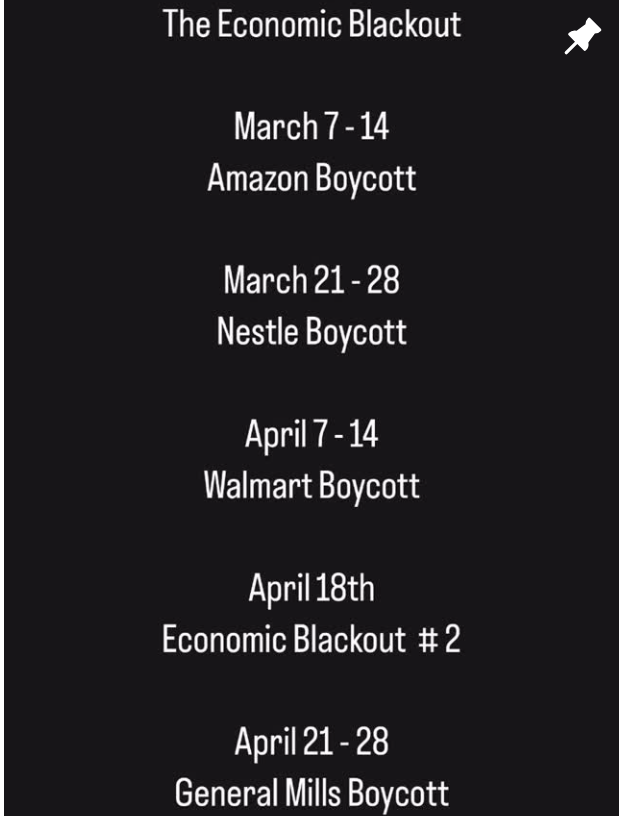
Organizations like the People’s Union have coordinated efforts to systematically send a message to corporations that will hurt their bottom line without jeopardizing the jobs of those who currently work for these entities.

And the beauty of this protest is that it doesn’t cost anything, you don’t have to go anywhere, no one gets hurt, and if you don’t like it, you get to make your own choices. That’s what is great about living in the United States — we still have the freedom to say what we want, to spend what we want, and to support what we want.

For me, that means speaking up about inequity wherever I see it — in education, in health care, in commerce.

Now, I’m sure I still spend money, unwittingly, at businesses that have practices that don’t jive with my guiding principles, and if I learn about them, I will shift. It’s as easy as that.

What do I hope to accomplish? I truly hope the combined efforts of all those who are shifting their buying habits (some sources say 24% of Americans so far in 2025) will get the attention of these corporate giants and they will begin to change some of their policies. I think this could happen, because although the pen is mightier than the sword, money is what really talks.

If this movement can sustain itself long enough for these large corporations to notice changes in their quarterly earnings, we just might get their attention. And if we get their attention, they may hear our message — you can’t abuse people and still get our business.

It’s a small action of many that stands up for those whose voices are not being listened to; it’s an expectation that in a country that professes that all are created equal, that all would be given equal opportunity. Period

That’s reason enough for me to boycott.

uphold the cause of the poor and the oppressed; rescue the weak and the needy;
    deliver them from the hand of the wicked. Psalm 82:3-4

It is Written, Re-visit

On Monday, I suggested we return to the Word of God as we try to find our way through the coronavirus crisis. I wrote this post in the fall of 2016 during another challenging time in this country — another time when I found myself returning to the Word of God for solace and guidance.

My blog has been silent for a few weeks. It’s not that I haven’t had anything to say; I just haven’t had anything I wanted to put in print.

My brain has been processing a flood of images and information — in addition to the madness that we will call the election of 2016, my husband and I traveled to South Africa for a week, came back for a week, and then went to Austin, TX for four days. Oh, and we’ve also been holding down our day jobs — he’s the dean of students at a small university and I am an adjunct professor of English and a private tutor.

I’ve really wanted to write more about what we observed in South Africa and how that has informed the ways in which we see our community, but when we got back, we saw things in our community that were very unsettling — so much posturing and name-calling, blaming and shaming, people positioned on the figurative both sides pointing fingers and shouting accusations. We, or perhaps I should switch now to I, I reeled.

While in South Africa, we were in a unique position to just observe. For as long as I can remember, my husband and I have been in positions of leadership, so being free to observe with no responsibility for others was very unusual. We met people, heard their stories, were inspired by their dreams, saw their struggles, and shared their joys. We didn’t really do anything other than bear witness to their lives. And then, about a week later, we were put in a similar position. In Austin, although my husband had minimal responsibilities, for the most part, we were again observers. Seeing. Listening. 

Is it too egotistical of me to imagine that God crafted these experiences so that we could come back and observe what has been happening in our very own community, in our very own country? Because I really think that is what happened. For the last two weeks, we have been watching and listening. We debrief with one another in the evenings, of course, and I’ll admit, I’ve shared a bit on social media, but for the most part, we have tried to position ourselves in conversations in which we can hear what people are saying. We want to understand how a country can be so divided. We want to be able to speak peace into the hostility. But how? People are positioned. They are sunk in.  Nobody seems to want to move. Where do we start?

So, yesterday, when I walked into church and saw who would be our pastor for the day, I hugged him and said, “Yay, we’re going to get a good word!” I was being playful in greeting him, because he’s a dear friend, but my playfulness revealed my hope that God would speak a good word through him.

And guys, He did.

Now, let me just give my standard disclaimer. I am very distractible in church. My husband often asks me about his sermon — did his main point come through? What did I think about a particular illustration. I want to be generous to myself and say that 50% of the time I can give him a meaningful response. My mind often takes tangential journeys away from the sermon. So, I won’t mention the pastor’s name or try to claim what he actually said. I will just tell you what I heard.

Jesus reigns. Over everything. Period.

No political candidate reigns. No political party reigns. No particular country reigns. No particular church body reigns. I don’t reign.

Jesus reigns.

It has been rather tempting over the past days, weeks, and months to become aligned with a particular ‘side’, hasn’t it? I have heard Christ-followers on both sides (myself included) claim that certainly Christians “should” feel this way or that. And we’ve been making these claims waving our fists in the air at each other. We are passionate, are we not? We are passionate about politics, but are we just as passionate about our True Leader?

I gotta admit, I’ve been misdirected.

My friends in South Africa showed me what it looks like to be passionate about the One who reigns. They worshipped — I mean three hours or more of singing, dancing, clapping, marching worship! They breathe thankfulness and reverence as they walk through their days.

Me? I’ve been grumbly and judgmental. It’s almost as if I’ve forgotten that Jesus reigns over everything. Will he stop reigning if we turn and go our own way? Nope. We’ve seen story after story written in His Word about generations who have turned away to idols and godlessness. Yet, He reigns.

We’ve heard stories about how God has worked among peoples who are oppressed and disadvantaged. We know that He is a God who steps into difficult places and makes a way for His people. Will He stop now? No. He will continue to reign.

So, should we stand idly by? No. We should be engaged in the discourse of our community, our state, our country. However, we can be careful that what we speak gives honor to the One who reigns, and the only way to do that is to continually look to the written Truth.

I can’t rely on myself right now. Not in this emotionally-charged environment. I need to turn, once again, to what has been written.

“Love the Lord, your God, with all your heart, soul, and mind, and love your neighbor as yourself.”  

“Do not think of yourself more highly than you ought.”

“Be devoted to one another. Honor one another above yourselves.”

“Do justice, love mercy, walk humbly with your God.”

How about if we start there? What if Jesus-followers across the country and around the world just saw and loved the people in front of us? What if we stopped shaking our fists and really cared about individuals in ways that showed we were devoted to them? What if we cared about the widow, the fatherless, and the foreigner? What if we looked after the sick, the homeless, the marginalized, the disgraced? What impact would that have?

I’d like to find out. Wouldn’t you?

It is written; Christ is risen. Jesus, you are Lord of all.

“Stronger” Hillsong Worship

The power of the positive call

On Tuesday night, at the Washtenaw County Courthouse, I sat for over seven hours in a conference room with two young men — Rick and Christopher.  They had been hired by the Associated Press to report the vote count, just like I had been hired by Reuters. These guys were old pros, I was the rookie.  They had done this job all through undergrad and were now in law school and pharmacy school, respectively.  They each had to get up for 8:50 class the next morning, but were glad to stay up late phoning in results because AP pays them ‘a ridiculous amount of money’.

You can’t sit in a room with two others for that long without having a little bit of banter going back and forth, even if you are making phone calls or entering data into an app. (Isn’t it cute that the young guys had to call in their data and the middle aged woman got to use her app?) We all had our Mac books open and were watching the screens for updated counts.  We were also clicking on news websites to see how the media were reporting the results.

One of the guys observed that the media only reports the bad stuff that politicians do.  He asked, what would it be like if every day at the end of the day, someone announced only your mistakes and none of your accomplishments?

Today in Ann Arbor, a middle aged woman slept in very late, stayed in her pajamas until mid afternoon, didn’t comb her hair at all, forgot to feed the dog, left dirty dishes in the sink, and ignored a call from a friend. 

Wow.  What a loser. I would prefer the following:

Today in Ann Arbor, a lovely wife and mother enjoyed a luxurious morning of rest, was greeted by her loving golden retriever, shared lunch with her husband, enjoyed a work out at the local gym, and made delicious black bean nachos for dinner. 

I asked the guys what would happen if at the end of each day the news media reported all the cool things that the president and his ‘buddies’ accomplished?  One of them quickly replied, “We would turn the channel.”

Can you imagine it?

Today in Washington, for the two thousandth day in a row, the president arrived in the oval office, dressed and pressed, at six a.m.  He led his staff meeting, gave a press conference, met with a foreign dignitary, and consulted with the joint chiefs, all before his noon lunch meeting with the secretary of education. 

Instead we get carefully constructed sound bytes meant, quite frankly, to draw viewers and increase ratings. Almost without exception, they are framed as bad news.  And, hey, we’re human. We can’t turn away when we see the collision on the side of the road.

And then, fueled on negativity, we rush out into our circles of people and  share ‘that horrible thing’ that we just saw on the the television.  “Did you hear…”

What would happen if we just as enthusiastically ran to our people and shared the good stuff that we see?  Well, first we would have to notice the good stuff, which might mean that we have to turn off the negativity for a moment. We might have to actually demand more of our media and insist that they report the good things that are happening in our nation.

Educators learned a long time ago the power of the positive call.  Imagine you are sitting down to dinner with your family, asking everyone, “how was your day?” when the phone rings.  “Hello, Mrs. Smith, this is Mrs. Rathje from Junior’s high school.  I just wanted to let you know that Junior arrived to class early today and straightened all the desks for me before everyone else arrived.  That really started my day off well and I just wanted to let you know what a fine young man you have.”

Did you smile when you glanced over at Junior who was sitting looking at his plate of meatloaf and mashed potatoes?  Did you walk back to the table, look Junior in the eyes, and say “That was your teacher, she said you made her day today.”  Did you see Junior look up, meet your eyes, and smile sheepishly? Did you see him sit up straighter when you beamed at him?  Did you hear him start to tell some details about his day?

It took the teacher time to make that phone call, but first it took a decision to notice the kid who was doing something right in addition to the one who was doing something wrong.  It’s easy to get consumed with putting out fires and noticing the troublemaker in the crowd.  In fact, some kids cause trouble just to get noticed.

It takes a mature, seasoned teacher to notice Junior in the back of the room doing what he is supposed to be doing for the two thousandth day in a row.  It takes a counter-cultural move to focus on him, to publicly praise him, and to celebrate his consistency with the people who care about him.

It’s not as exciting to report on what is going well, but it’s much more productive.  It draws people together instead of putting them at odds.  It breeds a spirit of celebration rather than cynicism.  It inspires a shared, “Go, team!” rather than a divisive, “You suck!”

I am not suggesting that we turn a blind eye to corruption or to real problems in the world. I’m just saying it might be nice to give the good and the bad equal time.

Ephesians 4:29

Let no unwholesome talk come out of your mouths, but only what is helpful

for building other up according to their needs,

that it may benefit those who listen.