
What is Needed

Often in this space, I write about the students at my small charter high school in Detroit. From time to time, I share their needs and invite you to partner with me in meeting them. One time I mentioned the need for athletic shoes, and a handful of you helped me purchase about twenty (yes, 20!) pairs for our track athletes! Other times, I’ve asked for support at Christmas, and some of you have sent items from an Amazon wish list, purchased gift cards, or simply sent cash. It’s not always the same people — some of you are local to me, some are friends from way in the past, and some of you I’ve never even met — but when I ask, the needs of my students always get met.

This past week, not having the time or inspiration for a complete blog post, I just flung out a request via social media. I said we had 8-10 families with extraordinary hardship that we’d like to send on their holiday break with grocery and gas gift cards. I’ve been coordinating efforts like these for five years or more, and my school community has come to count on the fact that “I’ve got a lot of great friends.” However, every time I ask, I momentarily wonder if the magic will continue — will people see my request? will they want to contribute? Then I usually remind myself that “before I am asking, He is answering,” and trust that God will provide.

This week was no different. That Facebook ask was just a week ago and we have plenty of donated cash and gift cards to support ten families in ways that they are not expecting — what a fun day our principal will have later this week, handing fat envelopes over to families who have no idea they are coming! I can’t know the impact your gifts will have!

So, first, let me say thank you to those who stop by to read my posts about education, my health, politics (gasp), and the things I am learning, but also to those who choose to contribute to students they have never met. I am astounded by your generosity that keeps showing up at just the right time. Even sometimes when I haven’t asked, a need is just around the corner, and you have met it in advance. Thank you for your heart, for your thoughtfulness, for your care.

Now, let me tell what I learned this week about what kids really need.

A few weeks ago, a teacher who is somewhat new to our district, a woman who just has a way of connecting with kids — the kind of teacher who kids show up to school for, the rare one who can get a whole room to lean in and listen as she walks step by step through a procedure, the kind who can glance up from a demonstration and silence a chatterbox without saying a word — this teacher mentioned to me that she’d like to put on a Christmas event for our students, did I think that would be ok?

I, thinking of our students’ physical needs, immediately (and wrongly) assumed that she wanted to coordinate the giving effort I have just described, and I directed her to speak with our principal. I thought it would be a great idea to pass the baton. LOL. It took me a couple of weeks to realize that what she was planning was very different than what I was assuming. She had a vision for a night of games and fun for a select group of students — a meal, prizes, and gaiety. No presents, nope. Instead, these students would “pay” the entry fee of a donated hat or mittens for someone less fortunate than themselves.

You heard me. She wanted our students — all of whom qualify for free breakfast and lunch — to make a sacrifice to be there. And not just anyone could attend. It was invitation only — kids who consistently come to school, kids who lean into learning, kids who lead, kids who volunteer, kids who do the right thing.

This was so far off my radar that I couldn’t picture the impact until I actually showed up.

The teacher asked her church to donate a meal, and churches being what they are, they had a crew walking in with wings, fries, mac and cheese, and green beans in chafing dishes that they placed over sterno pots.

She asked our staff to donate water, cookies, and prizes for the games — each category filled a table.
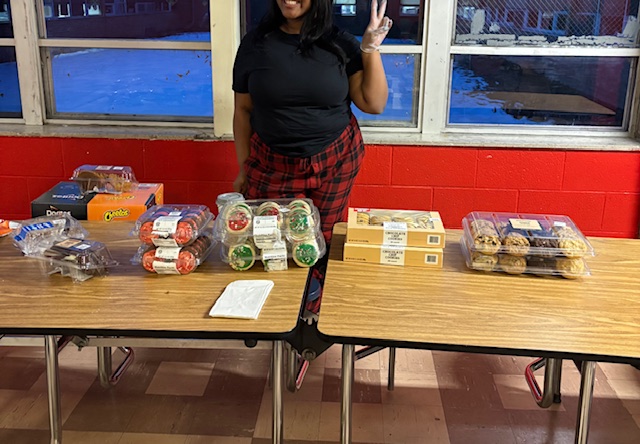
“What can I bring,” I asked around Tuesday when most of the above had already been donated.

“I have hot chocolate. Would you bring toppings?”

“Toppings? Like whipped cream?” I asked.

“Yeah, and I like mini chocolate chips, and sprinkles, and marshmallows…you know, to make a self-serve hot chocolate bar.”

“Ok, I can do that.” I said.

Since I was headed to the grocery anyway to pick up gift cards with the cash that some of you had sent me, it was easy to throw a few more things into the cart.

“Oh,” she said, “one more thing. Would you go around to the classes on Friday and hand out tickets to the ones who can attend?”

“Sure. Whatever you need,” I said — before I realized that this would mean handing them out in front of kids who were not invited. This was a struggle for me — little miss equity this and access that — but, I did it. It was uncomfortable saying, “I’m sorry, you are not on the list. This is an invitation-only event,” but I had to trust my colleague’s vision.

School was dismissed at 3:30 and a crew of students moved to the gym to set up. They were in charge of decorating and setting up the space for the meal, the games, the celebration. While they were doing that, I retreated to my office to finish an administrative task. When I arrived shortly after 5:00, students clad in Christmas pajamas were personalizing their hot chocolate, greeting their friends, chatting at tables, and listening to Christmas music. You might expect this at any Christmas party, but in this community’s world of scarcity, it felt different.

Teens who are normally just trying to get through the day — to get a ride to school, to find something to eat, to stay warm, to manage all the expectations of all the people around them — were free just to be.

And then, the silly Christmas games began!

Asked to find a partner and line up in the gym, students who typically display reluctance to engage, jumped out of their seats, grabbed hands, and ran to the designated location. They tossed miniature Christmas ornaments into cups, they played a version of Head, Shoulders, Knees, and Toes, and they raced to steal Christmas bows that were stuck to each other’s shirts (the one who ends up with the most wins)!

They laughed. They played. For a few moments on a Friday evening, they were allowed to be kids.

Students who typically have to put up a hard exterior — who have to save face — in this small group of students felt safe enough to put their guard down and be silly.

And that my friends was exactly what our students needed. They needed a safe space, they needed to feel like contributors, they needed the extravagance of a meal prepared just for them, of a hot chocolate bar, of games with prizes, of a fun Friday night with their friends. I sat and took it in — smiling, laughing, snapping photos — and realizing that I need to broaden my view of what is essential.

Friends, I am likely going to keep asking for contributions, so thank you in advance for tolerating my boldness and joining when you choose, but I am also going to open my eyes to what else my students need. I’m going to look for more opportunities to acknowledge all of Maslow’s hierarchy (not just the the foundation) because the sense of connection, of respect, of fulfillment are just as essential to developing teens as food, as transportation, as shelter, as safety.

Hats off to my colleague for leveraging her community to meet these needs. In doing so, she also challenged me.

God will meet all your needs. Philippians 4:19

It’s complicated

The seemingly unintelligle words of hospice — one month, a few days, 48 hours, probably today — all started making sense and then were undeniable. My stepfather took his last breath in the early morning hours last Saturday. In the days that followed, we gathered, made arrangements, gathered again, handled details, cared for our mom, and came to terms with the fact that my stepfather, Roger, is no longer here.

We’re still working on that last part, of course, and for me, the essence of our relationship makes it little complex.

While many found him charming, Roger and I had what was often a prickly relationship. We didn’t agree on hardly anything — politics, the setting on the thermostat, the way to wash dishes, vacuum a floor, wipe off a table, or do just about anything. I found him to be demanding, opinionated, and critical. I often felt great irritation toward him over our 50-year relationship, probably because I always felt that he usurped the position that should’ve been held by my father who I have long-adored and often idolized, likely because he and I haven’t had many opportunities to interact on politics, the thermostat, or dishwashing.

Because of this complicated relationship with Roger, it came as a great surprise to me when I found myself feeling tenderness, compassion, and love for this man as he declined, as he lost his agency, as he forgot where he was, as he was unable to breathe, as he was confined to bed — a man who rarely sat still, who worked and golfed and bowled and rode a motorcycle halfway across the country. I was stunned to watch my heart shift from irritation to caring, advocating for, and comforting this man who has been an annoyance in my life for most of my life.

When my mom married Roger, she had four kids aged 8-14. He had two kids aged 8 and 10. Together there were three boys and three girls — just like the Brady Bunch, which was in vogue at the time. For a few years, the eight of us took vacations together and hung out together, but as we turned into teens and then adults, we were rarely together. In fact, my three birth siblings and I have only managed to all be together on a dozen or so occcasions in the last 30 years, and the six of us “kids” hand’t been together in the same room for close to 40 years before we all gathered on a Monday night for pizza a year ago.

Who knows how this happens — people are busy with their own lives, and if one person doesn’t act with intention, folks never come together. But last year we did, and then, miraculously, Roger took his turn for the worst just as we were scheduled to all be in the same state again this past month.

We all worked together — getting him moved in to assisted living, taking phone calls, running errands, and sitting by his bedside. We took shifts. His daughter, who claimed the overnights, fell asleep holdng his hand that last night, saying, “Good night, Dad. I love you” and reading him the 23rd Psalm.

We crammed in a small room at the funeral home — writing an obituary, picking out flowers, deciding on printed materials, then shared a meal with our mom, who kept saying, “I can’t believe this is happening.”

And then, on Wednesday, we all rolled in — the six kids, and our kids, and even some of their kids. Because of the nature of this complex family, some cousins met each other for the first time. Some nieces and nephews met their aunts and uncles for the first time.

Families can be like this, can’t they? Frustrations can lead to fractures and before you know it, you’re meeting your brother’s kids for the first time, marveling at their kids, and watching your own kids (and nieces) interact with their new-found family with curiosity and grace.

I probably won’t ever understand the complexity of Roger — why he was the way he was — but I can celebrate the fact that despite my irritation with him, he remained invested. He cared for my mom to the end (even if that in itself was complicated) and he cared for all of us in his own way, too.

Mom and Roger married when I was 10, and maybe because of “ew — cooties” or that previously mentioned loyalty to my dad, I rarely let Roger touch me — not a hug or a pat on the back, let alone a kiss on the cheek. So imagine my surprise when near the end, I found my hands on his waist steadying him, or when I agreed to scrub his back when he couldn’t shower himself, or when he grasped my hand to say goodbye, or when I kissed his head to reassure him when he was afraid.

We don’t know the love we have inside of us that is sometimes buried under hurt or anger or a little girl’s longing for her actual dad, but it is there, and it surfaces when it matters — when you need to sit beside a hospital bed, empty a urostomy bag, or say “I’m sorry this is what’s happening right now. I know you want it to be different.”

It doesn’t mean I don’t love my dad or that you could ever take his place. It means that I saw you show up and hang in there, even when I found you to be annoying, critical, demanding, and cootie-infested.

It’s complicated, that’s true. Much of life is.

Rest well, Roger, I’m pretty sure it was complicated for you, too.

Love one another. John 13:34

Rapidly-shifting Reality

Three weeks ago, I made a phone call. Just a simple call.

My stepfather had just returned home from the hospital again — I’ve lost track of how many times he’s been in and out in the past year or so — and this time he was prescribed 2L of oxygen to be worn 24 hours a day. He has COPD, among other health issues, and he’s been on a slow decline for a few years. When he came home with the portable oxygen tank, the nurse from the home health agency who had been doing weekly visits on my parents for the past many months, just happened to be at the house accompanied by her clinical director who planned to evaluate the need for more services. She saw my stepfather enter the house, assisted by my brother, and rewrote the script in her head.

She’d been planning to offer palliative care services to support him through this ongoing and prolonged illness, but when she saw how difficult it was for him to just enter the house, she suggested to my mother that perhaps it would be wise to enlist the help of Hospice. “It’s different now,” she said. “Hospice isn’t just for end of life; it can provide prolonged in-home care so that your husband doesn’t have to travel to the doctor or hospital any more. We can manage his care right here.”

My mom called me, told me what was going on, and I asked, “what do you think?” She admitted she could no longer do it alone, which my siblings and I had been suggesting for months. “Well,” I said, “it might be nice to have someone coming to the house regularly that can help us make decisions when it’s time to make other changes. Would you like me to call them?”

“I think so. She said so much. Maybe you can hear the details yourself.”

So, I made the call.

Hospice would be covered 100% by medicare. They would adjust their visits as needed. They would handle all medications and would assist us in the transition if the time came for my stepfather to move to a facility.

I called my brother, who has been the point man through our whole journey, and he agreed that I should set up an appointment.

Hospice came to the house the next day. We signed my stepfather up, and the visits began — a nurse, an aide, a social worker. The door on the house was continually opening, and my mother was overwhelmed.

The following Monday, I sat down at my desk to complete some tasks for work and texted my siblings. “Hey guys, hospice is up and running. I won’t be able to come this week or next to help out, but I will be available by phone.”

I opened some documents, started working, and then spoke to my husband, “I think I’ve gotta go up there.” No one had called. Nothing had changed, I just felt myself pulled to my suitcase and mentally moving toward my vehicle. I called my mom, “How about I bring you guys dinner and stay til tomorrow afternoon? I can just provide you with a little support.”

“I hate to have you drive all the way up here, but that would be great.”

By early afternoon I was on my way.

I brought dinner. We ate. I got them both their meds, did the dishes, and made sure they were all set for the night before heading to the guest room.

Around 4am I heard yelling. I ran to my stepfather. He’d had trouble standing to go to the bathroom and was having some respiratory distress. I administered his new emergency med regimen, then helped him stand. He stood right there by his chair for several minutes so he could catch his breath, and then slowly, so slowly, used his walker to get to the bathroom. It took us 20 minutes to travel 20 feet. Once there, he was unsteady — teetering. I had to use my body weight to brace him so he wouldn’t topple into the bathtub. He did what he came to do, then we stood there for a moment, so he could steady his breathing before the trip back to his recliner.

It had been an emotional event for both of us, and neither of us got any more sleep.

The hospice nurse came that morning. My brother, mother, stepfather, and I spoke with her about what options we had. If I hadn’t been there for the incident the night before, what would our 100 pound mother have done? The nurse suggested she send over the social worker that afternoon to walk us through some options. Also, since my stepfather was having difficulty standing up from his chair, she recommended we purchase a lift chair.

That afternoon, the social worker came and talked my brother, my mother, my stepfather, and I through our options. We could keep him at home and hire additional home health aides (we were already paying for eight hours of assistance a week), or we could move him to adult foster care, a nursing home, or an assisted living facility. But before we made any decisions, we needed, she said, to meet with a lawyer who specializes in elder law. Any of these options would be quite expensive and we should have guidance on how to protect our parents’ assets before we acted.

We had a plan of action, so my brother ran a mile down the road to our small hometown’s furniture store to purchase a lift chair. While he and my other brother arranged to bring it home, I ran to the pharmacy to pick up some prescriptions. We met back at the house, brought in the chair, and while all of us were rearranging furniture and tidying up the space, my stepfather attempted to move from his walker to sit into his new chair. Up until recently he had been independently getting in and out of his chair without difficulty, so none of us thought to stand near him, and down he went. We all rushed to see that he was ok, my brothers lifted him back to his feet and got him in the chair, and we all looked our new reality right in the face.

That reality would start changing day by day.

The next morning, the hospice nurse stopped by the house to assess any damage from my stepfather’s fall. We’d been up again in the night — for breathing issues, for trips to the the bathroom, for confusion. She examined him, found the cut on his arm from where he’d hit the coffee table and a large bruise on his backside from the point of impact. She assessed his breathing and other vitals then met my mother, sister-in-law and I in the kitchen.

She used words we hadn’t heard before rapid decline…24-hour assistance… and about one month. We tried to comprehend this adjustment to our new reality.

And the scramble began — some siblings investigating elder lawyers, the social worker and I investigating facilities. Phone call after phone call, text message after text message. Eventually a couple tours. Finally an open bed. Then digesting the cost, then agreeing to the terms. All the while, on-going conversations with my mother and stepfather about what is happening and why…over and over and over.

Four days after I had decided that I was too busy to go up to my parents and then pivoted on that decision and went anyway, we were loading my stepfather, his clothes, his walker, and his newly acquired lift chair into our vehicles and transporting him to his new residence.

He didn’t love it, but we couldn’t see another way.

That was two weeks ago.

Hospice has continued to use incomprehensible words…rapid decline, days, family should come.

Family has come. Someone is beside him now.

It won’t be long.

That’s a reality.

From his fullness, we have all received grace upon grace. John 1:16

Re-post: For a Pair of Shoes

**I wrote this is Spring of 2024, and here we are in Spring of 2025. Track season started Monday, and we have a handful of kids who need running shoes. If you would like to contribute, an address is at the end of this post, or you can choose to reach out via message.

I’d been watching the girls’ basketball team all season — from the first game of their first season ever, where very few showed any evidence of having played the game before, where one girl received a “traveling” call for carrying the ball football-style while running down the court, where our players froze in place as the other team stole the ball, where the referees pulled our girls aside to teach them the rules in the middle of the game. From that game forward, I had been encouraging the girls, both on the court and in the hallways, letting them know I was seeing their progress. They were not only learning the game –the skills, the rules, and the strategies — they were also building confidence, stamina, and resiliency.

Many on the team were girls I had had the previous year in my reading intervention class. They had been freshmen– freshmen who had spent most of middle school on Covid lock-down, freshmen who had missed some social development experiences, freshmen who had very little capacity to manage challenge, difficulty, or conflict. So when I saw them during that first game, barely hitting double digits on the score board, I wondered if they would make it the whole season. Could they take the losses they would certainly face? Could they [and their coach] see this for what it was — a building year. Could these young women show up every day, practice the basic skills of basketball, and arrive at the end of the season better for it?

Only time would tell.

But here I stood at the end of the season, watching this same group of girls prepare for one of the last games. As the other team was rolling into the building, our girls were practicing an inbounding strategy while the coach called cues from the sideline. The girl with the ball slapped it loudly, and the four on the floor quickly shifted to their new positions to receive the thrown in ball. I stood on the sidelines, recording the scene on my phone, grinning with pride.

I was there to sell concessions, so I was in a little room at the corner of the gym with one eye on the game and one eye on my concession window, when I noticed that one of the players, the center, was shuffle-jogging down the court. I had noticed that she wasn’t a very fast runner earlier in the season, but I had assumed it was as fast as she could move given that she was about 5’10” and probably close to 200 pounds or that she simply didn’t have the stamina to run up and down the court for an entire game. Being the first season, the team only had about ten team members total, and typically only six or seven of them were eligible to play on any given day. Whoever showed up typically played all four quarters — that’s a lot of running for anyone, even those who are are in top physical shape.

But for some reason on this day when I noticed her shuffle jogging, my eyes moved toward the floor and I noticed that her shoes appeared to be untied. When I looked a little closer, it appeared that they were not actually untied, but in a permanently knotted state of floppiness. She could neither tie nor untie them., so the laces flopped as she ran, and the shoes, a pair of high tops that appeared to have seen some days on and off the court, seemed to be of little support in her efforts to improve her pace.

Is this the pair of shoes she’s been wearing all season? Why didn’t I notice this before?

Now look, every day at my school I see need. I see students who need food, who need new clothing, who need a haircut, personal hygiene supplies, pens, pencils, or even a water bottle, but this pair of shoes got to me.

This girl, who against all odds shows up for school every day, goes to basketball practice every day, has a C average, and dares to put herself in front of an audience of classmates, teachers, and parents, has been doing so inside sneaker head culture where the shoes on your feet can be linked to your status, your belongingness, or your ridicule. (It would take another whole post to examine the complexity of sneaker head culture within the context of high poverty neighborhoods, so let me just say that yes, a student may have brand new Jordans and still experience housing insecurity or food insecurity. It is what it is.)

This girl, despite her classmates’ comments and/or ridicule, has enough grit and determination to continue to show up on the court in these beat up kicks for the entirety of the season. That should tell you something about her.

So, I’m standing, watching the game from the concession stand, a game in which an adult in the stands got in an insult contest with one of our sophomores that escalated into a fist fight that DID NOT disrupt the game play — nope, our girls kept right on playing as security officers wrangled a punching mass of bodies out of the gym–a game in which they were down by double digits, came back to tie and go into overtime, a game where they lost by two points at the buzzer, and I’m taking in the wonder of these young ladies who could barely bounce a ball at the beginning of the season, who were making eye contact and passing, who were boxing out under the boards, and I’m understanding the impact of it all on their development — their ability to overcome difficulty, their ability to stay the course, their ability to trust themselves in difficult times.

I was overwhelmed.

A couple weeks later, after the season had ended and track season was getting started, the same group of girls was walking down the hallway, headed to practice.

“Ya’all on the track team?” I asked.

“Yes, of course!” they replied.

“Excellent!” I said.

“Are you going to come to our meets?”

“Definitely!”

And during this quick exchange, I noticed that all of the girls had on the same shoes they had worn to run up and down the basketball court all season — including that beat up pair of high tops.

And something inside me snapped.

A few minutes later I saw the track coach, “Hey,” I said discreetly, ‘I notice that K’s shoes are not really appropriate for track. I’d be happy to anonymously fund a new pair for her. Is there a way to make that happen?”

“I’ll figure out a way,” she said.

A few days later, I mentioned the situation to our athletic director. “I don’t know how many students you have that could use running shoes or spikes for track, but if I gathered a few hundred dollars, could you put it to use?”

“I would love that,” she replied. “Let me take a little inventory and see how many pair of shoes we need.”

So here I am telling this story, friends, because this is what I know how to do. I know how to tell you that having athletics is transformational for all kids — but for my students, who have experienced poverty and trauma beyond what I can imagine, who have every reason to give up hope for a brighter future for themselves, sports can offer an opportunity to practice navigating low stakes wins and losses and build the muscle they need to weather bigger wins and losses outside of sports. For my students, the power of athletics is essential.

My school is doing what it can to build programs. Two years ago, the only sports we offered were boys’ basketball, football, and cheerleading. Last year we added track. This year we added girls’ volleyball and basketball. In the fall, we hope to have a cross country team.

Teachers show up to coach, to run a clock, and to sell concessions because we see the impact of these programs on the educational engagement and morale of our students. If they aren’t passing classes, they don’t get to play, so they get more invested in their classes. When they are invested in their classes, they learn more, their grades improve, and they have more opportunity for their future.

It’s not hard to connect the dots between athletic programs and successful adulthood. We’ve known this for decades. All students should have access to programs that lead to a hopeful future, and they should have everything they need to participate in such programs.

So I’m asking, friends. I’m asking you for help — again. If you love sports, if you love kids, if you have an insufferable belief in transformation, please consider joining me in building an Athletic Shoes Fund for my students. Funds will be used to provide athletic shoes for students like K who cannot otherwise purchase their own.

Email me at krathje66@gmail.com for details on how to give or simply send a check with “DLA Athletic Shoes Fund” in the memo line to Detroit Leadership Academy 5845 Auburn Street, Detroit, MI 48228.

And if this isn’t your project to give to, I hope you’ll keep cheering us on as I keep on sharing our stories.

Home On Their Own

I’m at my parents’ house this weekend. I’ve been here quite a bit in 2025. In their early 80s, they have been having health issues for years, but this is the first year that we’ve seriously considered that living on their own might be just beyond their reach, especially since my mother fell and broke her femur last month.

However, nothing convinced my mother that she wants to stay in her own home more than two and a half weeks in hospitals and rehab. Although (or perhaps because) she worked in a hospital for over 40 years, she does not like being a patient, particularly not one who can’t get out of her bed unassisted.

So, she learned how to get up by herself, how to use a walker, how to transfer into the shower using a special bench, and how to pull on pants healing-leg-first. She allowed my brothers to carry her in a chair up the seven stairs into her house and acquiesced to hiring a home health aide to come to the house for four hours five days a week.

That lasted one week.

Having allowed this aide to make her breakfast, do her laundry, and clean her floors, my mother has determined that having her just two days a week will be adequate. She and my stepfather can manage the rest of the time on their own.

My husband continues to remind me that our parents are adults and can make their own decisions. And I’m working hard to stand back and let them.

It’s a little like parenting teenagers except I’m older and a little wiser. I think I know better than my parents, but I’m trying to be willing (along with my five siblings who seem much less controlling than I am) to let them call the shots and, as my oldest sister says, “let the changes be their idea”.

She’s right, of course.

When I look at my mother and her fierce determination to be at home and take care of herself, I know that I will be just like her in 20 years or so. I won’t want my kids calling the shots. I will need to see for myself when I’m out of my depth, and I’ll want to be the one to yell “help” when, and only when, I’m about to sink.

I don’t want them to get there, of course. I don’t want to watch my parents flounder, but who I am to determine how much struggle they can manage? Who am I to say when enough is enough?

I’m just a kid looking on, watching my parents navigate their reality.

And right now their reality looks like side by side rocker recliners in front of the TV watching cooking shows, Perry Mason, football, Jeopardy, and Wheel of Fortune. It looks like excitement over a chocolate shake or a delivered chicken chimichanga. It looks like rearranging the furniture to accommodate walkers and canes and oxygen machines. It looks like my brothers and sister-in-law dropping by several times a week to bring in mail and groceries, to pay bills, to manage household maintenance, and to simply check in. It looks like me coming on weekends to work on projects, to problem-solve, and to bear witness.

What it doesn’t look like right now is me taking charge, me kicking butts, me taking names.

It looks more compassionate than that — more understanding — more loving. It looks like running to Meijer two days in a row to get the items that weren’t on the list my sister-in-law took with her the day before. It looks like picking up a McDonald’s milkshake at 2pm and a Wendy’s Frosty at 5pm because I was asked and someone who is all but confined to a recliner doesn’t need my judgment. It looks like bringing all the towels in the house to the living room so that my mom can sit in a chair and identify which towels go upstairs, which go downstairs, and which go to the rag pile. It looks like making a pot of chili, instant chocolate pudding, and scrambled eggs and toast– “I’ll take mine with strawberry jelly.”

For a while last night I sat with my mom on the edge of her bed showing her how to operate the television my brother installed — how to use the remote, how to access Netflix, how to navigate with the Roku to watch her regular shows. She did a lot of nodding then asked me to write it down step by step, which I did. I placed the instructions, laminated with packing tape, on her bedside table under the remotes.

This morning I found them sleeping side by side in their recliners. Evidence suggests that my mom tried to sleep in her bed but just couldn’t get comfortable and so carried her pillow back to the chair where she finally nodded off. They were still sitting their unmoved at 11am when I finally decided to make them some breakfast, deliver their meds, and load my things into the car before my trip home.

My exit was made easier because my brother and his family showed up. I didn’t have to leave them alone in their chairs, even if I did know that that would be their eventual reality. I got to leave believing they were in good hands, not worrying if one of them would fall, if they would forget their meds or my stepfather’s breathing treatment.

I called, of course, when I got home. My mom picked up and said, “hold on a minute, let me get to my chair.” I felt myself get tossed into the bag attached to the front of her walker, heard the step-slide as she crossed the floor, and, moments later, she said, “OK, what’s up?”

I knew she’d have to get back out of her chair to heat up dinner, to change into pajamas, to go to the bathroom. I knew it was gonna be a struggle every step of the way.

Everything is going to be a struggle for a while, but they want to give it a try.

This is me trying to be ok with that.

Honor your father and mother. Exodus 20:12

Team Effort

Although my mother is in a rehab facility two miles from her home recovering from a broken femur and the surgery to repair it, although my stepfather needs almost ’round the clock support to manage his physical and cognitive health issues, although there are appointments on the calendar and decisions to be made, I returned home last week and went back to work.

I felt ok returning because my parents are in the hands of a very capable team.

Two of my brothers are moments away, able to (mostly) cover the day to day, but the needs are increasing as physical and coggnitive health diminishes, and it’s nearly impossible to manage all the pieces while you are running a business or managing a division. Another brother is a moderate drive away, and he’s not working at the moment, but he has a family, two grandbabies on the way, and commitments he made before the current status emerged.

Two sisters are states away — time zones away — and they chime in to group chats and email threads; one is spearheading the investigation into care options, the other is providing funds for incidentals. They both stopped their lives and showed up for a week last summer to offer support during the last high intensity moments. Our sister-in-law has, for over a year, been managing the lion’s share of doctors’ appointments and errand running.

Right now, my daughter is boots on the ground, going back and forth between her grandma and papa, filling requests, attending to medical needs, purchasing groceries, and doing laundry.

I’m not close enough to my parents to pop over, but in between answering emails, attending meetings, leading classes, and grading assignments, I field texts and phone calls from siblings, agencies, and, of course, my parents.

Each of us has a role to play.

We’re trying to determine next steps. Should they/could they be in assisted living — are there any openings? what is the cost? would they be together? apart? Could they/should they remain in their home — what supports would they need? how often? for how many hours? what is the cost? what changes would have to be made?

It’s an all-out team effort. And, thankfully, everyone is here for it. Because even though each of us has a whole life of our own, we are doing our best to share the load. This is not always the case, especially not in blended families.

We’ve seen it, haven’t we? Siblings who refuse to speak to one another because of something that happened in 1995, or 1974, or 2021. Children who won’t show up because of the ways they felt mistreated or neglected by their parents. The hurts are usually real and the feelings valid, and our family is not immune from dysfunction, so the fact that everyone is able to show up and contribute is a testament to the maturity, healing, and selflessness of each individual.

And we’re learning.

We’re learning about how memory loss can change personality. We’re learning how the feeling of helplessness can look like anger. We’re learning how to take phone calls in the middle of the night with understanding and compassion. We’re learning to take a step forward, not knowing if it’s the right step, but being prepared to change course at any time.

We’re learning about each other — how one is a quick responder, an in-the-moment solver of every kind of problem, a leader who can make the decision when faced with myriad options, how another is a patient presence, willing to just hang out during a losing football game, nodding off in a chair, but staying to the end, ready to go to the grocery store three days in row, willing to heat up a meal or help a senior pull on a pair of socks. A third consistently has a can-do attitude — I can run the vacuum, I can mop the floors, I can stay the night, I can try to bring some humor to the situation. The fourth speaks up for the parents — almost without fail — what do they want? what do they need? are they comfortable? are they able to be together? The fifth speaks sparingly, and sometimes just one-on-one, but she seems to be observing what is happening, offering what she has, and watching for how she can make a contribution. And the last? She has a lot of words — in emails and texts and phone calls and google docs. She’s sharing information like she’s getting paid by the word — documenting the moments of each day so that everyone is in the loop, sees what’s happening, has all the information.

It’s almost like a hiring agent built a team specifically for this task, like the members have been training for these roles their whole lives. The time has come, and everyone is playing their part.

Tomorrow, several members of the team will show up for an assessment by a home health care provider who will determine exactly what is needed, whether or not they can provide it, and what exactly it will cost.

When I called my mom today to ask how she is feeling about this meeting, she said, “hopeful.” She really just wants to be at home, and we really want to make that happen for her, but even though we have a whole team, it is hard for us — the adult children — to know what is best. So, we’ll see what the experts have to say — this provider, our mom’s surgeon, her OT and PT team. Then, with our parents’ input we’ll make a decision.

Then we’ll see how it goes.

Then we’ll communicate with one another.

We’ll decide whether to stay the course or change direction.

It’s gonna be a journey. It’s nice to know we’re in it together.

from the whole body…each part does its work. Ephesians 4:16

I told you so.

See? I told you so! Anything can happen in 2025!

You can have your whole week planned — your students will do a peer review on Friday, you’ll sleep in on Saturday, and then you’ll pack a bag and head south to your grand girls to play for the weekend.

But instead, since it’s 2025, your mother will fall down and break her leg on Thursday, you’ll put some sub plans together, pack a different kind of bag to head north. You’ll sit in a hospital room, watching the second hand click so that your mother’s turn for surgery will come at 5:00…no 6:30. Really, it’ll be at 7…we just got pushed to 8, but it’s still gonna happen…no sorry, an emergency brain surgery just bumped her place. We’re moved to 9am tomorrow.

You’re watching her writhe in pain even though they’ve given her NORCO and morphine, then you see her finally settle when they administer dilaudid.

You drive 45 minutes, picking up a chocolate shake on the way, then deliver it to your stepfather who has probably not left his recliner today. You tell him to take his meds, then put on your pajamas, crawl into bed, and set the alarm. You don’t ask if the cat has gone outside. You don’t remind him to put on his oxygen.

Meanwhile, your husband is following through on the initial plan, packing a bag and preparing to drive south.

The alarm blares and you jump up, do a little yoga, gather the items your mother asked for, tell your stepfather that no, you won’t be running to get a coffee, but he should take his meds, take his inhaler, and get himself some breakfast. The last you knew he was still driving, still running to get his own coffee, telling you he can manage on his own, but his wife of 48 years, his primary caregiver, just fell and broke her leg two days ago, he has memory issues, COPD, and a urostomy, and he is quite confused.

He takes his night meds instead of his morning meds. He doesn’t use his inhaler. He doesn’t go get coffee or something to eat. No.

So, while you are waiting through your mother’s surgery, chatting with your younger brother, reading a book, completing a crossword, your stepfather is home struggling.

You call to tell him that his wife is out of surgery, and he says great, but he’s having trouble breathing.

Part of you is worried, but part of you thinks he just wants some of the attention for himself. All of you just wants one moment that isn’t a crisis.

“Do you have your oxygen on?”

“I don’t think so.”

“Ok, put it on. Keith is headed your way soon.”

You and your brother grab a lunch then head to your mother’s room to see her post op. As she’s wheeled in, sound asleep, your brother’s phone rings. Your other brother is with your stepfather, trying to get his oxygen on him, administering an inhaler, making him something to eat.

You stay at the hospital. Your brother goes to the other crisis.

And it’s just Saturday afternoon.

Your husband will watch one grand girl play basketball. He’ll watch the other one play in a school hallway then throw up in the middle of the night. Then, he’ll watch their parents leave on vacation. He’ll go to procure gatorade, make toast, cuddle on the couch, and play games.

You’ll advocate for your mom over the next two days and slowly come to terms with the fact that your stepfather indeed cannot remember which meds to take, which inhaler to use when. He spends 23 hours a day in a recliner because that’s what he has the strength and capacity for, not simply because he’s a selfish asshole.

Although your fatigue is growing, so is your compassion. Your words get softer. You start putting the meds right in his hand. You refill his juice for the 17th time today, and you pick him up one more chocolate milkshake.

Although the experts point out the obvious — your parents need assisted living — and although you and your siblings are trying to make that happen, you also hear their desire to stay at home. Can’t they get chair lift for the stairs? Can’t they get in-home care?

So, you text in the group chat with your five siblings, each of whom are contributing in one way or another. You create a Google doc to keep track of everything that is happening and share it with the group. You assure your mom you won’t make decisions without their input. You’ll try to help them keep their cat. You know this is hard. You know it’s been hard.

Because she voted for the incoming president, you sit beside her and watch the inauguration. Because she’s frail you shut your mouth. You don’t react to the audacity, to the misrepresentations, to the falsehoods. Instead you watch her fall in and out of sleep while the crowd boos former presidents and then applauds the renaming of the Gulf of Mexico. You don’t so much as cuss under your breath or facepalm. You just quietly take it in.

And as you’re driving home, you don’t listen to news. No. You listen to the sermon you missed on Sunday. You sing along with worship music. You’re so exhausted you miss your exit and have to turn around. You pick up dinner, meet your husband — who has picked up groceries — at home, unpack, put on pajamas, eat dinner, and try to stay awake for a movie.

You’re not surprised when you wake up to see that a newly appointed government official used what looks like a Nazi salute. You’re not surprised by the immediate executive orders that have been made. No. We’ve seen this coming.

And, it’s 2025. Literally anything is possible.

A girl could grow compassion for her step-father. Six siblings who have spent little time as a group for the past 40 years could come together to care for their parents. An arctic blast could close school for a couple of days and give a girl a chance to do some laundry, to binge-watch a period drama, to put together a puzzle, to catch her breath.

…with God, all things are possible. Matthew 19:26

Ten Years Later #11: A String of Miracles

This is the last of the “Ten Years Later” series that I had intended to be a weekly feature in 2024. The year, as most are, was more than I had anticipated — more struggle, more loss, more healing, more restoration, more hope. This post, written and recorded in January 2023, sums up the vibe I want to carry into 2025 — the continuing hope that all things can be made new.

We purchased the gifts and wrapped them. We planned menus, purchased loads and loads of food, and baked ourselves silly. We cleaned the house and made all the beds, and then we waited.

As we sat on the coach, staring at Netflix, the texts started to come in.

“We’re checked in at the hotel! See you in the morning!”

“Our flight just landed!”

“We should be there in an hour!”

And then our family started rolling in — from Ohio, from Massachusetts, from Missouri.

We hugged, we laughed, and we ate.

We puzzled; we played games. We did crafts, watched movies, and traveled to celebrate with even more family.

It sounds like what most families do over the holidays, but I suppose many families, like ours, can get together like this only because of a string of miracles — only because of choosing forgiveness, of going to therapy, and of healing and time and the stubborn belief that things get better.

Didn’t you, too, have the holiday where everyone was yelling at each another?

And the one where no one spoke a word?

And the one where everyone walked out of church sobbing?

And the one where some decided they just. couldn’t. do it — not this year.

And then there was the covid year (or years — who remembers?) where we packed presents into flat rate boxes and stood in line for hours at the post office, hoping our parcels would get there before Easter. The year (or was it two?) where we sat in Zoom rooms with family members, some of us trying not to hog the air time, others trying to endure those who were hogging the air time.

It seems after all those difficult years we might have stopped believing that we could once again be all in one space, laughing, eating, agreeing on what to watch, moving upstairs to open the gifts, and leaning together over a puzzle, snacking on chips and rock candy and cookies.

But we didn’t stop believing — really — did we?

Didn’t we keep hoping for the day when all the therapy would pay off? Didn’t we long for the moment when we all laughed at the same joke, all smiled at the same memory, all managed to load ourselves and our gifts and bags full of food into cars only to discover most of the way there that we had left the main dish warming in the oven and no one lost their shit but we rebounded easily, picking up take out on the way?

Didn’t we imagine it could happen? Didn’t we dream it?

And so I’m sitting here pinching myself, trying to believe that it actually happened. And someone in the Christmas 2022 group chat sends a text checking on someone else who left the festivities feeling subpar. Another sends a pic of a present that broke upon opening, and everyone laughs. More pics are shared, more laughter, and then a commitment to what we will do next year.

They want to do it again next year.

I need a moment to just take that in.

Every family relationship doesn’t get this gift, does it? We don’t all get the moments we prayed for.

Don’t we all have at least one relationship where we do all the initiating? where tender topics are avoided? where our hearts ache with disappointment at the end of each phone call? where we can’t shake the feeling of being unwanted?

In fact, I was sitting in therapy the very day that the last of our family left, on the come down, for sure, and all I managed was, “our Christmas was amazing, but this one relationship over here still sucks and that’s all I can think about.”

And over the hour of belaboring the one less-than-stellar relationship I have spent most of my life bemoaning, my therapist offered suggestions, role-playing, expectation-setting, and the like, and near the end of the session, I began to realize that the beauty we experienced with our family at Christmas didn’t come without the hard work of many — of all of us, really.

I can’t expect this other relationship to magically transform on its own. If I want something different, I’ll need to return — to my knees, to forgiveness, to therapy, to the stubborn belief that things can get better.

It’s risky — even just the hoping for change — because happy endings or even happy moments are not guaranteed. I might experience disappointment — again.

But I might risk hoping, and a series of miracles might just happen. We might laugh at the same joke or smile at the same memory. We might play a game together or lean toward each other over a puzzle. We might agree on a movie. We might enjoy a meal.

And it might be amazing.

Witnessing the string of miracles that led to an amazing Christmas has me thinking that I just might risk hoping again.

[He] is able to do far more than we would ever dare to ask or even dream of”

Ephesians 3:20

Last-minute Christmas Prep

You are all but ready for the holidays, but you’re starting to feel a little edgy because the gatherings are starting to happen? Me, too! Seeing all of our people can tricky — especially at the holidays.

It’s not because of the presents or the food or the clothing we choose to wear, it’s because of all the meaning we attach to the smallest of things. We come carrying the historical experiences we’ve had with each important person in our life, and our brains use some kind of warped algorithm to assign emotional value to every holiday interaction:

the language in that text,

the gesture she made when she said that thing about you know what,

the fact that she said nothing about you know what,

the size of the gift,

the absence of a gift,

the appropriateness of the gift,

the inappropriateness of the gift,

that phone call,

the lack of a phone call,

the food that was served,

the food that wasn’t served,

how much he ate,

how much he didn’t eat,

the church service,

the hymns we sang,

the hymns we didn’t sing,

the outfit they wore,

what they didn’t wear,

who showed up,

who didn’t show up…

It’s all laden with our individual and collective histories of hurt, joy, regret, longing, grief, love, loss, and all the other emotions that seem amplified around the holidays.

And why are they amplified? Maybe because holidays are times of expectation — we build them up to be the pinnacle of our human existence. When did you see your first holiday commercial or store display this year? When did you hear your first Christmas carol? When did you purchase your first Christmas present or attend your first holiday party?

For months we look forward to this season with expectation, creating scenarios in our minds, imagining who will be with us, how they will react to the gift that we bring, how we will embrace and enjoy one another’s company, and how perfect the experience will be. But when each of us arrives lugging our history and our expectation, there is bound to be disappointment.

I will be so busy tending to my historical hurt — the disappointment of Christmases past when I wasn’t with my father, the longing for the holidays my grandparents created, the belief that I didn’t fit in with my family — and trying to process my current reality — the work stresses, health issues, and dysfunction in relationships– that I don’t realize that you, too, are tending to your historical hurt and current reality, which may be very similar or very different from mine.

And, since my gaze is at least partially turned inward, I might say something that is less than thoughtful or even insensitive and you may feel hurt. And since it’s a holiday, you may contain your reaction to a mere shifting of your eyes, but I will see it, and, being focused on my own hurt, I won’t see that shift as you reacting to my insensitivity but will assign it some other type of meaning — I might assume the worst about you rather than taking accountability for my own actions.

And it doesn’t take many of these small interactions to lead to a tense and emotionally charged holiday gathering, even among the most civilized and emotionally evolved among us.

Before you know it, someone says, “What do you mean by that?” and storms away to a different room or out the front door. Or, they contain their hurt inside, plastering over it with a smile, but carrying the hurt to the car with them and taking it out to nurse and nurture in the privacy of their own home so that it can be brought back to the next holiday gathering. It’s not what we are hoping for, but it’s what we often do.

Hurt people hurt people, and if we are being honest, we are all hurting.

We are all longing for someone to say:

I’m really sorry about that thing that happened to you,

I didn’t mean what I said — I was angry when I said it,

I want to heal with you,

Will you forgive me?

Can we talk about it?

How can I help?

I’m proud of you,

I support you,

I love you.

We often approach holidays playing defense — putting up our guard, expecting the blows, preparing for the worst.

What if we tried a different way? What if we planned ahead and practiced checking in, listening, caring, and supporting? What if we processed our historical hurt through writing or therapy before we loaded up the car? What if we were vulnerable and admitted to a few at our gatherings, “I’m struggling. This season is hard. I’m sorry if I seem distracted.”

How might these little moves have a significant impact on our experience of the holidays?

And while we are at it, can we plan to overlook any insensitive comments someone else might make, any seemingly judgmental facial expressions, any downright rude comments? Can we chalk them up to the heightened emotions of the holidays and not give them too much weight? Can we decide in advance not to gather these infractions up in a bag to take home and examine under a microscope? Can we instead choose to sweep them up with the crumbs from the table and toss them in the trash, not because they are meaningless, but because we are not choosing to assign them any additional meaning?

Can we plan to check in with the oldest, the youngest, the quietest among us? Can we set out to embrace those we know are grieving? Can we provide space for those who need an ear? Can we offer to help? Can we turn our gaze away from ourselves?

Could we give that one extra gift?

…Love one another. (John 13:34)

Chester and I — A Return to Best Practices

Chester woke up with tummy trouble. It was not the first time. He’s always been little sensitive. Even from an early age, he was always a little “eating disordered”. Sometimes he would eat his food; sometimes he wouldn’t. Throughout his thirteen years, he has eaten 70-80% of the meals set out for him. It used to worry us, but eight or nine years in, we accepted it.

When he was younger, he was also a puker. Once a month or so, we would find a disgusting pile on the stairway landing or hear him retching and run him to the door. Usually after he’d emptied himself and slept it off, he’d be fine.

Now that he’s geriatric and since we’ve moved into our new place, his tummy trouble has found a new expression — diarrhea. The first time it happened was a few weeks ago. Chester woke me in the middle of the night, demanding to go outside. Once in the yard, he showed me why he had been so insistent. The next few nights, it was like I had a small child again. I let his belly rest a bit, started a bland diet, and called the vet. By the time of our visit, the issue was resolving, but then it came back in full force.

The vet’s hypothesis? “Sometimes when we go through change, this happens.”

Poor Chester had lived his first six years in one home, his next seven years in another, and now, when he’s thirteen, we are changing his environment again. It was a little overwhelming for all of us, and I had to admit, my body was feeling it, too.

Our bodies are so strong. They perform for us physically — packing and moving boxes, walking up and down the aisles of Lowe’s and Target, and meeting with realtors, contractors, and vendors — while at the same time holding all of our emotions — excitement, stress, joy, and anxiety. They are resilient and adaptable, but after several weeks of ongoing demands, our bodies can become overloaded.

Chester’s been a real trooper — learning to walk up and down stairs again, adapting to a new environment, learning the new rules of where he can go and where he cannot go — but I think his tired body was finally ready for some TLC.

My own body was energized through all of the packing and moving, but a couple weeks into the settling — unpacking boxes, welcoming guests, and making major purchases of furniture, hardware, etc. — I started to feel a familiar hum — inflammation, fatigue, the signs of a flare. Thankfully, my body doesn’t cry out in the same way as Chester’s. Instead, I first notice sassy replies sprinkled with sarcasm. Then, I notice a psoriasis outbreak or a headache. I find myself sleeping 10 hours some nights and 2 hours on others.

Just as Chester was suffering, my body was aching, and I knew I had to start paying attention.

This cross-town relocation took some work, and in order to meet the demands of the move, I had put some of my “best practices” on hold. I wasn’t taking the time each morning to write three pages, really read my Bible, or get in my daily walk. I was surely moving a lot, but I wasn’t connecting with the rhythms that have kept me well. It was time to return.

So, in fits and starts, I have been returning, but I have been distracted. Since Covid restrictions have been loosened, we, like countless others around the globe, have also welcomed guests and traveled quite a bit lately. We’ve been to Ohio, Indiana, Massachusetts, and several points in Michigan. We’ve seen all of our children, our grandchildren, our parents, and several siblings, nieces, and nephews. All of this time with family has been sheer bliss, and we have loved every minute. However, in order to make it all happen, I have been less than consistent with my routine. I’ve fit in some yoga here and there, and I’ve gone on some walks, but I have learned over the past seven years, that if I want to stay healthy, I need to observe my best practices daily.

I was doing a pretty good job last week. I had about seven days running of eating the right foods, doing yoga, going on walks, and writing, and I was starting to feel pretty good. Chester was doing well, too! He was eating his food every time it was set out, he was going on short walks, and he even had a short meet and greet with a neighbor dog.

We were already seeing the pay off of our routine.

We were feeling great when our son, daughter-in-law, and two granddaughters pulled into our driveway last Thursday. We hugged, we played, we chased, and we snuggled. Then, we piled in two cars to go meet more family for a fun-filled beach weekend. Chester was safely secured at home under watchful care, so he would certainly be fine if we were gone for thirty-six hours or so.

What could be better for a body than a couple days on a beach, watching children play, drinking in fresh air, and soaking up sunshine? What difference would it make if we ate a few extra chips, sampled a gluten-rich cookie or two, or splurged on some onion rings? We were laughing and smiling and having the time of our lives.

Exhausted, we pulled back into our driveway late on Saturday night to find that Chester, who’d been fine while we were gone, just couldn’t hold it together until we got to his crate. The stench in the house was evidence of what had happened as he awaited our return. So, instead of falling into my bed to recover from the weekend, I found myself on hands and knees cleaning up feces, carrying soiled blankets to the wash, and lighting candles throughout the house.

Later, as I stood in the shower, I felt my clenched jaw, my burning eyes, and my aching joints. I toweled off, pulled on pajamas, and flopped into bed. Almost immediately, Chester sunk onto his bed beside me. We sighed. We were tired. We couldn’t keep up this pace any more.

We needed a return to our best practices.

This morning, he urged me out of bed and stood near me until I found my way to my desk, carrying a bowl of gluten-free oatmeal and a cup of green tea. When I was adequately positioned, he plunked on his rug at my feet, happy to be back in the routine and looking forward to feeling the benefits.

Later this week, I’m going to welcome my sister who is visiting from out of state. We’re going to spend an evening with friends, and I am going to participate in an event for my recently graduated students. It’ll be fine. It’s not too much. I just need to remember to keep returning to these best practices.

 I pray that you may enjoy good health and that all may go well with you, even as your soul is getting along well.

3 John 1:2