
What World do We Live In? Part 2

**I wrote a piece called “What World Are We Living In” in the fall of 2020 when I first started commuting from Ann Arbor to Detroit to teach in a small charter school and began to daily witness the disparity between the two communities. The following post grew out of an experience I had last week in another school district.

Last Wednesday, instead of driving to Detroit first thing in the morning, I drove to Oakland County to participate in a day of professional development along with a dozen other teachers who use the Adolescent Accelerated Reading Intervention. I’ve been using the program for a little over a semester, with great results, but I have been aware that I might not be crossing all my t’s and dotting all my i’s. Having the opportunity to be a fly on the wall of two separate classrooms as other teachers implemented this intervention would hopefully help me see what I’ve been missing.

The beginning of my commute looked largely the same as it does on my daily trip to Detroit — interstate highway merging onto surface streets. However, I noted that while my regular route takes me past fast food, gas stations, minimarts, and older working class neighborhoods, this route into Oakland County took me past Starbucks, Trader Joes, and nicer restaurants before it led me through residential sections with large suburban homes. And then, when I took the final turn, I saw the school where I would begin the day.

It was a sprawling two-story building on a large piece of property surrounded by multiple well-lit and freshly-lined parking lots. I found a spot, grabbed my stuff, and made my way to the guest entrance at the front of the building. I approached a door, pushed a button, and looked into the camera before I was buzzed in to a glass-enclosed foyer.

There, a staff member/gatekeeper looked me over and buzzed me through the second door. She knew why I was there and directed me to room “two-oh-something or other”.

“Which way is that?” I asked.

“Up those stairs and follow the signs.”

I walked up the open carpeted stairway in the expansive atrium to the second floor, also carpeted, and found the group of teachers already in conversation.

They sat in a semicircle in the [also] carpeted classroom. I found a seat in the back of the room in a bar stool height chair next to a tall table. The students had not yet arrived, and the teachers were discussing what was on the agenda for the class this day — one of the final steps of reading a book in the AARI program, mapping the text.

I heard the bell ring in the hallway, and the students started coming in, finding their resources in a strategically placed filing system, then making their way to the table where I was sitting. I relocated myself and began to observe.

Right away I noticed a t I hadn’t been crossing when I looked at the big piece of butcher paper where they had started their text map. My students and I had mapped our own text the day before, and it looked somewhat similar to, if noticeably messier than, the one I was looking at, but there was one big difference — ours was written all in black on white paper. The map in this classroom was color-coded to illustrate its organization — sections of the book written in sequential order were outlined in pink, those written in a compare/contrast format were outlined in green, etc. I mentally thunked my forehead with my palm and said, “the colors! why do I always forget the colors!” And then I noticed the posters hung on the wall in this spacious classroom. At both the front and the back of the room, the teacher had full-color posters representing each of the eight text structures. Oh, I’d like to have those, I thought. If I had full color posters in my classroom instead of the black-and-white print outs I have, I might remember to use the color coding system!

One teacher asked, “Where did you get the posters?”

“Oh, I just printed them on our poster printer!”

Oh, I thought, they have a poster printer.

The class functioned mostly as my class does. The teacher had seven students around the table; one was absent. I have ten on my roster right now; typically one is absent. She used the socratic questioning that I use, and her students engaged as much as mine do, if slightly more politely, but then again, when I had a guest in my room last semester, my students were on their A game, too.

The second building was a literal carbon copy of the first, down to the same double buzzered entryway and carpeted stairs. We gathered in a classroom that “isn’t currently being utilized” where we found flexible seating — restaurant like booths, chairs on wheels at tables, and the one I chose, a rocking pod-like chair, where I noticed I could quietly shift my weight and stay better engaged in the discussion we were having before our second observation. Wow, I thought, I have some students who would benefit from chairs like these.

When the bell rang, we walked down the hall where our second teacher met us at the door and invited us first into her classroom and then across the hall to another room that “isn’t currently being utilized” so that she and her students could map their text.

Like me, she had a projection system where she displayed a slide that she used for her gathering — the time when we engage with our students to set the climate and build community. Her students were seated, much like mine are, around the room at desks. The difference I saw was, again, the carpeted floor, the colorful text-structure posters, and stacks of resources in every corner of the room.

In the room across the hall, we again found flexible seating — bar-height chairs with optional attached desks, lower seats on wheels, and one other form of desk-like seating. Again, full-color posters on the wall illustrating each of the text structures and some key questions to ask during the AARI process.

The students again were on their A-game, and I wondered if that was the case every day, even when they didn’t have a dozen teacher-y observers. I mean, what would get in the way of their learning in an environment like this?

As I drove home, I continued wondering, why do these schools look so different from my school? Why do students in Oakland County walk into a brand spanking new building every morning, pick what kind of chair works best for them, experience the warmth of carpeting, the advantage of full-color visual aids, and, when it’s hot outside, the benefit of air conditioning, while my students just thirty minutes down the road are bussed onto a crumbling parking lot, walk into an aging building with an inadequate gym, some windows that open and some that don’t, no air conditioning, no rooms that “aren’t currently being utilized”, one seating option whether it is appealing or not, and a jillion other obstacles to learning on any given day.

Is it just a case of money?

I spent some time this morning trying to figure out Michigan’s formula for school funding that might explain this disparity — why one child’s experience is so different from another’s when they both reside in the same state. But guys, I don’t understand the model.

It’s complicated and based on per student funding from the state, property taxes, income taxes, and even cigarette taxes! Low-income (and underperforming) districts like mine are supposed to get supplemental funding from the state — which is earmarked, but historically not always allocated. And even when it is allocated, why are most Detroit schools in disrepair, lacking in resources, and understaffed when schools in higher income districts are well maintained, richly resourced, and fully staffed with high quality instructors?

Why do they get the cool rocking pod chairs and my students don’t?

Is it because those students deserve better?

No! All students deserve better! Yet these disparities continue to exist — for going on centuries now.

And why?

The simple answer is systemic racism — in education, yes, but also in real estate, in health care, in hiring, in so many sectors of our society. It’s the historical practice of separating those who have from those who don’t to ensure that those who have will always have and those that don’t never will. And the remedy is anything but simple. It begins with recognizing that selfishness and greed have created the structures in our country that enable some to have a lovely experience and to guarantee that others do not.

Now, if you are in the camp that thinks I am completely off base and that the difference in schools is sheer economics and not based in historical racism at all, I ask you why the establishment is so up in arms about our students learning African American history or looking at history through the lens of Critical Race Theory? If there is nothing there to see, why not let our kids take a look for themselves? Maybe you’d like to take a look for yourself. If so, I recommend you check out the 1619 Project* which is available through The New York Times, on Apple podcasts, or in video form on Hulu. And if you still think I’m out of my mind, come spend a day with me at my school. Get to know my students and decide for yourself if you think they deserve more.

Yes, I feel pretty strongly about this.

It probably won’t come as a surprise that my seniors and I just finished learning about systemic inequities in preparation for reading Trevor Noah’s Born a Crime, where we see through the lens of his experience the structural racism of Apartheid and how it impacted his childhood experience. We learned terms like unconscious bias, prejudice, racism, and systemic racism, and my students created posters to illustrate disparities in health care, generational wealth, criminal justice, and education.

When I returned to my students on Thursday and we started our class with a review of terms, I saw that not everyone understood that Apartheid was like the systemic racism we see in the US. In order to help them fully make the connection, I asked them to recall examples of where we experience inequities in our community. As they started to list them off, I told them about my experience in the Oakland Schools.

I wondered if it was necessary — to point out the details I had experienced. Would I be rubbing it in their faces?

But then I thought, Don’t they deserve to know what the experience of students 30 minutes away is like? especially as we prepare to read this book? especially since some of them are about to go to college and may study beside some of these very students who are walking carpeted hallways, sitting in rocking pods, and enjoying an air conditioned full-sized gym? (Let alone taking AP classes, music, and other electives we are unable to offer.)

I described what I had seen, and I could see their faces register the reality — the reality that their experience is not equal to the students I observed just 24 hours before.

“This is educational inequity,” I said. “It is one aspect of systemic racism. And why do you suppose it’s not easy to change?”

“Because,” one student answered, “it’s part of so many systems — not just education. And they don’t want it to change.”

Who doesn’t want it to change?”

“The people in power.”

“Yes.” I gulped. “I suppose you are right. The people in power don’t want it to change.”

Pretty astute observation for a kid from Detroit? No. Kids from Detroit have this down, folks. They understand disparity; it’s the world they live in.

And the people in power can do something to change it. We are the people in power, my friends — people who vote, people in education, people in the church, white people — we can make choices that begin to make a difference for my students and their children and grandchildren. If we do nothing, this pattern will continue for more generations, and we shouldn’t be ok with that.

It’s not enough to fight for what’s best for our kids; we have to do what’s best for all kids.

As we established in my last post, I have “an insufferable belief in restoration.” The first step in restoration is acknowledging that our stuff is broken down, dilapidated, and no longer working, so I’m gonna keep talking about what’s broken to those who have the power and resources to fix it.

I hope you’ll start talking (and doing something) about it, too.


Do not withhold good from those to whom it is due, When it is in your power to do it.

Proverbs 3:27

*The 1619 Project is one of many places to start learning about historical systemic racism in the United States. For a list of other resources check out Harvard’s Racial Justice, Racial Equity, and Antiracism Reading List.

What World Are We Living In?, A Re-visit

I wrote and posted this piece just about a year ago, when the death toll from Covid-19 in the US was merely 200,000; now we are closing in on 700,00. A year ago we were waiting on a vaccine, anticipating an election, and hoping for financial assistance from the government. Now, we’ve got a different president, an opportunity to be vaccinated, and many are back to work, but the wide disparities in wealth, in access, in opportunity have not disappeared. I am re-sharing this post today to reflect on what has changed and what has not and to remind myself to continue doing what I can to re-shape the little corner of the world that I live in.

Each morning at 7am, I lug my lunch and laptop-crammed tote bag to my car, leave our home on a beautiful college campus in affluent Ann Arbor, and begin my journey to a different world thirty-five miles due east. I travel through a few small bedroom communities thick with half-million dollar homes and thriving school districts and take my exit into a community populated by run-down rental properties and struggling schools.

Each day on my commute I view the reality of disparity in our country.

In the community where I live, people regularly drop over $100 for dinner without batting an eye. Filling a grocery cart aisle by aisle, paying little attention to price tags and discounts, is just another Saturday morning.

In the community where I work, families count on the fact that they can pick up free food two times a week at the school — without it, they won’t make ends meet.

In the community where I live and others like it across the country, kids get their first Smart Phone around age 10, grow up playing games and watching movies on an iPad, and have access to one or more computers in the home. They are digital natives, able to easily navigate the internet, digital platforms, the Google suite, and spaces that I am sure I know nothing about. Some are social media pros — they have their own YouTube channels, have a thousand followers on Instagram, and are regularly exploring and even creating new media. They have a strong Internet connection, and if that should happen to fail, no problem — they have a personal HotSpot on their phone,

In the community where I work, most teenagers have some kind of cell phone. (Although one did admit to me this week that his flip phone would not be able to download the app I had displayed on the shared Zoom screen.) However, of the over 100 students I have met in the last two weeks, very few have had little more than limited access to computers. How do I know? Because they have difficulty copying and pasting a URL, they struggle to navigate their way to the six different Zoom rooms in which they find their teachers and their classmates. Google Classroom, Google Drive, Chat Box, and navigation bar are new vocabulary words. Their Internet service is spotty, and they get kicked off sometimes in the middle of class. HotSpot? What’s a HotSpot?

The kids in the community where I live have their own bedroom where they have set up a virtual learning space with the support of their parents. They have a desk, a MacBook and Airpods, an iPhone, a comfortable chair, and possibly even a printer. They can close the door to shut out distractions and then open the door to walk out to a fully-stocked kitchen complete with convenient snacks.

The kids in the community where I work often share a bedroom with a sibling, often one (or more) who they are charged with helping to connect to their virtual learning. As far as I can tell, the bed is the only piece of furniture in the room, and I often see two people sitting or lying in that bed, still in pajamas, sometimes looking at the screen, sometimes not.

When I say, “The expectation is that your camera will be on and I will be able to see your face,” I am asking a lot. Many have not had their hair cut in quite some time, and it’s a personal — even a cultural — matter of pride to look fresh if you’re gonna be seen. But in the times of Covid, when people may not have had work or a paycheck in six months, haircuts aren’t really a priority.

When I say, “I recommend that you find a space where you can sit up, minimize distractions, and fully engage in your learning,” I see students look back at me as if to say, “What world are you living in, lady?”

Indeed, what world am I living in?

What world am I living in where the richest most well-resourced country allows this kind of disparity? Where affluent — mostly white — folks in suits sit in a chamber and determine to send just ONE relief check in six months knowing that for most families that money was spent long before it was received? Where, with an election less than 50 days away — 50 days that families who are struggling beyond what we have ever experienced will have to find food for their families, gas for their vehicles (if they have them), and money to keep the power on — the suits refuse to come to an agreement over how to help our citizens who don’t have don’t have two homes, three cars, a time share in Florida, and a 401K.

What world am I living in where this story — the story of inequity that impacts not only education but health and lifespan and civil liberties — isn’t the number one headline, the number one problem, we are trying to solve every. damn. day.

Instead, in the midst of a global pandemic, where almost 200,000 Americans have died, many from communities like the one I work in every day, some people are still debating whether this pandemic is serious — or even real! Our president, who could be signing executive action to help the most vulnerable among us, spends his time and energy gathering large groups of supporters, flouting local laws prohibiting such gatherings, refusing to mandate that attendees wear masks, and spreading misinformation about the danger of Covid-19 and the timeline for a vaccine. And — and!– he stands on national television belittling those who would challenge his approach — calling them names and mocking them.

Is this real life?

What world am I living in where the nation’s leaders, instead of rushing to find solutions that will help those most in need, sit in climate-controlled rooms, six feet apart, freshly coiffed and smartly dressed, debating the political impact of an aid package? where in the moments following the death of one of our most loved Supreme Court Justices, a politically-charged debate about when and how to select her replacement reestablishes the political divide between us?

What kind of world am I living in?

I’m living in a world where I can do something, and so are you.

So what are we going to do? Are we going to stay in our comfortable communities sipping $5 coffees, debating the efficacy of masks, and throwing shade at the ‘other side’ from the safety of our Facebook and Instagram pages? Are we going to reduce our agency to a meme-fest bent on self-gratification and self-aggrandizement? Or are we going to take a long critical look at the world we are living in and decide if this is the best that we can do?

Is the best that we have a position where we consider our own lives to the exclusion of the lives of others?

I believe we are better than this.

The kids in the community where I live and those in the community where I work are counting on us. They need us to be better than this.

And we can be; we can change course at any time.

We can re-shape this world that we live in.

We can open our hearts, our minds, our hands. We can stop clinging so fiercely to our own ideals, our own ‘sides’, our own resources. We can love our neighbor — even the one we don’t agree with — as ourselves and determine to do all that we can for the least of these. Then we might be pleased with the world we find ourselves living in.

I was hungry and you fed me, I was thirsty and you gave me a drink, I was homeless and you gave me a room, I was shivering and you gave me clothes, I was sick and you stopped to visit, I was in prison and you came to me.’

Matthew 25:36

Zooming in Detroit: Week One

One of the school-wide practices at my new school is that every student, every period, completes a ‘Do Now’ at the beginning of each class. A ‘Do Now’ is a quick in-the-moment assessment of whether or not the student has already mastered or partially mastered the intended goal for the day.

For example, on Monday, each of my students will use their new school-issued laptops to learn how to navigate to Google Classroom — that is my goal for the day. Monday, before we get started with our lesson, each of my classes will start with a Do Now that will be completed in a Google form. It will look something like this

This image has an empty alt attribute; its file name is image-1.png

The form actually has about three questions: one that will review the lesson from last week, the one above, and a question that requires students to enter their first and last names. The students complete the form and submit it, and then I show them their results on my shared screen in the Zoom room.

Together, we will see if the students are familiar with Google Classroom or not, and how specific my instruction needs to be for them to be able to navigate to Google classroom, find an assignment, complete it, and submit it.

Learning how to get to Google Classroom doesn’t really sound tricky to most of us, but many of my students have just in the past week opened their first Gmail account, just had their first experience with Zoom, and just learned how to open a Google doc, make a copy of it, fill it in, download it, and email it to me as an attachment.

If you find this seems heavy with tech-lingo, imagine how they feel. Up until the Covid-19 quarantine, the students at my school were completing all of their assignments with pen and paper. The school has a computer lab, yes, but it had mostly been used by students who are working on credit recovery — making up courses that they failed but still need to pass in order to graduate. Because of this and other logistical factors, other students had limited opportunities to utilize the computer lab.

So, while some of my students found it quite simple to do what I was asking them to, others had to be walked through step by step, and several needed the steps modeled multiple times. Most of these juniors and seniors have never before Covid-19 utilized online learning, the Google suite, or — quite frankly — email. This, my friends, is what we call scarcity of resources — one aspect of educational inequity.

But I digress.

These students who six months ago were completing all of their assignments in the classroom with paper and pen are now in their homes logging into Zoom rooms — three classes per day — and learning not only the course content, but also all the language that supports digital literacy. Some of my students are learning how to copy and paste a link into their navigation bar just like you and I had to learn when we first started working on the Internet. I spent the whole of last week helping students ensure that they were logged into only their school-issued Gmail account, that they understood the expectations for participation and engagement in Zoom classes, and that they were able to navigate all the pieces we will use this year — Google forms and docs, Gmail, Zoom, etc.

And all the while, some of them were also babysitting younger siblings, taking phone calls from their doctors, trying to get their family members to give them a quiet space, figuring out how they are going to get to work after class, communicating with teachers that they will be out all next week because they are getting their wisdom teeth removed, and asking anyone who will listen how long we are going to have to do school this way.

Just in order to “show up” for school this past week, my students had to pick up equipment from the building, get familiar with a new device, find space in their homes from which to work, and read and understand their schedule which is housed on another website which they have to log in to and navigate. This schedule — one that was difficult to create in the first place because the school switched from a traditional six-period-a-day format to a block schedule — was found to have errors in it such as an imbalance in classes (i.e. one of mine had 47 students in it and another had zero). So, in order to show up this week, my students (and all their teachers) will have to view and understand a new version of that schedule and adjust to the resulting changes.

For me that means that one of my classes has a completely new roster — I will lose all of the students I had in the class last week and meet a whole new group tomorrow.

And this is how it goes when not only the students are learning new structures, new formats, and new technology, but the staff is learning, too. Glitches are going to happen. Connections are going to be lost. People are going to be in the wrong virtual place at the wrong time. And it’s going to be frustrating.

Students are figuring out — in the moment — how to enable their browser to access their microphone and their camera. Teachers are learning how to eject rogue disrupters who somehow gained access to their Zoom rooms while simultaneously learning the names and faces of the students who should actually be there, some of which are — despite the school’s best efforts to get them a computer — working from a phone which won’t allow them to turn on their camera.

It’s a lot.

Nevertheless, the students I saw on Thursday and Friday showed up, worked through all the difficulties, and found a way to do everything I was asking them to do. Some of them finished quickly; some of them took more time. Before they left my Zoom room, I gave them an “Exit Ticket.” The Exit Ticket, like the Do Now, is a quick in-the-moment assessment of whether or not the student achieved the stated goal of that class period.

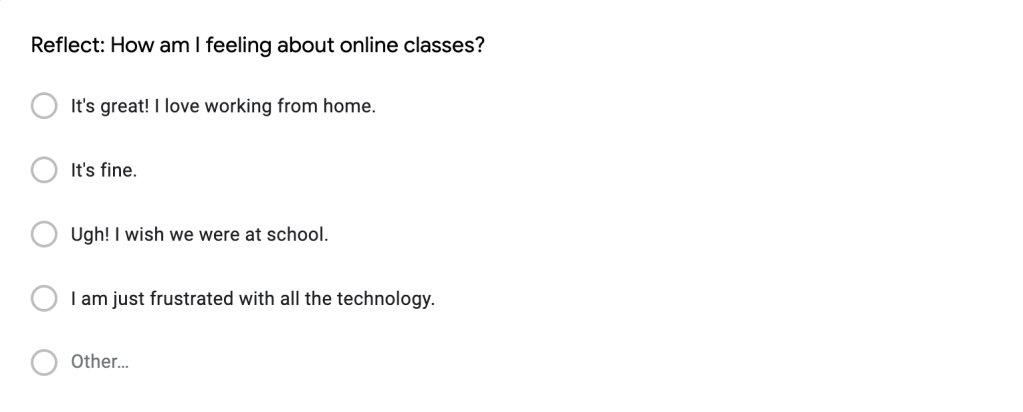
One question on the exit ticket asked for the student’s name, one asked if they were able to complete the task, the last question was this:

One week in, how do you imagine they responded?

Many clicked “It’s fine,” which I imagine hearing with a note of “it is what it is.” About just as many clicked, “Ugh! I wish we were at school.” But you know, only a few despite all the technological challenges we faced last week, noted frustration with technology, and a few even clicked “It’s great! I love working from home!”

I have about 130 students. I have to believe that each of their stories are different — each of them is overcoming a different set of obstacles just to show up. Because of this, I feel an obligation to be prepared, to bring my best, to demonstrate empathy, and to provide support for their learning so that each of these students who dared to show up, will leave with a plan to do it again the next day.

And when they show up the next day, I’ll put a link to the Do Now in the chat box, and we’ll get started.

Commit your work to the Lord, and your plans will be established.

Proverbs 16:3