*allegory, a symbolic fictional narrative that conveys a meaning not explicitly set forth in the narrative
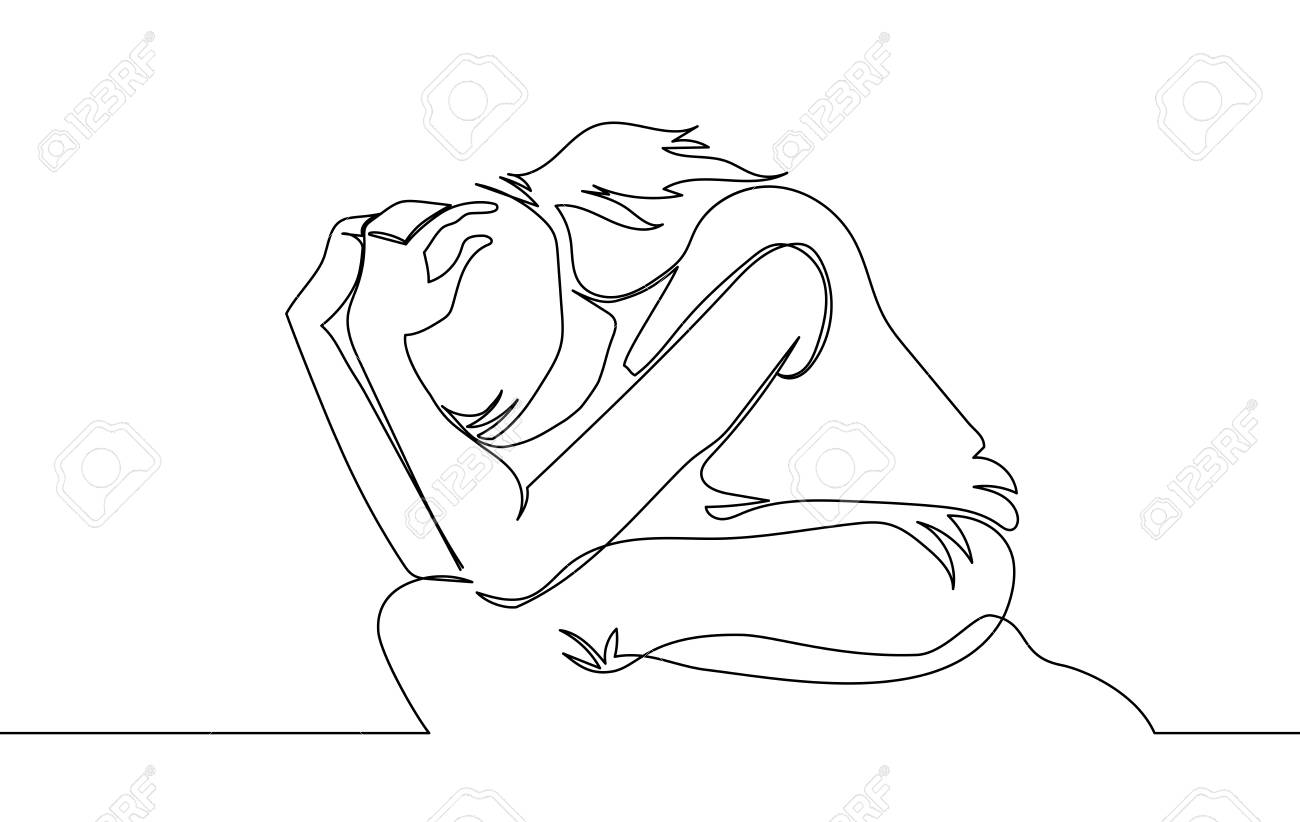
Her wound was open. She sat, sobbing.
It wasn’t the first time. Although it had scabbed over time and again since the injury was first sustained, it could be torn open with the slightest impact, even now, decades later.
She’d been a child when the initial blow had been dealt and her still-young flesh had first been split open. The pain had been stunning — it had shoved her back, and she had sat, a child, weeping on the floor, holding her chest, trying to stop the hemorrhaging.
After she had tired from much sobbing and flailing about, it had subsided — the pain, the bleeding — receding to a dull but ever present ache.
Since then, she had carried it around with her, this bruised and tender flesh,
It was the kind of injury that never fully heals, the experts had said. Even when sustained during the growing years, the body — the heart — could not regenerate enough cells to fully heal the damage that had been done.
The injury would remain, opening up from time to time. Then, new cells would form to stop the bleeding, to cover over the gaping wound. She’d use caution, covering the tender area with a protective layer, shielding it from subsequent blows, learning to avoid danger, developing a keen defensive awareness.
She’d be so careful, so vigilant, that she could even believe the spirit-altering injury might actually be healing. The pain would subside, and she would become hopeful that she would never again shed tears, never again ache, never again sob with the pain or even the memory of the pain.
But then, from out of nowhere — but often from somewhere familiar — a pointed blade would find its way through her armor, past layers of clothing, beneath the dressings, to pierce the flesh. Just like that, the wound would be torn open and she would crumble again, down, down, down, weeping, sobbing, holding her heart, and begging for the pain to stop,
In the early years, not long after the wound had first been dealt, she would, in pain, lash out — swinging and flailing at those closest, begging them to join her in the misery. Over the years, however, she learned this strategy was ineffective — it did not diminish her own hurt, but rather multiplied it. Instead of joining her in her pain, the others turned away, kept their distance, isolating her, piling guilt and regret on top of pain, and leaving those she loved with their own wounds to tend.
Later, as she aged, when certainly, she thought, this decades-old injury had to be fully healed, she could still be brought low by a stray arrow, an unintended blow that nevertheless grazed the tender flesh, re-opening the wound.
It was open now. The middle-aged heart had been hit, and it was laid bare.
Seeping.
Throbbing.
Reminding her of the many years of pain, many years of tears, many years of swallowing feelings past a tightened aching throat.
She lay supine, futilely wiping away an unstoppable deluge of tears, fighting against the years of pain — still not wanting to feel it — still not wanting to admit I’m hit! I’m hurt! I’m bleeding! I’m suffering!
Those standing over her, observing her as she lie bleeding, sobbing, say her wound, her perpetually open wound, informs her compassion, gives her language to comfort others with the comfort she herself has received, but that is little consolation when the tenuous flesh has been recently sliced, when the blood is dripping on the floor, when she is doubled over, trying desperately to silence her own cries.
Nevertheless she hears.
She admits they are right.
Her pain does give her compassion for others.
She sighs in resignation, then does what she has always done.
She rises.
She sits up, dabbing at the now-congealing blood,
taking a sip of cool water,
applying fresh dressings,
washing her face,
combing her hair.
Then, as she examines herself in the mirror, she hears a still small voice, “Do not be afraid; do not discouraged, for I am with you wherever you go.”
“I know,” she says, nodding, wiping a tear from the corner of her eye, “I know.”
And she, carrying the open wound with her, steps back into the land of the living.
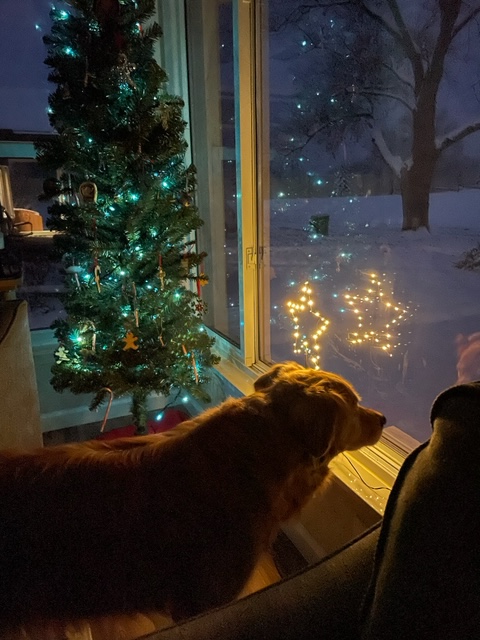
Chester and I relishing the end of a restful week.
Click the arrow to listen.
A thick blanket of wet snow covers our yard, our driveway, and the playground across the street. It’s almost 7:30 am, but the heavy winter clouds overhead are allowing just a soft gray glow to light the neighborhood. It’s a quiet ending to a quiet week.
In the months leading up to our Thanksgiving break, my husband and I had imagined all kinds of scenarios — flying someplace warm to sit in the sun for a few days, driving across the border to Canada to “flee the country” for the day or even a few hours, dining out, going to a movie, or possibly visiting with family. We scrolled through flight options, investigated Airbnbs, read restaurant menus, and discussed possibilities. We really wanted to get away. I had had a busy fall, but his had been even more taxing. We knew we needed a break and possibly even an escape.
For weeks we ran scenarios and dreamed dreams, but it seems each time we got close to a plan, we ran into a difficulty. Flight costs had skyrocketed, all of our usual caregivers for our aging golden retriever were unavailable, and I had to attend a virtual professional development on Monday and Tuesday, so the escape to a sunnier climate was off the table.
Still, a day trip to Windsor seemed doable, so my husband scouted out some restaurants and began to plan our day, but then we realized we’d need a negative Covid test 72 hours prior to our visit. That wouldn’t be a problem, but then, as we started to investigate a little further, we noticed from the New York Times Covid Map that Michigan was one of the hottest spots in the nation. Would it really be responsible to head across the border, especially since both of us spend our days in a petri dish surrounded by teens and young adults? What might we carry with us?
As we were coming to terms with our reality, my brother reached out. He was hosting Thanksgiving at his house, and he was inviting us to join. My mother and stepfather would be there along with my other brother and his family. That sounded lovely. We were not able to do Thanksgiving or Christmas with family last year. The idea of driving “over the river and through the woods” to enjoy a feast surrounded by loved ones sounded amazing. However, it wasn’t long into our discussion of this possibility when we realized that that, too, would be irresponsible. My mother, although fully vaccinated, has chronic myeloid leukemia (CML), and while she is in remission, her health is still quite compromised. We are fully vaccinated, and even boosted, but we still didn’t feel like it would be wise with the current spike in cases to gather and bring any traces of virus we might be carrying into her midst.
So, it was around last weekend when we determined that we should probably just stay home, roast our own turkey, binge on some Netflix and football, and get some rest. It was disappointing at first, but, as you might have guessed, it turns out it was just what we needed.
On Monday and Tuesday, I had a couple faculty meetings, and then I was afforded the time I needed to write detailed lesson plans for when I return tomorrow. Often that work is squeezed into my prep period or in the before or after school time, so having hours to imagine how my lesson might play out, to design an instructional activity, and to create a detailed rubric was luxuriant.
Between meetings on Monday, I popped a turkey into the oven, then at the end of the work day I threw together a couple of sides, and we welcomed a couple dear friends who already navigate within our work and social bubbles to share it with us. Then, because I didn’t think to send leftovers home with our guests, we ate turkey for the rest of the week — first in the form of reheated leftovers and then in bowl after bowl of yummy soup.
With days at our disposal, and nowhere to be, we were able to manage a car repair, sewing machine servicing, some quick dashes to pick up birthday and Christmas gifts, and a long walk in a county park nearby. We lost track of time, ate when we got hungry, and napped when we felt tired. Every once in a while, I would default to my schedule-checking mindset, “What nights next week do we have plans? Am I all set for teaching on Monday? What do I need to take with me?” and then I would remember that it wasn’t even the weekend yet. I could keep relaxing.
I crocheted, and I mended. We put up and decorated our little Christmas tree. We zoomed and Facetimed with family, and we did a lot of sitting around. I finished one book and started another, and we completed three jigsaw puzzles!
And still we had more time. Time to do yoga, to write, and time to just rest, sipping tea, and gazing out the window into the snowy day. This is what we needed — not a flight to sunny spot, not a run for the border, just some quiet, uncommitted time. We are thankful to have had it because tomorrow we will suit up, grab our bags, and head back into our work.
We are breathing fresh air, our bodies are restored, and we are ready to greet our students and colleagues.
We started school on September 7 and went straight through without a break. Outside of a week and a half of virtual instruction due to a high number of Covid cases, we were in the building with our students, following Covid protocols, managing the movements of a few hundred teenagers who are struggling to re-acclimate to the structures of school, and — oh, yeah — trying to provide high quality instruction.
Then, this past week was extra busy.
Monday, I drove home after school to log on to a short informational meeting about a Social-Emotional Learning pilot program we are starting next week. Would I be willing to be a participating instructor? Tuesday, I left school early so that I could be home for an online training from 3:30-5:00. Then, Wednesday, when we see all of our classes on a shortened schedule of seven forty-minute periods, we stayed late for in-person parent-teacher conferences. The school provided pizza and salad at 2pm, then we stationed ourselves at tables in the gym, and met with parents to discuss their students’ progress.
I had arrived at school at 7:30am; I left the building at 6:15 pm.
Thursday, I was up at 5 to do my morning routine, wanting to be in the right headspace before I taught three 100-minute blocks. I arrived at school at my usual 7:30 and was making last-minute preparations in my classroom when I saw my principal at my classroom door.
“Rathje, let me talk to you for a minute,” she said, as she pulled two other colleagues from across the hall to join us. “I just want to let you know,” she said, “that tomorrow we will be virtual. Be sure to take everything you need with you tonight. We won’t be back in the building until after Thanksgiving.”
“That’s amazing!” I blurted, and I kind of surprised myself. I have so loved being back with the students. We have learned more together in one quarter of in-person instruction than we learned in the whole of last year. I know every face and every name. I’m familiar with personalities, quirks, strengths, and challenges. I can anticipate which class is going to be a challenge to keep awake and which class is going to be a challenge to keep in their seats, on-task, and engaged.
If I love it so much, why was I so happy to be going virtual for the last day before the break? Because I was exhausted.
I’m not the only one. Teachers across the country are wiped out. We knew this year would be challenging, but we could not have know what all would be entailed. We knew that we would be re-acclimating students to schedules, to classrooms, to mask-wearing, and to seven-hour school days, but I’m not sure we fully pictured the volatility of emotions we would see in a school full of teenagers who have lived through the multiple traumas of a pandemic — how quick these kids would be to lash out, to cry, to completely check out. We knew in-person teaching, talking through a mask for the full day, would be a different kind of tired, but I, for one, never imagined that we would be short-staffed for the entire first quarter. Could I have guessed that my prep periods would sometimes be used to cover the class of another teacher? that we would fully employ not one but two building substitutes? that other schools would be cold-calling teachers on our staff, enticing them away with signing bonuses, higher pay, and grass that is much, much greener than ours?
Not even a little bit.
And though we started the year hoping and praying that Covid was winding down, officials are now saying that Michigan is in the “fourth surge” of the pandemic that “could last 4-5 months” (Fox 2 Detroit).
Teaching under these circumstances is stressful, and we are tired, folks. Teachers are tired.
So tired, in fact, that Detroit Public Schools have determined to be virtual every Friday in the month of December.
In a special announcement on the district’s website, Superintendent Nikolai Vitti said the decision was made “after listening and reflecting on the concerns of school-based leaders, teachers, support staff, students, and families regarding the need for mental health relief, rising COVID cases, and time to more thoroughly clean schools.” CBS Detroit.
School leaders are getting creative in order to hear the concerns of teachers and respond so that they can hang on to the ones that they still have. Our school, for example, announced before the school year began that they were issuing retention bonuses to all returning staff — the longer you’ve been on staff, the higher the bonus. Then, last week, they announced a mid-year pay bump for all staff, paid out in two installments over the coming months. Additionally, to discourage absenteeism, our school leaders offered a raffle wherein each teacher receives an entry for each day they attend and those with perfect attendance receive 25 bonus entries. Next week during our two professional development days, three names will be drawn, and winners will receive $100, $40, or $25. To build collegiality and team spirit, our building principal initiated a team-based contest — daily challenges encourage teacher teams to complete tasks, take photos, and share them in our group chat, earning points toward a team prize.
Do teachers need all of this? Yes, we need every bit of it.
Teaching is not easy. For each 100-minute block with my students, I spend at least that much time in intellectual preparation, thinking about behavioral strategies to increase engagement and decrease undesirable behaviors, procuring incentives, meeting with other staff, attending professional development, and myriad other tasks. That’s in a normal year.
This year, we’ve had the added stress of Covid. In the beginning of the year, some students needed daily assurance that it was indeed safe to sit next to peers, masked, for an entire class period, and that we were doing everything we could to stop the spread. Other students (and some staff) needed constant reminders to keep their mask over their nose and mouth throughout the school day. All teachers have had to keep seating charts to enable contact-tracing when students test positive, which has happened continuously since school started. Then, when students are quarantining, teachers have the added load of making sure all assignments are posted online and that students who return to school having done no school work at all get caught back up. And perhaps the most stressful for me have been the almost daily group chats informing staff how many teachers, behaviorists, or administrators will be out for the day, because any time a team is down one man, the rest of the team has a larger load to carry, and sometimes we’ve been down four, or five or six staff members on a single day.
It’s been stressful, to be sure, but let me reiterate that I love my job. I seriously do. I believe that most teachers who are still showing up, still standing, still delivering instruction to their students, and still opening their doors before school or during lunch so that students can drop in desperately love their students. They drive home thinking about how a lesson went well or how it tanked. They lie awake at night creating new strategies for content delivery. They write long blog posts sharing what’s going on so that others will care about their kids, too.
And while certainly the public is aware that teachers have a hard job and that teachers are essential to our communities and society as a whole, it seems that rather than offering support, encouragement, or suggestions that might lighten the load, public discussion about education often misses the point. Before this school year started the public was up in arms about the alleged insidious introduction of Critical Race Theory into the curriculum and whether or not schools had the right to issue mask mandates. These discussions and the enflamed and politically-charged emotion around them did nothing to improve the actual day-to-day experience of teachers, let alone students. The problems in eduction aren’t that easy to solve.
Problems in education are complex and often grow out of inadequate funding, inequitable resources, and societal systems that need to be restructured because they are outdated, ineffective, and designed for an economy, a culture, that no longer exists. Nevertheless, teachers continue to show up to buildings in need of repair, to use materials that are out of date, and to give what they have for children that they care about. And we need them to.
We’ve been moving toward a teacher shortage for years, and Covid has exacerbated the problem. The teachers who are left in classrooms want to be there, but they won’t stay unless they are given what they need — community support, parental cooperation, adequate pay, and the kind of respite that comes from a Friday of virtual learning, a week off at Thanksgiving, and two more at Christmas. Teachers need us to acknowledge that the load is heavier than anyone thought, that continuing to teach and learn in the wake of widespread trauma is taxing, and that we don’t know what in the world we would do if every last teacher woke up tomorrow morning and said, “That’s it. I can’t do this any more.”
I’m not anywhere near that breaking point. I’m still glowing with joy over the fact that I get to be back in the classroom. However, countless teachers are standing on the edge, wondering how many more times they can show up for our kids. If you know teacher, even if he or she seems to be doing just fine, grab them a cup of coffee, a bottle of wine, or a dinner out. Let them know you appreciate the work they are doing. You just might get them through to Christmas.
Do not withhold good from those to whom it is due when it is in your power to act.
I wrote this piece in November 2014, very early in my blogging days, when I was still hitting the space bar twice after every period and when I could say all I wanted to say in 800 words or less. I stumbled across it this morning, and I needed to hear what it had to […]
A friend asked me recently, “How are you doing with pain now that you’re back in the classroom?”
I appreciated her asking — it was an acknowledgement that she remembered how far I had come and that my move back to the classroom was not taken without much prayerful consideration regarding the impact such a move could have on my health after the years-long journey I have just taken.
It’s a good time to ask because a) last year wasn’t a real test since the students were learning from a distance and the physical demands were not as great and b) we’re now back in person, and the first quarter will end on Friday.
It’s an important question, too, because this blog started when I had to leave my teaching career due to health issues. I was struggling with pain, fatigue, and issues with my skin and eyes, and I just couldn’t bring quality care and instruction to my students in that condition.
My body, it seems, had gone on strike after years of overwork complicated by a failure to process my emotions or take care of myself. Inflammation was so prevalent in my body that I could feel it– it bubbled into my joints making them hot and stiff, it irritated my skin causing scaliness and itching, it inflamed my eyes sending me time and time again to a specialist for treatment.
Many times I’d landed on the couch or in my bed for days at a time. In the early years of my recovery, I had to lie down several times a day even though I slept 8-10 hours a night. I often found myself limping through the house or lying on the bathroom floor waiting to throw up. I was miserable, and I couldn’t imagine a time when I would be able to return to the rigor of the classroom.
However, over six long years, I learned strategies that began to reduce those symptoms and that have kept me on a path to improved health. Among those strategies is a diet that is rich fruits, vegetables, chicken, rice, and fish, and that avoids gluten, dairy, beans, and corn. I also exercise every day, write every day, and see a therapist, a physical therapist, a chiropractor, and a masseuse. When I do all of these things on a regular schedule, and get plenty of rest, I mostly stay well.
The progress has been slow and incremental, just as my return to working has been.
If you’ve been tracking the saga, you know that I didn’t work at all for six months, then I started by tutoring and proofreading. I moved on to part-time work in an educational agency, then progressed to teaching part-time as a college adjunct instructor. From there, I moved back to the agency and eventually worked full-time in a leadership role, but I still didn’t believe I would ever have the capacity to teach in a classroom full of students, managing their learning, their emotions, and their movements five days a week.
It was at this time, about almost six years into recovery, that Covid hit. We as a nation were knocked down by this highly contagious pandemic, and, as we social distanced from one another, we had some time and space within which other ailments — widespread poverty, systemic racism, educational inequity, and the like — became more evident.
The situation looked familiar to me because I had just lived through something similar — autoimmunity had knocked me down and forced me to take some time and space to recognize that I hadn’t been attending to my mental or physical health or to that of my family. I had to acknowledge that they were suffering, too.
And as I observed our nation’s symptoms in real time, something just clicked. It was like I had been training and preparing for this moment. I was in good shape and ready to step back in the ring, and if I was going to do it — if I was going to put myself out there and see if I still had the juice — I was going to do it in a place where I could turn the dial, be it ever so slightly, by identifying and using strategies that might reduce the impact of poverty, racism, and trauma for students who had been knocked down the hardest.
If you’ve been reading along for the last year, you know that I am intoxicated by the opportunity I’ve been given at Detroit Leadership Academy — I can’t keep my mouth shut about it.
But that didn’t answer my friend’s question, did it? How am I doing with pain now that I am back in the classroom full time?
I’d say I’m doing better than I might’ve hoped for. As I’m writing this, I’m tired, and I’m on the second day of a headache. I’m not surprised. It’s the weekend before the final week of the first quarter. We are still short one staff person, plus we’ve had one out due to Covid for over a week. I’m working in a setting that is rich with trauma and the impacts of trauma, and it shows. The students are tired, and worn, and often quite raw. I see all of this, and it weighs on my heart.
And, if I’ve learned anything through this journey, it’s that emotions are stored in the body. My students’ bodies show it, and my body shows it.
So, yes, I do have some pain — in my heart, but also almost always in my right sacroiliac joint, often in my low back, a little less in my hips and neck, and today in my head, and much to my dismay, my left eye.
That left eye — he’s the lookout — he always lets me know when I have pushed too far, when I need to take a down day, when I need to attend to self-care. Today I think he’s shouting because on top of a long week, I pushed a little further on Friday night, went out to dinner with my husband and a coworker, then travelled through a downpour to an away football game where my students were playing against a team with far greater resources — a well-lit turf field, cheerleaders, a marching band, and stands that were 1/3 full even in the downpour. Our side of the field had about a dozen fans including us. Our guys, after arriving late because the contracted transportation was late picking them up, fought hard, but they were outmatched; the final score was 42-6. The other team was jubilant — they had claimed their victory. Our team was despondent — their hopes were dashed. It felt emblematic of the divide in our country — the inequity of resources and opportunity I see in my work every day and the impact that inequity has on the lived experiences of students like mine. It was hard to watch.
We got home after 10:30, damp and chilled, and I crawled into bed to sleep. Through the night I felt a headache and some nausea. This morning, my body has the hum of inflammation — the heat and a quiet vibration that calls for my attention. Less subtly, my eye is shouting, “For the Love of God, take a break!”
So, I’m spending my morning writing and doing some yoga. Next, I’ll eat a breakfast of non-inflammatory foods, slowly go pick up some groceries, then come home, sit on the couch, and watch some football.
I’ll take the weekend to rest, recover, worship, and see some friends, and by Monday, I should be ready to step back into it again.
It takes vigilance to stay well — everyday attention to self care that puts the oxygen mask on myself before it dares to assist the person next to me. It’s counterintuitive to how I always imagined I was supposed to live — squaring my shoulders, gritting my teeth, muscling through, grinning and bearing it — and it’s a better, richer way.
I have way more gas in my tank, way more capacity to put my work down when students gather in my room like they did on Friday morning — a bunch of seniors huddled around my desk, asking for snacks, chatting, busting on each other, making me laugh.
Pain? Sure, I have pain; my students do, too. Somehow, we’ve landed in the same space, and we are learning how to be together, how to learn from each other, and, on the richest of days, how to laugh with one another.
For this, I am so thankful, and so committed to staying the course and attending to my wellness so that I can keep on showing up for these kids.
I was so excited last spring when I saw a crew replacing our hallway water fountains at school with filling stations.
As part-camel, I consume a couple quarts of water each day while I’m in the building. I’d been lugging in a large Igloo water jug all year; this would make my daily trek in from the car so much easier.
It made sense, in the times of Covid, that we would do away with traditional water fountains, the likes of which I’d stood in line at in my growing up years. It was the only way we got drinks of water back then, by bending over a shared porcelain bowl and glug-glugging until the person behind us got impatient and we stood up, wiped our dripping mouth on our sleeve, took a big gulp of air, and moved on.
Over the past few years, we’ve seen filling stations pop up everywhere — office buildings, airports, and, of course, schools, but in my little charter school in Detroit, which is on lease from the Archdiocese and in need of myriad repairs, I was surprised to see this improvement. Certainly, it was an expense mandated by Covid — I couldn’t imagine the funds would have been found otherwise.
However it came to be, I happily began to refill my water bottle and gladly left my Igloo at home.
I pictured my students doing the same — bringing a water bottle to school and carrying it with them all day, independently managing their thirst as countless students across the country do without thinking. No such thing happened. The students came, but they brought no bottles. They wanted drinks, but they had nothing to put them in.
“Mrs. Rathje, do you have a cup?”
“A cup?”
“Yeah, so I can go get a drink of water.”
“Oh, right. I guess you can’t get a drink of water unless you have something to put it in.”
The school could hardly let the students go thirsty, but what were we to do? The traditional fountains were gone. We certainly didn’t have a supply of water bottles lying around. Instead, as students became thirsty, they went to the office, asked for a paper cup, filled it at the filling station, and carried it back to class. Day after day after day.
It was a disruption to class and to the office staff, but even more, this paper cup carrying seemed like a step backward. Weren’t the filling stations supposed to be an improvement?
This whole situation really started to bug me, but in a world full of planning, teaching, grading, and managing the movements of hundreds of bodies of teenagers in a building, the water problem was not top priority, never mind Maslow.
We were about four weeks into the school year, four weeks in to the era of the paper cup, when a friend from our St. Louis days reached out to me. He said he’d read my blog and would like to support my students. How could he help? My first response was to say that although I had had a great deal of initial support that had allowed me to purchase snacks and prizes for my students, my supply would certainly need to be replenished in time. My reward system was working, and students were claiming prizes for their hard work, and the word was out — Mrs. Rathje has snacks — and the kids were making a bee-line for my classroom.
However, I had no sooner sent him that message when the water situation popped into my mind. I sent a follow-up: “Another project I’m thinking about starting soon is purchasing re-usable water bottles. We have those refillable water stations, but nobody has a bottle. Right now we are using paper cups. I’ve got 80+ seniors. I’d at least like to get each of them a bottle.”
Before too long, he replied that he’d like to support the water bottle effort and asked how he could get me some cash. As it turns out, he is the pastor of a church called Jacob’s Well. Do you remember Jacob’s well? The place where the Samaritan woman gave Jesus a drink, and He told her that He had water that would forever quench her thirst? (I really can’t make this stuff up.) It seems that Jacob’s Well wanted to make sure my students could get some drinks of water.
Within a day or two he had sent me enough money to purchase water bottles for the whole school. My mind was blown. I wanted to act as quickly as possible to put water bottles in my students hands, and since I was still preoccupied with planning, teaching, grading, and the like, I reached out to a few people who quickly got to work on ordering some pretty sweet water bottles — complete with the school logo — that would arrive within a week! I was telling a friend about this purchase, and she said she wondered if there would be confusion with 300 identical bottles all in the same building. Could she create and fund some custom name labels for the bottles? Before she could change her mind, I supplied her with the names of all of my seniors, and, guys, before I could blink twice, these were in the works.
Front side
Back side
Last week, we had just returned from two weeks of virtual learning due to a high number of Covid cases in our school, and I had brought in some new items to put in the prize bins. I was organizing these prizes Tuesday before I left for the day when one of our custodians said that UPS had just brought me a large delivery — the water bottles!
In my class, each time a student completes an assignment, he earns what I call a Rathje ticket (more on this here); on Wednesdays, students can use their tickets to purchase items in the Rathje Store. I have three bins of prizes that are worth 1, 3, or 5 tickets (almost all of this donated by friends). Additionally, each Wednesday, I hold a drawing; students can put a ticket in a cup, and I draw out the name of one person who can win a prize from the 5-ticket bin.
When my students walked in on Wednesday, tickets in hand, I couldn’t wait to show them that they could get a personalized water bottle for just 3 tickets.
“They have our names on them?”
“Yes!”
“I want one!”
“Me, too!”
It’s not a small thing to have a water bottle of your own, is it? It’s not nothing to be able to fill up your water bottle on the way into the building or in between classes — to take care of a vital need, to do it yourself, to not have to ask someone for a cup for your water every single time you want a drink, to know that this is something that belongs to you.
When people ask me what I mean by educational inequity, I cite examples like this. How can a student focus in class when he has to problem-solve to get a drink of water? And, let me be clear, this issue is not due to an uncaring or irresponsible school administration. I’m working with a very committed team of educators who are working hard each day to provide for our students. If lack of water bottles were the only inequity, it would’ve been handled already, but we’re also trying to ensure that all of our classes have teachers, that every student has a ride to school, that every student has a mask, that students have access to mental health care, winter coats, and all the other things that teenagers need.
Getting a drink of water is so basic, so ordinary, we might overlook the need. Having a water bottle is standard, isn’t it? Don’t we all have several in our homes? Don’t we assume that everyone does?
The fact is that everyone doesn’t. Everyone doesn’t have everything that they need — a water bottle, a warm meal every day, transportation to school, a home with electricity, or access to a quality education. But those of us who do can do something, We can turn the dial on societal inequities — one water bottle, one warm meal, one winter coat, one helping hand at a time. So thank you to my friend who asked how he could help, and thank you, Jacob’s Well, for quenching the thirst of my students.
I was thirsty and you gave me something to drink,”
When we lived in the little house by the river, on the campus where my husband is Dean of Students, we often had encounters with wild life.
Situated right next to the Huron River in Ann Arbor, Concordia is home to many kinds of animals.
Probably most populous are the less-than-desirable Canada geese that invade in spring and occupy until late fall, dropping unsightly bombs all over the campus grounds, causing students, faculty, and guests to acquire a particular gait that enables them to avoid calamity.
More pleasant in terms of fowl was a small flock of turkeys that visited one fall, taking up residence among the students, blending in, perhaps hoping for a short course in the benefits of veganism or nonviolence.
Most impressive in the category of fowl was a hawk who appeared outside our door last spring — huge, majestic, and unable to fly due to a damaged wing. I admired him from my window and watched when animal rescue arrived, wrapped him in a blanket, and took him away for repair.
Beyond birds, we were often visited by various little critters: countless squirrels dropping acorns on our metal roof — ping, ping, ping — moles who built a metropolis under our backyard and garden, opossums who scavenged through our compost pile, and woodchucks, one of whom found his way under an overturned bucket behind our house and scratched and clawed until I mustered the bravery of my husband to go free him.
We loved watching the deer who lived in the woods behind our yard, often venturing onto campus in the early morning, looking for food or exercise. During the pandemic shut-down, when all was desolate, the deer boldly explored central campus in the middle of winter, during broad daylight, searching for leaves, and seeds, and any other vegetation that remained.
We knew we would miss the exposure to animals of such variety when we moved to our mid-20th century neighborhood with its fenced yards and close proximity to I-94 — that we wouldn’t get as many great sightings. However, recently, we have had some close encounters with the animal kingdom, much to our dismay.
It was several weeks ago when my husband excitedly bounded in from his early morning walk.
“Kristin, oh my gosh, I almost got sprayed by a skunk!”
He had been on the sidewalk down the street when, in the morning darkness, he suddenly saw, right in his path, a furry black critter with distinguishing white marks down his back. Both of them stopped dead in their tracks and made eye contact. My husband adeptly turned and ran the other direction in hopes of mitigating the skunk’s fear response. In doing so, he was able to safely return home by an alternate route.
A similar scenario happened not long after. Then, one morning, as he was stepping outside for his morning walk, he spotted the skunk in our driveway! Again, my husband’s quick-footed response saved him from a morning spent showering and applying all manner of concoctions to eliminate that particularly acrid smell. The only consequence he felt was an elevated heart rate.
As days went on, the skunk seemed determined to get to know us better. On two or three occasions, my husband or I took Chester to the back yard for his morning relief and spotted the skunk in the bushes near our house. Panicking, thinking surely Chester would see him, move to investigate, and get sprayed, we whisper-called our nearly deaf doggo, waving our arms, trying to rush him back to the house. Miraculously, we continued to avoid trouble..
However, not wanting to continue standing idly by as this skunk got bolder, perhaps with eyes on taking up habitation in our backyard, we started taking action. We purchased a few solar-powered landscaping lights and placed them near the bushes where the skunk had been seen. My husband started carrying a large flashlight on his dark morning walks, and recently we purchased a motion-detector light for the backyard. We were going to make sure this nocturnal critter was greeted with light whenever he showed up.
We were taking action, but let me tell you, we were still looking both ways whenever we stepped outside after dark, until a few weeks ago, when we thought our worries were over.
I was driving home and was on the final leg of the journey. Several blocks from our house it hit me — the smell of skunk! It was late afternoon, the sun was still in the sky. I surveyed my surroundings and saw, lying in the street, a rather large skunk who had met his demise trying to get to the other side.
I immediately called my husband. “I have some sad news to report to you, dear.”
“Oh?”
“Yes, I am sorry to inform you that our friend, the skunk, is lying in state in the middle of the road. You might slow down at the corner on your drive home tonight and tip your hat in farewell.”
“Ah, yes,” he said, “I shall do that.”
Don’t let our solemn exchange fool you. We were rejoicing! We thought we were out of the woods, so to speak. We thought we had prevailed in this saga of the skunk. But alas, there is more to the story.
This past week, my husband was gone on a business trip, and while I had been teaching virtually due to a Covid outbreak at our school, I had agreed to go in to the building early on Wednesday morning to administer the SAT to a small group of students. I rose at 5am and walked with Chester to the side door for our first stop of the day — the back yard.
I was still rubbing my eyes when I opened the back gate, so it startled me when Chester bolted straight for the bushes at the back of the house. I wondered what he smelled there, but I wasn’t conscious enough to register an answer before he bolted right back out and started rubbing his face in the still-wet grass. Then, out of the corner of my eye, I saw movement — a small black critter, about the size of my hand, scurrying along the back of the house, under the fence, and away from us.
I looked back to find Chester still rubbing his face in the grass. I don’t think he had even relieved himself yet, he was so focused on getting rid of whatever was on his face. Still, I didn’t smell an oppressive skunk smell, so I wasn’t sure he had actually been sprayed. Nevertheless I led him back into the house, plunked him right in the bathtub, and started hosing him down and shampooing him before either of us had a chance to realize what was happening.
I washed and washed — his face, his paws, his body, his undercarriage — then I rinsed and rinsed and rinsed. As I became fully awake (and fully drenched), I did indeed smell skunk, but it was not overpowering. Perhaps the little guy who got him did not have the capacity of a full-grown skunk, and for that I was thankful.
I toweled Chester dry, put his leash on him, and walked him just outside our door so that he could do what we had set out to do in the first place. He gladly complied, and then we quickly went back into the house.
Chester watched me sheepishly as I ran through my morning routine, put him in his crate, and hurried off to work. As I drove away, I began to think that perhaps I had become nose-blind. Maybe he smelled much worse than I thought, but I wouldn’t know that until I got away for a while and then came back. I hoped my entire house hadn’t been tainted with the stench; I prayed I wouldn’t have to spend my evening on stink-abatement.
Later, after hours of reading SAT testing instructions, I arrived home, opened the door, and smelled just a trace of skunk, right near the door — right where I had brought Chester in after the encounter. I also smelled a little near his crate, where he had spent most of his day.
I was relieved. We had once again escaped almost entirely unscathed, but clearly, this saga is not over. It seems the skunks are here to stay. And, as long as Chester lives, like most old men, he’ll have to take care of business at five o’clock in the morning. So, I’ll continue to grab the big flashlight, wake myself fully, and step boldly forth to take Chester into the back yard.
And…I’ll keep hoping that the faint smell of skunk at the entry way will dissipate.
All things bright and beautiful, All creatures great and small, All things wise and wonderful, The Lord God made them all.
Since I re-entered the classroom last fall, I think I have been annoying some folks on my staff a bit. At least that’s the vibe I’m starting to pick up. Perhaps I’m a little too positive, a little too gung-hung, a little too happy-clappy.
I’ve not always been this way. I haven’t always interrupted staff meetings to say, “I really appreciate the thoughtfulness the leadership put into this decision,” or “Wow! Thank you so much for this meaningful professional development,” but after being away from the high school classroom for six years, thinking I’d never be back, I came to my little charter school in Detroit carrying an unbridled enthusiasm and wearing a lovely pair of rose-colored glasses.
You can almost hear the other teachers, most of whom have been trudging away in understaffed, under-resourced environments for most of their careers and who had recently closed out a school year that ended in an unanticipated three months of virtual instruction, saying, “Who is this woman? And why is she so happy?”
They didn’t ever say that out loud. In fact, I didn’t have any idea anyone was feeling that way until this fall when one teacher I’m growing closer to subtly implied that perhaps my positivity wasn’t firmly grounded in reality.
How could it be? I had been given a second chance at my career during a world-wide moment when everything was virtual. Reality was hard to get a grip on.
All last school year, I sat in my classroom alone, meeting with students who chose to log in to my Zoom room.Those who didn’t want to be there didn’t show up at all. I didn’t have to navigate noisy crowded hallways; I didn’t have to interact up close with the sometimes volatile emotions of high school students. I didn’t have to clean up messes, make copies on machines that sometimes get jammed, stand in line to use the faculty restroom, or cover a class when another teacher was out sick.
My first year back was a challenge, don’t get me wrong, but it wasn’t the typical Sisyphean grind that most teachers experience day after day, year after year. I was able to prepare, teach, and grade within the hours of the school day with very few exceptions. The classes I taught were similar to those I had taught in the past, and I was able to use my own materials that I had been developing for years. Other staff who had chosen to work from the building became my friends, joining me for walks on our lunch breaks. Every part of my position seemed tailor-made for me, and I was thrilled to be back!
I got excited every time a student logged into my classroom. The few rare times that we actually had students in the building, I gushed with enthusiasm, handing out gifts and prizes to anyone who crossed my path. I looked forward to faculty meetings and gladly answered the phone when anyone related to school — principal, coworker, parent, or even student — happened to call. I volunteered for opportunities such as a curriculum audit and mindfulness sessions, and I agreed to participate in a program for graduates over the summer.
I have been a cheerleader, literally clapping my hands, shouting “hooray”, and doing celebration dances for students and staff. I know, I know — perhaps it’s been a bit much.
But my colleagues can relax, because lately the rose-colored glasses haven’t been doing the trick. We started this school year in the flesh, and shit has been decidedly real.
I think we were “fully staffed” for four whole days, and that was before school even started. We lost one staff member before the students arrived and another within the second week. Not only did we have two fewer staff than we had planned on for the year, but we had a sudden need for an additional staff member when our freshmen class ended up being one and a half times as large as we thought it would be. Our HR department had just replaced the first two staff members that we lost early in the year and was still trying to find the additional teacher when another staff member resigned on the spot last week.
Why so much turnover? Because most teachers don’t experience what I had the privilege of experiencing last year. Most teachers work hard — very hard — with few, if any, breaks, and they do it for insubstantial pay. Teachers are leaving the profession in droves, and few young people are interested in entering the field. Our nation is experiencing a teacher shortage, which is especially felt in districts like mine where teaching can be even more challenging due to systemic inequities.
So, we’re still down two teachers, and Covid starts picking off first students and then staff. By the middle of last Monday, three key staff members had tested positive. Out of concern for student and staff safety, the decision was made to move to virtual instruction for two weeks. This news was to be communicated to students during the day on Tuesday.
When I walked into the building at 7:30 that morning, I felt wobbly. I think all of us did. We were extra short-staffed, and we all knew we’d be covering an extra class or two. The students, it seemed, were feeling it, too. The halls seemed louder, the classes a little more electric than usual.
About midday, as students got notification of the pending move to online instruction, the questions started coming. Why are we going to virtual? What about Homecoming — the dance is supposed to be this weekend?! The anxiety started building. I know it’s going to last longer than two weeks. I ‘m not coming to virtual class. I can’t do it again.
During the last period of the day, I was subbing for a class in which most of the seniors in the room were already disengaging. I tried, in futility, to get them to complete some of their work, to “get done what you can now before you are at home and don’t have the support.” Another teacher, whose room we were in, brought in a small group of underclassmen who were involved in “some trouble” in another room and needed to be removed. Since the vice principal was already backed up with other behavioral issues, we would have to house them until he had time. The two of us talked with students, answered questions, and tried to keep the atmosphere light until the final bell.
When it finally rang, and the students were dismissed, a handful of us teachers gathered in the hallway for a collective sigh. We hadn’t stood there long when we heard the yell of a staff member saying there was a fight in the parking lot and all of us were needed.
We ran out of the building to find chaos — a small cell of students involved in the actual fight and dozens of students moving about the parking lot instead of getting on their busses. What we had hoped would be a smooth transition to virtual instruction was anything but.
It made sense to me. The whole day had felt tenuous — not enough staff, impending change, and uncertainty about the future. I, a grown adult with years of therapy under my belt, had felt wobbly. How were teenagers, most of whom had experienced trauma after trauma after trauma, supposed to find any ground beneath their feet? How were they supposed to think logically, get on their busses, and go home trusting that we would indeed be back together in a couple short weeks?
The fight was soon dispersed, but not without injury, not without drama, not without the adrenaline and cortisol rush that witnessing chaos produces. Students who had missed their busses were picked up by parents or brought inside to wait for their rides, and staff wandered back to their rooms to hop on a Zoom meeting to discuss the details of Count Day which would coincide with our move to virtual instruction.
When the meeting was over, the same staff member who had gently chided me for my rose-colored glasses stopped by my room and pulled up a chair. We processed what had happened, shared our dismay, and acknowledged the reality within which we function, within which we have chosen to teach, within which we both believe we can make a difference — the messy, unpredictable, and sometimes volatile reality. Then, we loaded our computers into our cars and headed home.
The next day I sat in our home office, logged into my zoom room, and greeted each student who showed up with my overenthusiastic grin. I applauded the students who turned on their cameras, and I literally happy danced when a student told me that she had decided that she was going to go away to college after having resolved some personal issues that she had thought might keep her at home.
I think my happy-clappy self showed up not because I am wearing rose-colored glasses, but because I have fully acknowledged the reality within which my students live and move and have their being. Despite the fact that the challenges are many and varied, I am still a glass-three-quarters-full kind of gal. I think I have to be in order to see a path toward educational equity in spite of what I know to be true, to think that I can make a difference in the lives of my students and their families, and to believe that my experiences have brought me to this place for such a time as this.
My principal called me and my partner, the college access counselor, into her office. We’d received an invitation from Central Michigan University, our charter school’s authorizer, for our seniors to attend a college visit on Wednesday, September 29.
The event was free for our students, but it was only a few weeks away, and we’d have to hustle to pull it together — communicate with students and parents, get permission slips, and coordinate chaperones and transportation.
“What do you guys think? Do you want to take them?”
Almost simultaneously, my colleague and I said, “Absolutely!”
Last year we provided virtual college visits for our students. Each Wednesday, students would log into a zoom room and an admissions rep from a university would pop in and share a presentation, often with slides or a video. We provided incentives for students to show up, turn on their cameras, and ask questions. It was the best we could do, and for some of our students it was enough.
For most, though, it was hard to imagine what college life might be like by merely watching a slide show on the screen of their chromebooks while lying in bed in their pajamas. To be honest, it was very hard a year ago to imagine life beyond the isolation of Covid period.
Last year, virtual visits were the only choice we had. Now that we were being offered an opportunity to actually put our seniors’ feet on a college campus, we couldn’t pass it up. We had to give them a clearer vision of college.
My colleague got busy on a flyer and a permission slip, and our vice principal/athletic director quickly secured us a bus. A few days later, I started meeting with seniors one-on-one.
“You’ve been invited,” I said, “to go on a field trip to Central Michigan University next Wednesday. We’ll leave at 6:45 am and return at 6:45 pm.” I paused after this information each time I said it to allow students a moment to process. Each of the students looked me in the eyes and nodded before I continued. “Here is the agenda. You’ll tour the campus, attend a class, and get a T-shirt. There is no cost for you, but you need to return this permission slip by Monday.”
Each of my students — students who sometimes grumble and complain about school, who often want to sleep or eat in my class, who struggle to stay engaged from time to time — each of these students responded with a measured excitement.
“Ok. Thank you. I’ll bring in the permission slip.”
Over the next couple of days, I heard doubt surface.
“Mrs. Rathje, are we going to have to ride on a yellow school bus?”
“No,” I replied, “we’ll be on a charter bus.”
“What about the lunch? What are they gonna give us — some bologna sandwich and chips?”
“I imagine it will be a regular college dining room meal. I don’t think you’ll be disappointed.”
“Why do we have to leave so early?”
“CMU is a couple hours away. The event starts at 10am. We don’t want to miss anything.”
We started with a list of 48 students we were willing to invite — those who, despite Covid, are on track for graduation, have consistent attendance, and are mostly engaged in the journey toward college. Several opted out for various reasons, and we ended up with 31 students and four chaperones on a plain vanilla charter bus.
The students were excited and, I think, a little anxious. The questions kept coming.
“Mrs. Rathje, are we all going to stick together all day today?”
“No. We’ll be together for parts of it, but you will each go to the class you signed up for. We’ll be separated for that.”
“What if I don’t like my class? Can I just leave?
“No. You are going to give it a chance. You’re going to stay with your group. You’re going to survive. I promise.”
“Mrs. Rathje, you better be right about the food.”
“Trust me.”
After we left the Detroit metro area, Lansing was virtually the only sign of “city” life amid miles and miles of farm land. The students, on their phones or sleeping, were mostly oblivious, but as we neared Mt. Pleasant, which is not far from my childhood home, I woke them and called their attention to the surroundings.
“If you look out your windows, you’ll see mostly farmland, but in the next few minutes, on your left, you will see the CMU Chippewas’ football stadium.”
They looked out the windows as I continued to narrate.
“On the right you see everything you need within walking distance — restaurants, groceries, a pharmacy. As we turn left here, you are officially on campus.”
The phones were mostly down as students looked out the windows.
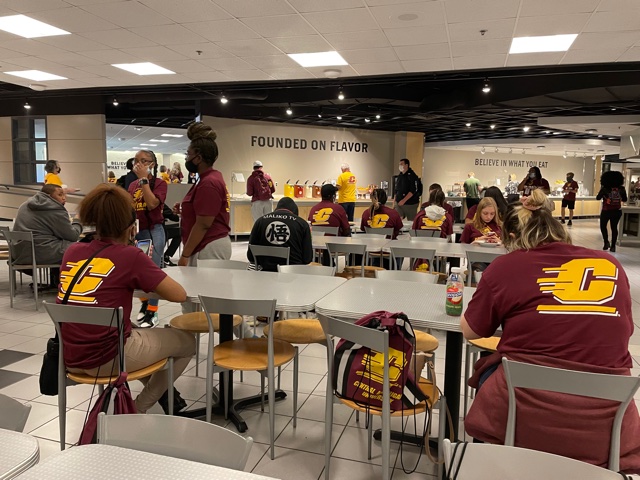
We pulled up in front of the Student Activities Center where someone in a maroon and gold shirt was waving us in. Inside, more people in maroon and gold were calling the names of our students, handing out backpacks and T-shirts, and encouraging us to change into them to designate that we were part of the group.
I heard just a little grumbling, “Mrs. Rathje, do I have to wear the shirt?”
“Yes.”
Then compliance. They quickly changed, grabbed a donut or a juice that had been set out for them, and then walked en masse into the basketball arena where the opening session was in progress.
The stands on one side of the gym were filled with students — I’d say about 300 or so — from charter schools across the state. Perhaps 80% or more of those students were Black, and most were from Detroit.
In this opening session, the students learned about the culture of CMU — “Fire up, Chips!” — and some of the programs. Next, we were broken into groups for a campus tour and lunch.
I was proud of our students as they followed our tour guides, asking questions, and checking out the campus, and I was probably as excited as they were when they got to lunch and realized they could pick what they wanted and eat as much as they liked. I got my own lunch and sat down at a table with some young men from our school. They weren’t embarrassed or trying to avoid me as some teenaged boys might do. They spoke to me. They asked me questions. In fact, other students sought me out during that lunch time. They, too, had questions and just wanted to check in. They were relishing a full hour of lunch and the freedom to move about among actual college students.
When I saw some of the students who’d expressed concern about lunch, I asked “How was your food?”
“It was great! You were right, Mrs. Rathje!”
After lunch, we moved into class sessions. We were separated into even smaller groups, and students attended sessions based on their interests. It was fun later to hear students report on their experiences.
“I learned about exercise science. It was about how the muscles work,” one said as he massaged his own bicep.
“We were in the TV station learning about how films are made,” said another.
But my favorite was the one that I read on a reflection assignment completed after the event: “We had to do an egg experiment where we dropped it from a certain height to see if it cracks or not. My egg was the only one that did not crack, and I got a mug for it.” He hadn’t said a word the whole trip home. He had held that little victory to himself.
As we wrapped up at the event, I questioned our students. “Well, what did you think? How was your day? What did you learn?”
I got all kinds of responses.
The understated: “It was alright.“
The tired: “It was a lot of walking.”
And the excited: “This is my dream school.I’m applying this month.”
As we walked to our bus, we met up with one of our grads from last year who is currently attending CMU. He shook the hands of some of our seniors who, in the fog of Covid, hadn’t known he had chosen to go to college at all. My colleague and I asked if he would come speak to our students when he is home; we’d like him to share his experience with our seniors. He said he would and added, “going to college has changed the way I think about everything.”
The bus ride home was hot. The air conditioning on our bus quit working as though to remind us that our fantastical day of hope was over. We were headed back to our school in Detroit where we wouldn’t go on tours, have hour-long all-you-can-eat lunches, or be bathed in images of possibility.
However, the next day in class, my students wanted to share with those who had not gone. They didn’t mention the hot ride home, but they wanted to share what they’d seen, what they’d done, and most importantly, what they had eaten.
“Mrs. Rathje, are we going to visit more colleges like that? “
“If it’s up to me, we sure will, but right now let’s get back to our college research. Who is adding CMU to their college comparison chart?”
A few hands in the room went up into the air.
“Excellent. Let’s find out even more than we learned yesterday.”
Perhaps I imagined it, but it seemed to me that my seniors were a little more engaged, a little more motivated, a little more interested in the possibilities of college.
Bring on the next road trip.
For I know the plans I have for you,” declares the Lord, “plans to prosper you and not to harm you, plans to give you hope and a future.
I wrote and posted this piece just about a year ago, when the death toll from Covid-19 in the US was merely 200,000; now we are closing in on 700,00. A year ago we were waiting on a vaccine, anticipating an election, and hoping for financial assistance from the government. Now, we’ve got a different […]




 Next Chapter