Since seven (yes, 7!) of our immediate family members have December birthdays, our “season” starts a little earlier than most. We have said for years that we start partying on Thanksgiving and finish on New Year’s Day. This year is no different. The birthday gifts are all but purchased, at least one package has been shipped, and our our living room is staged with “gifts in process” for both birthdays and Christmas so that we don’t miss anyone.
And each morning, I leave my comfortable home that is well-stocked with food, clothing, and this somewhat moderate collection of gifts, cross 28 miles of metro Detroit, pull into a disintegrating parking lot, enter the building, and prepare to meet the reality of the students that I serve.
Today’s reality came in the form of Kaden*, one of my seniors. I was in the gym when he entered from the bus, scowling.
“Good morning, Kaden. Everything ok?”
“I don’t know why we had school today. I almost froze to death.”
“Hey, come here a minute. You only have on a hoodie. Do you need a coat?”
“I mean, I have a coat,” his demeanor was shifting, “we just don’t have a washing machine right now, so I can’t wash it.”
“Ok, but we have coats. I can get you one this morning. Would you be good with that?”
“Yeah, that would be good. I would take a coat.”
Later in the day, I found him, we walked to our clothing closet, and he chose one of several new coats that remained from a large donation we received last year.
We have a fairly decent supply in that closet — coats, shirts, hats, and some miscellaneous toiletries and nonperishable food items — but it goes away quickly because our students are continuously in need of something.
Each day I am asked if I have something to eat — often by students I’ve never even had in class. I try to always say yes and walk students to my stash where they can select a granola bar, some trail mix, or a package of cheese crackers. Most teachers of teenagers probably have a similar routine.
I also get requests for deodorant, for socks, for cough drops, band aids, a toothbrush, or a safety pin — again pretty typical requests for teenagers, and fairly easy to accommodate. These small items solve in-the-moment problems for my students and allow them to get back to learning. I have a pretty healthy stash that many in my village help keep stocked, but when the holiday season comes around, the depth of my students’ need comes into sharp focus.
Before coming to this school, I’d never met families who simply “don’t do Christmas” but here I have met many students for whom December 25 is just another day because their families simply don’t have the financial capacity to purchase anything extra, let alone the privilege many of us have to line their living rooms with gifts, to create an elaborate feast, to deck the halls, and to gather with friends and family.
I have students who are housing insecure — one young woman whose mother died during Covid and who is currently carrying her possessions with her and bouncing between two places to “find a place to sleep”. I have students whose families bounce from apartment to apartment — one young man I spoke to yesterday said “we are definitely moving in a couple of weeks, but I don’t know where yet.” We have families who don’t have reliable transportation — who can’t join the basketball team because they don’t have a ride home after practice and have to take the school bus that leaves at 3:15. I have students who, in addition to coming to school, work to help their parents pay the bills. I have a senior whose very demeanor and aptitude scream “engineer” who is in the manager training program at McDonald’s. He often closes the store and does inventory or other related tasks that keep him up well into the night rendering him incapable of staying awake in school the next day. He’s working this hard, yet he is wearing the same worn clothes and shoes I’ve been seeing him wear since I’ve known him, which is most of high school.
Our students and their families are barely getting by. How in the world can they dream of doing anything for Christmas?
Yet these students keep showing up. They come to school, they log onto their school-issued chromebooks, they complete independent modules to earn their financial literacy credit, they come to my class, bend over their notebooks scrawling out the purpose and audience for their next essay, practice the nuance of Standard Academic English while teaching their middle-aged English teacher the current vernacular. They have big dreams — of being nurses and engineers and game designers and ultrasound technicians — and they need a whole village to rise up around them to give those dreams every chance at reality.
I’m part of their village, and I’m raising my voice to invite you to be part of their village with me.
School leaders have selected nine families who are in dire need of support this holiday season. Because it is already December 6, and we have to get items to our students before they leave for break on December 20, we won’t be filling traditional wish lists. Instead, we have set a goal of giving each of these 9 families one grocery gift card, one department store (Target or Kohl’s) gift card, and one gas gift card. Additionally, I have created an Amazon wish list of items that our students frequently request.
Joining this initiative may be a small part of your holiday giving, but it could make all the difference for a struggling family — it could help them put food in the fridge, buy some new jeans for a child, and put gas in their car so that they can visit a friend. It won’t change their whole world, but it might just change their opinion about the people in it.
All of us have many opportunities to give at Christmas. If caring for my students in Detroit is something you are interested in doing, I invite you to check out that Amazon wish list or to make a donation to our gift card initiative. To do that, you can send a check to Detroit Leadership Academy, 5845 Auburn Street, Detroit, MI 48228 or donate via CashApp.
so in Christ we …form one body, and each member belongs to all the others. 6 We have different gifts, according to the grace given to each of us. If your gift … is serving, then serve; if it is teaching, then teach; 8 if it is to encourage, then give encouragement; if it is giving, then give generously. Romans 12: 5-8, selected portions
Every fall, teachers have to teach students how to enter their classrooms, how to walk down the hallways, and how to raise their hands before speaking in a group setting.
Students, of course, have been taught before how to gather supplies, find their desks, and wait for instructions, but after a long summer of loosened expectations, a short weekend at home, or even just transitioning from one classroom to another, they often need explicit directions in order function in ways that support classroom learning.
They need a review.
Teachers need to relearn every fall, too. Administrators spend much of the first few weeks re-establishing norms like arrival times (teachers must be in their classrooms well before the students), duty stations (every teacher at their doorway during transitions), and procedural expectations (no bathroom passes during the first and last 10 minutes of class).
Teachers know these norms, of course; they haven’t changed since last year, and even if you switched schools, many routines are consistent from building to building. Nevertheless, teachers, too, have had loosened expectations over the summer, have checked out over the weekend, or are simply exhausted and have momentarily “lost track” of the ways we do things around here.
Teachers, too, need a review.
Folks outside of school need to be reminded of the rules, too.. For example, even though we’ve been knowing the speed limit is 65 miles per hour, even though we got a ticket for going 78 last February, even though we had to sit through an online driving course, don’t we find ourselves edging back up to 78? And even though we promised our dental hygienist that we would brush two times a day and floss daily, don’t we find ourselves skipping the floss or (gasp) the brushing from time to time?
I don’t think we [or most teachers or students] are deliberately trying to break the rules or walk a dangerous path. No, I think we are just living in the moment and not considering the impact of our actions on ourselves and others.
My students don’t consider what happens when they walk into my classroom five minutes late announcing, “What up, Rathje?” after the rest of the class has already settled in to our daily routine. They don’t see that they draw every eye away from learning and that they have initiated a series of steps that I wasn’t planning on — first giving them a consequence, then re-establishing the momentum of the class. No, they were merely chatting with a friend in the hallway, trying to grab a last minute drink, or possibly trying to avoid coming to class for as long as possible. They weren’t thinking that they were missing on the first few minutes of learning or stealing a couple of minutes from the teacher and the rest of the class; they thought they were hanging on to a few more minutes for themselves.
Likewise, teachers are not intending to create an unsafe environment when they arrive five minutes past their report time, finish entering grades instead of moving to their threshold during a transition, or allow a student to go to the bathroom five minutes after the hallways have cleared and classes have begun. No, they aren’t thinking of that impact. They are thinking, Surely five minutes is no big deal, or What difference does it make if I stand at my doorway? or But the kid really had to go! But the impact of any one of those decisions could be that students are left unsupervised for just a minute or even five minutes, and without supervision, our students might do something without considering the consequences — shove a friend, initiate a fight, or slip away undetected.
This is why rules and norms exist — to keep everyone safe, to maximize learning time, to create a culture in which people can thrive.
We’ve all got our own routines for similar reasons. I, for example, as you may have read about a thousand times in this blog, have many routines to keep my inflammation in check so that I can continue to be involved in education. The litany includes daily yoga, walking, writing, mental health therapy, physical therapy, Hellerwork massage, acupuncture, a diet that excludes gluten and dairy, intentional rest, and a variety of other strategies. When I follow my routine, I stay safe; in fact, I thrive. Recently, after our teachers had returned to the building and I was leading sessions, helping prepare the building, meeting with teachers, and preparing my own lessons, I remarked to my husband, “I am amazed at what this body is letting me do!” And, I truly was! I had been able to navigate long days and stressful situations including what is the most challenging for me — last minute changes of plans — with minimal stress or impact on my body.
So, I just kept chugging! I was living my best life, oblivious to the potential impact on me or anyone else.
Until last Tuesday afternoon around 5:15pm when I was sitting in a meeting at the end of the day. I’d been at the school since 7:30am — had greeted students as they had entered the building, had read and answered email, had observed two teachers, and had sat through two classes with my seniors who were visited by a college rep. I had helped supervise dismissal and gotten students on their busses and then reported to a meeting with the other leaders in our building. Over an hour into the meeting, I felt something weird in my left eye.
Huh. I thought. What’s that? It was like I had never had ocular herpes, iritis, or episcleritis before. I didn’t think anything of it. That’s a weird sensation, I thought. Probably something with my contacts.
The next morning, around 5:30am, as I was doing my morning writing, I thought, Oh, my eye is still bothering me,. Then, Oh, no! And I ran to the bathroom to look in the mirror. No signs of pink eye — wait, is this an autoimmune response?
Now, I am happy to report that five days later I am still not in a full-blown flare, but let me tell you, as one who has had several full-blown flares, that once I realized that this was a warning sign, I began taking steps.
Step one: Wear glasses. Vanity be damned.
Step two: Bathe the eye in sterile tears at least hourly. I was scheduled to go on a field trip that morning, so I scrounged around the house for every vial of sterile tears I could find. [Picture me on a college campus with 35 teens trying to find a place to discreetly administer eye drops.]
Step three: take Motrin. 800mg every 8 hours.
On that first day, these steps seemed to do the trick, so I got comfortable and ended up staying at the building until almost 5:30 again. It wasn’t until my phone reminded me that I was supposed to be in an online counseling session at 5:15 that I started planning my exit strategy, removing myself from a meeting, packing my things, and texting my therapist to tell her I would have to meet her via phone call.
I climbed in my car, got on the phone, took note of the growing pressure in my eye and made my confession: I am doing too much, pushing too hard, and my body is waving a warning flag.
And in her kindest way possible, she said, as she’s said many times before: What are you able to do to create some space so that you will be able to sustain this position?
I know all the things. I know to do all the things. I just get so excited about the possibilities of what we are doing that I start running at full speed forgetting that this is a marathon and not a sprint. I’ve gotta pace myself, plan my nourishment, utilize my support team, and visit the aid station.
I needed my therapist to point me to the review.
We are three weeks into school, and I find myself standing at my classroom door telling my students, “Good afternoon, grab your notebook and laptop.; get logged in, and…
They are beginning to interrupt me, “We got it, Mrs. Rathje. We’re already there.”
“Excellent,” I say, “that’s excellent.”
They are remembering what they need to do, and perhaps — for now — so am I.
if you listen to correction, you grow in understanding Proverbs 15:32
I wish I had a documentary film crew that had followed me over the last 30 plus days, because there is no way I can adequately communicate the amount of training, preparation, planning, sweat equity, and problem-solving I have witnessed and participated in to prepare for this the school year. Nor could I paint a full picture of the first interactions my team and I have had with our students as they have returned to our building over the last week. How could I ever show what I’ve seen with nuance and love and candor? And what is my point in doing so, anyway?
My point, I think, is that I want to both process what I’m experiencing and also share my experience — the ways that my lived reality continues to shape my thinking around education [and educational inequity] and how that thinking connects to my life as a believer in the power of the grace of God to transform lives.
The last thirty days or more has been powered by that belief. I didn’t return to work on July 31 to maintain the status quo. No. I returned with my leadership team a month before my students because this team actually has as one of its core values to be transformative. We all choose to stay with this organization because we believe that the status quo is perpetuating inequitable practices that limit the opportunities for our students and other students in communities across the country. We spent the past month reviewing the data from the past few years that shows us how far we have yet to go to close learning gaps caused by these inequities, situating ourselves within our teaching framework, building strong relationships with one another, and managing the unexpected.
I want to share a glimpse at the intentionality that goes into such work but also to show all the pivots that have to be made to function within and reform a structure that is inherently broken — kind of like trying to re-tool a machine that is continuously in production. The whole works can’t be shut down so that we can fix it. We’ve got to fix it while it’s running.
So I am going to scroll back through my mental camera roll and share a few images to show what this looks like.
In one shot, the teaching staff gathers on their first day together after the summer break. They are munching on breakfast snacks, hugging, laughing, sharing vacation stories, then finding their seats to hear network-wide updates: the fact that student phones will be “away for the day” — collected in the morning at arrival and returned to students right before dismissal — and the “new” dress expectations that students will wear school colors every day — a return to pre-Covid expectations with no hoodies, no hats, no pajama pants, no house shoes. Then, when the large group breaks into smaller teams, our high school teachers hear from our new principal who was once a teacher and then a coach in our building. She shares her vision for the school year — we will activate excellence in all that we do, holding ourselves and our students to a high bar from day one.
I’m seeing our staff show up the Thursday before school starts, many quite early in the morning, to put last minute touches on classrooms and hallways before families start arriving to pick up class schedules, sign up for transportation, obtain supplies and a free haircut, and reconnect with school life. Teachers call students by name, often running to wrap them in hugs. Students, in loud smiling groups, walk through the hallways, fist-bumping, hand-shaking, and laughing.
I’m picturing the hot, sticky day I showed up at our building almost a month ago, dressed fairly professionally because my principal and I were scheduled to interview a teaching candidate. We met to discuss which questions we each would ask and then chatted about other building-related issues while we waited. The time for the interview arrived and passed — still no candidate. Eventually, HR informed us that our candidate was no longer coming. This happened over and over this past summer. It would have been a mere frustration if we eventually found all the staff we needed to fill our classrooms. Unfortunately, it became a necessary pivot point when we realized we would start the school year three teachers short.
Pivot we did. In the last days before school started, we enlisted two ancillary staff to facilitate two classrooms where students will receive instruction in math and science via live online instruction over zoom. We also persuaded a paraprofessional to teach freshman English Language Arts each morning in the same classroom where I will teach two sections of senior ELA in the afternoon [in addition to my instructional coach duties]. In this way, all classrooms are “covered” until we can find certified teachers to add to our team.
The next shot in my camera roll is of students reluctantly turning in their phones in the morning (while some sneakily hide theirs on their person claiming, “I didn’t bring my phone today”).
Another is students struggling to know what to do with their hands, asking frequently what time it is, and clamoring to be first in line when the phones are returned at the end of the day.
In between those two scenes, I’m seeing students attend more to learning. I’m watching them find ways to talk to their classmates at lunch. I’m noticing frustration, resignation, and adaptation. And, I’m also noticing some who are not adapting — they are choosing to transfer to another school, to move to our self-paced online platform that will allow them to earn high school credits from home, or they are staying in the building and acting out. And we’re finding ways to manage each of those scenarios, too.
I’m seeing first-week fatigue — emotional outbursts, heads on desks, and students walking slowly to their busses at the end of the day, but I’m also seeing excitement — when the principal provides teachers with new t-shirts and free lunch on the first Friday, when the football team and cheerleaders wear jerseys for their first game, when the stands at the game are full of staff, students, and families [is it possible that they’ve never been this full before?]. I’m seeing our cheerleaders looking sharp and our team bringing home a win.
I’m remembering the one fight I heard in the hallway outside my room at the end of day two, but I’m also thinking about the three students who were brave enough to demonstrate their singing ability in my class while the rest of the room [instead of jeering or laughing] snapped and clapped along in support.
We aren’t fully staffed, we’ve got a busted up parking lot, lunch doesn’t always arrive on time, and next week our classrooms are going to be uncomfortably warm, but I’ve got a good feeling about this year — about the students who are showing up every day, about little [and big] moments of excellence, and about a front row seat to transformation.
I’ll try to share more snapshots with you along the way.
If you are interested in supporting the work that we do at Detroit Leadership Academy, check out my wishlist.
On Monday I wrote a post about inequity in schools. It’s not the first time. In the fall of 2020, I wrote a piece called “What World Are We Living In” when I first started commuting from Ann Arbor to Detroit to teach in a small charter school and began to daily witness the disparity between the two communities. In the spring of 2023, I wrote the following after a day spent in a suburban school district. I’m posting it again because I’ve spent the last three weeks facing the realities of life in my school — inadequate staffing, building issues, and a paucity of resources — and I feel compelled to share these realities and to call for change.
Last Wednesday, instead of driving to Detroit first thing in the morning, I drove to Oakland County to participate in a day of professional development along with a dozen other teachers who use the Adolescent Accelerated Reading Intervention. I’ve been using the program for a little over a semester with great results, but I have been aware that I might not be crossing all my t’s and dotting all my i’s. Having the opportunity to be a fly on the wall of two separate classrooms as other teachers implemented this intervention would hopefully help me see what I’ve been missing.
The beginning of my commute looked largely the same as it does on my daily trip to Detroit — interstate highway merging onto surface streets. However, I noted that while my regular route takes me past fast food, gas stations, minimarts, and older working class neighborhoods, this route into Oakland County took me past Starbucks, Trader Joes, and nicer restaurants before it led me through residential sections with large suburban homes. And then, when I took the final turn, I saw the school where I would begin the day.
It was a sprawling two-story building on a large piece of property surrounded by multiple well-lit and freshly-lined parking lots. I found a spot, grabbed my stuff, and made my way to the guest entrance at the front of the building. I approached a door, pushed a button, and looked into the camera before I was buzzed in to a glass-enclosed foyer.
There, a staff member looked me over and buzzed me through the second door. She knew why I was there and directed me to room “two-oh-something or other”.
“Which way is that?” I asked.
“Up those stairs and follow the signs.”
I walked up the open carpeted stairway in the expansive atrium to the second floor, also carpeted, and found the group of teachers already in conversation.
They sat in a semicircle in the [also] carpeted classroom. I found a seat in the back of the room in a bar stool height chair next to a tall table. The students had not yet arrived, and the teachers were discussing what was on the agenda for the class this day — one of the final steps of reading a book in the AARI program, mapping the text.
I heard the bell ring in the hallway, and the students started coming in, finding their resources in a strategically placed filing system, then making their way to the table where I was sitting. I relocated myself and began to observe.
Right away I noticed a t I hadn’t been crossing when I looked at the big piece of butcher paper where they had started their text map. My students and I had mapped our own text the day before, and it looked somewhat similar to, if noticeably messier than, the one I was looking at, but there was one big difference — ours was written all in black on white paper. The map in this classroom was color-coded to illustrate its organization — sections of the book written in sequential order were outlined in pink, those written in a compare/contrast format were outlined in green, etc. I mentally thunked my forehead with my palm and said, “the colors! why do I always forget the colors!” And then I noticed the posters hung on the wall in this spacious classroom. At both the front and the back of the room, the teacher had full-color posters representing each of the eight text structures. Oh, I’d like to have those, I thought. If I had full color posters in my classroom instead of the black-and-white print outs I have, I might remember to use the color coding system!
One teacher asked, “Where did you get the posters?”
“Oh, I just printed them on our poster printer!”
Oh, I thought, they have a poster printer.
The class functioned mostly as my class does. The teacher had seven students around the table; one was absent. I have ten on my roster right now; typically one is absent. She used the socratic questioning that I use, and her students engaged as much as mine do, if slightly more politely, but then again, when I had a guest in my room last semester, my students were on their A game, too.
The second building was a literal carbon copy of the first, down to the same double buzzered entryway and carpeted stairs. We gathered in a classroom that “isn’t currently being utilized” where we found flexible seating — restaurant like booths, chairs on wheels at tables, and the one I chose, a rocking pod-like chair, where I noticed I could quietly shift my weight and stay better engaged in the discussion we were having before our second observation. Wow, I thought, I have some students who would benefit from chairs like these.
When the bell rang, we walked down the hall where our second teacher met us at the door and invited us first into her classroom and then across the hall to another room that “isn’t currently being utilized” so that she and her students could map their text.
Like me, she had a projection system where she displayed a slide that she used for her gathering — the time when we engage with our students to set the climate and build community. Her students were seated, much like mine are, around the room at desks. The difference I saw was, again, the carpeted floor, the colorful text-structure posters, and stacks of resources in every corner of the room.
In the room across the hall, we again found flexible seating — bar-height chairs with optional attached desks, lower seats on wheels, and one other form of desk-like seating. Again, full-color posters on the wall illustrating each of the text structures and some key questions to ask during the AARI process.
The students again were on their A-game, and I wondered if that was the case every day, even when they didn’t have a dozen teacher-y observers. I mean, what would get in the way of their learning in an environment like this?
As I drove home, I continued wondering, why do these schools look so different from my school? Why do students in Oakland County walk into a brand spanking new building every morning, pick what kind of chair works best for them, experience the warmth of carpeting, the advantage of full-color visual aids, and, when it’s hot outside, the benefit of air conditioning, while my students just thirty minutes down the road are bussed onto a crumbling parking lot, walk into an aging building with an inadequate gym, some windows that open and some that don’t, no air conditioning, no rooms that “aren’t currently being utilized”, one seating option whether it is appealing or not, and a jillion other obstacles to learning on any given day.
Is it just a case of money?
I spent some time this morning trying to figure out Michigan’s formula for school funding that might explain this disparity — why one child’s experience is so different from another’s when they both reside in the same state. But guys, I don’t understand the model.
It’s complicated and based on per student funding from the state, property taxes, income taxes, and even cigarette taxes! Low-income (and underperforming) districts like mine are supposed to get supplemental funding from the state — which is earmarked, but historically not always allocated. And even when it is allocated, why are most Detroit schools in disrepair, lacking in resources, and understaffed when schools in higher income districts are well maintained, richly resourced, and fully staffed with high quality instructors?
Why do they get the cool rocking pod chairs and my students don’t?
Is it because those students deserve better?
No! All students deserve better! Yet these disparities continue to exist — for going on centuries now.
And why?
The simple answer is systemic racism — in education, yes, but also in real estate, in health care, in hiring, in so many sectors of our society. It’s the historical practice of separating those who have from those who don’t to ensure that those who have will always have and those that don’t never will. And the remedy is anything but simple. It begins with recognizing that selfishness and greed have created the structures in our country that enable some to have a lovely experience and to guarantee that others do not.
Now, if you are in the camp that thinks I am completely off base and that the difference in schools is sheer economics and not based in historical racism at all, I ask you why the establishment is so up in arms about our students learning African American history or looking at history through the lens of Critical Race Theory? If there is nothing there to see, why not let our kids take a look for themselves? Maybe you’d like to take a look for yourself. If so, I recommend you check out the 1619 Project* which is available through The New York Times, on Apple podcasts, or in video form on Hulu. And if you still think I’m out of my mind, come spend a day with me at my school. Get to know my students and decide for yourself if you think they deserve more.
Yes, I feel pretty strongly about this.
It probably won’t come as a surprise that my seniors and I just finished learning about systemic inequities in preparation for reading Trevor Noah’s Born a Crime, where we see through the lens of his experience the structural racism of Apartheid and how it impacted his childhood experience. We learned terms like unconscious bias, prejudice, racism, and systemic racism, and my students created posters to illustrate disparities in health care, generational wealth, criminal justice, and education.
When I returned to my students on Thursday and we started our class with a review of terms, I saw that not everyone understood that Apartheid was like the systemic racism we see in the US. In order to help them fully make the connection, I asked them to recall examples of where we experience inequities in our community. As they started to list them off, I told them about my experience in the Oakland Schools.
I wondered if it was necessary — to point out the details I had experienced. Would I be rubbing it in their faces?
But then I thought, Don’t they deserve to know what the experience of students 30 minutes away is like? especially as we prepare to read this book? especially since some of them are about to go to college and may study beside some of these very students who are walking carpeted hallways, sitting in rocking pods, and enjoying an air conditioned full-sized gym? (Let alone taking AP classes, music, and other electives we are unable to offer.)
I described what I had seen, and I could see their faces register the reality — the reality that their experience is not equal to the students I observed just 24 hours before.
“This is educational inequity,” I said. “It is one aspect of systemic racism. And why do you suppose it’s not easy to change?”
“Because,” one student answered, “it’s part of so many systems — not just education. And they don’t want it to change.”
“Who doesn’t want it to change?”
“The people in power.”
“Yes.” I gulped. “I suppose you are right. The people in power don’t want it to change.”
Pretty astute observation for a kid from Detroit? No. Kids from Detroit have this down, folks. They understand disparity; it’s the world they live in.
And the people in power can do something to change it. We are the people in power, my friends — people who vote, people in education, people in the church, white people — we can make choices that begin to make a difference for my students and their children and grandchildren. If we do nothing, this pattern will continue for more generations, and we shouldn’t be ok with that.
It’s not enough to fight for what’s best for our kids; we have to do what’s best for all kids.
As we established in my last post, I have “an insufferable belief in restoration.” The first step in restoration is acknowledging that our stuff is broken down, dilapidated, and no longer working, so I’m gonna keep talking about what’s broken to those who have the power and resources to fix it.
I hope you’ll start talking (and doing something) about it, too.
Do not withhold good from those to whom it is due, When it is in your power to do it. Proverbs 3:27
When I got my first teaching position back in 1989, the principal showed me my classroom, pointed to some textbooks, provided a spiral bound lesson plan book, and said, “Good luck.”
Ok, it probably wasn’t that bad. However, the expectation was that as a college graduate and a certified teacher, I should know what to do. Never mind that my degree was in Secondary English and that this job was a self-contained classroom for students with learning disabilities. Sure, I had had a few special education classes in my undergraduate studies, but was I prepared to teach all subjects every day to a group of seventh graders with specific needs?
Not at all, but I’m sure my naive self thought, “how hard can it be?” and got busy.
Other than the morning devotions we were encouraged to attend and chatting over the lunch table with the other middle school teachers, I don’t remember much interaction with anyone who had more experience than I did. I think the principal dropped into my class once. I had to report a few incidents to the vice principal, of course. And there was that one time when a couple of my colleagues pulled a prank on me, placing my teacher’s desk in the boys’ bathroom.
I felt like I was part of the team, but I definitely had no indication that anyone was supporting me in my instructional strategies other than the time I asked for help ordering a film and someone said to make sure it was relevant to what I was teaching.
The following year, I was moved to a high school resource room, which was a totally different experience! In fact, I was at one high school in the morning and a second high school in the afternoon. I supported my students the best I knew how, but other than a few instructions on a tour of both schools, I wasn’t given much support, and certainly no coaching. In fact, I only found out I was doing a less than stellar job in the spring when my supervisor dropped by and observed one student who was refusing services. She seemed rather upset that I wasn’t forcing him to learn.
What can I say? I was young, inexperienced, and not yet aware of when and how to ask for support.
This pattern continued as I moved next to a residential treatment facility where I taught English Language Arts, social studies and even a little math to a self-contained group of students with severe emotional disturbances. There, I at least had a full-time aide in the room with me– another adult to bear witness to what I was doing. I also had a principal who would meet with me to share new curriculum or updated expectations. I remember one day I was sitting in her office and she was sharing the latest change when I just started crying. She asked me what was wrong, and I had no idea! Looking back, I’m sure I felt overwhelmed and unsupported. I needed someone who would thought-partner with me, who wasn’t so busy that I felt like I was bothering them every time I showed up, who had as part of their job description the mentoring and coaching of teachers.
But that was in the early nineties when we had a surplus of teachers, If I didn’t cut it, they would find someone who could. The pressure was on! I’d better figure it out, or I wouldn’t have a position!
It wasn’t until after a break to stay home with my young children, after I’d earned my Master’s degree, after I’d taught in a couple of community colleges and one public high school, that I landed at Lutheran North in St. Louis. In many ways, LHSN was a pioneer — it was operating with a block schedule, was stocked with Apple products, and even had a projector and SMART board in every classroom. Not only that, they had a dedicated position, the curriculum coordinator, who not only oversaw curriculum adoption and implementation but also had as part of his job description observing teachers and providing objective data on engagement, teaching strategies, and the behavior management of the classroom. In my first year at LHSN, he visited my room several times and provided me with the kind of feedback I’d been looking for: this strategy seemed to work, did you notice that you speak mostly to the right side of the room and the left side disengages, how are you measuring mastery of this skill?
His questions and comments caused me to examine my practice, and when I reflected, I saw small changes I could make that would impact my effectiveness. Inside this model, I grew! Eventually, I became the curriculum coordinator and did my best to provide for other teachers what I had received. The only problem was that in this new position I was on my own again. On his way out the door, the previous curriculum coordinator gave me some pro tips, and I could reach out to him with questions, but I was not observed in my role and did not receive feedback, so I truly don’t know how effective I was or what moves I could’ve made to improve.
After my break from teaching, I re-entered the educational space at Lindamood-Bell, where coaching was the norm. We implemented two very prescribed programs that dramatically improved the reading and comprehension of our students. Parents were paying high dollar for these programs, and if instructors didn’t implement them with fidelity, the results would be less significant. I was regularly mentored in the moment — a mentor would observe my practice and sometimes jump in to model something that needed a tweak. I learned so much in this role! In time, I became a mentor and then a coach for others on my team. One added layer was that I continued to receive support from my supervisor who had held the role before me. She checked my data, followed up on my coaching, and nudged me when I needed to move in a slightly different direction.
You’d be amazed the confidence you gain when you know you are being supported so specifically toward a common goal.
In my interview for the ELA teaching position at Detroit Leadership Academy, when I was 54 years old, the principal looked me right in the eyes and said, “All of our staff members have coaches. How do you feel about having someone in your classroom on a regular schedule providing you with in the moment feedback?”
I think she thought I was going to push back. I mean, I’d been an educator for decades! I can see why she’d think I would resist coaching, but my response was the opposite, “I love it! I’m coming from a culture of coaching, and I am always looking to improve!” I don’t know if she believed me, but over the last four years, she has seen me receive feedback, reflect on my process, and make changes to improve the effectiveness of my teaching over and over again. I have had three coaches in the last four years, each of whom has had a coach to support them as they execute their role. Their coach has had her own coach. This organization believes in investing in the continuous improvement of all of its staff members.
Obviously, I love it.
So, when my coach moved in to the principal’s position over the summer, I applied for her position. I interviewed, shared my experience, answered the questions, and got the job.
So, this fall, I will continue to have a coach, but I will also be supporting eight other teachers in my building. The past two weeks I’ve been learning the tools and bonding with the team who will support me in this new role. I’m a little sad to let go of my seniors, but I will be coaching their new teacher, so I will still have my hand in their learning. And, I’ll have my hand in the learning of students in other classrooms.
Everything about my work at DLA seems to be a culmination of my journey in education. All the threads seem to come together in this space. I look forward to telling you more about it as I move into this next chapter.
He is before all things, and in Him all things hold together. Colossians 1: 17
**While my needs are slightly different this year, I do still have a wish list. You can find it here
At my small charter school in Detroit, attendance is always an issue. I very rarely have 100% of my students present in class, and when I say very rarely, I mean that in the last four years in this position, I have probably had perfect attendance in any one period fewer than five times.
As a school, we are doing well when we have more than 80% of the students in the building.
There are reasons for this, of course.
We have students with housing insecurity — they may not be in school because they are in the middle of a move, because they are “in between homes”, or because they have some other housing related issue such as the power or the water has been cut off. I know students who have moved every year (or multiple times per year) for much of their lives.
We have students with transportation issues — they might not have a ride to school because they live outside of our school’s bus route and maybe their family doesn’t have a vehicle at all, or the one vehicle they have broke down and they don’t have the money to get it repaired, or maybe the one vehicle that they have was needed to get someone to work or to an important medical appointment, or maybe they just didn’t have money for gas.
We have students who have to carry adult weight within the household — they might not be in school because their parents had to be at work and there was no one to watch a younger sibling, or they had to care for an ailing parent, or they had to drive a parent or sibling to an appointment, or they had to appear in court. I have one seventeen year old student who lives in a house alone — I’m not sure why, because he hasn’t been in school enough for me to build that kind of relationship.
Myriad reasons keep my students away from school, so it is remarkable that this past week, after finals were finished and students really did NOT have to come to school, many still did.
I arrived at school on Thursday morning, went for my daily mile-long walk around the building with a coworker, then took my station at the door of the gym. I stand in this position every morning, “holding” students in the gym from the time they enter the building until the designated release time after teachers have had time to arrive, prepare, and position themselves at their classroom doors to receive their students.
The gym was far from full, but students trickled in. Some found basketballs and started shooting like they do every day. Others sat or stood on the periphery of the gym, watching the activity on the court, or chatting, or scrolling on their phones. By the time I released them, I would have guessed we had about thirty of our two hundred or so underclassmen. (The seniors finished two weeks ago.)
But, Thursday was field day — a day where students had been promised burgers and dogs on the grill, popcorn, nachos, cotton candy, and, more importantly, a water fight — so the trickle continued, even after the morning bell signaling the start of class.
And when I say “class”, you need to broaden your definition a bit. Since our finals are finished, and we are introducing no new curriculum, the day is spent quite a bit differently than a normal day. The teacher across the hall, a conscientious and well-prepared science educator, who normally is engaging her students in goal-related content, had a video game projecting on her classroom screen, and a huddle of students sitting close together around the ones who held controllers.
A few students sat at the end of the hall at the table where the vice principal sits throughout the day. They weren’t in trouble, they were chatting, ready to receive and follow through on instructions such as, “Please help the custodian take that trash to the bin,” or “Would you help take down that bulletin board?”
Two of my second period students entered my room and saw that I was playing the video of the song from High School Musical, “What Time Is It?” where the final school bell rings on the last day of school and the students throw their papers in the air and start dancing, and one of them asked, “Can’t we switch this to ‘The Cupid Shuffle’?” and so began a whole period of watching videos and dancing along.
Later in the day, I had one student show up to class, and she and I sat quietly at a table working on sewing projects for forty minutes. I had brought my sewing machine to school to show students how it works, and she had determined to make a headband.
After a long day of such playful pursuits, the whole building emptied into the parking lot and the field behind the school. Music was pumping through a speaker as students lined up to grab snacks and then check out the activities. Some opted for games such as Uno under a tent, others raced through a blow up obstacle course. One teacher and one student spent a large chunk of time flinging a frisbee back and forth. Everyone ate, and many broke into momentary dance when “their song” came on.
The highlight for everyone, was, of course, the water fight. A staff member enlisted students to fill water balloons from a hose at the back of the school. Students and teachers wrapped up their hair, slipped out of sneakers, and secured their valuables. They knew what was coming — first water balloons, but when those were exhausted, people turned to the hose, grabbing any kind of container that would hold water, and then lugging buckets, Rubbermaid totes, and such in pursuit of their targets. Few were left un-doused. Shrieks and laughter and “you betta not”‘s filled the air.
And then the clean up, the arrival of the busses, and a couple attempts at end of the year scuffles over year-long beefs. The staff, hot, damp, and exhausted, found another gear to contain the potential for violence, to guide students onto busses, and to ensure that everyone had a way home.
And still, we had one more day of school. Surely after all of that, certainly after the big hurrah, students would not come to school on Friday. It was only a half-day after all, and — again — no intention to touch curriculum, but yet, they came. A very weak stream of students it was, but they came.
I again took my post in the gym, and saw a few bouncing basketballs, some grabbing the packaged breakfast that is provided each day, and a couple wandering over to me to tell me who they were mad at, what they were hoping to do today, and what they were worried about in the coming weeks — a cross country move, a conflict with a friend, and the like.
I released a couple dozen students into the school — that was it, just a couple dozen. They hung out in classrooms, shot baskets in the gym, and then, near the end of the day, we had an impromptu dance party in the hallway.
I try to pay attention on these days — to see who is here? why did they choose to come? what are they looking for? what do we have for them.
And what I see — every single time — is caring adults.
I see one of our custodians sitting next to a junior. He looks very serious when he says, “I am about to be a senior; I need to start acting my age.” The realization of his reality is sobering up this goof-ball.
I see a school leader ask a group of students to tear down a hallway full of bulletin boards. They eagerly comply — first demolishing a hallway and then cleaning it up and disposing of all the trash. A little later, I see the leader quietly slipping each of the students a five dollar bill to thank them for their efforts.
I see teachers hugging students. I see the whole staff walk the students to the door, out of the building, and onto the busses. I see the staff waving goodbye as the busses pull away, and I see high school students from inside the busses — not rolling their eyes, not looking away, not sneering, but smiling and waving back.
All year long we focus on instructional standards, and students being in class, completing their exit tickets, and turning in their assignments, but on these last few days, we loosen our hold on the shoulds and we lean into the opportunity to love on a small group of students who would rather be in our building than at home, who are soaking up a little bit more time with friends, leaning into a little more guidance from adults that they trust, and savoring the last few moments of what — stability? safety? belongingness? connectedness? — before two and a half months away from us.
We can’t be sure what the summer holds for each of our students, but as we smile and wave goodbye, we lift silent prayers for their safety, we ask that they would be provided for, we place them in the hands of One who knows every bit of their reality and who has loved them much longer than we have.
May He bless them and keep them — and us — until we meet again.
When our kids were still at home, we’d hit an uncharacteristic lull in the chaotic banter at the dinner table and someone would say, “Mom, did anything interesting happen in school today?”
I’d quickly scan my short term memory and spit out the first thing that registered, “Well, one of my juniors got down on one knee and proposed to me today.”
“What??”
I’d either shrug or begin to retell the scene exactly as it happened. I never had to make anything up — the stories from my classroom have always been more fantastic than you might imagine.
There was the group of guys from the same era as the proposal who regularly spoke in ‘Pterodactyl” as they walked down the hallway. Yes, it was a high-pitched, loud, screechy “language” that could not be ignored — or understood.
I had one class that routinely swiped the remote control for my projector and would play around with the virtual pointer until I noticed what was going on and then had to determine who the culprit of the day was. One of the students from that same class occasionally, during after school hours, suspended a sandwich from a string so that it swayed in my doorway. I would arrive at school at 7am to find a cellophane wrapped ham and cheese waiting for me.
I consider these to be expressions of love from the hormone-intoxicated minds of teenagers. They can’t help themselves. They’ve just got to be weird.
You might, when I tell you I teach high school English, have visions of me standing, dressed in an A-line skirt and heels, hair neatly styled above my cardigan, leading my students through sentence diagramming. It never looks like that in my classroom. Never.
Instead, teaching high school, for me, is more like bearing witness to a handful of humans coming of age — making (or beginning) the transition from childhood innocence to adult experience.
On Friday, I was sitting on a desk, balancing a giant tablet of Post-It Note paper in front of me while my students and I collaborated to chart the similarities and differences between ancient and modern maps found in a passage we had read. I was holding a marker in one hand and the pad in the other, wrangling both the students, who were unsuccessfully “trying” to ignore messages from classmates on their phones, and the giant tablet so that we could complete the task. I was sweating, they were distracted, and we were getting nowhere fast. Finally I put the paper and the marker down, walked to my desk, took a drink of water, looked at my students, and said, “I’m working too hard here.”
“Mrs. Rathje can I go to the bathroom?” asked one student.
“Mrs. Rathje can I have a bottle of water?” asked another.
“Mrs. Rathje, you got anything to eat,” chimed a third.
I took a deep breath, surveyed the room, and said, “Here’s the thing. We said at the beginning of class that we had to complete this task before any of that happens. We’ve been working on this for quite some time, and we can’t seem to get it finished. I’m handing it over to you. You know what to do. You guys work together to finish this chart and then we’ll talk about snacks and water and bathroom breaks.”
It was a hail Mary, to be sure. And it could’ve gone either way, but those students got out of their seats, huddled around the incomplete chart, and worked together to finish it.
“Wow!” I said, “this is how we are mapping texts moving forward. You guys are going to do it on your own, and I am going to sit back and watch.”
“That’s what I’ve been telling you, Mrs. Rathje. Just let us do the work.”
“Heard,” I replied as I handed out cold water bottles and and opened my container of snacks.
We had three minutes left in class and the boys in the group spent the remaining time trying to bottle-flip their water bottles so that they would land on a small ledge of a ceiling beam. They couldn’t quite get them to land, so eventually, one 6’2″ student jumped straight up in the air to place the bottle on the ledge. The room erupted in shouts of joy just as the bell was ringing.
This is English class, ladies and gentlemen — a study in human development with moments of maturity interspersed with childhood play.
Earlier that day, I had a small group of senior “men” in my room. The class has “women” in it, too, but none of them were in attendance, so I just had the guys for a class in which we were building our understanding of “coming of age” so that they could write their own coming of age narratives for an assignment next week. We’re reading Trevor Noah’s Born a Crime., his memoir about growing up in South Africa during Apartheid, which includes anecdotes of pivotal moments where he lost his innocence or where he gained some kind of experience. We’re finding those moments, discussing them, and preparing to write our own.
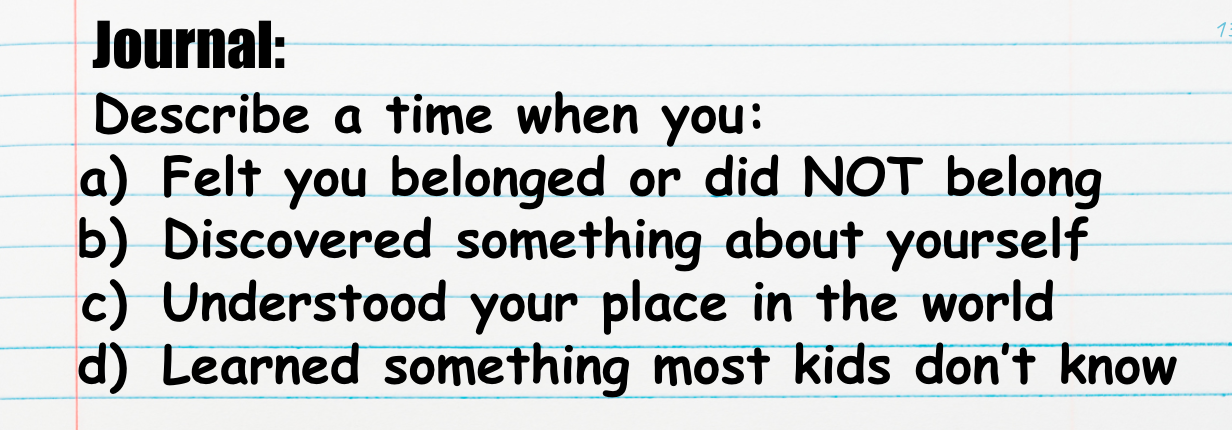
So, as part of Friday’s activity, I posted a journal prompt on my screen.
I tell them to write for eight minutes straight, I start a timer, and — you’ll never believe it — they start writing. They write and they write, and I sit at my desk, writing, too. The room is silent except for the ambient music of the timer. When time is up, I say, “Anyone like to share what they wrote?” half expecting that they would all say “Nah.” Being that it’s just five senior guys, I wouldn’t have been shocked if they all wanted to keep their thoughts to themselves. But, they began to share, one by one, the things they’ve discovered about themselves, the things they’ve learned, the times they felt like they did not belong.
Then, somehow we found ourselves in a discussion about how much you should share with a girlfriend — how vulnerable you should be.
“You should never share your personal feelings with a girlfriend,” one man-child said.
“What?!” I asked.
“You don’t share your personal feelings because they’ll use them against you,” he replied.
“No. That’s not how it works,” I said. “You should be able to share your feelings with your girlfriend.”
“No you shouldn’t, because when you break up they’ll tell your business.”
“Oh, well, right. I can see that,” I said. “I guess it’s all about trust. You can only be vulnerable with someone you trust. For example, my husband and I have been together for thirty-five years, and we can tell each other anything.”
“That’s what Mrs. O (the Spanish teacher) said, too,” another student replied.
And then, we’re on to the next topic. These guys are moving through their day gathering tidbits of wisdom about relationships while loosely committing to completing their school work.
Earlier last week, I went to another classroom to grab a senior who is in danger of failing a couple of classes and not graduating on time. Each of the members of the leadership team have been assigned a couple such students in order to get them across the finish line.
As this “very cool” senior and I walked down the hall, I linked my arm through his, looked up into his face and said, “You and I are going to get together once a week to make sure you do what you need to do to graduate.” He looked down at me, seeming a little more concerned than his usual playful self, but he walked with me to my classroom, sat in the desk where I directed him, and looked with me at the screen of my laptop to see his current grades.
“You are at school every day, ” I said, “and you are very bright. I don’t see any reason why your grades should look like this other than the fact that they are not your priority.”
He looked me straight in the face.
“Your priorities, from where I’m sitting, seem to be your girlfriend and having fun.”
He nodded.
“I get it. I do, but dude, her grades are strong, and she’s gonna graduate. It would be a shame if she left you behind.”
“I’m gonna do better. You watch,” he said.
“I was hoping you’d say that,” I replied. “Let’s check in again next week so that I can see your progress.”
“OK.”
A few days later, the same student saw me in the hall. “You were right about my priorities,” he said.
“Was I?”
“Yup. But I’m doing better. You’re gonna see.”
“Amazing. I look forward to it,” I said, and we fist bumped and went our own ways.
Is this what I pictured my life would be like — interacting with adolescents, trying to enjoy their playfulness while also pressing them to dabble in maturity? No; I think I pictured the woman in the cardigan analyzing literature or poetry. I do get to do that sometimes, but more often than not, my role is less about English Language Arts and more about developing humans.
And, what an irony that I am developing right along with them. I, too, am coming of age.
Much of the work of my adult life has been unlearning the internalized messages I have picked up inadvertently. Messages about my identity, about how the world works, about the value of others, and even about my faith are regularly being viewed under a microscope to see if they hold up to scrutiny.
The first time I remember doing this was in the counselor’s office in the mid 80s where I was being treated for an eating disorder. Regularly in my sessions, my therapist would ask me questions that would confuse me. Why did I need to lose weight? Why did I believe I would be more attractive if I was thinner?
Why would he ask me such questions when the answers seemed obvious. Throughout my whole twenty year life, I had learned to believe that thin was better than fat, that I’d better watch my weight, that “those fat people over there” were disgusting, probably lazy, and not worth as much as “we” thinner people. I was ever anxious that I, in my body, which was just a tad larger than those of my friends and my sister, was ounces away from losing my status as one of “us” and becoming one of “them”.
In fact, in my freshman year of college, like many overwhelmed, depressed, and floundering college students, I did put on ten or fifteen pounds, and people I barely new — dorm mates and classmates — repeated the refrain I’d heard at home, I’d better be careful. I should get my weight under control. Did I really want to eat that dessert?
I believed their messages, and in fear and trembling, I overcorrected. I began a regimented way of life that escalated into anorexia nervosa. I lost all the weight I’d gained my freshmen year plus another 20 or so pounds over the summer before transferring to a much smaller school in the fall.
There, my excessively thin body soon gained its reward. That very fall, I was selected for the Homecoming court. I’m guessing I was selected solely based on my appearance because no one could have known the real me. When I wasn’t studying in the library, I was secretly writing down every food I ate, calculating calories, and sneaking to step on the industrial scale in cafeteria where I worked to make sure the number continued to go down — the only way I knew to measure my value.
I felt so out of place on the stage being crowned in one of the most ironic moments of my life. My cohort was apparently applauding my external worth, while I was trembling on the inside — afraid of being revealed as an imposter, knowing that what they saw was artificial, a fragile facade concealing a very broken interior.
That was close to 40 years ago, so you might think I have completely unlearned that lie. That might be true if everyone in the culture I live in had learned it, too. Alas, they have not. Messaging about the connection between thinness and beauty persists today. It has lost some of its power what with the greater diversity of representation of women in the media, the elevation of body positive messaging (if you are willing to look for it), and the shift in the fashion industry toward inclusivity, but the message remains among us — thin is better than fat, especially for women who live under continuous pressure to present themselves in flawless well-toned bodies despite genetics, health, or circumstance.
So, my unlearning continues. When I hear my mind say, You’ve put on a couple of pounds; you’d better be careful. I ask myself questions that I started hearing from my therapist years ago: Why are those pounds bad? What will change about you if you decide to keep them rather than lose them? Why are you connecting those pounds to your value as a person?
Why indeed.
What is true about my body is that it is strong — it has carried my children, it has finished half marathons, it has communicated with me when I have overworked, it has kept going when my mind has refused to rest. It is strong and beautiful and resilient. It has value at any size. Period.
Do you see how it works? It takes awareness, diligence, and intentionality to unlearn the messages we carry with us all the time, often unknowingly.
My students and I just started reading Born a Crime by Trevor Noah, a memoir of the comedian’s life growing up in South Africa during Apartheid. Before we read the book, we start with learning about unconscious bias — the beliefs that we have that shape the way we view the world. We talk about bias against people of other races of course, but we also talk about gender bias, religious bias, disability bias, and even weight bias.
The very nature of unconscious bias is that we don’t know that we have it. That’s why I was confused when my therapist asked me questions that challenged my unconscious bias– my beliefs were so ingrained, I accepted them as fact — didn’t everyone feel this way? didn’t everyone know that being overweight was bad?
So as my students and I learn about unconscious bias, I have them take the Harvard Implicit Associations Test. This is an ongoing study that gathers data from participants regarding their bias around a variety of topics. It takes about 10 minutes per topic such as race, age, weapons, or weight. The participant clicks on images in response to the directions, and the speed of the response reveals the participants’ unconscious associations. It’s fascinating.
Now, I will admit that this is uncomfortable work. In all my years of teaching students of color, I have been working to unlearn the racist beliefs that permeate our culture — the not always subtle implication that Black people are poor and dangerous and not as smart as white people. I know that these statements are untrue. I have countless examples of students, coworkers, and friends of color who are wealthy and brilliant and successful and generous and kind, and yet my unconscious bias still sometimes reveals itself. I don’t like when this happens.
Let me give you an example. I was venting to my instructional coach one day. She is a brilliant educator who, like me, is committed to educational equity. She has taught in Detroit Schools for thirteen years and has risen through the ranks because of her commitment to excellence and her undeniable ability to support other educators in instructional design and implementation. Also, she is Black. It had been a difficult school day and the halls were loud and unruly, and I said, “Man, it is zoo-y in here today.”
She replied, “Well, I wouldn’t use the word zoo-y.” She was matter of fact, not accusatory, not incriminating. She just said it, and gave me a beat to process.
“Oh, wow,” I said out loud. “I never considered that using that word implies that our students are animals. Yikes. I won’t say that again. Thank you for bringing it to my attention.”
Even typing the words right now, I have an ache in my chest. How could I have used such language when I work so hard to push against racist ideas?
My coach happened to be in my classroom a few weeks ago when I shared this example with my students. I said, “If we really want to uncover our unconscious bias, we have to give the people around us permission to point it out to us. It was brave of my colleague to say something to me. She did not know how I would react.”
“Wait, why is zoo-y a bad word,” one of my students asked.
My colleague stepped in, “For many generations, white people used language that made Black people seem like animals so that they could justify the way they treated them — with slavery, with separate bathrooms and water fountains, with unequal schooling, you name it. To say that the school feels zoo-y implies that you are animals. And, you are not.”
All eyes on her. Silence. Reprogramming in process. A moment of unlearning. Priceless.
I continued, “Maybe you have heard me say something that revealed my unconscious bias in this class. I am giving you permission right now to let me know when that happens. It is the only way I can bring these beliefs to my consciousness, put them under a microscope, and reveal them for what they are. That’s the only way I can hope to change.”
A few days later, one student, my boldest, most confident rising star, interrupted me when I was explaining the term “white privilege” and how I have benefitted from it. I’m not sure what I said, to be honest, but she challenged my delivery and said, “I wouldn’t say it like that again.” It takes a lot of courage for an 18 year old girl to challenge her teacher in the middle of a lesson, so I stopped, heard what she had to say, thanked her for her courage, and practiced rephrasing my thoughts.
It was an uncomfortable moment for me, to be sure, but I am hopeful that it was a moment of agency for her. Perhaps she, too, will start on a lifelong journey of unlearning the things she has picked up about herself, her world, and the ways that she can operate within it.
The alternative is staying where we are, holding fast to every lie we have ever believed, which for me has felt like a trap. The unlearning, although at times uncomfortable, is liberating. In fact, it’s a transformation.
This year I am sharing posts that I’ve written over the last 10 years since I first started this blog in 2014. This one, from October 2014, shares a bit about my writing process — the process that allows me to … process.
A friend asked me yesterday if I know what I am going to write before I sit down at my laptop. Not usually. I sit down and think “Well, what’s it going to be today?” Sometimes I just start typing. Sometimes I look at a blank screen for a very long time. Sometimes I get two or three paragraphs in, delete the whole thing, lather, rinse, repeat.
On rare very blessed days, I wake up with an idea in my mind, sometimes in the middle of the night, and I can’t get to the keyboard fast enough. I have a start, I don’t know where it will take me, but I know for sure that I have the topic right. In those moments, I feel like I am being instructed by the Teacher himself, as though He is pushing the words through my fingertips onto the screen, because He knows that is where I am most likely to pay close attention to them.
On other days, I get up, drink my tea, eat my oatmeal, skim Facebook, read my emails, do my Bible study, then come to my computer with a general idea of where I am headed. This type of writing is usually an extension of my Bible study, allowing my brain to explore what I just studied, making it personal.
Sometimes my writing sorts out what is happening in my life — the death of a friend, a change in medication, a potential job. This writing usually reveals the feelings that I typically keep below the surface…the ones that are pressing to be examined…the ones that I really need to process in order to move forward.
And today, I am writing about my writing. Writing allows my soul to breathe. I learned that when I was very young, back in the days of pink diaries that locked with a little golden key. I treasured the time I could lie on my bed and write in my diary. I poured my little heart out into those cheesy little books. Somewhere along the way I discovered poetry and dabbled a little in finding just the right combination of words to cryptically express my innermost emotions. Later, poetry gave way to song lyrics, devotions, and lesson plans.
My student often asked me if I would ever write a novel. “No, I don’t really know how to write what’s not true.” And that’s a fact. The only type of writing I really know how to do is this — putting the ordinary stuff of life on the page in order to make sense of it.
Some people paint. Others dance. Some run marathons. Others garden. We each have to find the language of our heart and use it to say what’s inside of us. We know when we’ve found it because we can’t help but run to it, and getting there, we see that others too, miraculously, are blessed.
It’s a mystery, isn’t it? Someone could be blessed by my fumblings? Your fumblings? But they are! So, I’ll continue to fumble along.
I Corinthians 12:4
Now there are varieties of gifts, but the same Spirit…
It’s been 10 years since I wrote that first post, and since then I’ve written 652 more (653, if you count this one). In the beginning, I wrote almost every day. Having been instructed to be still after years of routine — first teaching, then parenting young children, then graduate school, then teaching and parenting combined — I needed something that would bring order to my day. So in those first months in the little house by the river, I woke every morning, made my tea, and wrote a post before I did anything else.
I think I began blogging because I needed a purpose, something that I could accomplish each day, something that I could produce — a physical representation that I could still do something. I didn’t really know what I was going to write each day, but an instinct — perhaps after years of journaling and teaching others the value of daily writing — pushed me to the keyboard every morning, and this writing became a lifeline.
Some of you began to read perhaps out of curiosity — why would someone daily post about their life? why would a teacher at the height of her career walk away? why were we moving to Michigan after years in Missouri? Some of you have told me that you resonated with the chronicling of my autoimmune disease. You, too, suffered with chronic health issues and my willingness to write about being stuck on the couch or lying on the bathroom floor writhing in pain let you know that you were not alone. Some of you read because you knew me as a child and wondered what I was up to. Some of you are my family and friends (or my husband) and you read out of care, concern, and solidarity.
Whatever the reason you read, the fact that someone — anyone — was reading gave me the encouragement I needed to keep going.
And when I kept going, kept writing, day after day after day, I dug deeper into my interior and discovered things about myself that had long been buried or that simply needed articulation — precious memories from my childhood that revolved around my grandparents and godparents, deep sadness over losses that had never been processed, my ongoing journey with autoimmune disease, my strong feelings about political issues, and probably more than anything my passion for educational equity.
I often tell my students (and my friends and anyone else who will listen) that I (and perhaps you) don’t know what I am thinking or feeling until I see what I have written on the page. Perhaps it is because I have spent a life in motion, constantly doing, producing, going, and moving, that I have pushed my thoughts and, even more so, my feelings deep down inside without taking the time to process them.
Having a health crisis and being forced to stop and be still provided the space in which I could — finally — pull up all those thoughts and feelings and begin to examine them, evaluate them, feel them, grieve them, and in some cases, move on from them.
So I’m sitting here, in my little home with the garden, ten years later, candle burning on my desk, still in my pajamas, reflecting on how far I (we) have come. In over 600 blog posts I’ve moved from debilitating pain and fatigue to manageable symptoms that remind me to move slowly and to routinely pause to take stock. I’ve transitioned from taking daily anti-inflammatory medication and monthly injectable biologics to mostly just daily vitamins and supplements with occasional Motrin added in. I’ve been growing in my ability to write and subsequently speak about my deepest hurts, greatest losses, daily struggles, and strongest passions. And, most tangibly, I’ve gone from my insecure 2014 self that felt like an invalid to my confident 2024 self, which my instructional coach recently described as “effortlessly dope”. (I think that’s the most treasured compliment I’ve ever been given.)
Do I owe it all to the writing? No, I wouldn’t say all, but I would say I wouldn’t be where I am today without the discipline of this blog. My commitment to write regularly and truthfully — sometimes painfully truthfully — has been not only the evidence of the miraculous growth and healing I have experienced in this next chapter, but also a primary instrument in that healing.
I don’t think I can unpack what I mean by that in one blog post, so the assignment I’m giving myself this year is to share a “vintage” post each Thursday and a new post most Mondays. The objective is to deeply reflect on the power of writing, of routine, of discipline, of transparency, of community, and of vulnerability. I can’t predict where this assignment will take me — I won’t know what happens until I see it on the page, but I invite you to come along with me.
If you dare, I challenge you to write along — you might just open a blank page and write for 5 minutes each morning to start. You might find that’s not enough. You might find it’s too much. But if you’ve read my blog for any amount of time, I hope you will see the possibility for transformation that might happen if you are willing to take a chance.
I’d love to hear from you — what you are finding out about yourself, what are you unearthing, what is happening for you as you write. It doesn’t have to be for the public eye as I am allowing here. Writing can be magical even if it is for your eyes only.
Whatever you choose — reading along on my journey, writing along with me, or doing something altogether different, I pray God’s blessing upon you — may 2024 be a year of growth, of healing, of transformation. May it be filled with love, with joy, and with a renewed sense of hope.
If you don’t believe that God can restore what is all but lost, let my blog be a testament that nothing is beyond His ability.
Behold, I am going to do something new, Now it will spring up; Will you not be aware of it? I will even make a roadway in the wilderness, Rivers in the desert.



 Next Chapter