Life These Days

The question of the moment around folks my age — and for the record, I’m just shy of 60– is “how much longer do you think you’re gonna work?”

My most frequent response is often something like, “I’m not in a hurry to be done. I love what I do. I hope I can stay at it a while!”

This is, of course, not how everyone feels. Many my age have put in a long, hard 40 or more years of work in jobs and careers that have taken a toll — physically, mentally, relationally, or in other ways that might make a person want to walk away.

Let’s be honest, if you’ve spent 30-40 years on an assembly line — you might be ready for a change of scenery. If you’ve led a corporation and had the weight of the bottom line, personnel challenges, and inventory management on your back, you might be ready to sit by a pool, sipping a cool drink. If you’ve been in a classroom for 40 years — attending to the needs of children, designing instruction, managing behavior, and adapting to continuously changing policies, cultural norms, and learning challenges, you might be ready to just have a day that doesn’t involve managing anything but yourself.

And while I have certainly had my challenges and seasons of disillusionment and burnout, none of those scenarios truly describe me. After working in many different settings over the years, I find myself in a role that feels like a culmination — the place I was intended to arrive at, so I don’t find myself asking how much longer I want to work, but rather: When I look back at all I have learned, what do I have to offer these days?

In the early years — the first 3-5 of my career — bravado carried me past insecurity so that I could survive in situations that were way outside my experience. A middle school special ed classroom in Detroit? No problem for this secondary English major from small town Michigan! A self-contained classroom inside a residential facility teaching not only ELA but also social studies, math, science — I got this! I faked my way through and while I can’t say that my students (or I) won any awards, everyone learned something — including me. I learned about being overwhelmed and about working with limited resources. I learned to lean into the uncomfortable and to try just about anything. Did I occasionally lose my shit and come undone in front of a classroom full of typically behaving students? Sure. Did I also take a van load of Detroit teenagers on a day-long adventure to Ann Arbor? Yes, I did! Did we overfill our day with activities? Absolutely! Did we arrive back to school late after dismissal? We sure did! Did those kids and I have a ball touring a college campus, going to a hands-on museum, and eating at Pizza Hut? Yes! Rookie me swung for the fences, folks.

The bravado only carried me so far into my years at home with my own children. In fact, I think it was day one home from the hospital when I called a friend emergency-style to come save me because nursing wasn’t working out according to plan. I wish I would’ve admitted right there and then that I was clueless about mothering, but faking it until I made it was my theme song, and I just kept singing. Before I knew it, I was sitting on the living room floor with three children of my own, reading stories, learning letters, and playing games. Those days were exhausting and precious to me! We had a lot of fun, but I was making it up as I went along, so I certainly made plenty of mistakes. I pushed myself and the kids way too hard, and I expected way too much, but in continuing to give it everything I had, I learned how to schedule out a day that included learning, adventure, rest, and play; how to turn a few hot dogs and some popcorn into a baseball watching party; and how to get through a puke-filled night with little to no sleep. I learned that I could manage much more than I imagined, that I had a lot of people who were willing to help, and that it wasn’t a weakness to ask them.

When I returned to the classroom the first time, it was to a position that was far bigger than my experience — the English Department Chair and Dual-Enrollment ELA teacher at a small private high school. Not only would I, once again, be faking it ‘til I made it, I would be doing so all day long in a new environment while I was also still —at home — learning how to parent my own children who were in the process of transitioning from childhood to adolescence in a new home in a new city in a new state.The lift in both arenas was immense, but I was gonna make it happen. I learned a curriculum, read dozens of books, short stories, poems, and essays and adapted to a modified block schedule and the world of Apple computers while I also navigated the needs and ever-changing emotions of a family that was struggling to find its footing. For nine years, it seems, I was in constant motion — either preparing to teach, teaching, or grading in one space or cooking, cleaning, driving, scheduling, or otherwise parenting in another. Those years seem like a blur as I look back, probably because I never stopped running.

And then, all the motion came to a halt. Readers of this blog know that those years ended in an autoimmune diagnosis and an exit from the classroom followed by convalescence and a [next chapter] of re-learning how to live which landed me where I am now.

I came into this season humbled by the knowledge that I did I have a limit, and that I did not indeed know everything. When I was offered the position to teach ELA at a small charter high school in Detroit, I was grateful to be in any classroom at all. The fact that it was familiar territory — teaching seniors about college and the skills they would need to be successful — meant that I would NOT have to fake it til I made it. I could just be the authentic me, sharing what I know and loving the students who were in front of me. Granted, I still had much to learn — our school has an instructional model that was new to me, and I would, for the the first time in my career, have a coach, but none of that was overwhelming. In fact, it was comforting to know that I had support and that I wouldn’t have to find all the answers on my own.

That was over five years ago, and now I’m no longer teaching but coaching other teachers who may be in their very first year or nearing their 10th or 20th year. Some of them are faking it until they make it, some are disillusioned, and some are managing a lot in other areas of their lives.

I have a front row seat to their experience and that’s why I’m asking myself this question: What have I learned and what do I have to offer these folks?

I’ve learned that showing up and doing your best goes a long way — even if your best isn’t amazing, it’s likely good enough.

I’ve learned that being brave can lead to remarkable opportunities that change you forever.

I’ve learned that others are willing to support you if you are willing to ask.

I’ve learned that family is much more important than work and that your health needs to take priority over any perceived deadline.

I’ve learned that who I authentically am is much more valuable to my students and the people I love than getting every decision right or accomplishing every task.

I learned these things the hard way over the last many years, and maybe these folks — the people I rub elbows with every day and those that I coach — will have to learn them the hard way, too.

I think what I have to offer right now is the empathy and compassion gained from my own journey. I have a rare opportunity to offer support and encouragement, and the wisdom that comes with each of these gray hairs.

I’ve got perspective — each day is important but no day is definitive.

I’ve got plenty of gas left in the tank to come alongside the members of my team, to see their passion, their frustration, their hope, and their fatigue. If they are willing to keep showing up, I will, too.

Maybe I’ll get a chance to share what I’ve learned. More likely, I, too, will learn something new.

Teach us to number our days, that we may gain a heart of wisdom. Psalm 90:12

Typical, 2025 version

It’s been a pretty typical week for 2025– a virtual genocide continues in Gaza (albeit with talks of a coming ceasefire and hostage release, all of which we’ve heard before), the US government is shut down, four people were killed in a church shooting an hour away, and Jane Goodall — a universal treasure– passed away. Oh, and I’ve spent the week trying to provide an equitable educational opportunity to six sections of high school science students.

Here’s what’s going on — I am the instructional coordinator in a small charter school on the border of Detroit and Dearborn. You could drive right by us and not know we are there. We operate out of a run-down former Catholic elementary school which we rent for a rumored gasp-worthy sum from the Archdiocese of Detroit. The parking lot of this building, which our busses have to traverse twice a day, is literally crumbling under our feet/wheels. To come onto the property each day, I have to ignore the willful negligence that would allow a literal lake to form in the center of the asphalt, but I digress.

We aren’t glamorous is my point. The building is too hot in the fall and spring because we have no air conditioning and too hot in the winter because of the antiquated boiler system we use to heat it. Windows need repair, and the gym, which we use as cafeteria, gym, and auditorium, is way too small to host any kind of athletic competition. If you could, based on facilities, choose to teach anywhere else, you probably would. Or, if you could choose to teach students who read at grade level or who have involved parents or who come to school prepared to learn every day, you would probably choose to do that.

But we aren’t that school.

Nevertheless, we have almost 300 students who deserve a high quality education. And we can’t provide that — we can’t get them up to their current grade level, we can’t adequately prepare them for postsecondary education or the work world, we can’t give them an opportunity to change their circumstances — without well-trained teachers, and I’m not sure if you’ve heard, but there isn’t a surplus of those lying around.

This is my 6th year at my school, and every single year we’ve had at least one, if not two or three, classes covered by long term substitute teachers or, more recently, online alternatives, and that’s not because we aren’t doing everything we can to find teachers — we are!

So here’s what happens — each spring we post all of our openings, then we interview all summer, we make offers to the most qualified people, we believe we are fully staffed for the fall, then days before school starts, we realize that one or more of our teachers has changed their mind and moved on — maybe for more pay, maybe for a different environment, maybe for a promotion. The reason doesn’t matter. We suddenly find ourselves with a hole to fill.

Now, because this is our reality, we do always staff 2-3 permanent building substitutes. These folks are salaried employees who come into the building every day. They are typically not certified teachers or subject matter experts, but they are committed members of our team who know and love our students. We also have a creative leadership team that has found myriad work-arounds over the years.

This year’s shortages were looming all summer — we found and hired multiple math and science teachers only to have each of them move on before the first day of school, so in the final hours we made a plan. Our Geometry and Algebra II courses would be staffed by a returning qualified educator. Our financial literacy course would be taught by a permanent employee who also runs his own business. Algebra I, Principles of Physics, and Chemistry would be covered by a company called Elevate K-12. This company hires certified teachers who live in other locations to zoom into our classrooms and provide high quality instruction. For these classes, we provide an in-person facilitator — a member of our team who knows the students and manages all on-location needs such as attendance, providing physical materials, and managing any student behavior issues. This is our second year using Elevate, and although last year’s start was bumpy, I must say that we have found our rhythm.

With all of those classes covered, we still had three sections of Biology and three sections of Earth Science to cover with days remaining before students would arrive. With no applicants in the hiring stream, we turned to an agency that provides long-term subs to area schools. (You read that right — the teacher shortage is so profound that agencies exist solely to provide long-term substitutes.) That agency sent us two people to interview. We chose the one who had some experience in a high school science classroom, and she started right away.

She did a good job of getting to know the people, finding her way around the building, fostering relationships with our students, and showing up for work everyday…until she didn’t.

And now we are looking again.

The students have not had a teacher now for seven school days. They have had members of our team covering, and I have been providing assignments (without instruction) and grading papers. Even if I could stay in the classroom every day, I don’t know enough about population dynamics or the chemical composition of the sun to guide these young minds through their learning. And I can’t stay in the classroom anyway — I have a whole job of coaching and supporting the other teachers in the building in their quest to meet the needs of our students who have profound knowledge gaps and who nevertheless have dreams and goals and deserve every opportunity to make them happen.

No, we need to find someone qualified to teach these classes.

My principal sent me a calendar invite to join her for an interview on Thursday — someone the agency sent to take over these courses. He was a career scientist — full of content knowledge. However, although he’d done some one-on-one tutoring over the years, he’d never been in a classroom, never kept a grade book, never presented with a slide deck. We’re starting week six of classes on Monday and we need someone to jump in there, hit the ground running, and salvage what is left of this semester for these kids.

So we’re still looking, and I’m still giving assignments and grading and encouraging students and their substitutes to stay the course. This is where we are, and this is what we have.

Meanwhile, a few states away, grown men who have their education can’t agree on how to fund the government while they are simultaneously allowing millions to be spent rounding up undocumented immigrants.

I wonder if they care that 411,549 teaching positions in the US remain unfilled or filled by folks not fully certified. I wonder if they care about the students impacted by those vacancies, many of whom are from low-income homes that struggle to meet their everyday needs for food, housing, and transportation. I wonder if they think about that when they are deadlocked on their decision over spending for healthcare that will most certainly impact these same families.

I wonder who we have become and how this has become just another typical week.

Do you wonder, too?

Seek justice. Defend the oppressed. Isaiah 1:17

If you or someone you know (certified or not) has a background in science and a heart for kids, click on this link and tell them I sent you. (We have openings at our elementary school, too.)

Finding a Footing

At the end of the last school year, as I waved goodbye to students and wished my colleagues a safe and restful summer, I was envisioning long days of reading broken up by an hour here or there with my hands in the dirt — weeding our garden, tending to our plants, and bringing in the fruits of our labor. I saw days on the beach of a great lake and others poolside with our granddaughters.

While I did manage to experience all of that, much of my summer was not what I was expecting. At all. Particularly not when, just a month ago, I was searching for an assisted living facility for my stepfather, helping my brothers move him in, being present for his rapid decline, then processing with my mom and siblings through his passing.

The flurry of activity was unanticipated and un-mooring. I’ve felt a little tossed about for several weeks, so the return to the rhythms of back-to-school prep of the past many days has been a welcome and anchoring exercise.

As I’ve been walking the hallways of our school buildings, I’ve been wondering if our students, too, have felt a little at sea. What has their summer been like — have they been working? helping out at home? have they had plenty to eat? time and space to rest? have they experienced loss? or trauma? joy? or celebration? Has their summer been what they were expecting? Are they, too, in need of the rhythms that will bring stability?

Because I’m not teaching this year, but rather supporting our teachers and students from a more global perspective, I’ve been managing tasks all summer like updating scope and sequence documents for various courses, familiarizing myself with the curricula taught in our building, creating Google classrooms for all of our teachers, updating our school’s testing plan, organizing and auditing the curriculum I created, and managing several other tasks. Over the last couple of weeks, I’ve also been preparing presentations and materials for the teacher orientation that begins this week.

As I’ve been checking all these boxes, I’ve needed some support (and grace) from my supervisors to reconnect with the world of school, to remind me what each of the pieces are exactly, to steady me as I find my way back to the vernacular of academics — to norms and standards, to unit plans and instructional strategies, to engagement and discourse.

I’m guessing that our teachers and students are going to need support (and grace), too. Certainly their summers have been far from the academic realm — less structured or predictable. Sure, some of them have punched a clock or had regular eating and sleeping habits, but many will have had no routine at all. Surely few, if any of them, will have sat in a desk, attended to a slide deck, navigated to a Google classroom, or submitted a document for review.

Transitioning away from my erratic summer to more routine work has not been easy nor has my body been quick to adapt. While I’m being quite diligent in getting back to eating three meals a day at the designated times and observing my normal bedtime, my body is still on high alert after weeks of urgent phone calls, last minute trips, and unexpected decisions. My digestive tract is suffering from role confusion, and my sleep patterns remain inconsistent.

Perhaps the bodies of my students and teachers, too, will be a bit out-of-kilter. Perhaps they will find it difficult to endure a seven hour school day, to sit upright for long stretches, to use the restroom at designated passing times, to make it from breakfast to lunch without a snack, to remember to get a drink between classes, or to stay awake for the entire day.

I’m finding a few things helpful in my regulation. First is seeing my people. As I’ve gone into our buildings over the last few weeks, I’ve reconnected with my colleagues, many of whom have offered hugs both of “I’ve missed you” and “I’m sorry for your loss.” We’ve shared stories and laughter as we’ve navigated our tasks.

I’ve found stability in the familiar — the drive, the building, and the faces.

I’ve found comfort in the physical — walking into my office, arranging my supplies, moving books, and touring classrooms.

I’ve found security in doing what I know how to do — creating a document, sending an email, meeting a deadline, planning a presentation.

I’m thinking about how I can use my experience of re-entry, my realization of what I’ve needed to re-acclimate, to support my teachers and students as they move from what also may have been erratic to what is more routine.

We already engineer the first week to be less about curriculum and more about connection. We are a trauma-informed organization, after all, and we know that Maslow comes before Bloom. We have a system of delivering school-wide norms and expectations, and we support teachers in integrating warm-ups, games, and getting-to-know-you activities. The first week is all about learning names and building community. It’s an opportunity for our students to get a literal or metaphorical hug– to reconnect with their teachers and classmates.It’s a time to situate themselves inside of the familiar — not only the building and its classrooms but the bell schedule, the movement patterns, the physicality of being in the space, and the kind of routine assignments that warm up muscles and build confidence.

How can I normalize the weirdness of it all — how our bodies and minds take time to adapt, how we may feel irritated, foggy-headed, tired, and out-of-sorts? The best way I know is to name it — call it out — talk about it.

Our teachers and our students may need the leaders in the building to acknowledge the heavy lift of transition — of moving from the summer-realm to the world of school. These worlds are not the same, and the move can be jarring. For me, back to school has always been a comfort — school is a place where I know how to be, what to do, and how to succeed — but it’s not like that for everyone. For some, school is an increase in stress, a place of conflict, a world of insecurity.

So, in my new role, I think one thing I can be is present — observing what is happening for teachers and for students, being willing to acknowledge that what they are experiencing is real. Of course you’re tired! Coming back to school takes a lot of effort! Yes, this is a lot of information to take it all at once, and our summer brains are not used to it.

I can also offer compassion. I get it! My body is still adjusting to the school day, too! I can cover your class while you run to the restroom. How can I support you in getting your documents completed on time? Would you like to tell me about what you are experiencing?

That’s the benefit of my role — I’ve got a head start on my teachers and my students. I have had a preview of what they might experience in the coming weeks. Now that I am feeling a little more stable, I can lend some of that to them as they transition. I can be a reminder that they will soon be settled in as well.

That, and I can make sure that my snack drawer is full, because I can bet that soon I will be hearing both teachers and students say, “Mrs. Rathje, you got anything to eat?”

I’ll be ready for them; I’m getting closer each day.

put on compassion, kindness, humility, gentleness, and patience. Colossians 3:12

**If you’d like to support what we do at Detroit Leadership Academy, here is a current wish list

It all adds up

In my many years of teaching, I have been “in charge” of delivering all kinds of content, mostly English Language Arts — everything from vocabulary to grammar to composition to poetry, drama, short stories, and novels. I’ve led lessons on irony, literary analysis, metaphor, meter, MLA documentation, and countless other ELA topics.

In some of my positions, particularly during the early years, I also led lessons on science, social studies, religion, sex education, PE, and yes, even math. I wouldn’t say I was amazing in these other content areas (if you are reading this and I was your teacher, please be kind!) but I muddled through. I understand the principles of teaching — the concept that first “I do,” then “we do,” then “you do,” so if I can figure something out, chances are, I can show you how to do it.

And, once upon a time, I could figure out math, but can I still?

In my new role, the plan is that I’ll be coaching eight teachers — two ELA, two social studies, two science, and two math. With each of these teachers, we will begin by looking at the curriculum — what are the broad goals for this year, how are those goals broken into units, how will each unit be assessed, what skills will students need to be successful, and what misconceptions might we be on the lookout for?

As I’m preparing for these discussions with my team, I’m diving into the curricula — this past week I dove into math.

At first glance I was like, how hard can it be — I can probably still do most of Algebra I, I mean 2x +5 = 25? No problem. But then I opened the first geometry lesson and thought, Oh, my, this is a whole different language, isn’t it? The first unit was all about triangles and parallel lines — Cool, cool, I remember this — the three angles of a triangle add up to 180 degrees, and if parallel lines bisect a transverse line, corresponding angles are equivalent – – yup, yup. But then I got to the part where you have to write the “proof” and I was immediately transported back to 1982 and Mr. Cronkright’s room. I was pretty sure my deodorant failed and a zit popped out on my nose. I shook myself — how hard can this be? You’ve got the teacher’s edition and supplemental videos! Walk through it! Figure it out.

And you know what? I did! I remembered all the things — with a little help from Great Minds Digital Learning — and was able to complete the unit assessment with flying colors! Thank you, ladies and gentlemen.

I was feeling pretty good about myself until the next day when I opened the first unit of Algebra II — Probability — this is an entirely different language, once again. I mean, suppose that a book store sells a book in both electronic and print format, and that customers can pay with either a gift card or a credit card. What is the likelihood that a random customer walks in the store and buys an electronic copy with a gift card.

I’m looking at the screen of my computer, scratching my head saying, Who in the world wants to know how to calculate this ? when the power in my house went out. What are the odds?

LOL. See what I did there? I’m telling math jokes.

The power literally did go out, but my computer had plenty of battery and I had plenty of daylight, so I pressed on. Certainly if I trudged through the lessons, even I could learn how to use a two-way frequency table. So trudge I did, and while the literal lights came back on while I was still hunched over my desk, the metaphorical light of understanading didn’t reach full strength. I’m not sure I comprehend enough about probability to pass the assessment — yet! — but I am confident that I can have a conversation about the unit with the instructor, and I am quite sure I will be able to identify some of the struggle areas that might take students [ahem, me] more time to digest.

Did I mention in last week’s post that I would be learning this year, too? I am certain of it.

That’s a large part of what teaching is, friends — it’s admitting that you might not know everything, but committing to getting on the bus anyway, deciding to show up, leaning over content that might be challenging, and using any means necessary to figure it out so that you can model it for your students, do it with your students, then release them to do it on their own.

This past year I had the privilege of watching someone do just that. Last August, when we realized that we would not be able to find an ELA teacher to fill the position I was vacating, I agreed to continue teaching two sections of seniors and to share the classroom with one of our paraprofessionals who would teach three sections of freshmen. Although this individual has been in our building for as long as I have, she is not a certified teacher and has no formal training in English Language Arts. Did that stop her? Not at all. She received coaching, read books, leaned into curricula, and announced to her students, “We’re going to figure this out together.” Day after day she showed up, implemented strategies, and learned lessons so that she could bring her students along with her. She knew she was responsible for what they were learning, and she took her role seriously.

And truly, that is what I plan to do with my team this year. I want to “figure it out together,” leaning over their content with them, modeling for them how to determine the best way to deliver a concept or a skill, partnering with them to try a new instructional strategy, then watching them take it from there.

The money in teaching is when the students [or this year, my teachers] take what we have learned together, personalize it, and go way beyond what the teacher could even conceive of. The student exceeds the teacher. That’s the goal.

What is the probability that it will happen this year? I’d say the odds are good.

“[He}is able to do more than we can ask or imagine.” Ephesians 3:20

P.S. We are still hiring for some of the positions on my team. If you or someone you know is interested, check out the postings here.

Rested and Ready for a new Rhythm

I wrapped up school year 2024-2025 –watched another group of seniors cross the stage into adulthood, entered final grades, and cleaned up my classroom.

Next, I joined my husband in clearing the clutter in our home.

Then we left town for two short treks — one to play with our granddaughters in Ohio and another to lie on the beach of Lake Huron. We crossed the miles listening to podcasts and chatting about everything from family to politics to music to our future. With our grand girls we lazed in the pool, played Uno and Skip-Bo, and were entertained by intricately choreographed dances. Near the beach, we ate well, slept long, took leisurely walks, and lost track of time.

They were luxurious and welcome — these two little trips back to back — and now we are re-entering real life. Since we’ve returned home we’ve been in the business of unpacking, doing laundry, tending to yard work, and taking stock of the new rhythms we are noticing since a) my husband transitioned from an almost four-decade-long career in church work to a private counseling practice and as b) I am making the shift from classroom teacher to full-time instructional coordinator. Some of the work each of us does in our new roles is similar to what we have done in the past, however, the routines and workloads are quite different. While he has been adapting to his new rhythm for over eighteen months, my real shift begins this week as I embrace the responsibilities of my new role.

How will it be the same? How will it be different?

What won’t change is my morning commute — I will still drive 30 minutes east from Ypsilanti to the edge of Detroit. I will park my car in the same spot, work with many of the same colleagues and students, and follow the same daily bell schedule and school year calendar. I will also continue to serve on our school’s leadership team, meeting at least weekly to plan initiatives and events, troubleshoot current issues, and collaborate toward best practices for our building.

However, many things will change — I will no longer have my own classroom. I will no longer have my own students or a grade book or lesson plans or the responsibility for all that happens inside a teacher’s classroom through the course of the day — behavior management, attendance, organizing materials, and managing the constant flow of information.

I will have plenty of new responsibilities on my plate. In addition to coaching the instructional moves of a handful of teachers like I did last year, I will also be partnering with those teachers to unpack curriculum, analyze assessments, and plan instruction. Further, I will be our building’s testing coordinator, responsible for all things PSAT/SAT, ACT Workkeys, and MSTEP.

All of this, of course, is in the interest of our students. I came to this position because I recognize the systemic inequities in American education that have benefitted some students (mostly white and affluent) and have disadvantaged others (mostly low-income and/or students of color). I wanted to lend my years of experience and expertise in service of closing the gap that continues to widen; I wanted to provide a high level of instruction and rigor for students who have, through no fault of their own, fallen multiple grade levels behind their peers who live sometimes just a few miles away.Over the past five years, I feel I have had limited success. I have, within my classroom, provided glimpses of rigor, moments of engagement, and small gains for individual students.

However, individual teachers in isolation cannot overcome centuries — literal centuries! — of harm. They do make a difference, of course, but for the sweeping change that is needed, we need a broader — a more systemic — solution.

I joined the team at my school in August of 2020. Covid had sent all of our students home the previous March, and because of the disproportionate impact on low income communities of color, particularly Detroit, our district provided instruction virtually for the entire 2020-2021 school year. The administrative team was making it up as they went along, and I — a teacher returning to the high school classroom after a six year hiatus — was enthusiastic about giving it my best. I popped into Zoom rooms, chatting with any students who would talk to me, leading lessons, and providing office hours every afternoon. We didn’t close any systemic gaps that year; we merely did what we could to slow the ever-widening distance between our students’ academic progress and that of those in neighboring districts.

The following year (2021-2022) , fully masked, we returned to in-person learning, bouncing back to virtual instruction several times throughout the year. It actually took us that year and the next (2022-2023) to re-establish routines within the building. We were on pretty solid footing as we started school year 2023-2024, but some mid-year leadership changes kept us from moving too far forward.

The standardized test scores told the story — about a tenth of our students were proficient in English Language Arts and none — 0% — were proficient in math. Our staff took in those realities as our newly appointed principal delivered them before the return of students in the fall of 2024. She gave us the hard truth and then cast a vision for us — we, the staff and our students, would activate excellence. We could no longer allow this to be the reality for the students in our building — things were going to change.

And, over the year I did see evidence of shift — in attitude, in practice, in thinking. However in order to overcome systemic inequities of the proportions that I have witnessed, we need a reimagining of what school likes like in our context. The principal sets the tone, and she has. The leadership team has come alongside our principal, supporting her vision, agreeing with the need, and implementing strategies. Staff members have also caught the vision, to a degree, but the kind of transformation that is needed is going to take the whole team — every teacher, every paraprofessional, every custodian, every social worker — to activate excellence, consistently and continuously, day in and day out.

Certainly in my own classroom, I have strived to provide excellent instruction, to have high expectations, and to inspire my students toward greatness, but I will admit that my efforts have sometimes been inconsistent. I have grown tired, and I have from time to time been merely mediocre. However, as I step into this role, I have been given an opportunity to activate excellence beyond my classroom — taking care to do my very best with the responsibilities I have been given, and to bring other staff members along with me.

I will push my team of teachers — some of whom are experienced, some who are brand new — toward excellence. Together, we will grow this year, beginning by building relationships, but then quickly moving into strategies, into accountability, into doing whatever it takes to activate excellence for our students — to give them the tools they need to move forward into their futures.

It’s a big job, but I’m rested, I have the vision, and I’ve been equipped. May God grant me the strength to persevere, the compassion to both see and inspire my team, and the heart to sustain my insufferable belief in restoration.

He is faithful, and He will do it. I Thessalonians 5:24

“Money” Moments

Eight days. That’s it. Eight more days with this group of seniors, and then, I might possibly be done with my years as a classroom teacher.

I’ve known this was coming. Last summer I took the role of Instructional Coach at the same school where I’ve been teaching since 2020. I interviewed, accepted the position, and came to terms with the fact that I would not be in the ELA classroom even for school year 2024-2025. But, things being as they are in the world of education where teachers are hard to come by, my replacement was not found. So, a long-term substitute took three sections from my previous load, and we crammed all the seniors into the two classes that I would cover.

It was my idea. I’ve been teaching senior English on and off since the fall of 2005, and angsty as they are, these are my people. They are wrestling to find their path from childhood to the world of adults, and that path (let me assure you) is quite circuitous. One day they are presenting their goals for their future via slideshow from the front of the room, the next day I stop them from throwing paper wads at each other. One day they applaud a peer who got accepted into college, the next day I’m having a conversation with them about how we don’t always have to announce when we smell someone’s body odor or flatulence. One might stop by to explain that they’ve been absent because they’ve been “going through it” and another might blurt out “you got any snacks?” in the middle of a lesson.

Yes, they get under my skin. Yes, they do indeed at times offend my sense of smell. Yes, they do give me a challenge every day of my working life, but these students, year after year after year, these seniors, have helped me to learn, to grow, to evolve.

One of this year’s seniors interviewed me this week for an article he’s writing for another class. His questions showed me that he sees me: “Mrs. Rathje, why do you take so many steps each day?” They showed me that he wants to make a connection: “What made you want to be a teacher?” And they showed me that he wants to gauge my commitment to him and our community: “Do you like teaching here?” That conversation gave us an opportunity — to sit one-on-one, knee-to-knee — to see each other not as teacher and student, but as two humans who are sharing the same space for a small season of time.

That is the money of teaching, friends — those intermittent interchanges that happen when you least expect them. These moments are what I treasure most from all my years in the classroom.

All year, I have navigated two roles — instructional coach in the AM, ELA teacher in the PM — and since I’ve known it was a transition year, I have tried to see ways that I can experience these same kinds of moments with the teachers that I coach. Most of the time our relationship looks like me observing a class then meeting with the teacher afterward to provide feedback — data and my observation of moves that were impactful and less impactful. Many of the teachers in our building lack experience, training, or certification, and my role is to facilitate their transition to being more experienced, more skilled, more effective. This path, too, can be circuitous. Teaching is hard work — all day long our teachers lead classrooms full of students at various levels of skill and engagement with the task of capturing the attention of 100% and providing them with high-level instruction, all while following our school’s instructional model and managing multiple interruptions.

One day I observe a teacher greeting his students at the door, providing them directions as they enter, and ensuring that all students are engaged in the day’s learning. Three days later, I notice that same teacher hasn’t replied to my email, is late to a meeting, or didn’t notice the student sitting in his room who was supposed to be in a different class.

Just like with my seniors, I am not looking for perfection; I am looking for growth.

I must confess this is hard for me. Any student I’ve ever had will tell you that my expectations are high, and if they are high for students, they are exponentially more so for the teachers of those students. I didn’t come out of a medically imposed leave from teaching to do a substandard job for students. No. I returned to the classroom in the middle of Covid because of the vast inequities in America’s school system. I came back to push the bar higher for students who have been historically underserved, under-challenged, and undereducated. I am not trying to enable low expectations for either my students or their teachers.

Yet…

Yet, I have learned from a couple decades worth of students (not to mention my own children), that folks don’t want to meet your expectations unless they know that you love and accept them for who they are. If I don’t love and accept you when you are late to class, smell of weed, and don’t know what unit we are on, what are the chances that you’ll be able to hear my expectations let alone take a swing at them. If I don’t hug you in the hallway, why should you listen to me when I approach you at your desk. If I can’t hear your request to use the bathroom or get a drink of water, how will you hear me give you feedback on a paper.

Over the years, it’s gotten easier for me to love a kid, even when they are disruptive, even when they are failing, even when they skip my class. I used to be very judgmental, but I’ve learned that judgment pushes kids away; love draws them closer.

I was tempted to judge one of my teachers recently. I was walking to my classroom one morning when I noticed a group of students standing outside a classroom instead of going in. “What’s going on here?” I asked, “why aren’t you all going in?” The students replied that the principal was inside speaking with the teacher. They intimated that the teacher was “getting in trouble” for something. I was curious, but instead of getting more information, I moved the students to my classroom to give the teacher and the principal room to speak. For all I knew, the conversation was of a personal and unrelated nature, and it was none of my or the students’ business.

However, later, when the teacher wanted to speak with me, I found out that they had been reprimanded. They had made a poor choice in the heat of the moment and things had escalated into the realm of unprofessionalism. We were sitting one-on-one, knee to knee, and this teacher was expressing regret and shame and the desire to undo what had been done. And in that moment I knew what to do. Years of parenting and teaching missteps had taught me that what this teacher needed was not judgment, but love. So I gave it. I heard the confession and acknowledged the regret, “Oh, wow. Yeah. That’s unfortunate.” I affirmed the teacher’s record, “This is not your typical m.o. I’ve seen you many times manage similar situations with finesse.” I heard their concern about the impact of this action on their relationship with the principal, “I see what you mean, yet I believe our principal to be fair, and I know she values opportunities to restore.” I encouraged the teacher to give the situation some space and then to circle back to the principal for a follow-up conversation. I finished with, “This moment does not define you; it’s unfortunate, but it’s over. You’ll get past it.”

In that moment, I saw it. I was going to miss my classroom for sure, but I wasn’t going to miss the money moments. They might be fewer and further in between, but I would still get opportunities to experience rich human to human interactions with the teachers I would be coaching. Even better, I might be showing them the impact of such conversations in a way that could inspire them to seek opportunities to engage similarly with their own students.

I am certainly going to miss my classroom, but here’s to loving my new students.

For of his fullness, we have all received grace upon grace. John 1: 16

Educational Break

On Thursday afternoon, I tidied my classroom, finalized some grades, and walked away from school and toward my Spring Break. The mere thought of not having to set an alarm for 10 days would’ve put a pep in my step if I’d had any pep left at all, but I did not.

All teachers are exhausted by this time in the year. Even though we had Christmas break, even though we might’ve had a long weekend or even a full week off in February, we’ve been, since September, coordinating learning for our students, planning multiple presentations each day, keeping records, reporting to our supervisors, and (and this is the most draining part) making countless in-the-moment decisions:

What is the first thing I need to do when I walk in the door?

Do I have an extra stapler, know where more chart paper is, and can I laminate another hall pass for Room 117?

No, you can’t go to my classroom unattended; yes, I can get you a bandaid; no I don’t know where Mr. Smith is,

You can’t go to the bathroom right now, but ask me again in 10 minutes.

Yes, you can take that pencil, borrow that book, eat that snack.

You sit over here; you stay there.

Yes, your topic sentence is solid, but no, that is not an adequate example.

You’ve used AI here, and you must re-do the assignment.

You’ve used AI here, and you cannot re-do the assignment.

Yes, you can turn it in late. No, the deadline has passed.

Yes, you can work with a partner. No, you can’t get the answers from a peer.

This is non-stop all day long, but teachers, while keeping this decision-making machine running, must also, intervene in interpersonal conflicts, address misbehavior, meet demands for mandatory documentation, and, oh yeah, provide high quality instruction.

And most of us are happy to do all of this. We see each piece as necessary for supporting human development, for preparing the next generation of humans for meaningful life in our society. We’re teaching our students to co-exist with one another, to manage themselves, to hold themselves accountable, to read, to write, to identify a career, and to begin to take steps toward attaining that career. We’re in this work because we like kids but also because we believe in the power of education to create possibility for students of all backgrounds and abilities and to create a better future for all of us.

In the school where I work — a small charter school on the edge of Detroit, where 99% of my students are Black, where 100% of the students qualify for free breakfast and lunch, where almost all of the students are below the national average in reading and math scores by no fault of their own but because of centuries-long inequity in education–the teachers, like me, believe in the transformative power of education. We see it as an opportunity to not only change lives but to save lives.

In addition to the exhausting work that teaching is in any context, teachers in buildings like mine have the added weight of wondering if our kids have enough to eat, if they have a home to sleep in, if their home is safe, if they will have what they need for the next 10 days, or if they will be alone, hungry, cold, or in danger. Our students have the same needs as any students in the country, but they have additional needs as a result of poverty that stems from systemic inequities that go back through the history of our nation — school segregation, red-lining in real estate, unconscious bias in hiring practices, and other elements of historical and current systemic racism.

So, you might imagine how I am feeling, heading into a much-needed break while simultaneously worrying about my students’ welfare, to learn that the president of this country has ordered the Director of the Department of Education to dismantle it.

You may say, “Settle down, Kristin, most funding for education comes from the state.”

That is true, most money for education comes from the state — but do you know what does come from the federal government? Funds that make a difference for students like mine. For example, Title I, which provides $18 million to low-income districts. It’s not enough to make up for the economic disparity between neighboring districts, but it’s a start. The Department of Education also provides IDEA (Individuals with Disabilities Education Act) funds to the tune of $15 billion to help districts provide additional resources to students with learning disabilities, cognitive impairments, and other diagnoses such as autism. Source.

Furthermore, the US Department of Education manages Federal Student Aid for post-secondary education, providing over $120 billion annually in grants, loans, and work study that allows students like mine to dream of a career. And not just students like mine — I myself relied on federal money to get my degrees, didn’t you? Source

Can you imagine what might happen in communities across the country if high school seniors no longer have access to the FAFSA? if they can no longer apply for federal dollars to fund their education through grants and/or loans? Tuition alone for Michigan State University is over $16,000 a year. Add in room and board and your talking about $35,000+. Most students need at least four years to get a basic degree. Who among us can fund $140k without the aid of at least a student loan?

Now, the State of Michigan is prepared to fund up to two years of community college and up to $5,500 per year at state universities, but states rely on the federal mechanism of the FAFSA to distribute those funds. If the DOE is dismantled, how long will it take for states to pivot to their own systems to ensure that students who need these funds get them? And, where will students borrow the balance that is not covered by state funds if they don’t have access to federal student loans?

How many students will take post-secondary education right off the table — including trade school programs that prepare our electricians, plumbers, welders, builders, and the like?

As I consider the potential outcomes of such action, the faces of my seniors are appearing in my mind — J. who wants to be a programmer, who has already completed several summers developing coding skills, L. who plans to be a nurse, K. who wants to be a truck driver, and S. who plans to become a police officer. None of these students can take one more step without the FAFSA and right this minute the Secretary of Education (who has zero experience with issues that impact schools) is busy laying off DOE employees under a directive from the president.

I am exhausted, and it’s my Spring Break, but I can’t just sit by and watch this happen.

So, I’m doing two things: First, I’m writing this post, and second I’m committing to use the app “Five Calls” to involve myself in the American process.

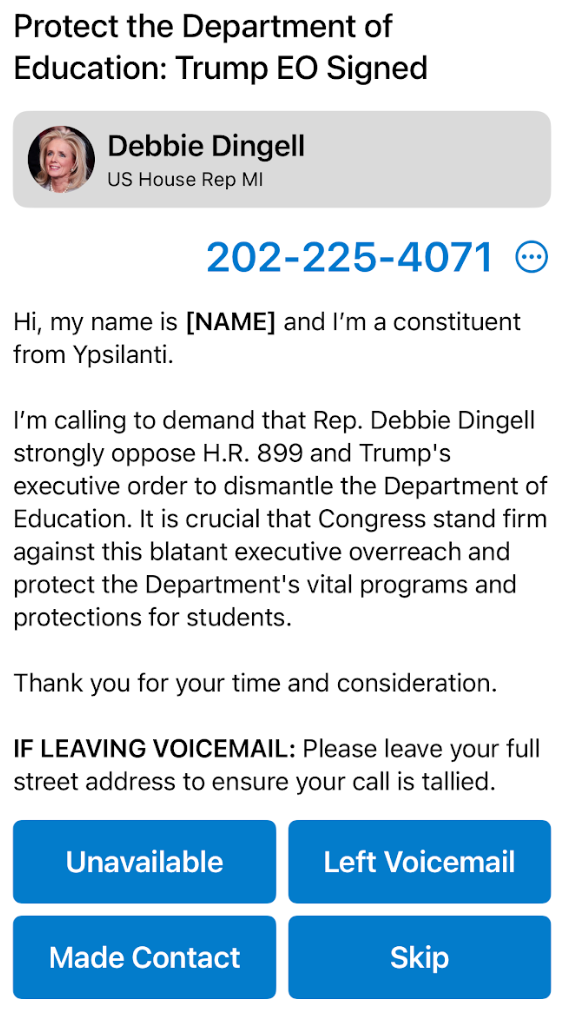
Here is how it works. Download the app, select the issue you are concerned about, and enter your zipcode. You will see a timeline of updates on that issue and a list of representatives from your district. One click later, you will see a page like this:

You click on the number, wait for an answer, read the script, and and click a blue button to register whether you left a voicemail or made contact, and the app sends you to the next number.

In just a few moments this morning I made three calls.

This may seem like something small — just like my boycotting may seem small and ineffectual to some –but if we truly believe that our government is of, by, and for the people, then we, the people, need to get involved. We need to do something when we see that our government is not representing all of the people — particularly when they are taking steps to further disenfranchise the most marginalized among us.

Look, you’re probably exhausted and overworked, too. You might feel like this is not worth your time, but perhaps you can take a journey back to your high school self, remember what it feels like to have a dream in front of you — of a career, a family, a whole adult life. Remember what that feels like? Don’t we want to make sure that every kid in America has an opportunity to pursue their dreams?

If you believe in the transformative power of education like I do, I urge you to make 5 calls — today, tomorrow, and until our voices are heard.

It’s a small decision you and I can make that could make a monumental difference for our kids, our country, our future.

Speak up … defend the rights of the poor and the needy. Proverbs 31:9

Re-post: For a Pair of Shoes

**I wrote this is Spring of 2024, and here we are in Spring of 2025. Track season started Monday, and we have a handful of kids who need running shoes. If you would like to contribute, an address is at the end of this post, or you can choose to reach out via message.

I’d been watching the girls’ basketball team all season — from the first game of their first season ever, where very few showed any evidence of having played the game before, where one girl received a “traveling” call for carrying the ball football-style while running down the court, where our players froze in place as the other team stole the ball, where the referees pulled our girls aside to teach them the rules in the middle of the game. From that game forward, I had been encouraging the girls, both on the court and in the hallways, letting them know I was seeing their progress. They were not only learning the game –the skills, the rules, and the strategies — they were also building confidence, stamina, and resiliency.

Many on the team were girls I had had the previous year in my reading intervention class. They had been freshmen– freshmen who had spent most of middle school on Covid lock-down, freshmen who had missed some social development experiences, freshmen who had very little capacity to manage challenge, difficulty, or conflict. So when I saw them during that first game, barely hitting double digits on the score board, I wondered if they would make it the whole season. Could they take the losses they would certainly face? Could they [and their coach] see this for what it was — a building year. Could these young women show up every day, practice the basic skills of basketball, and arrive at the end of the season better for it?

Only time would tell.

But here I stood at the end of the season, watching this same group of girls prepare for one of the last games. As the other team was rolling into the building, our girls were practicing an inbounding strategy while the coach called cues from the sideline. The girl with the ball slapped it loudly, and the four on the floor quickly shifted to their new positions to receive the thrown in ball. I stood on the sidelines, recording the scene on my phone, grinning with pride.

I was there to sell concessions, so I was in a little room at the corner of the gym with one eye on the game and one eye on my concession window, when I noticed that one of the players, the center, was shuffle-jogging down the court. I had noticed that she wasn’t a very fast runner earlier in the season, but I had assumed it was as fast as she could move given that she was about 5’10” and probably close to 200 pounds or that she simply didn’t have the stamina to run up and down the court for an entire game. Being the first season, the team only had about ten team members total, and typically only six or seven of them were eligible to play on any given day. Whoever showed up typically played all four quarters — that’s a lot of running for anyone, even those who are are in top physical shape.

But for some reason on this day when I noticed her shuffle jogging, my eyes moved toward the floor and I noticed that her shoes appeared to be untied. When I looked a little closer, it appeared that they were not actually untied, but in a permanently knotted state of floppiness. She could neither tie nor untie them., so the laces flopped as she ran, and the shoes, a pair of high tops that appeared to have seen some days on and off the court, seemed to be of little support in her efforts to improve her pace.

Is this the pair of shoes she’s been wearing all season? Why didn’t I notice this before?

Now look, every day at my school I see need. I see students who need food, who need new clothing, who need a haircut, personal hygiene supplies, pens, pencils, or even a water bottle, but this pair of shoes got to me.

This girl, who against all odds shows up for school every day, goes to basketball practice every day, has a C average, and dares to put herself in front of an audience of classmates, teachers, and parents, has been doing so inside sneaker head culture where the shoes on your feet can be linked to your status, your belongingness, or your ridicule. (It would take another whole post to examine the complexity of sneaker head culture within the context of high poverty neighborhoods, so let me just say that yes, a student may have brand new Jordans and still experience housing insecurity or food insecurity. It is what it is.)

This girl, despite her classmates’ comments and/or ridicule, has enough grit and determination to continue to show up on the court in these beat up kicks for the entirety of the season. That should tell you something about her.

So, I’m standing, watching the game from the concession stand, a game in which an adult in the stands got in an insult contest with one of our sophomores that escalated into a fist fight that DID NOT disrupt the game play — nope, our girls kept right on playing as security officers wrangled a punching mass of bodies out of the gym–a game in which they were down by double digits, came back to tie and go into overtime, a game where they lost by two points at the buzzer, and I’m taking in the wonder of these young ladies who could barely bounce a ball at the beginning of the season, who were making eye contact and passing, who were boxing out under the boards, and I’m understanding the impact of it all on their development — their ability to overcome difficulty, their ability to stay the course, their ability to trust themselves in difficult times.

I was overwhelmed.

A couple weeks later, after the season had ended and track season was getting started, the same group of girls was walking down the hallway, headed to practice.

“Ya’all on the track team?” I asked.

“Yes, of course!” they replied.

“Excellent!” I said.

“Are you going to come to our meets?”

“Definitely!”

And during this quick exchange, I noticed that all of the girls had on the same shoes they had worn to run up and down the basketball court all season — including that beat up pair of high tops.

And something inside me snapped.

A few minutes later I saw the track coach, “Hey,” I said discreetly, ‘I notice that K’s shoes are not really appropriate for track. I’d be happy to anonymously fund a new pair for her. Is there a way to make that happen?”

“I’ll figure out a way,” she said.

A few days later, I mentioned the situation to our athletic director. “I don’t know how many students you have that could use running shoes or spikes for track, but if I gathered a few hundred dollars, could you put it to use?”

“I would love that,” she replied. “Let me take a little inventory and see how many pair of shoes we need.”

So here I am telling this story, friends, because this is what I know how to do. I know how to tell you that having athletics is transformational for all kids — but for my students, who have experienced poverty and trauma beyond what I can imagine, who have every reason to give up hope for a brighter future for themselves, sports can offer an opportunity to practice navigating low stakes wins and losses and build the muscle they need to weather bigger wins and losses outside of sports. For my students, the power of athletics is essential.

My school is doing what it can to build programs. Two years ago, the only sports we offered were boys’ basketball, football, and cheerleading. Last year we added track. This year we added girls’ volleyball and basketball. In the fall, we hope to have a cross country team.

Teachers show up to coach, to run a clock, and to sell concessions because we see the impact of these programs on the educational engagement and morale of our students. If they aren’t passing classes, they don’t get to play, so they get more invested in their classes. When they are invested in their classes, they learn more, their grades improve, and they have more opportunity for their future.

It’s not hard to connect the dots between athletic programs and successful adulthood. We’ve known this for decades. All students should have access to programs that lead to a hopeful future, and they should have everything they need to participate in such programs.

So I’m asking, friends. I’m asking you for help — again. If you love sports, if you love kids, if you have an insufferable belief in transformation, please consider joining me in building an Athletic Shoes Fund for my students. Funds will be used to provide athletic shoes for students like K who cannot otherwise purchase their own.

Email me at krathje66@gmail.com for details on how to give or simply send a check with “DLA Athletic Shoes Fund” in the memo line to Detroit Leadership Academy 5845 Auburn Street, Detroit, MI 48228.

And if this isn’t your project to give to, I hope you’ll keep cheering us on as I keep on sharing our stories.

What a Village!

About a month ago I wrote a post (linked here) about what a challenge 2024 has been — how personal and national events have left me feeling dumbfounded and scrambling to find glimmers of hope amidst the ordinary. Then, a little over a week ago, rather unintentionally, I invited you to tangibly produce evidence of that hope — and you did!

Facing the pronounced need of some of my students at the small Detroit charter school where I teach, I, with a few other colleagues, selected what ended up being twelve families and determined to furnish them with some kind of Christmas miracle. I knew our staff alone would not be able to supply what was needed, so I asked you to be a village for my students, and you circled up!

I posted my blog on a Friday, and by Sunday, Amazon packages from a high school classmate were sitting on my porch and a friend had sent me some funds to get the gift card fund started. And the packages kept coming! As I opened each box, I saw the faces of the villagers — a woman who was my camp counselor when I was a teen, a former co-worker, a few dear friends, the parents of a former student I taught in St. Louis, and a sister- and brother-in-law. I saw them coming together to encircle my students, and the image buoyed my spirits.

Any teacher will tell you that every day of teaching in December feels like a solid week. The students are tired of being in school, yet lessons still have to be taught and programs still need to run.

This past week was cram packed, and by the end, I had lost my sense of humor. It’s probably because I expect the same level of rigor on a Friday in December as I do on a Tuesday in October. After all, that rough draft won’t write itself and it’s due on Tuesday so that we have time for feedback and editing before the final drafts are dropped on Thursday.

I get myself so wound up that I forget — still, after decades in this game — that kids are kids are kids and the fact that the calendar says Friday just does something inside the brain. Make that a Friday in December and that “something” is x10.

Anyway, I made it through last week — preparing for and co-leading a two-hour professional development session, observing and coaching three teachers, and teaching two sections of senior English each day, and only lost my sense of humor on Friday.

When the final bell rang, I settled in to finish the grading for the week, to prepare for Monday’s class, and to straighten my room before leaving for the weekend. I’d been a little amped all day, almost resembling the butt-kicking, name-taking self of yesteryear, but as I moved through my tasks, my emotions started to right themselves, and then I noticed the total in my CashApp account. In addition to my blog post ask, I’d invited our teachers to pitch in to the fund for our kids, too. These particular villagers are boots on the ground day in and day out. They are weary, of course, but I watch them hug students, hold students accountable, feed students snacks that they paid for themselves, talk students down from their own high emotions, and even give them rides home, half of their own lunch, or even the literal coats off their own backs.

Still, I asked them to give more. And they did!

Several of our teachers adopted our homeless expectant mother, purchasing everything off her wish list — items such as a blanket, a towel, shoes, and underwear. Others sent the first few dollars of their paychecks straight to my CashApp so that our students will receive what they need.

Combining the gifts from the virtual village and the on-the-ground village along with some gift cards provided by our organization, twelve (yes, 12!) families would receive gift cards that they can use at their discretion to purchase food, gas, gifts, or necessities! Additionally our pantry is restocked with essentials (seen below) for students to use now or when needed.

My principal and I texted Saturday morning, finalizing plans for purchasing gift cards and other needed items for the fun week we have planned before the break, and then we both headed out shopping. When I arrived home on Saturday evening, I was very content with what we had accomplished, and then came Sunday.

Never underestimate the power of a Sunday morning.

My husband and I had arranged to meet friends for both breakfast and lunch — it’s the cram-packed holiday season after all — and at BOTH meals, members of my village pressed into my hands gift bags stuffed with MORE gift cards to distribute to my students.

I became overwhelmed.

The needs of my students on any given day can seem staggering, and in the bitter cold of December, they can seem impossible to meet — our students need coats and food and clothes and phone chargers and rides and deodorant and feminine supplies. They need patience and hugs and accountability and grace and correction and encouragement and attention.

One middle-aged teacher can feel all alone in the face of such need, but she is not alone.

She has a whole village — on the ground, of course, but also at a distance. She can see them showing up, and cheering, and bringing water bottles and blankets and snacks.

Just knowing they are there gives her what she needs to show up for another day. On a Monday. In December.

It may look like I’m surrounded, but I’m surrounded by you.” — Michael W. Smith, “Surrounded”

The Giving Season

Since seven (yes, 7!) of our immediate family members have December birthdays, our “season” starts a little earlier than most. We have said for years that we start partying on Thanksgiving and finish on New Year’s Day. This year is no different. The birthday gifts are all but purchased, at least one package has been shipped, and our our living room is staged with “gifts in process” for both birthdays and Christmas so that we don’t miss anyone.

And each morning, I leave my comfortable home that is well-stocked with food, clothing, and this somewhat moderate collection of gifts, cross 28 miles of metro Detroit, pull into a disintegrating parking lot, enter the building, and prepare to meet the reality of the students that I serve.

Today’s reality came in the form of Kaden*, one of my seniors. I was in the gym when he entered from the bus, scowling.

“Good morning, Kaden. Everything ok?”

“I don’t know why we had school today. I almost froze to death.”

“Hey, come here a minute. You only have on a hoodie. Do you need a coat?”

“I mean, I have a coat,” his demeanor was shifting, “we just don’t have a washing machine right now, so I can’t wash it.”

“Ok, but we have coats. I can get you one this morning. Would you be good with that?”

“Yeah, that would be good. I would take a coat.”

Later in the day, I found him, we walked to our clothing closet, and he chose one of several new coats that remained from a large donation we received last year.

We have a fairly decent supply in that closet — coats, shirts, hats, and some miscellaneous toiletries and nonperishable food items — but it goes away quickly because our students are continuously in need of something.

Each day I am asked if I have something to eat — often by students I’ve never even had in class. I try to always say yes and walk students to my stash where they can select a granola bar, some trail mix, or a package of cheese crackers. Most teachers of teenagers probably have a similar routine.

I also get requests for deodorant, for socks, for cough drops, band aids, a toothbrush, or a safety pin — again pretty typical requests for teenagers, and fairly easy to accommodate. These small items solve in-the-moment problems for my students and allow them to get back to learning. I have a pretty healthy stash that many in my village help keep stocked, but when the holiday season comes around, the depth of my students’ need comes into sharp focus.

Before coming to this school, I’d never met families who simply “don’t do Christmas” but here I have met many students for whom December 25 is just another day because their families simply don’t have the financial capacity to purchase anything extra, let alone the privilege many of us have to line their living rooms with gifts, to create an elaborate feast, to deck the halls, and to gather with friends and family.

I have students who are housing insecure — one young woman whose mother died during Covid and who is currently carrying her possessions with her and bouncing between two places to “find a place to sleep”. I have students whose families bounce from apartment to apartment — one young man I spoke to yesterday said “we are definitely moving in a couple of weeks, but I don’t know where yet.” We have families who don’t have reliable transportation — who can’t join the basketball team because they don’t have a ride home after practice and have to take the school bus that leaves at 3:15. I have students who, in addition to coming to school, work to help their parents pay the bills. I have a senior whose very demeanor and aptitude scream “engineer” who is in the manager training program at McDonald’s. He often closes the store and does inventory or other related tasks that keep him up well into the night rendering him incapable of staying awake in school the next day. He’s working this hard, yet he is wearing the same worn clothes and shoes I’ve been seeing him wear since I’ve known him, which is most of high school.

Our students and their families are barely getting by. How in the world can they dream of doing anything for Christmas?

Yet these students keep showing up. They come to school, they log onto their school-issued chromebooks, they complete independent modules to earn their financial literacy credit, they come to my class, bend over their notebooks scrawling out the purpose and audience for their next essay, practice the nuance of Standard Academic English while teaching their middle-aged English teacher the current vernacular. They have big dreams — of being nurses and engineers and game designers and ultrasound technicians — and they need a whole village to rise up around them to give those dreams every chance at reality.

I’m part of their village, and I’m raising my voice to invite you to be part of their village with me.

School leaders have selected nine families who are in dire need of support this holiday season. Because it is already December 6, and we have to get items to our students before they leave for break on December 20, we won’t be filling traditional wish lists. Instead, we have set a goal of giving each of these 9 families one grocery gift card, one department store (Target or Kohl’s) gift card, and one gas gift card. Additionally, I have created an Amazon wish list of items that our students frequently request.

Joining this initiative may be a small part of your holiday giving, but it could make all the difference for a struggling family — it could help them put food in the fridge, buy some new jeans for a child, and put gas in their car so that they can visit a friend. It won’t change their whole world, but it might just change their opinion about the people in it.

All of us have many opportunities to give at Christmas. If caring for my students in Detroit is something you are interested in doing, I invite you to check out that Amazon wish list or to make a donation to our gift card initiative. To do that, you can send a check to Detroit Leadership Academy, 5845 Auburn Street, Detroit, MI 48228 or donate via CashApp.

so in Christ we …form one body, and each member belongs to all the others. We have different gifts, according to the grace given to each of us. If your gift … is serving, then serve; if it is teaching, then teach; if it is to encourage, then give encouragement; if it is giving, then give generously. Romans 12: 5-8, selected portions