
Mutual Friendship, revisit

This post, written in April 2017 and dragged back out in July 2019, was written before my current friendships really had a chance to show their strength. They’ve now proven themselves even stronger than I thought. I hope to one day reciprocate the kind of love and support I have received from my friends.

I have underestimated the power of friendship. If I sit and think about all the people I have loved or been loved by over the years, I have to admit that I have taken my friendships for granted. I have had the kind of friends who drive hours just to meet me for lunch. I have had the kind of friends who drop what they are doing to stay with my kids for the weekend. I have had the kind of friends who, after having not heard from me for months, will pick up the phone and continue a conversation as though it was started five minutes ago. But I’ve not always been that kind of friend.

Rather, I’ve sometimes been the friend who screens calls, is too busy to grab coffee, and who leaves church during the last song just so I can avoid talking after the service. Sigh. I can call it introversion if I want, but really, I’m just not always a great friend.

So, before I get bogged down in guilt and regret, let me share with you what I’ve learned recently from some of my friends.

I meet with a group of gals one morning every other week. We call ourselves The Breakfast Club. We are reading through a book together. We gather to share insights, to pray, to eat, and to encourage one another. Last week, I was headed to this group with an overwhelming emotional burden. I knew we were supposed to discuss chapter 4 of our book, but I didn’t even take the book with me. Instead, I hijacked the study, shared my burden, and asked the others to just sit with me in my grief. They sandwiched me between them on the couch, heard the story, and wept with me.

Over the weekend, I gathered with 120 other pastors’ wives from across the state of Michigan. Most of us only see each other once a year, but this sisterhood is strong. We come from diverse backgrounds, we are in different stages of life, and we have a variety of experiences, but for one weekend a year we laugh together, eat together, sing together, and study together. In the midst of that community experience, sisters share stories. They bear one another’s burdens. They encourage one another.

Yesterday, on the fourteenth day of an autoimmune flare, feeling the need for some support from others who could relate, I posted on a Facebook group for those who suffer like me. I asked a question. Just one question. Within moments the responses started. In the last twenty-four hours, twelve women have responded with information, encouragement, and shared experiences. Several of these women have been continuing the conversation with me.  I picture us all in our beds or on our couches, feet propped, joints iced or heated, phones in hand, gathering strength from one another. I’m in Michigan, another is in New Jersey; one is in Australia, another is in the state of Washington. We are different ages and surely have different personalities, political bents, and religious beliefs. We have never met or heard of each other before yesterday, but we are buoyed by one another.

When I was in college, I took a couple of semesters of sign language, and still, a hundred years later, some of the signs stick in my head. One, in particular, is the sign for ‘friend’. Like other signs, the sign for ‘friend’ requires movement. One index finger is hooked over the other —  a weight, depending on the other finger to hold it. The fingers then change places. Each finger takes a turn bearing the weight of the other. I need this visual from time to time.
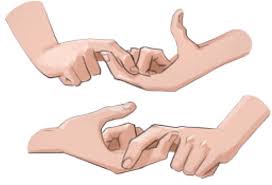
Too often I am willing to be the top finger, the one that depends on the other to hold me up. Or, I clench my fingers into a fist, determining that I will rely on no one, thank you very much.

I forget the beauty in the mutuality of friendship.

Yesterday, I opened the mail to find a thank you note from one of my breakfast club friends. She thanked me for sharing my burden last week. She said, “thank you for inviting us to cry with you.” I was overwhelmed by her thoughtfulness. Instead of allowing me to feel like I had used the group for my benefit, she implied that my request for support had been a blessing.

That’s how friendship works, isn’t it? We, sometimes without even knowing it, support and are supported by one another. And, in this mutuality, we are encouraged. We are reminded that we are not alone.

It takes some risk to invite someone into your life, to allow them to see your vulnerability, your cares, your weakness. But be encouraged; in the sharing, in the asking, you are inviting a response — a response that builds a bond of friendship.  And let’s be honest, life is much better because of our friends.

Carry each other’s burdens, and in this way you will fulfill the law of Christ.”

Galatians 6:2

Rube Goldberg

rube

You’ve seen a Rube Goldberg machine haven’t you?  It, according to source-of-all-sources, Wikipedia, “is a deliberately complex contraption in which a series of devices that perform simple tasks are linked together to produce a domino effect in which activating one device triggers the next device in the sequence.”

Artist and engineer, Rube Goldberg, drew many of these machines, like the one posted above, I think, to poke fun at humanity and our tendency to take too many steps to accomplish a simple task.  It’s just like us, isn’t it, to create a contraption that involves two people, a kitchen timer, a series of pulleys, and fire, for heaven’s sake, to get an olive out of a jar.

I was thinking about Rube Goldberg earlier today when I started piecing together the series of events that was involved in securing an appointment to get a third opinion on my medical diagnosis. You’d think it might be as simple as taking the darn lid off the jar, reaching in, and grabbing an olive, wouldn’t you?  Pick up the phone, touch a few numbers on a screen, ask a question, put a note on the calendar.  Easy.

But not really.

I’ve put the process off for a while.  Over twenty months ago, my then rheumatologist told me, not for the first time, that since she didn’t agree with my former rheumatologist’s diagnosis of psoriatic arthritis but rather thought I had fibromyalgia, there was no longer any need for me to be seen by rheumatology.  In fact, any primary care physician could manage my pain with prescription NSAIDS.  I should, she said, attend a workshop on fibromyalgia at the university and come to terms with my diagnosis.

I didn’t agree.

I had, and still have, three other members on my team. (I have written about this before.  If you want to meet my team, click here.) They supported my decision to disagree with the fibromyalgia diagnosis.  So, for twenty months, I have worked with this team and have been functioning quite well, as long as I keep my Kristin dial set at about 50-70%.  If I keep my self at a reduced level of functioning, inserting yoga, rest, physical therapy, chiropractic care, healthful eating, and regular walking, I have a manageable level of pain, psoriasis, fatigue, etc.

The problem is, that after a while of 50-70%, I get a little restless.  I think to myself, “Hey, self, you feel pretty good.  It probably wouldn’t hurt if you had three social engagements the week that you are planning to go out of town on a retreat.  I’m sure you’ll be fine.” Yeah, I say things like that to myself and I believe them. Still.  After almost four years in this adjusted reality.  Sigh.

Well, if you read my last post, you know that for about the last six weeks I have pushed myself to function consistently between 70 and 80%.  About 10 days ago, I “fell” pretty hard, and I’ve been hobbling along, still trying to keep the dial set at about 70% ever since. No surprise, I’ve still got significant pain, sustained eye symptoms, and the kind of fatigue that causes me to fumble with words, collapse on the couch, and sleep sometimes 10-12 hours at night.

So I got to thinking, as one does when she’s packed in ice, maybe I should give rheumatology another try.  Maybe 50-70% is my sweet spot; maybe, as I’ve been saying, I do my best caring and listening when I slow myself down enough to notice what’s happening around me rather than constantly pressing full steam ahead.  But maybe, just maybe, at fifty-one years old, I should explore the possibility of improving my health so that I can function at say, 80-90%.  Wouldn’t it be worth a try?

I’d had this thought before the crash, too.  In fact,  I tried to have my last rheumatologist re-examine my file.  In the large university where she dwells, I have to reach out to her through an electronic portal.  I did. A month ago. No reply.

So, last week, when I was face down, I crawled over to my laptop (figuratively, of course) and requested an appointment with her.  They gave me her next available — three months from now. Sigh.

So, I Googled rheumatologists in my area and called one that is in my vicinity.  They are scheduling four to five months out. The receptionist suggested I call another nearby practice since they have more docs on staff and might not have such a long waiting list.

Let me just say here that I really don’t like talking on the phone. I make exceptions for my parents, my siblings, and my children, but when it comes to businesses or, worse, doctor’s offices, I try to avoid phone calling like the plague.  The fact that I was willing to pick up the phone twice in one day last week is evidence of the fact that I was indeed miserable. I felt so badly I was willing to call not one but two doctors’ offices.

And you would think, like I did, that I was pretty close to getting the olive out of the jar. No, I had miles to go, my child, miles to go. The second practice said they were indeed taking new patients, and they were scheduling in the next month.  All I needed to do was get a referral from my doctor and fax my medical records.

Those were the words that Rube was waiting for. You see, my primary doc, a DO who has coached me through homeopathic remedies, advised some nutritional changes, and has prescribed the fabulous physical therapy described here, recently relocated her practice and reduced her office hours.  I sent three emails before I got a reply.  I’ll admit that that last one may have had a tone.  Ok, it definitely had a tone, which is why she called me back and left a message. She asked me to send her a detailed message fully explaining why I wanted this referral. So, I sent email number four. It was a page long.

Then, I tried to request medical records.  Here’s the thing — the new doctor’s office said they needed my medical records faxed to them. My two prior rheumatologists’ offices said they could only email a record. I plead with the new office.  After all, I had two zip drives on the desktop of my Mac.  I could send them my full record from January of 2013 until now — every test, every x-ray, every prescription — in a couple of clicks. Nope.  They “don’t receive email.”

I shared my plight on Facebook and two friends came forward with a plan for how I could use a free website to convert my documents to a fax right from my laptop.  Who knew?

So, while all those gears and pulleys were doing what gears and pulleys do, the weekend arrived and I knew I wouldn’t hear whether or not my primary care doc would give me the referral until Monday.

Saturday morning, after yoga, I was running a few errands when a friend texted me.  She and her husband had tickets to a concert that night.  They couldn’t attend due to illness, would we like the tickets.  My husband and I exchanged a few texts and decided that yes, since going to the concert meant sitting with several other couples from our church we would go.  It would be late, but we were planning on attending the late service the next morning, so it should be fine. (This is how people with chronic illness make decisions, by the way — always measuring.)  A little while later, one of the other couples who was attending the concert texted to say that several were meeting for dinner first, would we like to join.  Well, I mean, we’ve got to eat, right?  These are people we don’t know well; it would be good to get to know them better. I’d be fine to go out for dinner and a concert. (Yes, this is me, continuing to press limits even when I’m already down.)

Why am I telling you about dinner and a concert?  Because the weirdest twist was added to the Rube Goldberg machine.  Eight people at a table and my husband and I end up sitting next to a physician with the same genetic marker that I have. I don’t usually bring up genetic markers over dinner, but he did.  It was weird.  We shared stories and frustrations.  At a dinner we weren’t meant to attend before a concert that we hadn’t planned on.  The next morning, after Easter worship, this same physician waited for me at the back of the church and handed me the names of two rheumatologists at the practice I was trying to get a referral to.  He had researched them when he got home the night before and thought that of all the doctors at that practice, these were two he would recommend.

Monday morning, I had an email from my primary care doc.  She had sent the referral. Today, Wednesday, I got a phone call from the new doctor’s office.  I pulled the recommended names out of my purse while I was on the phone with the receptionist and took a deep breath before I asked if there was any chance that my appointment could be with one of them, who just happens to not only be a rheumatologist but also an optometrist.

And just when I was starting to think that the whole thing would come crashing down, that I wouldn’t get my olive after all, the receptionist booked me with that specific doctor for an appointment just under two weeks from now.

Rube Goldberg? I think not.  I know only One who can take a very frustrating and seemingly hopeless situation and make it work out better than I had asked or imagined. And do you know what? The elaborate machinery of it all, the Divine intervention of it all, has dispelled my anxiety about going to one more doctor, telling my story one more time, and risking the possibility that she won’t have any answers for me at all.

Because I know who does have the answers, and, because of that,I am not afraid.

Romans 8:28

And we know that in all things God works for the good of those who love him, who have been called according to his purpose.


I’ve fallen, and I’ll eventually get up

It couldn’t have been the women’s retreat over a month ago. It probably wasn’t the day trip over Spring Break.  Or the hours of tutoring. Or teaching two classes. Or two recent back-to-back road trips. Or the fact that I haven’t found a free hour in the past month to do any blogging.  No, not one of those things slammed me to the floor.  In fact I was standing up straight and moving around freely even through this weekend’s musical that went way past my bedtime and through the day-long festivities yesterday at our church. Not only that, I woke up today, planned two classes, graded some papers, taught on my feet for two hours and then gave a private lesson before coming home at 5 and making a double-batch of caramel corn. I had two loads of laundry folded and the ironing board set out when I finally admitted that I could do no more.  I grabbed an ice pack and found my way to the floor.

I stayed there icing through the news, Wheel of Fortune, and Jeopardy.  Then, I switched to heat for The Voice.  The ache was deep in my hips, sacrum, and sacroiliac joints. Nothing was dulling the edge.  Glass of wine?  Tried it.  No help.  Then, although I have been committed for over a year to no NSAIDS or other pain meds, I finally caved around 8:30 and took 400 mg of Ibuprofen.  An hour later I took 400 mg more.

I put myself in bed and willed myself to sleep.  No chance.  It’s been a while since my pain, which usually fluctuates between and 3 and a 6 out of 10, has climbed the scale up to what I would call an 8.  I’m calling it an 8 because I can still move — slowly and with audible involuntary groans — from standing to sitting to lying, but I can’t stay in any of those positions for very long before I determine to try yet another strategy.

Around 11:45pm, I climbed into the tried and true epsom salt and baking soda bath.  The deep ache persisted.  I stayed there for more than 30 minutes, trying to give the magic a chance to work.  Finally, I admitted one more defeat, crawled out of the tub less than gracefully, dressed, ate a banana, and thought to myself, “Have you found a limit, then?”

Just yesterday, a good friend said to me, “You need to find some time to rest.” My husband, bless his heart, also gently reminds me and then lets me figure it out. He knows that I want to seem ‘normal’, even if temporarily.  The longer stretches I have of doing well, the more I question the validity of my limitations. When I begin to doubt my limitations, I attempt to accomplish even more.  It’s a vicious cycle.

Anyone with a vague diagnosis or an invisible illness will tell you that we are our biggest skeptics.  Although we may have very difficult days, characterized by extreme fatigue, insistent pain, or a rash that erupts (right on my face, thank you very much), we also have days, weeks, and sometimes up to a month or more, when the symptoms seem not so noticeable.  We begin to question ourselves, “Surely, you aren’t really as sick as you think; certainly you can see one more student and sit through a play on a Saturday night. Toughen up a little.” It’s as though our worst symptom is amnesia — the forgetting of the consequences that come from forgetting.

When I forget to pace myself, I may do alright for a few days, or a week or a month. However, if I keep forgetting, I will eventually get a reminder. I’ve had many over the last month. When I sleep for over 10 hours in a row, that’s a reminder that I’m depleted and I probably need to take a few slow days.  When I get a psoriasis or eczema breakout, that’s a reminder. I call it the ‘slow simmer’. The symptoms are beginning to bubble up, and if I don’t turn down the heat, they are going to reach a full boil. When I notice that I have to take stairs one foot at a time, I’m probably too far down the path to avoid the crash. Yesterday, when my friend, who has noticed my pace, gently nudged my memory, I said, “Yes, if I don’t willingly take a break, it will be thrust upon me.” And in a very speedy fulfillment of prophecy, here I am.

It’s been over four years now that I’ve been living in this strange reality — the reality that was named, and then unnamed,… That’s part of the struggle, too.  I don’t know what to call this ‘thing’ that I have.  People ask me. Often. And I give some kind of mumbled reply about autoimmunity blah blah arthritis blah blah eyes blah blah skin blah blah.  By then they are more confused then I am.  They don’t understand, because neither do I, why I choose not to eat gluten or dairy if I don’t really notice a difference when I do.  If I try to explain that no, I don’t drink coffee because it cancels my homeopathic medicines, again, I just hear myself sounding like the teacher in the old “Peanuts” cartoons. Blah, blah, blah.

So, why am I writing about this at 1 o’clock in the morning? Because that’s what I have. Writing continues to be the way that I think through all of this and try to find the meaning.  And yes, I realize, I just have to go back a post or two to the last time I wrote about how blessed I am that God has provided this season of slowness, that He has allowed me time and space to be aware, to be available, to just be.  But just like every other gift I’ve been given, sometimes I don’t appreciate fully it.  I want to take it back to the store and see what I can exchange it for.  I think I’m going to find something better, you know?

If I go just a few posts further back, I will be reminded of the drawbacks of soldiering. Just typing that word calls me out, doesn’t it?  I don’t even want to go back to the first paragraph I wrote here today, because that’s what I’ve been trying to do — go back to my soldiering ways.

If I don’t stop writing here, I’ll start drawing parallels to the ancient Israelites…and it’s already 1:15 am and I’m already at over a thousand words.  So, go ahead and draw your own conclusions. By now, I’m sure you’re way ahead of me.

As for me, I repent. I’ll try to get some rest. And then I’ll probably cancel my tutoring for tomorrow.  Because sometimes even retired soldiers need a little R ‘n’ R.

Matthew 11:28

“Come to me, all you who are weary and burdened, and I will give you rest.


Making Up for Lost Time, revisit

Editor’s Note, January 24, 2019: I’m looking back at old posts and seeing how they resonate with me now. This one, in light of what I wrote on January 21, 2019, reminds me of all the ground work that God did in anticipation of 2018. While we were trudging through, my husband and I often reminded ourselves, “none of this is a surprise to God.” This post, originally written in 2017, is evidence that He knew what was coming and was preparing us in advance.

During all my years of soldiering — of butt-kicking and name-taking — I was in constant motion, often simultaneously cooking, doing laundry, answering email, talking on the phone, and granting or denying permission to one of my children.  I got a lot done.  It seems that I was able to keep a clean house, feed a family, teach hundreds of students, and arrive most places fully-clothed for quite a few years. The down side? Very little time to reflect — very little time to examine options, consider outcomes, or feel.

I’m making up for lost time. Obviously.

In days of yore (Why, sonny, when I was your age…), I looked at the myriad obligations of the members of my family, the limited functions of two vehicles, and the tight schedules my husband and I kept, and I quickly formulated and executed a plan that accommodated everyone.  I planned my work and worked my plan.  “Here’s what’s happening today,” I would say, “You two will come with me to school.  After school, while you are at practice, I will get groceries. I’ll be back to pick you up.  When we get home, you’ll unload and put away groceries while I cook dinner.  Meanwhile, Dad will take you (other child) to your different school.  He’ll go to work then pick you up after your practice, stop by Walgreens to fill your prescription, then meet us back here. We will eat at exactly 5:30 because then, Dad has a meeting, I have parent-teacher conferences, two of you have homework to do, and the third one has to be at a study session on the other side of town.”  I would hit the start button and the plan would be executed.

Nowhere was there time for contemplation, negotiation, or revision.  We were in “go” mode.  In some ways, it was necessary for the season of life we were in with three kids in high school all at the same time, however, it could’ve been handled differently. I could’ve let some stuff go. I could’ve slowed down, allowed the kids to eat cereal for dinner more often, and let my laundry pile up. I could’ve valued processing over producing. Contemplating over completing.

So, yeah, I’m making up for lost time.

I’m currently reading three books. One is a book I am reading with my Bible study gals, Ann Voskamp’s The Broken Way.  Another was given to me by my physical therapist/counselor/friend, Doing Well at Being Sick by Wendy Wallace.  I also picked up Shauna Niequist’s Bread and Wine: A Love Letter to Life Around the Table with Recipes.  Why am I telling you this?  Well, it’s interesting to me that I have time to read three books, for one thing.  Also, I notice that I am interacting with these books, writing notes in the margins, going back to my notes, and thinking about what the books are saying to me. And, third, I am intrigued by the fact that these three books are speaking to each other.  It’s like they are three friends that said to one another, “Hey, guys, Kristin’s been still for quite a while now.  She might finally be able to hear us.”

And what are they saying?  They are saying the same things that I have been discovering, thinking, speaking, and writing about for the past three and a half years.  However, I think what’s interesting is that I am noticing.  I am processing. I am digesting. I am not more interested in completing these books than I am in connecting with them.  I am not compelled to finish them; I am drawn to understand the meaning they have for me.

And really, the meaning is this — my soldiering is done. Even though I’m tempted almost every day to go back to that life, I am no longer capable. God, in His mercy, has chosen a better way for me.  He has allowed limitations in my life — real physical limitations — that stop me from soldiering so that I can live a life that reflects, that feels, and that makes space for others. Because on my own, I wouldn’t have stopped soldiering, guys.  I would’ve keep right on kicking butts and taking names.  God had something better for me. Yes, you heard me right. My “broken” life, my life with the limitations of chronic illness, is a higher quality life than my “un-broken” life.  In fact, my “broken” life is more whole than the “unbroken” one was.

It’s a paradox, to be sure. God is often paradoxical, isn’t He?  His brokenness makes us whole.  By His wounds we are healed. He turns our mourning into dancing. He doesn’t always make sense, but today I’m not going to question Him. I’ll just thank Him.

I Peter 2:24

“He himself bore our sins” in his body on the cross, so that we might die to sins and live for righteousness; “by his wounds you have been healed.”

Swan-dive to Mundane

I was sitting in the waiting room of my physical therapist’s office yesterday morning, thumbing through a People magazine.  I was early for my 8:15 appointment, so she was still moving around me, tidying the office.  She greeted me, of course, and I continued to “read” meaningless celebrity “news”.

“Have you done any blogging lately?” she said out of nowhere.

“No,” sigh, “I’ve been kind of in a funk.  Writing would probably get me out of it, but I just haven’t found my way there in a while.”

“Yeah, it really centers your spirit, doesn’t it?”

Man, we haven’t even started my PT yet and she’s already getting at the core.  How does she do that?

The last time I blogged, I was sitting in Jerusalem.  Today I am sitting, still in pajamas, on the futon in my office in my little house by the river. Then, I was floating high on the experience, the relationships, the food — have I mentioned the food?  Today, I am back in the mundane — classes, laundry, tax preparation, and the like.

It’s a lot easier to write about the fantastic, isn’t it?  It’s lovelier to live in the beautiful. However,  we do most of our dwelling in the ordinary, so coming down from the extraordinary sometimes involves a crash landing. And crash I did.

Some of the crash was circumstantial.  I went from touring brilliantly-farmed land lush with oranges, strawberries, and figs to trudging across frozen tundra.  I transitioned from touring on a bus full of enthusiastic learners who scored one another’s jokes, sang together, laughed together,   and cried together, to spending a lot of time on my own sorting receipts, preparing for class, and putting away suitcases.

Some of the crash was self-inflicted. My doctor had recommended before the trip that I do a 21-day elimination diet to see if any foods were causing my pain and/or inflammation.  I postponed it until after the trip (yes, the trip where we ate like kings three times a day), but started immediately when we got home.  For the past three weeks, in addition to not eating gluten or dairy (both of which I have avoided for three years), I also eliminated soy, corn, citrus, peanuts, pork, and it seems like most everything else.  Oh, and at the same time I finished weaning myself off Zoloft.

Yeah, I’m nuts. I mean if you’re going to come off the mountaintop, you might as well swan-dive, right?  The thing about swan-diving, though, is that you can go pretty far down pretty darn quickly.

The casual observer might not detect the shift in position — from mountaintop to deep, dark valley.  The physical therapist?  The husband?  Oh, they saw the shift.  I did, too.  I could feel the snark, but I couldn’t shake it.

It probably didn’t help that we came back right before the presidential inauguration and all the virtual “noise” that ensued , because I certainly have difficultly not engaging with all of that.  And, rather than turning to my writing, which I know is an outlet for my emotions, I instead turned my gaze to the other things that need my attention — grading, a project I started for my in-laws a year ago, unfinished tax prep — and I thought to myself, it would be pretty selfish of you to sit down and blog for an hour right now.  You have other people depending on you.

And I believed that voice.  I muted the truth that says, “Oxygenate yourself first.”  I forgot that “in repentance and rest is my salvation; in quietness and trust is my strength.”  I trudged onward, avoiding my need for self-care, while attending to tasks that preserved the facade — cleaning the house, preparing for teaching, ironing clothes, cooking…anything but taking the pause that refreshes and centers my spirit.

So, after a sermon on Sunday about suffering and the encounter with my physical therapist who noted that my body is “all over the place,” I give up.  I turn to the keys.  I am honest.  I’ve been struggling, but I’m turning, guys.  I’m turning.  It might take a minute, but I’m turning.

Psalm 30:1ff

I will exalt you, Lord,
    for you lifted me out of the depths
    and did not let my enemies gloat over me.
Lord my God, I called to you for help,
    and you healed me.
You, Lord, brought me up from the realm of the dead;
    you spared me from going down to the pit.

Packing bags

A week ago I packed a suitcase with jeans, yoga pants, an MSU T-shirt, and tennis shoes. I was headed to Cincinnati to visit our son, daughter-in-law, and granddaughter.  I pictured lots of snuggling and laughing, a glass of wine or two, a Spartan win, and a weekend of refreshment.

I was disappointed on all counts.

We were supposed to leave on Friday morning, but I became ill and had to watch, instead, as my husband left to take the trip on his own. No snuggling, no wine, and I don’t want to discuss what happened to the Spartans.

Granted, I was thankful to have the time to recover. I read an entire book.  I crocheted two scarves.  I laughed quite a bit with my son. I watched an entire season of Call the Midwife.  Yes, it tugged at my heartstrings when my husband sent me photos of our granddaughter, but I knew I was where I needed to be.

This week I’m packing my suitcase again.  It’s a much bigger suitcase for a much bigger trip.  I’ve packed dresses and slacks, gifts and snacks, and all the necessities to carry me through a week in South Africa.  I’ve got to admit that, looking back on how last week turned out, I’m a little anxious.  Just one week ago, I was fully planning on going to Cincinnati, but I didn’t make it.  Today I am fully planning on leaving for South Africa in forty-eight hours. What if I feel this Friday like I felt last Friday?

It could happen.  After all, I didn’t have the flu or a head cold; I had an autoimmune flare. I felt like I’d been hit by a truck while recovering from the flu.  I call it “getting knocked down” because I am literally doing fine one minute, and then I notice that I feel nauseous, my guts are in knots, I have all over body aches, and I can’t do anything but lie in bed.  That’s phase one, which lasts a few hours.  During phase one, I typically am so uncomfortable that I can’t even read or watch Netflix.  I usually fill a tub with warm water, epsom salt, and baking soda, slither in and lie there groaning.  After about an hour in the tub, I can usually move on to phase two.  During phase two, I eat popsicles while reading or watching Netflix. I put an ice pack on my right SI and heated flaxseed pillows across my abdomen to continue the soothing that started in the tub.  This past weekend I moved in and out of phase two for about forty-eight hours.  I got spurts of ambition during which I organized my desk, graded papers, and did laundry, but then I headed back to the couch.

Traveling to South Africa is ambitious. It would be ambitious if I wasn’t teaching and tutoring.  It would be ambitious if I didn’t have an autoimmune disease.  It’s super ambitious because I am teaching and tutoring and I do have an autoimmune disease. Last weekend, while lying on the couch watching the fourth or fifth episode of Call the Midwife, the thought might have crossed my mind — what, are you crazy? Who do you think you are?  Why are you even going on this trip?

Why, indeed? I probably won’t be able to fully answer that question until I get back.  That’s usually the way with these things.  We were invited. We’re going.  While my husband has some ‘official business’ while we are there, my role, as far as I can see, is more to be a witness to what is happening and, possibly, to write about it.  That’s my hope, anyway.

But I can’t help but wonder what else I will find in South Africa.  How will this adventure shape my heart? How will it alter my views?  How will it direct my path?  I don’t know, but I want to find out.  So, I’m trusting that God, who provided the opportunity for this trip, will provide the health that I need to get on that plane this Friday.

God is faithful; won’t He do it?

Psalm 89:8

Who is like you, Lord God Almighty?
    You, Lord, are mighty, and your faithfulness surrounds you.


Just a little Crabby

I’ve been a little crabby lately.  I’m not new to this experience. In fact, my high school senior class voted me ‘moodiest’.  Yeah, nice of them; I know.

When I was a child, I was often scolded for crying too much, laughing too loud, and pouting too long.  I felt things — excessively.   I stomped, I slammed, I wailed, I jumped up and down, I yelled, and I screamed.

Most of these emotions were the response to the every day experiences of a kid — if my brothers picked on me or I didn’t get my way, I often cried to my mother, wailing about the injustices of life. If I got a good grade or a new pair of jeans, I likely beamed from ear to ear and informed everyone in my immediate vicinity.  If something was funny — I laughed. Loudly.  (I think my laugh will have its own blog post one day; I’m not sure I can contain it in one little sentence or paragraph.)

Anyway, early on I established myself as an emoter.  As time went by, I learned that not everyone is fond of such demonstrations of feelings, so I tried to contain them.  Really, I did.  I tried to bridle my tongue.  I tried to put the best construction on everything.  I tried to look at the bright side.  And guys, I have succeeded from time to time. I have; ask anyone!

But when the rubber hits the road, I am what I am.  And sometimes, friends, it ain’t pretty.

In fact, over the years, as I’ve mentioned in this blog, I have engaged in therapy to work through my feelings about all the events of life.  I wasn’t just sitting at home sipping tea when the idea popped into my head, “You know, I think I will go see a counselor and examine my feelings.”  No, it looked more like sobbing into a pillow feeling hopeless, yelling irrationally at a family member, or locking myself in the bathroom to rearrange a cupboard when we really needed to get in the car because we were expected at a social engagement.  I’ve gone to therapy because my feelings and my inability to appropriately process them mandated a change.

During a couple of those periods, my health care professionals suggested that I try taking anti-depressants.  Indeed, many members of my family have struggled with depression over the generations; I am a bit pre-disposed.  And, to be honest, these medications served their purpose for a period of time.  The first time, I only used them for about a year, if I recall.  Recently, I have been taking a low-dose of zoloft for about seven years. I like to think that this medication has dialed my emotions back a little and has allowed me to manage some very difficult periods.

Some people don’t like to talk about such things, but I think we’ve already established here that very few topics are off limits for me.  I don’t think taking zoloft is any more taboo than taking amoxicillin. They are both pharmaceuticals that work with the chemistry of the body to affect change. I’ve taken plenty of amoxicillin in my day; I’ve also taken zoloft.

On my current quest toward wellness, I have fallen out of love with traditional medicine, particularly the pharmaceutical industry.  (That’s a topic for another blog post.) I have found the most benefit for my personal maladies in less conventional methods –dietary choices, exercise such as yoga, pilates, and swimming, visceral physical therapy, nutritional supplements, and homeopathic remedies.   I took the risk of eliminating my biologic and anti-inflammatory medications at my doctor’s suggestion and found that my symptoms, after a period of adjustment, were no worse without them.   So together we decided that I would take the next step and gradually and cautiously reduce my anti-depressant dosage.

When I first eliminated my anti-inflammatory medication, I was pretty miserable.  My body, used to having that drug, rebelled when it was deprived.  My pain levels increased predictably.  My fatigue also increased.  My doctors warned me this would happen.  I expected two to three months of adjustment, and that’s about what I got. Eventually my body adapted and created its own response to the pain.  Now, several months later, my pain is at the level it was while on the medication.

So I don’t know why I didn’t expect a similar transition period when weaning off zoloft. Maybe because I was on a low dose to begin with.  Maybe because I am taking three months to totally remove it from my system.  Maybe because my life is so much different now than when I first started taking it so many years ago.  I expected to gently slide through the transition with little to no difficulty.  And truly, the first three weeks were pretty easy.  However, I’m no doctor, but I can tell you that the levels of zoloft in my blood are lower this week than they were last week.

I’m quicker to the snap.  I’m edgy.  I’m surly.  I’m easily irritated and slow to recover.

It’s to be expected.  So why do I judge myself so harshly for this?  I didn’t judge myself when my pain increased; why do I judge myself when my irritability increases.  After all, both changes are a response to a chemical change — a withdrawal from medication.

I want so badly to have a good attitude about all of this.  I want to be able to smile in the face of adversity.  I want to be understanding when Verizon can’t figure out my technical issues after an hour each on live chat, the telephone, and direct message. I want to laugh, loudly and often.  I want to smile, genuinely.  But guys, I’m a little (ok, a lot) crabby at the moment.  It is what it is.  This too shall pass.

Romans 8:18

I consider that our present sufferings are not worth comparing

with the glory that will be revealed in us.

Danger! Danger! Danger!

One dichotomy of thinking that I have clung to in various ways for most of my life is a bit embarrassing to admit:

If I am thin, I am valuable; if I am fat, I am detestable.

This belief led to a certain degree of self-loathing in my adolescent and young adult years and then propelled me into the disordered thinking and distorted body image that supported an eating disorder and remnants of one for much longer than I would care to admit.

‘Thin’ as defined by me has meant a variety of things. Its worst definition was a denial of self — a refusal to care for my needs in favor of controlling my body to attain and maintain a particular size.  Over the years, the definition morphed into something more socially acceptable — a particular dress size, for instance, that could be maintained through regular exercise, an aversion to excess, and a more private critical eye that was still always trying to find a way to weigh just a little bit less.

‘Fat’ as defined by me has meant anything over a particular number on a scale, laziness, apathy, and a refusal to take charge of one’s life.  I had been ‘fat’ in my younger years.  I didn’t like myself then, and I wasn’t going back.  I had control over my body.  Fat people were simply ‘less than’ me.

See why I am embarrassed?  I had put myself into a category, ‘thin people’, and, in so doing, had positioned myself in opposition to those outside of that category.  Now, in my defense, this was not conscious.  I would have never admitted this out loud.  I pride myself in treating people fairly, not judging a book by its cover, but looking on the inside to find value and worth.

But, I’m admitting here that I have been a hypocrite. And, as with almost every other judgment I have made in my life, my judgment of ‘non-thin’ people has had more to do with what is inside of me than what is inside of them.

I know this because in the last three and a half years that I have been dealing with health issues, I have been slowly putting on weight.  It’s now up to twenty pounds.  My clothing size has changed.  The number on the scale has exceeded my ‘safe number’.  I don’t like how I look.  I don’t like how I feel.

I’ve been trying to accept it.  I have bought some new clothes.  I have done a lot of self-talk.  I have continued to exercise.  I have continued to watch what I eat.  I keep telling myself, “this is not a failure; it is a disease.” Or, “you don’t have control over this, you will have to adapt.”

So last week when I went to see my doctor, I said, “My weight keeps climbing.  It edged up again this time, didn’t it?”  I think inside I was hoping she would say, “you don’t have control over this, you will have to adapt, it’s part of the disease.” But do you know what she said?  She said, “I want you to keep track of everything you eat for a while, so that I can see what is causing this.”

Gasp. You mean it’s something I am doing? I might be able to control this?

Danger! Danger! Danger!  All the alerts are going off in my head.  Keeping track of what I eat was a gateway to anorexia over thirty years ago.  Each day I tried to eat less and write down less. If I write down what I eat now, I will fall back into this disorder.  I can’t do that!  I have to let myself eat whatever I want.

Did you hear the dichotomy? Either I eat whatever I want, or I will have an eating disorder. It’s simply not true, but this is challenging territory.

Can I be attentive to what I eat without being restrictive? Can I assess what I am eating without the pressure to trim down? Can I trim down without dieting? Am I comfortable allowing my doctor to see everything I eat (or don’t eat)?  Am I willing to let her speak into this?

Before I could go too far down the rabbit hole, I blurted out in her office, “I used to be anorexic….” Phew! I got it out.  “Well,” she said, “we don’t want to get anywhere close to that, but we do want to make sure that what you are eating has a healthy ratio of fat to protein to carbohydrate.”

I didn’t initially want to follow her directions.  And then, I wanted too badly to follow her directions.  I started thinking, “well, I could lose those twenty pounds and get back into all of my old clothes….” That’s all it takes for me, really.  Just a quick thought and I am off and restricting.  Quietly.  In private.  Hiding my plans from others who might want to stand in my way.

For the first three days I recorded what I ate quietly on my phone app without telling anyone.  And, of course, I limited what I was eating so as to ‘eat less’ than the prescribed number on the app. Sigh.

Then, I told my husband about the app.  Now I am telling you.  I am not going to believe the dichotomy any longer.  I have value and purpose regardless of a number on a scale or a dress size.  My weight does not define me.  I can watch what I eat without being restrictive.

I can evolve past this dichotomous thinking.  God has so much more for me.

Romans 12:2

 Do not conform to the pattern of this world, but be transformed by the renewing of your mind. Then you will be able to test and approve what God’s will is—his good, pleasing and perfect will.

Marvel with me

No wallowing today. Period. I declare this a day of marvel.  Want to marvel with me?

First, I got out of bed after only 40 minutes of wakefulness today!  Woo-hoo!  And what did I find after I had maneuvered from horizontal to vertical?  A fresh blanket of snow reflecting a beautiful sunny day.

Second, having gone to bed without a lesson prepared for my 1pm class today, I woke to purposefulness, started with the end in mind, and prepared a process-oriented lesson that will allow my students some practice in critical analysis.

Third, while I was preparing this lesson, I heard from a couple of former students. One young man who I spent several years trying to convince of his giftedness shared a link to his recent appearance on an AOL sponsored webcast in which he brilliantly articulated the power of technology as a platform for young black voices (Here’s his link.); similarly a  young woman who was in my first high school class in Missouri shared her Christian maturity via social media. I get to know these brilliant young people!

Fourth, I found a forgotten gift card I received for Christmas and purchased two new pillows online.

Fifth, I discovered that a savings bond that we received as a wedding gift over twenty-five years ago will more than cover the cost of passports for me and my husband.

Six, I was offered a position teaching composition to high school students in a summer program at the University of Michigan.

Seven, I get to teach college students in just a couple of hours.

Eight, I get to work with two middle school students later today.

Nine, when I sat down to write, I first read a blog post by another former student. She reminded me that although I am prone to wander, my wandering never satisfies. Here’s her blog.

I read my devotion this morning and it reminded me that just as I have been blessed with following in the footsteps of many faithful believers, I am granted an opportunity to leave some footprints of my own.  I’d hate to spend all of those footprints on the path to wallowing.  So, I’m taking the opportunity, once again, to turn.

My life is rich. I am blessed. I’m just going to marvel at that today. Hope you’ll join me.

Psalm 71:17

Since my youth, God, you have taught me, and to this day I declare your marvelous deeds.

Beloved, regardless of wallowing

This must be anti-wallowing week!  What is it about February that induces the blues like no other month on the calendar? Yes, it’s cold.  Yes, it’s gray.  But, come on, it’s only 28 29 days.  How bad can it be?

Well, for an experienced wallower, it can be pretty bad, can’t it?

And I’ll admit, I’ve been a wallower this morning.  I woke around 8am.  I always feel the worst right when I wake up.  Every joint and muscle aches, and I feel somehow attached to my bed.  It typically takes me 30-60 minutes to convince myself that I will feel better once I get out from between the sheets.  Today it took closer to 90.  I didn’t have to stay in bed, but I chose to lie there, read Facebook, Twitter, and email, and take my turn on a dozen or more games of Words With Friends.

That, my friends, is professional-level wallowing.

I am not saying that to judge anyone out there with chronic illness — I know it’s rough, and I know that sometimes bed is where you need to be — I am just saying that for me, today, my first 90 minutes were spent wallowing.

It sounded something like this: “I don’t feel good. I ache. I’m tired. I’ll just lie here a few more minutes. I don’t have anywhere to go this morning anyway. My first appointment is at 3.  I need the rest. I’ll get up soon.”

Thank goodness I have a bladder. It recognized the situation and fired off a red alert.  “Emergency! Emergency! You need to get out of bed now!!”  I can always count on my bladder.  It forces me to pause in my wallowing.

Once I had taken care of the first order of business, I made my smoothie and my tea, and I sat down to my work for the day.  I was able to help a student on a couple of documents she needs to submit for a class and interact with a few friends on Facebook before I got a notification from a friend reminding me that my husband had given the message today at Concordia’s chapel service.

And then I was tempted to resume wallowing. “Seriously, Kristin, you couldn’t get yourself up and dressed in time for a 10:30 chapel service? What’s the matter with you?  You aren’t that sick!  Stop wallowing!”  You got it, my wallowing was perpetuating more wallowing!

And right then I had a choice — go down that path, or turn.

Today, I turned. If you’ve been reading this blog for any amount of time, you will know that I was once again ‘shocked’ that my Bible study for today directly applied to this situation. The words “I’m sorry” jumped right off the page at me.  Of course there were many other words, but I think “I’m sorry” was bolded and in 24pt font.  And what am I sorry for?

I’m sorry that I have forgotten to be content in all circumstances.  I’m sorry that I have forgotten the blessing of this next chapter — yes, I am not the person I once was, but that gives me an opportunity to not be the person I once was. You know what I mean?

I am no longer functioning at my best when I leap out of bed at 5:30am to conquer the world and everyone in it for fourteen or more hours.  I am now at my best when I amble into my day at a slower pace, when I notice who is posting what on Facebook, when I am aware of what is happening in the world, when I can offer encouraging words to a graduate student I have never met face to face, when I can sit next to my dog, read a devotion, and reflect on the thoughts I am having and the way I am feeling.

I didn’t take the time for any of that in previous chapters. I was busy trying to achieve, trying to manage it all, trying to be perfect.

I needed to pause from my wallowing this morning to remember that I was not meant to be “be-perfect”; I was meant to be “beloved”.

I am beloved even when I wallow. I am beloved when I stop wallowing.  Nothing I do can change the fact that I am beloved.

Hebrews 13:5

be content with what you have, because God has said, “Never will I leave you; never will I forsake you.”