What is Needed

Often in this space, I write about the students at my small charter high school in Detroit. From time to time, I share their needs and invite you to partner with me in meeting them. One time I mentioned the need for athletic shoes, and a handful of you helped me purchase about twenty (yes, 20!) pairs for our track athletes! Other times, I’ve asked for support at Christmas, and some of you have sent items from an Amazon wish list, purchased gift cards, or simply sent cash. It’s not always the same people — some of you are local to me, some are friends from way in the past, and some of you I’ve never even met — but when I ask, the needs of my students always get met.

This past week, not having the time or inspiration for a complete blog post, I just flung out a request via social media. I said we had 8-10 families with extraordinary hardship that we’d like to send on their holiday break with grocery and gas gift cards. I’ve been coordinating efforts like these for five years or more, and my school community has come to count on the fact that “I’ve got a lot of great friends.” However, every time I ask, I momentarily wonder if the magic will continue — will people see my request? will they want to contribute? Then I usually remind myself that “before I am asking, He is answering,” and trust that God will provide.

This week was no different. That Facebook ask was just a week ago and we have plenty of donated cash and gift cards to support ten families in ways that they are not expecting — what a fun day our principal will have later this week, handing fat envelopes over to families who have no idea they are coming! I can’t know the impact your gifts will have!

So, first, let me say thank you to those who stop by to read my posts about education, my health, politics (gasp), and the things I am learning, but also to those who choose to contribute to students they have never met. I am astounded by your generosity that keeps showing up at just the right time. Even sometimes when I haven’t asked, a need is just around the corner, and you have met it in advance. Thank you for your heart, for your thoughtfulness, for your care.

Now, let me tell what I learned this week about what kids really need.

A few weeks ago, a teacher who is somewhat new to our district, a woman who just has a way of connecting with kids — the kind of teacher who kids show up to school for, the rare one who can get a whole room to lean in and listen as she walks step by step through a procedure, the kind who can glance up from a demonstration and silence a chatterbox without saying a word — this teacher mentioned to me that she’d like to put on a Christmas event for our students, did I think that would be ok?

I, thinking of our students’ physical needs, immediately (and wrongly) assumed that she wanted to coordinate the giving effort I have just described, and I directed her to speak with our principal. I thought it would be a great idea to pass the baton. LOL. It took me a couple of weeks to realize that what she was planning was very different than what I was assuming. She had a vision for a night of games and fun for a select group of students — a meal, prizes, and gaiety. No presents, nope. Instead, these students would “pay” the entry fee of a donated hat or mittens for someone less fortunate than themselves.

You heard me. She wanted our students — all of whom qualify for free breakfast and lunch — to make a sacrifice to be there. And not just anyone could attend. It was invitation only — kids who consistently come to school, kids who lean into learning, kids who lead, kids who volunteer, kids who do the right thing.

This was so far off my radar that I couldn’t picture the impact until I actually showed up.

The teacher asked her church to donate a meal, and churches being what they are, they had a crew walking in with wings, fries, mac and cheese, and green beans in chafing dishes that they placed over sterno pots.

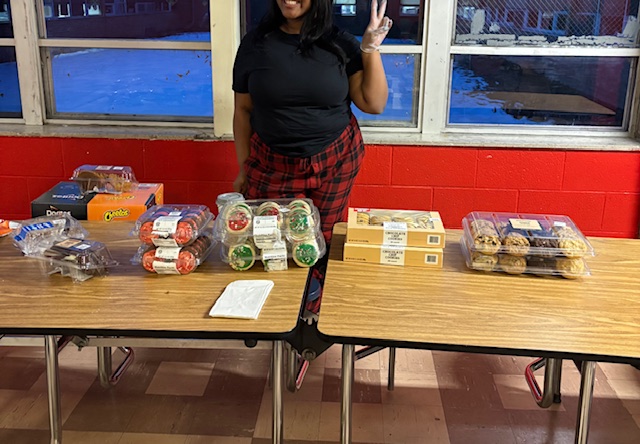
She asked our staff to donate water, cookies, and prizes for the games — each category filled a table.

“What can I bring,” I asked around Tuesday when most of the above had already been donated.

“I have hot chocolate. Would you bring toppings?”

“Toppings? Like whipped cream?” I asked.

“Yeah, and I like mini chocolate chips, and sprinkles, and marshmallows…you know, to make a self-serve hot chocolate bar.”

“Ok, I can do that.” I said.

Since I was headed to the grocery anyway to pick up gift cards with the cash that some of you had sent me, it was easy to throw a few more things into the cart.

“Oh,” she said, “one more thing. Would you go around to the classes on Friday and hand out tickets to the ones who can attend?”

“Sure. Whatever you need,” I said — before I realized that this would mean handing them out in front of kids who were not invited. This was a struggle for me — little miss equity this and access that — but, I did it. It was uncomfortable saying, “I’m sorry, you are not on the list. This is an invitation-only event,” but I had to trust my colleague’s vision.

School was dismissed at 3:30 and a crew of students moved to the gym to set up. They were in charge of decorating and setting up the space for the meal, the games, the celebration. While they were doing that, I retreated to my office to finish an administrative task. When I arrived shortly after 5:00, students clad in Christmas pajamas were personalizing their hot chocolate, greeting their friends, chatting at tables, and listening to Christmas music. You might expect this at any Christmas party, but in this community’s world of scarcity, it felt different.

Teens who are normally just trying to get through the day — to get a ride to school, to find something to eat, to stay warm, to manage all the expectations of all the people around them — were free just to be.

And then, the silly Christmas games began!

Asked to find a partner and line up in the gym, students who typically display reluctance to engage, jumped out of their seats, grabbed hands, and ran to the designated location. They tossed miniature Christmas ornaments into cups, they played a version of Head, Shoulders, Knees, and Toes, and they raced to steal Christmas bows that were stuck to each other’s shirts (the one who ends up with the most wins)!

They laughed. They played. For a few moments on a Friday evening, they were allowed to be kids.

Students who typically have to put up a hard exterior — who have to save face — in this small group of students felt safe enough to put their guard down and be silly.

And that my friends was exactly what our students needed. They needed a safe space, they needed to feel like contributors, they needed the extravagance of a meal prepared just for them, of a hot chocolate bar, of games with prizes, of a fun Friday night with their friends. I sat and took it in — smiling, laughing, snapping photos — and realizing that I need to broaden my view of what is essential.

Friends, I am likely going to keep asking for contributions, so thank you in advance for tolerating my boldness and joining when you choose, but I am also going to open my eyes to what else my students need. I’m going to look for more opportunities to acknowledge all of Maslow’s hierarchy (not just the the foundation) because the sense of connection, of respect, of fulfillment are just as essential to developing teens as food, as transportation, as shelter, as safety.

Hats off to my colleague for leveraging her community to meet these needs. In doing so, she also challenged me.

God will meet all your needs. Philippians 4:19

Life These Days

The question of the moment around folks my age — and for the record, I’m just shy of 60– is “how much longer do you think you’re gonna work?”

My most frequent response is often something like, “I’m not in a hurry to be done. I love what I do. I hope I can stay at it a while!”

This is, of course, not how everyone feels. Many my age have put in a long, hard 40 or more years of work in jobs and careers that have taken a toll — physically, mentally, relationally, or in other ways that might make a person want to walk away.

Let’s be honest, if you’ve spent 30-40 years on an assembly line — you might be ready for a change of scenery. If you’ve led a corporation and had the weight of the bottom line, personnel challenges, and inventory management on your back, you might be ready to sit by a pool, sipping a cool drink. If you’ve been in a classroom for 40 years — attending to the needs of children, designing instruction, managing behavior, and adapting to continuously changing policies, cultural norms, and learning challenges, you might be ready to just have a day that doesn’t involve managing anything but yourself.

And while I have certainly had my challenges and seasons of disillusionment and burnout, none of those scenarios truly describe me. After working in many different settings over the years, I find myself in a role that feels like a culmination — the place I was intended to arrive at, so I don’t find myself asking how much longer I want to work, but rather: When I look back at all I have learned, what do I have to offer these days?

In the early years — the first 3-5 of my career — bravado carried me past insecurity so that I could survive in situations that were way outside my experience. A middle school special ed classroom in Detroit? No problem for this secondary English major from small town Michigan! A self-contained classroom inside a residential facility teaching not only ELA but also social studies, math, science — I got this! I faked my way through and while I can’t say that my students (or I) won any awards, everyone learned something — including me. I learned about being overwhelmed and about working with limited resources. I learned to lean into the uncomfortable and to try just about anything. Did I occasionally lose my shit and come undone in front of a classroom full of typically behaving students? Sure. Did I also take a van load of Detroit teenagers on a day-long adventure to Ann Arbor? Yes, I did! Did we overfill our day with activities? Absolutely! Did we arrive back to school late after dismissal? We sure did! Did those kids and I have a ball touring a college campus, going to a hands-on museum, and eating at Pizza Hut? Yes! Rookie me swung for the fences, folks.

The bravado only carried me so far into my years at home with my own children. In fact, I think it was day one home from the hospital when I called a friend emergency-style to come save me because nursing wasn’t working out according to plan. I wish I would’ve admitted right there and then that I was clueless about mothering, but faking it until I made it was my theme song, and I just kept singing. Before I knew it, I was sitting on the living room floor with three children of my own, reading stories, learning letters, and playing games. Those days were exhausting and precious to me! We had a lot of fun, but I was making it up as I went along, so I certainly made plenty of mistakes. I pushed myself and the kids way too hard, and I expected way too much, but in continuing to give it everything I had, I learned how to schedule out a day that included learning, adventure, rest, and play; how to turn a few hot dogs and some popcorn into a baseball watching party; and how to get through a puke-filled night with little to no sleep. I learned that I could manage much more than I imagined, that I had a lot of people who were willing to help, and that it wasn’t a weakness to ask them.

When I returned to the classroom the first time, it was to a position that was far bigger than my experience — the English Department Chair and Dual-Enrollment ELA teacher at a small private high school. Not only would I, once again, be faking it ‘til I made it, I would be doing so all day long in a new environment while I was also still —at home — learning how to parent my own children who were in the process of transitioning from childhood to adolescence in a new home in a new city in a new state.The lift in both arenas was immense, but I was gonna make it happen. I learned a curriculum, read dozens of books, short stories, poems, and essays and adapted to a modified block schedule and the world of Apple computers while I also navigated the needs and ever-changing emotions of a family that was struggling to find its footing. For nine years, it seems, I was in constant motion — either preparing to teach, teaching, or grading in one space or cooking, cleaning, driving, scheduling, or otherwise parenting in another. Those years seem like a blur as I look back, probably because I never stopped running.

And then, all the motion came to a halt. Readers of this blog know that those years ended in an autoimmune diagnosis and an exit from the classroom followed by convalescence and a [next chapter] of re-learning how to live which landed me where I am now.

I came into this season humbled by the knowledge that I did I have a limit, and that I did not indeed know everything. When I was offered the position to teach ELA at a small charter high school in Detroit, I was grateful to be in any classroom at all. The fact that it was familiar territory — teaching seniors about college and the skills they would need to be successful — meant that I would NOT have to fake it til I made it. I could just be the authentic me, sharing what I know and loving the students who were in front of me. Granted, I still had much to learn — our school has an instructional model that was new to me, and I would, for the the first time in my career, have a coach, but none of that was overwhelming. In fact, it was comforting to know that I had support and that I wouldn’t have to find all the answers on my own.

That was over five years ago, and now I’m no longer teaching but coaching other teachers who may be in their very first year or nearing their 10th or 20th year. Some of them are faking it until they make it, some are disillusioned, and some are managing a lot in other areas of their lives.

I have a front row seat to their experience and that’s why I’m asking myself this question: What have I learned and what do I have to offer these folks?

I’ve learned that showing up and doing your best goes a long way — even if your best isn’t amazing, it’s likely good enough.

I’ve learned that being brave can lead to remarkable opportunities that change you forever.

I’ve learned that others are willing to support you if you are willing to ask.

I’ve learned that family is much more important than work and that your health needs to take priority over any perceived deadline.

I’ve learned that who I authentically am is much more valuable to my students and the people I love than getting every decision right or accomplishing every task.

I learned these things the hard way over the last many years, and maybe these folks — the people I rub elbows with every day and those that I coach — will have to learn them the hard way, too.

I think what I have to offer right now is the empathy and compassion gained from my own journey. I have a rare opportunity to offer support and encouragement, and the wisdom that comes with each of these gray hairs.

I’ve got perspective — each day is important but no day is definitive.

I’ve got plenty of gas left in the tank to come alongside the members of my team, to see their passion, their frustration, their hope, and their fatigue. If they are willing to keep showing up, I will, too.

Maybe I’ll get a chance to share what I’ve learned. More likely, I, too, will learn something new.

Teach us to number our days, that we may gain a heart of wisdom. Psalm 90:12

Capacity

Did you ever wonder what your capacity is? How much you can truly hold, carry, manage, or deal with? Have you, like me, recently found yourself staring that limit right in the face?

Yesterday, I walked into my principal’s office for a meeting we had scheduled. She was wrapping up a conversation with a student who had lashed out at a classmate because she “just couldn’t do it today” — she couldn’t handle his joking, couldn’t deal with the annoyance.

“Every other day I can just ignore him, but today wasn’t that day.”

“You didn’t have the bandwidth?”

“Nope.”

“I get it. I’m glad you’re talking about it. We all have days when we have reached our limit.”

At the age of nearly 60, I’ve had loads of days where I have reached my limit. When I was a child, I might’ve reached my limit quite quickly — I might have fallen to pieces simply because it was time to leave my grandparents’ house. When I was in high school, like the student above, a classmate’s comments might have pushed me over the edge.

But here’s the thing about life, as you move through it, you build muscle — and capacity — and you are able to manage much more than you ever thought possible. Still, everyone of us can find our limit.

I mean, everyday life can be seemingly at the “this is working” phase — you’ve finally found something that resembles work/life balance. You can meet job demands and also attend to the laundry, meal prep, family needs, and even routine maintenance of the house and the car. In fact, you can also easily manage your role in meeting the ongoing life and healthcare needs of an aging family member. You’re feeling pretty good because you also managed to budget for and schedule your participation at a weekend family vacation/celebration in the first quarter of the school year and you’ve plotted out on the calendar how to keep all systems functioning while you are away.

But then.. just as you are packing your suitcase, a major household system (think HVAC, plumbing, or electrical) has a major issue.

“No problem,” you announce boldly. “We’ve prepared financially and we can deal with it fully when we return.” You’ve been through enough difficult situations in your life that you know this isn’t the end of the world. A frustration? Yes, but meltdown worthy? No.

You merrily leave for the event, and upon your return home just a couple days later, you realize that said major household issue could possibly still be an issue, but it’s late, and you’re tired, so you try to get some sleep.

You wake the next day, to “knock out” a deliverable on a pre-arranged work-from-home day, only to realize it’s not the kind of thing that can indeed be “knocked out” in a day, so you lift up your concern to a supervisor who directs you to “just A, B, and C”, so you spend a few hours doing A, B, and C, and then your supervisor’s supervisor drops into the group chat and says, “No, A, B, and C won’t work. So, I’m just going to complete this deliverable so that you can run with it,” and your face falls flat. You close your laptop and go for a walk.

Did you let your supervisor know that you were annoyed? that it bothered you to spend time on a project that was subsequently dismissed? Did you perhaps have a tone? Did you perhaps register your complaint a bit too strongly and too repeatedly?

Perhaps. But have you hit capacity? Not even close. You can’t even count how many frustrating days you’ve had at work, how many hours you’ve spent on projects, or how many times you’ve had to toss the product of hard work.

However, while you were elbowing your way through your work day, your husband was discovering that the major house issue has actually turned into a much more major house issue involving multiple contractors, several estimates, insurance adjustors, and scheduling.

“Ok,” you say, taking deep breaths, “we are still ok. We’ve gotta keep doing yoga, keep eating right, keep walking, keep writing, but we’re ok.”

Your husband, thankfully, continues to manage most of the house details, while also meeting his own professional responsibilities, and you pinch hit when needed while juggling the demands of yours.

The next weekend arrives and while he stays home to continue project management, you head north to support the aforementioned family member. The weekend is less than demanding, and you catch up on sleep, before returning home in time to eat, rest, and return to work on Monday morning.

The work week starts out typically, but on Tuesday, things start to pile on. The family member needs additional medical tests, you learn the work on the house isn’t scheduled to start until December, and as you leave work, you find yourself driving through a torrential downpour so that you can make an appointment for a routine oil change. After waiting for an hour and managing various pieces of correspondence, you learn from the technician that it’s time to replace the tires and she has prepared you with three separate quotes. You can feel your affect going flat just as you receive a notification on your phone that the storm has caused a power outage at your house.

And that was it.

You hit capacity. You couldn’t talk about it. You couldn’t process it. You had not one shred of bandwidth.

You drove the 20 minutes home in silence, made your way into the house, and plunked into a chair by the window overlooking your husband who was trying to start an uncooperative generator.

You needed food. And sleep. And something to shift.

Somehow, the two of you found your way to a vehicle, drove to a restaurant, ordered food, ate it, and returned home. You had cleaned up and crawled into bed just before the lights came back on and the furnace kicked in.

[Thank God.]

The next day the repair date was moved up to the first week in November.

[Exhale.]

The family member was seen by the doctor and a plan was put in place.

[OK.]

The tire replacement was scheduled.

[We have a plan.]

Just enough shift happened, and somehow, everything seems manageable again.

For now.

Take it from this old head, wherever you are in life, trying times are going to come and test your capacity — you may lose your mind when someone eats a bag of corn chips that were intended for the evening meal, but the experiences of today are building your capacity for the difficulties of tomorrow. And, be assured, tomorrow will certainly have difficulty — maybe just an irritating boy at school, possibly just a flat tire on the way to work, hopefully just a major house system repair that can be done and dusted in the space of a month. We need those light and momentary troubles so that we can manage it when the shit gets particularly real. And that will happen, too, I’m sorry to say. That will happen, too.

And at those times, you may find you have reached capacity — you may find you don’t have words, or reason, or the ability to make a meal. I pray you discover you are not alone or without hope. I pray that something shifts and you find that once again have some capacity.

[Indeed…] in this world you will have trouble, but take heart [I have endless capacity,] and I have overcome the world. John 16:33

Back to School: Before and After

I write a post like this almost every year — scroll back, you’ll see! Each fall, I can’t stop myself! I’m still filled with the child-like wonder and excitement of going back to school. I mean, yeah, I had outfits picked out, bought a new pair of school shoes (okay, two pair!) and kept them fresh for day one (and two!). I had my classic teacher terror nightmare — only this year it wasn’t me showing up naked, late, and unprepared, it was my teaching cohort! And I’m here to tell you that the stress was not less!

I get so excited about the return to school because it holds so much possibility — imagine the potential for transformation!! And in any story of transformation you need the “before” pic. Let me see if I can paint it for you.

The students first showed up on the Thursday before Labor Day. I can spot the freshman from a mile away. They shyly and awkwardly accompany their parents and older or younger siblings. They stand quietly as their people sign them in, looking around to see who else is there, who is looking at them, who is judging them, who can see their insecurity.

Sophomores roll up with slightly more confidence, sometimes with a parent tagging along ten paces behind. These students steal glances, seeing what looks familiar — teachers, friends, anything.

Juniors have just a hint of swagger — they know the drill — they know who’s who, what’s what, and where’s where. They quickly run through the requisite stops — schedule pick-up, bus sign up, sports physical — then find their friends to take laps inside the building, check out new students, get into a little harmless mischief, or do a little peacocking.

Seniors? You can’t tell them nothin’. They have their hair done, are wearing a dope ‘fit, and have texted their friends to arrive at the same time. They run this place — they are beaming and bouncing. This is their year and they know it.

And that’s all on the Thursday before school even starts — before the three-day weekend, before reality hits, before they have to arrive on time, sit in an assigned seat, do the coursework, take notes, stand in lines, or listen intently.

But all that has begun now, too. We have finished a week of students being in the building, running to get to class before the bell, asking permission to use the bathroom, looking for a snack, trying to hide their phones, getting caught with their phones, turning over their phones, and waiting to get their phones back at the end of the day.

They came in on Tuesday, and we were ready for them.

Our teachers had on shirts emblazoned with our Activate Excellence motto, arriving early to put finishing touches on their rooms and man their stations in the gym for arrival. We had some teachers collecting phones, some handing out schedules, and some stationed as greeters. There were hugs and fist bumps and hand shakes with our returning students, so it wasn’t difficult to pick out those who are new to our building — freshmen, of course, but also quite a few transfers.

In Detroit, a district with over 50,000 students, most high schools have enrollments of over 700, and some have over 1000. Our charter high school is small — under 300 students — so we often get students who found those larger contexts to be untenable. Maybe they were overwhelmed. Maybe they didn’t find a connection or friend group. Maybe they got into a fight and are now dealing with the aftermath. Whatever the reason, we often end up with a unique collection of students who for whatever reason couldn’t or didn’t want to make it happen somewhere else.

We’re a charter school — so students choose to come to us. Granted, sometimes that choice is because they have run out of other options, but I like to think they choose us because we are a small community. Everyone knows everyone else — no one goes unseen. If you came to school without a jacket, someone saw that. If you look particularly down or quiet on a given day, a person noticed. You’re hungry? You know who to ask for a snack. You don’t have a ride home? Chances are you have a connection with a staff member who will help you figure it out.

Changed your hair? We saw it.

Grew up over the summer? We know.

Your ability to manage conflict is improving? We give you kudos.

Let me give you a glimpse at an “after” pic.

For the past four years, we have had a student in the building who was classified as “homeless” and qualified for resources under the federal McKinney-Vento Act. Last June, this student graduated despite having transportation challenges, learning difficulties, and very little family support. Staff at the school made it possible for him to attend prom and participate in all senior activities, and the young man was repeatedly overwhelmed with gratitude. When he walked into our decision day celebration in early May, he hugged several of us and wiped away tears. When he arrived at prom, he approached staff members, tearfully repeating, “I can’t believe this is actually happening!” and when he showed up for graduation, he could barely find words. He savored every moment, and his classmates and teachers saw it for what it was — the realization of a dream.

On that day, he didn’t know what his summer or future would look like. Because of his situation, he was having difficulty getting access to the documents that would make him work eligible, but late in summer we received word that he had what he needed and had found employment in a hospital. This past week, he reached out to one of our staff members and said he was working a lot of overtime and was looking for an affordable apartment.

The staff member reported this in our group chat, and I must say that in the middle of a school day at the end of the first week of school, when everyone is getting tired and ready to go home for the weekend, that little notification reminded us all what a special place we work in.

Just four years ago, this young man was one of our awkward freshmen — he missed a lot of school days, and we noticed. He often came unprepared to learn, and we said something. He had the support of a friend who got him to the building every day, but he came late and left early. It was frustrating, to be sure, but we found ways to work with him. He had the support of the social worker, the principal, the resource room teacher, and literally every single adult in the building. It was not uncommon to see him checking in with one of our custodians who might as well be everyone’s momma.

And now he’s a high school graduate, he’s got a job, and he’s looking for an apartment. If that’s not a transformation, I don’t know what one is.

I guess that’s why I get excited every September — that’s why I can’t stop writing about it. Every day is a miracle waiting to happen. I can’t believe I get to do this. Just like my student, “I can’t believe this is actually happening.”

[We] will see the goodness of God in the land of the living. Psalm 27:13

Job Postings at DLA!

DLA Wishlist

It’s complicated

The seemingly unintelligle words of hospice — one month, a few days, 48 hours, probably today — all started making sense and then were undeniable. My stepfather took his last breath in the early morning hours last Saturday. In the days that followed, we gathered, made arrangements, gathered again, handled details, cared for our mom, and came to terms with the fact that my stepfather, Roger, is no longer here.

We’re still working on that last part, of course, and for me, the essence of our relationship makes it little complex.

While many found him charming, Roger and I had what was often a prickly relationship. We didn’t agree on hardly anything — politics, the setting on the thermostat, the way to wash dishes, vacuum a floor, wipe off a table, or do just about anything. I found him to be demanding, opinionated, and critical. I often felt great irritation toward him over our 50-year relationship, probably because I always felt that he usurped the position that should’ve been held by my father who I have long-adored and often idolized, likely because he and I haven’t had many opportunities to interact on politics, the thermostat, or dishwashing.

Because of this complicated relationship with Roger, it came as a great surprise to me when I found myself feeling tenderness, compassion, and love for this man as he declined, as he lost his agency, as he forgot where he was, as he was unable to breathe, as he was confined to bed — a man who rarely sat still, who worked and golfed and bowled and rode a motorcycle halfway across the country. I was stunned to watch my heart shift from irritation to caring, advocating for, and comforting this man who has been an annoyance in my life for most of my life.

When my mom married Roger, she had four kids aged 8-14. He had two kids aged 8 and 10. Together there were three boys and three girls — just like the Brady Bunch, which was in vogue at the time. For a few years, the eight of us took vacations together and hung out together, but as we turned into teens and then adults, we were rarely together. In fact, my three birth siblings and I have only managed to all be together on a dozen or so occcasions in the last 30 years, and the six of us “kids” hand’t been together in the same room for close to 40 years before we all gathered on a Monday night for pizza a year ago.

Who knows how this happens — people are busy with their own lives, and if one person doesn’t act with intention, folks never come together. But last year we did, and then, miraculously, Roger took his turn for the worst just as we were scheduled to all be in the same state again this past month.

We all worked together — getting him moved in to assisted living, taking phone calls, running errands, and sitting by his bedside. We took shifts. His daughter, who claimed the overnights, fell asleep holdng his hand that last night, saying, “Good night, Dad. I love you” and reading him the 23rd Psalm.

We crammed in a small room at the funeral home — writing an obituary, picking out flowers, deciding on printed materials, then shared a meal with our mom, who kept saying, “I can’t believe this is happening.”

And then, on Wednesday, we all rolled in — the six kids, and our kids, and even some of their kids. Because of the nature of this complex family, some cousins met each other for the first time. Some nieces and nephews met their aunts and uncles for the first time.

Families can be like this, can’t they? Frustrations can lead to fractures and before you know it, you’re meeting your brother’s kids for the first time, marveling at their kids, and watching your own kids (and nieces) interact with their new-found family with curiosity and grace.

I probably won’t ever understand the complexity of Roger — why he was the way he was — but I can celebrate the fact that despite my irritation with him, he remained invested. He cared for my mom to the end (even if that in itself was complicated) and he cared for all of us in his own way, too.

Mom and Roger married when I was 10, and maybe because of “ew — cooties” or that previously mentioned loyalty to my dad, I rarely let Roger touch me — not a hug or a pat on the back, let alone a kiss on the cheek. So imagine my surprise when near the end, I found my hands on his waist steadying him, or when I agreed to scrub his back when he couldn’t shower himself, or when he grasped my hand to say goodbye, or when I kissed his head to reassure him when he was afraid.

We don’t know the love we have inside of us that is sometimes buried under hurt or anger or a little girl’s longing for her actual dad, but it is there, and it surfaces when it matters — when you need to sit beside a hospital bed, empty a urostomy bag, or say “I’m sorry this is what’s happening right now. I know you want it to be different.”

It doesn’t mean I don’t love my dad or that you could ever take his place. It means that I saw you show up and hang in there, even when I found you to be annoying, critical, demanding, and cootie-infested.

It’s complicated, that’s true. Much of life is.

Rest well, Roger, I’m pretty sure it was complicated for you, too.

Love one another. John 13:34

Rested and Ready for a new Rhythm

I wrapped up school year 2024-2025 –watched another group of seniors cross the stage into adulthood, entered final grades, and cleaned up my classroom.

Next, I joined my husband in clearing the clutter in our home.

Then we left town for two short treks — one to play with our granddaughters in Ohio and another to lie on the beach of Lake Huron. We crossed the miles listening to podcasts and chatting about everything from family to politics to music to our future. With our grand girls we lazed in the pool, played Uno and Skip-Bo, and were entertained by intricately choreographed dances. Near the beach, we ate well, slept long, took leisurely walks, and lost track of time.

They were luxurious and welcome — these two little trips back to back — and now we are re-entering real life. Since we’ve returned home we’ve been in the business of unpacking, doing laundry, tending to yard work, and taking stock of the new rhythms we are noticing since a) my husband transitioned from an almost four-decade-long career in church work to a private counseling practice and as b) I am making the shift from classroom teacher to full-time instructional coordinator. Some of the work each of us does in our new roles is similar to what we have done in the past, however, the routines and workloads are quite different. While he has been adapting to his new rhythm for over eighteen months, my real shift begins this week as I embrace the responsibilities of my new role.

How will it be the same? How will it be different?

What won’t change is my morning commute — I will still drive 30 minutes east from Ypsilanti to the edge of Detroit. I will park my car in the same spot, work with many of the same colleagues and students, and follow the same daily bell schedule and school year calendar. I will also continue to serve on our school’s leadership team, meeting at least weekly to plan initiatives and events, troubleshoot current issues, and collaborate toward best practices for our building.

However, many things will change — I will no longer have my own classroom. I will no longer have my own students or a grade book or lesson plans or the responsibility for all that happens inside a teacher’s classroom through the course of the day — behavior management, attendance, organizing materials, and managing the constant flow of information.

I will have plenty of new responsibilities on my plate. In addition to coaching the instructional moves of a handful of teachers like I did last year, I will also be partnering with those teachers to unpack curriculum, analyze assessments, and plan instruction. Further, I will be our building’s testing coordinator, responsible for all things PSAT/SAT, ACT Workkeys, and MSTEP.

All of this, of course, is in the interest of our students. I came to this position because I recognize the systemic inequities in American education that have benefitted some students (mostly white and affluent) and have disadvantaged others (mostly low-income and/or students of color). I wanted to lend my years of experience and expertise in service of closing the gap that continues to widen; I wanted to provide a high level of instruction and rigor for students who have, through no fault of their own, fallen multiple grade levels behind their peers who live sometimes just a few miles away.Over the past five years, I feel I have had limited success. I have, within my classroom, provided glimpses of rigor, moments of engagement, and small gains for individual students.

However, individual teachers in isolation cannot overcome centuries — literal centuries! — of harm. They do make a difference, of course, but for the sweeping change that is needed, we need a broader — a more systemic — solution.

I joined the team at my school in August of 2020. Covid had sent all of our students home the previous March, and because of the disproportionate impact on low income communities of color, particularly Detroit, our district provided instruction virtually for the entire 2020-2021 school year. The administrative team was making it up as they went along, and I — a teacher returning to the high school classroom after a six year hiatus — was enthusiastic about giving it my best. I popped into Zoom rooms, chatting with any students who would talk to me, leading lessons, and providing office hours every afternoon. We didn’t close any systemic gaps that year; we merely did what we could to slow the ever-widening distance between our students’ academic progress and that of those in neighboring districts.

The following year (2021-2022) , fully masked, we returned to in-person learning, bouncing back to virtual instruction several times throughout the year. It actually took us that year and the next (2022-2023) to re-establish routines within the building. We were on pretty solid footing as we started school year 2023-2024, but some mid-year leadership changes kept us from moving too far forward.

The standardized test scores told the story — about a tenth of our students were proficient in English Language Arts and none — 0% — were proficient in math. Our staff took in those realities as our newly appointed principal delivered them before the return of students in the fall of 2024. She gave us the hard truth and then cast a vision for us — we, the staff and our students, would activate excellence. We could no longer allow this to be the reality for the students in our building — things were going to change.

And, over the year I did see evidence of shift — in attitude, in practice, in thinking. However in order to overcome systemic inequities of the proportions that I have witnessed, we need a reimagining of what school likes like in our context. The principal sets the tone, and she has. The leadership team has come alongside our principal, supporting her vision, agreeing with the need, and implementing strategies. Staff members have also caught the vision, to a degree, but the kind of transformation that is needed is going to take the whole team — every teacher, every paraprofessional, every custodian, every social worker — to activate excellence, consistently and continuously, day in and day out.

Certainly in my own classroom, I have strived to provide excellent instruction, to have high expectations, and to inspire my students toward greatness, but I will admit that my efforts have sometimes been inconsistent. I have grown tired, and I have from time to time been merely mediocre. However, as I step into this role, I have been given an opportunity to activate excellence beyond my classroom — taking care to do my very best with the responsibilities I have been given, and to bring other staff members along with me.

I will push my team of teachers — some of whom are experienced, some who are brand new — toward excellence. Together, we will grow this year, beginning by building relationships, but then quickly moving into strategies, into accountability, into doing whatever it takes to activate excellence for our students — to give them the tools they need to move forward into their futures.

It’s a big job, but I’m rested, I have the vision, and I’ve been equipped. May God grant me the strength to persevere, the compassion to both see and inspire my team, and the heart to sustain my insufferable belief in restoration.

He is faithful, and He will do it. I Thessalonians 5:24

Clearing the Clutter

Click to listen. Sources and resources linked in text.

My husband and I just completed the minimalist challenge. For the month of June, each of us found items around the house that we were willing to toss, donate, or sell — one item on the first, two items on the second, three items on the third, and so on. (The last time I did this — in 2014 — is chronicled here in my blog, starting with this post.) As we’ve been purging — through our clothes, our kitchen, our books, our garage, and our storage — our kids, our friends, and our siblings have said, “How? You guys are already minimalists!”

And it’s true! We moved halfway across the country twice — paring our possessions each time — and we are pretty committed to hanging on to only what we use, but still we were able to find [over] 465 items each. No, we didn’t count sheets of paper or even individual pens and pencils, but we did count individual books, unused kitchen utensils, extra T-shirts, pairs of shoes, decades old journals, dusty trophies, and extra picture frames. The first 10 days we hardly had to move beyond our bedroom closets to find items we were no longer using!

So what inspired us to do this now? It’s a good question that could probably be answered by looking back at our experiences over the last year or so.

Maybe it began when we started spending more time with our aging parents. As their health declines, we’ve heard them say over and over, “What is going to happen to all this stuff?” We look around the room, around the house, around the garage, and we wonder the same thing — what indeed will happen to it? Last summer, I was staying with my mother while my stepfather was in the hospital, and I posted two treadmills that hadn’t been used in decades on a Facebook free group . Within a day someone had come to get them, and I registered the relief on my mother’s face — she was so glad to be rid of them! A few months ago, as we made room for a hospital bed, we found a new home for a large desk. Again, my mother said, “I’m so glad someone else could use it!”

While I have been with my mother seeing all her “stuff”, my husband, in the aftermath of his mother’s passing, has been sorting through all of her stuff. He’s touched countless items that had accumulated in 88 years of life and has often come back to our place with treasure or two but also with an intent desire to eliminate excess — to rid ourselves of anything that we do not need.

After all, extraneous stuff leads to clutter that can prevent us from seeing the things that are important to us.

This “stuff processing” has been happening against a political backdrop that is itself cluttered with a different shocking headline seemingly every day. It can be hard to sift through all the noise to find the issues — particularly the ones that seem meaningful to us. From the recent bombing of Iran and the role of the US in Gaza and the Ukraine, to the pending legislation that threatens to cut Medicaid, raise the debt limit by $5 Trillion, and increase the budget deficit by 2.4 trillion all while providing tax cuts to the wealthy (5 Calls), we find ourselves wanting to register our protest, and one way that we are able to do that is by considering where we want to spend our money and what we want to spend it on. What do we need? What companies do we want to use to meet those needs? What do we want our money to support?

We have been re-evaluating almost every expenditure, and it turns out that when you take a step back and look carefully at your life, you truly don’t need much.

Living in America has taught us otherwise, hasn’t it? We are barraged with ads from morning to night showing us “stuff” that we “need” that we can purchase with a single click. We don’t even have to leave our homes — a package will arrive sometimes the very same day! Wouldn’t our lives be just a little bit better with that new outfit, better shoes, handy tool, or sweet technology?

Purchasing is so easy that we don’t often consider the cost — to our bank accounts (a mere $20 once a day adds up to $600 a month) or to the environment (A report by Oceana estimates that Amazon alone created 208 million pounds of packaging waste in 2022.) Further, we don’t often look at who is profiting — is the handy new travel bag I’m considering made in the US? in China? What are the workers being paid? Who is getting the majority of the money I am spending? What are the other impacts of this purchase? What materials were used? Do the materials hurt me or the environment?

Each purchase, though easy to make, can have complex meaning, if we are willing to take the time to consider it. And I guess that is what we have been doing — considering each possession, each purchase. We want to be careful that our lives don’t become so cluttered that we fail to see what is important.

Each of us, in sorting through our stuff will deem different items to be of value.

What does it say about me that I still (after eliminating over 900 items from our house) have a few dozen writing implements on my desk, a stack of empty notebooks waiting to be written in, and more greeting cards than I could ever possibly send?

Why did I choose to hold on to those things and not the journals I have written in for more than thirty years? Why did I feel ok about letting go of crystal that we got for our wedding but not a jar of paper clips? Why did I keep baby blankets that haven’t been used over 25 years but toss plastic mixing bowls that I used last month?

It’s interesting to see what matters when you start combing through the stuff.

This latest round has trimmed away some excess, but I feel there is more that needs to go — but what leaves next likely won’t be possessions, those are fairly easy to eliminate. No, next might be attitudes and judgments, habits and pastimes.

It’ll be easier to see what needs to go next now that we have cleared some of the clutter.

Let us lay aside every encumbrance…and run with perseverance the race that is set before us. Hebrews 12:1-2

“Money” Moments

Eight days. That’s it. Eight more days with this group of seniors, and then, I might possibly be done with my years as a classroom teacher.

I’ve known this was coming. Last summer I took the role of Instructional Coach at the same school where I’ve been teaching since 2020. I interviewed, accepted the position, and came to terms with the fact that I would not be in the ELA classroom even for school year 2024-2025. But, things being as they are in the world of education where teachers are hard to come by, my replacement was not found. So, a long-term substitute took three sections from my previous load, and we crammed all the seniors into the two classes that I would cover.

It was my idea. I’ve been teaching senior English on and off since the fall of 2005, and angsty as they are, these are my people. They are wrestling to find their path from childhood to the world of adults, and that path (let me assure you) is quite circuitous. One day they are presenting their goals for their future via slideshow from the front of the room, the next day I stop them from throwing paper wads at each other. One day they applaud a peer who got accepted into college, the next day I’m having a conversation with them about how we don’t always have to announce when we smell someone’s body odor or flatulence. One might stop by to explain that they’ve been absent because they’ve been “going through it” and another might blurt out “you got any snacks?” in the middle of a lesson.

Yes, they get under my skin. Yes, they do indeed at times offend my sense of smell. Yes, they do give me a challenge every day of my working life, but these students, year after year after year, these seniors, have helped me to learn, to grow, to evolve.

One of this year’s seniors interviewed me this week for an article he’s writing for another class. His questions showed me that he sees me: “Mrs. Rathje, why do you take so many steps each day?” They showed me that he wants to make a connection: “What made you want to be a teacher?” And they showed me that he wants to gauge my commitment to him and our community: “Do you like teaching here?” That conversation gave us an opportunity — to sit one-on-one, knee-to-knee — to see each other not as teacher and student, but as two humans who are sharing the same space for a small season of time.

That is the money of teaching, friends — those intermittent interchanges that happen when you least expect them. These moments are what I treasure most from all my years in the classroom.

All year, I have navigated two roles — instructional coach in the AM, ELA teacher in the PM — and since I’ve known it was a transition year, I have tried to see ways that I can experience these same kinds of moments with the teachers that I coach. Most of the time our relationship looks like me observing a class then meeting with the teacher afterward to provide feedback — data and my observation of moves that were impactful and less impactful. Many of the teachers in our building lack experience, training, or certification, and my role is to facilitate their transition to being more experienced, more skilled, more effective. This path, too, can be circuitous. Teaching is hard work — all day long our teachers lead classrooms full of students at various levels of skill and engagement with the task of capturing the attention of 100% and providing them with high-level instruction, all while following our school’s instructional model and managing multiple interruptions.

One day I observe a teacher greeting his students at the door, providing them directions as they enter, and ensuring that all students are engaged in the day’s learning. Three days later, I notice that same teacher hasn’t replied to my email, is late to a meeting, or didn’t notice the student sitting in his room who was supposed to be in a different class.

Just like with my seniors, I am not looking for perfection; I am looking for growth.

I must confess this is hard for me. Any student I’ve ever had will tell you that my expectations are high, and if they are high for students, they are exponentially more so for the teachers of those students. I didn’t come out of a medically imposed leave from teaching to do a substandard job for students. No. I returned to the classroom in the middle of Covid because of the vast inequities in America’s school system. I came back to push the bar higher for students who have been historically underserved, under-challenged, and undereducated. I am not trying to enable low expectations for either my students or their teachers.

Yet…

Yet, I have learned from a couple decades worth of students (not to mention my own children), that folks don’t want to meet your expectations unless they know that you love and accept them for who they are. If I don’t love and accept you when you are late to class, smell of weed, and don’t know what unit we are on, what are the chances that you’ll be able to hear my expectations let alone take a swing at them. If I don’t hug you in the hallway, why should you listen to me when I approach you at your desk. If I can’t hear your request to use the bathroom or get a drink of water, how will you hear me give you feedback on a paper.

Over the years, it’s gotten easier for me to love a kid, even when they are disruptive, even when they are failing, even when they skip my class. I used to be very judgmental, but I’ve learned that judgment pushes kids away; love draws them closer.

I was tempted to judge one of my teachers recently. I was walking to my classroom one morning when I noticed a group of students standing outside a classroom instead of going in. “What’s going on here?” I asked, “why aren’t you all going in?” The students replied that the principal was inside speaking with the teacher. They intimated that the teacher was “getting in trouble” for something. I was curious, but instead of getting more information, I moved the students to my classroom to give the teacher and the principal room to speak. For all I knew, the conversation was of a personal and unrelated nature, and it was none of my or the students’ business.

However, later, when the teacher wanted to speak with me, I found out that they had been reprimanded. They had made a poor choice in the heat of the moment and things had escalated into the realm of unprofessionalism. We were sitting one-on-one, knee to knee, and this teacher was expressing regret and shame and the desire to undo what had been done. And in that moment I knew what to do. Years of parenting and teaching missteps had taught me that what this teacher needed was not judgment, but love. So I gave it. I heard the confession and acknowledged the regret, “Oh, wow. Yeah. That’s unfortunate.” I affirmed the teacher’s record, “This is not your typical m.o. I’ve seen you many times manage similar situations with finesse.” I heard their concern about the impact of this action on their relationship with the principal, “I see what you mean, yet I believe our principal to be fair, and I know she values opportunities to restore.” I encouraged the teacher to give the situation some space and then to circle back to the principal for a follow-up conversation. I finished with, “This moment does not define you; it’s unfortunate, but it’s over. You’ll get past it.”

In that moment, I saw it. I was going to miss my classroom for sure, but I wasn’t going to miss the money moments. They might be fewer and further in between, but I would still get opportunities to experience rich human to human interactions with the teachers I would be coaching. Even better, I might be showing them the impact of such conversations in a way that could inspire them to seek opportunities to engage similarly with their own students.

I am certainly going to miss my classroom, but here’s to loving my new students.

For of his fullness, we have all received grace upon grace. John 1: 16

Educational Break

On Thursday afternoon, I tidied my classroom, finalized some grades, and walked away from school and toward my Spring Break. The mere thought of not having to set an alarm for 10 days would’ve put a pep in my step if I’d had any pep left at all, but I did not.

All teachers are exhausted by this time in the year. Even though we had Christmas break, even though we might’ve had a long weekend or even a full week off in February, we’ve been, since September, coordinating learning for our students, planning multiple presentations each day, keeping records, reporting to our supervisors, and (and this is the most draining part) making countless in-the-moment decisions:

What is the first thing I need to do when I walk in the door?

Do I have an extra stapler, know where more chart paper is, and can I laminate another hall pass for Room 117?

No, you can’t go to my classroom unattended; yes, I can get you a bandaid; no I don’t know where Mr. Smith is,

You can’t go to the bathroom right now, but ask me again in 10 minutes.

Yes, you can take that pencil, borrow that book, eat that snack.

You sit over here; you stay there.

Yes, your topic sentence is solid, but no, that is not an adequate example.

You’ve used AI here, and you must re-do the assignment.

You’ve used AI here, and you cannot re-do the assignment.

Yes, you can turn it in late. No, the deadline has passed.

Yes, you can work with a partner. No, you can’t get the answers from a peer.

This is non-stop all day long, but teachers, while keeping this decision-making machine running, must also, intervene in interpersonal conflicts, address misbehavior, meet demands for mandatory documentation, and, oh yeah, provide high quality instruction.

And most of us are happy to do all of this. We see each piece as necessary for supporting human development, for preparing the next generation of humans for meaningful life in our society. We’re teaching our students to co-exist with one another, to manage themselves, to hold themselves accountable, to read, to write, to identify a career, and to begin to take steps toward attaining that career. We’re in this work because we like kids but also because we believe in the power of education to create possibility for students of all backgrounds and abilities and to create a better future for all of us.

In the school where I work — a small charter school on the edge of Detroit, where 99% of my students are Black, where 100% of the students qualify for free breakfast and lunch, where almost all of the students are below the national average in reading and math scores by no fault of their own but because of centuries-long inequity in education–the teachers, like me, believe in the transformative power of education. We see it as an opportunity to not only change lives but to save lives.

In addition to the exhausting work that teaching is in any context, teachers in buildings like mine have the added weight of wondering if our kids have enough to eat, if they have a home to sleep in, if their home is safe, if they will have what they need for the next 10 days, or if they will be alone, hungry, cold, or in danger. Our students have the same needs as any students in the country, but they have additional needs as a result of poverty that stems from systemic inequities that go back through the history of our nation — school segregation, red-lining in real estate, unconscious bias in hiring practices, and other elements of historical and current systemic racism.

So, you might imagine how I am feeling, heading into a much-needed break while simultaneously worrying about my students’ welfare, to learn that the president of this country has ordered the Director of the Department of Education to dismantle it.

You may say, “Settle down, Kristin, most funding for education comes from the state.”

That is true, most money for education comes from the state — but do you know what does come from the federal government? Funds that make a difference for students like mine. For example, Title I, which provides $18 million to low-income districts. It’s not enough to make up for the economic disparity between neighboring districts, but it’s a start. The Department of Education also provides IDEA (Individuals with Disabilities Education Act) funds to the tune of $15 billion to help districts provide additional resources to students with learning disabilities, cognitive impairments, and other diagnoses such as autism. Source.

Furthermore, the US Department of Education manages Federal Student Aid for post-secondary education, providing over $120 billion annually in grants, loans, and work study that allows students like mine to dream of a career. And not just students like mine — I myself relied on federal money to get my degrees, didn’t you? Source

Can you imagine what might happen in communities across the country if high school seniors no longer have access to the FAFSA? if they can no longer apply for federal dollars to fund their education through grants and/or loans? Tuition alone for Michigan State University is over $16,000 a year. Add in room and board and your talking about $35,000+. Most students need at least four years to get a basic degree. Who among us can fund $140k without the aid of at least a student loan?

Now, the State of Michigan is prepared to fund up to two years of community college and up to $5,500 per year at state universities, but states rely on the federal mechanism of the FAFSA to distribute those funds. If the DOE is dismantled, how long will it take for states to pivot to their own systems to ensure that students who need these funds get them? And, where will students borrow the balance that is not covered by state funds if they don’t have access to federal student loans?

How many students will take post-secondary education right off the table — including trade school programs that prepare our electricians, plumbers, welders, builders, and the like?

As I consider the potential outcomes of such action, the faces of my seniors are appearing in my mind — J. who wants to be a programmer, who has already completed several summers developing coding skills, L. who plans to be a nurse, K. who wants to be a truck driver, and S. who plans to become a police officer. None of these students can take one more step without the FAFSA and right this minute the Secretary of Education (who has zero experience with issues that impact schools) is busy laying off DOE employees under a directive from the president.

I am exhausted, and it’s my Spring Break, but I can’t just sit by and watch this happen.

So, I’m doing two things: First, I’m writing this post, and second I’m committing to use the app “Five Calls” to involve myself in the American process.

Here is how it works. Download the app, select the issue you are concerned about, and enter your zipcode. You will see a timeline of updates on that issue and a list of representatives from your district. One click later, you will see a page like this:

You click on the number, wait for an answer, read the script, and and click a blue button to register whether you left a voicemail or made contact, and the app sends you to the next number.

In just a few moments this morning I made three calls.

This may seem like something small — just like my boycotting may seem small and ineffectual to some –but if we truly believe that our government is of, by, and for the people, then we, the people, need to get involved. We need to do something when we see that our government is not representing all of the people — particularly when they are taking steps to further disenfranchise the most marginalized among us.

Look, you’re probably exhausted and overworked, too. You might feel like this is not worth your time, but perhaps you can take a journey back to your high school self, remember what it feels like to have a dream in front of you — of a career, a family, a whole adult life. Remember what that feels like? Don’t we want to make sure that every kid in America has an opportunity to pursue their dreams?

If you believe in the transformative power of education like I do, I urge you to make 5 calls — today, tomorrow, and until our voices are heard.

It’s a small decision you and I can make that could make a monumental difference for our kids, our country, our future.

Speak up … defend the rights of the poor and the needy. Proverbs 31:9

Team Effort

Although my mother is in a rehab facility two miles from her home recovering from a broken femur and the surgery to repair it, although my stepfather needs almost ’round the clock support to manage his physical and cognitive health issues, although there are appointments on the calendar and decisions to be made, I returned home last week and went back to work.

I felt ok returning because my parents are in the hands of a very capable team.

Two of my brothers are moments away, able to (mostly) cover the day to day, but the needs are increasing as physical and coggnitive health diminishes, and it’s nearly impossible to manage all the pieces while you are running a business or managing a division. Another brother is a moderate drive away, and he’s not working at the moment, but he has a family, two grandbabies on the way, and commitments he made before the current status emerged.

Two sisters are states away — time zones away — and they chime in to group chats and email threads; one is spearheading the investigation into care options, the other is providing funds for incidentals. They both stopped their lives and showed up for a week last summer to offer support during the last high intensity moments. Our sister-in-law has, for over a year, been managing the lion’s share of doctors’ appointments and errand running.

Right now, my daughter is boots on the ground, going back and forth between her grandma and papa, filling requests, attending to medical needs, purchasing groceries, and doing laundry.

I’m not close enough to my parents to pop over, but in between answering emails, attending meetings, leading classes, and grading assignments, I field texts and phone calls from siblings, agencies, and, of course, my parents.

Each of us has a role to play.

We’re trying to determine next steps. Should they/could they be in assisted living — are there any openings? what is the cost? would they be together? apart? Could they/should they remain in their home — what supports would they need? how often? for how many hours? what is the cost? what changes would have to be made?

It’s an all-out team effort. And, thankfully, everyone is here for it. Because even though each of us has a whole life of our own, we are doing our best to share the load. This is not always the case, especially not in blended families.

We’ve seen it, haven’t we? Siblings who refuse to speak to one another because of something that happened in 1995, or 1974, or 2021. Children who won’t show up because of the ways they felt mistreated or neglected by their parents. The hurts are usually real and the feelings valid, and our family is not immune from dysfunction, so the fact that everyone is able to show up and contribute is a testament to the maturity, healing, and selflessness of each individual.

And we’re learning.

We’re learning about how memory loss can change personality. We’re learning how the feeling of helplessness can look like anger. We’re learning how to take phone calls in the middle of the night with understanding and compassion. We’re learning to take a step forward, not knowing if it’s the right step, but being prepared to change course at any time.

We’re learning about each other — how one is a quick responder, an in-the-moment solver of every kind of problem, a leader who can make the decision when faced with myriad options, how another is a patient presence, willing to just hang out during a losing football game, nodding off in a chair, but staying to the end, ready to go to the grocery store three days in row, willing to heat up a meal or help a senior pull on a pair of socks. A third consistently has a can-do attitude — I can run the vacuum, I can mop the floors, I can stay the night, I can try to bring some humor to the situation. The fourth speaks up for the parents — almost without fail — what do they want? what do they need? are they comfortable? are they able to be together? The fifth speaks sparingly, and sometimes just one-on-one, but she seems to be observing what is happening, offering what she has, and watching for how she can make a contribution. And the last? She has a lot of words — in emails and texts and phone calls and google docs. She’s sharing information like she’s getting paid by the word — documenting the moments of each day so that everyone is in the loop, sees what’s happening, has all the information.

It’s almost like a hiring agent built a team specifically for this task, like the members have been training for these roles their whole lives. The time has come, and everyone is playing their part.

Tomorrow, several members of the team will show up for an assessment by a home health care provider who will determine exactly what is needed, whether or not they can provide it, and what exactly it will cost.

When I called my mom today to ask how she is feeling about this meeting, she said, “hopeful.” She really just wants to be at home, and we really want to make that happen for her, but even though we have a whole team, it is hard for us — the adult children — to know what is best. So, we’ll see what the experts have to say — this provider, our mom’s surgeon, her OT and PT team. Then, with our parents’ input we’ll make a decision.

Then we’ll see how it goes.

Then we’ll communicate with one another.

We’ll decide whether to stay the course or change direction.

It’s gonna be a journey. It’s nice to know we’re in it together.

from the whole body…each part does its work. Ephesians 4:16