Educational Break

On Thursday afternoon, I tidied my classroom, finalized some grades, and walked away from school and toward my Spring Break. The mere thought of not having to set an alarm for 10 days would’ve put a pep in my step if I’d had any pep left at all, but I did not.

All teachers are exhausted by this time in the year. Even though we had Christmas break, even though we might’ve had a long weekend or even a full week off in February, we’ve been, since September, coordinating learning for our students, planning multiple presentations each day, keeping records, reporting to our supervisors, and (and this is the most draining part) making countless in-the-moment decisions:

What is the first thing I need to do when I walk in the door?

Do I have an extra stapler, know where more chart paper is, and can I laminate another hall pass for Room 117?

No, you can’t go to my classroom unattended; yes, I can get you a bandaid; no I don’t know where Mr. Smith is,

You can’t go to the bathroom right now, but ask me again in 10 minutes.

Yes, you can take that pencil, borrow that book, eat that snack.

You sit over here; you stay there.

Yes, your topic sentence is solid, but no, that is not an adequate example.

You’ve used AI here, and you must re-do the assignment.

You’ve used AI here, and you cannot re-do the assignment.

Yes, you can turn it in late. No, the deadline has passed.

Yes, you can work with a partner. No, you can’t get the answers from a peer.

This is non-stop all day long, but teachers, while keeping this decision-making machine running, must also, intervene in interpersonal conflicts, address misbehavior, meet demands for mandatory documentation, and, oh yeah, provide high quality instruction.

And most of us are happy to do all of this. We see each piece as necessary for supporting human development, for preparing the next generation of humans for meaningful life in our society. We’re teaching our students to co-exist with one another, to manage themselves, to hold themselves accountable, to read, to write, to identify a career, and to begin to take steps toward attaining that career. We’re in this work because we like kids but also because we believe in the power of education to create possibility for students of all backgrounds and abilities and to create a better future for all of us.

In the school where I work — a small charter school on the edge of Detroit, where 99% of my students are Black, where 100% of the students qualify for free breakfast and lunch, where almost all of the students are below the national average in reading and math scores by no fault of their own but because of centuries-long inequity in education–the teachers, like me, believe in the transformative power of education. We see it as an opportunity to not only change lives but to save lives.

In addition to the exhausting work that teaching is in any context, teachers in buildings like mine have the added weight of wondering if our kids have enough to eat, if they have a home to sleep in, if their home is safe, if they will have what they need for the next 10 days, or if they will be alone, hungry, cold, or in danger. Our students have the same needs as any students in the country, but they have additional needs as a result of poverty that stems from systemic inequities that go back through the history of our nation — school segregation, red-lining in real estate, unconscious bias in hiring practices, and other elements of historical and current systemic racism.

So, you might imagine how I am feeling, heading into a much-needed break while simultaneously worrying about my students’ welfare, to learn that the president of this country has ordered the Director of the Department of Education to dismantle it.

You may say, “Settle down, Kristin, most funding for education comes from the state.”

That is true, most money for education comes from the state — but do you know what does come from the federal government? Funds that make a difference for students like mine. For example, Title I, which provides $18 million to low-income districts. It’s not enough to make up for the economic disparity between neighboring districts, but it’s a start. The Department of Education also provides IDEA (Individuals with Disabilities Education Act) funds to the tune of $15 billion to help districts provide additional resources to students with learning disabilities, cognitive impairments, and other diagnoses such as autism. Source.

Furthermore, the US Department of Education manages Federal Student Aid for post-secondary education, providing over $120 billion annually in grants, loans, and work study that allows students like mine to dream of a career. And not just students like mine — I myself relied on federal money to get my degrees, didn’t you? Source

Can you imagine what might happen in communities across the country if high school seniors no longer have access to the FAFSA? if they can no longer apply for federal dollars to fund their education through grants and/or loans? Tuition alone for Michigan State University is over $16,000 a year. Add in room and board and your talking about $35,000+. Most students need at least four years to get a basic degree. Who among us can fund $140k without the aid of at least a student loan?

Now, the State of Michigan is prepared to fund up to two years of community college and up to $5,500 per year at state universities, but states rely on the federal mechanism of the FAFSA to distribute those funds. If the DOE is dismantled, how long will it take for states to pivot to their own systems to ensure that students who need these funds get them? And, where will students borrow the balance that is not covered by state funds if they don’t have access to federal student loans?

How many students will take post-secondary education right off the table — including trade school programs that prepare our electricians, plumbers, welders, builders, and the like?

As I consider the potential outcomes of such action, the faces of my seniors are appearing in my mind — J. who wants to be a programmer, who has already completed several summers developing coding skills, L. who plans to be a nurse, K. who wants to be a truck driver, and S. who plans to become a police officer. None of these students can take one more step without the FAFSA and right this minute the Secretary of Education (who has zero experience with issues that impact schools) is busy laying off DOE employees under a directive from the president.

I am exhausted, and it’s my Spring Break, but I can’t just sit by and watch this happen.

So, I’m doing two things: First, I’m writing this post, and second I’m committing to use the app “Five Calls” to involve myself in the American process.

Here is how it works. Download the app, select the issue you are concerned about, and enter your zipcode. You will see a timeline of updates on that issue and a list of representatives from your district. One click later, you will see a page like this:
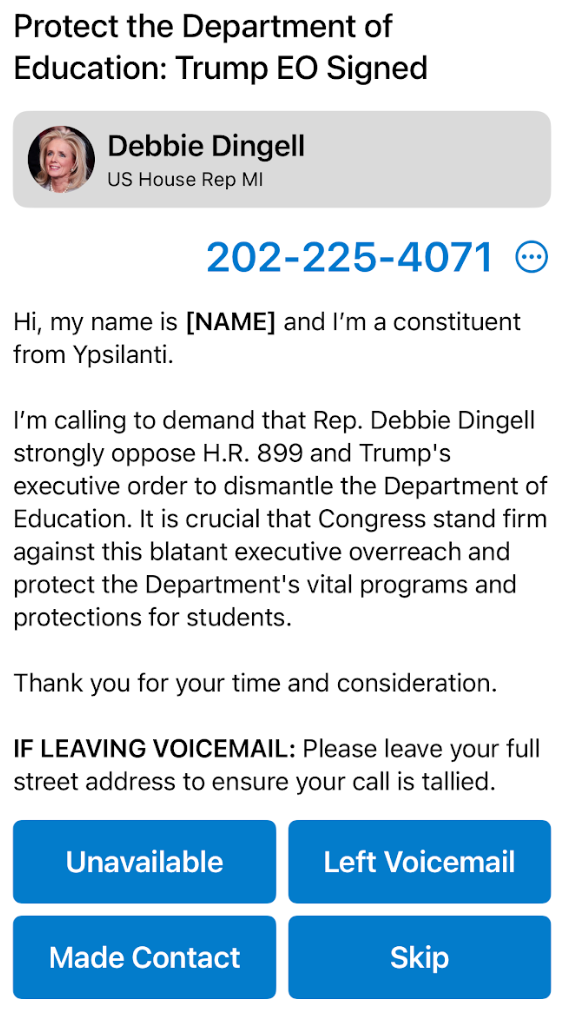
You click on the number, wait for an answer, read the script, and and click a blue button to register whether you left a voicemail or made contact, and the app sends you to the next number.

In just a few moments this morning I made three calls.

This may seem like something small — just like my boycotting may seem small and ineffectual to some –but if we truly believe that our government is of, by, and for the people, then we, the people, need to get involved. We need to do something when we see that our government is not representing all of the people — particularly when they are taking steps to further disenfranchise the most marginalized among us.

Look, you’re probably exhausted and overworked, too. You might feel like this is not worth your time, but perhaps you can take a journey back to your high school self, remember what it feels like to have a dream in front of you — of a career, a family, a whole adult life. Remember what that feels like? Don’t we want to make sure that every kid in America has an opportunity to pursue their dreams?

If you believe in the transformative power of education like I do, I urge you to make 5 calls — today, tomorrow, and until our voices are heard.

It’s a small decision you and I can make that could make a monumental difference for our kids, our country, our future.

Speak up … defend the rights of the poor and the needy. Proverbs 31:9

And, we’re off!

We just finished the second week of school and let me just say: All. Cylinders. Are. Firing.

From Monday morning at 8am to Friday afternoon at 4, the weeks are gonna be full, full, full.

Let me give you a glimpse. Mondays and Thursdays I spend three blocks — that’s 300 minutes –with seniors and one half block (50 minutes) with a small group of freshmen. From first thing in the morning until the very end of the day, all systems are go.

This past week, my seniors learned how we will respect one another in the classroom, explored my syllabus, and took the semester pre-test to show me what they already know. We also reviewed their SAT scores and had what I call “Real Talk” about where we are and where we are trying to be by the end of the school year. My students (and most students of color in urban areas across the country) have been broadly underserved educationally and their SAT scores show it. They’ve been underserved, and then they’ve spent their whole high school experience dealing with a pandemic. That’s right, my seniors went into lock-down as freshmen, spent their entire sophomore year “learning” remotely, came back for a repeatedly disrupted junior year, and are now trying to fully re-engage and prepare for college.

I need them to know from day one that we’ve got work to do. I don’t mince words. I say, “Look, we’ve got to look reality straight in the face if we want to accomplish our goals this year.”

“Sheesh, Mrs. Rathje, I feel like giving up right now.”

“Oh, we’re not giving up. Let’s pause for five minutes to catch our breath, but then we are right back to it.”

They took a 5 minute break, I called them back, and we were rolling — no time to waste here.

My freshmen — sweet babies — were hand selected because although most every freshmen in our building is trailing behind Common Core benchmarks, this little group of mine is the furthest behind of everyone. I spent the past couple weeks getting to know them, assessing their reading skills, and beginning to engage them in the arduous task of finding and filling in gaps in their literacy learning, getting their buy-in, establishing norms for how we behave in Mrs. Rathje’s class, and holding them to my expectations.

This little class, which meets every day from noon to 12:50 (pray for me!), has been 1 part “real talk”, 2 parts “you can do this!’, 1 parts “this is what we are doing”, and 1 part “this is what we are definitely NOT doing”. They are immature and a bit squirrely, but for whatever reason, they respect me and they know I am not playing. They lean in — they want to learn. And guys, the work we are doing is not easy or fun — I’m making them learn/remember very basic phonetic rules — we’re counting vowels, breaking words into syllables, clapping them out, and even playing games with flashcards.

Yesterday, at the end of our class, when the white board was covered with our notes — the words we broke up and the outline of the book we are reading, one of my students asked, “Mrs. Rathje, do you leave this on your board for your other students to see?”

“No, I do not. I will cover it all up. They won’t even know it’s here. I’ve got you.”

And the whole group collectively sighed.

They couldn’t have a bunch of seniors knowing that they are reading about what animals do in the winter, that they were discovering what the author’s claim was, that they had to break the word hi-ber-nate into chunks, or that we’re all learning the word adapTAtion.

And that’s just Monday and Thursday.

On Tuesday and Friday I meet with my freshmen, of course, but I also have about 300 minutes on each of those days for other tasks. Last week I filled those minutes by writing lesson plans, completing a reading assessment with a freshman, meeting with my instructional coach, returning emails, calling parents, supporting my student teacher, creating materials, grading assignments, and recording grades. The time fills up fast, and I often find myself scrambling to finish “one last thing” before I walk to my car at the end of the day.

I haven’t mentioned Wednesday yet. Wednesdays are typically what we call a “sprint” schedule. We see all seven of our classes in one day on a shortened schedule –typically less than 40 minutes per period with one additional period for social-emotional learning. This past Wednesday was an exception. All of our ninth through eleventh graders had to take the Academic Approach assessment which is a pre-test for the PSAT and SAT. It is computer-based and takes 3-4 hours. Because the seniors didn’t have to take this test, we decided to a) get them out of the building to limit distractions for the underclassmen, and b) get them on their first college visit.

Students filling out applications at EMU

Wednesday morning I found myself on a bus with 50 seniors and four other chaperones riding to Eastern Michigan University. Our students spent a few hours learning about EMU’s programs and touring the campus. Then, we boarded the bus and headed back to Detroit where we dismissed the students and I returned to preparing for the long day of instruction I would have on Thursday.

And before I new it, I was gathering my things on Friday afternoon, loading them into my car, and making the trek home. The week had flown by.

Not only were my days full, I had commitments at night, too.

On Monday, I left work to drive almost an hour to Chelsea where I have physical therapy about once a month. (I do still have to practice self-care if I want to keep pushing on the gas so steadily with my students.)

Tuesday was my first virtual meeting for the educational policy fellowship I am participating in this year where I learned that my working group will focus on policies that impact students’ post-secondary plans.

By Wednesday, I was out of gas. My husband was out of town, so I showered, crawled into jammies, and ate popcorn and garden vegetables while watching Arrested Development. Sometimes a girl’s just got to shut down.

Thursday night was for mental health therapy, and Friday night was for eating curry, watching Netflix, and nodding off to The Great British Baking Show — good old faithful wholesomeness to end the week.

And now? Now I continue to rest and refuel for the weekend because by the time you are reading this, we’ll be back in motion.

Teaching is hard work, but it’s good work. Teachers watch transformation happen right before their eyes — we set the climate and expectations, and because our experience tells us it’s going to happen, we wait and watch in expectation. It won’t be long before my little baby freshmen are reading like professionals telling me the author’s claim and supporting themselves with evidence or before my seniors are texting me from college saying, “Mrs. Rathje, I’m here! I’m setting up my dorm right now!”

We won’t get there by idling or pulling into the garage. No. The only way we’ll get there is by the everyday progress that happens by continually firing on all cylinders.

He who began a good work will complete it.

Philippians 1:6

A Little Help?

As you may have read, I moved my teaching life back into the classroom last week, hoping that my students — the seniors who have been moved back and forth from remote to in-person instruction over and over since March 2020 — would join me there. I planned my classes, rearranged desks that had been moved during the roof repair, opened up windows to let in fresh air (and to lower the boiler-heated room’s temperature to a setting somewhere close to “less-than-suffocating”), and positioned myself at my threshold, mustering all the “we’re back” enthusiasm I could find.

And they came.

Well, some came.

Our students trickled in on Monday, looking around skeptically as though asking, “are we really back? Are we actually going to stay this time?”

I started class by assuring them that yes, we should be back for good this time and by re-setting expectations — again.

“Your phones need to be down; your eyes need to be up. Learning requires engagement — a choosing to attend, to try, to open the mind.”

But for some, it seemed too much.

Take Darren*. Darren has been with me all year. He has not just one class with me, but two. He is in ELA IV, the required class for all seniors, and he is also in 12 Writing, an elective for a handful of seniors who are most likely to move on to a 4-year college.

All year he has struggled — mostly to stay engaged and stay awake. Once he gets started, he is typically able to complete any assignment I give him, but it’s the starting that’s the thing. After all, if he doesn’t start, he can’t finish.

I don’t have a clear picture of what’s going on at Darren’s home, even though I’ve met his mom a couple of times.

I know he loves basketball, even though he’s not on the team.

I know he wants to be an athletic trainer, even though he’s not currently connected to any sports.

I know he’s been accepted to college, even though there’s a seemingly impossible-to-fix issue with his FAFSA, and even though when he walked in last Monday, he was failing ALL — yes, ALL — of his classes.

Why? Because the whole time we were working from home, he didn’t have a charger for his laptop or the $35 to replace it. He couldn’t fix this problem, he had missed four weeks worth of assignments, and he didn’t see a way to climb out of this hole and make it to graduation.

So he walked in to class with his ear buds in, turned up his music, put his head down, and went to sleep.

I tried to wake him — once, twice, three times — but he wasn’t staying up.

Rather than just let him check out, I called our behavior interventionist, who took him for a walk. I’d hoped he’d wake Darren up and bring him back — but I’d lost him for that day.

It was that very day that I had posted my most recent blog, “Under These Circumstances.” While Darren was out walking to wake up, I received a message from a dear friend I’ve known for more than 40 years who said he’d read my blog. He said, “I just sent you [a gift] in memory of my dear friend and high school instructor who passed away on April 3. In his will he asked that his estate be used for progressive social change in America….if that doesn’t describe you and what you do, nothing does.”

My jaw dropped — the amount he’d sent would allow me to incentivize my students for the remainder of this year and into next fall and give me the freedom to help when situations arise, and in my context, they do always seem to arise. I was buoyed by the encouragement and by God’s way of providing for my students, which He has done consistently from the moment I took this position.

On my way home that day, I used these newly gifted resources to stop and restock on snacks, prizes, and a few essentials. As I was paying, I requested a little cash back, just in case.

The next day, Tuesday, Darren came back to my class, and his routine from Monday began to repeat. The headphones went in, his head went down, and he began to fall asleep. We were in the middle of the research paper that would be the major grade for the semester. If he opted out, he would certainly remove all possibility of passing, and I was not about to have it.

“You are not quitting,” I said with my jaw set, “you are too close.”

“It’s no use,” he replied. “There’s no way I can make up all that I missed. I don’t have a charger. There’s no sense in trying.”

“That’s not true. You just have to get started. It’s one step at a time. Just start with what we are doing today. Have you asked about getting a charger?”

“It’s $35. I don’t have that. It’s no sense in getting started. I can’t get caught up.”

That was it for me. I walked to my wallet, got $35 of the cash that had been provided the day before, and said, “Darren, come with me.”

I asked the teacher across the hall to keep an eye on my class, the rest of whom were working on their research, minus the one who had already been sent out because he was throwing up [it’s all part of a day in the life of a teacher, friends].

Darren reluctantly dragged behind my Momma-Ratch-on-a-mission pace as we trekked to the office where we could get a charger. At the door to the office was our vice principal, a great champion of our students. I told him what was going on, enlisted him in my conversation with Darren, and made it clear to him and to Darren that under no circumstances was I going to allow a student who was this close to graduation, who had been accepted to a four-year university, who had a dream to be an athletic trainer, to sleep out the last four weeks of the semester.

That ain’t how Mrs. Rathje works. Not today. Not any day.

The vice principal encouraged Darren, told him we were on his team, and let him know that we would support him every step of the way to graduation. His tone was encouraging and not quite as in-your-face as mine was that morning, Darren seemed to hear us, even if he wasn’t sure he believed us.

The Vice Principal said, “You can still do this; you’ve got to believe me.”

Darren said, “It’s too late; It’s not possible.”

I said, “It is possible. We’ve been down this road many times. We wouldn’t say it if it weren’t true. We’ll believe it for you until you believe it for yourself.”

I glanced at my watch. We’d been in the hallway about five minutes; I knew I had to get back to the others.

“Come on, you’ve got work to do. Let’s get to it.”

Darren shuffled back into the classroom behind me.

Over the next few days, with plenty of prodding and encouragement, he got to work. By the end of the week, Darren was passing ALL –yes ALL — of his classes.

He’d needed us to insist. He’d needed some resources. He’d needed an intervention. He’d needed a village.

Countless Darrens are trying to sleep in classrooms across the country, and they need us. They need us to believe with and for them that it’s not too late. We need to show them with our time, with our money, and with our whole bodies.

Why? Because they’ve seen all kinds of evidence that it’s not going to work out. That there is, in fact, no use.

If I’ve learned anything in my years of teaching, in my years of living, in my years of falling flat on my face, it’s that no one is beyond the point of no return. Restoration is always a possibility, but when we find ourselves deep in a pit, we often need some assistance before we can take the first few steps.

Do not withhold good from those to whom it is due,

    when it is in your power to act.

Proverbs 3:27

With thanks to all who have prayed for, encouraged, supported, and helped me take my first few steps.

*As always, I have changed the name of this particular student.

Road Trip

Click the arrow to listen to me read this post.

My principal called me and my partner, the college access counselor, into her office. We’d received an invitation from Central Michigan University, our charter school’s authorizer, for our seniors to attend a college visit on Wednesday, September 29.

The event was free for our students, but it was only a few weeks away, and we’d have to hustle to pull it together — communicate with students and parents, get permission slips, and coordinate chaperones and transportation.

“What do you guys think? Do you want to take them?”

Almost simultaneously, my colleague and I said, “Absolutely!”

Last year we provided virtual college visits for our students. Each Wednesday, students would log into a zoom room and an admissions rep from a university would pop in and share a presentation, often with slides or a video. We provided incentives for students to show up, turn on their cameras, and ask questions. It was the best we could do, and for some of our students it was enough.

For most, though, it was hard to imagine what college life might be like by merely watching a slide show on the screen of their chromebooks while lying in bed in their pajamas. To be honest, it was very hard a year ago to imagine life beyond the isolation of Covid period.

Last year, virtual visits were the only choice we had. Now that we were being offered an opportunity to actually put our seniors’ feet on a college campus, we couldn’t pass it up. We had to give them a clearer vision of college.

My colleague got busy on a flyer and a permission slip, and our vice principal/athletic director quickly secured us a bus. A few days later, I started meeting with seniors one-on-one.

“You’ve been invited,” I said, “to go on a field trip to Central Michigan University next Wednesday. We’ll leave at 6:45 am and return at 6:45 pm.” I paused after this information each time I said it to allow students a moment to process. Each of the students looked me in the eyes and nodded before I continued. “Here is the agenda. You’ll tour the campus, attend a class, and get a T-shirt. There is no cost for you, but you need to return this permission slip by Monday.”

Each of my students — students who sometimes grumble and complain about school, who often want to sleep or eat in my class, who struggle to stay engaged from time to time — each of these students responded with a measured excitement.

“Ok. Thank you. I’ll bring in the permission slip.”

Over the next couple of days, I heard doubt surface.

“Mrs. Rathje, are we going to have to ride on a yellow school bus?”

“No,” I replied, “we’ll be on a charter bus.”

“What about the lunch? What are they gonna give us — some bologna sandwich and chips?”

“I imagine it will be a regular college dining room meal. I don’t think you’ll be disappointed.”

“Why do we have to leave so early?”

“CMU is a couple hours away. The event starts at 10am. We don’t want to miss anything.”

We started with a list of 48 students we were willing to invite — those who, despite Covid, are on track for graduation, have consistent attendance, and are mostly engaged in the journey toward college. Several opted out for various reasons, and we ended up with 31 students and four chaperones on a plain vanilla charter bus.

The students were excited and, I think, a little anxious. The questions kept coming.

Mrs. Rathje, are we all going to stick together all day today?”

“No. We’ll be together for parts of it, but you will each go to the class you signed up for. We’ll be separated for that.”

“What if I don’t like my class? Can I just leave?

“No. You are going to give it a chance. You’re going to stay with your group. You’re going to survive. I promise.”

“Mrs. Rathje, you better be right about the food.”

“Trust me.”

After we left the Detroit metro area, Lansing was virtually the only sign of “city” life amid miles and miles of farm land. The students, on their phones or sleeping, were mostly oblivious, but as we neared Mt. Pleasant, which is not far from my childhood home, I woke them and called their attention to the surroundings.

“If you look out your windows, you’ll see mostly farmland, but in the next few minutes, on your left, you will see the CMU Chippewas’ football stadium.”

They looked out the windows as I continued to narrate.

“On the right you see everything you need within walking distance — restaurants, groceries, a pharmacy. As we turn left here, you are officially on campus.”

The phones were mostly down as students looked out the windows.

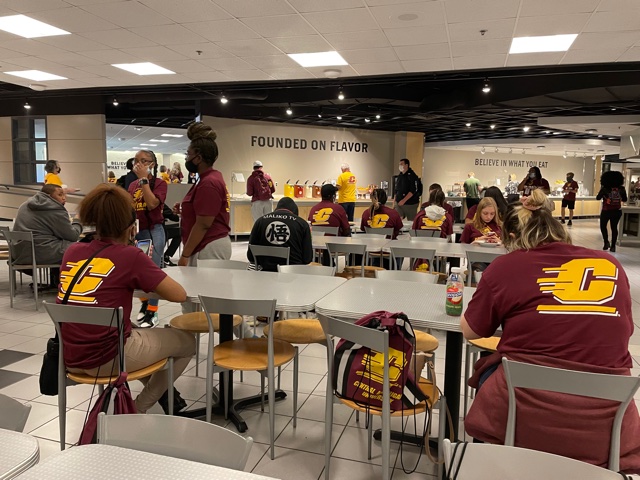
We pulled up in front of the Student Activities Center where someone in a maroon and gold shirt was waving us in. Inside, more people in maroon and gold were calling the names of our students, handing out backpacks and T-shirts, and encouraging us to change into them to designate that we were part of the group.

I heard just a little grumbling, “Mrs. Rathje, do I have to wear the shirt?”

“Yes.”

Then compliance. They quickly changed, grabbed a donut or a juice that had been set out for them, and then walked en masse into the basketball arena where the opening session was in progress.

The stands on one side of the gym were filled with students — I’d say about 300 or so — from charter schools across the state. Perhaps 80% or more of those students were Black, and most were from Detroit.

In this opening session, the students learned about the culture of CMU — “Fire up, Chips!” — and some of the programs. Next, we were broken into groups for a campus tour and lunch.

I was proud of our students as they followed our tour guides, asking questions, and checking out the campus, and I was probably as excited as they were when they got to lunch and realized they could pick what they wanted and eat as much as they liked. I got my own lunch and sat down at a table with some young men from our school. They weren’t embarrassed or trying to avoid me as some teenaged boys might do. They spoke to me. They asked me questions. In fact, other students sought me out during that lunch time. They, too, had questions and just wanted to check in. They were relishing a full hour of lunch and the freedom to move about among actual college students.

When I saw some of the students who’d expressed concern about lunch, I asked “How was your food?”

“It was great! You were right, Mrs. Rathje!”

After lunch, we moved into class sessions. We were separated into even smaller groups, and students attended sessions based on their interests. It was fun later to hear students report on their experiences.

“I learned about exercise science. It was about how the muscles work,” one said as he massaged his own bicep.

“We were in the TV station learning about how films are made,” said another.

But my favorite was the one that I read on a reflection assignment completed after the event: “We had to do an egg experiment where we dropped it from a certain height to see if it cracks or not. My egg was the only one that did not crack, and I got a mug for it.” He hadn’t said a word the whole trip home. He had held that little victory to himself.

As we wrapped up at the event, I questioned our students. “Well, what did you think? How was your day? What did you learn?”

I got all kinds of responses.

The understated: “It was alright.

The tired: “It was a lot of walking.”

And the excited: “This is my dream school. I’m applying this month.”

As we walked to our bus, we met up with one of our grads from last year who is currently attending CMU. He shook the hands of some of our seniors who, in the fog of Covid, hadn’t known he had chosen to go to college at all. My colleague and I asked if he would come speak to our students when he is home; we’d like him to share his experience with our seniors. He said he would and added, “going to college has changed the way I think about everything.”

The bus ride home was hot. The air conditioning on our bus quit working as though to remind us that our fantastical day of hope was over. We were headed back to our school in Detroit where we wouldn’t go on tours, have hour-long all-you-can-eat lunches, or be bathed in images of possibility.

However, the next day in class, my students wanted to share with those who had not gone. They didn’t mention the hot ride home, but they wanted to share what they’d seen, what they’d done, and most importantly, what they had eaten.

“Mrs. Rathje, are we going to visit more colleges like that? “

“If it’s up to me, we sure will, but right now let’s get back to our college research. Who is adding CMU to their college comparison chart?”

A few hands in the room went up into the air.

“Excellent. Let’s find out even more than we learned yesterday.”

Perhaps I imagined it, but it seemed to me that my seniors were a little more engaged, a little more motivated, a little more interested in the possibilities of college.

Bring on the next road trip.

For I know the plans I have for you,” declares the Lord, “plans to prosper you and not to harm you, plans to give you hope and a future.

Jeremiah 29: 11