Hold on…

I am not sure I made my expectations clear. When I wrote my letter to 2026 last week, I thought I spelled out the fact that I was looking for something different than years past — something better — but perhaps I was not specific enough.

When I asked for no falls, no cancer or chronic illness diagnoses, I guess I should have specified that aging family members experiencing strokes was also off the table. Maybe when I asked for grace for those who are already suffering, I should’ve included a request that they have access to the meds and the care that they need.

Now, I will acknowledge that while I haven’t received the snow (or snow day) that would’ve been not only acceptable but welcome, I was not disappointed in the unseasonably warm temps we experienced this past week.

However, my staffing vacancy has not been resolved unless you count the fact that I am — while also attending to my myriad other responsibilities — cleaning up the former teacher’s grade book, giving assignments, communicating with students, and preparing for the more formal transition when we will indeed have a highly qualified replacement, before the end of January, even. However, I probably should have made it clear that I was thinking that replacement wouldn’t have the exact same name and birthdate as me.

And, when I asked for sanity in the political realm, perhaps I should have started by defining some terms. By sanity, I mean “reasonable and sensible behavior or thinking.” Since all of the words in that definition are abstract let me provide a concrete example. A reasonable way to arrest an unarmed protestor who is driving a car is perhaps to, I don’t know, aim your gun at their tires to stop them rather than, say, at their head. And perhaps a way to stay out of wars is to speak respectably to the leaders of other nations, inviting them to civil conversations, and not, say, threatening to “do it the hard way.”

I was encouraged by crowds gathering in Minneapolis, Minnesota to mourn the loss of life of a civilian who was committing no crimes and then almost immediately discouraged by a subsequent shooting of similarly innocent civilians in Portland, Oregon.

This violence stems, of course, from racist and xenophobic rhetoric (which I also asked for an end to) that comes straight out of the Oval Office, where the president has, for example, called Somalian immigrants “garbage” and has said that ICE agents, those responsible for these and nine other shootings since September, “acted in self-defense,” which you’d be hard pressed to agree with if you examined the collection of videos that have been compiled.

All of this can be downright discouraging less than two weeks into a year that many of us were hoping would be different — and by that I mean the good kind of different, not the insane kind of different.

Ugh! I can’t stay in this angry space for the whole year! I can’t keep seeing headlines, shaking my head, and sputtering!. Instead, I am going to willfully point out some bright spots from the past seven days so that I can keep myself grounded in hope, in the belief in human decency and resiliency. For that, I have to turn my eyes away from national headlines and take a look at the spaces where I spend most of my time.

I will start by sharing the fact that I work with an amazing staff — there is some kind of magic that brings a team together to work in an under-resourced environment serving students who are significantly below grade level. Every person on the team wants to be there — and, we quickly (as you’ve seen) weed out those who are not on board. Because of that, staff meetings are often enjoyable, even fun — a gathering of like-minded folks who want to be together, who support and celebrate one another.

Next, I must mention our resilient students. All of our 10th and 11th grade students had a substitute science teacher for about eight weeks this fall. This same group — which now has a very capable science teacher who has quickly re-established a culture of learning — this very same group of students just found out that they no longer have an English Language Arts teacher, at least temporarily, and how did they respond? They listened to the administrator who delivered the news, they gathered evidence of assignments they had completed, they cooperated with school staff, and they opted in to the temporary plan, and trusted those who said a permanent plan was on the way.

Some of these same students and others — the athletes in our building — worked with the athletic director this week to hand deliver printed invitations to the Friday night basketball game to school staff members. Not only that — the following day they delivered team jerseys to each staff member, took photos with them, and invited them to wear the jersey to the game.
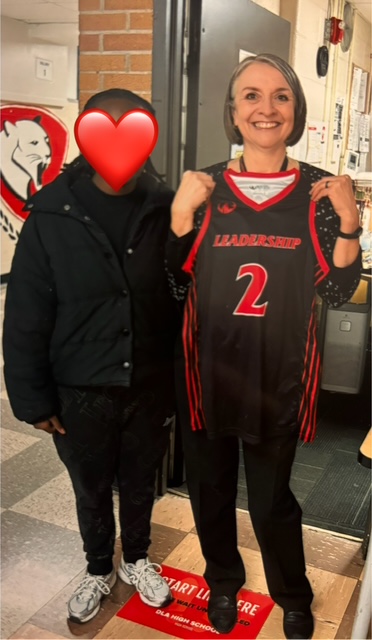
The hype continued to build throughout the week, and many staff wore the jerseys to school and showed up on a Friday at 5:30, after a very long week, to cheer on their students, first at the ladies’ game and then the men’s game. The AD and students had created a VIP section decorated with photos of every staff member in the building posing with a student. Colleagues chatted and laughed together as they watched the games, cheering loudly for every steal, every change in possession, every landed shot, and especially that one sweet moment when a 6’5″ senior who we’ve all watched grow up from a timid impulsive freshmen to the guy who waited for just the opportunity, saw his moment, and slam-dunked like a pro! The crowed (especially the VIP section) went wild!!

Throughout the evening, students boldly grabbed the mic to shout out their teachers, and then, between the games, the whole group — athletes and staff — took to the floor for a photo op. Smiles everywhere!

It’s still January. Nothing has really changed, but all is not tragic.

In a small building on the border of Detroit and Dearborn is a little community that is somehow choosing to keep going. Communities like this exist everywhere, despite corruption, despite tragedy, despite illness, despite loss. Folks who would have every reason to throw their hands in the air and say, “that’s a wrap” are getting out of bed, combing their hair, and showing up for another day, and sometimes, that day, against all odds, turns into a celebration. Even now. Even in places like Minneapolis and Portland.

No matter how politely we ask, we have little control over what 2026 brings, however, we can choose to search out these spaces and these moments. We must, also, call out corruption, gather to protest, and work for the change we wish to see in the world; in order to do all that, we’ve got to hold on to hope.

I am confident that I will see the goodness of God in the land of the living. Psalm 27:13

Typical, 2025 version

It’s been a pretty typical week for 2025– a virtual genocide continues in Gaza (albeit with talks of a coming ceasefire and hostage release, all of which we’ve heard before), the US government is shut down, four people were killed in a church shooting an hour away, and Jane Goodall — a universal treasure– passed away. Oh, and I’ve spent the week trying to provide an equitable educational opportunity to six sections of high school science students.

Here’s what’s going on — I am the instructional coordinator in a small charter school on the border of Detroit and Dearborn. You could drive right by us and not know we are there. We operate out of a run-down former Catholic elementary school which we rent for a rumored gasp-worthy sum from the Archdiocese of Detroit. The parking lot of this building, which our busses have to traverse twice a day, is literally crumbling under our feet/wheels. To come onto the property each day, I have to ignore the willful negligence that would allow a literal lake to form in the center of the asphalt, but I digress.

We aren’t glamorous is my point. The building is too hot in the fall and spring because we have no air conditioning and too hot in the winter because of the antiquated boiler system we use to heat it. Windows need repair, and the gym, which we use as cafeteria, gym, and auditorium, is way too small to host any kind of athletic competition. If you could, based on facilities, choose to teach anywhere else, you probably would. Or, if you could choose to teach students who read at grade level or who have involved parents or who come to school prepared to learn every day, you would probably choose to do that.

But we aren’t that school.

Nevertheless, we have almost 300 students who deserve a high quality education. And we can’t provide that — we can’t get them up to their current grade level, we can’t adequately prepare them for postsecondary education or the work world, we can’t give them an opportunity to change their circumstances — without well-trained teachers, and I’m not sure if you’ve heard, but there isn’t a surplus of those lying around.

This is my 6th year at my school, and every single year we’ve had at least one, if not two or three, classes covered by long term substitute teachers or, more recently, online alternatives, and that’s not because we aren’t doing everything we can to find teachers — we are!

So here’s what happens — each spring we post all of our openings, then we interview all summer, we make offers to the most qualified people, we believe we are fully staffed for the fall, then days before school starts, we realize that one or more of our teachers has changed their mind and moved on — maybe for more pay, maybe for a different environment, maybe for a promotion. The reason doesn’t matter. We suddenly find ourselves with a hole to fill.

Now, because this is our reality, we do always staff 2-3 permanent building substitutes. These folks are salaried employees who come into the building every day. They are typically not certified teachers or subject matter experts, but they are committed members of our team who know and love our students. We also have a creative leadership team that has found myriad work-arounds over the years.

This year’s shortages were looming all summer — we found and hired multiple math and science teachers only to have each of them move on before the first day of school, so in the final hours we made a plan. Our Geometry and Algebra II courses would be staffed by a returning qualified educator. Our financial literacy course would be taught by a permanent employee who also runs his own business. Algebra I, Principles of Physics, and Chemistry would be covered by a company called Elevate K-12. This company hires certified teachers who live in other locations to zoom into our classrooms and provide high quality instruction. For these classes, we provide an in-person facilitator — a member of our team who knows the students and manages all on-location needs such as attendance, providing physical materials, and managing any student behavior issues. This is our second year using Elevate, and although last year’s start was bumpy, I must say that we have found our rhythm.

With all of those classes covered, we still had three sections of Biology and three sections of Earth Science to cover with days remaining before students would arrive. With no applicants in the hiring stream, we turned to an agency that provides long-term subs to area schools. (You read that right — the teacher shortage is so profound that agencies exist solely to provide long-term substitutes.) That agency sent us two people to interview. We chose the one who had some experience in a high school science classroom, and she started right away.

She did a good job of getting to know the people, finding her way around the building, fostering relationships with our students, and showing up for work everyday…until she didn’t.

And now we are looking again.

The students have not had a teacher now for seven school days. They have had members of our team covering, and I have been providing assignments (without instruction) and grading papers. Even if I could stay in the classroom every day, I don’t know enough about population dynamics or the chemical composition of the sun to guide these young minds through their learning. And I can’t stay in the classroom anyway — I have a whole job of coaching and supporting the other teachers in the building in their quest to meet the needs of our students who have profound knowledge gaps and who nevertheless have dreams and goals and deserve every opportunity to make them happen.

No, we need to find someone qualified to teach these classes.

My principal sent me a calendar invite to join her for an interview on Thursday — someone the agency sent to take over these courses. He was a career scientist — full of content knowledge. However, although he’d done some one-on-one tutoring over the years, he’d never been in a classroom, never kept a grade book, never presented with a slide deck. We’re starting week six of classes on Monday and we need someone to jump in there, hit the ground running, and salvage what is left of this semester for these kids.

So we’re still looking, and I’m still giving assignments and grading and encouraging students and their substitutes to stay the course. This is where we are, and this is what we have.

Meanwhile, a few states away, grown men who have their education can’t agree on how to fund the government while they are simultaneously allowing millions to be spent rounding up undocumented immigrants.

I wonder if they care that 411,549 teaching positions in the US remain unfilled or filled by folks not fully certified. I wonder if they care about the students impacted by those vacancies, many of whom are from low-income homes that struggle to meet their everyday needs for food, housing, and transportation. I wonder if they think about that when they are deadlocked on their decision over spending for healthcare that will most certainly impact these same families.

I wonder who we have become and how this has become just another typical week.

Do you wonder, too?

Seek justice. Defend the oppressed. Isaiah 1:17

If you or someone you know (certified or not) has a background in science and a heart for kids, click on this link and tell them I sent you. (We have openings at our elementary school, too.)

Support That Claim

Click the arrow above to listen to me read this post. Printed text has linked content, some of which supports my claims.

Since we discussed bullying in my last post, perhaps we should also discuss another adolescent behavior — making unsubstantiated claims.

Guys, I’ve been hanging out with teenagers and children since 1989 when I taught my first class of mostly male 7th graders in a small school on the east side of Detroit. From there to suburban Detroit to a couple small towns in south central Michigan to St. Louis, Missouri, to Ann Arbor, and back to Detroit where I teach now, one hallmark behavior of all the teenagers and youth I have worked with is blurting out accusations without proper evidence.

I’m walking down the hall and a senior runs up to me frantically, “Mrs. Rathje, can you talk to Mr. Smith. I’m failing his class, and I did my work. He’s just not putting in the grades.”

A young man says, “We would’ve won that game last night, but the other team cheated.”

Someone else says, “My parents won’t pay for me to go to the prom. Can you help me out?”

These are all claims that one might be tempted to immediately believe. They might reply, “The teacher can’t do that! I’ll make him post his grades immediately.” or “They cheated! What did they do?” or “What a shame! Of course I will get you some money for prom.”

But critically thinking adults know that before they believe a claim, they need to ask for the evidence.

“Come with me to that teacher and let’s see what work has been recorded and what work has not.”

“Tell me more about the game. Who scored? How? What did your team do?”

“I know you want to go to the prom. What conversations have you had with your parents? What kinds of things do you think you need?”

Often, when we ask a follow up question we find out that the student did indeed do some of the school work and that the teacher had put in those grades, however, the student had missed some other critical assignments that he may or may not have been aware of. The team may have suffered a loss, but the other team may have simply outplayed them. The prom-goer might have assumed the parents couldn’t afford to pay for any of prom, but after a brief conversation, the student learns that they can cover the needed clothes, just not the admission ticket.

Teenagers (and other folks who have not matured beyond adolescent thinking) make unsubstantiated claims for lots of reasons. Often they are panicking — about their grades, about finances, or about feeling slighted — or they are feeling insecure — about their performance, their identity, or their social standing. One of the most important roles of the adults in the room is to identify that dysregulated emotion and to help ground the developing mind in reality.

Critical thinkers have to ask questions. If we see in the news that a man was shot and some are suggesting that a particular group was responsible, we have to ask the question, how do you know that?

If a political leader claims that a well-known and widely used medication causes neurodivergence, adults need to ask for the studies that prove this. Those in the room who know the claim to be false need to stand up and say, “Um, sir, that simply has not been proven.”

Most people from time to time make an unsubstantiated claim. I might say, for example, “prices are sky-rocketing; retailers really don’t care about the average consumer.” I may really feel this way, but unless I have evidence of retailers making decisions — setting prices — with blatant disregard for consumers, my claim is unsubstantiated. It might seem fairly harmless for me to say this in a fit of exasperation, but I may impact others simply by making the claim. Some people who trust me and know my track record of being thoughtful and researched may actually believe my unproven rant and form an opinion about retailers based on my spouting off. They may even change their shopping behavior because of their belief in my momentary rant.

And I’m just an every day middle-aged woman from the midwest. What if I had a national platform — what if I held a position of leadership or even power? What if I, standing on a national stage made the claim that a large northwestern city was under the siege of war? Would my constituents believe me? Would they form opinions about that city? Would they act on my claim? Would anyone in my orbit have the courage to demand that I provide evidence before broadcasting such incendiary language?

In a typical day, the average person is peppered with claims — from their coworkers touting the most efficient way to get the job done to their social media feeds spouting the latest health fad to their television news shows (whichever angle they are espousing) delivering their packaged opinions, to their neighbors and family members simply sharing their thoughts. It can be exhausting to interrogate every single claim you hear, but responsible adults must.

What complicates matters is that all of these claims are being made at a time when 54% of US adults (aged 16 to 74) read below a 6th grade level and 21% are functionally illiterate. More than half of the adults you encounter in a day may not be able to comprehend the evidence that supports some of the claims being made or may not have the critical thinking skills required to interrogate them.

However, some of us do! Some people have positions in rooms where very big decisions are made based on unsubstantiated claims, and they have the knowledge and ability to ask hard questions, to challenge authority, to stand up to crazy.

And they — we — must.

Whatever room you are in, whatever claims are being made, you have the responsibility to identify the dysregulation in the room and ask the questions that ground people in reality.

For the love of God and all things holy.

Ask for the evidence. Question the claim.

…examine everything carefully; hold fast to what is good. I Thessalonians 5:21

Of (not politics, but) Bullying

Some people don’t like it when I talk about politics….I get it. If, as Wikipedia* states, politics is “the set of activities that are associated with making decisions in groups, or other forms of power relations among individuals, such as the distribution of status or resources,” I can see why the topic might make some people feel uncomfortable.

I mean, why would you want to examine the reality of which folks hold the power, which groups benefit from the decisions of those folks, and which groups are historically and perpetually disenfranchised by those decisions. That examination could lead to unsavory images, to be sure, and we wouldn’t want anyone to have to see that, so, let’s not talk about politics.

Instead, class, today let’s talk about bullies.

Every single school I have been a part of has had its bullies.

They don’t have to be the stereotypical intimidatingly oversized thugs that might be populating on your brain screen. In fact the bully of my first class was quite undersized. Physicality is not essential to the bully. Rather what characterizes the bully is the behavior that seeks to dehumanize, belittle, embarrass, or otherwise harm others and the presence of, at first, a yes man, then a crew, and ultimately the compliance of the larger group in allowing the bully to continue harming others.

It often starts with the bully targeting someone who is demonstrably “weak”. The bully might make fun of the disabled, denigrate immigrants, or even make jokes about someone’s weight. He (or she) looks around for a target then slings a grenade with the intent to do harm. But the harm is not where the power lies.

No. The power lies in the reaction to the harm. He gets a laugh at the expense of the disabled, a snicker at the expense of the immigrant, a guffaw at the expense of the overweight. And those responses are the fuel for the next attack.

Still high from the reaction of the yes men, the bully begins to scope out his next target — maybe someone with a little more clout — maybe a classmate or a peer. First he spreads rumors to harm his target’s reputation, he engages in name-calling to dehumanize his foe, he might even accuse others of wrong-doing, whether or not there is credence to his claims.

Throughout all of this, those around him, seeing the power he is building, have to make a choice — do they want to land in the bully’s sites or take a position at his side?

That’s a tough call, especially if you are in middle school or still have the insecurities that you had when you were in middle school. You might not think you can handle humiliation. You might not think you could weather the name-calling. You might not think you could bear up under the rumors. So, you chuckle at his antics, you move to his side of the room, you excuse his behavior as harmless, and you turn your eyes away from the victim.

And you continue to live with that decision because it still feels safer than having him turn the attention on you.

But then the assaults escalate. The blows become physical. And he’s going after someone who is or who used to be your friend. He might even attack a member of your family. Then you have to face a crisis of identity — who do you want to be? Do you want to stand behind this guy, smiling for the camera in your suit, waving your flag of allegiance, as he takes shots at not only the least of these but also at your neighbor, your brother, your friend, or your mom?

This moment happens in every bullying movie you’ve ever watched — The Karate Kid, when Danny LaRusso takes the blows of Johnny Lawrence almost to his peril in the final match, Mean Girls when Cady, who was once part of Regina George’s crew, finds herself a target when the burn book is circulated — the individual who had chosen to capitulate or even join a bully has to decide if they are going to stand up.

The rare ones who, despite their inner terror, find the courage to say “Not here, not today,” rise up from their devastation and face the bully. In the movies, this usually results in the bully walking away in shame or, in the most ideal of scenarios, having a change of heart and determining to be a different kind of person.

This sometimes happens in real life, too, although not inside the space of 90 minutes, and certainly not when the bully has been allowed to gain control beyond the schoolyard and into the community. No, in those cases, one person standing up will not be enough. To stop a bully who has, through all the text-book tactics of instilling fear through intimidation, established a culture of systemic compliance to the most ludicrous of actions, the community must come together and take a collective stand. They must, united, shout “Not here, not today!”

One person might not stop a bully, but a lot of single people, together, can do almost anything.

The bully can’t continue unless the community lets him.

Certainly the community will wake up and put a stop to it — it’s not politics, after all, it’s just refusing to let one person dehumanize another.

Defend the weak and fatherless; uphold the cause of the poor and the oppressed. Psalm 82:3

A couple of notes:

*If you were a student of mine in the early 2000s and cannot believe that I actually cited Wikipedia, see also lecture #497 entitled “Anybody Can Change”**.

**And when I say “anybody can change”, I do mean even bullies.

Also, if you listened to this post, you might be interested to know that the text version has several embedded links.

Educational Break

On Thursday afternoon, I tidied my classroom, finalized some grades, and walked away from school and toward my Spring Break. The mere thought of not having to set an alarm for 10 days would’ve put a pep in my step if I’d had any pep left at all, but I did not.

All teachers are exhausted by this time in the year. Even though we had Christmas break, even though we might’ve had a long weekend or even a full week off in February, we’ve been, since September, coordinating learning for our students, planning multiple presentations each day, keeping records, reporting to our supervisors, and (and this is the most draining part) making countless in-the-moment decisions:

What is the first thing I need to do when I walk in the door?

Do I have an extra stapler, know where more chart paper is, and can I laminate another hall pass for Room 117?

No, you can’t go to my classroom unattended; yes, I can get you a bandaid; no I don’t know where Mr. Smith is,

You can’t go to the bathroom right now, but ask me again in 10 minutes.

Yes, you can take that pencil, borrow that book, eat that snack.

You sit over here; you stay there.

Yes, your topic sentence is solid, but no, that is not an adequate example.

You’ve used AI here, and you must re-do the assignment.

You’ve used AI here, and you cannot re-do the assignment.

Yes, you can turn it in late. No, the deadline has passed.

Yes, you can work with a partner. No, you can’t get the answers from a peer.

This is non-stop all day long, but teachers, while keeping this decision-making machine running, must also, intervene in interpersonal conflicts, address misbehavior, meet demands for mandatory documentation, and, oh yeah, provide high quality instruction.

And most of us are happy to do all of this. We see each piece as necessary for supporting human development, for preparing the next generation of humans for meaningful life in our society. We’re teaching our students to co-exist with one another, to manage themselves, to hold themselves accountable, to read, to write, to identify a career, and to begin to take steps toward attaining that career. We’re in this work because we like kids but also because we believe in the power of education to create possibility for students of all backgrounds and abilities and to create a better future for all of us.

In the school where I work — a small charter school on the edge of Detroit, where 99% of my students are Black, where 100% of the students qualify for free breakfast and lunch, where almost all of the students are below the national average in reading and math scores by no fault of their own but because of centuries-long inequity in education–the teachers, like me, believe in the transformative power of education. We see it as an opportunity to not only change lives but to save lives.

In addition to the exhausting work that teaching is in any context, teachers in buildings like mine have the added weight of wondering if our kids have enough to eat, if they have a home to sleep in, if their home is safe, if they will have what they need for the next 10 days, or if they will be alone, hungry, cold, or in danger. Our students have the same needs as any students in the country, but they have additional needs as a result of poverty that stems from systemic inequities that go back through the history of our nation — school segregation, red-lining in real estate, unconscious bias in hiring practices, and other elements of historical and current systemic racism.

So, you might imagine how I am feeling, heading into a much-needed break while simultaneously worrying about my students’ welfare, to learn that the president of this country has ordered the Director of the Department of Education to dismantle it.

You may say, “Settle down, Kristin, most funding for education comes from the state.”

That is true, most money for education comes from the state — but do you know what does come from the federal government? Funds that make a difference for students like mine. For example, Title I, which provides $18 million to low-income districts. It’s not enough to make up for the economic disparity between neighboring districts, but it’s a start. The Department of Education also provides IDEA (Individuals with Disabilities Education Act) funds to the tune of $15 billion to help districts provide additional resources to students with learning disabilities, cognitive impairments, and other diagnoses such as autism. Source.

Furthermore, the US Department of Education manages Federal Student Aid for post-secondary education, providing over $120 billion annually in grants, loans, and work study that allows students like mine to dream of a career. And not just students like mine — I myself relied on federal money to get my degrees, didn’t you? Source

Can you imagine what might happen in communities across the country if high school seniors no longer have access to the FAFSA? if they can no longer apply for federal dollars to fund their education through grants and/or loans? Tuition alone for Michigan State University is over $16,000 a year. Add in room and board and your talking about $35,000+. Most students need at least four years to get a basic degree. Who among us can fund $140k without the aid of at least a student loan?

Now, the State of Michigan is prepared to fund up to two years of community college and up to $5,500 per year at state universities, but states rely on the federal mechanism of the FAFSA to distribute those funds. If the DOE is dismantled, how long will it take for states to pivot to their own systems to ensure that students who need these funds get them? And, where will students borrow the balance that is not covered by state funds if they don’t have access to federal student loans?

How many students will take post-secondary education right off the table — including trade school programs that prepare our electricians, plumbers, welders, builders, and the like?

As I consider the potential outcomes of such action, the faces of my seniors are appearing in my mind — J. who wants to be a programmer, who has already completed several summers developing coding skills, L. who plans to be a nurse, K. who wants to be a truck driver, and S. who plans to become a police officer. None of these students can take one more step without the FAFSA and right this minute the Secretary of Education (who has zero experience with issues that impact schools) is busy laying off DOE employees under a directive from the president.

I am exhausted, and it’s my Spring Break, but I can’t just sit by and watch this happen.

So, I’m doing two things: First, I’m writing this post, and second I’m committing to use the app “Five Calls” to involve myself in the American process.

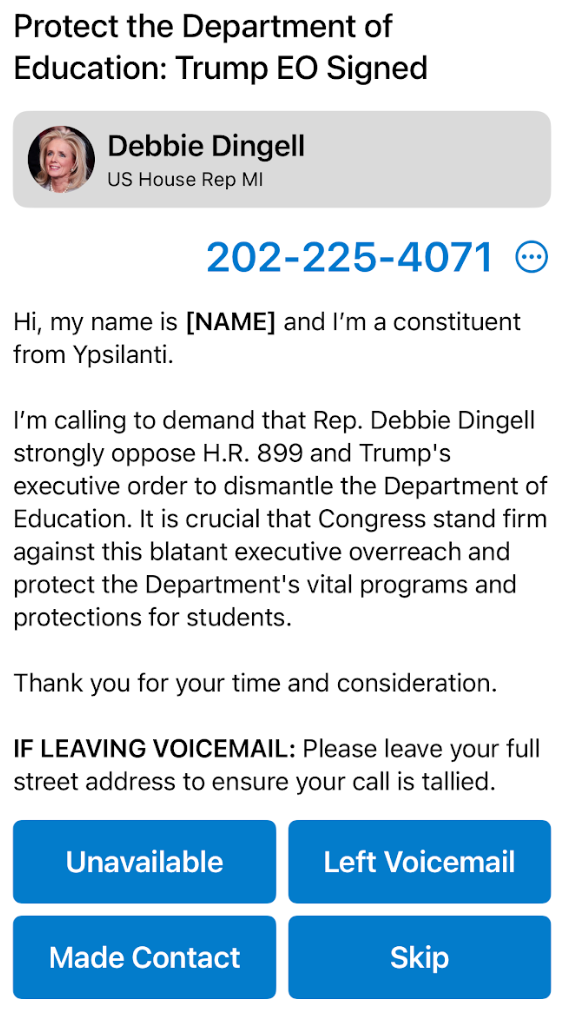
Here is how it works. Download the app, select the issue you are concerned about, and enter your zipcode. You will see a timeline of updates on that issue and a list of representatives from your district. One click later, you will see a page like this:

You click on the number, wait for an answer, read the script, and and click a blue button to register whether you left a voicemail or made contact, and the app sends you to the next number.

In just a few moments this morning I made three calls.

This may seem like something small — just like my boycotting may seem small and ineffectual to some –but if we truly believe that our government is of, by, and for the people, then we, the people, need to get involved. We need to do something when we see that our government is not representing all of the people — particularly when they are taking steps to further disenfranchise the most marginalized among us.

Look, you’re probably exhausted and overworked, too. You might feel like this is not worth your time, but perhaps you can take a journey back to your high school self, remember what it feels like to have a dream in front of you — of a career, a family, a whole adult life. Remember what that feels like? Don’t we want to make sure that every kid in America has an opportunity to pursue their dreams?

If you believe in the transformative power of education like I do, I urge you to make 5 calls — today, tomorrow, and until our voices are heard.

It’s a small decision you and I can make that could make a monumental difference for our kids, our country, our future.

Speak up … defend the rights of the poor and the needy. Proverbs 31:9

Why boycott?

Note: If you are listening to this blog post, several links are embedded in the print if you are interested in reading further.

Many years ago, not long after I met my husband, we began discussing a topic I’d never really considered before — boycotting. As I’ve mentioned here before, I grew up in a family that rarely, if ever, discussed politics. I remember when the Watergate hearings were on TV, but I have no shred of memory of how my parents felt about Nixon or the scandal. I have no idea, even, how they voted..

So when I met my husband, it was a little surprising to hear open political discussions — in the back yard, over dinner, on a car ride — about elections, of course, but much more specific issues such as unions, public assistance, and even (gasp!) abortion.

When I learned that in my husband’s family everyone drove American made cars or were required to park across the street when visiting, it made sense to me. My father-in-law was a retiree of General Motors and brand loyalty mattered. However, when my husband said he didn’t want to shop at Walmart, I had to ask why. He explained that Walmart was anti-union, and as a child of an autoworker, he had learned the power of the union to protect and support workers. He preferred not to support a company that wouldn’t allow its employees to organize. I didn’t feel passionately about it at the time, but I could get behind it.

As the years have passed, I’ve learned more about how Walmart underpays its employees while the owners become billionaires, I’ve grown my own distaste for the company and have shopped elsewhere. (This Time article chronicles some of Walmart’s journey including attempts they have made — under pressure from boycotting! — to improve.)

Of course, Amazon is similar in its practices. While it has made moves to reform, well-documented accounts cite drivers not being able to stop on their routes to use the bathroom and how they adapt to this expectation by carrying urine receptacles in their vehicles or by wearing disposable undergarments. Other accounts cite unpaid overtime, unsafe working conditions, and low wages, all while corporate profits rose to $88 Billion in the first quarter of 2025.

Amazon, Walmart, and other large companies are known for using employees — many of whom are low income and/or people of color — working them just up to the number of hours that don’t require them to pay benefits like insurance and sick leave and hiring for “provisional” employment and firing before the employee qualifies for permanent status. As a result, many employees of these companies remain on state and federal assistance while their CEOs pay a lower tax rate than the average American.

I have seen many of my students lured into jobs at Walmart, Amazon, and McDonald’s, promised pay raises, promotions, and an actual future, only to realize just weeks or months later that they had been misled.

So, what’s a middle-aged, middle-income woman like me supposed to do? How can I show that I don’t stand for this kind of corruption, that I don’t agree with these unfair practices? I vote with my purse. I’ve been doing this for years — avoiding companies that I don’t want to support and purchasing from those that I do. For many years this has been an isolated act that helps me feel like I have integrity. I doubt that I’ve made much impact, but I’ve slept better at night.

But this year, in 2025, anything can happen! All kinds of everyday people, using the engine of social media, can rise up and say, “You’re not getting our money!” If you take away your DEI programs, “you’re not getting our money.” If you won’t pay your employees a fair wage, “you’re not getting our money.” If you stand behind causes that harm our fellow Americans, “you are not getting our money.”

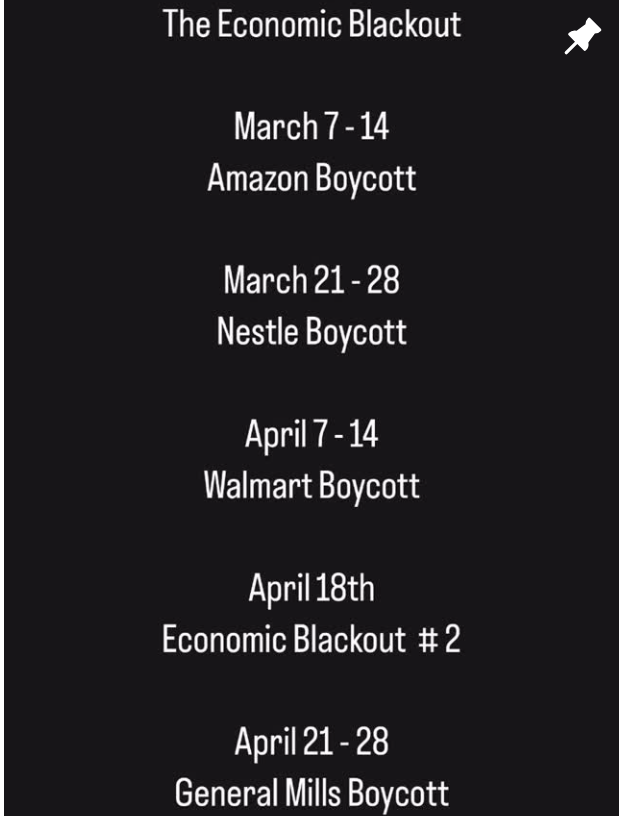
In 2025, I am not standing alone! People across the country are cancelling their Prime memberships and refusing to shop at Target, Amazon, Walmart, and other retailers. Last weekend, many refused to spend any money at all for 24 hours. This week, thousands are abstaining from Amazon purchases, and this is just the beginning!

Organizations like the People’s Union have coordinated efforts to systematically send a message to corporations that will hurt their bottom line without jeopardizing the jobs of those who currently work for these entities.

And the beauty of this protest is that it doesn’t cost anything, you don’t have to go anywhere, no one gets hurt, and if you don’t like it, you get to make your own choices. That’s what is great about living in the United States — we still have the freedom to say what we want, to spend what we want, and to support what we want.

For me, that means speaking up about inequity wherever I see it — in education, in health care, in commerce.

Now, I’m sure I still spend money, unwittingly, at businesses that have practices that don’t jive with my guiding principles, and if I learn about them, I will shift. It’s as easy as that.

What do I hope to accomplish? I truly hope the combined efforts of all those who are shifting their buying habits (some sources say 24% of Americans so far in 2025) will get the attention of these corporate giants and they will begin to change some of their policies. I think this could happen, because although the pen is mightier than the sword, money is what really talks.

If this movement can sustain itself long enough for these large corporations to notice changes in their quarterly earnings, we just might get their attention. And if we get their attention, they may hear our message — you can’t abuse people and still get our business.

It’s a small action of many that stands up for those whose voices are not being listened to; it’s an expectation that in a country that professes that all are created equal, that all would be given equal opportunity. Period

That’s reason enough for me to boycott.

uphold the cause of the poor and the oppressed; rescue the weak and the needy;
    deliver them from the hand of the wicked. Psalm 82:3-4

2024, How Extraordinary!

From day one, 2024 suggested it would be one for the books, but never could I have imagined just how extraordinary it would turn out to be (and yes, I do realize I am writing this with six whole weeks remaining in this storied year).

Now, when I use the word extraordinary, I am not trying to say it has been wonderful or fantastic. I am sticking with the dictionary definition of very unusual. So much about this year — in my personal life, but also in the public realm — has been extraordinary.

It might have seemed ordinary that my 61 year old husband took his pension after a thirty-seven year long career and began a private practice — lots of people do that. But it was rather extraordinary that within two weeks of his new reality his mother was diagnosed with stage 4 liver cancer and my stepfather was diagnosed with bladder cancer. We couldn’t have known when my husband decided to make this major life transition that we would be stepping into more supportive roles with our parents for the next many months and that he would need the flexibility that his private practice has allowed.

It is pretty ordinary for an organization to go through transitions when key people leave, but it is rather extraordinary that within two months of my husband leaving his university role, the board of directors of that institution announced that it would be all but closing within the next academic year. It’s rather ordinary for institutions to have a life cycle, of course, but it is rather extraordinary that this life cycle would be ended when the university was as strong — or stronger — as it had ever been.

I could continue…the whole year has been like this. I mean, it’s ordinary to have family drama, and we’ve had some of the ordinary kind, but since it’s 2024, we’ve had some extraordinary family drama. A friend, early in the year made the observation that when families are under distress or trauma, all the dysfunction shows up to an exponential degree, and I can attest that it is so. (In fact, I may have been a little exponential myself on a couple occasions, truth be told.)

We had some extraordinary moments with my mother-in-law — some of the very good kind of extraordinary moments — before she passed away on October 1. And it was extraordinary to see the friends and family roll in to say goodbye and to honor her life.

I had a couple pretty extraordinary moments with my stepfather during his chemo, during a couple hospitalizations, and during his recovery. And since his chances were 50/50 with the type of cancer he had, it might be considered extraordinary that he is now cancer free!

As we ordinarily do, my husband and I prepared our garden in the spring, sowed seeds for lettuce, radishes, carrots, and beets and planted tomato plants and potatoes. And, as usual, the radishes and lettuce thrived, the carrots and beets struggled, and the potatoes and tomatoes gave a respectable yield. But what was extraordinary was that despite the fact that we didn’t plant pumpkins, have never planted pumpkins, we harvested dozens — yes, dozens — of pie pumpkins, many of which are still in my pantry.

I don’t ask questions. It’s 2024. Anything can happen.

I can take a new role and expect to transition away from teaching, only to find two weeks before school that I will be doing the new role and teaching. I can expect this to be overwhelming only to find that I am thriving — loving the opportunity to do both roles.

It’s very ordinary to have a presidential election every four years, but how ordinary is it that both candidates are basically octogenarians? how ordinary that one of them — the actual president — drops out of the race months before the election? how ordinary that a Black and Asian female would take his place? how ordinary that her opponent is a convicted felon under investigation for myriad crimes? how ordinary that she breaks all fund-raising goals on record? how ordinary that her opponent has two attempts on his life while campaigning? how ordinary that his running mate creates a racist narrative and admits to creating it? how ordinary that a candidate campaigns from a garbage truck, spends thirty minutes of a rally playing random songs from his playlist, and still — still — still gets elected?

That’s extraordinary. And then it just gets even more unusual when he selects someone else under criminal investigation for sex-related crimes to be the United States Attorney General and someone accused of “traitorous parroting of Russian propaganda” to be the Head of U.S. Intelligence!

But it’s 2024 — anything can happen!

I can fly to Philadelphia, visit dear relatives, attend a wedding on the Jersey Shore, fly back home, and test positive for Covid all within the span of a week. That might be pretty ordinary in these post-pandemic times, but is it also ordinary to follow a Covid isolation with food poisoning? Probably not.

This year has been anything been ordinary, and it’s not over yet.

What will the next six weeks bring? I wouldn’t dare to guess.

But I am not afraid — a little obsessive about self-care, but not afraid.

After all, “What has been will be again, what has been done will be done again; there is nothing new under the sun.” (Ecclesiastes 1:9). Since the dawn of time there has been disease, death, corruption, immorality. Perhaps the brazenness of 2024 is what is catching me off-guard, but that, too, is not new.

It’s especially not new to a high school teacher. No, we live in the realm of brazenness, of bravado, of actual crying out loud — these are the hallmarks of adolescent behavior. They are intended to intimidate, to gain control, to encourage onlookers on to “pay no attention to what is behind the curtain,” but don’t make the mistake I made in my earlier days of interacting with teens. Any seasoned teacher of adolescents will tell you that behind the curtain is exactly where you need to look. Usually what you find there is insecurity, loneliness, and perhaps even desperation.

Let’s not let the extraordinary of 2024 keep us from recognizing what is truly ordinary in all of this. Each of us longs for connection, for the ability to trust those around us with our most vulnerable parts, but there is no way we can make connection when we are distracted by name-calling, blaming, bravado, the extraordinary.

One by one we have to refuse to be intimidated in the face of bluster. We have to be willing to risk, to get close, to look behind the curtain.

People are hard to hate close up. Move in. Speak truth to bullshit. Be civil. Hold hands. With strangers. Strong back. Soft front. Wild heart.” — Brene Brown, Braving the Wilderness

Ten Years Later #10: Evolution of a Voter

I’m getting ready to head to the polls this morning like I have in every presidential election since 1984. My practices have shifted quite a bit since those early years. I wrote about it in 2020, and I’m re-posting it here now.

In the house I grew up in, we didn’t talk politics. I knew who the president was, and I knew I should exercise my civic duty and vote, but other than my fifth grade teacher strongly extolling the merits of then-candidate Jimmy Carter, I didn’t know that people held strong opinions about elections or politics.

I was a white girl in middle America, the world was working pretty well for me, and nobody told me I should feel differently.

When I recently watched Mrs. America, a re-telling of the early failed attempts to ratify the Equal Rights Amendment in the 1970s, I was startled to realize that my family and my community had indeed been political in that they had believed an ideology and pushed to maintain a reality that worked for them, even if they didn’t consciously acknowledge or care to discuss it.

I believed from a young age that “those women” who were fighting for the ERA were bra-burning radicals who were bent on destroying Christian values. They were going to destroy the family as we knew it. No one in my family actually said this out loud, but I know I received that message, because as I watched the series, I was transported back in time to interrogate those beliefs and compare them with what I feel strongly about now.

I’ve been doing that a lot in recent years — interrogating firmly held beliefs. As the president’s nominee for Supreme Court Justice awaits a politically-charged confirmation, I find myself looking back on how I became a one-issue voter and how I walked away from that practice.

I remember voting for the first time as a freshman at Michigan State University in 1984. I walked to the neighboring dorm and cast my vote to re-elect President Reagan. It seemed the obvious choice. I’d watched the footage of him being shot as he was climbing into his vehicle, secret service agents swooping in to move him to safety. He’d survived that and resumed his duties. Why wouldn’t I vote to let him continue doing so? I was 18, what did I know?

I don’t think I voted in 1988. I was registered to vote in Michigan and student teaching in Indiana. I probably assumed the vote would do just fine without me for one cycle. I had more important tasks on my list.

In 1992, my husband and I bent over the Sunday newspaper the week before the presidential election, sorting through pages of charts to find the candidates and proposals we would be voting on. We read, discussed, and began our tradition of creating a “cheat sheet” to carry with us to the polls. Sorting through a sea of candidates, many of whom we did not know, we made a decision, as professional church workers in a conservative denomination, that we would vote for candidates who were pro-life.

Our decision to reduce complex candidates and platforms down to one issue speaks perhaps to our trust in our denominational leadership and our commitment to our duty as leaders in that denomination. That commitment to duty convinced me that we had to get things ‘right’. We had to vote the right way, parent the right way, lead the right way, and live the right way.

This whole-hearted commitment to being right made me very judgmental of those who I believed to be wrong. I was not afraid to speak out if I thought someone was going the wrong way or to impose my beliefs on others.

For example, I believed Halloween was decidedly anti-Christian. I was sure to let other parents know that if they allowed their children to participate they weren’t being very good parents. (Yeah, I was pretty fun to be around all of October.)

Similarly, I was firm in my pro-life commitment, so when my husband and I joined our church community to stand on the side of the street and hold signs and pray to end abortion, it seemed fitting that our children should join us, too. And, we continued to vote based on that one issue through many local and national elections.

The intention was good — I stand by that. We believe that life begins at conception, and to turn our backs on the unborn seemed unconscionable. But, just like the ideologies around feminism that my family and community held in my childhood, this belief — that voting for candidates who claimed to be pro-life was an imperative of our Christian faith — needed to be interrogated.

For one, just because a political candidate says he or she stands for something, does not mean that policy will be impacted. Some would wave a banner high just to get a vote.

Also, platforms can be misleading. A candidate may say she is pro-life when talking about abortion, but if she is also pro-NRA, is she actually pro-life? If she believes that American citizens have the right to own semi-automatic weapons, the likes of which have been used in many mass shootings in recent years, is she really concerned about the value of life? Many pro-life politicians have failed in recent months to enact legislation to provide life-sustaining relief to those who have been financially devastated by the pandemic and who are desperate for housing, food, and medical care.

What is our definition of pro-life, anyway?

And then there’s the actual issue of abortion.

I was nine months pregnant with my first daughter, when my in-laws joined us at our place to celebrate Thanksgiving. I sat across the table from my father-in-law, digesting turkey and potatoes, when the topic of abortion came up. I was poised for a fight, to stand firmly on my belief that abortion was wrong, but then he complicated the issue for me. He said, “It’s great to want to stop abortion, but once we protect that unborn child, who will be willing to provide for it? Who will care for the mother? Who’s going to fund that? Are we ready to really be pro-life?”

That conversation has stuck with me for almost 28 years. For many of those years, we continued our one-issue voting strategy, believing ourselves to be right.

But here’s the thing with believing you’re right — you often discover that you are wrong.

You might firmly instill in your children the belief that abortion is wrong, that they should save sex for marriage, and that sexual purity is highly valued by the family and the church, and leave no room for scenarios that you never would have expected.

You might discover that someone you love has been sexually assaulted and is afraid to let you know because you might not value them as much — you might find them broken.

Will they come to you? Will they trust you to have compassion? Will they believe that you love them more than your firmly held beliefs? Or will they feel alone?

You might discover that someone you love has had an abortion. Will they feel judged by you (and by God)? Will they find acceptance and grace?

What is our goal as Christians who vote pro-life? If Roe v. Wade is overturned, will the gospel of Christ be advanced? If in trying to achieve that goal, we find ourselves name-calling and shaming those around us, have we demonstrated the love of Christ, whose name we bear?

Is outlawing abortion the only way to value life? Or is it merely relegating the practice to secrecy where it will be unregulated, dangerous, and further demonized?

For most of my life, I have tried to get it right, but what if I admitted that I’ve gotten so much wrong? What if I acknowledged that I am sorely in need of grace?

What if rather than teaching my children that they’d better get it all right, I ensured them that I’d be with them when it inevitably goes wrong.

Several elections back, I stopped being a one-issue candidate. I found myself taking a long look at the complexity of our society, seeing all of its brokenness, examining the faulty options set in front of me, having complicated discussions with people who matter to me, weighing the options thoroughly, and voting as though I cared not only for the unborn, not only for myself, but also for those who have repeatedly and historically been overlooked, mistreated, marginalized, and forgotten.

I can no longer vote for a candidate who waves the pro-life flag with one hand while using the other to give the finger to millions of already-born humans who long for equality, justice, and a chance to breathe freely.

More than one issue is at stake in this election.

I plan to vote as though I know that.

Do not be conformed to this world, but be transformed by the renewal of your mind, that by testing you may discern what is the will of God, what is good and acceptable and perfect. (Romans 12:2)

More than Voting

It’s been a politically charged few weeks — an assassination attempt on a former president followed by the Republican National Convention followed by the withdrawal of the current president from the presidential race followed by the nomination for president of the first women of color ever followed by the Democratic National Convention.

If you missed any of that, you certainly have not been on the Internet.

The country is fully engaged (at least virtually) in the conversation around who will be our next president. I’ve seen mentions on my social media streams supporting Trump, others supporting Harris, others bashing Trump, others bashing Harris. This seems to be the way we do politics in America now. It can leave a girl feeling a little icky, if I’m going to be honest.

I sat down the last two mornings with my journal to do some processing around where I am in this conversation and it turned into a recounting of where I started as a voter, where I am now, and why. When I finished with my journal, I intended to write a post called “Evolution of a Voter”, but before I did, I did a quick search of previous posts to see if I had ever written about voting, and boy was I shocked! Almost everything I had written in my journal yesterday and today I’d already written before the election in 2020, and I’d even called it “Evolution of a Voter”!

I read it through and thought, “wait, has my view expanded at all since that time? Has anything shifted further?”

And I think the main thing that has become more a part of my everyday life since 2020 is a deeper commitment to doing something.

For a long time, I was a citizen who voted. And, full-disclosure, I voted almost exclusively pro-life. Other than that, I carried on with my life not really making the connection between what I do with my time and my money and how those choices impacted those in my community. Politics seemed very removed from my daily reality. I voted in every regular election and typically even primaries, but I was not making intentional moves that aligned with my vote, other than to once a year attend a pro-life march in my community.

It was probably in my graduate studies from 2002-2004 when I began to question some of the choices I was making. I started to dig into my motives and to begin to understand the impact of my actions. For example, our decision to place our children in parochial schools was intended to “bring them up in the nurture and admonition of the Lord” (Ephesians 6:4), but an unintended consequence was that they were isolated from children from different backgrounds — not only religious, but socioeconomic, racial, and cultural. We wanted our children to be raised in the Christian faith, but we also wanted them to have a diverse group of friends. We wanted to have a diverse group of friends. Our choice to work for the church and send our children to a Christian school was keeping us in a silo, oblivious to the complexity around us.

Our move to St. Louis in 2004, where our children attended public schools — both in an affluent suburb and in the city of St. Louis itself — and also two parochial schools, and where I taught in the St. Louis Public Schools and then a racially diverse suburban Lutheran high school, exposed us all to more complexity — a broader view of the culture within which we lived. We regularly interacted with Christians, Jews, and people of other faiths or no faith tradition at all. We had friends, classmates, and colleagues who were white, Black, Hispanic, and Asian. We encountered people who were in the top 1% financially and those who struggled to feed themselves from day to day. Our church was attended mostly by white people who drove in from neighboring suburbs to the mostly Black neighborhood in which both our home and the church were situated.

Our ten years in St. Louis were transformative. If we had once been siloed, we no longer were. We regularly witnessed financial and racial disparity and the ways in which those disparities were tied to education, health care, crime, and the general quality of life.

That exposure and my current role teaching in Detroit and residing in Ypsilanti have broadened my view of the sanctity of life. If all life is holy, why are some lives devalued and others elevated? And why are those valuations tied to income, race, education, and gender? I’ve come to the conclusion that the best way I can continue to vote “PRO-life” is to get behind candidates that support ALL life.

Now, I hear some of you shouting at me, “What about the lives of the unborn? They can’t speak for themselves! We must speak for them!”

Well…

First, we must speak up for ALL of those whose voices cannot currently be heard — the orphan, the widow, the sojourner (Deuteronomy 14:29) — but also the immigrant, the child in foster care, the homeless, and the felons who are no longer able to vote.

But also, outlawing abortion doesn’t necessarily protect the unborn, in fact, since the Dobbs Decision which overturned Roe v. Wade, abortions in this country have actually increased (source). I suspect a better way to decrease the number of women who obtain abortions, 75% of whom are low income (source) is to do a better job of providing sex education, affordable (or free) mental health care, affordable (or free) child care, and other resources such as paid maternity leave.

If the goal is demonstrating that every life has value, perhaps simply voting pro-life isn’t the best strategy.

Maybe we need to go beyond voting to taking action. Some donate to a local food bank, to women’s shelters, or to pregnancy clinics, and that’s a great start! I wonder what is next. Are any of us committed enough to valuing the lives of others that we might be willing to advocate for policy change, to participate in a demonstration, or to write a member of congress? Even more, are we willing to engage with communities of need, to come alongside those who can’t find affordable housing, who struggle to put food on the table, or who can’t go to work because they can’t afford child care?

I’m wondering if we are willing to go beyond disparaging remarks on social media to actually doing something with our money, our time, and our lives.

I’m just wondering. I’m not doing a great job at the moment. I’m not really going out of my way.

I vote, of course, and we’re making contributions to support our preferred candidates and their initiatives, but I think its time to look for ways to increase my political engagement, my activism, my involvement in the community that might demonstrate my belief that ALL life is valuable.

It’s a little scary. Most things worth doing are.

Speak up for those who cannot speak for themselves,
    for the rights of all who are destitute. Proverbs 31:8

Ten Years Later #10, What World Do We Live In? Part 2

On Monday I wrote a post about inequity in schools. It’s not the first time. In the fall of 2020, I wrote a piece called “What World Are We Living In” when I first started commuting from Ann Arbor to Detroit to teach in a small charter school and began to daily witness the disparity between the two communities. In the spring of 2023, I wrote the following after a day spent in a suburban school district. I’m posting it again because I’ve spent the last three weeks facing the realities of life in my school — inadequate staffing, building issues, and a paucity of resources — and I feel compelled to share these realities and to call for change.

Last Wednesday, instead of driving to Detroit first thing in the morning, I drove to Oakland County to participate in a day of professional development along with a dozen other teachers who use the Adolescent Accelerated Reading Intervention. I’ve been using the program for a little over a semester with great results, but I have been aware that I might not be crossing all my t’s and dotting all my i’s. Having the opportunity to be a fly on the wall of two separate classrooms as other teachers implemented this intervention would hopefully help me see what I’ve been missing.

The beginning of my commute looked largely the same as it does on my daily trip to Detroit — interstate highway merging onto surface streets. However, I noted that while my regular route takes me past fast food, gas stations, minimarts, and older working class neighborhoods, this route into Oakland County took me past Starbucks, Trader Joes, and nicer restaurants before it led me through residential sections with large suburban homes. And then, when I took the final turn, I saw the school where I would begin the day.

It was a sprawling two-story building on a large piece of property surrounded by multiple well-lit and freshly-lined parking lots. I found a spot, grabbed my stuff, and made my way to the guest entrance at the front of the building. I approached a door, pushed a button, and looked into the camera before I was buzzed in to a glass-enclosed foyer.

There, a staff member looked me over and buzzed me through the second door. She knew why I was there and directed me to room “two-oh-something or other”.

“Which way is that?” I asked.

“Up those stairs and follow the signs.”

I walked up the open carpeted stairway in the expansive atrium to the second floor, also carpeted, and found the group of teachers already in conversation.

They sat in a semicircle in the [also] carpeted classroom. I found a seat in the back of the room in a bar stool height chair next to a tall table. The students had not yet arrived, and the teachers were discussing what was on the agenda for the class this day — one of the final steps of reading a book in the AARI program, mapping the text.

I heard the bell ring in the hallway, and the students started coming in, finding their resources in a strategically placed filing system, then making their way to the table where I was sitting. I relocated myself and began to observe.

Right away I noticed a t I hadn’t been crossing when I looked at the big piece of butcher paper where they had started their text map. My students and I had mapped our own text the day before, and it looked somewhat similar to, if noticeably messier than, the one I was looking at, but there was one big difference — ours was written all in black on white paper. The map in this classroom was color-coded to illustrate its organization — sections of the book written in sequential order were outlined in pink, those written in a compare/contrast format were outlined in green, etc. I mentally thunked my forehead with my palm and said, “the colors! why do I always forget the colors!” And then I noticed the posters hung on the wall in this spacious classroom. At both the front and the back of the room, the teacher had full-color posters representing each of the eight text structures. Oh, I’d like to have those, I thought. If I had full color posters in my classroom instead of the black-and-white print outs I have, I might remember to use the color coding system!

One teacher asked, “Where did you get the posters?”

“Oh, I just printed them on our poster printer!”

Oh, I thought, they have a poster printer.

The class functioned mostly as my class does. The teacher had seven students around the table; one was absent. I have ten on my roster right now; typically one is absent. She used the socratic questioning that I use, and her students engaged as much as mine do, if slightly more politely, but then again, when I had a guest in my room last semester, my students were on their A game, too.

The second building was a literal carbon copy of the first, down to the same double buzzered entryway and carpeted stairs. We gathered in a classroom that “isn’t currently being utilized” where we found flexible seating — restaurant like booths, chairs on wheels at tables, and the one I chose, a rocking pod-like chair, where I noticed I could quietly shift my weight and stay better engaged in the discussion we were having before our second observation. Wow, I thought, I have some students who would benefit from chairs like these.

When the bell rang, we walked down the hall where our second teacher met us at the door and invited us first into her classroom and then across the hall to another room that “isn’t currently being utilized” so that she and her students could map their text.

Like me, she had a projection system where she displayed a slide that she used for her gathering — the time when we engage with our students to set the climate and build community. Her students were seated, much like mine are, around the room at desks. The difference I saw was, again, the carpeted floor, the colorful text-structure posters, and stacks of resources in every corner of the room.

In the room across the hall, we again found flexible seating — bar-height chairs with optional attached desks, lower seats on wheels, and one other form of desk-like seating. Again, full-color posters on the wall illustrating each of the text structures and some key questions to ask during the AARI process.

The students again were on their A-game, and I wondered if that was the case every day, even when they didn’t have a dozen teacher-y observers. I mean, what would get in the way of their learning in an environment like this?

As I drove home, I continued wondering, why do these schools look so different from my school? Why do students in Oakland County walk into a brand spanking new building every morning, pick what kind of chair works best for them, experience the warmth of carpeting, the advantage of full-color visual aids, and, when it’s hot outside, the benefit of air conditioning, while my students just thirty minutes down the road are bussed onto a crumbling parking lot, walk into an aging building with an inadequate gym, some windows that open and some that don’t, no air conditioning, no rooms that “aren’t currently being utilized”, one seating option whether it is appealing or not, and a jillion other obstacles to learning on any given day.

Is it just a case of money?

I spent some time this morning trying to figure out Michigan’s formula for school funding that might explain this disparity — why one child’s experience is so different from another’s when they both reside in the same state. But guys, I don’t understand the model.

It’s complicated and based on per student funding from the state, property taxes, income taxes, and even cigarette taxes! Low-income (and underperforming) districts like mine are supposed to get supplemental funding from the state — which is earmarked, but historically not always allocated. And even when it is allocated, why are most Detroit schools in disrepair, lacking in resources, and understaffed when schools in higher income districts are well maintained, richly resourced, and fully staffed with high quality instructors?

Why do they get the cool rocking pod chairs and my students don’t?

Is it because those students deserve better?

No! All students deserve better! Yet these disparities continue to exist — for going on centuries now.

And why?

The simple answer is systemic racism — in education, yes, but also in real estate, in health care, in hiring, in so many sectors of our society. It’s the historical practice of separating those who have from those who don’t to ensure that those who have will always have and those that don’t never will. And the remedy is anything but simple. It begins with recognizing that selfishness and greed have created the structures in our country that enable some to have a lovely experience and to guarantee that others do not.

Now, if you are in the camp that thinks I am completely off base and that the difference in schools is sheer economics and not based in historical racism at all, I ask you why the establishment is so up in arms about our students learning African American history or looking at history through the lens of Critical Race Theory? If there is nothing there to see, why not let our kids take a look for themselves? Maybe you’d like to take a look for yourself. If so, I recommend you check out the 1619 Project* which is available through The New York Times, on Apple podcasts, or in video form on Hulu. And if you still think I’m out of my mind, come spend a day with me at my school. Get to know my students and decide for yourself if you think they deserve more.

Yes, I feel pretty strongly about this.

It probably won’t come as a surprise that my seniors and I just finished learning about systemic inequities in preparation for reading Trevor Noah’s Born a Crime, where we see through the lens of his experience the structural racism of Apartheid and how it impacted his childhood experience. We learned terms like unconscious bias, prejudice, racism, and systemic racism, and my students created posters to illustrate disparities in health care, generational wealth, criminal justice, and education.

When I returned to my students on Thursday and we started our class with a review of terms, I saw that not everyone understood that Apartheid was like the systemic racism we see in the US. In order to help them fully make the connection, I asked them to recall examples of where we experience inequities in our community. As they started to list them off, I told them about my experience in the Oakland Schools.

I wondered if it was necessary — to point out the details I had experienced. Would I be rubbing it in their faces?

But then I thought, Don’t they deserve to know what the experience of students 30 minutes away is like? especially as we prepare to read this book? especially since some of them are about to go to college and may study beside some of these very students who are walking carpeted hallways, sitting in rocking pods, and enjoying an air conditioned full-sized gym? (Let alone taking AP classes, music, and other electives we are unable to offer.)

I described what I had seen, and I could see their faces register the reality — the reality that their experience is not equal to the students I observed just 24 hours before.

“This is educational inequity,” I said. “It is one aspect of systemic racism. And why do you suppose it’s not easy to change?”

“Because,” one student answered, “it’s part of so many systems — not just education. And they don’t want it to change.”

Who doesn’t want it to change?”

“The people in power.”

“Yes.” I gulped. “I suppose you are right. The people in power don’t want it to change.”

Pretty astute observation for a kid from Detroit? No. Kids from Detroit have this down, folks. They understand disparity; it’s the world they live in.

And the people in power can do something to change it. We are the people in power, my friends — people who vote, people in education, people in the church, white people — we can make choices that begin to make a difference for my students and their children and grandchildren. If we do nothing, this pattern will continue for more generations, and we shouldn’t be ok with that.

It’s not enough to fight for what’s best for our kids; we have to do what’s best for all kids.

As we established in my last post, I have “an insufferable belief in restoration.” The first step in restoration is acknowledging that our stuff is broken down, dilapidated, and no longer working, so I’m gonna keep talking about what’s broken to those who have the power and resources to fix it.

I hope you’ll start talking (and doing something) about it, too.


Do not withhold good from those to whom it is due, When it is in your power to do it. Proverbs 3:27

*The 1619 Project is one of many places to start learning about historical systemic racism in the United States. For a list of other resources check out Harvard’s Racial Justice, Racial Equity, and Antiracism Reading List.

**You can support underfunded schools wherever you live, but if you’d like to support mine, here is my current wish list

***Since the first time I posted this, someone donated the funds to pay for full-color posters for my classroom.

Thank you for reading!.