Tell Me Your Story, re-visit

This post, written in January 2018, further examines the assumptions we make about one another — assumptions that can prevent connection. I repost it here in the wake of this week’s post, Of Reality and Social Media.

I am a hypocrite.

Although I have stood on my soapbox pointing out injustices and crying out for equity, I am a prejudiced person. I’m racist. I’m classist. I’m sexist. I’ll judge a person based on one Facebook status or incriminate a whole group of people for their stance on whether they think athletes should stand for the National Anthem or not. I’ll sort you into a category so fast, it’ll make your head spin.

It’s embarrassing, actually.

I’ve lived my professional life encouraging students to write narratives – to tell their stories of defining life moments — their parents’ divorce, the death of a sibling, a betrayal of friendship, a proclamation of love. These stories cross all lines of race, class, gender, political affiliation, musical preference, and lifestyle choice.

Our stories reveal our humanity; they connect us to one another.

In my classroom I have made space for students to laugh with one another, cry with one another, challenge one another, and embrace one another. I, too, have laughed, cried, challenged, and embraced. I have revealed my humanity to an audience of twenty or so students at a time. I have met and loved kids who are rich, poor, black, white, Asian, Hispanic, Arabic, Christian, atheist, Jewish, male, female, gay, straight, fat, thin, extroverted, introverted, funny, serious,…

It’s not hard to love someone – anyone – once you have heard his or her story. But in order to hear that story, you’ve got to risk getting close. That’s the challenge for me, because I’m prejudiced. I look at your hair, your clothing, your skin color, and your car. I see who you hang out with, what you share on Facebook, and what you retweet on Twitter. I know who you are, I think to myself.You are ‘that kind’ of person. I sort you into a clump and make assumptions about you before I even hear you speak.

I recently returned to a job after two and a half years away. Since I left, my former supervisor, who I loved, had resigned for health reasons. I had had a couple interactions with the woman who took her place, but before I had even worked with her one day, I had decided that she would be not as amazing, not as on top of things as my previous boss. I pre-judged her. Then, during the last hour of a two-day-long training, the new supervisor partnered with me for some role-playing activities, and I got my first up-close glance at her personality and heard the first few lines of her story. My prejudices were confirmed, but they were also dashed. She isn’t, actually, exactly like my previous supervisor; rather, she has her own unique personality and gifts. (Shocking, I know.) I wasn’t anticipating laughing with my new supervisor as she pretended to be a precocious nine-year old to my role of reading instructor, but there we were – giggling like close friends lost in make-believe.

People are hard to hate close up. Move in.”

Brene Brown, Braving the Wilderness

From a distance, even the length of my arm, I can keep you handily sorted into a category – liberal, conservative, educated, ignorant, friend, or foe. However, if I ask to hear your story, everything can change. My beliefs can be challenged, my assumptions destroyed, my heart opened.

Years ago I picked up my first Jodi Picoult book, My Sister’s Keeper. It’s the story of a girl who was conceived by her parents in the hope that she would be a donor match for her critically ill older sibling. Gasp!  One glance at that premise and I formed an opinion. How could they?  What kind of parents….? However, Picoult, I soon learned, is a master at using narrative to bring her readers in close to see issues in their complexity – issues that most of us find ourselves firmly positioned on – euthanasia, gun violence, infidelity, and abortion. She weaves her narratives, often from multiple points of view, to expose these issues as more than dichotomies. She can move me from my Gasp! How could they? to a Wow! I can’t even imagine that kind of love! in 400 pages or less!

Real-life stories are no different from fictional narratives – they are full of complexity and factors that don’t appear on the surface. If I judge someone based on her skin color, clothing, language choices, or friends, I am missing out! I am missing her story – all the characters and plot twists that have led her to today. Not only that, I am diminishing her humanity – I am relegating her to a category rather than appreciating her individuality. Most importantly, I am denying the connectedness that she and I share as members of humanity – children of the Creator.

Our pastor, Gabe Kasper, spoke recently about the necessity for genuine relationships in the church (read or listen to the full-text here). He said that genuine relationships are characterized by vulnerability, empathy, love, and the willing of good for the other person. We don’t often enter into such relationships because 1) we are afraid of getting close to people, and 2) we don’t want to take the time. However, if we are willing to risk getting just a little closer, of asking others to tell us just a little piece of their story, everything — EVERYTHING – can change. Story has the power to transform us – our understandings, our experience of life, and our relationships. Imagine the impact of a couple hundred people who have chosen to be vulnerable, empathetic, loving, and supportive of one another — intentionally and consistently. What ripple effect might that have?

Are we willing to, knowing better, do better. Are we willing to call out our prejudices and stereotypes? Are we willing to set those aside, step in close, and hear the stories of people who may not be just like us?

Consider this: Because I am a 50-something white woman who has been a teacher and a pastor’s wife, you may draw some assumptions about me – that I’m Christian, heterosexual, pro-life, Republican, and financially secure. You might believe that my family is immune from tragedies such as chronic illness, sexual assault, alcoholism, eating disorders, family conflict, depression, or anxiety.  Some of your assumptions may be right; most would certainly be wrong. How will you know which is which? You will have to lean in and listen to my story.

Some of the things you learn about me might be confusing. They might challenge you. You might not agree with me. You might choose to walk beside me anyway. And, in that walking, I might learn some things about you that confuse and challenge me. I see us taking lots of long walks together, learning about one another and growing together.

I imagine that if we are willing to take the chance to move in close and learn the stories of those who we might have previously sorted into categories, our assumptions will be destroyed, and we will never be the same again.

Are you willing to take that risk? Are you willing to tell me your story?

Romans 12:10

Be devoted to one another in love. Honor one another above yourselves.

The Sum of the Lesson

In education, when teachers have identified a learning objective, they design instruction in such a way that the student encounters the content in multiple settings using multiple modalities so that the student’s likelihood of achieving mastery is increased. For example, when a child is learning the alphabet, he might see the letters, say the letters, and sing the letters.  He might write the letters with his finger on his desk or in the air before practicing with a pencil on paper.  In life, I have found that the lessons I most need to learn are presented to me across various contexts through various means until I finally throw my hands up and declare, “Ok, Ok, I see what’s happening here!”  At that point, I typically sit down and write about these observations so that 1) I can fully process them,  and 2) I can create a public record of my learning in an attempt to hold myself accountable.

Today’s Lesson: Time, Tension, and Technology

Sometime last fall, I discovered that I often felt anxious around bedtime.  I would lie down and begin to have restless thoughts about stuff that hadn’t crossed my mind during the day or even during the past several months or years.  I’d begin to wonder if I had been a good enough mother — if I had made enough home-cooked meals, had enough candid conversations, or provided my kids with the lessons and assurances that breed confidence and independence.  Then I’d move on to wondering whether I’d been a good enough wife, friend, sister, daughter, teacher, etc.  I would fuss and stew over conversations and decisions that had taken place years ago, coming to no peace, of course, but rather escalating my anxiety further.  I wouldn’t say I ever had a full-fledged anxiety attack, but these anxious thoughts were keeping me awake at night.

About this same time, I started seeing studies and reports about the increase in anxiety among teens, children, and young adults and some researchers’ theories that such anxiety was tied to the amount of time that kids spend on social media now that practically everyone always has a Smartphone in his or her hand. I got to thinking — I have a Smartphone in my hand most of the time, too.  In fact, I often play Words With Friends, scroll through Facebook, read my Twitter feed, and check emails right up until bedtime.  What if I took a break from that habit to see what impact it has on my bedtime anxiety?

To answer that question,  I began to conduct some rather informal research of my own — a private and inconsistent case study.  It didn’t take long for me to come to the conclusion that I feel less anxious when I don’t use my phone right up until bedtime.  I know, I know, this is a mind-blowing discovery.

In the midst of my ‘study’, I kept finding myself encountering content reinforcing my conclusion.  I heard a podcast that, among other topics, talked about the need for boundaries in the use of technology.  I had a conversation with my therapist about technology addiction. A friend shared a YouTube video about the impact of devices on our sense of peace. I read articles.  I examined my life. I was convicted.

However, although I realized the benefit of using my phone less, I routinely fell back into old habits. And I’ve continued to have anxious thoughts.

One thread of anxiety I have been experiencing is related to growing older. At 51 I am hardly old, but I’ve begun to have thoughts (late at night when most unsettling thoughts plague me) that I’ve already lived more than half of my life, that my body will never again be as fit and agile as it once was, that other people must look at me, seeing my gray hair and aging body, and think thoughts about me that I probably thought about people older than me when I was much younger.  I’ve begun to think about what I want to do with “the rest of my career” and to discuss retirement options with my husband.  For some reason the thought that time is running out and the realization that life actually comes to an end sometimes pop up even when it is not my bedtime.

Ironically enough, one thing I do sometimes to ‘quiet’ the anxious thoughts is to get out my phone, play a game, check social media sites, and respond to emails.  It’s a Catch-22.

For Christmas, one of my children got me a book, Sum: Forty Tales from the Afterlives by David Eagleman.  The other night before bed, I lay down and opened to the first tale. Reading stories has always been  a calming way for me to end the day.  Much of what I read at bedtime is what I call “candy bar fiction” —  stuff I can consume and forget about.  The goal of such reading is not to get deep; it’s to fall asleep.  To that end, I opened the book and began to read the two-page tale “Sum”.  The tale suggests that when we die we relive all of our life experiences but that they are re-arranged so that similar events are clumped together.  “You spend two months driving the street in front of your house,” it says, and “six days clipping your nails. Fifteen months looking for lost items. Eighteen months waiting in line.”  As I read, I started thinking, If this really happened, how much time would I spend scrolling through Facebook, playing Words With Friends, having a cup of tea with my husband, reading good books, appreciating the sunshine?  

It wasn’t a particularly good story to read for falling asleep, but it was an excellent concluding activity to nail home this learning objective, which is not that all technology is evil or that I (we) should shun all forms of social media but rather that if my (our) days and minutes are numbered, I want to consider my choices wisely.  I am still going to check social media and play Words With Friends, but I am also going to be intentional about turning off my phone at day’s end, I’m going to engage with the people in the room, I’m going to have a cup of tea with my husband, I’m going to read good books, and I’m going to appreciate the sunshine.


Teach us to number our days, that we may gain a heart of wisdom.

Psalm 90:12 NIV*


*I finished writing this blog and went to find the address for this very verse on Biblegateway.  To my surprise, it is the verse of the day.  Perhaps this lesson, too, will be ongoing.


For Us, re-visit

This post, written in September 2017 and polished for you here in June 2019, illustrates another instance of how sharing my skill-set with a friend worked to shape my growth. After I read the initial two chapters, Marv Fox and I spent the next 18 months or so reading, re-reading, writing, and re-writing. Marv is now truly a friend. If you’d like to read his book, Become, you can purchase it at this link.

A friend of mine is writing a book, and he asked me if I would read a couple of chapters. Actually, two weeks ago, ‘friend’ might have been assuming too much on my part. I knew this guy from church and from around the university, but other than a few standing-around-after-church conversations, we hadn’t spoken much. However, in one of those conversations, he mentioned a book that he is writing. He said he’d been giving chunks to people to read, and I casually said that I’d like to take a look.

Not long after that I found a stack of papers on my desk with a note on top that said, “Please call me before you take a look at this.” Last Monday, the day before the first day of fall classes, I called. We chatted about his goals in writing  and his purpose for my reading. The whole conversation lasted maybe fifteen minutes before I said, “You know, God’s timing is very interesting. I think this is a book I need to look at as I face yet another transition in my life.” He said, and I’m paraphrasing here, “If you are getting ready to step into something big, you’ve got to settle in your mind that God is for you. Obstacles are going to pop up and you need to see them as God preparing you, strengthening you, using those very obstacles in your favor. You have got to believe that Romans 8:28 is true; God will work all things together for good.”

Well, I hadn’t anticipated the conversation going there, but I heard those words as though they had been the main intention of the call, even though they were an impromptu 90-second add-on.

The rest of that day was a blur of activity —  helping my daughter prepare to go back to college and preparing myself for the first day of class.  The next morning I woke up early, checked and double-checked my schedule, my bag, my clothes, my hair. I ate my standard bowl of oatmeal and prepared my cup of green tea, my cup of black tea, and a tumbler of water. My daughter snapped my ‘first day of school’ pic which I quickly uploaded to Facebook and Instagram, and then, realizing that I had better get going if I wanted to rearrange the classroom into a circle before the students arrived, I tucked my Macbook, my notebooks, and my water tumbler into my school bag and grabbed both cups of tea because I hadn’t had time to drink either yet.

Yeah, that was a juncture.  You can see it coming, can’t you?

I mean, why? Why do I have to take all those drinks to a 75-minute class.  I end up drinking my tea at room temp most days anyway. Why not take one cup of tea in one hand and one tumbler of water in the other hand? Two drinks is plenty.

Nope. I had to have all three.

I  walked to class, set my bag down, placed all three cups on the teacher’s stand, and rearranged the classroom.  As the students filed in, I grabbed my Macbook and noticed that a few drops of water were on its cover.  I wiped them off casually as I opened it up. As it came to life, I also noticed that a few drops were on the keyboard and on the screen.  A little frantically, I wiped those away as I looked around the classroom and noted the students filling the seats. I clicked a couple keys to pull up attendance and noticed that my MacBook was not responding. I panicked a little, then set it aside; I had student relationships to establish and a lesson plan to complete.  The laptop would wait, but guys, I knew it was dead.

As I moved through my day — that first class, chapel, online chatting with Apple, a trip to a local computer store — I kept hearing my friend’s words in my head. You have got to settle in your mind that God is for you. Did I believe that?  Did I believe that God could be for me even when I made a very careless and very costly mistake? Could He be working even my mistakes together for my good?

Well, apparently I was intended to get this lesson settled because also during the same week, I lost a notebook that I was using as a model with my composition students, the lenses on my glasses became ‘crazed’, we lost both of the keys to our house, and let’s not forget that I am still dealing with compromised health and the stress of observing two adult children move out of our place and go back to school.

Of course you know that if I am willing to write about all of this, a few of the issues have been resolved — I have filed an insurance claim and my MacBook has been sent off for repairs, the university has given me a loaner to bridge the gap, the optical shop has ordered replacement lenses because mine were still under warranty, a student found my notebook in an adjacent classroom, and the keys? Well, the keys are still missing. We’re working on that.

But more importantly, I finished reading the chapters my friend had given me to read, and we agreed to meet to discuss them. I gave him my feedback on content and, less importantly, mechanical issues, and then I told him the story I just told you. I said that even when I was yelling, crying, and fighting my way through all these setbacks, I wasn’t without hope, because I kept hearing him say, You have got to settle in your mind that God is for you. I kept reciting Romans 8:28.

Marv Fox

He smiled and nodded as I told him everything that had happened, and he said something like this, “God is strengthening you because He is getting ready to use you. As you managed all these difficulties, He was building your stamina, getting you ready for what is coming next.”

He doesn’t know me.  He doesn’t know that for years I have told students that “God is always preparing us for what is coming next.” He doesn’t know that I have been kind of beaten down lately — grieving a bit, wallowing a bit. He doesn’t know that I needed a dramatic reminder that God is still God and that even in the midst of my failures He is for me.

But God knew.

It still blows my mind. Every time.

I’ve got a new friend, guys, and a fresh perspective.

God is for us.

Meanwhile, the moment we get tired in the waiting, God’s Spirit is right alongside helping us along. If we don’t know how or what to pray, it doesn’t matter. He does our praying in and for us, making prayer out of our wordless sighs, our aching groans. He knows us far better than we know ourselves, knows our pregnant condition, and keeps us present before God. That’s why we can be so sure that every detail in our lives of love for God is worked into something good.

Romans 8:26-28, The Message

26-28 

Driving Lessons

Early in my driving career, I didn’t pay much attention to the rear-view mirror.

It’s not because my driver’s education teacher, Mr. Horn, (Yes, seriously.) didn’t teach me to use it, or remind me to use it.  It’s not my stepfather’s fault either (bless his heart for taking me out driving in his meticulously-kept Caprice Classic).  Both Mr. Horn and my stepfather emphasized the need to adjust the mirrors so that I could glance at them from time to time to make sure I wouldn’t run into anything.

It’s not their fault.  They taught me the value and necessity of using the rear-view mirrors, but I was all about the forward motion.  I wanted to get on the road and make progress toward my goal  — friends’ homes, work, school, dates, etc.  I had places to be that were in front of me; I didn’t have a lot of time to look back.

The problem is that those mirrors are there for a reason.  Just ask my friend’s dad — he no longer has a tree next to his driveway.  I wasn’t paying attention to what was behind me; I was looking at my friend,  saying goodbye as I got on the road to the next destination.  I also hit my share of mailboxes. And once, forgetting that we had purchased a second car, I backed the first car out of the garage right into the new-to-us vehicle that was parked behind it. (Insert eye-roll here.)

Through trial and mostly error, I have learned the value of the rear-view mirror.

Lately I have been looking into it quite a bit.  In fact, I have been looking back so much that it has been hard to keep my focus on what’s ahead of me.

Here’s the thing — when you put the car in park, and you are no longer moving forward, you take a few minutes to pick up the crap that fell on the floor, you check the visor mirror to see if you have anything in your teeth, and then, if you sit there long enough, you start thinking about all the places you’ve been.  And I don’t know about you, but I spend a lot more time thinking about missed turns and fender benders than I do about grand voyages and thrill rides.  You know what I’m saying?

Now, so that I don’t forget the value of sitting with it, I must point out here that it is good to look back at the traffic violations, detours, and collisions.  After all, beside the inherent value in grieving losses, we can also learn our best lessons from the mistakes that have cost us dearly.  However, we must not stay stuck back there on the side of the road weeping over the loss of property or, God forbid, life.  We must grieve, yes, but we must also be brave enough to get back in the driver’s seat, buckle up, set a direction, and put a foot on the gas.

Have you had enough of my extended metaphor? How about just one more thought.

The best drivers, I’ve heard, find a way to balance their determination to get to the next stop with a sustained consciousness of their surroundings and a sober realization of what is behind.

I look forward to being a better driver.

 But we all, with unveiled face, beholding as in a mirror the glory of the Lord, are being transformed into the same image from glory to glory..

2 Corinthians 3:18


You’d be amazed

You’d be amazed to know what happens when you sit down, shut up, and pay attention.

You notice things.  You finish writing a confessional blog about sitting with your grief, walk a few steps to your bed, lie down, open the book you have been reading on and off for over six months, and the very next words that you read are these:

Maybe grieving over plans changed is part of the plan to change us.*

Then, after sleeping for just a few hours, you hop in your car and turn on a podcast** to hear two women discussing shame and vulnerability.  You’re stunned because as they share their failures,  you feel somehow drawn into the discussion like you’re a member of the sisterhood of the fallen.

As the podcast finishes, you arrive at a restaurant to meet a  woman for lunch — someone you’ve never met before — she offhandedly mentions her struggle with autoimmune disease,  and before you know it, you’re choking out something like, “It’s so frustrating because I like to be a positive fun person, but right now, I don’t feel like that person.”

Then, a couple hours later, in a session with your therapist, you hear yourself recounting the most mortifying moments of your week when your child brought her friend to your house ahead of schedule to ‘surprise you’ and you made them leave so that you could finish cleaning and you weren’t joking. When the therapist says, “so we’re going to work on your need to be in control and your ability to be kind to yourself,” you sit in stunned amazement that 1) you actually confessed the story out loud and, 2) she gets you and this is only the second time you’ve spoken to her.

You leave your session, drive through Starbucks to buy a tall lemonade before picking up your four-year-old great nephew and taking him home for dinner.  After dinner you chat about serious things like whether or not a four-year-old can actually run faster than a race car, then hear your nephew, the four-year-old’s daddy, say “you are such a blessing to us” as he walks you to your car.

You drive home, wiping tears off your cheeks because you are overwhelmed at the richness of the day, walk into your house, plop down on a chair next to your husband, and try to give him some snippets that can somehow convey the way God spoke to you all day long, but you are so exhausted from the last twenty-four hours that you can barely make coherent sentences.

After a total knock-out sleep, you wake up and eat a bowl of oatmeal on the way to your physical therapy appointment. Then, the angel who is your therapist places her hands directly on the exact spots that have been screaming for attention.  She just barely touches you, but the warmth and intention radiating from her hands moves from your skin through your joints and directly into your heart.

It’s several hours later, after you have baked banana bread, prepared chicken curry, drank tea with a friend, choked up at the opening chapel service on your school’s campus, talked with three out of four of your children, made major financial decisions with your husband, cried over a minor miracle, started crocheting a new afghan, and laughed at the Weekend Update, when you realize that for the last two days God has been placing His hands directly on the exact spots that have been screaming for attention.  He has just barely touched them, but the warmth and intention radiating from His hands has moved directly into your heart.

That’s what happens when you sit down, shut up, and pay attention.

I think I might try sitting with this a little longer.

Blessed are those who mourn, for they will be comforted.

Matthew 5:4

*Ann Voskamp, The Broken Way.

** Jen Hatmaker’s For the Love, “Episode 2: Brenae Brown”

Trials

One month without writing. I had every intention of jumping back into routines.  Fresh from my time away at the beginning of the summer, I wrote three days in a row, and then the whirlwind — the 5-week summer course I taught, visits from all of our kids and our grandbaby, and a full-family excursion to see both sides of the family.  I might’ve still managed to write a little, but in the midst of all that activity, I did a new medication trial.

My new rheumatologist, who thankfully reasserted my psoriatic arthritis diagnosis, said I should try Cosentyx.  “It’s a relatively new drug,” she said, “and it has helped a lot of people with psoriatic arthritis.”

“What’s the down side?” I asked.

“Nothing!” she assured me.

Skeptical, I did my own research. I googled and queried online groups.  It seemed that everyone agreed with my doctor — the risks and side effects were minimal.

Mm-hmm.

I wish I would’ve gotten a rash. Or stomach pain.  I did get what other patients call, “a temporary spike in symptoms,” but I also had another, more bizarre reaction.

Cosentyx is injectable.  Once a week for five weeks, you use a syringe or a ‘pen’ to give yourself a 150mg dose of this drug. I’m nothing if not dutiful, so I started the day I got home from grading the AP exam.  One quick click in the right thigh.  I didn’t notice anything until the next day when around 4pm I felt like I needed to lie down and be done for the day.  I wasn’t too worried;  I am often tired.  It is not unusual for me to be in my pajamas by 7pm, so I did what my body told me and rested for the next couple of days. Then I was back to normal.

The next Sunday, I did one quick click in the left thigh.  Again, nothing immediate, but the next morning, I got out of bed barking orders, complaining, and overreacting to every little nothing.  Ok, still, I wasn’t too concerned.  I’m known to be a bit crabby, and this ‘mood’, like others I’ve had in the past, lasted about 48 hours and then seemed to wane.

Next Sunday, next click — this time in the belly.  It was the Fourth of July weekend. And I was starting to see a pattern.  I had to teach on Monday, July 3rd for the summer program I was part of.  I got up and grumbled around the house, complaining that I was the only one who had to work, the only one who cleaned up around the house, blah, blah, blah.  My family observed me from afar.  They were starting to catch on, too.  I barely made it through my class.  I was not interested in being there, neither were my students.  I went home and barked at my family and put myself to bed early.  The next day, some friends invited us over to their pool.  I agreed to go for the sake of my family.  I figured I would be less aggressive if I was in front of witnesses. And, these were close friends who were aware of my health issues and also aware of the new drug.  They were champs. They distracted me and fed me and my family.  True heroes.

Next Sunday, next click — the other side of the belly. Again, Sunday night was fine, but Monday morning I was already in a funk when my husband called me from his annual physical to tell me that he had to go to the ER for an EKG.  I rallied the troops — I sent my kids to him while I readied myself to teach and pushed pause on my emotions.  I transitioned to full soldier mode when he called again and said he had to have a heart catheterization right away.  The next twenty-four hours, which had been the hardest on this med in the previous weeks, were a whirlwind of distraction.  My husband’s tests eliminated heart disease and any blockages and suggested the need for my husband to go on — wait for it — a medication trial.  (He has had not further symptoms, thankfully.) By the time he was home from the hospital, it was Tuesday night and I was almost back to normal.

Next Sunday, next click — back to the thigh, but this time, we had a house full of visiting family.  I had no issues on Sunday night.  Maybe I would be ok.  After all, during the previous week with the medical distraction, I had kept my rage in check.  Certainly I would be able to control my tongue in front of house guests.  Nevertheless I warned them in advance while hoping for the best.

It came out of nowhere.  Unbridled venom.  I spewed.  Then the backlash of remorse and embarrassment.  Apologies, and then, wham! The second wave.  I felt desperate.  I mumbled explanations and left the house.  I was going to isolate myself until the storm passed.  I spent the next six hours alone.  I had a book, but I couldn’t read.  I had my laptop, but I couldn’t write.  My mind was swirling frantically.  I worried over every decision past, present, future.  I cried.  I raged.  I fumed.  It was terrible.  After dark, I slithered back home, showered, and put myself to bed.

The next morning, we attended a funeral for a friend where tears released any remaining emotions, then I taught my class.  Afterward, I made a meal, and by dinner time I was able to join the family around the table.  I was still careful to speak very few words for fear of saying something barbed or pointed.

By the next day, Wednesday, I was pretty much back to normal.

I am now two weeks away from the last dose.  And two weeks away from the next dose. After the five loading doses, I switch to once-a-month injections.  I’ve called my doctor. She’s “never heard of” this type of reaction.  I contacted the manufacturer.  They are “following” my case.  My doctor wants me to continue the course, if I can, to see if Cosentyx will eventually help me.

That’s the other kicker.  This med does not give immediate relief from pain, fatigue, or psoriasis.  People have varied results.  Some have noticed improvement after the loading doses.  Some after the third month.  Some after the — gulp — eighth month.

Is it worth it?  I don’t know, because right now I don’t have any relief.  None.  I had, as I mentioned, a spike in my psoriasis, pain, and fatigue. That, coupled with the bizarre emotional reaction, is what I have noticed as a result of this medication.

Nevertheless, I am going to press on.  I am going to take the next dose and not plan anything for the two days after the injection.  We are going to watch and wait.

Why? Because I am still hopeful that something is going to work.  I still believe that at fifty-one years of age I should be able to live a full life.  I still want to teach during the day and go out to dinner with friends in the evening.  I want to be able to have Bible study with the girls in the morning, teach my classes, and then be conscious for dinner with my husband.  I am hopeful that I will be able to lie down at night and sleep without groaning every time I have to reposition myself.

It feels a bit selfish when I put it like that, I guess.  I mean, psoriatic arthritis is not life-threatening.  It is only life-altering.  And, as I have mentioned in this blog, my life did need altering.  I am not angry that I have this disease, but I do want to pursue a path to healing. And, I think, for me, the healing may need to come slowly so that I don’t abandon all the lessons I have learned in this chapter.


Romans 12:12

Be joyful in hope, patient in affliction, faithful in prayer.

Sorbet before Lunch, revisit

This post, written in June of 2017, is being edited in June 2019, on the heels of a week away with my husband, as I sit in a hotel room I’m sharing with the roomie I met two years ago. This is a pattern I’ve enjoyed repeating.

So much is jangling around inside my head this morning. Over three weeks ago my husband and I left on a two-week vacation — we slipped away to an undisclosed location where no one recognizes us so we could begin to recognize one another again. We spent hours together, just the two of us. It was quiet; it was restful; it was lovely. At the end of the two weeks, I jetted off, instead of coming straight home, to a week of AP English Literature Exam scoring with hundreds of strangers. Inside of those three weeks, I read a couple of books and several articles, I listened to podcasts, I watched meaningless television, I had long, and short, conversations in person and over the phone, and I read thousands of words written by high school students.

Now I’m home.

I’m back at my desk in my little house by the river.  My dog is under my desk at my feet. I’m halfway through the first cup of tea, and I am trying to get the jangling to coalesce into some kind of meaning.

What do you learn from three weeks outside of your routine? If you sort all the pieces into piles, what do you have?

First, I have the realization that the things that I planned — the ones that we just had to do — weren’t the ones that I valued the most. In fact, the sandwich that I just had to eat from that particular restaurant did taste delicious, but its gluten- and dairy-rich delicious-ness left me feeling miserable for the next twenty-four hours. The things that I thought would make the experience ‘perfect’ weren’t really the highlights. No, the unexpecteds, the ad libs, were the nuggets I will cherish — a last minute detour, a lunch time phone call, impromptu sorbet right before lunch.

This plan-happy girl needs to be reminded from time to time that her plans aren’t always the best and that she can’t plan for everything. In fact, often the best parts of life are the ones I didn’t, or couldn’t anticipate.

In the weeks leading up to the AP Reading, I was feeling a bit apprehensive because I had been assigned a random hotel roommate. Although, you might not expect it, I tend a little to introversion. While my career has involved standing up in front of students, cracking jokes and calling out bad behavior, I truly love my end-of-day quiet alone time. What if my roommate loved to chat until all hours of the night? What if she was a slob? What if her personality got on my nerves. It’s not like we would just have to get through a weekend. We would be co-existing for eight days!! I had a plan, though — if she was super creepy, I told myself, I would request a single room and just pay the difference. Phew! Glad I solved that dilemma.

I arrived at the hotel before she did and quelled my anxiety by staying busy. I situated my stuff, got myself registered, went for a swim, showered, and then waited. She arrived on a different schedule, so we didn’t actually meet until almost 8pm on the first day! After so much fretting, all worry evaporated when she arrived, Southern twanging her greeting —  a virtual “Hi honey, I ho-ome!” — and putting me at ease.

Not for one minute did I feel that awkward let-me-ask-questions-to-get-to-know-you feeling. From the start we chatted like old friends, laughing over ridiculousness and tearfully sharing our hearts. We were ok being quiet together, too. I didn’t feel like I was imposing when I felt poorly and had to cash-in early. I didn’t feel like I had to explain myself or justify my actions. I felt like I was living with a sister. Probably my favorite moment of the week was the last night when our conversation went something like this:

“Hey, thanks for not being a creepy roommate.”

“Hey, thanks for not snoring.”

“And thanks for not being a slob or watching tv until 4 in the morning.”

“And thanks for not judging me for going to bed before 9.”

I couldn’t have hand-picked a better roommate.

So what’s the take-away here? Do I suddenly turn from my planner-ly ways and go forth in a life of abandon? (She says as she glances over at the to-do list she made for today and the one she made for this week.) Every teacher-fiber of my being loves to plan. In fact, two items on my to-do list involve planning — for the summer class that starts next week and for the new course I’m teaching in the fall.

Writing lists and anticipating alternatives is in my DNA. I won’t ever not be a planner, but is there a way for me to plan for spontaneity? for margin that allows for ad lib? Of course!

Something about filling my days with plans reduces my anxiety.  If I fill in all the spaces, I leave no room for the big scary unknown, but, also, if I fill in all the spaces, I leave no room for surprise, for serendipity, for spontaneity.

Leaving space is taking a risk.

Do I dare? Do I dare let myself sit quietly in the chair on my patio, watching nothing, anticipating nothing, expecting nothing? Do I dare have a day that’s not planned wall-to-wall with activity? What could happen?

I might take a last-minute detour.  I might make a new friend. I might eat sorbet before lunch.

I wait for the Lord, my whole being waits, and in his word I put my hope.”

Psalm 130:5

Putting it in Practice, revisit

Editors Note: This is a re-post. As part of my TBT series, I am following each Monday post with a Thursday re-post. This post, first written in May of 2017, looks at the same concept of “practicing” disciplines that I explored earlier this week. 

I’m beginning to think that lessons are never fully learned, or as we say in the field, mastered, but rather that our lessons require continuing practice.

A child sits at a piano slowly fingering the do, re, mi, fa, so of a C-major scale.  Over and over she plays, repeatedly faltering at one particularly tough spot where the thumb has to cross under two fingers in order to hit all eight notes in the octave. Sure, sure, after hours upon hours of practice, the scale becomes easier, the rhythm more consistent and measured, but let that pianist take a month away from the keys, and almost assuredly, the stumbling will return. Learning is only safe with continual practice.

I’ve been blogging at this space for almost three years and I keep coming back to the same lessons — the ones that I need to rehearse over and over and over.  Perhaps the one that needs the most practice, the one for which my Instructor has utilized multi-modal approaches, is this idea that I can breathe — I can slow down — I can rest — I can be still.

One problem I encounter in learning this lesson is the muscle memory of having practiced a different way for years. The old way was a rushing, plate-spinning frenzy of activity — checking items off lists and powering through. I’ve often described this practice as soldiering — task-driven, focused doing with minimal regard for relationship or self-care. I didn’t reflect or take time to decompress; I went on to the next mission as though my life depended on it. Ultimately, I was given a medical discharge — diagnosis? chronic battle-fatigue.

So, per orders, I’ve been undergoing job retraining for almost three solid years. It’s been cyclical. I rest and recover, then, feeling restless, I get busy. I try for moderation, but since my historical practice has been frenetic, I usually return to that pre-set. I end up sick, of course, so I back off and review the lesson — I can breathe — I can slow down — I can rest — I can be still.

The layers of instruction involved in my practice of this lesson are many. First, and most obvious, is the actual physical slowing of my body. I feel as though my major joints of propulsion — my hips, shoulders, feet — have been coated in a rigid rubber-like compound that limits movement. The compound has, it seems, been grafted into my bones in such a fashion that if I do find a way to make the rubber pliable enough to allow movement that is too fast, too insistent, or too prolonged, the grafting sights become irritated and inflamed like a newly healing surgical site. The pain slows me and reminds me that I can breathe — I can slow down — I can rest — I can be still.

The second layer of instruction comes through my practice of yoga. Within the confines of a very small space — 24″ x 68″ — I focus on breathing, being very intentional about every move I make. Rushing is not allowed.  Multi-tasking is impossible. It takes all of my attention to hold warrior two — right knee at a forty-five degree angle, right heel in line with the arch of my left foot, arms extended as though drawing an arrow across a bow, gaze looking across the middle finger of my extended hand. Once there, I breathe; I rest; I am still.  This practice, which was absolutely foreign to me in my former life, makes me feel stronger than any butt-kicking and name-taking ever could. Yet, in this strength, I am not calling the shots; I am trusting the voice of the instructor and moving only where she tells me to move. She assures me that I can do this — I can live this way even when I step off the mat.

A third layer of instruction is my reading list, which comes from a variety of sources: one book from a member of my breakfast club Bible study, another from my child as a Mother’s Day gift, one more from a summer reading list for some of my students, and daily readings from my YouVersion Bible reading plan. Despite the varied sources, the message is resoundingly the same — I can breathe — I can slow down — I can rest — I can be still.

Last week I saw my rheumatologist who is offering a trial of the medication Cosentyx. I find myself hoping this drug will break up the rubberized coating, free my joints, increase my energy, and allow me to do a little more.

I was sitting with my breakfast club friends the other day, sharing this news about the potential drug trial, when one of them asked, “Kristin, how would you like us to pray?” Surprising frustration rose in me; I think because I realized that what I was hoping for is in direct opposition to what I have been trying to learn. I snarled, “I don’t even know, because if this drug works, I know that I will go right back to doing too much. I’m practically doing too much already, and I’m in the middle of a flare!” My poor friend, she hasn’t known me too long and probably isn’t accustomed to my surliness. She said, “Do you guys need the money that badly?”  I reflexively burst out, “Not at all!  I mean, sure, we could use more money, but that is not how we live our lives. We don’t make decisions based solely on money.” I was stunned at my clarity and embarrassed by my tone.

I am the most reluctant of learners — the little girl who needs to be nudged back to the piano bench, a finger poking her between the shoulder blades. Why do I have to practice, I whine. I understand all the notes in the scale;  I know where my fingers belong! However, if I ever want to get past these darn scales and on to playing some real music — enjoying the freedom and bliss of playing outside of the practice — then I have got to stick to the practice.  I have got to keep rehearsing the truth that I can breathe — I can slow down — I can rest — I can be still.

Why? Because I can trust the voice of my Instructor. I can stay in a limited space, listen to His voice, and believe what He believes about me — that I can do this; I can live this much richer connected way. I want to learn this lesson so well, that even if this medication works, even if I am free of pain, and even if I regain my energy, I won’t go back to my soldiering life, but I will live in the freedom that I have been given to breathe, to slow down, to rest, and to be still.

PS. The Cosentyx did not work. In fact, it made me more restless and agitated and didn’t decrease my pain or increase my mobility. A year and a half later, I am not taking any pharmaceuticals for my chronic pain and fatigue. For me, it has been best to adjust my lifestyle — to keep returning to the practice of breathing, slowing, resting, and being still.

Be still and now that I am God

Psalm 46:10

Mutual Friendship, revisit

This post, written in April 2017 and dragged back out in July 2019, was written before my current friendships really had a chance to show their strength. They’ve now proven themselves even stronger than I thought. I hope to one day reciprocate the kind of love and support I have received from my friends.

I have underestimated the power of friendship. If I sit and think about all the people I have loved or been loved by over the years, I have to admit that I have taken my friendships for granted. I have had the kind of friends who drive hours just to meet me for lunch. I have had the kind of friends who drop what they are doing to stay with my kids for the weekend. I have had the kind of friends who, after having not heard from me for months, will pick up the phone and continue a conversation as though it was started five minutes ago. But I’ve not always been that kind of friend.

Rather, I’ve sometimes been the friend who screens calls, is too busy to grab coffee, and who leaves church during the last song just so I can avoid talking after the service. Sigh. I can call it introversion if I want, but really, I’m just not always a great friend.

So, before I get bogged down in guilt and regret, let me share with you what I’ve learned recently from some of my friends.

I meet with a group of gals one morning every other week. We call ourselves The Breakfast Club. We are reading through a book together. We gather to share insights, to pray, to eat, and to encourage one another. Last week, I was headed to this group with an overwhelming emotional burden. I knew we were supposed to discuss chapter 4 of our book, but I didn’t even take the book with me. Instead, I hijacked the study, shared my burden, and asked the others to just sit with me in my grief. They sandwiched me between them on the couch, heard the story, and wept with me.

Over the weekend, I gathered with 120 other pastors’ wives from across the state of Michigan. Most of us only see each other once a year, but this sisterhood is strong. We come from diverse backgrounds, we are in different stages of life, and we have a variety of experiences, but for one weekend a year we laugh together, eat together, sing together, and study together. In the midst of that community experience, sisters share stories. They bear one another’s burdens. They encourage one another.

Yesterday, on the fourteenth day of an autoimmune flare, feeling the need for some support from others who could relate, I posted on a Facebook group for those who suffer like me. I asked a question. Just one question. Within moments the responses started. In the last twenty-four hours, twelve women have responded with information, encouragement, and shared experiences. Several of these women have been continuing the conversation with me.  I picture us all in our beds or on our couches, feet propped, joints iced or heated, phones in hand, gathering strength from one another. I’m in Michigan, another is in New Jersey; one is in Australia, another is in the state of Washington. We are different ages and surely have different personalities, political bents, and religious beliefs. We have never met or heard of each other before yesterday, but we are buoyed by one another.

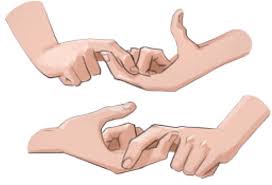
When I was in college, I took a couple of semesters of sign language, and still, a hundred years later, some of the signs stick in my head. One, in particular, is the sign for ‘friend’. Like other signs, the sign for ‘friend’ requires movement. One index finger is hooked over the other —  a weight, depending on the other finger to hold it. The fingers then change places. Each finger takes a turn bearing the weight of the other. I need this visual from time to time.

Too often I am willing to be the top finger, the one that depends on the other to hold me up. Or, I clench my fingers into a fist, determining that I will rely on no one, thank you very much.

I forget the beauty in the mutuality of friendship.

Yesterday, I opened the mail to find a thank you note from one of my breakfast club friends. She thanked me for sharing my burden last week. She said, “thank you for inviting us to cry with you.” I was overwhelmed by her thoughtfulness. Instead of allowing me to feel like I had used the group for my benefit, she implied that my request for support had been a blessing.

That’s how friendship works, isn’t it? We, sometimes without even knowing it, support and are supported by one another. And, in this mutuality, we are encouraged. We are reminded that we are not alone.

It takes some risk to invite someone into your life, to allow them to see your vulnerability, your cares, your weakness. But be encouraged; in the sharing, in the asking, you are inviting a response — a response that builds a bond of friendship.  And let’s be honest, life is much better because of our friends.

Carry each other’s burdens, and in this way you will fulfill the law of Christ.”

Galatians 6:2

Making Up for Lost Time, revisit

Editor’s Note, January 24, 2019: I’m looking back at old posts and seeing how they resonate with me now. This one, in light of what I wrote on January 21, 2019, reminds me of all the ground work that God did in anticipation of 2018. While we were trudging through, my husband and I often reminded ourselves, “none of this is a surprise to God.” This post, originally written in 2017, is evidence that He knew what was coming and was preparing us in advance.

During all my years of soldiering — of butt-kicking and name-taking — I was in constant motion, often simultaneously cooking, doing laundry, answering email, talking on the phone, and granting or denying permission to one of my children.  I got a lot done.  It seems that I was able to keep a clean house, feed a family, teach hundreds of students, and arrive most places fully-clothed for quite a few years. The down side? Very little time to reflect — very little time to examine options, consider outcomes, or feel.

I’m making up for lost time. Obviously.

In days of yore (Why, sonny, when I was your age…), I looked at the myriad obligations of the members of my family, the limited functions of two vehicles, and the tight schedules my husband and I kept, and I quickly formulated and executed a plan that accommodated everyone.  I planned my work and worked my plan.  “Here’s what’s happening today,” I would say, “You two will come with me to school.  After school, while you are at practice, I will get groceries. I’ll be back to pick you up.  When we get home, you’ll unload and put away groceries while I cook dinner.  Meanwhile, Dad will take you (other child) to your different school.  He’ll go to work then pick you up after your practice, stop by Walgreens to fill your prescription, then meet us back here. We will eat at exactly 5:30 because then, Dad has a meeting, I have parent-teacher conferences, two of you have homework to do, and the third one has to be at a study session on the other side of town.”  I would hit the start button and the plan would be executed.

Nowhere was there time for contemplation, negotiation, or revision.  We were in “go” mode.  In some ways, it was necessary for the season of life we were in with three kids in high school all at the same time, however, it could’ve been handled differently. I could’ve let some stuff go. I could’ve slowed down, allowed the kids to eat cereal for dinner more often, and let my laundry pile up. I could’ve valued processing over producing. Contemplating over completing.

So, yeah, I’m making up for lost time.

I’m currently reading three books. One is a book I am reading with my Bible study gals, Ann Voskamp’s The Broken Way.  Another was given to me by my physical therapist/counselor/friend, Doing Well at Being Sick by Wendy Wallace.  I also picked up Shauna Niequist’s Bread and Wine: A Love Letter to Life Around the Table with Recipes.  Why am I telling you this?  Well, it’s interesting to me that I have time to read three books, for one thing.  Also, I notice that I am interacting with these books, writing notes in the margins, going back to my notes, and thinking about what the books are saying to me. And, third, I am intrigued by the fact that these three books are speaking to each other.  It’s like they are three friends that said to one another, “Hey, guys, Kristin’s been still for quite a while now.  She might finally be able to hear us.”

And what are they saying?  They are saying the same things that I have been discovering, thinking, speaking, and writing about for the past three and a half years.  However, I think what’s interesting is that I am noticing.  I am processing. I am digesting. I am not more interested in completing these books than I am in connecting with them.  I am not compelled to finish them; I am drawn to understand the meaning they have for me.

And really, the meaning is this — my soldiering is done. Even though I’m tempted almost every day to go back to that life, I am no longer capable. God, in His mercy, has chosen a better way for me.  He has allowed limitations in my life — real physical limitations — that stop me from soldiering so that I can live a life that reflects, that feels, and that makes space for others. Because on my own, I wouldn’t have stopped soldiering, guys.  I would’ve keep right on kicking butts and taking names.  God had something better for me. Yes, you heard me right. My “broken” life, my life with the limitations of chronic illness, is a higher quality life than my “un-broken” life.  In fact, my “broken” life is more whole than the “unbroken” one was.

It’s a paradox, to be sure. God is often paradoxical, isn’t He?  His brokenness makes us whole.  By His wounds we are healed. He turns our mourning into dancing. He doesn’t always make sense, but today I’m not going to question Him. I’ll just thank Him.

I Peter 2:24

“He himself bore our sins” in his body on the cross, so that we might die to sins and live for righteousness; “by his wounds you have been healed.”