How the Health are You?

A friend of mine used to ask me this every time she saw me. It made me laugh.  I was just a kid, and I liked how she, an adult, was playing with language and ‘getting away with’ saying a ‘bad word’.

Who knew, way back then, that questions of health would one day dominate my life?  Who knew that I would spend years trying to discover what the health is wrong with me and how I can remedy the problem or at least minimize its effects?

But guys, I have relatively good news!  After five years of trial and error — testing, medication, treatment, side effects, etc. — we have discovered a strategy that, at least for now, is reducing my symptoms!

Let me pause here and give my disclaimer that every body is different, no one treatment works the same for every person, and certainly this is just my story.  I am in no way suggesting that your strategy for managing your health is inappropriate or that you should alter it in any way.  

I haven’t written about my health since last summer when I was doing a trial of Cosentyx.  After a over a year of no medical intervention for my illness, which had been labelled psoriatic arthritis and/or fibromyalgia, I had gone to a new rheumatologist who, at least initially, promised hope for reduced pain, better mobility, and less fatigue.  She felt that Cosentyx was a miracle drug and that I would certainly see dramatic results perhaps even with the first dose.  I was so excited!  After four years of pain and fatigue that limited my everyday life, I was looking forward to ‘getting back to normal’!

Well, I did see a dramatic effect, but it was not the one I was looking for.  Cosentyx made me an emotional wreck — I mean a serious emotional wreck.  I could barely function, particularly when the doses were back-to-back in the initial ‘loading’ period.  I was irrational, depressed, impulsive, and downright mean.   Nevertheless, I continued through that initial phase hoping to strike the promised gold; it never surfaced.  I stayed on Cosentyx for six months with no real improvement.

My doctor, suspecting a different diagnosis of degenerative arthritis, next recommended that I visit a pain management clinic.  I have been very opposed to this from the start.  Remember that prior to this illness, I had been a pretty avid runner for about 10 years.  I had run 5-6 days a week and completed two half-marathons.  I was in pretty great shape up until I started noticing joint pain and extreme fatigue.  I did not want to resign myself to a life of pain meds — I wanted to get better!  I wanted to find the source of the problem, fix it, and get back to my life!  My previous doctor had also recommended pain management; that’s when I had decided to try  homeopathy.  Homeopathy offered me hope and agency but no true change.

Anyway, I digress.  Last fall, when my current rheumatologist recommended I go to the pain management clinic, she suggested I try a steroid shot in my sacroiliac joint — the biggest source of my pain.  This sounded different to me.  She was not suggesting that I take NSAIDS for the rest of my life or that I take opioids or some other form of pain medication.  She was just suggesting a steroid injection.  I was willing to give that  a try.

With the very first injection I noticed a change — I didn’t have such a high degree of pain or such dramatic fatigue.  In fact, I was moving around more easily and having more energy.  After my second injection a month later, my chiropractor and physical therapist both noticed structural differences — my spine adjusted more easily, my muscles seemed more relaxed, and my posture was more erect.  After the third injection just two weeks ago, I notice that I have more endurance as I move through my days and I sleep more comfortably at night.

For the first time in five years, I have noticed a significant change in my ability to function!

Now, I will say that I am cautious in celebration.  First, I am only two and a half months into this treatment.  I do not know how long it will last.  In fact, after the third shot, the medical team said that I should call them “as needed”.  What does that mean?  Will my relief last a month? Two months?  a year?  What I am told is that everyone is different.  Some people get relief for months; some get relief for much longer.

The second reason that I am cautious is that I do not want to go back to my soldiering ways.  My illness has helped me, through trial and error, find a better pace for my life. I don’t try to cram twenty hours of living into every day any more.  I find time for work, but I also find time to rest.  I have built boundaries into my life that never existed before. I have more time with my husband, more availability for my kids and grandkids, and more margin to manage the unexpected stuff that arises in life.  I don’t want to lose this balance as my health improves.

I still believe that this journey of the last five years has been a lesson designed uniquely for me.  The way I was living my life previous to this illness was a path of my own making — I was kicking butts and taking names. I was not caring for the others in my life or, least of all, myself.  I don’t want to lose what I’ve learned in any level of recovery.

So, for now, I will continue the practices that have sustained me this far:

  •  A commitment to daily Scripture reading — this has been a calming anchor to my days.  I listen to a daily ‘dose’ on a YouVersion Bible reading plan every morning as I move through my routine.  It’s a small thing that makes a huge difference.
  • Regular visits with my chiropractor and physical therapist who have been my coaches and supporters for going on three years now.  I can’t say enough good about these two.
  • Yoga, a healthful eating regimen, and walking.  Daily intentional care of my physical body helps maintain both my physical and emotional health.
  • Writing — putting my thinking on a page with a commitment to total transparency has been an accountability that contributes to my emotional and physical health.
  • Psychological therapy — a once a week discussion with a trained professional who helps me sort out the healthy and unhealthy messages I am giving myself.  I am always surprised by the interrelationship between physical and mental health; it cannot be overstated.
  • A renewed commitment to prayer — this seems to be the hardest for me.  I am so used to muscling through and finding my own solutions.  Turning to prayer is a highly intentional act right now.  I am praying that it becomes more automatic over time.

I sometimes joke that taking care of myself is a part-time job.  It takes a lot of effort.  However, I have learned that if I have any hope of caring for the people I love or for being effective with my students, I have got to oxygenate myself first.  It’s not selfish; it’s a healthy practice that enables me to do the things I love.  It honors the Creator to care for what He created.

Jeremiah 17:14

Heal me, Lord, and I will be healed; save me and I will be saved, for you are the one I praise.

The Sum of the Lesson

In education, when teachers have identified a learning objective, they design instruction in such a way that the student encounters the content in multiple settings using multiple modalities so that the student’s likelihood of achieving mastery is increased. For example, when a child is learning the alphabet, he might see the letters, say the letters, and sing the letters.  He might write the letters with his finger on his desk or in the air before practicing with a pencil on paper.  In life, I have found that the lessons I most need to learn are presented to me across various contexts through various means until I finally throw my hands up and declare, “Ok, Ok, I see what’s happening here!”  At that point, I typically sit down and write about these observations so that 1) I can fully process them,  and 2) I can create a public record of my learning in an attempt to hold myself accountable.

Today’s Lesson: Time, Tension, and Technology

Sometime last fall, I discovered that I often felt anxious around bedtime.  I would lie down and begin to have restless thoughts about stuff that hadn’t crossed my mind during the day or even during the past several months or years.  I’d begin to wonder if I had been a good enough mother — if I had made enough home-cooked meals, had enough candid conversations, or provided my kids with the lessons and assurances that breed confidence and independence.  Then I’d move on to wondering whether I’d been a good enough wife, friend, sister, daughter, teacher, etc.  I would fuss and stew over conversations and decisions that had taken place years ago, coming to no peace, of course, but rather escalating my anxiety further.  I wouldn’t say I ever had a full-fledged anxiety attack, but these anxious thoughts were keeping me awake at night.

About this same time, I started seeing studies and reports about the increase in anxiety among teens, children, and young adults and some researchers’ theories that such anxiety was tied to the amount of time that kids spend on social media now that practically everyone always has a Smartphone in his or her hand. I got to thinking — I have a Smartphone in my hand most of the time, too.  In fact, I often play Words With Friends, scroll through Facebook, read my Twitter feed, and check emails right up until bedtime.  What if I took a break from that habit to see what impact it has on my bedtime anxiety?

To answer that question,  I began to conduct some rather informal research of my own — a private and inconsistent case study.  It didn’t take long for me to come to the conclusion that I feel less anxious when I don’t use my phone right up until bedtime.  I know, I know, this is a mind-blowing discovery.

In the midst of my ‘study’, I kept finding myself encountering content reinforcing my conclusion.  I heard a podcast that, among other topics, talked about the need for boundaries in the use of technology.  I had a conversation with my therapist about technology addiction. A friend shared a YouTube video about the impact of devices on our sense of peace. I read articles.  I examined my life. I was convicted.

However, although I realized the benefit of using my phone less, I routinely fell back into old habits. And I’ve continued to have anxious thoughts.

One thread of anxiety I have been experiencing is related to growing older. At 51 I am hardly old, but I’ve begun to have thoughts (late at night when most unsettling thoughts plague me) that I’ve already lived more than half of my life, that my body will never again be as fit and agile as it once was, that other people must look at me, seeing my gray hair and aging body, and think thoughts about me that I probably thought about people older than me when I was much younger.  I’ve begun to think about what I want to do with “the rest of my career” and to discuss retirement options with my husband.  For some reason the thought that time is running out and the realization that life actually comes to an end sometimes pop up even when it is not my bedtime.

Ironically enough, one thing I do sometimes to ‘quiet’ the anxious thoughts is to get out my phone, play a game, check social media sites, and respond to emails.  It’s a Catch-22.

For Christmas, one of my children got me a book, Sum: Forty Tales from the Afterlives by David Eagleman.  The other night before bed, I lay down and opened to the first tale. Reading stories has always been  a calming way for me to end the day.  Much of what I read at bedtime is what I call “candy bar fiction” —  stuff I can consume and forget about.  The goal of such reading is not to get deep; it’s to fall asleep.  To that end, I opened the book and began to read the two-page tale “Sum”.  The tale suggests that when we die we relive all of our life experiences but that they are re-arranged so that similar events are clumped together.  “You spend two months driving the street in front of your house,” it says, and “six days clipping your nails. Fifteen months looking for lost items. Eighteen months waiting in line.”  As I read, I started thinking, If this really happened, how much time would I spend scrolling through Facebook, playing Words With Friends, having a cup of tea with my husband, reading good books, appreciating the sunshine?  

It wasn’t a particularly good story to read for falling asleep, but it was an excellent concluding activity to nail home this learning objective, which is not that all technology is evil or that I (we) should shun all forms of social media but rather that if my (our) days and minutes are numbered, I want to consider my choices wisely.  I am still going to check social media and play Words With Friends, but I am also going to be intentional about turning off my phone at day’s end, I’m going to engage with the people in the room, I’m going to have a cup of tea with my husband, I’m going to read good books, and I’m going to appreciate the sunshine.


Teach us to number our days, that we may gain a heart of wisdom.

Psalm 90:12 NIV*


*I finished writing this blog and went to find the address for this very verse on Biblegateway.  To my surprise, it is the verse of the day.  Perhaps this lesson, too, will be ongoing.


Sumballo, a Re-visit

This post, written right after Christmas 2015, seems relevant today. As you gather all the pieces of your holiday celebration and ponder them in your heart, may God grant you the wisdom to see the big picture.

This morning, I opened my morning devotion from Beth Moore’s Whispers of Hope: 10 Weeks of Devotional Prayer and found this verse from Luke 2 — the Christmas story:

But Mary treasured up all these things and pondered them in her heart.

Luke 2:19

When I’ve read this verse in the past, I’ve pictured Mary holding baby Jesus in her arms kind of shaking her head in disbelief; I’ve imagined her saying, “Well, you weren’t kidding, were you? You said I would conceive and bear and son, and here he is!” I’ve imagined pondered to mean “wondered in astonishment.” However, Beth Moore, a biblical scholar, corrects my image a bit; she says pondered is translated from the Greek word sumballo which means “taking many things, casting them together, and considering them as one”. These words make me picture tossing many snapshots onto a table, discovering connections between them, and finding the theme of the collection.

Among Mary’s photos I see — her pregnant body on a donkey on that long journey to Bethlehem, her downcast eyes in the moment when her parents discovered her ‘situation’, her peaceful resolve during tense conversations with Joseph, and her brow beaded with sweat during the labor and delivery amid the straw and dung. I see images of the first glance at her child, I hear the knock on the wall of the stable when the shepherds arrived, I smell the frankincense when she opens the gifts from foreign dignitaries.

When she pondered those moments “as one” what did they add up to for her?

I’m sitting here three days after Christmas in my little house by the river, and I, too, am taking a moment to ‘sumballo’. I’m looking back at the events of the last few weeks — the parties, the visits with family, the gift buying and giving, the hopes, the disappointments, the laughter, and the tears — and I’m casting them together as one.

In fact, this whole blog — every post on every day –has been an attempt to ‘sumballo’. Since I started writing in the summer of 2014, I have been looking back over sections of my life: I’ve been ‘casting them together’ and ‘considering them as one’.

Sometimes we are  tempted to look at isolated moments as defining moments — that time that you lied to a trusted a friend, the year that your parents were divorced, the semester that you failed a class, that car accident that nearly claimed your life, the winning football championship, the Homecoming coronation, the birth of a child. Certainly these moments shape us, but they do not define us — not in isolation. They only offer hints until we sumballo  — until we put these moments into perspective as parts of a whole.

If I am going to look at the fact that for the ten soldiering years of my life I was way too busy, and I often overlooked the emotional needs of my family, if I am going to acknowledge that this behavior was costly to my physical, spiritual, and emotional health and to the physical, spiritual, and emotional health of my family, I can’t view that time in isolation. If I am going to truly sumballo, I need to look at other seasons as well. I need to remember that I also stayed at home with my children for almost ten years — nurturing, hugging, reading, teaching, correcting, and guiding. I need to acknowledge that for the past five years I have been recovering from soldiering and learning a new way. Within each of these periods have been awesome moments  — young children singing happily in the car on a road trip, teenagers rolling on the floor with laughter, and young adults gathering for the holidays. However, each period has also had moments of devastation — betrayal, trauma, and disappointment. If we grasp onto any one moment and let it define us, we get a a distorted view. In order to see the clearest picture, we have to cast all of the moments together. We must consider them as one. Only then, can we discover a theme.

And what is that theme? Way back in my twenties when someone challenged me to write my testimony, I wrote that the theme of my life was “rescued by grace”. Even in those early years, I knew that God had been protecting me, walking with me, holding his cupped hands beneath me to carry me through. He was overlooking mistakes, forgiving wrongs, and allowing me second and third and fourth chances. When I was careless, he protected me. When I was selfish, He was benevolent. When I was hateful toward others, He poured love on me.

He rescued me with grace.

As I am approaching fifty, I look back at all the events of my life, and I ponder them all in my heart. Time and again I see my  failed attempts to do things on my own followed by God’s miraculous provision. I see God transforming my pain into compassion for others. I see my pride falling into humility. I see the love of God.

I wonder what Mary thought as she pondered ‘all these things’ in her heart.  She had to see God’s miraculous provision in a faithful husband, a place of shelter, and safety from Herod. She had to see God transforming her pain and embarrassment into compassion for others. She had to feel humbled in the presence of the Christ child. She had to see the love of God for herself and for all of humanity.

Despite our weaknesses, our poor choices, our sin — He loves us. He has seen every moment — every victory, every failure, every injury and every recovery. None of it has been a surprise to Him. He has gone before us, and He has held us in the palm of His hand. He has cast all the events of our lives together and saturated them with grace.

That is the message that I find when I sumballo.

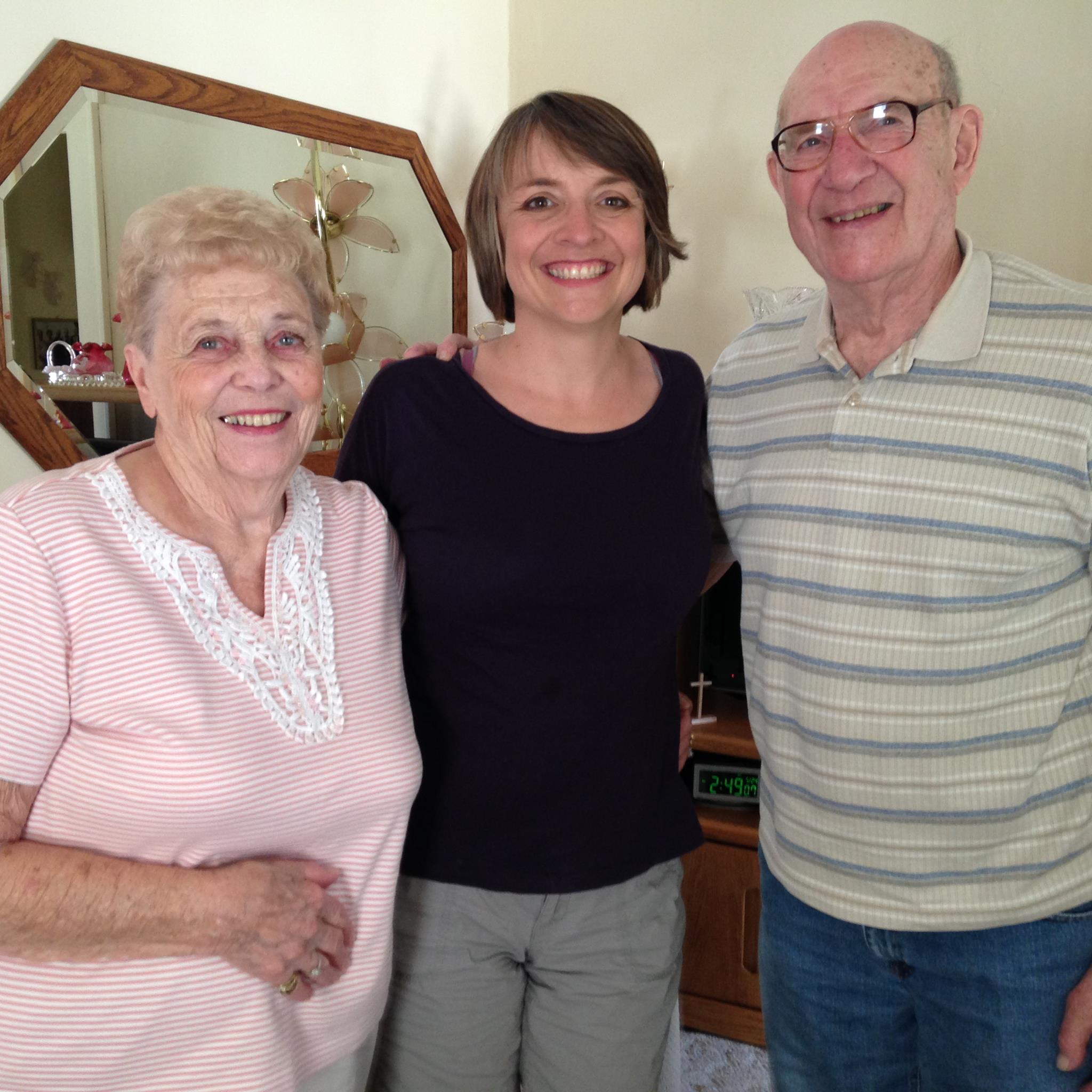
Uncle Louie and Aunt Margaret, a re-visit with much love

I wrote this post over six years ago, shortly after I’d moved back to Michigan. I was so excited to be back around extended family, and I had taken a trip to visit with some of them. I’m dusting it off today, because yesterday, my Uncle Louis died at the age of 92, on a Covid unit in a hospital. He was one of the sweetest men I have ever known.

I have been on a little excursion. I travelled to my childhood home on Saturday and have had one great moment after the other since.

It started with dinner on Saturday with my parents and my brothers followed by worship on Sunday with the whole family. After church, my niece and I saw a movie. I’ve eaten well, slept famously, and have had many walks down memory lane.

This morning was particularly special. I drove about an hour to visit my aunt and uncle — my father’s older brother and his wife. My godparents, Uncle Louie and Aunt Margaret, are the most precious of gems.

They have showed up for everything. Everything. My baptism. My confirmation. My birthdays. My wedding. My grandparents’ funerals — my mother’s parents, not just my father’s. None of this probably seems astounding, but let me tell you why it is.

My parents were divorced in the 1970s. Divorce was not very common back then, particularly not among ‘church folk’. In those days, when divorce happened, it was fairly common for the mother to get sole custody of the children and the father to fade into the background, sending financial support and visiting occasionally. This was way before shared custody.

To complicate matters, my parents divorced around the same time that my dad was relocating to take a new job several hours away.

My three siblings and I stayed with my mother, as was the usual course of events, while my dad moved. While I am thankful that during my childhood and adolescence we had the stability of one household and the ongoing involvement of the relatives on my mother’s side, I have been sad over the years because of the diminished relationship with my dad and his side of the family.

We saw my dad, but because he was several hours away, those visits were infrequent. We usually stayed with him in the summer for a week or two, talked on the phone regularly, and saw him around the holidays. Sometimes, when he came to Michigan , he would take us to see my grandmother, his mother, who for most of my childhood lived a nursing home, but of his five siblings, usually the only one we visited was my Uncle Louie, and his dear wife, Aunt Margaret.

Whenever we stopped by their house, Uncle Louie would pull out a cardboard box of toys that they kept just for our visits, and Aunt Margaret would magically produce some kind of sweet — cookies, cake, or maybe some donuts. They wanted to hear what we had to say. Aunt Margaret asked all the questions; Uncle Louis was pretty quiet, until he spoke in his soft bass voice. Whatever he said, he said with a smile and sparkling eyes.

Sometimes they told stories about their snowmobiling adventures, my Uncle Louie’s job as a postal worker, or my Aunt Margaret’s love for hand-painted china, but the best story they told was their love story. When they shared their ‘scandalous’ beginning, they both looked mischievous as they took turns in the telling, as though it were a scripted piece they’d been telling over and over for years.

The love story of Louie and Margaret began with a one-month courtship that quickly escalated one night right before they were both supposed to punch in for their second shifts at the factory where they worked. They were sitting in the car when Aunt Margaret suggested that they drive to Indiana instead of going to work. In Indiana, she said, right across the state line, they could get married the next day, without the waiting period required in Michigan. Uncle Louie, apparently no longer concerned about his factory shift, turned the car back on, drove home to borrow $20 from his mother, stopped to pick up two witnesses, and headed to Indiana. They changed into their wedding clothes in a cornfield and were married by the justice of the peace the next morning. They stayed married for 71 years.

They were always together, those two. They took lots of drives looking for antiques and visiting family. They had just one son who was a bit older than we were — he, his wife, and their three children were the lights of their lives, but they had space enough for all of us, too. Three out of four of us were their godchildren, although my Aunt Margaret always said, “I alway include your brother in all my prayers, too.” They took their role seriously, and weren’t going to drop off because of a divorce.

Instead, Uncle Louie and Aunt Margaret regularly drove an hour to come see us at our mom’s house. They said, “Your mom is still our sister; you are still our family.” It may not sound that remarkable now, but, believe me, it was very unconventional at the time.

They came to every birthday party and special event. They always hugged my mother when they came and when they left. They modeled for me how to treat family, even in the midst of brokenness. I never saw judgment or distance from them — just love.

When I grew up and had a family of my own, they would then drive two hours just to drop by and say ‘hello.’ Their big yellow Oldsmobile would pull into our driveway, and I would say, “What? You drove all this way?” They always hugged us — Uncle Louie with his big compression hugs — and said, “I love you.” Aunt Margaret wrote long letters and would share news from my dad’s side of the family, including family history that I didn’t know much about. I always felt loved and treasured by my godparents; I have been so thankful to have them.

As my husband and I have faced divorce and other brokenness in our own extended family, we have often referred to the example that Uncle Louie and Aunt Margaret set. While it is heart-wrenching to watch family members experience pain, it has given me some measure of comfort to know my role. My job is to show love, to give hugs, and to communicate belongingness, just like Uncle Louie and Aunt Margaret have done for me.

Of the many things in my life I am thankful for, Uncle Louie and Aunt Margaret are near the top of the list. I told them that this morning and reminded them of the special lesson they taught me.

since God loved us, so also we ought to love one another

1 John 4:11

postscript January 17, 2021: In the summer of 2018, my Uncle Louis fell in the yard, breaking his hip. He never returned home after that. He went from a hospital to a nursing home where he lived out the rest of his days, separated from the love of his life. It was a hard hit that came not too long after the death of their only son from cancer. My heart has ached these last two years watching these two gems finish their days apart, especially since Covid kept Aunt Margaret from sitting next to Uncle Louis for his last ten months. When he was admitted to the hospital a little over a week ago, Aunt Margaret said, I just wish I could hold his hand. Now I know she’s just longing to be with him again.