
Educational Break

On Thursday afternoon, I tidied my classroom, finalized some grades, and walked away from school and toward my Spring Break. The mere thought of not having to set an alarm for 10 days would’ve put a pep in my step if I’d had any pep left at all, but I did not.

All teachers are exhausted by this time in the year. Even though we had Christmas break, even though we might’ve had a long weekend or even a full week off in February, we’ve been, since September, coordinating learning for our students, planning multiple presentations each day, keeping records, reporting to our supervisors, and (and this is the most draining part) making countless in-the-moment decisions:

What is the first thing I need to do when I walk in the door?

Do I have an extra stapler, know where more chart paper is, and can I laminate another hall pass for Room 117?

No, you can’t go to my classroom unattended; yes, I can get you a bandaid; no I don’t know where Mr. Smith is,

You can’t go to the bathroom right now, but ask me again in 10 minutes.

Yes, you can take that pencil, borrow that book, eat that snack.

You sit over here; you stay there.

Yes, your topic sentence is solid, but no, that is not an adequate example.

You’ve used AI here, and you must re-do the assignment.

You’ve used AI here, and you cannot re-do the assignment.

Yes, you can turn it in late. No, the deadline has passed.

Yes, you can work with a partner. No, you can’t get the answers from a peer.

This is non-stop all day long, but teachers, while keeping this decision-making machine running, must also, intervene in interpersonal conflicts, address misbehavior, meet demands for mandatory documentation, and, oh yeah, provide high quality instruction.

And most of us are happy to do all of this. We see each piece as necessary for supporting human development, for preparing the next generation of humans for meaningful life in our society. We’re teaching our students to co-exist with one another, to manage themselves, to hold themselves accountable, to read, to write, to identify a career, and to begin to take steps toward attaining that career. We’re in this work because we like kids but also because we believe in the power of education to create possibility for students of all backgrounds and abilities and to create a better future for all of us.

In the school where I work — a small charter school on the edge of Detroit, where 99% of my students are Black, where 100% of the students qualify for free breakfast and lunch, where almost all of the students are below the national average in reading and math scores by no fault of their own but because of centuries-long inequity in education–the teachers, like me, believe in the transformative power of education. We see it as an opportunity to not only change lives but to save lives.

In addition to the exhausting work that teaching is in any context, teachers in buildings like mine have the added weight of wondering if our kids have enough to eat, if they have a home to sleep in, if their home is safe, if they will have what they need for the next 10 days, or if they will be alone, hungry, cold, or in danger. Our students have the same needs as any students in the country, but they have additional needs as a result of poverty that stems from systemic inequities that go back through the history of our nation — school segregation, red-lining in real estate, unconscious bias in hiring practices, and other elements of historical and current systemic racism.

So, you might imagine how I am feeling, heading into a much-needed break while simultaneously worrying about my students’ welfare, to learn that the president of this country has ordered the Director of the Department of Education to dismantle it.

You may say, “Settle down, Kristin, most funding for education comes from the state.”

That is true, most money for education comes from the state — but do you know what does come from the federal government? Funds that make a difference for students like mine. For example, Title I, which provides $18 million to low-income districts. It’s not enough to make up for the economic disparity between neighboring districts, but it’s a start. The Department of Education also provides IDEA (Individuals with Disabilities Education Act) funds to the tune of $15 billion to help districts provide additional resources to students with learning disabilities, cognitive impairments, and other diagnoses such as autism. Source.

Furthermore, the US Department of Education manages Federal Student Aid for post-secondary education, providing over $120 billion annually in grants, loans, and work study that allows students like mine to dream of a career. And not just students like mine — I myself relied on federal money to get my degrees, didn’t you? Source

Can you imagine what might happen in communities across the country if high school seniors no longer have access to the FAFSA? if they can no longer apply for federal dollars to fund their education through grants and/or loans? Tuition alone for Michigan State University is over $16,000 a year. Add in room and board and your talking about $35,000+. Most students need at least four years to get a basic degree. Who among us can fund $140k without the aid of at least a student loan?

Now, the State of Michigan is prepared to fund up to two years of community college and up to $5,500 per year at state universities, but states rely on the federal mechanism of the FAFSA to distribute those funds. If the DOE is dismantled, how long will it take for states to pivot to their own systems to ensure that students who need these funds get them? And, where will students borrow the balance that is not covered by state funds if they don’t have access to federal student loans?

How many students will take post-secondary education right off the table — including trade school programs that prepare our electricians, plumbers, welders, builders, and the like?

As I consider the potential outcomes of such action, the faces of my seniors are appearing in my mind — J. who wants to be a programmer, who has already completed several summers developing coding skills, L. who plans to be a nurse, K. who wants to be a truck driver, and S. who plans to become a police officer. None of these students can take one more step without the FAFSA and right this minute the Secretary of Education (who has zero experience with issues that impact schools) is busy laying off DOE employees under a directive from the president.

I am exhausted, and it’s my Spring Break, but I can’t just sit by and watch this happen.

So, I’m doing two things: First, I’m writing this post, and second I’m committing to use the app “Five Calls” to involve myself in the American process.

Here is how it works. Download the app, select the issue you are concerned about, and enter your zipcode. You will see a timeline of updates on that issue and a list of representatives from your district. One click later, you will see a page like this:
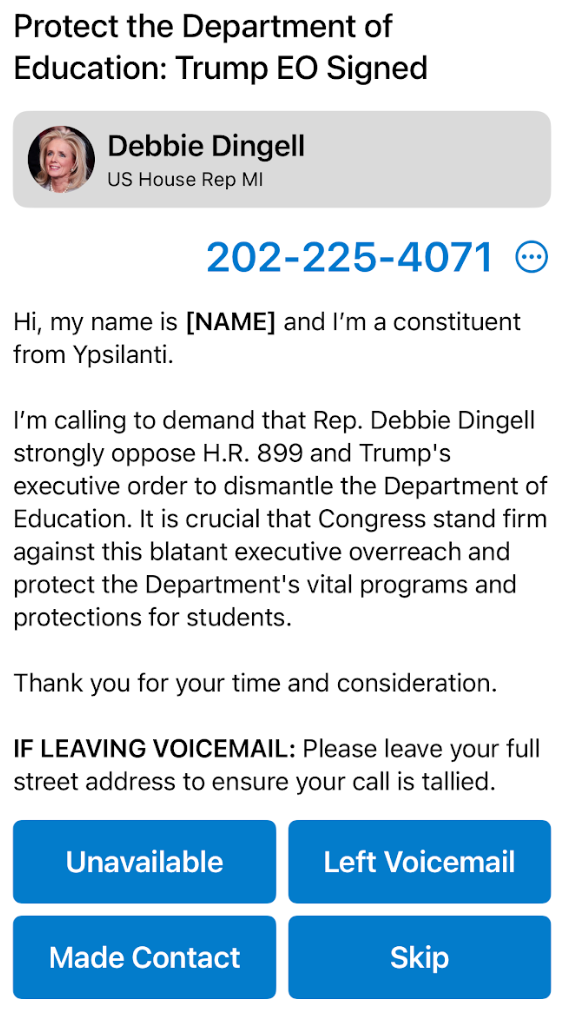
You click on the number, wait for an answer, read the script, and and click a blue button to register whether you left a voicemail or made contact, and the app sends you to the next number.

In just a few moments this morning I made three calls.

This may seem like something small — just like my boycotting may seem small and ineffectual to some –but if we truly believe that our government is of, by, and for the people, then we, the people, need to get involved. We need to do something when we see that our government is not representing all of the people — particularly when they are taking steps to further disenfranchise the most marginalized among us.

Look, you’re probably exhausted and overworked, too. You might feel like this is not worth your time, but perhaps you can take a journey back to your high school self, remember what it feels like to have a dream in front of you — of a career, a family, a whole adult life. Remember what that feels like? Don’t we want to make sure that every kid in America has an opportunity to pursue their dreams?

If you believe in the transformative power of education like I do, I urge you to make 5 calls — today, tomorrow, and until our voices are heard.

It’s a small decision you and I can make that could make a monumental difference for our kids, our country, our future.

Speak up … defend the rights of the poor and the needy. Proverbs 31:9
Re-post: For a Pair of Shoes

**I wrote this is Spring of 2024, and here we are in Spring of 2025. Track season started Monday, and we have a handful of kids who need running shoes. If you would like to contribute, an address is at the end of this post, or you can choose to reach out via message.

I’d been watching the girls’ basketball team all season — from the first game of their first season ever, where very few showed any evidence of having played the game before, where one girl received a “traveling” call for carrying the ball football-style while running down the court, where our players froze in place as the other team stole the ball, where the referees pulled our girls aside to teach them the rules in the middle of the game. From that game forward, I had been encouraging the girls, both on the court and in the hallways, letting them know I was seeing their progress. They were not only learning the game –the skills, the rules, and the strategies — they were also building confidence, stamina, and resiliency.

Many on the team were girls I had had the previous year in my reading intervention class. They had been freshmen– freshmen who had spent most of middle school on Covid lock-down, freshmen who had missed some social development experiences, freshmen who had very little capacity to manage challenge, difficulty, or conflict. So when I saw them during that first game, barely hitting double digits on the score board, I wondered if they would make it the whole season. Could they take the losses they would certainly face? Could they [and their coach] see this for what it was — a building year. Could these young women show up every day, practice the basic skills of basketball, and arrive at the end of the season better for it?

Only time would tell.

But here I stood at the end of the season, watching this same group of girls prepare for one of the last games. As the other team was rolling into the building, our girls were practicing an inbounding strategy while the coach called cues from the sideline. The girl with the ball slapped it loudly, and the four on the floor quickly shifted to their new positions to receive the thrown in ball. I stood on the sidelines, recording the scene on my phone, grinning with pride.

I was there to sell concessions, so I was in a little room at the corner of the gym with one eye on the game and one eye on my concession window, when I noticed that one of the players, the center, was shuffle-jogging down the court. I had noticed that she wasn’t a very fast runner earlier in the season, but I had assumed it was as fast as she could move given that she was about 5’10” and probably close to 200 pounds or that she simply didn’t have the stamina to run up and down the court for an entire game. Being the first season, the team only had about ten team members total, and typically only six or seven of them were eligible to play on any given day. Whoever showed up typically played all four quarters — that’s a lot of running for anyone, even those who are are in top physical shape.

But for some reason on this day when I noticed her shuffle jogging, my eyes moved toward the floor and I noticed that her shoes appeared to be untied. When I looked a little closer, it appeared that they were not actually untied, but in a permanently knotted state of floppiness. She could neither tie nor untie them., so the laces flopped as she ran, and the shoes, a pair of high tops that appeared to have seen some days on and off the court, seemed to be of little support in her efforts to improve her pace.

Is this the pair of shoes she’s been wearing all season? Why didn’t I notice this before?

Now look, every day at my school I see need. I see students who need food, who need new clothing, who need a haircut, personal hygiene supplies, pens, pencils, or even a water bottle, but this pair of shoes got to me.

This girl, who against all odds shows up for school every day, goes to basketball practice every day, has a C average, and dares to put herself in front of an audience of classmates, teachers, and parents, has been doing so inside sneaker head culture where the shoes on your feet can be linked to your status, your belongingness, or your ridicule. (It would take another whole post to examine the complexity of sneaker head culture within the context of high poverty neighborhoods, so let me just say that yes, a student may have brand new Jordans and still experience housing insecurity or food insecurity. It is what it is.)

This girl, despite her classmates’ comments and/or ridicule, has enough grit and determination to continue to show up on the court in these beat up kicks for the entirety of the season. That should tell you something about her.

So, I’m standing, watching the game from the concession stand, a game in which an adult in the stands got in an insult contest with one of our sophomores that escalated into a fist fight that DID NOT disrupt the game play — nope, our girls kept right on playing as security officers wrangled a punching mass of bodies out of the gym–a game in which they were down by double digits, came back to tie and go into overtime, a game where they lost by two points at the buzzer, and I’m taking in the wonder of these young ladies who could barely bounce a ball at the beginning of the season, who were making eye contact and passing, who were boxing out under the boards, and I’m understanding the impact of it all on their development — their ability to overcome difficulty, their ability to stay the course, their ability to trust themselves in difficult times.

I was overwhelmed.

A couple weeks later, after the season had ended and track season was getting started, the same group of girls was walking down the hallway, headed to practice.

“Ya’all on the track team?” I asked.

“Yes, of course!” they replied.

“Excellent!” I said.

“Are you going to come to our meets?”

“Definitely!”

And during this quick exchange, I noticed that all of the girls had on the same shoes they had worn to run up and down the basketball court all season — including that beat up pair of high tops.

And something inside me snapped.

A few minutes later I saw the track coach, “Hey,” I said discreetly, ‘I notice that K’s shoes are not really appropriate for track. I’d be happy to anonymously fund a new pair for her. Is there a way to make that happen?”

“I’ll figure out a way,” she said.

A few days later, I mentioned the situation to our athletic director. “I don’t know how many students you have that could use running shoes or spikes for track, but if I gathered a few hundred dollars, could you put it to use?”

“I would love that,” she replied. “Let me take a little inventory and see how many pair of shoes we need.”

So here I am telling this story, friends, because this is what I know how to do. I know how to tell you that having athletics is transformational for all kids — but for my students, who have experienced poverty and trauma beyond what I can imagine, who have every reason to give up hope for a brighter future for themselves, sports can offer an opportunity to practice navigating low stakes wins and losses and build the muscle they need to weather bigger wins and losses outside of sports. For my students, the power of athletics is essential.

My school is doing what it can to build programs. Two years ago, the only sports we offered were boys’ basketball, football, and cheerleading. Last year we added track. This year we added girls’ volleyball and basketball. In the fall, we hope to have a cross country team.

Teachers show up to coach, to run a clock, and to sell concessions because we see the impact of these programs on the educational engagement and morale of our students. If they aren’t passing classes, they don’t get to play, so they get more invested in their classes. When they are invested in their classes, they learn more, their grades improve, and they have more opportunity for their future.

It’s not hard to connect the dots between athletic programs and successful adulthood. We’ve known this for decades. All students should have access to programs that lead to a hopeful future, and they should have everything they need to participate in such programs.

So I’m asking, friends. I’m asking you for help — again. If you love sports, if you love kids, if you have an insufferable belief in transformation, please consider joining me in building an Athletic Shoes Fund for my students. Funds will be used to provide athletic shoes for students like K who cannot otherwise purchase their own.

Email me at krathje66@gmail.com for details on how to give or simply send a check with “DLA Athletic Shoes Fund” in the memo line to Detroit Leadership Academy 5845 Auburn Street, Detroit, MI 48228.

And if this isn’t your project to give to, I hope you’ll keep cheering us on as I keep on sharing our stories.

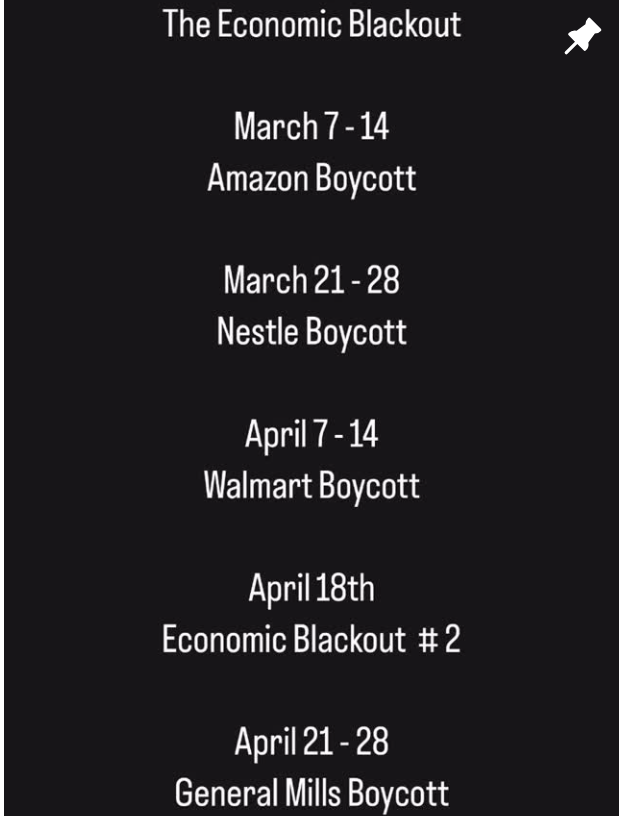
Why boycott?

Note: If you are listening to this blog post, several links are embedded in the print if you are interested in reading further.

Many years ago, not long after I met my husband, we began discussing a topic I’d never really considered before — boycotting. As I’ve mentioned here before, I grew up in a family that rarely, if ever, discussed politics. I remember when the Watergate hearings were on TV, but I have no shred of memory of how my parents felt about Nixon or the scandal. I have no idea, even, how they voted..

So when I met my husband, it was a little surprising to hear open political discussions — in the back yard, over dinner, on a car ride — about elections, of course, but much more specific issues such as unions, public assistance, and even (gasp!) abortion.

When I learned that in my husband’s family everyone drove American made cars or were required to park across the street when visiting, it made sense to me. My father-in-law was a retiree of General Motors and brand loyalty mattered. However, when my husband said he didn’t want to shop at Walmart, I had to ask why. He explained that Walmart was anti-union, and as a child of an autoworker, he had learned the power of the union to protect and support workers. He preferred not to support a company that wouldn’t allow its employees to organize. I didn’t feel passionately about it at the time, but I could get behind it.

As the years have passed, I’ve learned more about how Walmart underpays its employees while the owners become billionaires, I’ve grown my own distaste for the company and have shopped elsewhere. (This Time article chronicles some of Walmart’s journey including attempts they have made — under pressure from boycotting! — to improve.)

Of course, Amazon is similar in its practices. While it has made moves to reform, well-documented accounts cite drivers not being able to stop on their routes to use the bathroom and how they adapt to this expectation by carrying urine receptacles in their vehicles or by wearing disposable undergarments. Other accounts cite unpaid overtime, unsafe working conditions, and low wages, all while corporate profits rose to $88 Billion in the first quarter of 2025.

Amazon, Walmart, and other large companies are known for using employees — many of whom are low income and/or people of color — working them just up to the number of hours that don’t require them to pay benefits like insurance and sick leave and hiring for “provisional” employment and firing before the employee qualifies for permanent status. As a result, many employees of these companies remain on state and federal assistance while their CEOs pay a lower tax rate than the average American.

I have seen many of my students lured into jobs at Walmart, Amazon, and McDonald’s, promised pay raises, promotions, and an actual future, only to realize just weeks or months later that they had been misled.

So, what’s a middle-aged, middle-income woman like me supposed to do? How can I show that I don’t stand for this kind of corruption, that I don’t agree with these unfair practices? I vote with my purse. I’ve been doing this for years — avoiding companies that I don’t want to support and purchasing from those that I do. For many years this has been an isolated act that helps me feel like I have integrity. I doubt that I’ve made much impact, but I’ve slept better at night.

But this year, in 2025, anything can happen! All kinds of everyday people, using the engine of social media, can rise up and say, “You’re not getting our money!” If you take away your DEI programs, “you’re not getting our money.” If you won’t pay your employees a fair wage, “you’re not getting our money.” If you stand behind causes that harm our fellow Americans, “you are not getting our money.”

In 2025, I am not standing alone! People across the country are cancelling their Prime memberships and refusing to shop at Target, Amazon, Walmart, and other retailers. Last weekend, many refused to spend any money at all for 24 hours. This week, thousands are abstaining from Amazon purchases, and this is just the beginning!

Organizations like the People’s Union have coordinated efforts to systematically send a message to corporations that will hurt their bottom line without jeopardizing the jobs of those who currently work for these entities.

And the beauty of this protest is that it doesn’t cost anything, you don’t have to go anywhere, no one gets hurt, and if you don’t like it, you get to make your own choices. That’s what is great about living in the United States — we still have the freedom to say what we want, to spend what we want, and to support what we want.

For me, that means speaking up about inequity wherever I see it — in education, in health care, in commerce.

Now, I’m sure I still spend money, unwittingly, at businesses that have practices that don’t jive with my guiding principles, and if I learn about them, I will shift. It’s as easy as that.

What do I hope to accomplish? I truly hope the combined efforts of all those who are shifting their buying habits (some sources say 24% of Americans so far in 2025) will get the attention of these corporate giants and they will begin to change some of their policies. I think this could happen, because although the pen is mightier than the sword, money is what really talks.

If this movement can sustain itself long enough for these large corporations to notice changes in their quarterly earnings, we just might get their attention. And if we get their attention, they may hear our message — you can’t abuse people and still get our business.

It’s a small action of many that stands up for those whose voices are not being listened to; it’s an expectation that in a country that professes that all are created equal, that all would be given equal opportunity. Period

That’s reason enough for me to boycott.

uphold the cause of the poor and the oppressed; rescue the weak and the needy;
    deliver them from the hand of the wicked. Psalm 82:3-4