
A Week in the Desert

I’ve spent this week in the desert — the literal desert.

My husband, who is both an ordained pastor and a licensed therapist, is serving this week at Shepherd’s Canyon Retreat, outside Phoenix, Arizona. SCR is an organization that exists to assist Christian ministry leaders who are navigating a season of difficulty. Several times a year, eight participants come to the retreat and are served by a chaplain and two therapists who guide the participants through group, individual, and couples therapy.

Why am I here? Well, the chaplain and the therapists are allowed to bring a spouse for the week! When my husband suggested I come with him, I was thinking, that is the first week after school dismisses! Wouldn’t it be great to escape to the desert to read, write, and recover from the school year? I can sit poolside, and simply let my body heal from the strain of the year. Great plan, right?

I thought so, too!

About a month before our scheduled arrival, we received an email that asked if I’d be willing, while here at the retreat center, to volunteer in the kitchen. Well, I thought, I will be eating everyday, of course, and even if I were at home, I would have to spend some time in the kitchen — cooking, doing dishesand really, I reasoned, I don’t mind helping out a little each day. So, I responded to the email, “Of course, I’ll help! I love washing dishes!” And, I do! I really do love the rhythm and the industry of bringing order to post-meal chaos.

So, last Monday, we left our home at 4am EST, traveled to the airport, boarded our flight, stopped off for a change in aircraft, then landed in Phoenix many hours later. From there, we were picked up in a van and driven another hour, past mountains and hundreds of enormous saguaro cacti to a small town where we stopped to eat and gather whatever snacks and provisions we would need while staying — in the middle of the desert — at the ranch for the next week. Finally, about thirteen hours after we left our home, we arrived at the retreat center, were shown our rooms, and received some orienting information about where to go for meals, how to use the in-room humidifier, and why drinking water is so important.

Then, a little before dinner time, as I had been directed, I arrived at the kitchen and received my initiation to the crew. I was kind of in a dazed stupor, since we had been awake for over 16 hours by that time, but I followed directions, did as I was told, and even learned how to operate the kitchen’s dishwasher. When I walked away from the kitchen a couple of hours later, soaked to the skin across my belly and noticing the raisin-like quality of my fingers, it became clear to me what I had signed up for.

It took me a minute to adjust my vision of what the week would hold, but it wasn’t difficult. While I wasn’t really ever in the same room with the participants, I saw them coming and going from the dining room. I didn’t know any of them, but I saw familiarity. I saw clergy, missionaries, and other professional church workers who looked as I have looked in the past — weary and perhaps a little wary about what this week held for them.

I briefly flashed back to seasons in our lives when we could have used a week away in the desert, where someone else planned and prepared our meals, where we left dishes sitting on the table for someone else to clear, where snacks were mysteriously restocked, and refrigerators were continuously filled with cold drink. More than once in our lives of ministry, we would’ve benefitted from getting away from it all with some trained professionals who might’ve helped us navigate the unthinkable, process the traumatic, and begin to heal what Ann Voskamp calls our “unspoken broken”. Because of the careful confidentiality SCR practices, I don’t know the names of the participants or, of course, the issues they are navigating, but I do know that most professional church workers suffer from overwork and unreasonable expectations and many have been betrayed by their leadership, suffered personal family trauma that they don’t feel they can process in the public eye, or are journeying through their own personal struggles with mental or physical health.

The five of us in the kitchen, two paid staff members (both professional church workers), and three volunteers (all of us educators and two of us pastor’s wives), remarked early in the week that each of us have “been there”, and then got busy with the task at hand, preparing and presenting meals, and attending to the associated housekeeping tasks — dishwashing, packaging leftovers, vacuuming floors, and quietly attending to the needs of the participants.

After each “shift”, I would escape to my previously scheduled activities — daily journaling, re-engaging with The Artist’s Way, sitting poolside, reading an enormous novel, and taking daily dips in the pool. Then, I would make my way back to the kitchen, to join my “crew”. Together we chopped vegetables, arranged beautiful salads, poured condiments, and told stories about our lives. One has partnered with her husband in camp ministry for almost forty years, and it shows. She has endless cheer and positivity and a tireless ability to pivot when the propane tank runs out of gas before breakfast, when five of the week’s participants have specific dietary challenges, when there is no way that the baked potatoes will be ready to serve on time. Another has also spent her career in camp ministry and is one of those people who can chat about the difficulties of her life while browning ground beef or making French toast, and then stop everything she’s doing to show you a photo of the most beautiful sunset she’s seen in her months here in the desert or to tell you about the local movie theater’s habit of showing cowboy or alien movies on Tuesday nights. One woman joined us this week just because she loves the place. She paid her own airfare to come from Alaska and sleep in a camping trailer for two weeks, helping out in the kitchen for almost every meal. Another is the wife of the chaplain for the week. She not only worked in the kitchen three meals a day but made it her job to walk around in the the heat (of the desert) with a bucket of soapy water, scrubbing down any chair or bench that had become soiled.

Over the week, we have worked as a team, learning little known facts about Alaska, sharing stories of foods we like (or don’t like) to make, and laughing at one another’s silliness, and mostly making sure that the participants got what they needed when they needed it.

And, (you might have seen this coming), I got what I needed, too. When I was explaining to my colleagues that I was going to Arizona the week after school let out, I said I was looking forward to the abrupt transition into summer, a break in my school year routine, and an opportunity to detach from reality a bit. I got all of that, and I got another thing that I almost always need — a sense of purpose, of mission, of teamwork, of collaboration.
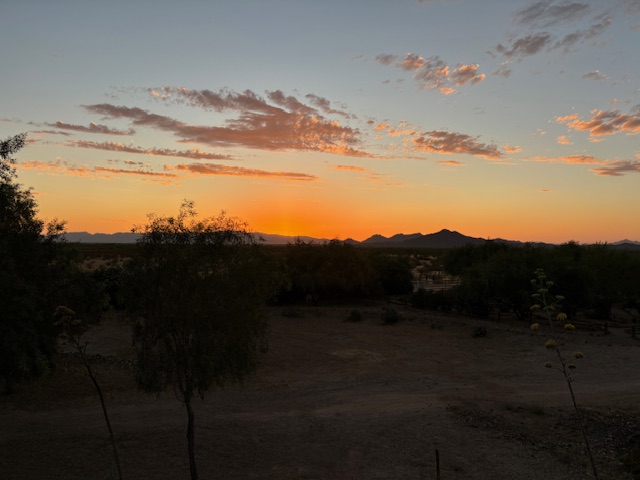
Even more, I’m walking away with some new lifelong friends — my kitchen crew — may we meet again, here or elsewhere.

‘Come away with me by yourselves to a quiet place and get some rest.” Mark 6:31

*If you or someone you know is a ministry leader navigating a personal, family, or ministry challenge, check out Shepherd’s Canyon Retreats.

**If you’d like to support this ministry, check out their latest newsletter for current needs.

Attending

At my small charter school in Detroit, attendance is always an issue. I very rarely have 100% of my students present in class, and when I say very rarely, I mean that in the last four years in this position, I have probably had perfect attendance in any one period fewer than five times.

As a school, we are doing well when we have more than 80% of the students in the building.

There are reasons for this, of course.

We have students with housing insecurity — they may not be in school because they are in the middle of a move, because they are “in between homes”, or because they have some other housing related issue such as the power or the water has been cut off. I know students who have moved every year (or multiple times per year) for much of their lives.

We have students with transportation issues — they might not have a ride to school because they live outside of our school’s bus route and maybe their family doesn’t have a vehicle at all, or the one vehicle they have broke down and they don’t have the money to get it repaired, or maybe the one vehicle that they have was needed to get someone to work or to an important medical appointment, or maybe they just didn’t have money for gas.

We have students who have to carry adult weight within the household — they might not be in school because their parents had to be at work and there was no one to watch a younger sibling, or they had to care for an ailing parent, or they had to drive a parent or sibling to an appointment, or they had to appear in court. I have one seventeen year old student who lives in a house alone — I’m not sure why, because he hasn’t been in school enough for me to build that kind of relationship.

Myriad reasons keep my students away from school, so it is remarkable that this past week, after finals were finished and students really did NOT have to come to school, many still did.

I arrived at school on Thursday morning, went for my daily mile-long walk around the building with a coworker, then took my station at the door of the gym. I stand in this position every morning, “holding” students in the gym from the time they enter the building until the designated release time after teachers have had time to arrive, prepare, and position themselves at their classroom doors to receive their students.

The gym was far from full, but students trickled in. Some found basketballs and started shooting like they do every day. Others sat or stood on the periphery of the gym, watching the activity on the court, or chatting, or scrolling on their phones. By the time I released them, I would have guessed we had about thirty of our two hundred or so underclassmen. (The seniors finished two weeks ago.)

But, Thursday was field day — a day where students had been promised burgers and dogs on the grill, popcorn, nachos, cotton candy, and, more importantly, a water fight — so the trickle continued, even after the morning bell signaling the start of class.

And when I say “class”, you need to broaden your definition a bit. Since our finals are finished, and we are introducing no new curriculum, the day is spent quite a bit differently than a normal day. The teacher across the hall, a conscientious and well-prepared science educator, who normally is engaging her students in goal-related content, had a video game projecting on her classroom screen, and a huddle of students sitting close together around the ones who held controllers.

A few students sat at the end of the hall at the table where the vice principal sits throughout the day. They weren’t in trouble, they were chatting, ready to receive and follow through on instructions such as, “Please help the custodian take that trash to the bin,” or “Would you help take down that bulletin board?”

Two of my second period students entered my room and saw that I was playing the video of the song from High School Musical, “What Time Is It?” where the final school bell rings on the last day of school and the students throw their papers in the air and start dancing, and one of them asked, “Can’t we switch this to ‘The Cupid Shuffle’?” and so began a whole period of watching videos and dancing along.

Later in the day, I had one student show up to class, and she and I sat quietly at a table working on sewing projects for forty minutes. I had brought my sewing machine to school to show students how it works, and she had determined to make a headband.

After a long day of such playful pursuits, the whole building emptied into the parking lot and the field behind the school. Music was pumping through a speaker as students lined up to grab snacks and then check out the activities. Some opted for games such as Uno under a tent, others raced through a blow up obstacle course. One teacher and one student spent a large chunk of time flinging a frisbee back and forth. Everyone ate, and many broke into momentary dance when “their song” came on.

The highlight for everyone, was, of course, the water fight. A staff member enlisted students to fill water balloons from a hose at the back of the school. Students and teachers wrapped up their hair, slipped out of sneakers, and secured their valuables. They knew what was coming — first water balloons, but when those were exhausted, people turned to the hose, grabbing any kind of container that would hold water, and then lugging buckets, Rubbermaid totes, and such in pursuit of their targets. Few were left un-doused. Shrieks and laughter and “you betta not”‘s filled the air.

And then the clean up, the arrival of the busses, and a couple attempts at end of the year scuffles over year-long beefs. The staff, hot, damp, and exhausted, found another gear to contain the potential for violence, to guide students onto busses, and to ensure that everyone had a way home.

And still, we had one more day of school. Surely after all of that, certainly after the big hurrah, students would not come to school on Friday. It was only a half-day after all, and — again — no intention to touch curriculum, but yet, they came. A very weak stream of students it was, but they came.

I again took my post in the gym, and saw a few bouncing basketballs, some grabbing the packaged breakfast that is provided each day, and a couple wandering over to me to tell me who they were mad at, what they were hoping to do today, and what they were worried about in the coming weeks — a cross country move, a conflict with a friend, and the like.

I released a couple dozen students into the school — that was it, just a couple dozen. They hung out in classrooms, shot baskets in the gym, and then, near the end of the day, we had an impromptu dance party in the hallway.

I try to pay attention on these days — to see who is here? why did they choose to come? what are they looking for? what do we have for them.

And what I see — every single time — is caring adults.

I see one of our custodians sitting next to a junior. He looks very serious when he says, “I am about to be a senior; I need to start acting my age.” The realization of his reality is sobering up this goof-ball.

I see a school leader ask a group of students to tear down a hallway full of bulletin boards. They eagerly comply — first demolishing a hallway and then cleaning it up and disposing of all the trash. A little later, I see the leader quietly slipping each of the students a five dollar bill to thank them for their efforts.

I see teachers hugging students. I see the whole staff walk the students to the door, out of the building, and onto the busses. I see the staff waving goodbye as the busses pull away, and I see high school students from inside the busses — not rolling their eyes, not looking away, not sneering, but smiling and waving back.

All year long we focus on instructional standards, and students being in class, completing their exit tickets, and turning in their assignments, but on these last few days, we loosen our hold on the shoulds and we lean into the opportunity to love on a small group of students who would rather be in our building than at home, who are soaking up a little bit more time with friends, leaning into a little more guidance from adults that they trust, and savoring the last few moments of what — stability? safety? belongingness? connectedness? — before two and a half months away from us.

We can’t be sure what the summer holds for each of our students, but as we smile and wave goodbye, we lift silent prayers for their safety, we ask that they would be provided for, we place them in the hands of One who knows every bit of their reality and who has loved them much longer than we have.

May He bless them and keep them — and us — until we meet again.