
10 Years Later #7: Play Ball!

I wrote this post in May of 2015 when I was newly employed at Lindamood-Bell, six months after leaving the classroom. My confidence had taken some blows, and I needed to talk myself back into the game. I’m sharing it again here, as part of my 10th anniversary series because, as any teacher will tell you, May is when our spirits are flagging and we [and possibly you] need some encouragement to just keep swinging.

I am not too proud of myself at the moment. I’ve had a series of less-than-stellar performances, and I’m starting to feel like I’m going to get put on the bench.

Last week I had a dud of a session with one of my students. We were working on ACT prep and making very little progress. We kept getting stymied and bogged down in words. I was frustrated and so was he.

I left him to go to another student. She and I worked for an hour and a half on an outline for a research paper she is writing. We referred to the teacher’s model, we attended to his rubric, and we created a finished product. Her mom messaged me the next day — the outline earned a 60%.

This morning I worked with a student on reading comprehension. We were pouring over college-level text that involved math. I am not inept when it comes to math, but I am rusty. Very rusty. We each read the text silently creating notes at the same time. We compared our notes, then I asked her some higher order thinking questions about the content. Without getting into the gory details, let me just say that my student became acutely aware that I was out of my comfort zone. I could have left it there. I didn’t. I asked a colleague, in the student’s presence, to help me understand what I did wrong. And I didn’t just ask once, I blathered on and on, joking about my inability to set up a proportion correctly. That doesn’t sound like a horrible sin, but I had been told before working with this student that I should not reveal that I was a newbie — the student is very intelligent and needs to know that I am qualified to do this job. I  blew it.

The colleague pulled me aside and reminded me that this student’s success is contingent on the fact that she trusts our credibility. That’s when I remembered the explicit instructions.

It was time for me to go home, so I clocked out and walked to the car feeling a physical sensation I haven’t felt in years. A dull ache was settling in my throat and through my chest. I couldn’t take back what I had done. What if this student didn’t want to work with me any more? What hardship would that cause for the agency?  What would it take to rebuild her confidence in me.

Really, I was a mess.

I texted the colleague expressing my grief. When I got home and realized she hadn’t texted me back, I started to draft an email about how devastated I was at my failure, etc. That’s when I heard the ‘ping’.  My colleague texted me back: “Don’t worry about it! It’s all part of this crazy steep learning curve!”

We texted back and forth for a few minutes and I began to breathe more regularly, to release the tension in my muscles, and to prepare for the student that I had later this afternoon — the same ACT student that I tanked with last week.

I have had a lot of successes as a teacher.  I know I am capable, but lately I feel like I’ve been falling a little (or a lot) short. I don’t cut myself much slack. I expect to hit a home run every time I get up to bat, but even the best batter in the MLB isn’t getting a hit even half of the time. I don’t expect my students to get a hit every time they are at bat either, yet they, too, get discouraged when they strike out.

They often want to throw the bat, stomp to the dugout and sulk. That is how I felt today.  I was sure I would collapse on my bed when I got home and cry for a while — I know better! How could I make such a novice mistake!!

And I just made another one, didn’t I? My last post, Trajectory, was about how success is often related to how well we are able to adapt, bounce back, take another swing.

And so I’ve got to take a step back for a minute.

So I’ve had a few rough spots in the last week. Who hasn’t? I’ve said from the beginning that working with students is as much about lessons for me as it is about lessons for them. Why would I be surprised when my learning gets a little uglier than I am comfortable with. It happens for my students all the time. And yet they keep swinging.

I can learn a lot from these kids.

So, let me pick up this bat and head back to the plate. Before long, I’m bound to knock one out of the park.

…we count as blessed those who have persevered. (James 5:11)
10 Years Later #6: Trouble Drives the Narrative

Written in May 2018, this post remains a favorite of mine. Today I’m adding a voice recording.

Every story worth reading is built around a problem — forbidden love, mistaken identity, murder, theft, robbery, and the like. I doubt many of us would even bother to read a story in which everything goes smoothly or in which the main character never faced a challenge. What would be the point?

If when Mayella Ewell accused Tom Robinson of violating her, someone had stepped up and said, “Come on now, you just want to accuse an innocent black man because it’ll make you feel better about yourself,” and Mayella had said, “Oh, you’re right. Sorry about that,” To Kill a Mockingbird wouldn’t have been a story. Sure, we all would’ve preferred Tom to have gone free — he was innocent after all — but Harper Lee builds her story around this fictional trouble to reveal a real-life trouble of the time. And that trouble drives her narrative.

In the story, Atticus Finch wrestles with racial injustice. We see him take risks to stand up to prejudice, shoot the symbolic rabid dog, and try to explain the harsh realities of life to Jem and Scout — and those are the reasons we love this story! We don’t love the ugliness of racism, the trial of an innocent man, his conviction, or his death. No, we like the character who recognizes and stands up to injustice, who doesn’t lose his head, who is able to speak truth and maintain hope. We don’t love the conflict, we love what the character does in the face of the conflict.

Without conflict a story hardly exists.

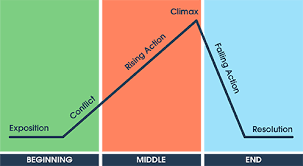
In fact, from early grades, we learn that stories have an arc — the exposition in which the writer provides context and sets the stage for the action, the rising action that introduces the conflict, the climax where the outcome of the conflict becomes evident, the falling action during which the loose ends get tied up, and the resolution that enables us to close the book and move on to the next story. The heart of every story is the conflict — the trouble drives the narrative.

The trouble, however, is not the story; the ways in which the character faces, weathers, endures, or learns from the trouble — that is the story.

Real life stories, too, consist of ups and downs, twists and turns, successes and failures, joys and disappointments. We expect these rhythms in the lives of fictional characters, but when we are living out our own life stories, we get can trapped in the mistaken belief that life is only good when it is free from trouble. When conflict is introduced — divorce, crime, illness, addiction — we can be tempted to believe that our story is over. Any writer knows that the introduction of conflict is the very beginning of the story.

The Wizard of Oz opens with a tornado that lifts Dorothy’s home off its very foundation, hurls it through the air, and lands it in a far away land with an impact that kills an evil witch. Talk about trouble! The story, however, is not about the tornado or the traumatic journey through the air or even about the witch, but it is about Dorothy’s ability to take step after step down the yellow brick road in a quest to find her way back to the people she loves.

The trouble is not the end of the story; it is the beginning.

Each of us has faced trouble. My close circle of friends could sit sipping coffee and share tales of betrayal, abuse, illness, financial ruin, scandal, and broken relationships. In fact, as we get to know one another, it is not typically our successes that we share but the troubles that have played out in our lives. Why? Because these times of trouble shape us. Just like Atticus’ defense of Tom Robinson revealed his integrity and his ability to keep his cool when an angry mob confronted him in the middle of the night, our experience with trouble exposes our inner grit — that strength that lies dormant inside of us until a moment of crisis requires it to surface. Dorothy would’ve never known that she was capable of standing up to the Wicked Witch of the West if she hadn’t been hurled through the air and found herself in completely foreign territory.

Trouble reveals what we are made of.

In the smooth sailing sections of my life, I have been tempted to think that I know all there is to know. I have lived with the mistaken belief that I have it all together — that I can handle life all by myself, thank you very much. I’ve even been prone to judge those whose lives are not sailing smoothly — certain that their trouble is the result of some fault of their own.

However, when crisis arrives in my life — and it surely does — I have to admit that I don’t know everything, that I can’t work things out by myself, and that trouble comes with or without my help.

One thing remains certain: times of trouble shape me.

That’s what conflict does. It allows the character in the story to be transformed — to be dynamic — to be reshaped. Dorothy arrives back home with a new gratefulness for the people in her life. Scout, having watched Atticus navigate the trial of Tom Robinson, gains a new compassion for those who have a different experience than she does. Me? I learn humility and reliance on God.

Trouble brings me to my knees and forces me to admit that I am poor and needy. From this position on the ground, heaving with sobs, I hear a still small voice: Be still. Know that I am God. I will never leave you or forsake you. My sobbing softens. I remember that I am but dust. I am not exempt from suffering. No crisis has afflicted me that is not common to man. And certainly this trouble is not the end of my story.

I whisper a thank you as I wipe my tears and push myself up to standing. I remember the words prayed over me many years ago, “Do not be afraid; do not be discouraged, for the Lord your God will be with you wherever you go.”  That is my grit. That is my inner strength that sometimes lies dormant but never fails to surface in times of trial. The strength of my character is not in my ability to have all the answers but in my realization that I have none of them. That realization keeps my pride at bay and allows me to turn for guidance and strength to the One who knew me before I was born and who has written every page of my story. He is not surprised by the trouble; He is using it to re-shape my character.

In this world you will have trouble. But take heart; I have overcome the world.”

John 16:33

Living in the Tension

It’s hard, isn’t it? Living in the tension?

The tension of things not yet finished, of things that are uncertain, of things we need to do, of things that will probably work out in time, and of just all the things.

But isn’t that just life? Aren’t we always living in the midst of tension?

I certainly can’t be the only one who has a list of things I’d like to work on around the house — things that need to be cleaned on repeat, things that need updating, things that need repair, and things that just need to be maintained. It’s never finished all at the same time, so we learn to live with the tension of wanting things done but always having something undone.

Right now, I’ve got seedlings sprouted on the back patio, drinking in sunlight, waiting for the garden to be prepared, which will require several [more] rounds of weeding, an infusion of compost, some tilling, and then several days of meticulously moving the seedlings from their current location into the ground.

Sounds pretty normal, right? And isn’t it also normal that we are struggling to find the time to schedule the steps required to make that process happen. When do we have time to go pick up compost, to weed [again], to rototill, and to plant? Don’t we all have day jobs and groceries to purchase and laundry to keep up with and meals to prepare and family to visit and friends to have dinner with?

We will certainly get to the garden — we manage every year — but until we do, I feel this hum of electricity. It’s the tension.

And it’s not just the garden, of course. My seniors have four weeks of class remaining, and in that time I have ensured them that they will submit two more discussion board posts, write one more five-paragraph essay, and take a grammar and vocabulary quiz. When I say it all in one sentence like that, I hear the protests from the classroom. How could I expect them to do all that when they also have prom to prepare for, a cap and gown to procure, jobs to go to, and parties to attend. They (and I) know it will all happen, but until it does, we live in the tension.

Right now, in this season, my husband and I [and possibly you, too] have some extra life circumstances that are adding to the volume of tension we are experiencing. With one parent on hospice for stage 4 liver cancer and another finishing chemo and awaiting surgery for stage 3 bladder cancer, the tension around the unknown is palpable — I can feel the vibrations in my body.

What will the next weeks look like? Where will we be needed? Will this difficulty be addressed? Will this problem find a solution? What is our role? Who else can help?

I was sitting in therapy this past week, verbally processing all of this when my therapist said, as she often does, “This is a lot.” Looking back into the screen of our zoom room, I replied, “Yeah, it really is.” Then, because she’s known me for going on four years, and because she knows about my chronic health condition, she added “all of this stress is of course impacting your body, so you need to make sure that you are doing the things that off load some of the stress. Prayer can help. Yoga can help. Massage or acupuncture….”

“Oh, yes,” I replied, “that is a good reminder. In fact, just this week I noticed the first stages of psoriasis showing up on my elbows.”

“That’s a signal,” she said.

“Yes, it is,.” I replied, and then added, “I am still walking every day and doing yoga, I do pray, and my writing is essential, but with such a busy schedule, I have let some of the body work go. However, I think I can fit in some acupuncture this week. That’s a good thought.”

And when I closed out our zoom room, I went online to schedule an appointment.

Friday after school, I made my way to the airy acupuncture practice. I signed myself in, sat down, took off my shoes and socks, and waited for the practitioner. Diane, to come over to me. When she arrived, she said, “Hi, Kristin, how are you doing today?”

“Actually, I feel pretty good, but I’m under a lot of stress, and my therapist recommended that I receive some care.”

We chatted for a minute, and she said she is recommending that all her teachers watch a show called Rita on Netflix. She said it’s a fun Danish show about a badass teacher that I had to promise to check out. Smiling, I said, “I’ll watch it tonight.”

“Good,” she said, and then she checked my pulses and the appearance of my tongue, and had me lie down on a bed. She started inserting needles, first in my left ear, then my forehead, then my wrists, and finally my ankles. My eyes were already closed before she started, and I felt my body grow heavy and shift into a deep relaxation almost immediately.

I was aware of ambient piano music and of Diane speaking to other patients nearby, but I was definitely semi-conscious and allowing my body to receive some restorative care, to offload some stress, to release some of the tension.

Before I knew it, Diane was standing next to me, removing the needles, and welcoming me back to reality. “I let you go an extra five minutes; I hope that’s ok.”

“Oh, yes, I think I actually slept a bit.”

“You did,” she affirmed. “I’ll see you back in a week.”

A little surprised, I said, “You think I should be seen in a week?”

“Yes, I do, until this stressful period is over.”

“Oh, that makes sense,” I thought out loud.

I sat up, put my socks and shoes back on, and wandered slowly to my car. My husband was out of town, so needing a little dinner, I drove to the nearby food co-op and purchased a pre-made chicken curry and lemon rice, went home, opened the windows to let some fresh air in, tidied the house just a little bit, and sat down to enjoy my meal.

The warmth of the spices felt like a balm, and I ate every last grain of rice. I could feel the healing goodness seeping into my body, and I could no longer hear the electric hum of the tension.

I had almost forgotten the promise I made to Diane, but then I remembered, went to Netflix, and searched for Rita. Oh my, I thought, it really is Danish. It has subtitles. Am I really up for this at the end of a long week? Let me give it a couple of minutes.

And I was drawn in to the life of this teacher who has all kinds of tension of her own — a very demanding student, the student’s indignant parents, a complicated involvement with an administrator, and her relationships with her three grown children. She navigates it all — the messiness, the richness, the unsettledness, the tension.

I laughed, I smiled, and I finished the episode.

Then, I climbed the stairs, tucked myself in bed, and slept.

It’s just a normal amount of self care for one person on a Friday night — acupuncture, a delicious meal, therapeutic Danish television, and a good night’s sleep.

Did the tension so away? Of course not. Nothing has changed — the garden is as it was, the house is merely momentarily tidier, my seniors still have four more weeks of class, and our parents are still battling cancer—in fact, one is in the hospital right now.

Life is full of persistent tension.

And, because my body does really need a significant amount of self-care to stay healthy, I kept it going throughout the weekend — I practiced yoga, ate several healing meals, took long walks, got lost in a novel, met with our small group, worshipped, watched another episode of Rita, and got a pedicure. Perhaps it seems like a lot, but as the tension amps up, apparently so must the self care.

For now, my body is relaxed, the electric hum is quiet, but I will need to continue to find spaces to rest and restore, because life [and its tensions] will continue, and I want to be able to show up for it. I want to be able to dig in the dirt, congratulate my students as they walk across the stage, and support our parents as they move through this season.

I just scheduled my next acupuncture appointment, and it won’t be long before I watch my next episode of Rita.

We can’t get rid of the tension, but we can find ways to live in it.